 by Tom Gurney
Tom Gurney BSc (Hons) is an art history expert with over 20 years experience
Published on June 19, 2020 / Updated on October 12, 2026
Email: tomgurney1@gmail.com / Phone: +44 7429 011000
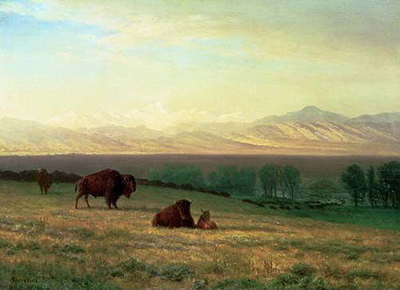
Buffalo on the Plains by Albert Bierstadt
A dark bison stands at the left, while a larger resting animal and a smaller companion occupy the sunlit grass near the centre. Behind them, trees and a shaded plain stretch towards a distant mountain range. Albert Bierstadt's Buffalo on the Plains brings individual animals close enough to examine within a landscape that continues far beyond them.
Bridgeman's exact image catalogue entry, CH89230, lists the painting as circa 1890, in oil on canvas, measuring 66 × 91.4 cm. Its reproduction matches the animals, tree line and mountain profiles shown here. The entry labels the location “Private Collection” and credits Christie's Images, but identifies no individual owner. The approximate date and dimensions are retained as catalogue information; they do not independently establish an exact completion year or present ownership.[1]
At a Glance
Where this painting sits in Bierstadt’s career
Dates refer to the paintings, rather than to the journeys behind them. Approximate dates and ranges retain the qualifications in the collection records.
Lake Lucerne
1858Mountain Brook
1863Street in Nassau
c. 1877–1880The Last of the Buffalo
1888–1889Buffalo on the Plains
Circa 1890 (catalogue date)The Golden Gate
1900Contents
Standing and resting animals
The standing bison is seen largely from the side, its head directed towards the right. Its massive shoulder and dark forequarters contrast with the slimmer rear legs and the lighter ground visible beneath its belly. The space between its feet makes its body seem firmly supported rather than simply outlined against the grass.
The animal resting nearer the centre presents a different shape. Its body extends sideways along the ground, while its head turns more towards the viewer. Its bulk becomes a low, rounded mass, and the difference between dark head and illuminated coat makes that turn noticeable.
A smaller, warmer-coloured animal lies immediately beside it. Their proximity introduces an intimate grouping within the open view. The image does not establish the larger animal's sex or a precise family relationship, but the difference in size makes their companionship visually important.
Farther left, another small bison stands against darker ground. Its distance reduces the detail of its features, while its upright silhouette remains legible. The group combines several positions and degrees of visibility rather than repeating one animal shape across the meadow.
Grass close to the viewer
The foreground has a more varied surface than the distant plain. Low clumps, scattered upright stems and warm patches of grass interrupt its broad extent. These small changes keep the ground from becoming a uniform stage beneath the animals.
Illumination crosses the meadow in irregular passages. The resting pair occupies a relatively bright area, while darker bands run behind and around it. The animals' brown coats belong to the same warm colour range as the ground, yet their heavier forms remain distinct.
Their shadows and contact with the grass are especially useful to notice. They make the bison part of the landscape's physical space. A viewer can follow the lower edge of a body towards the ground before looking outward across the plain.
Trees between plain and mountains
A line of trees occupies the middle distance. Their trunks and crowns are smaller and less clearly separated than the animals in front, but they introduce another scale between the nearby grass and the mountain range.
At the right, a denser group rises from the darker ground. Nearer the centre, thinner trees permit glimpses through and between their forms. This variation prevents the middle distance from becoming a continuous barrier.
Above it, the mountains catch pale, warm light. Their long ridges contrast with the rounded bison bodies and upright trees. Some more distant peaks are much lighter, so that the range appears to extend beyond the nearer foothills.
The sky occupies a broad portion of the picture. Patches of blue remain visible among warmer clouds, offering a relatively open surface above the crowded textures of grass, animals and woodland. The shifts in contrast suggest distance without identifying an exact mountain or time of day.
Animals that shape their habitat
The National Park Service describes bison as social animals whose herds vary in size and composition. It also explains how grazing, movement and wallowing influence vegetation and soils, while carried seeds and decomposing dung contribute to ecological processes.[2]
This context changes the relationship between animals and setting. The grass is their habitat and food, while their activities help shape the land they occupy. They are participants in the plain's ecology as well as conspicuous forms within a landscape.
The painting does not show every process described by the Park Service. Its resting animals and grass provide an entry into that relationship, rather than evidence for a particular habitat survey or a historical population count. A small group selected for a composition cannot measure how many bison remained elsewhere.[2]
Bierstadt studying bison
Fitz Hugh Ludlow's The Heart of the Continent, published in 1870, gives an account of Bierstadt making animal studies during their western journey. In the buffalo-hunting chapter, Ludlow describes the artist travelling with a colour box, stool and sketching umbrella, more interested on that occasion in opportunities to study bulls than in shooting them.[3]
The account is also disturbing. Ludlow describes a wounded bison being held at bay and provoked into movement while Bierstadt worked. Once the study was finished, the animal was killed; the artist subsequently studied another dead bull.[3]
This records circumstances surrounding some of Bierstadt's animal studies. It does not identify a preparatory drawing for Buffalo on the Plains. Its value is in complicating the peaceful image of an artist simply observing undisturbed wildlife: artistic attention and the practices of a hunting party could be closely connected.
Comparing The Last of the Buffalo
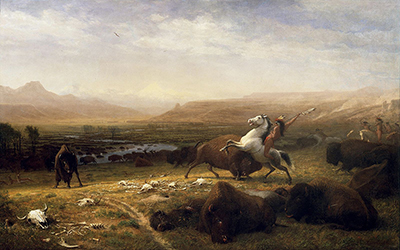
Bierstadt's The Last of the Buffalo, dated 1888–1889 by the National Gallery of Art, presents a very different encounter. Its centre contains a mounted hunter confronting a charging bison, with dead animals and scattered bones in the foreground and a much larger herd extending into the distance.[4]
The Gallery interprets that expansive scene as a romantic invention made when the species was approaching extinction. It distinguishes the painting's seemingly abundant wildlife from the actual crisis of its period.[4]
Buffalo on the Plains places its animals at rest or standing quietly within the grass. Its subject can be considered alongside Bierstadt's more dramatic buffalo imagery, but the comparison does not establish that it carries an identical allegory or documents the same event.
The difference concerns how the viewer encounters the animals. In the larger hunting scene, conflict organises attention. Here, posture, proximity and distance provide the main relationships visible within the group.
Buffalo and Tribal history
The InterTribal Buffalo Council's own history connects the nineteenth-century destruction of buffalo with efforts to subjugate Tribal nations that depended on them. It recounts a 1991 gathering of nineteen Tribes united around restoring buffalo to Tribal lands for cultural and spiritual preservation.[5]
This perspective extends beyond reading bison only as picturesque wildlife. Their survival has relationships with communities, cultural practices and sovereignty that cannot be recovered from the animals' painted appearance alone.
The absence of human figures in Bierstadt's meadow does not remove those relationships from the subject. It leaves them outside the visible scene. Reading the painting alongside the Council's account gives the apparent quietness a historical context without assigning an undocumented political intention to this particular work.[5]
The Council's account of its continuing work brings cultural and spiritual renewal together with ecological restoration on Tribal lands.[6] Buffalo history therefore includes continuing stewardship, as well as loss. That distinction matters when a nineteenth-century painting is encountered today: neither the animals nor the communities connected with them belong solely to a vanished past.[6]
Looking again at the resting pair
Return to the two animals near the centre. Their low forms interrupt the meadow's horizontal spread, giving the eye something near and particular to consider before moving towards the distant trees and ridges.
The picture's calm comes from the way Bierstadt arranges those relationships. A standing silhouette, a turned head, a smaller companion and illuminated grass make the animals accessible within a much larger setting. Broader ecological and cultural histories give that quiet scene further meaning while preserving the distinction between what the image shows and what its subject brings into view.
Watch: Albert Bierstadt
Five perspectives on his paintings and their historical setting.
American Landscape Painting: Albert Bierstadt and the American Land
A Museum of Fine Arts, Boston presentation on American Landscape Painting: Albert Bierstadt and the American Land.
Explore Bierstadt’s artworks
Discussion
How does the standing bison differ in presence from the resting pair beside it?
Reader Insights
Compare the animals’ poses and the spaces beneath or around them. Which detail makes their weight most tangible?
Read the ecological account of grazing and wallowing beside the meadow. What relationships with the ground are suggested, and what remains outside the scene?
Compare this quiet group with The Last of the Buffalo and the Tribal restoration history. How do those contexts change a seemingly ordinary wildlife view?
Join the Conversation
Share a specific observation, documented connection or comparison from Buffalo on the Plains.
References
- Bridgeman Images. Buffalo on the Plains, c.1890 (oil on canvas), CH89230. Exact catalogue record, approximate date, medium, dimensions, anonymous collection label and photographic credit; reproduction matched to the composition discussed here. View source text
- National Park Service. “Basic Facts — Bison.” Social behaviour and ecological roles. View source text
- Fitz Hugh Ludlow. The Heart of the Continent, 1870, printed pp. 62–69. Selected passages on the hunting party and Bierstadt's animal studies. View source text
- National Gallery of Art. The Last of the Buffalo, 1888–1889, accession 2014.79.5. Separate painting's record and interpretation. View source text
- InterTribal Buffalo Council. “History.” The Council's account of buffalo destruction and its founding mission. View source text
- InterTribal Buffalo Council. “About Us.” Continuing cultural, spiritual and ecological restoration. View source text