 by Tom Gurney
Tom Gurney BSc (Hons) is an art history expert with over 20 years experience
Published on June 19, 2020 / Updated on October 12, 2026
Email: tomgurney1@gmail.com / Phone: +44 7429 011000
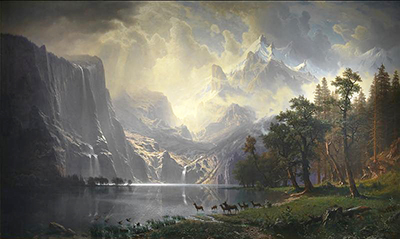
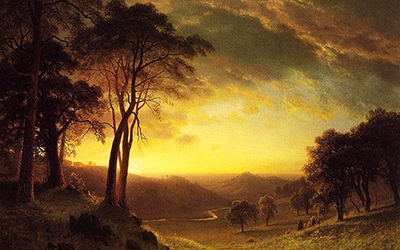
Sacramento River Valley by Albert Bierstadt
A winding river catches the light beneath a golden opening in the clouds. Tall trees stand close at the left, while a more open group occupies the opposite slope. In Albert Bierstadt's Sacramento River Valley, these wooded banks make the distance seem both inviting and difficult to reach. The view appears quiet, yet its land and water carry a history that the luminous sky cannot reveal.
At a Glance
Where this painting sits in Bierstadt’s career
Dates refer to the paintings, rather than to the journeys behind them. Approximate dates and ranges retain the qualifications in the collection records.
Lake Lucerne
1858Mountain Brook
1863Sacramento River Valley
1872–1873Street in Nassau
c. 1877–1880The Last of the Buffalo
1888–1889The Golden Gate
1900Contents
Date, medium and collection history
Alba Campo Rosillo reproduces this composition as figure 3 in her 2022 study of Bierstadt's Street in Nassau. Her caption dates it to 1872–1873, identifies oil on canvas and gives dimensions of 81.5 × 122.5 cm. The work is described as privately owned; the accompanying text places it in the earlier Thyssen collection.[1]
The painting also appeared in the Cantor Arts Center's California: The Art of Water, held at Stanford from 13 July to 28 November 2016. Its checklist records a private loan and an approximate date of 1872–1873.[2] These records establish a documented exhibition and historical collection association. Neither identifies a present owner or promises that the painting can be seen in a museum today.
A California painting from a sustained western visit
The date belongs to an extended period of Bierstadt's engagement with California. Nancy K. Anderson's National Gallery of Art biography records his arrival with Rosalie in San Francisco by transcontinental railroad in July 1871. Apart from his brief return to New York that autumn, their California stay lasted until October 1873. Anderson describes his continued practice of gathering field studies for later studio paintings.[3]
That chronology helps place the picture within his working life. It does not establish where this particular canvas was painted, or which sketch supplied its river and trees. The finished scene joins sharply articulated foreground forms to a broad atmospheric distance. Reading that arrangement as a constructed landscape leaves room for observation and selection together, rather than treating every feature as a map of one identifiable spot.
Trees that hold the valley open
The nearest trees rise from a dark, uneven bank. Two pale trunks near the centre-left divide and cross as they climb towards a canopy that extends over the sky. Other trunks withdraw into shadow. Rocks and broken wood interrupt the ground beneath them, making the foreground more irregular than the smooth country beyond.
Those pale trunks are especially effective because they do two jobs at once. They are close enough to give the view a tangible surface, but their brightness belongs to the light spreading across the distance. Following them upwards brings the eye into the foliage; following the spaces between them takes it past the trees. The group therefore offers a frame through which to look, without forming a completely closed screen.
The right-hand hillside answers this group with smaller, more separated trees. Gaps beneath their rounded crowns expose the descending ground. Their spacing gives the slope a readable rhythm: tree, opening, tree, then open valley. The two sides differ in height and density, so the composition avoids a symmetrical pair of curtains. Its centre remains the place where depth and brightness gather.
The river and the changing scale of detail
The water is a slender feature within a much larger landscape. Its bends supply a route through the middle ground, catching pale gold where the surrounding banks are darker. As it recedes, the river narrows until its direction becomes harder to follow. It draws attention across the valley without competing with the sky for area.
The land also changes character as the eye moves away. Foreground debris and divided trunks give way to soft slopes, small tree groups and subdued contours. No monumental cliff closes the view. The low terrain allows the illuminated horizon to stretch across the scene, while the river's turns prevent that openness from becoming an undifferentiated band.
It is useful to look first at the dark foreground, then at the water, and finally at the horizon. Each offers a different kind of information: nearby texture, a continuous path, and a distant glow. Looking back from the horizon makes the trees seem darker and more solid. The painting's sense of space depends on this exchange between an enclosing foreground and an expansive background.
Golden light and the sublime
The clouds occupy a substantial part of the canvas. Dark grey masses gather overhead, while their lower edges break into warmer passages around the yellow light. The glow reaches the river and the sloping ground, linking areas that would otherwise remain separate. Its intensity depends on the darker forms around it; the painting gives the light a setting as carefully as it gives the river a course.
Campo Rosillo pairs this work with Evening on the Prairie, identifying a repeated arrangement of foreground figure or tree against warm evening light. She reads that illumination through the sublime, including its suggestion of a divine presence.[1] This is an interpretation of Bierstadt's visual language, rather than evidence of a recorded statement about this canvas.
The comparison is particularly revealing when the two pictures are viewed together. In Evening on the Prairie, the low horizon leaves much of the movement to the sky. Here, the river and the wooded slopes lead the eye through several layers before it reaches the brightest distance. The drama comes from recession and contrast as well as from the clouds themselves. Their appearance does not establish an approaching storm, an exact hour, or the artist's emotional state.
The human history behind an apparently open landscape
The Cantor's 2016 exhibition placed this picture within the history of California water. Its accompanying interpretation challenged the idea that the wooded valley represented untouched wilderness. The museum explained that Indigenous communities had shaped such habitats over centuries through harvesting, sowing and burning, including the maintenance of oak woodlands that supplied acorns.[4]
Regional Indigenous testimony gives that history a more specific voice. The Yocha Dehe Wintun Nation describes Patwin ancestral territory extending east to the Sacramento River. Its account connects oak groves, fishing and gathered foods with controlled burns that renewed grasses and increased native seeds and wildflowers. It also records violence, forced schooling and survival, presenting connection to the land as a continuing responsibility.[5] This is regional context; it does not identify the painting's precise site or assign it to a particular Patwin village.
These accounts change what an open gap between trees can mean. A park-like appearance need not imply land beyond human influence. The picture makes the valley legible through light, spacing and distance, but those visual qualities cannot tell us who maintained the land or how it was used. Appreciating the scene therefore includes recognising a difference between what Bierstadt has made visible and the longer history of the place he names.
A revealing comparison with California Spring
California Spring offers another treatment of the Sacramento River Valley. The Fine Arts Museums of San Francisco date that painting to 1875 and describe its cattle, fertile fields and idealised appeal to potential settlers. Their account connects it to studies from Bierstadt's third western journey.[6]
In that picture, grazing animals make agricultural use conspicuous. Sacramento River Valley places greater weight on the enclosed foreground and the luminous passage beyond it. The distinction concerns emphasis: one view invites attention to pasture, while the other draws the eye through wooded slopes towards water and sky. It would be too simple to call the second an untouched alternative to the first. The Cantor interpretation supplies a reason to look beyond that apparent contrast.
Read together, the paintings show how differently Bierstadt could present a valley through choices of foreground, scale and light. Here, the river remains small but indispensable. It connects the near and far parts of the composition, and it connects the picture's visual appeal to questions about how a landscape is inhabited, cared for and represented.
Watch: Albert Bierstadt
Five perspectives on his paintings and their historical setting.
American Landscape Painting: Albert Bierstadt and the American Land
A Museum of Fine Arts, Boston presentation on American Landscape Painting: Albert Bierstadt and the American Land.
Explore Bierstadt’s artworks
Discussion
Near trees frame a river winding towards distant light. What makes that distance inviting without erasing the rougher foreground?
Reader Insights
How do the closest trunks, rocks and broken wood give you a position from which to look into the valley?
Where does the narrowing water carry attention, and how does its path relate to the open sky?
How does the Cantor interpretation of Indigenous woodland stewardship change your reading of the open spaces between the trees?
Join the Conversation
Share a specific observation, documented connection or comparison from Sacramento River Valley.
References
- Alba Campo Rosillo. “Bierstadt's view of a street in Nassau: a painting about becoming,” Open Windows 11, Museo Nacional Thyssen-Bornemisza, 2022, p. 7, figure 3 and adjoining text. Object details, historical Thyssen association and sublime comparison. View source text
- Cantor Arts Center. California: The Art of Water, 2016 exhibition checklist, p. 1, “water and the wilderness”; museum-issued checklist preserved by Traditional Fine Arts Organization. Date and private loan; its dimension line is marked “framed” and is not substituted for Campo Rosillo's measurement. View source text
- Nancy K. Anderson. Albert Bierstadt biography in American Paintings of the Nineteenth Century, Part I, National Gallery of Art, 1996, pp. 31–33. California journey and field-study practice. View source text
- Cantor Arts Center. “New Cantor Exhibition Presents Works by Eminent Artists that Influenced Californians' Attitudes about Water,” 13 July 2016. Painting-specific interpretation and Indigenous management of Californian woodland. View source text
- Yocha Dehe Wintun Nation. “Our Story.” Patwin ancestral territory, land stewardship, historical violence and continuing cultural connection. Regional context, not an identification of the pictured site. View source text
- Fine Arts Museums of San Francisco. California Spring, 1875, object 1941.6, collection record and interpretation. Comparison painting's date, subject and relationship to Bierstadt's western studies. View source text