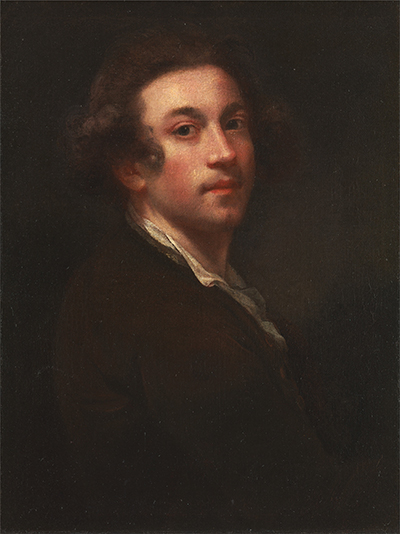
 by Tom Gurney
Tom Gurney BSc (Hons) is an art history expert with over 20 years experience
Published on June 19, 2020 / Updated on November 6, 2026
Email: tomgurney1@gmail.com / Phone: +44 7429 011000
Introduction
Sir Joshua Reynolds was the dominant British portrait painter of the eighteenth century and one of the artists most responsible for giving British art a new public confidence. He was not simply a successful maker of likenesses. He was a theorist, collector, social strategist, traveller, lecturer and institutional founder whose career helped define what ambitious painting could mean in Georgian Britain. The National Portrait Gallery identifies him as Britain's leading portrait painter and the first President of the Royal Academy, while the National Gallery describes him as the leading English portraitist of his century.[1][2]
Reynolds's achievement rests on a productive tension. He earned fame by painting portraits, yet he wanted portraiture to carry the dignity traditionally associated with history painting. He looked to classical antiquity, Italian Renaissance art and the great European masters, but he made his reputation in a London world of aristocrats, actors, writers, children, military officers, clubmen and public celebrities. He praised general principles in art, but his own career depended on the living presence of individuals who sat before him.
That mixture explains why Reynolds still matters. He took a genre often treated as social record and pushed it toward performance, allegory, drama and learned invention. A portrait by Reynolds could flatter, commemorate, advertise rank, stage public character, evoke moral virtue or transform a sitter into a figure with mythic overtones. His best works do not abandon likeness. They enlarge it.
At a Glance
- Life1723–1792 [2][3]
- BornPlympton, Devon [2][3]
- ApprenticeshipThomas Hudson, from 1740 [2]
- ItalyTravelled in 1749 and studied especially in Rome [2][3]
- London practiceEstablished around 1753 [3]
- Known forLeading eighteenth-century British portrait painter [1][2]
- Royal AcademyFirst President from its foundation in 1768 [1][2]
- Portrait recordAssociated with 1,441 portraits in the National Portrait Gallery record [1]
- Major modern acquisitionPortrait of Mai (Omai), jointly acquired in 2023 [7]
- Technique cautionExperimental materials caused fading, cracking and vulnerable paint structures [2][8]
Contents
- Introduction
- A career built around portraiture
- The Grand Manner
- Reynolds and the Royal Academy
- Sitters, society and self-fashioning
- Major works and recurring subjects
- Women, children and public character
- Men of letters, soldiers and empire
- Old art and modern sitters
- The studio as a machine of reputation
A career built around portraiture
Reynolds was born at Plympton in Devon in 1723, the son of a headmaster.[2][3] This educated family background mattered. The National Gallery notes that he came from a more learned setting than many painters of his generation, and that he was apprenticed in 1740 to the fashionable London portrait painter Thomas Hudson.[2] That apprenticeship gave him access to the commercial and social realities of portrait painting before he made his own broader claims for the art.
In 1749 Reynolds travelled to Italy, spending much of the following years abroad, especially in Rome.[2][3] The journey was decisive. He studied antique sculpture, Italian painting and the example of older European schools. When he returned to Britain and established himself in London around 1753, he brought with him a larger ambition for portraiture than a mere record of features, dress and status.[3] He wanted portraiture to absorb the lessons of historical and religious painting without losing its usefulness to patrons.
London was ready for such an artist. Wealth, empire, politics, theatre, literature and the aristocratic marriage market all fed a demand for portraits. Reynolds responded with extraordinary professional energy. The National Portrait Gallery records Reynolds as artist associated with 1,441 portraits, a figure that gives a sense of the scale of his practice even allowing for versions, copies and works after him.[1] He became a painter of people who wanted to be seen by society, and of people whom society increasingly wanted to see.
His portrait practice was never one thing. Some sitters are presented with elegance and restraint; others are staged with theatrical splendour. Children become emblems of innocence, wit or charm. Actors become embodiments of role and reputation. Military figures are shown with the props of command, danger and public service. Aristocratic women may appear as muses, graces, mothers, dynastic figures or refined social presences. Reynolds made portraiture flexible enough to serve many forms of identity.
The Grand Manner
The phrase most often attached to Reynolds is the Grand Manner. The National Portrait Gallery explains that Reynolds sought to raise the status of portraiture by borrowing from classical antiquity and the Old Masters, filling portraits with moral and heroic symbolism.[1] The idea was not simply to make portraits large or expensive. It was to give them intellectual and imaginative weight.
In practice, the Grand Manner allowed Reynolds to turn sitters into more elevated pictorial beings. A fashionable woman could be associated with a muse or grace. A soldier could be given the urgency of public action. A child could be surrounded by a mood of innocence or fantasy. A theatrical celebrity could be transformed into an emblem of tragedy. The sitter remained identifiable, but the painting asked viewers to read character through pose, costume, light, composition and reference.
This ambition helps explain why Reynolds's portraits can feel so staged. He was not trying only to catch an informal likeness. He wanted a portrait to possess the authority of art history. Venetian colour, Roman gravitas, Flemish richness, Van Dyck's elegance and Rembrandt's depth all mattered to him as models of artistic possibility.[2] His paintings speak the language of social Britain, but they also speak to a European museum of images that he studied and admired.
The Grand Manner could be magnificent, but it could also be risky. It depended on the viewer accepting the transformation of a modern sitter into something more symbolic. When it succeeds, Reynolds makes the sitter feel larger than a private individual. When it strains, the borrowing can feel theatrical or artificial. That tension is part of his fascination. He was constantly negotiating between likeness, learning, fashion and invention.
Reynolds and the Royal Academy
Reynolds's importance is inseparable from the Royal Academy. When the Academy was founded in 1768, he was elected its first President.[1][2] The appointment gave him an institutional platform unmatched by any other British painter of his generation. It also suited his temperament. Reynolds believed deeply that British art needed education, hierarchy, public exhibition, serious criticism and a sense of national cultural ambition.
His presidential lectures, later known as the Discourses on Art, became a central statement of academic artistic theory in Britain. The National Portrait Gallery describes them as influential annual lectures that shaped contemporary theory and practice and helped raise the prestige of British art across Europe.[1] Reynolds used the lectures to address students, defend disciplined study and argue for the elevation of art through general principles rather than merely mechanical imitation.
The Discourses reveal Reynolds as an artist who thought institutionally. He did not treat painting only as private genius or marketplace craft. He saw it as a learned profession that required study, emulation, judgment and public standards. In the opening discourse, delivered at the Royal Academy in January 1769, he framed the Academy itself as an event of national importance.[6] That tone is telling. Reynolds wanted British painting to think of itself on a European scale.
At the same time, his lectures sit in productive tension with his own career. Reynolds repeatedly exalted history painting as the noblest form of art, yet the National Gallery notes that he had little opportunity to practise it and that his greatest works are portraits.[2] Rather than weakening him, this tension made his portraiture more ambitious. He tried to import the seriousness of history painting into a genre driven by living patrons.
Sitters, society and self-fashioning
Reynolds's success depended on more than paint. The National Portrait Gallery calls him an extraordinary socialite, social climber and self-promoter who used his contacts to advance himself.[1] That judgment should not be treated as a dismissal. In eighteenth-century London, portraiture was a social art. To paint the elite, a painter had to enter networks of patronage, conversation, exhibition, clubs and reputation.
Reynolds understood this world with unusual intelligence. He was a friend of Samuel Johnson and a key figure in London's intellectual circles.[2] His studio brought together people from politics, literature, theatre, aristocratic society and imperial life. The painter's social position and artistic ambition reinforced one another. Sitters came to Reynolds because he could make them visible within a prestigious public language; Reynolds became more prestigious because important sitters came to him.
This gives his portraits a double character. They are images of individuals, but they are also records of social performance. A sitter's clothes, pose, gesture and surroundings often show how that person wished to be understood. Reynolds did not invent this function of portraiture, but he raised its pictorial pitch. He could make a portrait look like a public claim about refinement, courage, maternal virtue, theatrical genius or cultivated leisure.
Such portraits can be read historically as documents of power and taste, but they are not only documents. Reynolds's best works have psychological and pictorial life. His children can be tender without becoming simple. His theatrical portraits can feel grand without losing the force of performance. His military portraits often use movement, costume and landscape to dramatise public identity. The social machinery is visible, but so is artistic invention.
Major works and recurring subjects
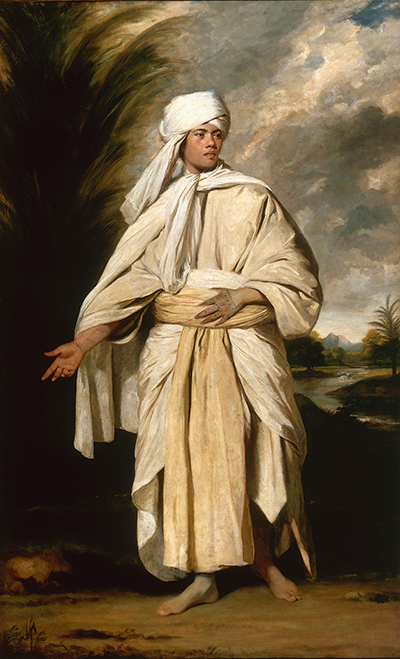
The current Reynolds canon contains several works that need special attention. Portrait of Mai, long known as Portrait of Omai, is one of the most important British portraits of the eighteenth century. Its 2023 joint acquisition by the National Portrait Gallery and Getty confirmed its exceptional modern status and made it a central work for any account of Reynolds.[7] It connects portraiture, travel, empire, celebrity, cross-cultural encounter and the theatrical staging of identity.
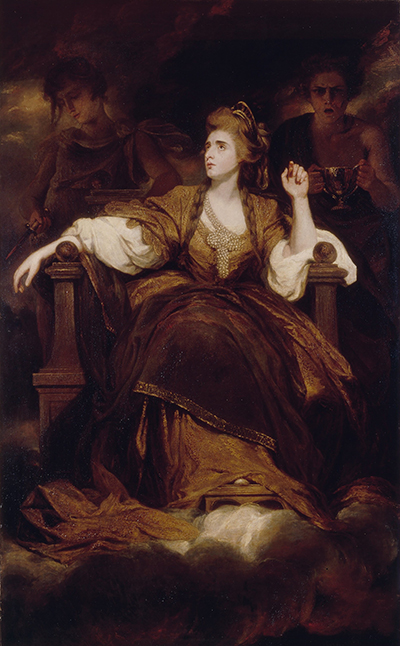
Sarah Siddons as the Tragic Muse is another central work. It presents the most celebrated tragic actress of her age not merely as a performer but as an embodiment of tragedy itself. The picture belongs to the Grand Manner, to theatre history and to Reynolds's ability to convert celebrity into allegory. It deserves extended treatment because it shows how his portraiture could become almost history painting without ceasing to be a portrait.
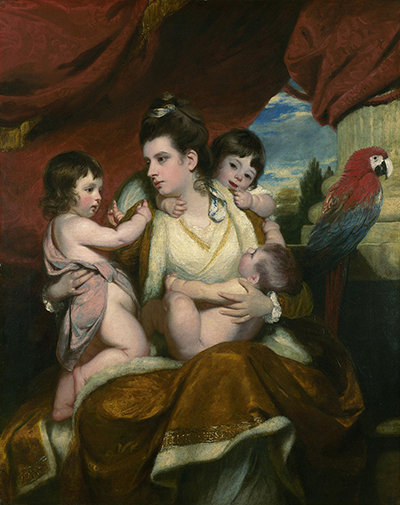
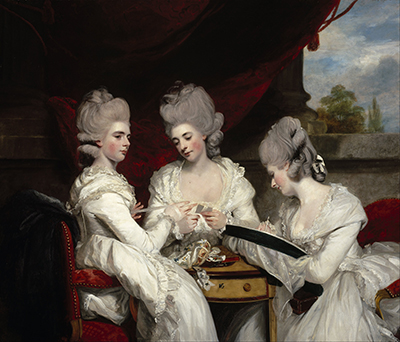
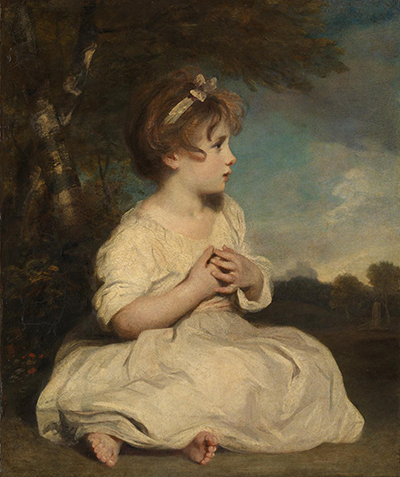
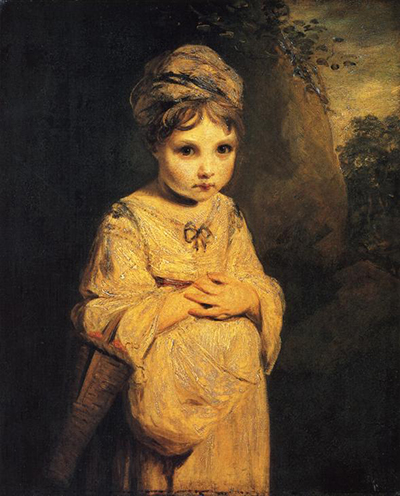
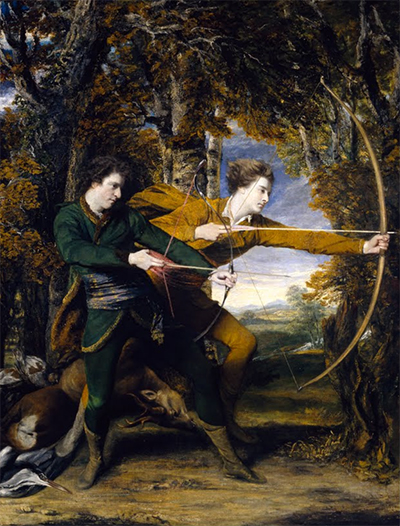
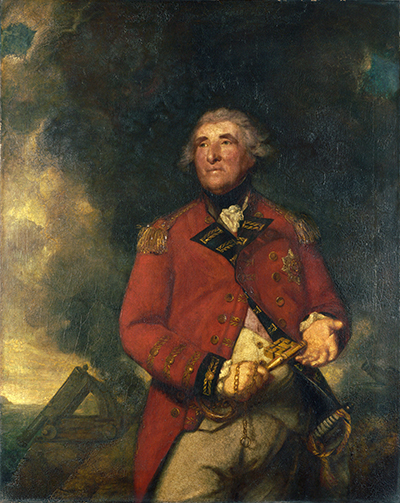
Other major works reveal the range of his invention. Lady Cockburn and Her Three Eldest Sons turns motherhood into an elevated composition. The Ladies Waldegrave presents aristocratic sisters in an image of elegant sociability and dynastic possibility. Colonel Acland and Lord Sydney: The Archers turns sporting friendship into a dramatic outdoor portrait. Lord Heathfield of Gibraltar stages military endurance and imperial defence with extraordinary force. The Strawberry Girl, The Age of Innocence and The Infant Samuel show Reynolds's taste for childhood, fancy and sentiment.
This range is one reason Reynolds should not be reduced to a maker of society likenesses. Society likeness was his professional base, but he repeatedly pressed beyond it. His art turns portraits into scenes, roles, emblems and experiments in style. The sitter is often the starting point, not the limit.
Women, children and public character
Reynolds's reputation depends heavily on portraits of women and children, not because these subjects were secondary or merely charming, but because they gave him room to test how social identity could be made pictorial. A portrait of an aristocratic woman might negotiate beauty, virtue, marriage, family, inheritance and public reputation at once. A portrait of a child might appear innocent while also serving dynastic, sentimental or commercial functions. Reynolds understood that portraiture could be emotionally attractive and socially strategic at the same time.
This is clear in his family groups. Lady Cockburn and Her Three Eldest Sons and Lady Elizabeth Delmé and her Children are not simply records of mothers and children. They show how motherhood itself could be pictured as cultivated, graceful and publicly meaningful. Reynolds often borrowed from religious or classical composition to give such family images greater dignity. The result is a portrait that can look tender while also performing a public claim about lineage, femininity and rank.
Children offered a different opportunity. In The Age of Innocence, The Strawberry Girl, Miss Bowles, Master Hare and Lady Caroline Howard, Reynolds helped shape an eighteenth-century visual language of childhood that is not identical from work to work. Some children are poised and aristocratic; others are sentimental, vulnerable or theatrical. The child portrait could be a family record, but it could also become a widely reproduced image of innocence, feeling or refinement. This is why the print afterlife matters so much: once engraved or mezzotinted, a child's likeness could become a cultural type.
Reynolds also painted women whose public identities came from performance rather than aristocratic inheritance. Sarah Siddons as the Tragic Muse and Mrs Abington belong to a theatrical world in which actors and actresses could become national celebrities. Here portraiture does not merely preserve appearance. It translates performance into a durable visual identity. The actress is shown as herself, but also as the role, reputation and imaginative force that audiences associated with her.
These works show Reynolds's intelligence about public character. He knew that a sitter was never only a face. A sitter arrived with family, ambition, rumour, profession, rank, costume, patronage and expectation. Reynolds's task was to make those pressures visible without collapsing the portrait into illustration. His solution was often to stage identity through a carefully chosen artistic language: antique reference, theatrical light, landscape setting, symbolic gesture, historical echo or borrowed pose.
Men of letters, soldiers and empire
Reynolds's male sitters occupy a different but equally varied world. His portraits of writers and intellectuals connect him to the conversation culture of eighteenth-century London. The National Gallery identifies him as a friend of Dr Johnson, and Johnson's presence in Reynolds's circle matters because it places the painter within literary as well as artistic society.[2] Reynolds painted authors, thinkers and clubmen as figures of mind, reputation and sociability.
Military portraits gave him another arena for invention. A military sitter could be shown as a commanding public figure, a man of action, a survivor, a defender or a participant in Britain's global conflicts. Lord Heathfield of Gibraltar is the most powerful example among the current Reynolds subjects: a portrait that turns command into an image of endurance and symbolic possession. The visual language is dramatic, but the historical background requires care. These portraits belong to a Britain shaped by war, empire and colonial ambition.
That wider context is increasingly important for Reynolds. The National Gallery's artist record notes ongoing research into his relationship to histories of enslavement and identifies several relevant connections in Reynolds's world and imagery.[2] Such material should not be bolted onto every discussion as a perfunctory aside, but neither can it be ignored. Reynolds painted in a society whose wealth, status and global reach were entangled with colonial systems. Some sitters, households and subjects carry that history directly.
Portrait of Mai makes this especially clear. Mai was not an English aristocrat performing a familiar social role. He was a Polynesian visitor whose presence in Britain was bound to Cook-voyage celebrity, cross-cultural encounter and imperial spectatorship. Getty's account of the 2023 joint acquisition by the National Portrait Gallery and Getty underlines the painting's exceptional modern significance.[7] The work demands an interpretation that is admiring of Reynolds's pictorial achievement but alert to the unequal conditions through which Mai became a public figure in London.
This is one reason Reynolds remains so rich for modern readers. His paintings give us beauty, ambition and invention, but also access to the social systems that produced them. Portraiture records status; status has a history. A Reynolds portrait can therefore be visually dazzling and historically uncomfortable at the same time. Responsible writing about him has to keep both truths in play.
Old art and modern sitters
Reynolds's art often begins from a modern sitter and reaches backward into older art. The National Gallery stresses his study of ancient and Italian Renaissance art, and also Rembrandt, Rubens and Van Dyck.[2] These models were not neutral. Each offered a different resource. Antique sculpture suggested ideal form and elevated bearing. Italian art offered composition, grandeur and colour. Van Dyck offered aristocratic elegance. Rembrandt offered depth, shadow and psychological force. Rubens offered energy and richness.
The challenge was to make such sources work for eighteenth-century Britain. A borrowed pose could not simply be pasted onto a modern sitter. It had to be adapted to clothing, status, personality and occasion. Reynolds's success lies in the way he made old art serve new social needs. His portraits helped Georgian Britain imagine itself as culturally mature, connected to European tradition and capable of producing art with more than local charm.
This borrowing is sometimes misunderstood as mere quotation. Reynolds did quote and adapt, but his larger purpose was transformation. He believed that students should study great art in order to understand principles, not merely copy surfaces.[6] In his own portraits, that belief appears as a constant search for elevated form. A sitter might become more graceful, more heroic, more maternal, more tragic or more public through contact with older art.
There is an obvious danger here. Elevation can become disguise. A Grand Manner portrait may soften social realities, idealise power or turn privilege into virtue. Reynolds's art often asks us to admire the very world that commissioned it. Yet this does not make the paintings empty. It makes them active participants in the construction of social meaning. They show how beauty, learning and power can reinforce one another.
For that reason, Reynolds should be read neither as a simple flatterer nor as a detached intellectual. He was a working artist in a competitive city, dependent on patrons, ambitious for national art and convinced of the value of tradition. His portraits are where those forces meet. The old master echo and the modern sitter are not separate ingredients. They are the two halves of his project.
The studio as a machine of reputation
Reynolds's productivity required organisation. The Paul Mellon Centre's research guide points to sitter books for 1757-1790, a crucial reminder that portraiture was built from appointments, sittings, records, payments, studio labour and social negotiation.[4] The finished painting can appear effortless, but behind it lay a schedule. Reynolds's studio had to manage demand from a large and varied clientele.
Sittings mattered because portraits were made through repeated encounters. A sitter might arrive in fashionable dress, military uniform, theatrical identity or family role. Reynolds had to choose pose, format, costume treatment, setting, expression and degree of finish. The portrait then entered a world of exhibition, private display, engraving, inheritance, sale and reputation. A likeness could be both personal property and public performance.
This is why Reynolds's career cannot be separated from London as a cultural environment. The capital offered patrons, exhibitions, clubs, academies, publishers, dealers and printmakers. It also offered conversation. A painter of Reynolds's kind benefited from being talked about, visited, recommended and socially visible. He built his artistic identity partly through the same world that supplied his sitters.
The studio also complicates questions of authorship. In a large portrait practice, repeated compositions, copies and versions were part of the economy of art. Some images were known through prints after Reynolds rather than through the original painting. Later collections and attributions can blur the boundaries between autograph work, studio participation, copy and reproduction. Mannings's catalogue is therefore central not because it makes Reynolds more remote, but because it helps restore order to a busy, living practice.[5]
Understanding the studio also makes the paintings more human. They were not isolated miracles. They were made under pressure, with deadlines, patrons, fees, ambitions and experiments. Reynolds's greatness lies partly in the fact that he could make this system produce images that still feel ambitious, memorable and pictorially inventive.
Theory and practice
Reynolds's theory can seem stern beside the liveliness of his best paintings. The Discourses praise study, discipline, general ideas and the example of established masters.[6] He warned against narrow imitation and encouraged artists to absorb the principles behind great art. He was, in that sense, an academic thinker: he believed that art could be taught, argued over and improved through standards.
Yet Reynolds was not a cold academician in practice. His paintings are full of costume, gesture, colour, pose and theatrical intelligence. He loved the resources of old art because they could make modern portraits more alive to meaning. A borrowed pose or antique echo was not necessarily dead quotation. In his hands, it could become a way of raising a sitter into a richer imaginative field.
The relationship between theory and practice is therefore complicated. Reynolds wanted art to rise above accidental detail, but portraiture forced him to attend to individual presence. He admired general forms, but he painted distinctive faces. He lectured about history painting, but he thrived in the marketplace of portrait commissions. These contradictions are not signs of failure. They are the engine of his career.
They also explain why Reynolds remained influential and controversial. Later artists and critics could admire his ambition while questioning his formulas. Gainsborough, for instance, offered a very different model of portraiture and landscape, one more openly painterly and less academically programmatic. Reynolds's own response to Gainsborough after his death shows admiration as well as pedagogical distance.[6] Their comparison is one of the great stories in British eighteenth-century art.
Technique and experiment
Reynolds's technique is one of the most important cautions in any account of him. The National Gallery notes that his paintings are not perfectly preserved because of faulty technique, including faded reds and cracking blacks.[2] National Galleries of Scotland similarly warns that many of his pictures have deteriorated badly.[3] These are not small conservation footnotes. They affect how viewers encounter Reynolds today.
The National Gallery Technical Bulletin gives the fuller picture. A major study of Reynolds's materials, connected with research on works in the Wallace Collection and the National Gallery, describes fragile and vulnerable paint structures, fading flesh paints and complex combinations of media.[8] Reynolds experimented with supports, grounds, pigments, binders, varnishes, oils, resins and glazes in ways that could produce richness but also instability.
This technical story should be handled fairly. Reynolds's material experiments were part of his ambition. He wanted depth, glow, richness and the effects he associated with old master painting. The problem is that some of the mixtures and layering practices he used did not age well. The present condition of a Reynolds painting may therefore be very different from its original force.
That fact changes how we look. A pale flesh tone may not represent Reynolds's full intention. A darkened passage may have lost clarity. A cracked or sunken surface may reveal the physical cost of experiment. The technique problem does not diminish his importance; it makes the paintings more historically complex. Reynolds was pursuing greatness through materials that sometimes betrayed him.
Drawings, prints and the wider record
Reynolds is primarily remembered for paintings, but the wider record of his practice is broader. The Paul Mellon Centre points researchers toward sketchbook material, sitter books, archives and a photographic archive arranged according to Mannings catalogue numbers.[4] These records matter because Reynolds's career was vast, collaborative and socially embedded. The finished painting is only one part of the evidence.
Drawings and sketchbooks can reveal study, borrowing, travel, composition and memory. Sitter books can show the rhythm of appointments and the practical structure of portrait production. Prints after Reynolds show how his images travelled beyond the original paintings. Reproductive prints helped make actors, writers, aristocrats and famous children visible to a wider audience, and they shaped the afterlife of works that many people knew first through engraved or mezzotint versions.
This wider record is especially important because Reynolds's studio produced versions, repetitions and works that later circulated in complicated ways. A careful account of any individual picture must distinguish autograph work, studio participation, copies, prints after Reynolds and later images based on his compositions. Mannings's catalogue raisonné is essential here because it helps organise the enormous body of paintings and variants.[5]
For a general reader, this may sound like scholarly housekeeping, but it directly affects interpretation. A title may attach to more than one version. A famous composition may be known through prints. A sitter may appear in several portraits. A painting's present condition may obscure earlier colour. Reynolds's art sits within a dense web of objects, records and reproductions.
Mannings and the modern Reynolds
Modern Reynolds study depends heavily on David Mannings's Sir Joshua Reynolds: A Complete Catalogue of His Paintings, published by Yale University Press for the Paul Mellon Centre in 2000, with Martin Postle cataloguing the subject pictures.[5] Bibliographic records describe it as a two-volume work, with text and plates, and the Paul Mellon Centre identifies it as part of its catalogue raisonné programme.[4][5] For a painter as prolific and version-heavy as Reynolds, that kind of structured catalogue is not optional background. It is a foundation.
The importance of Mannings lies in scale and control. Reynolds produced, inspired or was associated with an enormous body of portraits and subject pictures. Titles shifted, sitters were renamed, copies and studio versions multiplied, and paintings moved through private collections and public institutions. A catalogue raisonné gives the structure needed to keep those identities straight.
That matters for public understanding. Without catalogue control, a Reynolds article can easily repeat an old title, misidentify a sitter, confuse a copy with an original or treat an engraving as if it were a painting. With catalogue control, the discussion can begin from firmer ground. The painting can be described as an object with a history, not merely as an image.
Mannings also helps place Reynolds within a bigger historical pattern. The catalogue shows the breadth of his work: aristocratic portraits, actors, writers, children, family groups, military figures, fancy pictures, subject pictures and self-images. It reveals Reynolds not as an isolated genius producing a handful of masterpieces, but as the centre of a vast portrait enterprise.
How to look at Reynolds
A useful first question before a Reynolds portrait is: what kind of public identity is being made? The sitter's face matters, but it rarely carries the whole meaning alone. Costume, pose, hand gesture, background, scale, companion figures and borrowed artistic references all help construct the answer. Reynolds often asks viewers to move between recognition and interpretation. We recognise a person, then begin to read the role that the painting builds around that person.
The second question is: what older art is being activated? Reynolds's portraits often become clearer when placed beside the traditions he admired. A Van Dyck-like elegance may give aristocratic ease to a sitter. A Rembrandt-like darkness may suggest inwardness or gravity. A classical pose may lift a modern figure toward allegory. These references do not need to be identified every time in order for the painting to work, but they explain why Reynolds's portraits can feel more ceremonious than ordinary likenesses.
The third question is: what has time done to the surface? Reynolds's colour and modelling may not always appear as he intended, because his experimental technique could age unpredictably.[2][8] Some passages that now look subdued, cracked or pale may once have carried greater warmth or depth. Looking at Reynolds therefore involves a small act of historical imagination. The viewer has to consider both the visible painting and the altered material object that survives.
The final question is ethical as well as visual: who benefits from the portrait's splendour, and who is left outside it? Reynolds painted a world of patronage, property, celebrity, colonial travel and inherited rank. His art is not reducible to those structures, but it is shaped by them. To admire Reynolds responsibly is not to pretend that elegance is innocent. It is to see how power, beauty, learning and ambition could meet inside a portrait.
These questions make Reynolds more rewarding rather than less. They slow the viewing down. A portrait that first appears simply grand may begin to reveal family strategy, theatrical fame, imperial encounter, technical experiment or academic theory. Reynolds was a painter of surfaces, but never only surfaces. His best portraits use surface to make public character visible.
Reynolds's legacy
Reynolds died in London in 1792.[4] By then he had become more than a successful painter. He had helped create the institutional language of British art. He had shown that portraiture could aspire to intellectual seriousness. He had turned the Royal Academy presidency into a platform for national artistic ambition. He had painted many of the people through whom eighteenth-century Britain imagined power, taste, celebrity, childhood, authorship and public virtue.
His legacy is not simple admiration. Reynolds can feel grand, calculated, theatrical and socially complicit. His world was one of rank, patronage and empire, and modern institutions increasingly study those connections with greater care.[2] Some paintings preserve beauty and ambition alongside histories of inequality, colonial encounter and social exclusion. Portrait of Mai especially requires that larger historical attention.
Yet Reynolds's durability also comes from his ability to make portraiture intellectually restless. He did not invent social portrait painting, and he did not escape its limits, but he stretched it. A sitter could become a tragic muse, a heroic commander, a tender mother, a polished aristocrat, an emblem of childhood, a figure of literary authority or a visitor whose image carried the pressures of global encounter. That elasticity is why his art supports so many different kinds of study: visual, social, theatrical, technical, institutional and ethical.
It also explains why Reynolds is a rewarding artist to revisit after the first impression of grandeur has passed. The portraits are not only grand images of grand people. They are negotiations between painter and sitter, past art and present ambition, material brilliance and material risk, private likeness and public meaning. Few British artists of his century made those negotiations so visible, and few left such a rich trail through galleries, archives, prints, lectures and later scholarship, with every thread returning to the central problem of what a portrait could be in a changing public culture of display and reputation.
At the same time, Reynolds remains indispensable because he shaped the terms of British art at a decisive moment. He made portraiture central to national culture. He argued for artistic education when British institutions were still young. He built a career that connected studio, academy, club, exhibition, print culture and public reputation.
The best way to approach Reynolds is to keep all those dimensions in view. He was a brilliant portraitist, but also a theorist of art. He was a social operator, but also a serious student of old masters. He was an institutional leader, but also an experimental painter whose materials could fail. He looked backward to antiquity and Renaissance models while helping build a modern British art world. His achievement lies in that complicated combination: the face of Georgian society painted through the ambition of European art.
Frequently Asked Questions
Discussion
A useful first question before a Reynolds portrait is: what kind of public identity is being made?
Reader Insights
The second question is: what older art is being activated?
The third question is: what has time done to the surface?
The final question is ethical as well as visual: who benefits from the portrait's splendour, and who is left outside it?
Join the Conversation
These questions make Reynolds more rewarding rather than less. They slow the viewing down.
References
- National Portrait Gallery, “Sir Joshua Reynolds”, https://www.npg.org.uk/collections/search/person/mp03755/sir-joshua-reynolds
- National Gallery, London, “Sir Joshua Reynolds 1723-1792”, https://www.nationalgallery.org.uk/artists/sir-joshua-reynolds
- National Galleries of Scotland, “Sir Joshua Reynolds”, https://www.nationalgalleries.org/art-and-artists/artists/sir-joshua-reynolds
- Paul Mellon Centre, “Joshua Reynolds (1723-1792)”, https://www.paul-mellon-centre.ac.uk/archives-and-library/artist-subject-guides/joshua-reynolds
- David Mannings, Sir Joshua Reynolds: A Complete Catalogue of His Paintings, with subject pictures catalogued by Martin Postle, Yale University Press / Paul Mellon Centre for Studies in British Art, 2000.
- Sir Joshua Reynolds, Fifteen Discourses Delivered in the Royal Academy, Project Gutenberg edition, https://www.gutenberg.org/files/52436/52436-h/52436-h.htm
- Getty News, “Joshua Reynolds' Portrait of Mai Jointly Acquired by the National Portrait Gallery and Getty”, https://www.getty.edu/news/joshua-reynolds-portrait-of-mai-jointly-acquired-by-the-national-portrait-gallery-and-getty/
- Alexandra Gent, Ashok Roy and Rachel Morrison, “Practice Makes Imperfect: Reynolds's Painting Technique”, National Gallery Technical Bulletin, vol. 35, 2014, https://www.nationalgallery.org.uk/technical-bulletin/vol-35-essay-2-2014