 by Tom Gurney
Tom Gurney BSc (Hons) is an art history expert with over 20 years experience
Published on June 19, 2020 / Page Updated on November 6, 2026
Email: tomgurney1@gmail.com / Phone: +44 7429 011000
Introduction
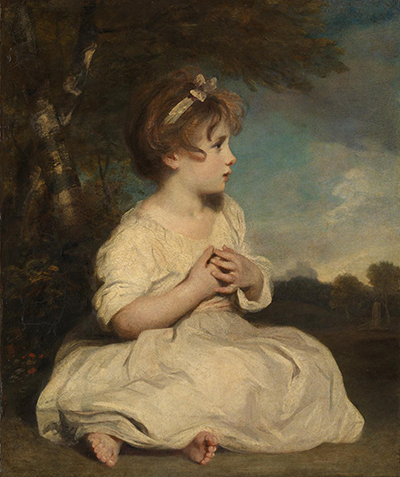
Sir Joshua Reynolds's The Age of Innocence is one of the most familiar images of childhood in eighteenth-century British art, but almost every part of its fame needs careful handling. The Tate-linked A&AePortal record identifies the work as The Age of Innocence, by Joshua Reynolds, dated 1788?, oil on canvas, measuring 76.4 by 63.5 centimetres, with the Tate accession number N00307.[1] It is a small painting compared with Reynolds's great full-length portraits, yet its afterlife was enormous.
The picture shows an unidentified young girl seated outdoors beneath a tree. The British Museum's record for Joseph Grozer's print after the painting describes her as whole-length, with her head in profile to the right, hands together at her chest, bare feet, a white dress and a bow in her hair, with a landscape and distant castle beyond.[2] That description captures the image's immediate appeal: a child alone in nature, vulnerable but composed, turned into a model of innocence.
Yet the painting is not a straightforward portrait of a known child. It is a fancy picture, a character study rather than a securely identified likeness. The title itself belongs to later reception and print culture, not necessarily to Reynolds's own first naming of the work. Beneath the visible image lies another Reynolds subject, a version of The Strawberry Girl. The painting is therefore famous not because it is simple, but because its simplicity is built over uncertainty, repetition, technical experiment and Victorian admiration.
At a Glance
- Current titleThe Age of Innocence [1]
- ArtistSir Joshua Reynolds
- Date1788? / around 1788 [1]
- MediumOil on canvas [1]
- Dimensions76.4 × 63.5 cm [1]
- AccessionTate N00307 [1]
- Current holderTate Britain, London [1]
- SitterUnidentified young girl [2]
- GenreFancy picture rather than a confirmed portrait
- Collection historyPresented by Robert Vernon in 1847 [1]
Contents
- Introduction
- The Tate painting
- What the picture shows
- A fancy picture, not a confirmed portrait
- The uncertain sitter
- The title and print afterlife
- Painted over The Strawberry Girl
- Technique and vulnerability
- Nineteenth-century fame
- Legacy
The Tate painting
The main object to keep in view is the Tate painting, N00307. A&AePortal records the title, artist, date as 1788?, medium as oil on canvas, dimensions and Tate Britain location, while linking the image to Tate's own work record.[1] Tate's live record is not extractable here, so the Tate-linked A&AePortal entry, British Museum print records and Tate-derived metadata must be read together with caution.
The work was presented by Robert Vernon in 1847, according to Tate-derived image metadata, and it has long been associated with both National Gallery and Tate collection history.[1][2] Older records sometimes preserve the former National Gallery number NG307 alongside Tate N00307. That dual numbering can create confusion, but it reflects institutional history rather than a different painting.
The date also needs caution. The familiar dating is around 1788, but the British Museum record, citing David Mannings, notes that the painting may be identifiable with a work exhibited in 1785 as A Little Girl.[2] That possibility matters because it affects sitter identification and the painting's place among Reynolds's late fancy pictures. A responsible account should therefore avoid pretending the date is absolutely settled.
This is a small canvas, but not a minor image. Its dimensions make it intimate, and that intimacy helped it become reproducible, ownable and emotionally legible. Unlike Reynolds's most public Grand Manner portraits, The Age of Innocence does not depend on a named sitter's rank. It depends on a general idea: childhood as tenderness, naturalness and moral vulnerability.
That shift makes the painting unusual within a career dominated by social identity. Reynolds's aristocratic portraits often ask viewers to recognise family, rank, office or celebrity. Here recognition works differently. The child is not famous because she is a known person in a powerful family. She became famous because she could stand for a state of life. The painting's very uncertainty helped it become widely available to later viewers.
The Tate accession number, British Museum print records and Mannings-related caution therefore all need to be held together. They do not make the painting less important. They explain why the work has been so repeatedly interpreted. The Age of Innocence is both an object with a collection history and an image that escaped into reproduction, memory and sentiment.
What the picture shows
The child sits on the ground, turned in profile, hands gathered close to her chest. She is barefoot, dressed in white, and placed in a landscape setting. Nothing in the image identifies her by rank, family or public role. This absence is crucial. Reynolds removes the child from the ordinary markers of portraiture and lets her become an emblem.
The pose is quiet rather than dramatic. The child does not perform an action for the viewer. She sits, listens or thinks. Her hands are folded in a way that suggests inwardness, modesty or self-protection. The bare feet connect her to the ground and to a fantasy of natural childhood, while the white dress gives the image its moral tone.
The landscape is equally important. A tree shelters the figure, and the distant castle gives the scene a hint of story without explaining it. The child seems apart from society, yet not abandoned. Reynolds creates an atmosphere of stillness in which childhood appears as a state before social complication.
This is why the image has been so easy to reproduce and remember. It is not crowded with details. It offers a single figure, a legible emotion and a title that tells viewers how to feel. But that clarity is also deceptive. The more one looks at the painting's history, the less innocent the image becomes as an object.
The picture also works by withholding action. Reynolds does not show the child playing, speaking, reading, selling, praying or interacting with another figure. The folded hands and profile turn create a pause. That pause lets the viewer imagine several states at once: shyness, patience, contemplation, modesty or withdrawal. The image feels full because it refuses to specify too much.
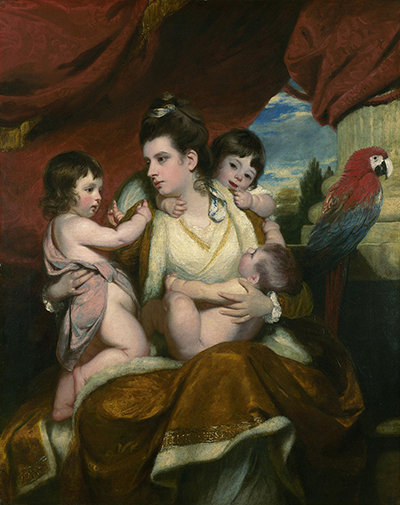
The child's isolation is equally important. In the major family portraits already treated in the Reynolds sequence, children are connected to parents, siblings, lineage or public identity. Here the child appears apart. She is not held by Lady Cockburn, nor coordinated with sisters like the Waldegraves.[8][9] The single figure becomes a more abstract vessel for feeling.
A fancy picture, not a confirmed portrait
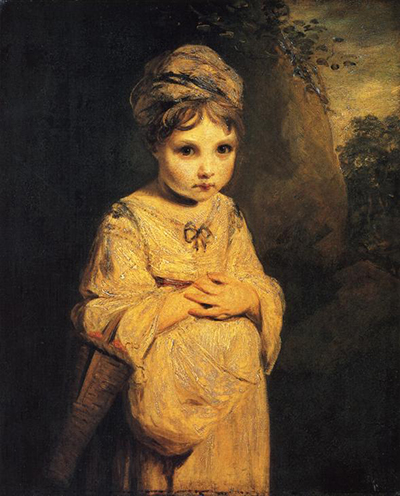
The Wallace Collection describes The Strawberry Girl as one of Reynolds's so-called fancy pictures, a type that often showed children in sentimental costumes or guises.[4] That category is essential for The Age of Innocence as well. Fancy pictures were not conventional likeness commissions, even when they drew on real children. They were images of types, moods and ideas: the strawberry seller, the girl with a bird, the child in nature, the innocent figure.
Christie's, discussing another Reynolds fancy picture and citing Mannings/Postle, notes that such works are associated with what David Mannings called "contrived innocence."[6] The phrase is sharp because it catches the double nature of the genre. Reynolds's children can seem fresh and unguarded, but the innocence is carefully made. Costume, pose, setting, expression and title all help produce it.
This does not make the picture false. It means the painting belongs to a culture that enjoyed images of childhood as moral theatre. The child is not asked to carry family history in the way the Waldegrave sisters or Cockburn children do. She carries an idea of childhood itself. Her anonymity helps the image work.
Reynolds's fancy pictures also gave him room to experiment outside the demands of formal likeness. A named aristocratic portrait had obligations to family resemblance, rank and patron expectation. A fancy picture could be freer. It could borrow from street life, literature, sentiment, old-master memory or studio invention. The Age of Innocence belongs to that more elastic part of Reynolds's practice.
This freedom also explains why the painting feels less like a social document than an emotional proposition. The child is not doing the work of a sitter presenting family status. She is doing the work of an image presenting a condition. Reynolds uses her to explore a subject that was becoming increasingly important in eighteenth-century culture: the idea that childhood had its own moral and imaginative value.
The fancy picture therefore sits between portraiture and genre. It borrows the human immediacy of portraiture, but it does not require the same kind of identity. It borrows the generality of genre painting, but it is less narrative and more distilled. Reynolds found in this hybrid a way to make small pictures with large emotional reach.
The uncertain sitter
The British Museum is clear that the model's identity is uncertain.[2] That uncertainty should be preserved rather than solved too neatly. The record cites Mannings no. 2008 and says Mannings proposed the painting may have been exhibited in 1785 as A Little Girl, at which time Theophilia Gwatkin would have been three.[2] It also notes facial similarities with Lady Anne Spencer, while warning that if she were the model the painting would need to date from the mid to late 1770s.[2]
The same British Museum record lists associated names including Anne, Countess of Shaftesbury, with a question mark, and Theophila Lowther.[2] These names show how the painting's history has attracted identifications without resolving them. It is tempting to attach a famous or family name to a beloved image, but the evidence remains cautious.
This uncertainty changes the way the painting should be read. If the child cannot be securely named, the work should not be treated as a conventional biographical portrait. The sitter may have been a real child known to Reynolds, but the finished picture uses her to create a more general image. She is not anonymous because she was unimportant; she is anonymous because the painting's later meaning moved beyond individual identity.
The title strengthens that movement. The Age of Innocence sounds like a universal condition, not a family name. It turns the child into a stage of life. Viewers are invited to see childhood itself, not merely one child.
The possible identifications still matter, because they reveal how viewers have tried to bring the image back from emblem to biography. Theophilia Gwatkin would fit one dating scenario; Lady Anne Spencer would fit another only if the painting were placed earlier.[2] Both names are tempting because they would make the image more concrete. But the responsible position is to let the uncertainty remain visible.
That restraint is not evasive. It is part of the painting's truth. Reynolds may have begun with a real model, but the picture's later power depends on its drift away from secure naming. The child has become culturally memorable precisely because she is not finally pinned down.
The title and print afterlife
Joseph Grozer's print after Reynolds is central to the painting's reception. The British Museum holds a 1794 stipple with etching titled The Age of Innocence, after the Tate painting N00307.[2] Another British Museum example, published by Thomas Philipe, repeats the same title, medium and after-Reynolds identity.[3] These prints matter because they helped fix the title and spread the image.
The British Museum record describes Grozer's print as a portrait of an unidentified young girl after Reynolds and gives its technique as stipple with etching.[2] This distinction corrects a common confusion. The original painting is oil on canvas; the stipple-and-etching works are later prints after it. They are not the same object and should not be merged.
Stipple was well suited to sentimental childhood imagery because it could render softness, pale flesh and gentle tonal transitions. A print after The Age of Innocence could carry the child's quiet profile and delicate gesture into domestic spaces far from the original painting. The image became portable, repeatable and emotionally accessible.
The title's success is part of that process. Once the print named the subject as The Age of Innocence, viewers could read the image through the phrase. It offered an interpretation before the viewer even began to look. The title may feel natural now, but it belongs to the image's afterlife as much as to Reynolds's studio.
The British Museum record also notes an earlier publication-line possibility for Grozer's engraving, connected to an example published in 1788 by W. Dickinson.[2] That detail matters because it complicates a simple 1794 print story. The image was already entering printed circulation close to the period when the painting itself was made or exhibited. The print afterlife was not a distant Victorian addition; it began early.
Print culture also changed the painting's emotional scale. The original is modest in size, but print allowed it to multiply. A child painted in oil became an image encountered in paper form, copied, collected and reinterpreted. This is one reason the title gained such authority. A phrase printed beneath an image can guide thousands of later readings.
Painted over The Strawberry Girl
One of the most intriguing facts about the painting is that it covers an earlier Reynolds image. Tate technical examination, reported in secondary accounts, has revealed that The Age of Innocence was painted over a version of The Strawberry Girl, another of Reynolds's celebrated fancy pictures.[4][5] This should be stated carefully, because the full technical account belongs to conservation literature, but the broad point is well established in Reynolds scholarship.
The connection is fitting. The Wallace Collection describes The Strawberry Girl as a fancy picture showing a child adapted from the real-life figure of a strawberry seller but removed from a usual urban setting and placed in a woodland environment.[4] That description already places it near the world of The Age of Innocence: child, costume, nature, sentiment and invention.
The hidden earlier image also reminds us how Reynolds worked. He repeated, revised and transformed subjects. The Wallace Collection notes that Reynolds produced at least four versions of The Strawberry Girl in the 1770s, with only two known to survive.[4] It also records technical deterioration and experimental materials in the Wallace example.[4] Against that background, the reuse of a canvas is not a bizarre accident. It belongs to a studio culture of repetition, experiment and revision.
The idea that only elements such as the hands may have survived from the earlier image is especially suggestive. The visible child's gesture, so central to the emotional force of The Age of Innocence, may be connected materially to a different child subject beneath. The painting's innocence is literally layered over another Reynolds fancy picture.
The relationship also links two of Reynolds's most popular child images. The Strawberry Girl presents a child associated with a street seller but transported into a stylised woodland setting.[4] The Age of Innocence removes even that social clue. The basket, trade and costume give way to bare feet, white dress and folded hands. Reynolds moves from a child type with social colour toward a purer emblem of childhood feeling.
Seen this way, the overpainted canvas is not just technical trivia. It is a material trace of Reynolds refining one kind of fancy picture into another. The visible work looks more universal because many of the earlier signs have been suppressed. The hidden image reminds us that universality in art is often made by removing context.
Technique and vulnerability
Reynolds's technical habits are a recurring caution in his career. The Wallace Collection links the deteriorated condition of The Strawberry Girl to Reynolds's experimental approach and unconventional materials.[4] The National Gallery Technical Bulletin similarly presents Reynolds as a painter whose materials and methods created difficult conservation problems, especially in flesh tones and complex layered surfaces.[5]
For The Age of Innocence, the technical story matters because the image became beloved partly through its surface softness. The pale dress, bare feet, tender hands and gentle light all depend on fragile pictorial effects. If the painting was made over another damaged or altered image, then its visible serenity is inseparable from technical instability.
That contradiction is very Reynolds. He sought freshness, depth, old-master richness and emotional effect, but his experiments could age unpredictably. The same ambition that made his paintings luminous could also make them vulnerable. The hidden Strawberry Girl beneath The Age of Innocence is therefore more than a curiosity. It is a material sign of Reynolds's risk-taking.
This does not reduce the painting's charm. It deepens it. The image looks simple and tender, but its making was complex. A child in white sits peacefully beneath a tree; beneath her lies another subject, and within the paint lies the history of Reynolds's experimental practice.
Nineteenth-century fame
The Age of Innocence became one of Reynolds's most copied and admired fancy pictures. Christie's, citing Reynolds scholarship, notes that more than 300 full-scale copies of the Tate painting are known.[6] The Wallace Collection likewise says that The Strawberry Girl, together with Tate's The Age of Innocence, became among the most popular of Reynolds's fancy pictures in the nineteenth century.[4]
That popularity is easy to understand. The image is legible, sentimental and adaptable. It does not require knowledge of aristocratic genealogy, classical mythology or Royal Academy politics. A viewer can respond immediately to the child's pose, the white dress, the landscape and the idea of innocence. The painting became an image that could be copied, engraved, studied and loved without much explanation.
The nineteenth century was especially receptive to ideal images of childhood. Reynolds's child seemed to offer moral purity and natural feeling in a form that could be reproduced for homes and collections. The title did much of the work. It converted a painted figure into a concept that Victorian viewers could embrace.
Yet the very number of copies should make modern viewers cautious. Fame can simplify. A painting copied hundreds of times may become more familiar than understood. The Age of Innocence was repeated because it appeared clear, but the original is full of complications: uncertain sitter, uncertain date, later title, hidden earlier subject and fragile technique.
The copying history also shows how Reynolds's fancy pictures could become models for taste. Full-scale copies in oil were not simply casual reproductions. They testify to demand, admiration and the desire to possess a version of the image's emotional authority. The child under the tree became a formula others wanted to repeat.
That repetition may have strengthened the very qualities modern viewers now recognise: the profile, folded hands, white dress, bare feet and quiet landscape. Copies can flatten an image, but they can also make its essentials clearer. By the nineteenth century, The Age of Innocence had become less a single Reynolds painting than a cultural type.
Childhood and sentiment
The painting belongs to a broader eighteenth-century interest in childhood as a distinct and emotionally charged state. Reynolds was not alone in this. British and European art increasingly represented children as natural, feeling, vulnerable and morally revealing. Fancy pictures of children could blend observation, sentiment and fantasy.
In The Age of Innocence, childhood is imagined as withdrawal from adult society. The girl is outside, barefoot, alone and quiet. She is not shown reading, playing with fashionable toys or receiving instruction. She exists in a suspended moment before adult identity. The pose invites tenderness because it suggests self-contained vulnerability.
But the innocence is carefully staged. The white dress, folded hands, profile head and landscape setting are not accidental. They create an image of childhood that adults could admire, collect and reproduce. The painting tells adults what childhood should mean to them: purity, feeling, natural grace and distance from corruption.
This is why the painting remains both beautiful and revealing. It shows a child, but it also shows an adult culture imagining childhood. The little girl becomes a mirror for adult longing: the desire to believe in a state before knowledge, social compromise or loss.
Seeing the painting now
To see the painting now is to see a small image carrying a large afterlife. The sitter's identity is uncertain, but her posture has become familiar. The title may be later, but it has shaped how the painting is understood. The visible surface seems quiet, while technical evidence points to a buried Reynolds image beneath.
The girl herself remains hard to pin down. Her profile turns away from direct confrontation. Her hands gather near her chest, and the bare feet keep her close to the earth. Reynolds gives her enough detail to feel present, but not enough to become fully knowable. She is a person and an emblem at once.
That unresolved quality is the painting's strength. A more specific portrait might have been historically clearer but less resonant. By leaving the sitter unidentified, or by allowing later history to loosen her name, the picture became available to a wide emotional imagination. It could stand for a child, childhood, innocence, memory or loss.
Mannings and Postle's catalogue raisonné remains crucial for controlling the identity and version issues attached to Reynolds's paintings.[7] In this case, British Museum records explicitly cite Mannings no. 2008 when discussing sitter and date questions.[2] Current object facts must still be held to the Tate-linked record, but the catalogue tradition helps prevent overconfident claims.
Legacy
The legacy of The Age of Innocence is bound to its paradox. It became famous as an image of simplicity, yet it is one of Reynolds's most layered works in meaning and making. It is a fancy picture rather than a secure portrait. It carries a title fixed by reception. It was reproduced in prints and copied at remarkable scale. It sits visibly over another Reynolds image.
That paradox makes the painting more interesting, not less. Reynolds created an image that could survive the loss of a sitter's name because its emotional form was so powerful. The child beneath the tree became an idea of childhood, and that idea travelled through prints, copies and public memory.
The painting also shows a quieter side of Reynolds's ambition. There is no grand aristocratic setting, no heroic officer, no theatrical Muse and no complex family group. Instead, a small figure in a white dress carries the weight of innocence. Reynolds proves that a fancy picture can be as culturally potent as a formal portrait.
Its fame should therefore be handled with both affection and scepticism. The image is tender, but its tenderness is made. It is innocent, but not uncomplicated. In The Age of Innocence, Reynolds gave the public one of its favourite children in British painting, while leaving later viewers a puzzle of title, sitter, technique and memory.
Frequently Asked Questions
Discussion
How does a small fancy picture become a cultural emblem of childhood while retaining so many uncertainties?
Reader Insights
What changes when the child is read as an emblem rather than a securely named sitter?
How do pose, white dress, bare feet and landscape construct the image's emotional claim?
How do the later title, prints, copies and hidden earlier subject complicate the visible simplicity?
Join the Conversation
Share your reading below.
References
- A&AePortal, Joshua Reynolds, The Age of Innocence, Tate Britain / N00307, https://aaeportal.com/images/41855/the-age-of-innocence
- British Museum, Joseph Grozer after Sir Joshua Reynolds, The Age of Innocence, 1868,0822.2133, https://www.britishmuseum.org/collection/object/P_1868-0822-2133
- British Museum, Joseph Grozer after Sir Joshua Reynolds, The Age of Innocence, 1940,1109.21, https://www.britishmuseum.org/collection/object/P_1940-1109-21
- Wallace Collection, The Strawberry Girl, P40, https://wallacelive.wallacecollection.org/eMP/eMuseumPlus?module=collection&objectId=64930&service=ExternalInterface
- Alexandra Gent, Ashok Roy and Rachel Morrison, “Practice Makes Imperfect: Reynolds's Painting Technique,” National Gallery Technical Bulletin, vol. 35, 2014, https://www.nationalgallery.org.uk/technical-bulletin/vol-35-essay-2-2014
- Christie's, Sir Joshua Reynolds, A young girl holding her cat, with a landscape in the distance, lot essay, https://www.christies.com/en/lot/lot-6571000
- David Mannings, Sir Joshua Reynolds: A Complete Catalogue of His Paintings, with subject pictures catalogued by Martin Postle, Yale University Press / Paul Mellon Centre for Studies in British Art, 2000.
- National Gallery, London, Sir Joshua Reynolds, Lady Cockburn and her Three Eldest Sons, NG2077, https://www.nationalgallery.org.uk/paintings/sir-joshua-reynolds-lady-cockburn-and-her-three-eldest-sons
- National Galleries of Scotland, Sir Joshua Reynolds, The Ladies Waldegrave, NG 2171, https://www.nationalgalleries.org/art-and-artists/5360