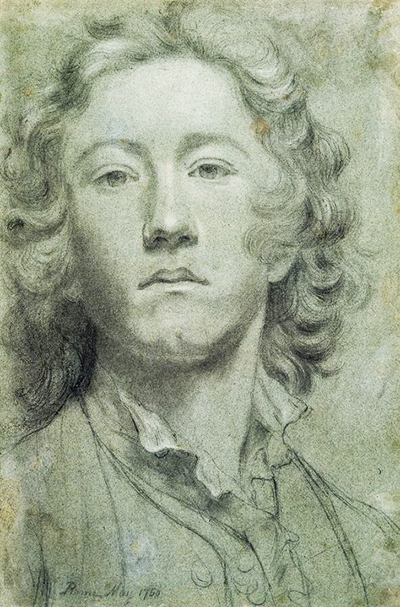
 by Tom Gurney
Tom Gurney BSc (Hons) is an art history expert with over 20 years experience
Published on June 19, 2020 / Page Updated on November 6, 2026
Email: tomgurney1@gmail.com / Phone: +44 7429 011000
Introduction
Sir Joshua Reynolds is remembered above all as a portrait painter, but his drawings and sketchbooks reveal something quieter and more revealing: how he learned, borrowed, remembered and converted visual experience into art. They do not form a public career in the way his portraits do. They are less a parade of finished works than a record of movement, attention and preparation. In them, Reynolds appears not as the grand President of the Royal Academy, but as a young painter looking hard at other artists and gathering material for a lifetime.
This distinction matters because many discussions of Reynolds turn immediately to oil painting, colour, flesh tones, studio practice and the unstable materials that affected the condition of his pictures. Those issues belong to his technique as a painter, but they should not be mistaken for the specific subject of his drawings. Reynolds's graphic work survives chiefly in sketchbooks and individual studies on paper. The best evidence comes from collection records, sketchbook scholarship and archives rather than from treating famous canvases as if they were drawings.
The Paul Mellon Centre's guide to Reynolds makes clear how important sketchbook evidence is within the wider study of the artist. John Hayes began a research project in the early 1970s on Reynolds's sketchbooks; the resulting Hayes Archive contains twenty-seven files, including twenty-two files of photographs and photocopies of the sketchbooks.[1] The Centre also records facsimiles of Reynolds's sitters books and sketchbooks in the Photo Archive, as well as sketchbook material connected with the Royal Academy and private collections.[1] That evidence gives Reynolds's drawings a special status: they are working documents, but they are also central witnesses to his artistic formation.
At a Glance
- Primary evidenceSketchbooks and individual studies on paper [1]
- Italian journey1749–52 [2][3]
- Places recordedRome, Florence, Venice, Milan and Turin [4]
- Key mediaGraphite, black chalk, pen and brown ink [4][6]
- Working formatPortable vellum-bound sketchbooks [4][7]
- British MuseumTwo major Italian sketchbooks [5][6]
- Morgan LibraryRome sketchbook from 1750 [7]
- Separate studyMother-and-child studies in black chalk on blue paper [9]
- Scholarly archiveTwenty-seven Hayes Archive files [1]
- Central purposeObservation, memory, copying and composition
Contents
- Introduction
- Drawing and the Making of Reynolds
- The Italian Sketchbooks
- Rome, Florence and Venice
- Copying Without Merely Copying
- Drawings, Notes and Written Looking
- What Reynolds Drew
- Materials and Graphic Character
- Sitters Books Are Not Drawings
- Archives and Later Scholarship
Drawing and the making of Reynolds
Reynolds trained first as a portrait painter in London, entering Thomas Hudson's studio in 1740, before travelling to Italy in 1749 and returning to London in the early 1750s.[2][3] That chronology explains the role of drawing in his development. Drawing was not an isolated pastime. It was part of a young painter's education: a way to study pose, gesture, composition, drapery, sculpture, architecture and the work of earlier masters.
The most important surviving group is associated with his Italian journey. The Metropolitan Museum of Art describes one Reynolds sketchbook from 1750-52 as a record of paintings, sculpture and architecture encountered in Rome, Florence, Venice, Milan and Turin.[4] It includes graphite, black chalk, pen and brown ink, and its very format suggests mobility: leaves of paper fastened into a vellum binding, ready for use as the artist travelled.[4]
That portable character is essential. Reynolds was not making polished presentation drawings for collectors. He was gathering impressions. A figure, a façade, a compositional scheme, a remembered colour effect or a sculptural pose could be captured quickly enough to remain useful. The sketchbook worked as a portable memory. It allowed the young painter to store material that later informed his portraits, subject pictures and theory.
Reynolds's drawings therefore belong to a career based on absorption. He became famous for giving British portraiture a grander pictorial language, but that language had to be learned. The drawings show the learning before the public result. They reveal the work behind the later ease.
Selected Drawings and Sketchbooks
The Italian sketchbooks
The British Museum holds two important Reynolds Italian sketchbooks. One, museum number 1859,0514.304, is a 1752 sketchbook containing drawings and notes made mainly from paintings and sculpture during the journey from Florence to Venice and in Venice.[5] The British Museum records that Reynolds travelled by way of Bologna, Modena, Parma, Mantua and Ferrara, and visited Padua after Venice.[5] The book is therefore not simply a collection of drawings. It is a travel record, an art notebook and a map of artistic encounter.
The other British Museum sketchbook, 1859,0514.305, contains Old Master studies and notes made at Florence and on the journey from Florence to Rome in 1752.[6] Its materials are black chalk, with pen and brown ink on one folio, again in a vellum binding.[6] The subject matter is telling: Reynolds was looking at older painting, not merely at nature directly. He was training his eye through the work of predecessors.
The Morgan Library & Museum preserves a related Rome sketchbook from 1750. Its record describes a vellum-bound book in graphite on paper, with observations on pictures, sculpture and buildings seen in Rome.[7] The Morgan notes that the first half of the volume is mainly made of written observations on Roman palaces and churches, while the second half contains drawings after paintings and sculpture, along with several landscape sketches.[7] That mixture is crucial. Reynolds did not separate looking, writing and drawing as sharply as later viewers might expect. He thought with all three.
The Met's sketchbook confirms the same pattern on a broader geographical scale. It records art and architecture in Rome, Florence, Venice, Milan and Turin, and the visible contents include both architectural observation and rough figure study.[4] Taken together, these sketchbooks show Reynolds as a traveller who turned every collection, church, palace and sculpture group into a possible lesson.
Rome, Florence and Venice as working schools
The Italian sketchbooks matter partly because they break Reynolds's education into a sequence of different visual environments. Rome gave him antique sculpture, grand church interiors, palaces and the prestige of classical and Renaissance art. The Morgan's Rome sketchbook describes observations on Roman palaces and churches, and then drawings after paintings and sculpture.[7] That combination shows Reynolds learning from buildings as well as figures. He was training himself to think about scale, setting and authority, not just anatomical outline.
Florence sharpened a different kind of attention. The British Museum sketchbook 1859,0514.305 is centred on Florence and the journey between Florence and Rome.[6] Its studies from Old Master paintings suggest Reynolds moving through galleries and churches with a keen eye for drapery, figure arrangement, gesture and memory. Florence offered him a concentrated encounter with earlier art, and the sketchbook allowed him to convert that encounter into portable material.
Venice then opened the problem of colour and painterly effect. A sketchbook cannot reproduce Venetian colour in oil, but it can record arrangement, movement, notes on effect and the names of artists worth remembering. The British Museum's 1859,0514.304 record places Reynolds in Venice and on the journey toward it, with material relating to paintings and sculpture.[5] The importance of Venice for Reynolds cannot be reduced to any single drawing. It lies in the way he carried the memory of Venetian richness back into British portraiture.
These three environments also help explain why Reynolds's later art can feel so densely allusive. Rome, Florence and Venice did not give him one rule. They gave him competing models. He learned from antique gravity, Florentine and Roman design, Venetian colour and Baroque movement. The drawings show the early accumulation of these models before they were smoothed into the polished surface of a finished portrait.
The sketchbooks also make Reynolds's education look active rather than passive. He did not simply visit Italy and receive influence. He selected, copied, compared and judged. The hand moves quickly, but the choices are revealing. A figure is worth noting; a pose may be useful; a building sets a mood; a remembered group may return years later in a British portrait.
This is why the drawings are so valuable for understanding his later confidence. Reynolds's mature portraits often imply that dignity can be constructed through pose, composition and association. The sketchbooks show the young painter collecting the grammar of that construction.
Copying without merely copying
Reynolds's Italian drawings are often drawings after other works. That can sound derivative if misunderstood, but in eighteenth-century artistic education it was central. Copying helped a painter understand composition, proportion, gesture, lighting and expressive economy. Reynolds's later Royal Academy lectures repeatedly insist that students must study great examples and learn general principles rather than rely on accidental facility.[8] The sketchbooks are the practical foundation of that argument.
This does not mean that Reynolds wanted to become an imitator. The British Museum's 1859,0514.304 record includes commentary on the way his Italian experience enriched his store of motifs, ideas and poses, while also deepening his understanding of Old Master principles.[5] That is the right distinction. Reynolds was not merely stockpiling decorative quotations. He was building a mental library.
The drawings also reveal breadth. Reynolds looked at paintings, sculpture, architecture, landscape, costume and figural arrangement. He studied Rome, Florence and Venice not as separate tourist stops, but as different schools of seeing. Rome offered antique authority and compositional gravity. Florence sharpened attention to Old Master design and form. Venice encouraged interest in colour, atmosphere and painterly richness, even though those qualities had to be translated into drawings and notes rather than fully captured in chalk or ink.
This helps explain the strange energy of his mature portraits. Many look effortless, but behind that appearance lies an accumulated vocabulary of poses and effects. A sitter could be made to stand, turn, gesture or occupy space in ways that carried echoes of earlier art. Drawing was one of the means by which Reynolds internalised those possibilities.
Drawings, notes and written looking
One of the most interesting things about Reynolds's sketchbooks is that they are not purely visual. They contain drawings, notes, observations and reminders. The British Museum and Morgan records both stress this mixture.[5][6][7] For Reynolds, writing and drawing seem to have worked together as instruments of attention.
This makes the sketchbooks unusually revealing. A finished portrait tells us what Reynolds wanted a public viewer to see. A sketchbook shows what Reynolds wanted himself to remember. The difference is profound. In the sketchbooks, he is not staging a sitter for society; he is collecting relationships between form, movement, tone and artistic precedent.
The written element also guards against a common misunderstanding. Reynolds was not only making visual copies. He was judging. He recorded impressions of works and places, compared artists, noted effects and considered how old art achieved its authority. His mature voice in the Discourses did not appear from nowhere. It grew from years of looking that were both practical and reflective.
A sketchbook is therefore both image store and thought record. It catches Reynolds between direct observation and later doctrine. The young traveller studying in Italy and the older Academy President lecturing in London are connected by this habit of written looking.
What Reynolds drew
Reynolds drew from paintings, sculpture and architecture. He drew figure groups, individual bodies, gestures, drapery, children, mothers, landscape elements and compositional arrangements. The surviving records do not support a simple list of "great Reynolds drawings" equivalent to a list of famous paintings. Instead, they suggest a working practice spread across bound sketchbooks and separate sheets.
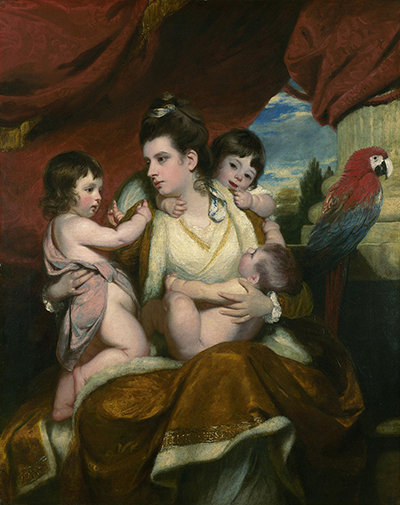
The British Museum's drawing 1911,0517.23 gives a useful example. It consists of three studies of a child supported by his mother, made in black chalk on blue paper.[9] The Museum's curator notes that the coarse graphic style is closely related to Reynolds's Italian sketchbooks and that the studies were probably copied from earlier pictorial sources rather than made from life.[9] The same note suggests that Reynolds may have recalled this kind of aide-memoire in later mother-and-child paintings.[9]
That record is valuable because it shows how cautious we need to be. A drawing of mother and child does not automatically prove a direct life study for a particular later portrait. It may instead be a remembered source, a compositional resource or a fragment of pictorial vocabulary. Reynolds's drawings are often most useful when read as working memory rather than as straightforward preparatory evidence.
The British Museum's 1859,0514.305 record gives an even more specific connection between drawing and painting. It notes that David Mannings's catalogue of Reynolds's paintings refers to the sketchbook in relation to the portrait of Robert Orme, and that Homan Potterton believed the horse in the painted portrait derived from a drawing in the sketchbook.[6][10] This is exactly the kind of link that should be made carefully: not a blanket claim that every painting has a surviving preparatory study, but a specific case where catalogue and collection evidence connect a graphic note to a later painted solution.
Materials and graphic character
The surviving records also remind us how simple many of Reynolds's drawing materials were. The Met sketchbook is recorded as graphite, black chalk, pen and brown ink.[4] The Morgan's Rome sketchbook is graphite on paper.[7] The British Museum's 1859,0514.305 sketchbook is mainly black chalk, with pen and brown ink on one folio.[6] The separate mother-and-child studies are black chalk on blue paper.[9] This is a modest graphic world compared with the complex layers of his oil paintings.
That modesty matters. Reynolds's drawings were not trying to do the same work as his paintings. Chalk, graphite and ink could seize relation, not finish. They could capture the angle of a horse's head, the fall of drapery, the structure of a group or the silhouette of a figure. They could preserve what was needed before memory dissolved it.
The British Museum's mother-and-child sheet is especially useful because the curator describes its graphic manner as coarse and related to Reynolds's Italian sketchbooks.[9] That description suggests a working hand rather than a polished display manner. The drawing is valuable not because it is refined, but because it reveals the artist keeping a useful visual idea alive.
Blue paper, black chalk, graphite and brown ink also invite a different kind of looking from oil paint. They bring us close to selection. What did Reynolds need to capture? What could be left out? A sketch can be revealing precisely because it is incomplete. It shows the point at which the artist's attention fastened onto a pose, a rhythm or a relation between figures.
The physical scale of the sketchbooks reinforces this intimacy. The Met records the binding of its Italian sketchbook as under eight inches high, with individual leaves a little smaller.[4] The Morgan's Rome sketchbook is similarly portable.[7] These are not grand studio objects. They are hand-sized tools for movement. Their smallness is part of their meaning.
This helps correct another common distortion. Reynolds's art is often approached through large portraits and institutional ambition, but his drawings remind us that ambitious art can begin with small acts of notation. Before a sitter becomes grand, an artist has to notice how a body turns, how a group holds together, how a remembered figure might be repurposed.
Sitters books are not drawings
The Paul Mellon Centre also mentions facsimiles of Reynolds's sitters books from 1757-90.[1] These are vital for understanding his practice, but they are not drawings. They belong to the documentary record of appointments, sittings and studio organisation. Sketchbooks and drawings show visual thought; sitters books show the rhythm of professional encounter.
The distinction is important because Reynolds's career can otherwise become blurred into one general mass of "studio evidence." His drawings tell us how he studied art and remembered form. His sitters books tell us who came to the studio and when. His paintings show the public result. All three matter, but they answer different questions.
A sitter's appointment does not prove the existence of a drawing, and a drawing does not always prove a sitter's presence. Reynolds's studio was too busy, too collaborative and too socially complex for that kind of simple equivalence. He could develop a painting from inherited pose, memory, copy, earlier sketch, direct observation and studio adjustment at once.
This is one reason the drawings are so fascinating. They do not give us an easy backstage pass to every portrait. They give us something subtler: evidence of how Reynolds assembled an artistic mind. The sketchbooks show him taking possession of earlier art so that it could later reappear, transformed, in Georgian portraiture.
Archives and later scholarship
Reynolds's drawings also matter because they have produced their own scholarly history. The Paul Mellon Centre's account of the Hayes Archive is unusually revealing: Hayes worked on Reynolds's various sketchbooks in the early 1970s, and his unpublished project left behind twenty-seven files, including extensive photographic and photocopy material.[1] That body of work tells us that the sketchbooks have long demanded specialised attention.
The reason is easy to understand. Sketchbooks are difficult evidence. They combine drawing and writing, travel and memory, observation and later usefulness. They may not be arranged in a way that satisfies modern expectations. A single bound book can move between copied art, quick notes, places visited, reminders and compositional fragments. It requires patient reconstruction.
The Paul Mellon Centre's mention of sketchbook facsimiles from the Royal Academy and private collections also shows that the evidence is dispersed.[1] Reynolds's drawings are not held in one simple group. They survive across institutions and collections, with related research photographs, facsimiles and cataloguing traditions helping scholars see them together.
That dispersal changes the public image of Reynolds. The famous painter appears unified because the portraits are familiar and the Academy presidency gives the life a clear shape. The drawings resist that neatness. They are scattered, provisional and sometimes difficult to connect directly to later works. They keep the artist in motion.
Mannings's catalogue is still important in this world, but in a particular way. It helps organise the paintings and can illuminate moments where a drawing relates to a painted work, as in the Robert Orme example noted by the British Museum.[6][10] It should not be treated as a substitute for drawing records. The strongest account of Reynolds's drawings comes from letting each kind of evidence do its own job.
Drawing and the Grand Manner
Reynolds's drawings help explain his Grand Manner. That term is often used for his elevation of portraiture through antique pose, Old Master memory, history-painting scale and idealising rhetoric. The drawings show one of the ways he acquired that elevated language. He saw, copied, noted and adapted.
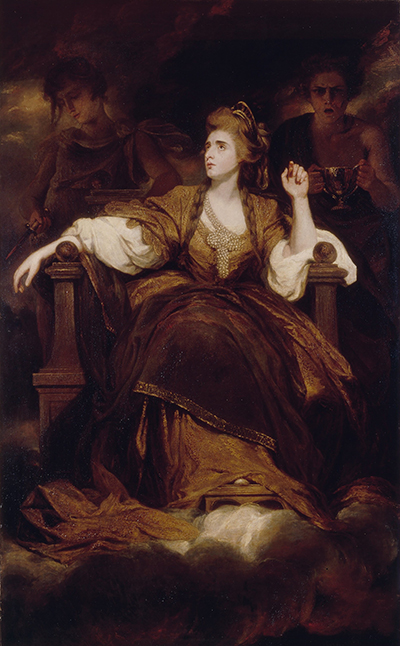
This matters because the Grand Manner was not simply a theatrical costume placed over a sitter. It depended on stored knowledge. A standing officer, a tragic actress, a child, a mother or an aristocratic woman could be shaped by memories of older art. Reynolds's sketchbooks made such memory portable and practical.
The British Museum's Italian sketchbook records are especially important here because they show Reynolds encountering a wide range of Italian sources rather than obeying one narrow academic line.[5][6] The Morgan's Rome sketchbook similarly combines observations on architecture, sculpture and painting with drawings after art and landscape sketches.[7] Reynolds's mature style grew from this range.
The drawings also reveal that the Grand Manner was not only about finished grandeur. It began in fragments. A head, a hand, a gesture, a group, a standing figure, a horse, a mother and child: any of these could become part of a later pictorial solution. The sketchbooks preserve the small units out of which large public effects could be made.
Drawings and paintings
Reynolds's drawings should not be isolated from his paintings, but neither should they be swallowed by them. His fame rests on oil portraits and subject pictures. Mannings and Postle's catalogue raisonné remains essential for that painted oeuvre.[10] Yet a catalogue of paintings cannot by itself replace the evidence of drawings collections and sketchbook scholarship.
The relationship between drawings and paintings is best understood as one of pressure and memory. A drawing might preserve a remembered pose from Raphael, a sculptural arrangement from Florence, a Venetian figure, an architectural impression or a mother-and-child group. Later, that material might return in a portrait or subject picture, but often changed enough that direct proof becomes difficult.
This is why the British Museum's Robert Orme connection is so useful. It shows a possible path from sketchbook observation to painted composition, while still requiring attributional caution.[6][10] It also demonstrates how Reynolds's study of older art could enter portraiture in practical ways. A horse observed from an earlier source could help shape the visual authority of a military sitter.
At the same time, not every drawing needs to be justified by a later painting. Some drawings matter because they show Reynolds learning. Others matter because they preserve the texture of travel. Others reveal what caught his eye before he knew how a motif might be used. The sketchbooks are not merely servant documents to the paintings. They are evidence of artistic appetite.
Why the drawings matter
Reynolds's drawings matter because they make his ambition visible at an early and intimate scale. The later Reynolds could appear grand, official and polished: knighted, Academy President, portraitist of the elite, lecturer on high art. The sketchbooks show a different figure: mobile, hungry, observant, copying, judging and storing.
They also correct the idea that Reynolds's art was only social performance. His portraits certainly depended on patrons, conversation and metropolitan reputation, but the drawings reveal another foundation: sustained study. He did not merely flatter sitters into elegance. He built a repertoire from earlier art and then adapted it to British portraiture.
The drawings also explain why Reynolds's theory and practice are so closely bound together. When he later told students to study great examples, he was not offering empty institutional advice. He was describing a method he had used. His Italian sketchbooks show that method before it became doctrine.
Finally, the drawings help us see Reynolds without reducing him to either triumph or fault. They do not erase the later problems of technique, conservation or social hierarchy. Nor do they replace the achievement of the paintings. They make the career more human and more intelligible. In these small sheets and bound books, Reynolds's greatness begins as attention: a pencil, chalk or pen moving across paper while the artist teaches himself how to see.
Frequently Asked Questions
Discussion
What do Reynolds’s sketchbooks reveal that his finished portraits cannot?
Reader Insights
Which kinds of line or note seem designed to preserve an idea for later use?
Where does copying an earlier work become an act of selection and interpretation?
How might a pose, group or architectural impression return inside a finished portrait?
Join the Conversation
Share your reading below.
References
- Paul Mellon Centre, “Joshua Reynolds (1723-1792)”, https://www.paul-mellon-centre.ac.uk/archives-and-library/artist-subject-guides/joshua-reynolds
- National Gallery, London, “Sir Joshua Reynolds 1723-1792”, https://www.nationalgallery.org.uk/artists/sir-joshua-reynolds
- National Galleries of Scotland, “Sir Joshua Reynolds”, https://www.nationalgalleries.org/art-and-artists/artists/sir-joshua-reynolds
- Metropolitan Museum of Art, “Sketchbook, Italy”, 18.121(1-182), https://www.metmuseum.org/art/collection/search/355616
- British Museum, “drawing; sketch-book”, 1859,0514.304, https://www.britishmuseum.org/collection/object/P_1859-0514-304
- British Museum, “drawing; sketch-book”, 1859,0514.305, https://www.britishmuseum.org/collection/object/P_1859-0514-305
- Morgan Library & Museum, “Sketchbook, Rome”, 1996.140, https://www.themorgan.org/drawings/item/123231
- Sir Joshua Reynolds, Fifteen Discourses Delivered in the Royal Academy, Project Gutenberg edition, https://www.gutenberg.org/files/52436/52436-h/52436-h.htm
- British Museum, “drawing”, 1911,0517.23, https://www.britishmuseum.org/collection/object/P_1911-0517-23
- David Mannings, Sir Joshua Reynolds: A Complete Catalogue of His Paintings, with subject pictures catalogued by Martin Postle, Yale University Press / Paul Mellon Centre for Studies in British Art, 2000.