 by Tom Gurney
Tom Gurney BSc (Hons) is an art history expert with over 20 years experience
Published on June 19, 2020 / Page Updated on November 6, 2026
Email: tomgurney1@gmail.com / Phone: +44 7429 011000
Introduction
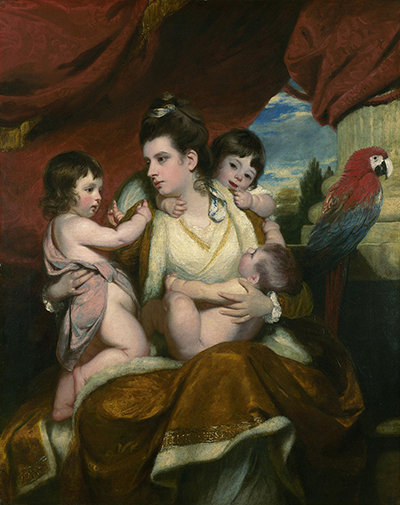
Sir Joshua Reynolds's Lady Cockburn and her Three Eldest Sons is one of his most persuasive family portraits because it turns domestic life into grand allegory without draining it of movement or human warmth. The National Gallery, London identifies the painting as an oil on canvas of 1773, measuring 141.5 by 113 centimetres, with the inventory number NG2077.[1] It shows Augusta Anne, Lady Cockburn, with her three young sons, but Reynolds does more than record a mother and children. He transforms a fashionable portrait commission into an image of Charity, one of the great virtues of Christian and classical moral culture.
The painting matters because it shows Reynolds's Grand Manner at work in a deliberately modern setting. Lady Cockburn is a living eighteenth-century woman, her hair dressed in contemporary fashion, yet she is arranged with the weight of an inherited pictorial type.[1] The children are lively, tactile and almost unruly; the composition is learned, balanced and full of art-historical memory. Reynolds is asking portraiture to do two things at once: preserve likeness and family feeling, while lifting the sitter into a language of virtue.
That dual ambition makes the picture far richer than a pleasing family group. It is a portrait of maternity, but also a demonstration of Reynolds's belief that modern sitters could be dignified by older forms. Van Dyck, Velázquez, print culture, Royal Academy display and Reynolds's own fragile technique all belong to the work's meaning. The painting is bright, affectionate and spectacular, but its brightness rests on a serious argument about how portraiture could become elevated art.
At a Glance
- Current titleLady Cockburn and her Three Eldest Sons [1]
- ArtistSir Joshua Reynolds
- Date1773 [1]
- MediumOil on canvas [1]
- Dimensions141.5 × 113 cm [1]
- InventoryNG2077 [1]
- Current holderNational Gallery, London [1]
- Principal sitterAugusta Anne, Lady Cockburn [1]
- ChildrenJames, George and William Cockburn [1]
- AcquisitionBequeathed by Alfred Beit, 1906 [1]
Contents
- Introduction
- The National Gallery painting
- Portrait and virtue
- Van Dyck and Charity
- Velázquez and the child on the lap
- The macaw
- The Grand Manner at home
- Royal Academy reception in 1774
- Technique and condition
- Why the painting still works
The National Gallery painting
The current object record gives the title as Lady Cockburn and her Three Eldest Sons, by Sir Joshua Reynolds, dated 1773.[1] It is in the National Gallery's Main Collection and is recorded in Room 34. The work was bequeathed by Alfred Beit in 1906, and the Gallery describes its frame as an eighteenth-century English frame, original to the picture.[1] These details are important because the painting has a long history of family descent, contested ownership and public collection before its present identity became stable.
The sitter is Augusta Anne, Lady Cockburn, born in 1749 and dying in 1837.[1] She was the second wife of Sir James Cockburn, 8th Baronet of Langton, who commissioned the portrait.[1] The three sons are James, George and William Cockburn. The National Gallery identifies James, born in 1771, as the child kneeling on Lady Cockburn's lap; George, born in 1772, as the boy leaning over her shoulder; and William, born in 1773, as the baby held in a nursing position.[1] The National Portrait Gallery's later print record also identifies the sitters as Augusta Anne, Lady Cockburn, Sir James Cockburn, Sir George Cockburn and Sir William Cockburn.[6]
The painting is signed and dated. The National Gallery records the inscription J REYNOLDS:PINX in gold in the lower centre, above the fur-trimmed edge of Lady Cockburn's mantle, with 1773 in gold at the lower left.[1] That matters because older discussions sometimes confuse the date through later engraved versions and through traditions attached to Reynolds's signatures. The secure current identification is the National Gallery's 1773 painting.
Portrait and virtue
At first glance, the image seems simply to celebrate motherhood. Lady Cockburn sits with three infant boys clustered around her, each child given a distinct energy. James kneels against her lap and points upward; George leans over her shoulder and meets the viewer; William rests in her arms. The scene is full of touch: arms, hands, cloth and bodies interlock in a carefully controlled tangle.
Yet the National Gallery stresses that the painting combines individual portraiture with the personification of Charity.[1] Charity, in this context, does not mean casual generosity alone. It is one of the theological virtues, a moral and spiritual ideal often represented through a mother caring for children.[2] Reynolds therefore uses maternal action as a visual bridge between family identity and virtue. Lady Cockburn is a named aristocratic sitter, but she is also made to stand for a larger moral image.
This is the cleverness of the composition. The children are not still symbols arranged around a motionless emblem. They are active bodies, pulling, leaning, pointing and being held. Their energy makes Charity seem lived rather than merely declared. Lady Cockburn's calm is not emptiness; it is the poise required to hold the group together. Reynolds turns maternal care into composition itself.
That is why the picture avoids becoming a cold allegory. The viewer can read it as a portrait of a particular family or as a modern version of a traditional virtue. The two readings do not cancel each other. They strengthen each other. The moral form gives the family group grandeur, while the family group gives the moral form warmth.
Van Dyck and Charity
The National Gallery identifies Van Dyck's Charity of about 1627-8 as the main compositional model behind Reynolds's picture.[1][2] Van Dyck's work also shows a woman with three children and belongs to a long tradition in which Charity was represented as maternal care. In Van Dyck, the allegorical figure looks upward, linked to heaven as the source of her strength.[2] Reynolds adapts that structure but changes its social and emotional emphasis.
Lady Cockburn is not shown as celestial Charity detached from the world. She is dressed as an eighteenth-century woman, with fashionable hair, expensive drapery and a clearly legible family identity.[1] Instead of gazing upward, she looks toward James, the child on her lap. The movement of attention is therefore humanised. Charity is no longer only a heavenly virtue descending into the world; it is also enacted through the attentive relation between a mother and her children.
Reynolds's borrowing is not passive. The National Gallery says he adopted and adapted elements from Van Dyck and other sources, rather than simply copying.[1] That distinction is crucial for understanding his art. Reynolds believed that invention could involve selecting, transforming and recombining forms from admired predecessors. The originality lies in the act of translation: a devotional allegory becomes an aristocratic family portrait, and a portrait commission becomes a modern moral image.
Van Dyck's example also brought prestige. Reynolds admired the old masters not as museum furniture, but as living resources for modern painting. By invoking Van Dyck, he gave Lady Cockburn's portrait a lineage within European art. The sitter is not just placed before the viewer; she is placed inside a history of forms through which maternal care had already been given dignity.
Velázquez and the child on the lap
The National Gallery also notes a more specific borrowing from Velázquez. James, the child kneeling on Lady Cockburn's lap, is described as an almost direct copy of Cupid in Velázquez's The Toilet of Venus, often called The Rokeby Venus.[1][3] This is one of the most revealing details in the painting because it shows Reynolds working from fragments, not only from whole compositions.
Reynolds could not have known Velázquez's original canvas directly in London. The National Gallery explains that the painting was in Madrid and had not been engraved; Reynolds seems to have known the figure through a pencil drawing by the engraver Richard Cooper.[1] That chain of transmission matters. A Spanish mythological painting, mediated through a drawing, becomes a child's pose in a British family portrait. Reynolds's imagination was fed by copies, sketches, prints and memory.
The borrowed Cupid is transformed by context. In Velázquez, Cupid belongs to a scene of Venus, beauty and erotic looking.[3] In Reynolds, the adapted figure becomes James Cockburn, a lively child within a maternal allegory. The pose carries old-master grace into a new emotional register. What was once part of a mythological image becomes part of a family structure organised around care.
This transformation reveals the discipline behind Reynolds's apparent ease. The child looks natural, but the naturalness has been built out of art. Reynolds is not asking the viewer to spot a borrowed motif as a game of connoisseurship alone. He is showing how high pictorial memory can make a modern portrait feel inevitable.
The macaw
One of the most memorable details is the brightly coloured macaw at the right. The National Gallery says it was painted from life and was probably Reynolds's own bird.[1] The record also preserves a lively tradition: the bird was disliked by Reynolds's housemaid but reportedly tame enough to perch on Dr Johnson's wrist.[1] Even if the anecdotal colour should be handled carefully, the bird's pictorial role is unmistakable.
The macaw adds brilliance, surprise and a note of worldly possession. Its red and blue plumage sharpens the palette and interrupts the soft flesh, warm drapery and maternal grouping. It also keeps the painting from becoming too solemn. Charity may be a virtue, but Reynolds gives the virtue a household creature with theatrical colour and alert life.
The bird also complicates the meaning of the image. It is exotic, decorative and slightly comic, an emblem of display as well as companionship. In a portrait about children and family affection, the macaw introduces another living presence that does not quite obey the moral scheme. It is a splash of Reynoldsian wit: an old-master allegory made modern by a creature that seems both luxurious and mischievous.
At the same time, the macaw helps organise the composition. Its colour holds the right edge and counters the weight of the children. Without it, the arrangement might feel more enclosed around Lady Cockburn's body. With it, the image opens outward into display, collecting, domestic eccentricity and the cultured world around the commission.
The macaw also signals Reynolds's confidence with tonal theatre. It could easily have become a distracting novelty, but he uses it as a controlled accent. The bird's vividness makes the surrounding flesh and drapery look warmer, while its alert posture gives the far side of the canvas a living pulse. In this sense, the detail is not simply charming. It is part of the painting's structure, a small burst of spectacle that helps the allegory remain sensuous and modern.
The Grand Manner at home
Reynolds's Grand Manner is often associated with heroic pose, antique drapery and the ambition to raise portraiture toward history painting. Lady Cockburn and her Three Eldest Sons shows how that ambition could enter the domestic sphere. The painting is not a battle scene, a mythological subject or a public monument. It is a mother with children. Yet Reynolds gives the group a structure borrowed from virtue, old-master composition and classical dignity.
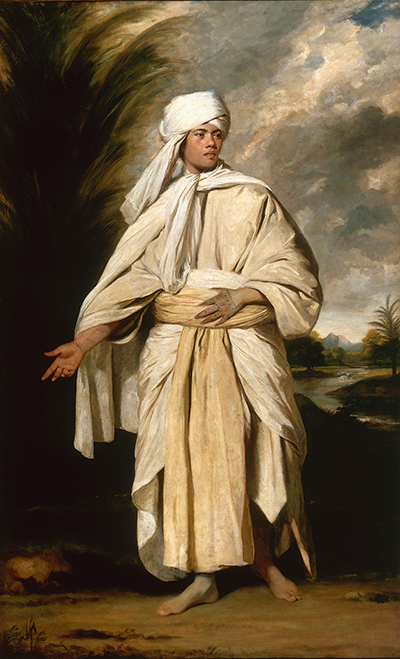
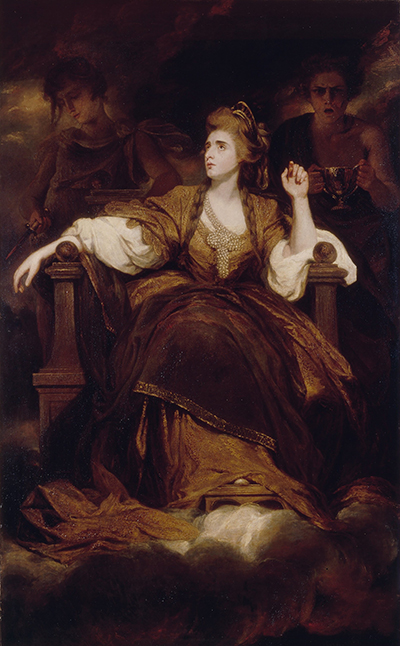
This is a different kind of grandeur from the severe authority of Portrait of Mai (Omai) or the enthroned theatre of Sarah Siddons as the Tragic Muse. In the Cockburn portrait, grandeur is softened by infancy. The bodies are small, restless and dependent. The maternal figure becomes noble not by commanding soldiers or ruling a realm, but by absorbing the movement of children into a harmonious whole.
The painting therefore reveals a flexible side of Reynolds's theory. The National Gallery's artist record presents him as the leading English portraitist of his day and first President of the Royal Academy, a painter deeply invested in raising portraiture beyond plain resemblance.[7] That ambition did not always need a public hero. It could be made from family affection, provided that the affection was shaped by inherited art. Lady Cockburn's modern dress and hair preserve likeness; the mantle, pose and allegorical structure lend dignity. Reynolds's achievement lies in keeping those elements in tension rather than letting one erase the other.
The result is intimate and formal at the same time. The children may appear spontaneous, but their placement is exact. Lady Cockburn may be a mother in action, but she also carries the composure of an allegorical figure. Reynolds creates a domestic image that behaves like a major painting.
That balance also explains why the portrait is so useful for understanding Reynolds's wider career. It belongs to the same intellectual world as his Discourses, but it is not dry theory converted into paint. It is agile, social and visually generous. Reynolds knew that a portrait had to please the family that commissioned it, but he also knew that an Academy picture needed scale, memory and learned resonance. Lady Cockburn and her Three Eldest Sons satisfies both demands.
The old-master borrowings should therefore be understood as productive pressure rather than as academic decoration. Van Dyck supplies the broad moral architecture; Velázquez supplies a pose transformed through another medium; Reynolds supplies the modern family, the colour, the bird and the theatrical unity. The painting is not a collage of quotations. It is a living synthesis, and that synthesis is precisely what Reynolds wanted elevated portraiture to achieve.
Royal Academy reception in 1774
The painting was exhibited at the Royal Academy in 1774, a year when the Academy was still young and still under pressure to prove that Britain could sustain a serious national school of art. Matthew Hargraves's account of the 1774 exhibition notes that it ran from 25 April to 30 May and drew 23,164 visitors.[4] He also describes a critical climate anxious about history painting and about whether British art could meet the elevated ambitions attached to the monarch's Academy.[4]
That context helps explain why Reynolds's picture mattered. It was technically a portrait commission, but it carried the intellectual ambition of history painting. By adapting Charity, Van Dyck and Velázquez, Reynolds could present a family portrait as something more than likeness. In a culture hungry for a British art of dignity, this kind of portrait-allegory answered a need.
The National Gallery records a striking report from the work's arrival for the 1774 exhibition: painters present were said to have responded with sudden applause because of its splendour and excellence.[1] Such anecdotes should not be inflated into proof of unanimous opinion, but they do preserve a sense of the painting's immediate impact. It was seen as a work that displayed Reynolds's power to make portraiture impressive, learned and emotionally attractive.
The Academy setting also changed the viewer. A private family commission became a public example. Visitors did not see only Lady Cockburn and her sons; they saw what Reynolds believed British portraiture could become. The image advertised family continuity, maternal virtue and pictorial learning all at once.
This public setting is one reason the painting's sweetness should not be underestimated. Reynolds was not merely offering a charming mother-and-child scene to people who already knew the family. He was making a claim in an exhibition culture where portraiture had to defend its seriousness against higher-ranked genres. The picture's affection is therefore strategic as well as genuine. It proves that a modern family portrait could carry the dignity, compositional learning and moral resonance expected of more elevated forms.
Its charm works because it carries ambition quietly rather than announcing it loudly.
Family fortune and public image
The National Gallery notes that the commission came when the family was financially prosperous, but that by 1781 Sir James Cockburn had been declared bankrupt and Lady Cockburn was later granted a private pension by the king.[1] The painting therefore captures the family at a moment of confidence that history would not entirely preserve. Its splendour now carries an unintended poignancy.
This does not mean the portrait should be read cynically. Reynolds was not painting future collapse. He was painting an ideal of family, status and virtue as it could be imagined in 1773. Yet the later reversal reminds modern viewers that portraits can freeze confidence at a moment when it is still vulnerable. The children who seem to secure lineage are held inside a composition that outlived the family's prosperity.
The painting's later titles also shaped its public image. In 1791, the National Gallery notes, the work was engraved as Cornelia and her Children, invoking the Roman matron who called her children her jewels.[1] That title shifted the image from Christian Charity toward classical maternal virtue. It allowed the sitter's maternity to be read through antiquity, turning a British aristocratic mother into a modern Cornelia.
The National Portrait Gallery holds a later mezzotint, also titled Cornelia and her Children, by Samuel William Reynolds after Sir Joshua Reynolds, dated 1820 or after.[6] That later print confirms the continued life of the image beyond the original painting. It also shows how reproductive culture could detach a family portrait from its first commission and carry it forward as a more general emblem of maternity.
The print history is worth separating from the painting's object facts. The National Gallery oil is dated 1773, signed and held in London as NG2077.[1] The later Cornelia identity belongs to reception and reproduction. It tells us how viewers and publishers wanted to frame the image after the fact: less as a private portrait of Lady Cockburn and more as a public lesson in maternal value. That shift helps explain why the work remained legible even when the Cockburn family story was no longer familiar.
It also shows the strength of Reynolds's original design. A weak family portrait would not easily survive a change of title. This one could become Cornelia and her Children because the allegorical structure was already there. The children already functioned as living treasures; the mother already carried the weight of virtue; the composition already invited a moral reading beyond the names of the sitters.
Technique and condition
The National Gallery object record includes an important condition note: much of the lighter paint has wrinkled, especially in Lady Cockburn's costume, her left hand and the flesh of the eldest and youngest children.[1] This should not be treated as a marginal detail. Reynolds's technique is part of how his paintings look now, and in many cases part of the distance between his original ambition and the present surface.
The National Gallery Technical Bulletin essay by Alexandra Gent, Ashok Roy and Rachel Morrison explains that Reynolds's works were known in his own day as fragile and vulnerable to change, and that his flesh paints had a notorious tendency to fade.[5] The essay places these problems within a wider pattern of complex materials, experimental methods and unpredictable conservation needs.[5] Lady Cockburn and her Three Eldest Sons therefore belongs to a broader Reynolds problem: brilliant invention joined to technical risk.
That risk matters aesthetically. The painting is about vitality, colour and living bodies, yet its surface bears evidence of material instability. The wrinkling of lighter passages does not destroy the image, but it reminds us that Reynolds's pursuit of effect often depended on methods that aged unevenly. The warmth of the family group now exists alongside visible history in the paint itself.
This also helps modern viewers resist a too-polished idea of the Grand Manner. Reynolds wanted elevation, but elevation was not mechanically smooth. It was constructed through experiment, mixture, adaptation and sometimes technical hazard. The work's present condition is not separate from its history; it is one of the ways that history remains visible.
Why the painting still works
The painting still works because it holds together competing energies. The children are active, the mother is composed, the macaw is vivid, and the borrowed old-master structure keeps the whole image from scattering. Reynolds turns motion into order without making the figures stiff. The viewer feels both the liveliness of a household and the authority of an allegory.
The picture also succeeds because it never asks us to choose entirely between portrait and symbol. Lady Cockburn is Augusta Anne Cockburn; she is also Charity. James, George and William are named children; they also become the living proof of maternal virtue. The macaw is probably a real studio bird; it is also a brilliant pictorial accent. Reynolds's art depends on these double identities.
Mannings and Postle's catalogue raisonné remains the essential backbone for Reynolds's painted oeuvre, especially for object identity, versions and the larger structure of his production.[8] For current object facts, however, the National Gallery record must control the details: title, date, medium, dimensions, inventory number, holder, display record and acquisition.[1] Holding those levels together keeps the painting from dissolving into attractive anecdote.
The result is one of Reynolds's most approachable major works, but also one of his most intellectually revealing. It shows him borrowing without merely copying, idealising without freezing, and celebrating family without abandoning artistic ambition. Lady Cockburn and her Three Eldest Sons is a portrait of a mother and children, but it is also a lesson in how Reynolds made modern British life speak in the language of inherited art.
Its charm should not make it seem simple. The painting's ease is produced by a great deal of pictorial intelligence: a devotional model revised for aristocratic portraiture, a mythological child repurposed as a modern son, a brilliant bird used to enliven the edge, and an Academy audience invited to see family affection as serious art. Reynolds's best portraits often work in this way. They flatter the sitter, but they also make the sitter carry an idea. Here the idea is that maternity, lineage and care can be imagined with the grandeur usually reserved for heroes and sacred figures.
Frequently Asked Questions
Discussion
How does Reynolds make a modern family portrait behave like an inherited allegory of Charity?
Reader Insights
How do the children's movements animate the group without breaking its compositional unity?
Where do Van Dyck and Velázquez remain visible, and where has Reynolds transformed them?
Does the bird reinforce the painting's grandeur, interrupt it, or make it distinctly modern?
Join the Conversation
Share your reading below.
References
- National Gallery, London, Sir Joshua Reynolds, Lady Cockburn and her Three Eldest Sons, NG2077, https://www.nationalgallery.org.uk/paintings/sir-joshua-reynolds-lady-cockburn-and-her-three-eldest-sons
- National Gallery, London, Anthony van Dyck, Charity, NG6494, https://www.nationalgallery.org.uk/paintings/anthony-van-dyck-charity
- National Gallery, London, Diego Velázquez, The Toilet of Venus ('The Rokeby Venus'), NG2057, https://www.nationalgallery.org.uk/paintings/diego-velazquez-the-toilet-of-venus-the-rokeby-venus
- Matthew Hargraves, “1774: Sculpture and Britishness,” The Royal Academy Summer Exhibition: A Chronicle, 1769-2018, Paul Mellon Centre / Royal Academy of Arts, https://chronicle250.com/1774
- Alexandra Gent, Ashok Roy and Rachel Morrison, “Practice Makes Imperfect: Reynolds's Painting Technique,” National Gallery Technical Bulletin, vol. 35, 2014, https://www.nationalgallery.org.uk/technical-bulletin/vol-35-essay-2-2014
- National Portrait Gallery, Samuel William Reynolds after Sir Joshua Reynolds, Cornelia and her Children, NPG D1483, https://www.npg.org.uk/collections/search/portrait/mw35617/Cornelia-and-her-Children
- National Gallery, London, “Sir Joshua Reynolds 1723-1792”, https://www.nationalgallery.org.uk/artists/sir-joshua-reynolds
- David Mannings, Sir Joshua Reynolds: A Complete Catalogue of His Paintings, with subject pictures catalogued by Martin Postle, Yale University Press / Paul Mellon Centre for Studies in British Art, 2000.