 by Tom Gurney
Tom Gurney BSc (Hons) is an art history expert with over 20 years experience
Published on June 19, 2020 / Page Updated on November 6, 2026
Email: tomgurney1@gmail.com / Phone: +44 7429 011000
Introduction
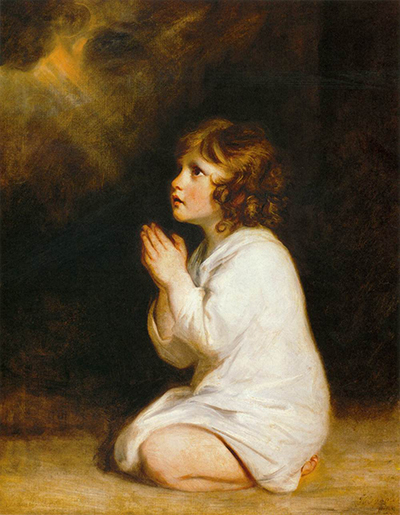
The Infant Samuel is one of Joshua Reynolds’s most familiar religious child subjects, but it is also one of the works that needs careful version control. The familiar English title usually refers to a boy kneeling in prayer, illuminated by a supernatural light and connected with the calling of Samuel in the Old Testament. The version most relevant here is the Musée Fabre painting in Montpellier, where Reynolds’s work is catalogued under the French title Le Petit Samuel en prière. The museum dates it to 1777, identifies it as oil on canvas, records the inventory number 836.4.50, and notes that it entered the museum through the Antoine Valedau bequest of 1836.[1]
The painting has often been described in English-language captions as a 1776 work measuring 89 x 70 cm, now at the Musée Fabre. That shorthand is useful as a starting cue, but it is not enough. The Musée Fabre’s current entry gives 1777 and provides its own dimensional fields, while its extended account explains that the Montpellier painting repeats a similar composition exhibited at the Royal Academy in 1776 and now lost.[1][2] Tate also has a related Infant Samuel, N00162, dated 1776, and the National Trust notes that Reynolds made both The Infant Samuel and The Calling of Samuel compositions in multiple versions.[3][4] The subject is simple; the object history is not.
This complexity is part of the painting’s interest. Reynolds did not treat Samuel as a grand biblical hero shown in maturity. He imagined him as a child, vulnerable and receptive, caught at the moment when divine speech enters ordinary darkness. The result stands between religious painting, fancy picture and psychological child study. It shows Reynolds drawing on Rembrandt, Greuze and Van Dyck, but also adapting those models to his own English world of childhood, feeling and carefully staged inwardness.
At a Glance
- English titleThe Infant Samuel
- Museum titleLe Petit Samuel en prière [1]
- ArtistJoshua Reynolds
- Date1777 [1]
- MediumOil on canvas [1]
- Inventory836.4.50 [1]
- Current holderMusée Fabre, Montpellier [1]
- AcquisitionAntoine Valedau bequest, 1836 [1]
- SubjectSamuel called by God as a child, 1 Samuel 3
- Version noteRepetition related to a lost 1776 Royal Academy composition [2]
Contents
- Introduction
- The Musée Fabre painting
- Samuel’s calling
- A religious subject close to fancy pictures
- Rembrandt, Greuze and Van Dyck
- Versions, variants and lost works
- Light and domestic spirituality
- Reception and reproduction
- Why the painting still matters
The Musée Fabre painting
The Musée Fabre painting shows the young Samuel kneeling in prayer, dressed in a pale night garment and turned upward toward a source of light. The image depends on a strong contrast between the child’s exposed body, the warm darkness around him and the radiance that gives the scene its sacred meaning. The Fabre account stresses that the inscription on the canvas, “Samuel, chap. 3,” identifies the Old Testament source: God calls Samuel while he is still a child in the temple.[2]
The current Fabre entry identifies the picture as Le Petit Samuel en prière, by Sir Joshua Reynolds, and places it in the museum’s collection as inv. 836.4.50.[1] It also records the Valedau bequest, which is significant because the painting became part of a French collection through a collector who also owned major works by French artists. The extended Fabre resource says the painting probably reached France in 1778, only a year after its execution, and was likely in François Michel Harenc de Presle’s collection by 1787.[2]
That early French history gives the work a special position. The Fabre account describes it as one of the first English paintings to enter a French collection, and the museum entry calls it probably the earliest example of English painting to enter a French public collection.[1][2] This is not merely a matter of ownership. Reynolds’s picture crossed the Channel as an object that could sit beside French child imagery and old-master painting. Its success depended on recognisable sentiment, religious seriousness and a style that could converse with continental taste.
The dimensions require caution. The current Fabre entry lists H. 90.50 cm, W. 72 cm and D. 2.50 cm for one state, and H. 114 cm, W. 94.50 cm and D. 11 cm for another, while older reproductions often give the simpler 89 x 70 cm.[1] Rather than forcing those figures into a false certainty, it is safer to anchor the work by title, inventory number, holder, date and medium. Those fields establish the object more securely than inherited captions.
Samuel’s calling
The subject comes from 1 Samuel 3. Samuel is a child serving under Eli when he hears a voice calling his name in the night. At first he mistakes the call for Eli’s voice. Only after repeated summons does Eli understand that the Lord is calling the boy, and Samuel is instructed to answer as a servant ready to hear. Reynolds compresses that narrative into a single moment of prayerful response.
This compression is crucial. He does not paint an elaborate temple interior, Eli’s presence, or a sequence of mistaken awakenings. He gives the viewer the child’s body, the upward turn, the folded hands, the night garment and the light. The theology is carried by pose and illumination rather than by crowded storytelling. Reynolds makes divine calling visible through the child’s receptiveness.
The Fabre account notes that the supernatural light from the upper left is the main sign that this near-domestic scene is religious.[2] Without that light and inscription, the image might be read as a tender child at prayer. With them, it becomes Samuel’s vocation. Reynolds makes the ancient prophet accessible by showing him before the weight of prophecy has arrived in full. The greatness of Samuel’s future is not displayed as power; it appears as attention.
That choice suited Reynolds’s wider interests. He often looked for ways to make elevated subjects emotionally legible without losing dignity. Here, the child’s humility becomes the source of elevation. The painting is not grand because Samuel is grandly dressed or placed among architectural symbols. It is grand because the private act of listening has been made pictorially luminous.
A religious subject close to fancy pictures
The Musée Fabre interpretation places the painting near Reynolds’s child portraits and fancy pictures.[2] That is the right territory. The work is biblical, but it is not a conventional history painting with many figures and a dramatic narrative climax. It is closer to the small, emotionally concentrated child subjects that Reynolds developed in the 1770s: figures suspended between likeness, role and invention.
This does not mean that Samuel is a portrait of a named child. No secure sitter identity governs the image. Instead, Reynolds uses the persuasive immediacy of child portraiture to make a sacred subject feel intimate. The child’s body is particular enough to seem observed, but the title and light move him into scriptural time. That double status is what gives the painting its quiet force.
The comparison with Reynolds’s other child subjects also clarifies its tone. The Strawberry Girl transforms a street seller into a poetic fancy figure; The Age of Innocence later turns childhood into a more generalized emblem. The Infant Samuel is more devotional than either. Its feeling is not playful, rustic or merely sentimental. The painting asks childhood to bear religious seriousness without becoming stiff.
There is a delicate risk in such a subject. The kneeling child can easily slide into sweetness. Reynolds avoids that by using shadow, warm brown colour and a concentrated beam of light. The scene is tender, but it is also hushed and slightly grave. Samuel is not performing piety for an audience; he appears caught in a moment that exceeds him.
Rembrandt, Greuze and Van Dyck
The Fabre account gives three useful stylistic co-ordinates: Greuze, Rembrandt and Van Dyck.[2] Greuze matters because eighteenth-century viewers associated him with emotionally legible children and domestic feeling. His works helped define how innocence, pathos and moral attention could be staged in modern painting. Reynolds’s Samuel shares that interest in the expressive child, though the subject is biblical rather than familial.
Rembrandt matters for light and atmosphere. The Fabre text describes brown and golden tones, expressive handling and the mingling of human and divine feeling as Rembrandtesque.[2] Reynolds admired such effects because they allowed darkness to become active rather than empty. In The Infant Samuel, the darkness is not just a background. It creates the condition through which the divine light can be perceived.
Van Dyck matters in a different way. For eighteenth-century British painters, Van Dyck was a central model for grace, softness and aristocratic polish. The Fabre interpretation suggests that Reynolds tempers Rembrandt’s force with a Van Dyckian sweetness.[2] That is a helpful way to understand the painting’s balance. Samuel is not painted with Rembrandt’s roughest intensity. His vulnerability is softened, made graceful, and folded into Reynolds’s own cultivated manner.
These references should not be mistaken for a checklist of borrowings. Reynolds was not making a disguised copy of Greuze, Rembrandt or Van Dyck. He was constructing an image that could behave like an old-master subject while still belonging to modern British painting. The Samuel works show him using imitation as transformation. He enters older styles in order to produce something newly useful for his own period.
That old-master ambition also had a material side. Reynolds wanted surfaces that looked mellow, layered and emotionally resonant, and he was willing to experiment to get them. The National Gallery Technical Bulletin essay on Reynolds’s painting technique stresses how vulnerable some of his results became, especially where complex media, unstable colour and dark passages were involved.[7] In The Infant Samuel, this wider technical context matters because the whole drama relies on tonal atmosphere. The warm darkness around the child, the soft flesh, the pale garment and the sudden divine light all depend on subtle transitions. Reynolds was not simply choosing brown because Rembrandt had used brown. He was trying to make paint carry time, reverence and depth. That search gave his religious child subjects their persuasive glow, but it also belongs to the larger pattern of risk in his practice.
Versions, variants and lost works
The version history of The Infant Samuel is unusually important. The Musée Fabre extended account says that a first version was shown at the Royal Academy in London in 1776 and was destroyed in the Belvoir Castle fire of 1816.[2] The Montpellier painting is described as a repetition of a similar composition, while Tate preserves another variant in which a bed-foot can be distinguished in the background.[2]
Tate’s version, N00162, is recorded through Art UK-linked metadata as The Infant Samuel, dated 1776, oil on canvas, 91.4 x 71.4 cm, and associated with the biblical figure Samuel.[4] It is therefore not enough to say simply that The Infant Samuel is in Montpellier or in London. Reynolds’s subject exists across related works, and each version has to be identified by holder, date, inventory number and composition.
The National Trust adds another necessary distinction through its entry for The Calling of Samuel at Knole, NT 129935. That work is a smaller oil on canvas, dated 1770-1776, showing a young boy half-length, turned to the left, looking upward with one hand raised.[3] The National Trust explicitly notes that Reynolds created two distinct compositions on the Samuel theme, The Infant Samuel and The Calling of Samuel, both in multiple versions, and that the Royal Academy 1776 identification is confused.[3]
This is the kind of confusion that can distort a short account of the painting. The Infant Samuel generally shows the kneeling boy in prayer. The Calling of Samuel is a related but distinct compositional idea. The lost Royal Academy work, the Fabre picture, the Tate variant and the Knole Calling should not be collapsed into a single object. Reynolds returned to the theme because it gave him a compact way to join childhood, prophecy, devotion and old-master lighting.
Light and domestic spirituality
One reason the subject became so durable is that Reynolds domesticates biblical calling. The child wears a night shift; later descriptions of the Tate version mention a bed-foot and interior details.[2][6] These details bring Samuel close to the ordinary experience of childhood at night. The ancient temple becomes less remote, and the viewer can imagine the story unfolding within a familiar domestic space.
This domestication does not weaken the sacred mood. It intensifies it. The divine call enters a setting that might otherwise be read as a child’s bedroom. Reynolds’s light turns ordinary night into revelation. The image therefore works on two scales at once: the small scale of a child kneeling beside a bed, and the larger scale of prophetic vocation.
The kneeling pose is also carefully chosen. Samuel is not shown asleep, startled in bed, or running to Eli. Reynolds chooses the response rather than the confusion. The hands are joined, the head lifted and the body gathered into concentration. This makes the picture less narrative than devotional. It represents not the whole episode but the spiritual attitude that the episode teaches.
For later viewers, that attitude made the image readily adaptable. It could be understood as biblical history, as a model of childhood prayer, as a print for domestic devotion, or as an example of Reynolds’s old-master ambitions. Few of Reynolds’s works move so easily between high art and popular piety. That movement explains much of the painting’s long life.
Reception and reproduction
Reproductive culture helped The Infant Samuel become widely known. The National Galleries of Scotland holds a coloured print on paper after Reynolds by George Baxter, titled The Infant Samuel, accession P 1452.[5] Baxter’s print belongs to a later world of devotional and domestic images, where Reynolds’s kneeling child could circulate far beyond the painted originals and variants.
The subject also had a strong exhibition memory. The British Institution display reconstructed by What Jane Saw lists No. 39 as “Infant Samuel,” gives Mannings #2153, identifies the current title as The Infant Samuel, and locates the work at the Tate Gallery.[6] The same account describes a boy kneeling in a night shift at the foot of a bed, with a ray of light and interior details, and notes Maria Edgeworth’s admiration for Reynolds’s child pictures in that exhibition.[6]
Such reception evidence is useful, though it must be kept in its lane. It helps show how the Tate version and the broader subject were understood in the nineteenth century. It does not replace current museum object facts for the Montpellier painting. The Mannings/Postle catalogue raisonné remains the deeper backbone for separating these subject pictures, with WJS giving Mannings #2153 for Tate’s Infant Samuel.[6][8]
The image’s later popularity depended on its ability to pass between media without losing its central effect. Whether seen as painting, engraving, coloured print, cameo-like devotional image or book illustration, the essential formula remained stable: a child, a night garment, prayer, darkness and light. Reynolds had found an image simple enough to reproduce and solemn enough to retain authority.
Why the painting still matters
The Infant Samuel matters because it reveals Reynolds working outside the most familiar field of elite portraiture while still using portraiture’s emotional precision. The child is not a noble sitter presented to secure family memory. Nor is he a grand biblical figure surrounded by narrative machinery. He is a small body receiving a vast call.
The painting also shows Reynolds’s theory of old-master study in action. His Royal Academy Discourses urged artists to learn from earlier masters without becoming trapped by mechanical imitation. In Samuel, that principle becomes visible. Rembrandt gives atmosphere, Greuze gives emotional child imagery, Van Dyck gives polish, and Reynolds turns the mixture into a British devotional subject suited to collectors, exhibitions and prints.
The version history makes the work more, not less, interesting. The lost Royal Academy picture, the Fabre repetition, the Tate variant and the separate Calling of Samuel all show Reynolds testing how a single biblical idea could be staged. He could move from kneeling prayer to upward response, from domestic interior to more abstract visionary space, from painted canvas to reproductive culture. The subject was flexible because its emotional core was so clear.
That flexibility also explains why the image could appeal across religious and artistic settings. It was specific enough to be Samuel, but broad enough to stand for childhood prayer, obedience and listening. The balance remains unusually persuasive.
Seen in that light, The Infant Samuel is not merely a charming child at prayer. It is Reynolds’s meditation on receptivity: the moment before knowledge becomes burden, before the child becomes prophet, before private devotion becomes public destiny. That is why the picture’s quietness has lasted. It gives grandeur to listening.
Its modesty is easy to underestimate. Reynolds was President of the Royal Academy, author of the Discourses and portraitist of an ambitious elite, yet here he gives lasting force to a figure without rank, wealth, costume splendour or adult authority. Samuel’s importance lies ahead of him. The painting therefore turns prophecy into latency. It shows the instant when a child is still small enough to kneel in a night garment, but already large enough, spiritually, to hear a call that will alter the history around him. That poised interval is the reason the composition survived repetition, exhibition and reproduction. It made childhood neither merely cute nor merely symbolic, but expectant.
Frequently Asked Questions
Discussion
How does Reynolds give grandeur to a child’s act of listening while keeping the biblical moment intimate?
Reader Insights
Which visual and collection clues keep Fabre, Tate, the lost Academy work and the Knole Calling distinct?
How does illumination transform night clothing and a domestic interior into revelation?
Where does observed childhood meet the future authority implied by Samuel's calling?
Join the Conversation
Share your reading below.
References
- Musée Fabre, Le Petit Samuel en prière, inv. 836.4.50, https://www.museefabre.fr/recherche/musee%3AMUS_BIEN%3A3133
- Les enfants ambassadeurs du musée Fabre, Le petit Samuel en prière, https://enfantsambassadeurs.museefabre.fr/choisir-une-oeuvre/le-petit-samuel-en-priere
- National Trust Collections, The Calling of Samuel, NT 129935, https://www.nationaltrustcollections.org.uk/object/129935
- Wikimedia Commons file metadata from Art UK/Tate, Reynolds, The Infant Samuel, N00162, https://commons.wikimedia.org/wiki/File:Joshua_Reynolds_(1723-1792)_-_The_Infant_Samuel_-_N00162_-_National_Gallery.jpg
- National Galleries of Scotland, George Baxter after Reynolds, The Infant Samuel, P 1452, https://www.nationalgalleries.org/art-and-artists/24975
- What Jane Saw, British Institution 1813, No. 39 “Infant Samuel,” https://www.whatjanesaw.org/1813/rooms.php?location=NRWS
- Alexandra Gent, Ashok Roy and Rachel Morrison, “Practice Makes Imperfect: Reynolds’s Painting Technique,” National Gallery Technical Bulletin, 2014, https://www.nationalgallery.org.uk/technical-bulletin/vol-35-essay-2-2014
- David Mannings, Sir Joshua Reynolds: A Complete Catalogue of His Paintings, with subject pictures catalogued by Martin Postle, 2 vols, Yale University Press / Paul Mellon Centre for Studies in British Art, 2000.