 by Tom Gurney
Tom Gurney BSc (Hons) is an art history expert with over 20 years experience
Published on June 19, 2020 / Page Updated on November 6, 2026
Email: tomgurney1@gmail.com / Phone: +44 7429 011000
Introduction
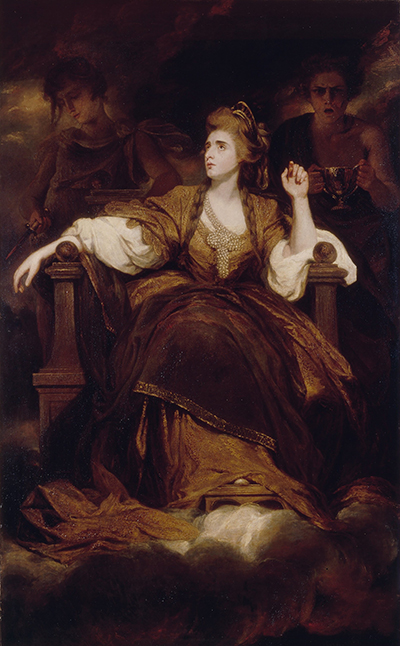
Sir Joshua Reynolds's Sarah Siddons as the Tragic Muse is one of the great theatrical portraits of eighteenth-century British art. It shows a living actress transformed into an allegorical power. Sarah Siddons does not merely sit for Reynolds; she appears enthroned as Tragedy itself, surrounded by shadowy figures of Pity and Terror. The painting belongs to portraiture, theatre, celebrity culture and the Grand Manner all at once.
The Huntington Library, Art Museum, and Botanical Gardens identifies the work as Sarah (Kemble) Siddons as the Tragic Muse, painted by Joshua Reynolds in 1783-1784, oil on canvas, accession 21.2.[1] The canvas measures 94 1/4 by 58 1/8 inches, or 239.4 by 147.6 centimetres.[1] The sitter was Sarah Siddons, born Sarah Kemble in 1755, who became the dominant tragic actress of the British stage and one of the most recognisable cultural figures of her age.[2]
This is a portrait of fame at the instant it becomes myth. Siddons had recently conquered London in tragic roles; Reynolds, already President of the Royal Academy, responded by giving her the visual status of a classical and moral force. The painting is not simply a likeness of an actress. It is an argument that acting, feeling and public celebrity could be made as grand as history painting.
At a Glance
- Current titleSarah (Kemble) Siddons as the Tragic Muse [1]
- ArtistJoshua Reynolds
- Date1783–1784 [1]
- MediumOil on canvas [1]
- SitterSarah Siddons (née Kemble), 1755–1831 [2]
- AccessionHuntington 21.2 [1]
- Dimensions239.4 × 147.6 cm [1]
- Current holderThe Huntington [1]
- IconographyTragic Muse with Pity and Terror [1]
- Print afterlifeFrancis Haward stipple, 1787 [4][5]
Contents
- Introduction
- Why the Painting Matters
- Sarah Siddons before Reynolds
- The Actress as Tragic Muse
- Composition and Scale
- Pity and Terror
- Colour, Darkness and Stage Light
- The Grand Manner and Celebrity
- The Royal Academy in 1784
- Seeing the Painting Now
Why the painting matters
The painting matters because it gives unprecedented authority to a performer. Eighteenth-century portraiture often elevated aristocrats, officers, writers and patrons, but Reynolds here turns an actress into an enthroned emblem of tragedy. That move was bold. It treated theatrical performance not as entertainment alone, but as a serious cultural art capable of moral and emotional grandeur.
The Huntington describes Siddons as a famed Welsh-born British theatre actress and cultural icon of the late eighteenth and early nineteenth century.[1] That word "icon" is not casual. Siddons's public image spread far beyond the stage, through portraits, prints, magazines and objects.[2][6] Reynolds's painting became the most powerful of those images because it did not merely record her fame; it monumentalised it.
The painting also matters within Reynolds's career. It is one of the clearest examples of the Grand Manner applied to modern celebrity. Reynolds wanted portraiture to rise above plain resemblance by drawing on classical example, allegory, old-master effect and heroic composition.[7][8] In Siddons, he found a sitter whose profession already depended on transformation. The actress became an ideal subject for a painter who wanted portraiture to become more than social likeness.
The result is one of Reynolds's most successful fusions of person and idea. Siddons remains recognisable, but the painting also asks viewers to see her as Melpomene, the Muse of Tragedy. She is not simply shown acting a role. She is presented as the source of tragic feeling.
That distinction separates the portrait from a conventional celebration of theatrical success. A fashionable likeness might have shown Siddons as admired, accomplished or socially desirable. Reynolds instead gives her a form of cultural rank. The throne, the scale, the shadowed attendants and the concentrated light all insist that her fame had become something more durable than applause. The picture asks the viewer to accept an actress as a figure of public imagination, not merely as a performer known to London playgoers.
It also reveals how quickly eighteenth-century celebrity could move across media. Siddons's reputation began in performance, but it was sustained by description, portraiture and reproductive print. The theatre supplied the living event; Reynolds supplied a commanding image; Haward's later print helped the image travel.[4][5] The portrait matters because it stands at the crossing point of those forces. It preserves not a literal night at Drury Lane, but the kind of authority audiences believed Siddons possessed when she entered tragic character.
Sarah Siddons before Reynolds
Sarah Siddons was born Sarah Kemble in 1755 into a theatrical family.[2] The National Portrait Gallery describes her as part of a powerful theatrical dynasty: her father Roger Kemble was an actor-manager, her brothers Philip and Charles Kemble were actors, her husband William Siddons was an actor, and her son Henry Siddons also entered the theatre.[2] Acting was not an incidental profession in her life; it was the world from which she emerged.
Her London success was not immediate. Folger Shakespeare Library notes that Siddons made an unimpressive debut at Drury Lane in 1775 as Portia in The Merchant of Venice, before returning triumphantly in 1782.[6] The National Portrait Gallery identifies that 1782 success with her portrayal of Isabella in The Fatal Marriage, written by David Garrick.[2] This return transformed her career.
Siddons's power lay in tragic intensity. The National Portrait Gallery calls her a leading tragic actress and says she dominated the London stage until her farewell in 1812.[2] It also identifies Lady Macbeth as her masterpiece and says she excelled in roles that combined passionate intelligence with pathos.[2] Folger similarly stresses her reputation for Lady Macbeth and the emotional force of her tragic acting.[6]
By the time Reynolds painted her, Siddons was not merely a successful performer. She was a public phenomenon. Audiences responded to her as if tragedy had acquired a living body. That is the key to the portrait. Reynolds did not invent Siddons's aura from nothing; he translated a theatrical reputation into painted allegory.
That reputation had a moral dimension as well as a theatrical one. Siddons was admired for arousing powerful emotion, but also for seeming to govern it. Her greatest roles demanded grief, guilt, courage, maternal anguish and stern self-command. Reynolds's portrait draws on that balance. It does not make her famous because she is expressive in an easy or decorative sense. It makes her famous because she appears capable of giving sorrow a disciplined public form.
The timing is important. The 1782 return to Drury Lane placed Siddons near the beginning of her great London ascendancy, not near its end.[2][6] Reynolds caught the moment when success had become unmistakable but was still fresh enough to feel like revelation. His image therefore has the energy of recognition. It is the work of an established painter responding to a performer whose power had suddenly become one of the capital's great cultural facts.
The actress as Tragic Muse
The painting shows Siddons as the Muse of Tragedy.[1] In classical tradition, the Muses are figures of artistic inspiration; Melpomene is associated with tragedy. Reynolds does not paint Siddons as a woman preparing for a specific performance. He paints her as an embodiment of tragic art. The transformation is the whole point.
This was a shrewd choice because Siddons's fame depended on the public's belief that she could make tragic emotion seem noble, intelligent and irresistible. Her acting was admired not as mere display, but as a kind of elevated feeling. The National Portrait Gallery records William Hazlitt's later phrase for her as "tragedy personified."[2] Reynolds's painting anticipates that idea visually.
The portrait's allegory is not abstract in a cold way. Siddons sits with physical weight, an illuminated face and arms, and a grave inward expression. Her body is present, but her role is larger than bodily presence. She is a performer elevated into a principle.
This is why the work has such force. Reynolds does not show Siddons mid-speech, fainting, weeping or declaiming. He refuses the obvious theatrical moment. Instead, he shows tragic authority before or beyond action. Siddons becomes the power from which tragedy proceeds.
That refusal of a literal scene is central to the portrait's intelligence. If Reynolds had painted Siddons as Lady Macbeth or Isabella in a named episode, the picture would have depended on one part of her repertory. By making her the Muse, he gathers many roles into a single image. The painting becomes an emblem of tragic acting itself. It is therefore specific enough to belong to Siddons and broad enough to stand for the whole imaginative territory in which she excelled.
The transformation also treats acting as a creative art. Siddons is not represented as someone merely repeating a playwright's words. She appears as the force through which tragic feeling becomes visible and believable. That is a generous idea of performance. It grants the actress a kind of authorship: not authorship of text, but authorship of presence, timing, gesture and emotional conviction. Reynolds's allegory depends on taking that artistic labour seriously.
Composition and scale
The Huntington records the painting's large scale: 94 1/4 by 58 1/8 inches.[1] Those dimensions place the work firmly in the world of full-length grand portraiture. Reynolds gives Siddons a format suitable for aristocrats, rulers and heroic figures. Her profession as an actress does not reduce the scale of representation; it justifies it.
Siddons is seated rather than standing, but the composition remains monumental. Her throne rises into a shadowed, cloud-like setting. The body turns slightly, the head lifts, and the arms create a measured structure across the figure. Nothing is casual. Every part of the pose contributes to authority.
The painting's lighting is crucial. The Huntington label notes that Reynolds uses a dark palette throughout, except for Siddons's head and arms, which appear as if in a spotlight.[1] This theatrical lighting is not merely decorative. It makes the actress's face and hands the emotional centre of the work, while the surrounding darkness becomes the atmosphere of tragedy.
That spotlight effect also connects painting to the stage. Siddons's fame came from being seen in theatrical space; Reynolds converts that stage presence into pictorial illumination. The face emerges from shadow as a performer emerges from darkness into attention. The painting makes viewing itself feel dramatic.
Pity and Terror
Behind Siddons, two figures emerge from the shadows. The Huntington identifies them as personifications of Pity and Terror, two elements of tragedy.[1] This is one of the painting's strongest ideas. Siddons is not accompanied by attendants, servants or admirers. She is accompanied by emotional forces.
The figure of Terror appears to Siddons's left, holding a poisoned chalice, with a grimacing face that the Huntington says was modelled on Reynolds's own features.[1] This detail gives the painting a strange intimacy. Reynolds inserts a distorted version of himself into the allegorical machinery of tragedy. The painter becomes a shadow force inside the actress's myth.
To Siddons's right is Pity, clutching a dagger.[1] The pairing of chalice and dagger evokes tragic plots, fatal choice and the instruments of dramatic catastrophe. These figures do not illustrate a single play. They form an emotional architecture around Siddons's identity.
The placement of Pity and Terror also changes how we read the central figure. Siddons sits between them as if she commands them, contains them or gives them form. She is not overwhelmed by tragic emotion. She presides over it. Reynolds's portrait turns the actress into the sovereign of feeling.
This is one reason the painting avoids simple melodrama. Terror and Pity are animated in shadow, but Siddons herself is controlled. Her authority comes from restraint. She appears powerful because she does not need to perform grief outwardly; tragedy seems already gathered within her.
The pairing also connects Reynolds's portrait to a long tradition of thinking about tragedy as an art that stirs and regulates emotion. Pity and Terror are not random ornaments. They name the feelings tragedy was expected to awaken in its audience. By placing them behind Siddons, Reynolds turns the portrait into a theory of spectatorship. The actress is the mediator who releases those emotions while remaining above them.
That is why the shadow figures are so effective. They suggest the emotional consequences of tragedy without turning the central figure into a victim of them. Terror grimaces and offers its poisoned chalice; Pity clutches the dagger; Siddons sits between them in grave command.[1] The emotional storm is present, but it is organised around her. The painting's drama lies not in frenzy, but in mastered intensity.
Colour, darkness and stage light
The painting's dark palette has often been central to its effect. The Huntington notes that the head and arms are the major exceptions to the surrounding darkness.[1] Reynolds uses this contrast to make Siddons appear almost lit from the theatre. The body is dressed in rich tones, but the light concentrates on expression and gesture.
This use of darkness belongs to Reynolds's old-master ambition. He admired the drama of earlier European painting and often sought a surface that could give modern portraits historical depth.[7][8] In Sarah Siddons as the Tragic Muse, that ambition serves a theatrical subject perfectly. Darkness becomes mood, memory and moral atmosphere.
The background figures depend on that darkness. Pity and Terror are not cleanly separate from the space around them. They seem to form out of it. This makes them feel less like actors in costume and more like emotions becoming visible. Reynolds uses paint to give tragedy a psychological climate.
Siddons's illuminated face and arms then become the point of stability. The viewer's eye returns to her because the painting's whole tonal system leads there. She is not simply brighter; she is pictorially necessary. Without her, the shadow world would lose its centre.
The darkness also lends the portrait a ritual quality. It is not the darkness of ordinary interior space, nor simply the dimness of a theatre. It feels like an atmosphere of moral testing, suitable for the roles with which Siddons became associated. Lady Macbeth, Isabella and other tragic characters live in worlds of pressure, guilt, sacrifice and irreversible choice. Reynolds's palette gives that world an enveloping presence without tying the image to one script.
This is where Reynolds's old-master ambition becomes more than stylistic polish. The sombre tonality gives a modern actress the weight of inherited art. It allows Siddons to seem both contemporary and ancient, both famous in London and linked to a wider history of tragic representation. The paint surface becomes a bridge between celebrity and tradition.
The result is a portrait that feels staged without feeling shallow. Reynolds borrows the spectacle of theatre, but he uses oil painting to slow it down. The viewer is not watching a passing performance. The viewer is made to contemplate a permanent image of theatrical power.
The throne helps produce that suspended effect. It fixes Siddons in ceremonial stillness while the surrounding shadows imply movement, fear and inward disturbance. Scale also matters. A full-length format gives the actress room to become architectural. She is not pressed close to the viewer as an intimate acquaintance; she is held at a distance appropriate to awe. Reynolds uses that distance to transform social recognition into reverence.
Yet the portrait is not remote in every respect. The spotlighted head and arms preserve the bodily reality of performance.[1] Acting depends on face, hands, posture and controlled attention, and Reynolds makes those instruments visible. The picture therefore balances two kinds of presence: Siddons as an elevated allegorical figure and Siddons as a woman whose body has learned how to command an audience.
The Grand Manner and modern celebrity
Reynolds's Grand Manner is often associated with aristocratic elegance, antique pose and history-painting grandeur. In this portrait, those devices are directed toward celebrity. Siddons was not a duchess or royal figure; she was a professional actress. Reynolds's decision to enthrone her makes the painting socially and artistically charged.
The National Portrait Gallery records Siddons as a sitter associated with 44 portraits.[2] That number signals the scale of her image culture. She was repeatedly drawn, painted, engraved and collected. Reynolds's portrait enters this broader celebrity field, but it also dominates it because it turns celebrity into myth.
This is where the painting's modernity lies. It recognises that fame can create authority outside hereditary rank. Siddons's throne is not inherited. It is earned through performance, emotional discipline and public recognition. Reynolds gives visual form to a new kind of cultural power.
At the same time, the portrait domesticates theatrical fame within classical allegory. Siddons becomes acceptable to elite art because she is not shown as a theatrical worker backstage or a fashionable performer seeking applause. She is transformed into the Muse of Tragedy. Reynolds raises acting by removing it from ordinary labour and placing it in the realm of inspiration.
This transformation is both empowering and limiting. It grants Siddons immense dignity, but it also turns her into an emblem. The living woman and working actress are partially absorbed into the role that makes her immortal.
That double effect is one of the reasons the portrait remains so interesting. Reynolds honours a modern professional woman by clothing her in classical authority, yet the same elevation smooths away much of the ordinary reality of her profession. The viewer is not asked to think about contracts, rehearsal, touring, rivalry or physical exhaustion. Those things disappear into allegory. What remains is fame purified into a grand image.
But that purification should not be mistaken for emptiness. The portrait is modern precisely because it needs the machinery of myth to express a new public situation. Siddons's authority did not come from birth, land or political office. It came from repeated acts of performance before paying audiences, from critical language, from visual reproduction and from collective emotional memory. Reynolds understood that such fame required a new form, and he found one by making the Muse wear the face of a living actress.
The Royal Academy in 1784
Reynolds exhibited the portrait at the Royal Academy in 1784. Meredith Gamer's account of that year's exhibition notes that Reynolds showed 17 paintings, including his portrait of the Prince of Wales and another of Charles James Fox, but that his full-length portrait of Sarah Siddons in the guise of the Tragic Muse was by far his most admired work.[3] The painting therefore succeeded in a crowded and politically complicated setting.
The 1784 exhibition was not a calm stage for artistic triumph. Gamer describes disputes, absences and institutional tensions, including Gainsborough's withdrawal from the exhibition after a disagreement over hanging.[3] That absence mattered because Gainsborough was Reynolds's great rival. His withdrawal helped shape the circumstances in which Reynolds's Siddons could command attention.
The Royal Academy Chronicle records that the 1784 exhibition ran from 26 April to 3 June and drew 48,892 visitors.[3] This was a large public audience for a painting that already dealt with public performance. Siddons had conquered the theatre; Reynolds now placed her before the exhibition-going public as an image of tragic sovereignty.
The original Academy catalogue title was not necessarily the later title by which the work became famous. The Royal Academy account refers to the work as Reynolds's full-length portrait of the actress in the guise of the Tragic Muse, while contemporary responses helped consolidate the painting's identity as a grand theatrical allegory.[3] The title we now use reflects reception as well as authorship.
This matters because the painting's fame grew through interpretation. Viewers and critics recognised that Reynolds had done something larger than a standard portrait. They helped name the transformation. The public saw not just Mrs Siddons, but Siddons as an embodiment of tragedy.
The crowded exhibition setting sharpened that recognition. Nearly fifty thousand visitors encountered the Academy display in 1784, and Reynolds's contribution had to compete with portraits, histories, landscapes and the reputations of other exhibitors.[3] A quieter image of Siddons might have been lost among so many claims on attention. The Tragic Muse, by contrast, was built to hold a wall. Its scale, darkness and allegorical clarity gave it the kind of visual authority needed in a public exhibition room.
The success also mattered for Reynolds's own position. He was not only a painter showing a striking work; he was the Academy's President, a theorist of elevated art and a figure whose authority was always measured against ambitious rivals.[7][8] Siddons allowed him to demonstrate that the Grand Manner could still respond to contemporary life. The portrait is traditional in language, but acute in its reading of modern fame.
Gainsborough, absence and rivalry
The 1784 exhibition also belongs to the long comparison between Reynolds and Gainsborough. Gamer notes that Gainsborough's absence still cast a shadow over Reynolds, and that one contemporary observer suggested Gainsborough might have shared public applause with the President had he exhibited.[3] That context gives Siddons's triumph an extra edge.
Reynolds and Gainsborough represented different possibilities within British portraiture. Reynolds was institutional, theoretical, grand and academic; Gainsborough was more fluid, musical and socially immediate. Siddons herself sat to Gainsborough in 1785, the year after Reynolds's Academy triumph.[6] The contrast between the two artists' images of her would later become part of her visual legacy.
For the Reynolds article, the point is not to settle the rivalry. It is to recognise how the Academy setting made the portrait's success sharper. Reynolds's painting did not merely succeed because it was good. It succeeded in a public arena where artistic leadership, institutional authority and rivalry were all visible.
The portrait therefore served Reynolds as well as Siddons. It confirmed his power to create an image that critics and viewers could treat as major art. At a moment when Academy politics and rival artists complicated the exhibition, the Siddons portrait gave Reynolds a commanding answer.
This is one reason the painting feels so deliberate. It is not only a tribute to Siddons. It is Reynolds demonstrating that portraiture could absorb theatre, allegory, modern fame and exhibition spectacle into one grand statement.
Gainsborough's absence made that demonstration more conspicuous, but it did not make the work merely competitive. The two painters imagined social presence differently. Gainsborough often gives sitters a living immediacy, an air of music, movement and private sensation. Reynolds more often seeks public form: a way of making likeness participate in history, literature or antique example. In the Siddons portrait, that public form is pushed to its most theatrical extreme.
The comparison also helps clarify why Reynolds's image became so dominant. A more intimate Siddons might have captured charm, personality or nervous vitality. Reynolds chose majesty. He accepted the risk that the painting might seem artificial because artificial elevation was part of the claim. Siddons's fame had already turned her into a figure spectators imagined larger than life; Reynolds gave that enlargement a visual structure.
Siddons and Shakespearean tragedy
Siddons's reputation was inseparable from tragedy on stage. The National Portrait Gallery says she was hailed as the chief interpreter of Shakespeare and that Lady Macbeth was her masterpiece.[2] Folger Shakespeare Library likewise identifies her as eighteenth-century London's best-known tragedienne and stresses her association with Lady Macbeth.[6]
The painting does not show Lady Macbeth directly, but Lady Macbeth hovers behind it as cultural memory. Siddons's audience knew her through tragic roles, and Reynolds's allegory depends on that knowledge. The Muse of Tragedy is not an arbitrary costume; it is a painted summary of what spectators believed Siddons could do.
Folger also notes Siddons's return to Drury Lane in 1782 as Isabella in Thomas Southerne's The Fatal Marriage, a performance described as emotionally overwhelming for audiences.[6] That success came shortly before Reynolds's portrait and helps explain the timing. Reynolds was painting an actress whose tragic identity had just become nationally visible.
Siddons's acting mattered because it joined passion to control. The National Portrait Gallery's phrase "passionate intelligence with pathos" is especially apt.[2] Reynolds's painting makes a similar combination visible. Siddons is full of tragic feeling, but she is not uncontrolled. She appears grave, commanding and inwardly disciplined.
That discipline is central to the portrait's meaning. Tragedy is not presented as hysteria. It is presented as intellectual and moral power. Reynolds turns Siddons's art into a form of authority.
Lady Macbeth is especially relevant because the role depends on contradictions that suited Siddons's reputation: ambition and horror, command and collapse, inward guilt and outward force. Even when Reynolds avoids a direct Shakespearean episode, the portrait borrows the prestige of such roles. It presents Siddons as someone who could make moral extremity visible without losing control of form.
The painting also shows why images of Siddons multiplied. Her acting produced memories that spectators wanted to keep, but performance itself could not be possessed. Portraits and prints answered that desire.[2][5] Reynolds's version became pre-eminent because it did not try to document one gesture from the stage. It gave viewers a symbolic image capacious enough to hold many remembered gestures at once.
Print afterlife
The portrait's fame did not depend only on those who saw the painting itself. Francis Haward produced a stipple print after Reynolds in 1787. The National Portrait Gallery holds an example, Sarah Siddons (née Kemble) as the Tragic Muse, NPG D9069, and records it as a stipple published in 1787 after the 1783-1784 painting.[4] Princeton University Art Museum also holds Haward's Mrs. Siddons in the Character of the Tragic Muse, dated 1787.[5]
Princeton's record explains why such prints mattered before photography: the fame of a painting and the reputation of its subject were spread through publication and collection of fine reproductive prints.[5] This is especially important for Siddons. Her celebrity was visual as well as theatrical. Prints allowed her image to circulate beyond the audience of any single performance or exhibition.
The Haward print did more than reproduce Reynolds's picture. It extended the portrait's authority into domestic and collecting spaces. People could own an image of Siddons as Tragedy, even if they never saw the Huntington painting or the Royal Academy exhibition. The print helped convert performance into portable memory.
The National Portrait Gallery record for Haward's print also notes that the central idea of the portrait may have been taken from William Russell's 1783 poem The Tragic Muse: A Poem addressed to Mrs Siddons.[4] That possible literary connection reminds us that Siddons's public image was made across media: theatre, poetry, painting, print and criticism.
The print afterlife also helps explain why Reynolds's painting became the definitive image of Siddons. It was not merely admired; it was reproduced. Reproduction fixed the enthroned Tragic Muse in cultural memory, turning a painted portrait into a public icon.
Haward's stipple also changes the way the painting should be understood historically. It was not only a single canvas admired by exhibition visitors and later owners. It became an image capable of repeated encounter. The print translated Reynolds's tonal drama and solemn composition into a medium designed for circulation, allowing Siddons's tragic identity to enter rooms, albums and collections far from the original work.[4][5]
That circulation suited the paradox of theatre. Acting is intense because it happens in time and disappears; celebrity needs forms that outlast disappearance. The print afterlife supplied one such form. It did not preserve Siddons's voice, but it preserved the idea of her voice having had public force. In that sense, reproduction was not secondary to the painting's meaning. It was part of how the meaning became historical.
Picturing a woman of power
The portrait is also a major image of female power. Siddons is not shown as decorative, flirtatious or subordinate. She is enthroned, elevated and grave. Her authority does not come from family rank or romantic availability. It comes from tragic art.
This makes the painting unusual within a culture that often constrained how women could appear in public. Actresses occupied a complicated social position. They could be admired, desired, criticised and morally scrutinised. Reynolds's portrait solves that problem by making Siddons almost sacred. She becomes untouchable, solemn and monumental.
Yet the painting does not erase her femininity. Her face, dress and bodily presence remain central. Reynolds does not turn her into a masculine hero; he gives tragic authority a female body. That visual decision mattered in a period when female performers were becoming increasingly important to public culture.
The picture's power depends on restraint. Siddons is not shown in emotional collapse. Her strength lies in controlled intensity. She is the person who can summon pity and terror without being destroyed by them. The portrait therefore imagines female genius as command over feeling.
Modern viewers may also notice what the painting suppresses. It does not show the labour of rehearsal, the instability of theatrical income, family responsibilities or the scrutiny that actresses faced. It gives Siddons a throne, not a dressing room. That choice is the source of both the work's grandeur and its distance from ordinary theatrical work.
The elevation was especially powerful because actresses could be culturally celebrated while remaining socially vulnerable. Public performance exposed women to admiration and suspicion at the same time. Reynolds's answer was to make Siddons almost inviolable. He surrounds her not with fashionable chatter or theatrical anecdote, but with the grave emotional powers that tragedy itself was supposed to command.
This gives the portrait a rare kind of female authority. Siddons is not passive before the viewer. Nor is she presented only as an object of beauty. She appears as the governing intelligence of the image. Pity and Terror are active, but they are subordinate to her. The painting imagines a woman whose public power comes from mastery over feeling rather than from submission to social expectation.
Reynolds's authorship and the hem
The inherited tradition around the painting often includes anecdotes about Reynolds signing the hem of Siddons's garment. Such stories belong to the portrait's reception, but they should be handled carefully unless tied to a reliable source. What can be said with confidence is that Reynolds used the painting to connect his own name with Siddons's fame and with the future memory of tragedy.
The anecdote matters because it is plausible as an expression of the painting's ambition, even when the exact circumstances are less important than the meaning attached to it. Reynolds understood posterity. He knew that a portrait of Siddons as Tragedy could carry both sitter and painter forward. If her theatrical fame was fleeting by nature, painting and print could make it durable.
This durability is one of the great themes of the work. Siddons's performances vanished as soon as they occurred; the painting remained. Reynolds converted temporary acting into a lasting icon. Haward's print then repeated that conversion in another medium.[4][5]
The painting is therefore also about the rivalry between arts. Theatre lives in time; painting promises permanence. Reynolds's portrait does not replace Siddons's performances, but it gives them an afterimage. It allows later viewers to imagine the force of an actress they can never hear.
This is why the work still matters to theatre history. It is not documentary evidence of a single performance, but it is powerful evidence of how Siddons was understood. Reynolds painted the idea her acting had created in the public mind.
The portrait's authorship is therefore shared in a subtle way. Reynolds designed and painted the image, but Siddons's public identity supplied its emotional material. Haward's print then extended that image into a wider culture of looking.[4][5] The work is best understood as a collaboration among performance, painting and reproduction, even though only Reynolds made the original canvas.
That shared authorship does not weaken Reynolds's achievement. On the contrary, it shows his alertness. He recognised that Siddons's fame was already pictorial in the minds of spectators. His task was to find the form that could hold it. The success of the portrait lies in that translation: the living shock of performance becomes a still image that continues to feel charged.
Catalogue and version caution
As with other major Reynolds works, careful identification matters. The Huntington object record controls the current object facts for the main painting: title, date, accession, dimensions, medium, sitter and present holder.[1] Mannings and Postle's catalogue raisonné remains important as the wider backbone for Reynolds's painted oeuvre, but live institutional records should guide current object details.[9]
Prints after the painting require their own care. The Haward stipple at the National Portrait Gallery is not the Huntington oil painting; it is a reproductive work after Reynolds.[4] Princeton's example likewise belongs to print culture and has its own maker, date, medium and object history.[5] Those distinctions matter because Siddons's image circulated in several forms.
There were also many portraits of Siddons outside Reynolds's painting. The National Portrait Gallery's person record lists 44 portraits associated with her as sitter.[2] This broad visual field included images by or after Gainsborough, Lawrence, Downman, Beechey and others.[2] Reynolds's painting became pre-eminent, but it was part of a much larger culture of Siddons imagery.
That larger culture is important because it prevents the Reynolds portrait from becoming the whole Siddons. She was a performer, reader, writer, mother, member of a theatrical dynasty and a long-career public figure. Reynolds created her most famous image, but not her entire identity.
The best reading of the work therefore holds together object precision and cultural breadth. The painting is a Huntington oil by Reynolds from 1783-1784; it is also part of a network of stage performance, Academy exhibition, reproductive print, critical praise and celebrity culture.
That balance also protects the painting from a simple mythological reading. Classical allegory explains the form, but not the whole meaning. The portrait is old-fashioned and new at the same time: old-fashioned in its use of Muse, throne and personification; new in its willingness to make a living actress the centre of such a structure. Reynolds uses antiquity not to escape modern London, but to interpret it.
Mannings and Postle are useful here because their catalogue approach keeps Reynolds's enormous production from dissolving into anecdote.[9] A famous work such as the Siddons portrait attracts stories, repetitions and simplified claims. Catalogue discipline helps restore proportion. It reminds the reader to distinguish the Huntington painting from related prints, later accounts and the broader family of Siddons images that gathered around her celebrity.
Seeing the painting now
To see the painting now is to encounter a carefully staged stillness. Siddons sits in command, but the surrounding shadows are restless. Pity and Terror seem to press in from the dark, while she remains composed. The emotional force of the picture comes from that contrast between agitation and restraint.
The face is central. Reynolds gives Siddons neither a theatrical grimace nor a fashionable smile. Her expression is serious, inward and remote. She appears to have passed beyond ordinary social address into a higher state of tragic consciousness. This is not the face of conversation; it is the face of role, memory and authority.
The hands and arms matter too. The Huntington's spotlight description draws attention to them alongside the head.[1] They are not merely anatomical details; they carry the body into gesture. One arm rests with solemn weight, while the other helps bind the figure into the composition. Siddons's authority is bodily as well as facial.
The figures behind her are deliberately less complete. Pity and Terror exist almost as shadows of thought. They make visible the emotional range Siddons commanded in performance, but they do not compete with her. Reynolds makes the secondary figures vivid enough to animate the allegory and indistinct enough to keep Siddons sovereign.
This is why the painting still feels theatrical without showing an actual scene. It creates the atmosphere of tragedy rather than an episode from tragedy. Siddons is not Lady Macbeth in a specific moment. She is the source from which Lady Macbeth, Isabella, Desdemona, Ophelia and other tragic roles can be imagined.
That openness is a major part of the portrait's endurance. A literal scene would end in the mind once its narrative moment had been recognised. Reynolds's allegory remains less closed. It invites viewers to imagine the before and after of tragic action, the gathering of emotion before speech, and the aftershock of feeling once speech has ended. Siddons's stillness contains potential movement.
The painting also asks viewers to supply memory. Those who had seen Siddons act could bring the sound of her voice and the authority of her bearing to the image. Later viewers, unable to recover the performance itself, must work from testimony and representation. That gap gives the portrait its melancholy fascination. It is an image of theatrical life made permanent, but permanence also marks what has vanished.
Legacy
The legacy of Sarah Siddons as the Tragic Muse belongs equally to Reynolds and Siddons. For Reynolds, it proved that portraiture could absorb theatre and allegory without losing force. For Siddons, it created the image by which her tragic genius would be most widely remembered.
The painting also shows how eighteenth-century celebrity could become cultural memory. Siddons's voice, timing and stage movement cannot be recovered directly. What survives is testimony, criticism, prints, portraits and objects. Reynolds's painting stands at the centre of that survival because it made her fame monumental.
The portrait remains compelling because it does not feel like ordinary celebrity flattery. It is too severe, too dark and too ambitious for that. It praises Siddons by making her almost remote. The painting gives her grandeur, but it does not make her easy.
That difficulty is part of its greatness. Siddons as Tragic Muse is both woman and allegory, performer and enthroned power, celebrity and timeless figure. Reynolds understood that her fame depended on this double nature. She was admired because she appeared fully human on stage, yet also more than ordinary human feeling.
The work therefore deserves its flagship place in Reynolds's career. It is one of his clearest answers to the problem that shaped so much of his art: how can portraiture become grand without losing the sitter? In Sarah Siddons as the Tragic Muse, Reynolds found one of his strongest solutions. He made a portrait that is still a likeness, but also a theatre, an allegory, a monument and a memory of performance.
The solution is agile as well as grand. Reynolds did not merely apply an academic formula to a fashionable actress; he adapted the Grand Manner to the realities of theatrical celebrity. Siddons brought tragedy alive before audiences, and Reynolds made that living force sit still without making it dead. That is the portrait's deepest achievement. It holds performance at the moment when it becomes memory, and it gives that memory a form severe enough to last.
Frequently Asked Questions
Discussion
How does Reynolds turn theatrical celebrity into a permanent image of tragic authority?
Reader Insights
How do spotlight, throne and shadow direct attention to Siddons's face and arms?
Does Siddons command the shadowed figures, contain them, or give them form?
What can a still portrait preserve—and not preserve—of a vanished stage performance?
Join the Conversation
Share your reading below.
References
- The Huntington Library, Art Museum, and Botanical Gardens, Sarah (Kemble) Siddons as the Tragic Muse, 21.2, https://www.huntington.org/collections/mus-245
- National Portrait Gallery, “Sarah Siddons (née Kemble)”, https://www.npg.org.uk/collections/search/person/mp04109/sarah-siddons-nee-kemble
- Meredith Gamer, “1784: Dialogues, Defections, and Disputes,” The Royal Academy Summer Exhibition: A Chronicle, 1769-2018, Paul Mellon Centre / Royal Academy of Arts, https://chronicle250.com/1784
- National Portrait Gallery, Francis Haward after Sir Joshua Reynolds, Sarah Siddons (née Kemble) as the Tragic Muse, NPG D9069, https://www.npg.org.uk/collections/search/portrait/mw12922/Sarah-Siddons-ne-Kemble-as-the-Tragic-Muse
- Princeton University Art Museum, Francis Haward after Sir Joshua Reynolds, Mrs. Siddons in the Character of the Tragic Muse, x1968-9, https://artmuseum.princeton.edu/art/collections/objects/10851
- Folger Shakespeare Library, “Sarah Siddons: ‘Tragedy Personified’”, https://www.folger.edu/blogs/shakespeare-and-beyond/sarah-siddons-tragedy-personified/
- National Gallery, London, “Sir Joshua Reynolds 1723-1792”, https://www.nationalgallery.org.uk/artists/sir-joshua-reynolds
- National Portrait Gallery, “Sir Joshua Reynolds”, https://www.npg.org.uk/collections/search/person/mp03755/sir-joshua-reynolds
- David Mannings, Sir Joshua Reynolds: A Complete Catalogue of His Paintings, with subject pictures catalogued by Martin Postle, Yale University Press / Paul Mellon Centre for Studies in British Art, 2000.