 by Tom Gurney
Tom Gurney BSc (Hons) is an art history expert with over 20 years experience
Published on June 19, 2020 / Page Updated on November 6, 2026
Email: tomgurney1@gmail.com / Phone: +44 7429 011000
Introduction
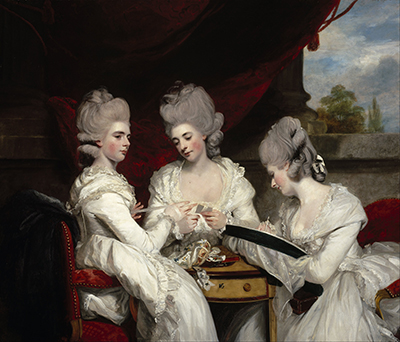
Sir Joshua Reynolds's The Ladies Waldegrave is one of the most elegant group portraits of late eighteenth-century British art. It shows three sisters seated together at a small work table, absorbed in silk, lace and thread. The National Galleries of Scotland identifies the painting as an oil on canvas of 1780, measuring 143.00 by 168.30 centimetres, with the accession number NG 2171.[1] The work is held by National Galleries of Scotland and is displayed at the National in Edinburgh when its collection record is current.[1]
The sitters are Lady Elizabeth Laura Waldegrave, Lady Charlotte Maria Waldegrave and Lady Anna Horatia Waldegrave, daughters of James Waldegrave, 2nd Earl Waldegrave.[1][4] Reynolds presents them as aristocratic young women, but he avoids the stiffness that can weaken formal portraiture. They are not lined up as separate likenesses. They are joined by shared action. One winds silk, another assists, and the youngest works silk lace on a tambour frame.[1] The picture is therefore a portrait of family, skill, composure and social readiness all at once.
Older summaries sometimes preserve the correct title while confusing the object description. This is not a work on paper, nor a mezzotint or etching. The original painting is oil on canvas.[1] Prints after it matter to the story, especially Valentine Green's 1781 mezzotint, but those are separate reproductive works after Reynolds.[2] The distinction is essential because the painting's power lies in the way Reynolds uses oil painting to turn a social group into a carefully staged image of aristocratic harmony.
At a Glance
- Current titleThe Ladies Waldegrave [1]
- ArtistSir Joshua Reynolds
- Date1780 [1]
- MediumOil on canvas [1]
- Dimensions143 × 168.3 cm [1]
- AccessionNG 2171 [1]
- Current holderNational Galleries of Scotland [1]
- SittersElizabeth Laura, Charlotte Maria and Anna Horatia Waldegrave [1]
- CommissionerHorace Walpole [4]
- AcquisitionPurchased with Cowan Smith Bequest and Art Fund aid, 1952 [1]
Contents
- Introduction
- The Scottish National Gallery painting
- The three sisters
- Needlework as composition
- Horace Walpole and Strawberry Hill
- Conversation piece and Grand Manner
- Royal Academy exhibition in 1781
- Print afterlife
- Surface, reproduction and facsimile
- Reading the painting now
The Scottish National Gallery painting
The National Galleries of Scotland gives the title as The Ladies Waldegrave, by Sir Joshua Reynolds, dated 1780.[1] Its dimensions are large enough for a major conversation piece: 143.00 by 168.30 centimetres, with framed dimensions of 171.00 by 196.50 by 10.00 centimetres.[1] The painting was purchased in 1952 with the aid of The Cowan Smith Bequest and the Art Fund.[1] The Art Fund's own archive record also connects the work with National Galleries Scotland and records the 1952 support, oil-on-canvas medium and comparable dimensions.[5]
The object facts anchor the reading. The painting is not merely a pretty image of three fashionable women. It is a large, ambitious group portrait made by the leading British portrait painter of the period. Reynolds was first President of the Royal Academy and had built his reputation by giving portraiture intellectual scale, social polish and echoes of older art.[6] In The Ladies Waldegrave, he does this without turning the sitters into remote allegorical statues. Their hands are busy, their bodies lean toward one another, and their identities remain tied to family, age and social circumstance.
The current institutional title is simple, but the work has carried other descriptions. At the Royal Academy in 1781 it was known as Portraits of Three Ladies, according to the Royal Academy Chronicle's account of that year's exhibition.[3] That earlier title is plainer, but it helps reveal the painting's first public identity. Before it became famous as The Ladies Waldegrave, it entered exhibition culture as a refined three-sitter portrait by Reynolds.
The three sisters
The National Galleries of Scotland identifies the sisters with unusual clarity. Elizabeth Laura, the eldest, was aged twenty in 1780 and sits in the centre winding silk thread.[1] Charlotte Maria, aged nineteen, assists her, while Anna Horatia, aged eighteen, works on silk lace stretched across a tambour frame.[1] The National Portrait Gallery's record for Valentine Green's print confirms their later identities: Elizabeth Laura became Countess Waldegrave, Charlotte Maria became Duchess of Grafton, and Anne Horatia became Lady Seymour.[2]
Reynolds's arrangement gives each woman a different role within a single rhythm. Elizabeth Laura occupies the centre and controls the winding of the thread. Charlotte Maria supports the action from the left, her pose turned toward the group and toward the viewer. Anna Horatia bends to the tambour frame, giving the right side of the composition a more concentrated and inward energy. The three figures are close in age and dress, yet Reynolds avoids making them interchangeable.
The painting depends on relation. The sisters are linked by the thread, by the table, by the shared task and by the pale harmony of their gowns. None is isolated as a self-contained beauty. The picture's grace comes from cooperation. Reynolds turns a practical activity into a social composition, so that sisterhood becomes visible through coordinated gesture.
This is also a portrait of youth at a poised public moment. The sisters are old enough to be represented as socially available, cultivated and marriageable, but young enough for the image to emphasise freshness and delicacy. Reynolds does not state those social pressures bluntly. He lets the needlework carry them. Thread, lace and fabric suggest domestic accomplishment, patience, refinement and disciplined hands.
The age sequence matters because the sisters are almost a matched set without becoming copies of one another. Elizabeth Laura's centrality gives the image a quiet axis; Charlotte Maria's support makes the action sociable; Anna Horatia's tambour work gives the youngest sister a more specialised task. Reynolds uses small variations of posture and occupation to keep the group alive. The painting is a study of likeness within difference: three related women, close in age, joined by family and activity, but given enough variety to remain individually present.
Their pale clothing reinforces that balance. The dresses bind the sisters visually, but the heads and hands prevent the unity from becoming bland. Reynolds understood that group portraiture could easily become mechanical if every sitter competed for equal emphasis. Here, he solves the problem by making the work itself, the winding and making of thread and lace, the shared centre of attention. The sisters are not only arranged around a table; they are arranged around a task.
Needlework as composition
The needlework is not decorative filler. It is the engine of the painting. The National Galleries of Scotland stresses that the joint activity links the girls together.[1] Without the shared task, the image might become three adjacent portraits. With it, the sisters become part of one continuous action. The silk thread gives Reynolds a visible way to bind the group.
Needlework also lets Reynolds show character through action rather than through exaggerated expression. Elizabeth Laura's central concentration, Charlotte Maria's assisting pose and Anna Horatia's tambour work all suggest different kinds of attention. The result is understated but deliberate. Reynolds was particularly skilled at choosing poses and actions that suggested character while creating strong composition, as the National Galleries of Scotland observes.[1]
The activity also speaks to the social world of the sitters. Embroidery and lace work were associated with feminine accomplishment, leisure, patience and refinement. In a grand aristocratic portrait, such work could present domestic skill as a form of cultivated grace. Reynolds is not painting labour in a modern economic sense. He is painting accomplishment as social display.
Yet the image is not empty ornament. The hands matter because they make the sisters active. They do not merely sit to be looked at. They do something together. The painting's beauty is inseparable from that action. The thread becomes a compositional line, a social bond and a sign of controlled energy.
This makes the painting unusually dependent on process, though not in a literal documentary sense. We are not being shown the practical realities of textile production. We are being shown the idealised language of accomplishment. The point is not how much lace the sisters might produce, but how gracefully shared work can express education, patience and mutual dependence. Reynolds converts a small domestic activity into a language of aristocratic cultivation.
The tambour frame is especially useful in this regard. It anchors Anna Horatia at the right and gives her hands a precise action. The winding of silk in the centre and the assistance from Charlotte Maria at the left create a soft chain of attention across the canvas. The physical materials are delicate, but pictorially strong. They give Reynolds a way to organise three sitters without making the composition feel forced.
Horace Walpole and Strawberry Hill
Factum Foundation, working with Strawberry Hill House, identifies Horace Walpole as the commissioner of the painting and describes him as the great-uncle of Elizabeth Laura, Charlotte Maria and Anne Horatia Waldegrave.[4] It also records that the painting originally hung in Walpole's house at Strawberry Hill, was sold in 1842 and entered the collection of the Scottish National Gallery in 1952.[4] That history gives the portrait a setting beyond Reynolds's studio and the Royal Academy.
Walpole's involvement matters because Strawberry Hill was not an ordinary country house. It was a highly self-conscious Gothic villa shaped by collecting, family memory, literary taste and historical fantasy. A portrait of three grandnieces by Reynolds could function there as family record, social display and aesthetic possession. The painting belonged to Walpole's world of objects, rooms and narratives.
The commission also clarifies the painting's social purpose without reducing it to a crude advertisement. It is reasonable to see the portrait as connected to marriageability and family advancement, because the sitters were young aristocratic women presented with elegance, unity and accomplishment. But the evidence should be handled carefully. Reynolds's painting is more than a suitor-facing image. It is also a family picture, a Strawberry Hill object, a Royal Academy exhibit and a major statement of group portraiture.
That complexity is what saves the painting from seeming merely strategic. Walpole may have wanted a splendid public image of his young relatives, but Reynolds gives the commission an artistic intelligence that exceeds social utility. The sisters are presented as desirable, certainly, but also as coordinated, thoughtful and self-possessed. Their beauty is made credible by attention and action.
Strawberry Hill also deepens the painting's atmosphere of performance. Walpole's house was a place where family identity, antiquarian imagination and curated display met one another. A large Reynolds portrait of the Waldegrave sisters could sit naturally within that world because it was both personal and theatrical. It did not need a mythological title to feel staged. The room, the family name, the artist's reputation and the sisters' poised activity would have supplied their own drama.
The later removal of the painting from Strawberry Hill changed that drama. Once separated from Walpole's rooms, the work became less a family possession embedded in a house and more a celebrated Reynolds picture moving through the history of collections. Factum's twenty-first-century recording project makes that displacement newly visible, because it treats the absent original as something that can be evoked through a highly detailed facsimile.[4] The portrait's modern story is therefore also a story about loss, return and substitution.
Conversation piece and Grand Manner
The picture belongs to the tradition of the conversation piece, a form of group portrait that often shows sitters in shared activity, domestic setting or sociable relation. Reynolds enlarges that format. The sisters are not small figures in a crowded interior. They command a large canvas, with a red curtain, columned setting and pale dresses giving the scene a theatrical dignity.
The Frick Collection, in its exhibition description of the painting, calls it a large-scale informal group portrait or conversation piece and stresses Reynolds's ability to create sophisticated compositions and graceful gestures.[7] That is exactly the balance the work requires. The picture feels informal because the women are engaged in needlework; it feels grand because the setting, scale and arrangement elevate the scene.
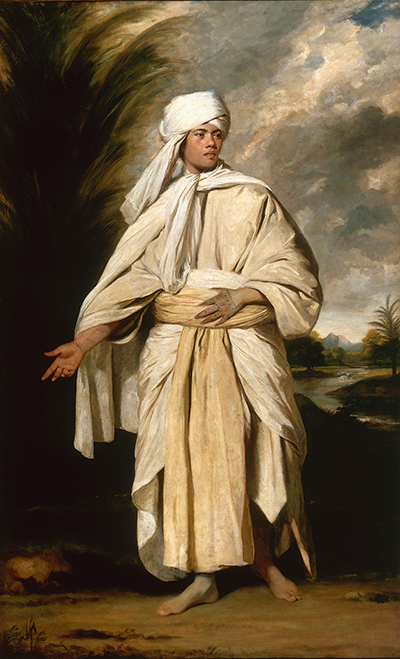
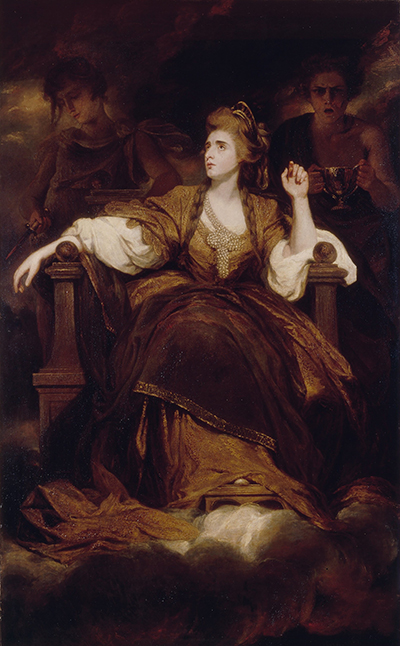
This is a gentler form of the Grand Manner than Reynolds used in Sarah Siddons as the Tragic Muse or Portrait of Mai (Omai). There is no single enthroned figure and no overt allegorical machinery. Instead, Reynolds builds grandeur through harmony: the repeated pale dresses, the linked hands, the controlled fall of fabric, the architectural background and the poised relation of the three heads.
The result is both social and classical. The sisters are recognisably modern young women, yet the grouping invites comparison with the Three Graces or with other inherited images of female harmony. Reynolds does not need to state a mythological identity. The classical tone is carried by arrangement, rhythm and whiteness. The sitters remain themselves while acquiring a general air of cultivated beauty.
Royal Academy exhibition in 1781
The painting entered a busy exhibition culture. Meredith Gamer's account of the Royal Academy exhibition of 1781 notes that the show ran from 30 April to 2 June and drew 42,824 visitors.[3] Reynolds was the leading contributor by number, exhibiting fifteen works.[3] In that environment, Portraits of Three Ladies, now known as The Ladies Waldegrave, was among the admired works of the year.[3]
The 1781 exhibition also belonged to a new phase in the Academy's public life at Somerset House. Gamer describes Joseph Baretti's guide to the Academy's newly rebuilt and expanded quarters, a text designed for curious visitors who wanted to understand what they were seeing.[3] This matters for Reynolds because his portraits were not seen only by patrons and connoisseurs. They were seen by a large public audience in a crowded institutional setting.
For the Waldegrave sisters, that setting sharpened the painting's social force. A private family commission became a public image. Viewers at the Academy could admire the sisters, the painter, the composition and the social world the portrait represented. The painting therefore operated both as art and as visibility. It gave three young women an elegant public presence within one of the most watched cultural arenas in London.
The work's Academy title, Portraits of Three Ladies, also tells us something about its first reception. The name does not foreground Walpole, Strawberry Hill or later marriages. It presents the painting as a Reynolds group portrait whose refinement had to be grasped through looking. The later title The Ladies Waldegrave gives family specificity; the earlier title gives exhibition directness.
The large attendance number matters because the portrait's audience was not narrow. More than forty thousand visitors passed through the Academy exhibition in 1781.[3] Some would have known the Waldegrave name; many would have approached the image through the broader language of beauty, rank and Reynolds's reputation. The painting had to communicate instantly in a crowded room, and its design does exactly that. Pale dresses, red curtain, graceful hands and a shared task make the group legible from a distance, while the thread and lace reward closer looking.
This is one reason the painting should not be dismissed as merely pretty. Prettiness is part of its effect, but the effect is built for public display. Reynolds creates a surface of elegance that can survive the visual noise of an exhibition and the social noise of spectatorship. Underneath the charm is a disciplined strategy for holding attention.
Print afterlife
The National Portrait Gallery holds Valentine Green's mezzotint The Ladies Waldegrave, after Reynolds, published in 1781.[2] The record identifies Green as both maker and publisher, and gives the plate size as 13 by 14 7/8 inches, with paper size 15 1/8 by 17 3/8 inches.[2] This print is not the original oil painting. It is a reproductive work that helped the image circulate beyond the canvas.
The timing is important. A print published in 1781 placed the Waldegrave image into circulation almost immediately after its Royal Academy exposure. Reynolds's portraits often gained wider fame through engravings and mezzotints, and Green was one of the leading printmakers associated with that culture. The print allowed the composition to become known to people who did not own the painting or see it at Strawberry Hill.
The print also stabilised the sitters' public identity. The National Portrait Gallery record names Charlotte Maria, Anne Horatia and Elizabeth Laura, with their later married titles.[2] Those later names remind us that the portrait's social world continued after the canvas was painted. The young women who appear together in Reynolds's image entered separate dynastic and marital histories, while the print kept them visually united.
This afterlife is especially important because the painting itself moved through collections. Factum Foundation records its original Strawberry Hill setting, its sale in 1842 and its entry into the Scottish National Gallery in 1952.[4] Prints, descriptions and later facsimiles all helped the work remain culturally available even as the original changed setting.
Green's mezzotint also shows how quickly Reynolds's image became a public commodity. The oil painting belonged first to a family and collector's environment, but the printed version could reach a wider market. In that form, the Waldegrave sisters became not only relations of Horace Walpole, but recognisable figures in the print culture surrounding Reynolds's most desirable portraits. The mezzotint compressed colour into tone, yet it preserved the essential structure: three young women, one shared table, and an image of refinement made through coordinated action.
Surface, reproduction and facsimile
The painting's later history includes a striking modern episode. In 2018, Factum Foundation recorded The Ladies Waldegrave in high resolution as part of a collaboration with Strawberry Hill House.[4] The team used composite photography, hundreds of images, photogrammetry and Lucida 3D scanning to record colour and surface relief.[4] This was done in connection with efforts to restore aspects of Walpole's collection to their original surroundings through facsimiles.[4]
That modern recording is not part of the original eighteenth-century meaning, but it is relevant to the painting's continuing life. A portrait once commissioned for Strawberry Hill and later sold away can now be materially evoked there through a highly detailed facsimile. The story returns the work to questions that were already present in Reynolds's age: original, copy, reproduction, ownership and display.
There is also a useful contrast between Valentine Green's mezzotint and Factum's facsimile. Green translated Reynolds's painting into the language of print, sacrificing colour and scale but preserving composition and social identity.[2] Factum's work attempts a different kind of closeness, recording colour and surface in order to make a physical substitute for a lost domestic setting.[4] Both afterlives show that the painting's meaning has never belonged only to the canvas.
The persistence of reproduction suits the subject. The sisters are shown making and handling delicate material. Threads, lace, image and copy all become part of a wider meditation on refinement and transmission. Reynolds could not have foreseen digital scanning, of course, but his portrait's careful attention to surface and coordinated making has made it especially receptive to later forms of recreation.
Reading the painting now
To see The Ladies Waldegrave now is to notice how little drama Reynolds needs. There is no crisis, no theatrical darkness, no spectacular animal, no explicit mythological costume. The drama lies in arrangement. Three young women, dressed in light fabrics, work together at a table; from that modest premise Reynolds creates a full social image.
The red curtain and architectural elements give the scene depth and authority. The pale gowns create unity while allowing small differences in pose and character. The table creates a centre of activity. The thread moves the eye from one sister to another. Reynolds keeps the whole group in a state of gentle circulation. The viewer moves through the picture almost as the silk passes through their hands.
The portrait's femininity is highly constructed, but it is not passive. The sisters are beautiful, but their beauty is organised through skill. Their hands, not only their faces, are central to the composition. This makes the work more active than many aristocratic portraits. It presents refinement as something practised, not simply possessed.
At the same time, the painting belongs to a world of privilege. The needlework is elegant accomplishment, not necessity. The setting, dresses, scale and commission all speak of aristocratic resources. Reynolds's art makes that privilege graceful, even persuasive. A modern reading should register both the charm and the social structure that made such charm possible.
Legacy
The legacy of The Ladies Waldegrave lies in its ability to make social ambition appear harmonious. Reynolds takes three young aristocratic women at a decisive age and gives them an image of sisterly coordination, taste and composure. The painting flatters them, but it also makes them memorable as a group. Their individuality is held within relation.
The work also shows Reynolds's gift for making portraiture look effortless while building it from careful decisions. The shared activity, the pale dresses, the table, the curtain and the differing angles of the heads all contribute to a disciplined composition. The picture looks graceful because it is so carefully engineered.
Mannings and Postle provide the catalogue structure needed for Reynolds's painted production, including the kind of sitter and version questions that attach themselves to famous portraits.[8] In this case, the National Galleries of Scotland supplies the governing present-day object facts: title, date, medium, dimensions, accession number, acquisition credit and display status.[1] Keeping those layers distinct prevents the oil painting from being confused with later prints or facsimiles.
The painting deserves its place among Reynolds's major portraits because it shows a quieter form of ambition. It does not overwhelm the viewer. It persuades through poise. In The Ladies Waldegrave, Reynolds made thread, lace and sisterly attention carry the weight of aristocratic portraiture. The result is a painting of exceptional polish: social, intimate, public, decorative and deeply composed.
Frequently Asked Questions
Discussion
How does Reynolds turn coordinated needlework into a public image of sisterhood and aristocratic accomplishment?
Reader Insights
How do thread, hands and the table bind three distinct sitters into one composition?
Where does graceful accomplishment end and aristocratic performance begin?
What changes when the oil painting becomes a mezzotint or a modern facsimile?
Join the Conversation
Share your reading below.
References
- National Galleries of Scotland, Sir Joshua Reynolds, The Ladies Waldegrave, NG 2171, https://www.nationalgalleries.org/art-and-artists/5360
- National Portrait Gallery, Valentine Green after Sir Joshua Reynolds, The Ladies Waldegrave, NPG D37981, https://www.npg.org.uk/collections/search/portrait/mw197347/The-Ladies-Waldegrave
- Meredith Gamer, “1781: Baretti's Guide and its Public,” The Royal Academy Summer Exhibition: A Chronicle, 1769-2018, Paul Mellon Centre / Royal Academy of Arts, https://chronicle250.com/1781
- Factum Foundation, “Reynolds' The Ladies Waldegrave, Horace Walpole's Collection,” https://factumfoundation.org/our-projects/digitisation/facsimiles-of-horace-walpoles-collection-at-strawberry-hill-house/reynolds-the-ladies-waldegrave-horace-walpoles-collection/
- Art Fund, The Ladies Waldegrave, https://www.artfund.org/our-purpose/art-funded-by-you/the-ladies-waldegrave
- National Gallery, London, “Sir Joshua Reynolds 1723-1792”, https://www.nationalgallery.org.uk/artists/sir-joshua-reynolds
- The Frick Collection, The Ladies Waldegrave, https://www.frick.org/exhibitions/scottish/reynolds
- David Mannings, Sir Joshua Reynolds: A Complete Catalogue of His Paintings, with subject pictures catalogued by Martin Postle, Yale University Press / Paul Mellon Centre for Studies in British Art, 2000.