 by Tom Gurney
Tom Gurney BSc (Hons) is an art history expert with over 20 years experience
Published on June 19, 2020 / Page Updated on November 6, 2026
Email: tomgurney1@gmail.com / Phone: +44 7429 011000
Introduction
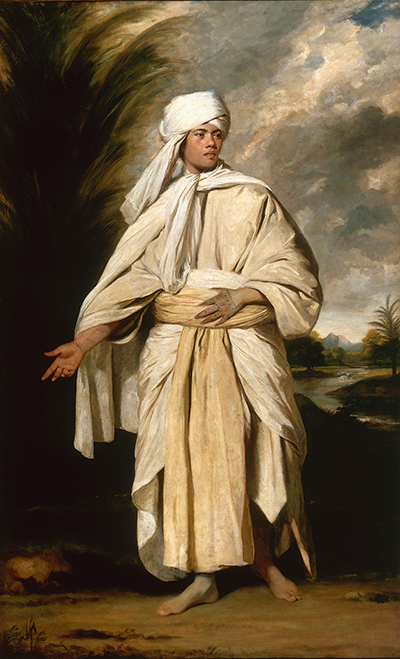
Sir Joshua Reynolds's Portrait of Mai (Omai) is one of the decisive paintings of eighteenth-century British art. It is a portrait, a performance of the Grand Manner, a record of celebrity, a document of Pacific-European encounter and a modern test case for how national collections handle works shaped by empire. Few Reynolds paintings carry so many histories at once. A single figure stands almost life-size, barefoot and robed in white, before a darkened landscape. The pose reaches back to antique sculpture; the sitter's tattooed hands and possible tapa cloth hold the image in the Pacific world from which he came.
The painting is now jointly owned by the National Portrait Gallery in London and the J. Paul Getty Trust, following a major 2023 acquisition.[1][2] The National Portrait Gallery identifies the work as Mai (Omai), NPG 7153, by Sir Joshua Reynolds, oil on canvas, circa 1776, with overall dimensions of 92 7/8 by 57 1/4 inches, or 2360 by 1455 millimetres.[1] Getty's object presentation gives the title as Portrait of Mai (“Omai”), dates it to 1776 and records the Getty accession number as 2023.18.[3] These current facts matter because the painting spent most of its long life in private ownership and only recently entered shared public stewardship.
The sitter was Mai, known in Britain as Omai, a young man from Raiatea in the Society Islands. The National Portrait Gallery describes him as the first Polynesian to visit England.[1] Getty's account explains that he arrived in Britain in 1774 and became a figure of fascination across British society.[3] Reynolds painted him without a commission, using the occasion of Mai's celebrity to create what the National Portrait Gallery presents as one of the most ambitious and exceptional British portraits of the period.[1]
At a Glance
- Current titleMai (Omai) / Portrait of Mai (“Omai”) [1][3]
- ArtistSir Joshua Reynolds
- Datecirca 1776 [1]
- MediumOil on canvas [1]
- SitterMai of Raiatea, known in Britain as Omai [1]
- NPG accessionNPG 7153 [1]
- Getty accession2023.18 [3]
- Dimensions2360 × 1455 mm overall [1]
- OwnershipNational Portrait Gallery and J. Paul Getty Trust, jointly acquired 2023 [1][2]
- Current displayJ. Paul Getty Museum, Los Angeles [1]
Contents
- Introduction
- Why the Painting Matters
- Mai in Britain
- Reynolds's Decision
- Composition and Scale
- Pose, Costume and the Classical Body
- The Grand Manner Transformed
- The 1776 Exhibition
- Ownership and Public Acquisition
- Seeing the Painting Now
Why the painting matters
The importance of Portrait of Mai (Omai) begins with its scale and authority. Reynolds did not make a small ethnographic likeness or a decorative curiosity. He made a full-length portrait in the grandest language available to him. The body is monumental, the gesture expansive and the surrounding landscape theatrical. Mai is not tucked into an anecdotal scene. He commands the whole composition.
The National Portrait Gallery states that the painting dominated the Royal Academy exhibition of 1776 and that Reynolds kept it in his Leicester Square studio as a major proof of his skill.[1] That studio retention is crucial. The picture was not sold during Reynolds's lifetime. It stayed with him as a showpiece, a demonstration of what portraiture could do when it fused celebrity, idealisation, classical reference and contemporary encounter.
The work also matters because it stretches the category of British portraiture. Reynolds was famous for elevating aristocrats, actors, writers, officers and children through Old Master and antique models. Here he used that same pictorial language for a Pacific Islander whose presence in Britain had already become a social sensation. The result was neither straightforward likeness nor simple allegory. It was a portrait of a living person transformed into a public emblem.
That transformation is where the painting becomes difficult as well as magnificent. Reynolds gave Mai dignity and authority, but he also framed him through European ideas of antiquity, costume, nature and difference. The painting is therefore not a neutral document. It is a powerful image made inside a world of exploration, colonial expansion, scientific curiosity, elite sociability and metropolitan self-display.
Mai in Britain
Mai's journey to Britain was not accidental sightseeing. Getty explains that he travelled to England after his home island of Raiatea had been attacked by Bora Bora, and that he hoped to secure firearms and support that might help him recover his family's position.[3] This political purpose is essential. Mai was not merely transported into British society as an object of wonder. He had aims of his own.
He reached England in 1774 aboard HMS Adventure, associated with Captain Cook's second voyage.[4] Getty places his arrival at Spithead in July 1774, while the National Portrait Gallery's display material says he became the first Pacific Islander to visit Britain and took fashionable society by storm.[1][3] In Britain he was known as Omai, a name that became familiar in portraits, prints and public conversation.
British observers often treated Mai as evidence of the wider world opened by Pacific voyages. He met royalty and intellectual elites, and his presence intersected with the circles of Joseph Banks, Cook's voyages and London's culture of conversation.[2][3] Yet modern discussion has to keep his own motives in view. He came from a Pacific political world, not from a blank space waiting for British interpretation.
The painting stands at the meeting point between these realities. To British viewers in 1776, Mai could seem exotic, admirable, unsettling, theatrical or politically suggestive. To Reynolds, he offered a chance to make a new kind of grand portrait. To Mai himself, the visit belonged to a practical effort shaped by loss, ambition and the hope of power on returning home.
This is why the portrait should not be treated as a simple celebration of British curiosity. Mai's celebrity in London was real, but celebrity did not mean equality. The attention he received was shaped by fascination with difference, by imperial ambition and by the desire to turn encounter into spectacle. Reynolds's painting is beautiful partly because it makes that spectacle visually persuasive; it is troubling because it shows how easily a living person could be absorbed into another culture's fantasy.
Mai's presence also connected several different British worlds that did not always overlap neatly. He belonged to the history of Cook's voyages, to the social world around Joseph Banks, to courtly display, to Royal Academy culture and to popular print. That range helps explain why Reynolds's portrait could become so resonant. It was not an image of an unknown stranger. It was an image of someone whose identity had already been circulated, discussed and interpreted.[1][2][3]
At the same time, the painting compresses Mai's story into one still moment. The conflict involving Raiatea and Bora Bora, his reasons for travelling, his experience in London, his return to the Pacific and his early death all sit behind the image rather than inside an explicit narrative.[3] Reynolds gives viewers a powerful surface, and modern interpretation has to restore the life pressing behind it.
Reynolds's decision to paint Mai
Reynolds painted Portrait of Mai (Omai) without a commission.[1] That fact separates it from much of his portrait practice. Many Reynolds portraits were made for patrons, families or institutions. This one seems to have been driven by the painter's own ambition and by the opportunity presented by Mai's fame. Reynolds recognised that Mai was not only a sitter but a public phenomenon.
By the mid-1770s Reynolds was at the height of his authority. He was President of the Royal Academy, a leading portrait painter and a theorist of artistic elevation.[5][6] He had long argued that art should draw on great models and general ideas rather than settle for ordinary transcription. Mai gave him a subject through which that theory could become visible.
The painting allowed Reynolds to merge several of his strongest interests: living likeness, antique pose, theatrical presentation, costume, landscape and public effect. It was also a risk. A grand portrait of a Polynesian visitor could not be handled exactly like a British aristocrat's portrait. The picture had to make Mai legible to British viewers while preserving enough specificity to mark him as a person from the Pacific.
The National Portrait Gallery emphasises the mixture of classical sculpture and costume with individual details, including tapa cloth and tattoos.[1] Getty similarly notes the Apollo Belvedere pose, the turban, the tattooed hands and the likely reference to tapa or bark cloth.[3] Reynolds therefore did not simply clothe Mai in generic fantasy. He combined European classicism with selected signs of Pacific identity, making the picture both elevated and culturally charged.
The result is one of Reynolds's most self-conscious demonstrations of portraiture as transformation. Mai is not shown in British dress, even though Getty notes that he adopted British dress while in England.[3] Instead, Reynolds invents or composes a costume that makes him appear at once antique, foreign, noble and theatrical. The painting tells us as much about Reynolds's visual imagination as it does about Mai's actual appearance.
This decision also separates the portrait from simpler records of Mai's visit. A likeness might have fixed his features; Reynolds wanted more. He wanted a public image that could carry the force of encounter itself. That ambition explains the painting's unusual authority, but also its risks. It turns Mai's body into the meeting place of British academic art and Pacific identity, while Reynolds controls the terms of that meeting.
The non-commissioned nature of the portrait may have encouraged this freedom. Without a patron demanding family resemblance, estate setting or dynastic message, Reynolds could shape the picture as a statement about his own art. Mai became a sitter, but also a vehicle for Reynolds's claim that portraiture could match the scale and seriousness of history painting.
Composition and scale
The painting's size is part of its meaning. Getty records the unframed dimensions as 236 by 140 centimetres, while the National Portrait Gallery gives closely related overall measurements.[1][3] This is the scale of a major full-length portrait. Reynolds grants Mai the visual space normally associated with elite European sitters, military heroes or public figures.
Mai stands almost alone, without narrative clutter. The body forms a strong vertical axis, but the gesture opens outward. One arm extends, the other draws fabric across the body. The feet are bare, connecting the figure to the ground. The white garments glow against the darker background, creating a dramatic contrast that makes the body both present and idealised.
The background is not a literal record of a place. It is an imagined landscape, part Arcadian, part tropical, part stage. Getty calls it an idealised tropical setting.[3] Reynolds uses the landscape to detach Mai from the ordinary room of a London sitting and place him in a larger imaginative world. That world is neither wholly Pacific nor wholly classical; it is a British painter's constructed arena for encounter.
The figure's isolation is equally important. Mai is not shown among ships, collectors, scientists, patrons or court figures, although all those contexts shaped his British visit. Reynolds strips away the social machinery and leaves a single body in a theatrical field. This gives the portrait grandeur, but it also conceals much. Mai's political purpose, the violence behind his journey and the networks that managed his celebrity are not narrated directly. They have to be recovered from the history around the painting.
The scale also changes the viewer's relationship to the sitter. A small likeness might invite inspection. This large portrait asks for recognition. Mai is presented as a figure of consequence. Reynolds's achievement lies in making that consequence visually immediate.
A painting between likeness and theatre
The portrait works because it keeps likeness and theatre in tension. Mai is recognisable as an individual, but everything around him heightens the encounter. The gesture is too poised to feel casual, the costume too arranged to feel merely documentary, the landscape too dramatic to feel local. Reynolds turns a real sitter into a staged presence without making him disappear.
This was one of Reynolds's great gifts as a portraitist. He knew that a portrait could be more than a record of face and costume. It could propose a role for the sitter to occupy. In aristocratic portraits, that role might be graceful inheritance, maternal virtue, military honour or cultivated ease. In Portrait of Mai (Omai), the role is more complex: Pacific visitor, celebrity, noble stranger, classical figure and sign of a widening world.
Theatricality does not mean falseness in any simple way. Reynolds lived in a London culture where theatre, conversation, exhibition and portraiture were closely connected. A sitter's public image was often made through performance. Mai's British celebrity was itself theatrical, shaped by introductions, visits, display and retelling. Reynolds's painting extends that theatrical culture into oil paint.
But the painting's theatricality also creates distance. Viewers are not invited into Mai's thoughts. They see him as arranged for their admiration. The image withholds the voice of the person it monumentalises. That withholding is one reason the painting now needs careful reading. Its grandeur is real, but grandeur can be a beautiful form of silence.
Reynolds's success lies in making the silence active. Mai's gaze, stance and outstretched arm keep the image from becoming passive display. He appears alert, composed and self-possessed. Even inside Reynolds's constructed theatre, the sitter resists being reduced to ornament. The portrait holds him between presentation and presence.
Pose, costume and the classical body
The pose is one of the painting's most discussed features. Getty states that it recalls the Apollo Belvedere, one of the celebrated sculptures of classical antiquity.[3] That reference places Mai within the European language of ideal male beauty and heroic poise. Reynolds had studied Italian and antique models during his own formative travels, and his mature Grand Manner often depended on such learned borrowing.[5][6]
The classical reference does several things at once. It elevates the sitter, giving Mai a dignity associated with ancient art. It also translates him into a European visual code, making him intelligible to British viewers through a familiar ideal. The result is powerful but not innocent. Mai becomes both individual and type, both person and symbol.
Costume deepens this ambiguity. The white garments are flowing and luminous, but they are not a straightforward ethnographic record. Getty suggests that the cream-coloured fabric of sash, turban and robe is likely intended to represent tapa, or bark cloth, traditionally associated with high standing in Polynesian culture.[3] The National Portrait Gallery likewise identifies tapa cloth as one of the individualising details mixed into the picture.[1]
At the same time, the turban and drapery also belong to Reynolds's theatrical vocabulary of "oriental" and classical costume. They make Mai appear distant from ordinary London modernity. The clothing is therefore both an attempt at cultural reference and an artistic invention. It is part Pacific sign, part European fantasy and part Grand Manner theatre.
The tattoos on Mai's hands are among the painting's most important specific details. Both the National Portrait Gallery and Getty mention them.[1][3] They anchor the sitter's body in Polynesian identity even as the pose and costume translate him through antique and European forms. Reynolds does not hide the tattoos; the gesture helps display them. The result is a portrait that makes difference visible, but within a frame controlled by the painter's artistic culture.
The same complexity applies to the bare feet. They can suggest naturalness, vulnerability, classical simplicity, non-European difference or a carefully staged rejection of ordinary European dress. Their meaning is not fixed. In a European portrait, bare feet could invoke antiquity or pastoral innocence; in Mai's portrait they also mark him as outside the conventions of British elite footwear. Reynolds uses that ambiguity to strengthen the image's symbolic charge.
The white clothing also alters the body. It gives Mai luminosity and ceremonial force, but it does not behave like ordinary British costume. Its folds let Reynolds draw on the draped forms of classical sculpture and Renaissance painting. At the same time, the likely reference to tapa connects the garment to Polynesian social meaning.[3] The fabric therefore becomes one of the painting's most active devices: a bridge between Reynolds's art-historical memory and Mai's cultural identity.
It is tempting to solve the costume by calling it accurate or inaccurate, but the painting is more subtle than that. Reynolds was not making an ethnographic illustration. He was composing a portrait that had to persuade British viewers visually. The costume is therefore evidence of selection, translation and invention. It tells us how Reynolds imagined Mai should appear in order to become monumental.
The Grand Manner transformed
Reynolds's Grand Manner aimed to raise portraiture above ordinary likeness by borrowing from history painting, antique sculpture and Old Master composition. In many portraits, that meant making aristocrats look heroic, maternal, learned, graceful or tragic. In Portrait of Mai (Omai), the same method is applied to a sitter whose fame came from Pacific travel and metropolitan fascination.
This makes the painting one of the most revealing tests of Reynolds's theory. The Grand Manner could dignify Mai, but it could also remake him. The portrait does not simply show who Mai was; it shows what British art could make of him. It transforms a politically motivated Pacific traveller into a figure of European pictorial grandeur.
The National Portrait Gallery presents the painting as exceptional because it gives a person of colour a grandeur and authority unusual in British portraiture of the period.[1] That is an important claim, but it should be held together with the painting's limits. Reynolds's grandeur is real. So is the European framing that shapes it. The painting honours Mai visually while also absorbing him into British expectations of nature, classicism and exotic encounter.
The portrait therefore expands the Grand Manner and exposes it. It proves that Reynolds's elevated language could be extended beyond the British aristocratic world. It also shows how that language depended on turning people into types and ideals. Mai's individuality survives, but it survives inside a highly constructed image.
This tension is part of the painting's continuing force. The work is too great to reduce to propaganda and too historically entangled to admire without questions. It is both a masterpiece of portraiture and an artefact of imperial looking.
The Grand Manner also gave Reynolds a way to avoid simple caricature. Eighteenth-century images of non-European people could easily collapse into costume study, curiosity or comic difference. Reynolds did something more ambitious. He made Mai occupy a pictorial rank associated with heroic and noble figures. That does not free the painting from the assumptions of its culture, but it gives the sitter a visual seriousness that remains striking.
This is why the painting can be described as both generous and appropriating. Reynolds grants Mai grandeur, but the grandeur is built from European codes. The portrait enlarges the sitter while translating him. Its power lies in that unresolved exchange.
The 1776 Royal Academy exhibition
Reynolds exhibited the portrait at the Royal Academy in 1776.[1][3][7] The timing was extraordinary. Mai returned toward the Pacific shortly after the exhibition, while Britain was entering a year marked by imperial strain, political anxiety and the American declaration of independence. Esther Chadwick's account of the 1776 Royal Academy exhibition describes the show as a space in which empire, politics and art met with unusual intensity.[7]
The National Portrait Gallery states that Reynolds's portrait dominated the 1776 Royal Academy exhibition.[1] Getty notes that the picture was submitted to the annual exhibition in April 1776 and met with wide acclaim.[3] In the exhibition room, Mai's image was not simply an impressive portrait. It was part of a broader visual field in which Britain was thinking about its place in the world.
Chadwick's discussion places the painting among other works and responses connected with empire, including the reported reaction of the Mohawk leader Thayendanegea, or Joseph Brant, to Reynolds's classicising full-length of Mai.[7] That account is historically mediated and needs care, but it reveals how the painting could become a screen for British anxieties about race, masculinity, alliance, war and colonial power.
The exhibition also mattered because Reynolds was not merely one painter among many. He was President of the Royal Academy. His choice to show Mai on this scale had institutional weight. Viewers encountered the portrait as a work by the Academy's leading figure, displayed in a public artistic setting at a politically charged moment.
For Reynolds, the exhibition confirmed the painting's success as spectacle. For modern viewers, it reveals the portrait's first public life. The picture entered the world not as a quiet private likeness, but as a major exhibition event. It asked to be seen, discussed and remembered.
The 1776 setting also helps explain why Mai's portrait could carry such heavy symbolic pressure. Britain was not simply looking outward from a secure centre. The same year brought revolutionary crisis in North America, debate over imperial authority and a public appetite for images connected with global expansion.[7] A Pacific visitor painted by the President of the Royal Academy could therefore become part of a much wider conversation about empire, loyalty, difference and power.
Chadwick's account of the exhibition is valuable because it reminds us that the Academy room was not politically neutral.[7] Paintings did not hang outside history. They were seen by viewers who brought newspaper debates, war news, colonial anxieties and ideas about race and gender into the act of looking. Portrait of Mai (Omai) was admired as art, but it also operated in that charged public atmosphere.
Reynolds may not have intended every political reading the painting attracted. Great portraits often exceed the painter's control. What matters is that the image was large enough, strange enough and timely enough to become a place where competing meanings gathered. That is one mark of a major work.
Mai's agency and British fantasy
Modern writing about the painting has to resist two simplifications. One is to treat Mai only as a victim of British representation. The other is to treat the portrait only as enlightened dignity. The harder truth lies between those positions. Mai had agency, aims and political intelligence; he was also represented within a culture that turned him into an object of fascination.
Getty's account is especially useful because it stresses Mai's own purpose in travelling: he hoped to gain military assistance and resources for his Pacific objectives.[3] The National Portrait Gallery notes that he joined Cook's second voyage with specific intentions, seeking weapons and social advancement in Polynesia.[1] These details prevent the painting from becoming a story only about British curiosity.
Yet British society did transform Mai into "Omai," a celebrity figure whose name, image and story circulated in portraits, prints and later theatre. The National Portrait Gallery notes the impact of his visit on the popular imagination of eighteenth-century Britain.[1] That imagination could admire him while misunderstanding him. It could celebrate his grace while ignoring the violence and political struggle that shaped his journey.
Reynolds's portrait participates in this transformation. The picture gives Mai a grandeur denied to many non-European subjects in British art, but it also converts his real political situation into a poised, beautiful, silent image. He does not speak in the painting. He appears.
This silence is not emptiness. It is one reason the portrait remains so compelling. Mai's body carries multiple meanings: sitter, traveller, celebrity, political actor, Pacific subject, British spectacle, classical figure and modern object of historical reckoning. Reynolds's genius was to make that body unforgettable. The challenge now is to remember that the image's beauty does not exhaust the sitter's life.
Mai's return to the Pacific gives the portrait an additional poignancy. Getty records that he left Britain in June 1776, shortly after the Royal Academy exhibition, reached the Pacific and died there in 1780 without recovering Raiatea.[3] The painting therefore preserves him at the height of British fascination, just before his story moved away from London and back into the political world from which he had come.
That timing can change how the picture feels. In 1776, viewers saw a current celebrity. Today, we see a person whose later hopes were not fulfilled. The portrait's elegance is haunted by what it cannot show: the limits of British admiration, the failure of Mai's project and the shortness of his life.
This does not diminish Mai. It restores him. Instead of treating him as the timeless figure Reynolds created, modern interpretation can place him back into time: born around 1753, displaced by conflict, brought to Britain in 1774, exhibited by Reynolds in 1776, returned to the Pacific in 1777 and dead by about 1780 according to NPG and Getty chronology.[1][2][3]
Studio showpiece and ownership history
After the 1776 exhibition, Reynolds kept the portrait. The National Portrait Gallery says it remained on display in his Leicester Square studio as a premier example of his skill and creativity.[1] Getty likewise describes it as a showpiece in the artist's studio until his death in 1792.[3] This was unusual and telling. Reynolds evidently understood the painting as a major achievement.
The later ownership history is also significant. The GOV.UK export-bar notice records the provenance from Reynolds's studio sale at Greenwood's in London on 16 April 1796, where the painting was bought by Michael Bryan for 100 guineas, then acquired by Frederick Howard, 5th Earl of Carlisle, by 13 August 1796.[4] It then remained with the Carlisle family at Castle Howard by descent for more than two centuries before appearing at Sotheby's in London in 2001, where it sold for £10,343,500.[4]
That long private history shaped access to the painting. Although famous, it was not continuously available in a national collection. Its reputation depended on exhibitions, scholarship, reproduction and the aura of rarity. The painting's movement from Reynolds's studio to Castle Howard and eventually to the international art market is part of its modern significance.
The National Portrait Gallery and Getty acquisition changed that history. In 2023 the two institutions jointly acquired the painting, with support from the National Heritage Memorial Fund, Art Fund and many donors.[1][2] Getty described the arrangement as an innovative model in which the painting would be shared for exhibition, study and conservation care, travelling between Britain and the United States.[2]
The current NPG record states that the painting is on display at the J. Paul Getty Museum in Los Angeles.[1] This is not a minor logistical fact. It is the visible result of the shared ownership model that saved the painting from remaining a largely private trophy and placed it within a transatlantic public framework.
Castle Howard's long place in the story matters because it kept the painting in an aristocratic setting after Reynolds's death. The picture moved from the artist's own self-fashioning environment into a country-house collection, where it belonged to another kind of prestige. It was famous, but not ordinary to see. That partial inaccessibility helped create the aura around it.
The 2001 Sotheby's sale marked another transformation. The government provenance note records the price at more than £10 million.[4] By 2022, the recommended matching price had become £50 million.[4] The rise in value was not just market inflation. It reflected the painting's exceptional status as a Reynolds masterpiece, a key image of Mai and a work increasingly recognised as central to histories of empire and representation.
The 2023 acquisition therefore resolved more than a financial problem. It changed the painting's civic status. A work long associated with private prestige entered a shared museum arrangement designed around access, interpretation and care. That shift is now part of the portrait's meaning.
Export bar and public acquisition
The modern acquisition story began with concern that the painting might leave the United Kingdom. In 2022 the UK government placed a temporary export bar on the work, describing it as worth £50 million and identifying it as a full-length, life-size eighteenth-century painting.[4] The notice stressed its connection to voyages of exploration and to British reception of people from beyond Europe.[4]
The Reviewing Committee on the Export of Works of Art and Objects of Cultural Interest found that the painting met all three Waverley Criteria: connection with national life, outstanding aesthetic importance and outstanding significance for the study of British history and eighteenth-century art, especially Reynolds.[4] This placed the painting among works considered of exceptional cultural importance.
The eventual 2023 acquisition required an unusual financial and institutional structure. Getty reported that the National Portrait Gallery raised £25 million, including £10 million from the National Heritage Memorial Fund and £2.5 million from Art Fund, with Getty matching the amount needed to reach the £50 million purchase price.[2] The campaign also involved major philanthropic support and donations from more than 2,000 members of Art Fund, NPG supporters and the wider public.[2]
This acquisition story should not distract from the painting itself, but it belongs to the painting's meaning now. Portrait of Mai (Omai) is no longer simply a great Reynolds that passed through aristocratic and private ownership. It is a test case in how major works connected with empire, race and global encounter are acquired, shared and interpreted by public institutions.
The joint ownership also mirrors the painting's own history of movement. Mai travelled from the Pacific to Britain and back; the portrait moved from Reynolds's studio to a country house, the market and now shared museum care. Its history has always involved crossings: geographic, cultural, social and institutional.
The fundraising language around the acquisition also shows how the painting now belongs to several publics at once. Getty reported major institutional support and donations from thousands of members and supporters.[2] The object is shared between London and Los Angeles, but its acquisition also involved a wide network of people who understood it as worth preserving in public hands. That broad participation is a modern counterpoint to the painting's older private life.
The acquisition does not erase the difficult history embedded in the painting. It makes that history more available. Public ownership creates the possibility of more layered interpretation: Pacific context, British portraiture, Reynolds's ambition, colonial encounter, conservation, display and reception can be held together rather than separated into specialist compartments.
Prints and the making of Omai's image
The painting was not known only through direct viewing. Prints played an important role in spreading Mai's image. The National Portrait Gallery holds Johann Jacobé's 1780 mezzotint after Reynolds, and its record states that Reynolds's portrait became widely known through that print.[8] This print afterlife helped fix Omai in British visual culture.
The NPG record for Jacobé's mezzotint also notes that the image influenced perceptions of Omai in relation to the idea of the "natural man" associated with Jean-Jacques Rousseau.[8] That language needs careful handling. The phrase belongs to European intellectual fantasy as much as to Mai's own identity. It reveals how British and European viewers turned him into a symbol for their own arguments about nature, civilisation and difference.
The print mattered because it detached the image from the unique painting. A mezzotint could circulate among people who never saw the Royal Academy exhibition or Reynolds's studio. It could be collected, displayed and copied. It could make Mai's image part of a wider visual economy.
Later prints and adaptations extended this afterlife. The National Portrait Gallery's person record for Mai includes a 1774 line engraving, works by Francesco Bartolozzi after Nathaniel Dance, Johann Jacobé after Reynolds, Samuel William Reynolds after Reynolds and a 2023 print by Elizabeth Peyton after Reynolds.[9] Such variety shows that Mai's image did not remain confined to one painting. It was repeatedly remade.
This circulation is double-edged. Prints preserved and amplified Mai's visibility, but they also intensified the process by which he became an image for others to interpret. The more the portrait circulated, the more "Omai" became a British cultural construction as well as a name attached to Mai.
The Jacobé mezzotint is especially important because it translated Reynolds's large painted spectacle into a medium built for circulation. Mezzotint could preserve tonal drama more effectively than many linear methods, allowing the white costume, dark setting and modelled body to retain some of their force. Viewers who never stood before the painting could still encounter the basic structure of Reynolds's invention.
Print also hardened the portrait's identity. Once copied and published, the image could travel with captions, assumptions and interpretive habits attached. The sitter's name, costume and pose became repeatable signs. That repeatability helped make Mai famous, but it also made him vulnerable to simplification. The print afterlife is therefore a crucial part of the painting's power and its problem.
Preparatory and related works
The inherited history of the painting often mentions related studies, and here caution is useful. The National Library of Australia's Nan Kivell Collection guide confirms that the collection includes a sketch by Joshua Reynolds of the Tahitian chief Omai.[10] This is an important related object, especially because the Nan Kivell Collection is strong in Pacific voyage material, drawings and prints.[10]
The existence of a Reynolds sketch supports the view that Mai's image was worked through in more than one medium. It also links the painting to the broader visual record of Pacific exploration and collecting. But a sketch should not be overused as proof of every compositional decision in the finished painting. It is best treated as related evidence within a larger cluster of portraits, prints and studies.
Yale-related references also record an oil sketch of Omai associated with Reynolds, though the strongest current object narrative for the main painting remains the NPG/Getty material.[3] For a flagship article, the hierarchy of evidence matters: current institutional records should control title, date, medium, dimensions, ownership and display, while related sketches and prints illuminate process and reception.
This is where Mannings and Postle's Reynolds catalogue remains important.[11] The catalogue raisonné provides the backbone for Reynolds's painted oeuvre, object identity and version control, but current ownership and display must be checked against live museum records. Portrait of Mai (Omai) is exactly the kind of painting where older literature, market history, institutional acquisition and modern interpretation must be held together.
Related material also helps prevent the finished painting from appearing out of nowhere. Reynolds's portrait was the most famous image of Mai, but Mai had already been drawn, engraved and described in other contexts. The National Portrait Gallery's Mai record shows several images of him across print and portrait culture.[9] Reynolds's achievement was not simply to introduce Mai visually, but to give his image a new monumental form.
The related sketches and prints also make clear that the portrait belongs to a culture of image-making, not a single isolated encounter. Mai's likeness moved through drawings, engravings, paintings and later reinterpretations. Each medium changed him. Reynolds's canvas became the dominant image because it had exceptional pictorial authority, not because it was the only visual record.
Seeing the painting now
To look at the painting today is to see two kinds of brilliance. The first is pictorial. Reynolds handles scale, contrast and gesture with extraordinary confidence. The white costume glows against the darker landscape. The body is poised without stiffness. The face is individual enough to resist total allegory, yet the composition is grand enough to turn the sitter into an emblem.
The second brilliance is historical, and it is less comfortable. The portrait condenses a world of voyages, collecting, diplomacy, colonial violence, courtly curiosity, Academy display and art-market prestige. Mai's presence in Britain was made possible by Pacific conflict and European expansion. Reynolds's painting transforms that history into beauty, but does not dissolve it.
The bare feet are a good example. They can be read as natural simplicity, theatrical exoticism, bodily presence or separation from European shoes and court dress. The tattoos can be read as specific identity, visual fascination or a sign absorbed into a European pose. The tapa-like cloth can be read as cultural reference and as pictorial drapery. Each detail is doing more than one thing.
That multiplicity is why the painting remains so alive. It does not settle into one moral or one formal category. It is not merely a portrait of Mai, not merely an imperial fantasy, not merely a Grand Manner masterpiece and not merely a modern acquisition story. It is all of these at once.
The current joint ownership by the National Portrait Gallery and Getty gives modern viewers a chance to keep those meanings open. Getty's 2023 statement described the portrait as a starting point for ongoing study by the two institutions.[2] That is the right approach. The painting is not finished as a historical problem just because it has entered public care.
The painting also asks viewers to look slowly at the difference between splendour and truth. Its splendour is immediate: the robe, the gesture, the scale, the theatrical sky. Its truth is harder because it is dispersed across biography, voyage history, colonial ambition, Reynolds's theory and later ownership. The work rewards formal admiration, but it also insists that admiration alone is not enough.
This is perhaps why it has become such a valuable modern museum object. It can introduce Reynolds's art to viewers who know little about eighteenth-century portraiture, while also opening onto Pacific history, the politics of display, the art market and institutional collaboration. Few paintings are so useful without becoming merely illustrative. Portrait of Mai (Omai) remains first a powerful work of art; its historical reach grows from that power.
The painting's present visibility also changes the kind of questions that can be asked of it. Earlier viewers often approached it through Reynolds's fame, Mai's celebrity or the drama of private ownership. Current viewers can set those questions beside others: how Pacific histories are represented in British art, how non-European sitters were made legible to European audiences, how costume can honour and distort at once, and how museum partnership can alter the future of a long-private work.[1][2][3]
This expanded context does not make the painting less beautiful. If anything, it makes the beauty more demanding. Reynolds's surface is still persuasive, but the viewer now has to ask what persuasion is doing. The portrait invites admiration and then complicates that admiration. It turns looking into an ethical as well as visual act.
Place within Reynolds's career
Within Reynolds's career, Portrait of Mai (Omai) stands near the centre of his ambition. It belongs to the years when he was not only the most prominent portrait painter in Britain but also the public voice of the Royal Academy.[5][6] He wanted portraiture to borrow dignity from history painting and antique example. In Mai, he found a sitter whose unusual position in British society allowed him to test that ambition with exceptional force.
The painting also shows Reynolds at his most visually strategic. He did not need to invent a complicated narrative. He arranged a single figure with enough authority to carry a world of meanings. The picture's simplicity is deceptive. Its power depends on highly calculated choices of pose, costume, scale, landscape and exhibition timing.
Compared with many Reynolds portraits, this one has a different public charge. Aristocratic portraits often confirm status that already exists within British social hierarchy. Portrait of Mai (Omai) creates status inside the image itself. Mai was famous in Britain, but he did not belong to the rank system that structured many of Reynolds's commissions. Reynolds therefore used pictorial grandeur to make a different kind of authority visible.
That authority is not free from contradiction. Reynolds's visual elevation depends on European codes. Yet the painting also resists being reduced to a European fantasy because Mai's individual presence remains strong. The viewer is aware of a real sitter behind the image, a person whose life extended beyond the picture and whose aims were not the same as Reynolds's.
This is the painting's lasting achievement. It shows Reynolds's Grand Manner at full power, but also pushes that manner into territory where its assumptions become exposed. The portrait is magnificent because Reynolds succeeded; it is historically urgent because the terms of that success now demand scrutiny.
Legacy
The legacy of Portrait of Mai (Omai) has changed over time. In 1776 it was a sensational Academy portrait of a celebrated Pacific visitor. In Reynolds's studio it became a personal showpiece. At Castle Howard it became a famous but privately held masterpiece. In the modern export-bar debate it became a contested national treasure. After the 2023 NPG/Getty acquisition, it became a shared object of public access, transatlantic stewardship and renewed interpretation.
That changing legacy is part of the painting's greatness. It has never been static. Its meanings have shifted with the viewers who faced it: Academy visitors, aristocratic owners, print collectors, museum campaigners, historians of empire, Pacific scholars and contemporary audiences alert to representation and power.
The portrait also changes the way we understand Reynolds. It confirms him as a master of scale, pose and public image, but it also reveals the ambition and risk of his art. He wanted British portraiture to speak in the language of great European painting. With Mai, that language encountered a global subject and became both splendid and unstable.
For Mai, the painting is neither a full biography nor a final truth. It is a powerful British image of him, made during a brief and extraordinary period of his life. The more carefully we look, the more important it becomes to separate Mai from the role Britain assigned him. He was not only Omai, the celebrity. He was Mai, a man from Raiatea, travelling with purpose through a world increasingly shaped by imperial contact.
That is why Portrait of Mai (Omai) remains indispensable. It is beautiful, but beauty is only the beginning. It asks how portraiture creates dignity, how art converts encounter into image, how celebrity can obscure agency, how collections inherit empire and how a painting can become more historically demanding as it becomes more publicly visible. Reynolds made a masterpiece. Modern viewers inherit the responsibility of seeing all that it contains.
Among Reynolds's paintings, few offer such a concentrated view of his strengths and contradictions. He could command scale, manage theatrical gesture, borrow from antiquity, and make a sitter seem larger than ordinary life. He could also turn a complex human being into an image shaped by British desire. The painting's greatness lies partly in the fact that these two truths cannot be separated.
The portrait therefore deserves its flagship status. It is a key to Reynolds's ambition, but also a key to the broader eighteenth-century world in which his ambition operated. Through Mai, Reynolds made one of the grandest portraits in British art. Through the painting, viewers can still see the meeting of art, empire, celebrity, collecting and historical memory with startling clarity.
Its force lies in how calmly it holds those pressures together.
Frequently Asked Questions
Discussion
How does Reynolds's splendour shape—and complicate—the way Mai is seen?
Reader Insights
How do pose, bare feet, tattoos and white cloth distribute attention across the figure?
Where can Mai's own purpose be recovered from a portrait controlled by Reynolds's visual language?
How does the 2023 joint acquisition change the questions museums can ask of the painting?
Join the Conversation
Share your reading below.
References
- National Portrait Gallery, Mai (Omai), NPG 7153, https://www.npg.org.uk/collections/search/portrait/mw304993/Mai-Omai
- Getty News, “Joshua Reynolds' Portrait of Mai Jointly Acquired by the National Portrait Gallery and Getty”, https://www.getty.edu/news/joshua-reynolds-portrait-of-mai-jointly-acquired-by-the-national-portrait-gallery-and-getty/
- Google Arts & Culture / J. Paul Getty Museum, Portrait of Mai (“Omai”), https://artsandculture.google.com/asset/portrait-of-mai-%E2%80%9Comai%E2%80%9D-purchased-jointly-with-national-portrait-gallery-london-sir-joshua-reynolds/QQGGvk4YvQQ2Tg
- GOV.UK, “Reynolds' Portrait of Omai at risk of leaving UK”, https://www.gov.uk/government/news/reynolds-portrait-of-omai-at-risk-of-leaving-uk
- National Gallery, London, “Sir Joshua Reynolds 1723-1792”, https://www.nationalgallery.org.uk/artists/sir-joshua-reynolds
- National Portrait Gallery, “Sir Joshua Reynolds”, https://www.npg.org.uk/collections/search/person/mp03755/sir-joshua-reynolds
- Esther Chadwick, “1776: The Edges of Empire,” The Royal Academy Summer Exhibition: A Chronicle, 1769-2018, Paul Mellon Centre / Royal Academy of Arts, https://chronicle250.com/1776
- National Portrait Gallery, Johann Jacobé after Sir Joshua Reynolds, Mai (Omai), NPG D1361, https://www.npg.org.uk/collections/search/portrait/mw35500/Omai?LinkID=mp11723&rNo=3
- National Portrait Gallery, “Mai (Omai)” person record, https://www.npg.org.uk/collections/search/person/mp11723/mai-omai
- National Library of Australia, “Nan Kivell Collection”, https://www.library.gov.au/research/guides-and-resources/guides-selected-collections/nan-kivell-collection
- David Mannings, Sir Joshua Reynolds: A Complete Catalogue of His Paintings, with subject pictures catalogued by Martin Postle, Yale University Press / Paul Mellon Centre for Studies in British Art, 2000.