 by Tom Gurney
Tom Gurney BSc (Hons) is an art history expert with over 20 years experience
Published on June 19, 2020 / Page Updated on November 6, 2026
Email: tomgurney1@gmail.com / Phone: +44 7429 011000
Introduction
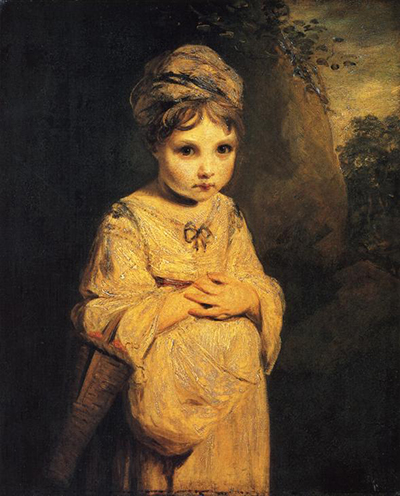
Joshua Reynolds painted The Strawberry Girl at the point where his portrait practice and his more poetic pictures of children began to overlap in unusually delicate ways. The best-known surviving version is now in the Wallace Collection, London, where it is catalogued as P40, an oil on canvas dated 1772-1773 and measuring 76.6 x 63.7 x 2 cm unframed, with a framed size of 97 x 84 cm. The Wallace Collection Online record places it in the Boudoir and identifies it not as a formal commission but as a fancy picture: an image of childhood, costume, feeling and invention rather than a conventional likeness made for a patron.[1]
That distinction matters. The painting shows a young girl standing in a loose pale dress, with a basket of strawberries and a turban-like headdress, alone before rocks and woodland. She appears to belong partly to London street life and partly to a private imaginative world. Reynolds began with the recognisable figure of a strawberry seller, a child hawker who would have been familiar in eighteenth-century London, but he removed her from the ordinary urban surroundings in which such a child would normally be seen. He gave her a stillness and an exoticised costume that transform a social type into a charged image of vulnerability, performance and artistic memory.[2]
For Reynolds, the subject seems to have carried special weight. Later accounts record his high opinion of the invention, and the Wallace Collection’s Reynolds Project notes that he regarded it as one of the rare truly original ideas of his career.[2] That claim should be treated as an index of ambition, not as a reason to isolate the painting from its wider visual culture. The work belongs to a world of repeated versions, engraved images, child fancy pictures, old-master references and family associations. Its power lies precisely in that mixture: familiar enough to be legible, strange enough to remain unsettled.
At a Glance
- Current titleThe Strawberry Girl [1]
- ArtistJoshua Reynolds
- Date1772-1773 [1]
- MediumOil on canvas [1]
- Dimensions76.6 × 63.7 × 2 cm unframed [1]
- InventoryP40 [1]
- Current holderThe Wallace Collection, London [1]
- Subject typeFancy picture / subject picture [1]
- Possible sitterTraditionally Theophila Palmer, later Gwatkin [4]
- Known surviving versionsWallace Collection and Bowood House [1]
Contents
- Introduction
- The Wallace Collection painting
- A fancy picture rather than a portrait
- Strawberry sellers and invention
- Theophila Gwatkin and sitter caution
- Versions and the Bowood comparison
- Colour, surface and condition
- Print afterlife and public familiarity
- Relation to The Age of Innocence
- Legacy
The Wallace Collection painting
The Wallace painting is small enough to invite close looking yet carefully staged enough to carry the authority of a formal picture. The child faces the viewer with her hands gathered at her chest, her body turned slightly, her basket held at one side. A rocky mass behind her frames the figure and pushes her forward into light. The setting is not described as a specific landscape. It works more like a theatrical surround: dark, compressed and suggestive, designed to make the solitary figure feel at once present and withdrawn.[1]
The costume is central to the picture’s effect. The Wallace Reynolds Project describes a cream gown, a pinkish turban and a blue ribbon at the neck, with a basket filled with fruit.[2] These details make the child neither simply poor nor simply aristocratic. She is dressed for an invented role. The turban lifts her away from ordinary labour, while the fruit basket keeps the strawberry seller in view. Reynolds does not erase the idea of street selling; he refashions it as a poetic sign. The result is one of his most memorable examples of a child made to hover between portraiture, theatre and allegory.
The Wallace Collection’s object record gives a particularly useful account of this ambiguity. It notes that such fancy pictures often represented children in sentimental guises, and that Reynolds adapted the real-life figure of a strawberry seller into something unlike standard depictions of working children.[1] The word “sentimental” can sound soft, but the painting is not merely sweet. The child’s isolation, direct look and altered costume introduce unease. Her basket is a familiar object; her surroundings and dress are not. Reynolds invites recognition, then complicates it.
A fancy picture rather than a portrait
The sitter has often been connected with Reynolds’s niece Theophila Palmer, later Theophila Gwatkin, but the painting should not be reduced to a family portrait. The British Museum’s person record identifies Theophila Gwatkin, born Theophila Palmer in 1757 and daughter of Reynolds’s sister Mary Palmer, as generally identified with the model for The Strawberry Girl.[4] The British Museum record for Thomas Watson’s 1774 mezzotint after Reynolds similarly gives the figure as probably Theophila Palmer while also noting Mannings 2165 and the subject-picture classification.[3]
That double framing is the sensible one. Theophila Palmer may well stand behind the face and pose, but the finished work belongs to Reynolds’s subject imagery. It does not present her with the naming apparatus, social markers or dynastic purpose of an exhibited aristocratic portrait. The sitter’s identity is absorbed into role, costume and pictorial invention. In that sense, The Strawberry Girl sits in a different register from Reynolds’s great society portraits, even though it uses his portrait painter’s gift for facial presence.
The distinction also helps explain why the painting remained unusually mobile in meaning. A commissioned likeness is tethered to a family, a name and an occasion. A fancy picture could move more freely through exhibition memory, print culture and later taste. Viewers could admire the child as a type of innocence, melancholy, ruralised labour, family tenderness or painterly invention. Reynolds’s art often depends on that elasticity. Here, he gives just enough biographical foothold for the image to feel personal, while leaving the figure open enough to become emblematic.
Strawberry sellers and invention
Strawberry sellers were common in London, and their cries, baskets and seasonal movement through the streets made them visible figures in urban life.[2] Reynolds’s transformation of that material is striking because it declines literal description. He does not show a city street, a market, a doorway or a crowd. He does not make the child’s labour into a crowded anecdote. Instead, he isolates the seller and turns the basket into a small but essential token of identity.
That transformation changes the emotional key of the subject. A street seller in a city scene would usually belong to the social rhythm around her. Reynolds’s child is separated from that rhythm. Her pose is still, almost devotional. Her gaze meets the viewer, but it does not feel socially easy. The painting’s atmosphere comes from this dislocation: the child is recognisable as a seller, yet the setting makes her seem suspended, as though she has stepped out of everyday time into a pictorial reverie.
The likely French and Dutch echoes deepen that effect without explaining it away. Reynolds had seen paintings by Jean-Baptiste Greuze in Paris in 1771, and the Wallace essay suggests that Greuze’s emotionally charged images of children may have helped shape the mood of The Strawberry Girl.[2] The same account points to a Rembrandtian inheritance, especially the precedent of young figures emerging from shadow, with warm brown tonalities and a sense of inwardness.[2] Reynolds did not copy either model. He absorbed their emotional and tonal possibilities into an English fancy picture.
The invention is also unusually economical. Reynolds does not need many accessories to make the subject memorable. The fruit basket, the turban, the clasped hands and the darkened ground do nearly all the work. Each detail has a practical explanation, yet each detail also exceeds that explanation. The basket belongs to the seller’s trade; the headdress belongs to theatrical transformation; the clasped hands suggest reserve, need or prayer without naming any one emotion. That compression is why the painting can feel larger than its scale. Reynolds builds a whole imaginative situation from a few charged signs.
This is where The Strawberry Girl becomes more than a charming image of a child. Reynolds is testing how much significance a small figure can carry when detached from direct narrative. The basket identifies a social role, the costume invents a second identity, the woodland darkens the mood, and the child’s face keeps the whole arrangement intimate. The painting does not tell a story in the ordinary sense. It creates a condition of attention.
Theophila Gwatkin and sitter caution
The Theophila identification is valuable, but it has to be handled with restraint. The British Museum record gives her life dates as 1757-1848, names her as Reynolds’s niece, and notes that she is generally identified as the model for The Strawberry Girl.[4] That family connection is plausible and important. Reynolds repeatedly painted or used relatives and close acquaintances, and Theophila Palmer’s presence in the wider Reynolds circle helps ground the picture in domestic experience rather than anonymous fantasy.
At the same time, the painting does not behave like a secure named likeness. Its public identity rests on the role rather than on the sitter. The child is remembered as the strawberry girl because Reynolds made the costume, basket and mood stronger than the biographical tag. This is not a failure of identification; it is part of the design. The girl is particular enough to seem alive, but general enough to become a figure of feeling.
Mannings and Postle’s catalogue raisonné, Sir Joshua Reynolds: A Complete Catalogue of His Paintings, is important here because it gives Reynolds’s pictures the discipline of catalogue identity while preserving subject distinctions. The British Museum’s print record explicitly links the Watson mezzotint with Mannings 2165 and notes that Mannings classifies the painting as a subject picture rather than a portrait.[3][7] That is the safest way to read the work. It may draw on Theophila Palmer, but it asks to be understood as invention.
The caution is also useful because Reynolds’s family circle can otherwise pull the painting toward sentimentality. If Theophila is treated as the answer to the picture, the painting becomes too simple: a niece dressed up, a family image made charming. Reynolds’s achievement is stranger. He takes a familiar child, a familiar urban role and a set of older pictorial memories, then fuses them into an image whose identity remains deliberately poised.
Versions and the Bowood comparison
The Wallace painting is not the only version Reynolds made. The Wallace Collection records that he produced at least four versions in the 1770s, of which two are known to survive: the Wallace Collection picture and another at Bowood House in Wiltshire.[1] The Bowood picture is especially important because it represents a distinct compositional type. According to the Wallace record, one type shows a headdress with tassels covering the hair more fully, while the Wallace version leaves hair visible beneath the turban.[1]
That difference might sound minor, but it reveals Reynolds thinking through the image as a repeatable invention rather than a single fixed design. In fancy pictures, small changes of costume, expression and silhouette can alter the emotional balance. A more enclosing headdress may make the child seem more costumed and remote; visible hair can soften the figure and draw her closer to the viewer. Reynolds’s repetitions were not mechanical. They were opportunities to adjust how the idea breathed.
The technical evidence makes the Wallace version still more interesting. The Wallace Collection notes that X-ray examination shows the present painting originally resembled the alternative composition and that the headdress was subsequently reworked.[1] In other words, the Wallace painting carries traces of movement between the version types. Its surface is not simply the endpoint of a design; beneath it lies evidence of decision, revision and comparison.
James Northcote’s later account of Reynolds’s advice about working on repetitions alternately is relevant in this context, and the Wallace record uses it to illuminate the artist’s practice.[1] The point is not that Reynolds copied himself lazily. It is almost the opposite. Repetition allowed him to keep several states of a composition alive, test one against another and discover changes that a single uninterrupted version might not have produced. The Strawberry Girl belongs to that experimental habit.
The Bowood comparison also protects the Wallace painting from a misleading singularity. The best-known version has become the one through which many viewers meet the subject, but Reynolds’s original idea existed as a cluster of related pictures and prints. A full reading has to allow for that multiplicity. The image was not merely painted; it was rehearsed, revised, multiplied and circulated.
Colour, surface and condition
The Wallace painting’s present appearance is partly the result of Reynolds’s technique and the later life of the surface. The Wallace Collection notes that the picture has deteriorated in part because of the artist’s experimental and unconventional materials.[1] The Wallace Reynolds Project adds that the original colour effects were probably more varied than they now seem, with unstable red and yellow lake pigments contributing to changes in the dress and surrounding tonal relationships.[2]
This matters because Reynolds’s colour should not be judged only by what survives at first glance. The dress, now often read as a pale cream mass, may originally have included livelier distinctions among underskirt, apron and other fabrics.[1][2] Multiple varnish layers further complicate the reading of tone.[1] The painting’s softness, therefore, is not simply a chosen aesthetic. It is also a historical condition produced by materials, ageing and conservation history.
Reynolds’s technical adventurousness was one of the glories and hazards of his practice. The National Gallery Technical Bulletin essay “Practice Makes Imperfect” discusses the wider problem of Reynolds’s complex paint structures, unusual media and vulnerable surfaces.[5] The Strawberry Girl fits that broader pattern. The old-master warmth he sought could be dazzling, but the means by which he pursued it were not always stable.
The connection with Rembrandt is especially vivid here. Reynolds admired warm shadows, luminous flesh and the sense that a figure might emerge slowly from darkness. In The Strawberry Girl, those ambitions are scaled down to a child subject. The golden-brown world around the figure gives the picture an air of age and depth, but the technical record reminds us that such effects were not neutral. Reynolds was not merely imitating old pictures; he was trying to manufacture old-master richness through modern experiment.
Print afterlife and public familiarity
The painting’s reputation was strengthened by prints. The British Museum holds Thomas Watson’s 1774 mezzotint after Reynolds, made by Watson and published by Walter Shropshire.[3] The print shows the young girl in three-quarter length, with her hands together, a basket on her arm and rocks behind her. Its record identifies it as a proof before title and connects it with Mannings 2165.[3] The print is important evidence for how quickly the image entered reproductive circulation.
Mezzotint was particularly well suited to Reynolds’s tonal ambitions. Its velvety blacks, soft transitions and luminous highlights could translate the painter’s chiaroscuro into a form suitable for wider ownership and viewing. For a picture such as The Strawberry Girl, that mattered. The image depended less on complex narrative than on mood, light and a child’s inward presence. Mezzotint could carry those qualities with unusual sympathy.
The print also helped detach the subject from any one painted version. Once engraved, the strawberry girl could circulate as an image known by title, role and feeling. The public did not need to stand before the Wallace or Bowood canvas to recognise the invention. Reproductive culture gave Reynolds’s fancy pictures a second life, and in some cases helped define their later fame.
That afterlife requires careful separation from the painting itself. Watson’s mezzotint is not Reynolds’s canvas, and its details cannot simply be read back into the Wallace picture without caution. But the print demonstrates that the subject was available to viewers early, and that it belonged to a broader market for images after Reynolds. The strawberry girl became not just a painted child but a reproducible idea.
Relation to The Age of Innocence
The Strawberry Girl is often considered alongside The Age of Innocence, another Reynolds child image whose later fame outgrew the precision of its original identity. The Wallace Collection notes that, with The Age of Innocence, The Strawberry Girl became one of Reynolds’s most popular fancy pictures in the nineteenth century.[1] The comparison is useful because both works ask viewers to respond to childhood as an imaginative construct rather than a straightforward record.
The relationship should not be pushed too far. The Age of Innocence has its own history of naming, sitter uncertainty and overpainted identity; British Museum and Tate-linked records treat that object’s status with appropriate caution.[6] The Strawberry Girl is earlier, more explicitly tied to street selling, and more visibly entangled with repeated versions. Yet both works show Reynolds turning child subjects into images capable of bearing moral, emotional and commercial value long after their first making.
The comparison also clarifies Reynolds’s range. He could make children dynastic, as in grand family portraits; theatrical, as in fancy pictures; or emblematic, as in later images of innocence and feeling. The Strawberry Girl belongs to the middle of that spectrum. It is not a family monument, yet it is not an abstract allegory either. It preserves the immediacy of a child’s face while releasing that child into a more poetic order.
Legacy
The later popularity of The Strawberry Girl depended on several linked qualities: a memorable title, a compact composition, a child subject, a strong reproductive afterlife and a surface that seemed to carry old-master atmosphere. The Wallace Collection record notes that the composition was much copied and admired, and that the fourth Marquess of Hertford acquired the painting in 1856 through Samuel Mawson.[1] Its passage into the Wallace Collection gave the picture a prominent place within one of London’s great collections of eighteenth-century British painting.
What remains most compelling is the painting’s tension between sweetness and disturbance. The child is beautifully presented, but she is also alone. The strawberries promise appetite and abundance, but the setting is shadowed. The costume charms, yet it also distances. Reynolds understood that an image of childhood could become powerful when it refused to settle into simple prettiness.
The painting’s fame can therefore be explained without reducing it. It is not merely a portrait of Theophila Palmer, not merely a London strawberry seller, not merely a Rembrandtian exercise, and not merely a sentimental child. It is a Reynolds invention in which those elements are held together. Its delicate instability is the point. The girl seems to have stepped out of the street, out of family memory and out of old-master darkness, only to pause before us with a basket of fruit and a gaze that still resists possession.
Frequently Asked Questions
Discussion
How does Reynolds transform a recognisable child seller into an image poised between labour, costume, family memory and invention?
Reader Insights
Where does the possible sitter end and the fancy-picture role begin?
What do the Bowood comparison and X-ray reveal about repetition as experiment?
How should altered colour and layered varnish affect a modern reading of Reynolds's atmosphere?
Join the Conversation
Share your reading below.
References
- Wallace Collection Online, The Strawberry Girl, P40, https://wallacelive.wallacecollection.org/eMP/eMuseumPlus?module=collection&objectId=64930&service=ExternalInterface
- Wallace Collection, Reynolds Project, The Strawberry Girl, https://www.wallacecollection.org/explore/explore-in-depth/reynolds/the-paintings/the-strawberry-girl/
- British Museum, Thomas Watson after Joshua Reynolds, The Strawberry Girl, 1840,0808.130, https://www.britishmuseum.org/collection/object/P_1840-0808-130
- British Museum, Theophila Gwatkin, biographical record, https://www.britishmuseum.org/collection/term/BIOG30158
- Alexandra Gent, Ashok Roy and Rachel Morrison, “Practice Makes Imperfect: Reynolds’s Painting Technique,” National Gallery Technical Bulletin, 2014, https://www.nationalgallery.org.uk/technical-bulletin/vol-35-essay-2-2014
- A&AePortal, Joshua Reynolds, The Age of Innocence, https://aaeportal.com/images/41855/the-age-of-innocence
- David Mannings, Sir Joshua Reynolds: A Complete Catalogue of His Paintings, with subject pictures catalogued by Martin Postle, 2 vols, Yale University Press / Paul Mellon Centre for Studies in British Art, 2000.