 by Tom Gurney
Tom Gurney BSc (Hons) is an art history expert with over 20 years experience
Published on June 19, 2020 / Page Updated on November 6, 2026
Email: tomgurney1@gmail.com / Phone: +44 7429 011000
Introduction
Sir Joshua Reynolds lived a career of unusual reach: provincial beginnings in Devon, training in London, Italian study, social ascent, artistic celebrity, Royal Academy leadership and a ceremonial funeral at St Paul's Cathedral. His life cannot be reduced to a steady climb from talent to fame. It was a careful construction of identity, reputation and authority. Reynolds became the most influential British portrait painter of his age because he understood painting as social art, learned art and public performance at once.
He was born at Plympton in Devon on 16 July 1723 and died in London on 23 February 1792.[1] The Paul Mellon Centre describes him as a painter, collector and writer, the foremost portrait painter in eighteenth-century England, a founding member and first President of the Royal Academy of Arts, and a painter whose poses often drew from Old Masters or antique sculpture.[1] That summary captures the unusual breadth of his biography. Reynolds was a maker of images, but also a builder of institutions and artistic language.
The National Portrait Gallery calls him Britain's leading portrait painter and notes that he used social contacts to advance himself.[2] That observation is crucial, not merely colourful. Reynolds's career depended on the art of being seen by the right people. He painted aristocrats, writers, actors, children, soldiers and public figures, but he also turned himself into a public figure. His biography is the story of a painter who learned that the portrait studio, the club, the exhibition room, the lecture hall and the academy could all serve the same ambition.
At a Glance
- Born16 July 1723 [1]
- BirthplacePlympton, Devon [1][6]
- FatherReverend Samuel Reynolds, teacher and scholar [6]
- TrainingApprenticed to Thomas Hudson from 1740 [4][5]
- Italian studyRome and other Italian centres, 1749–52 [4][6]
- London studioEstablished in the early 1750s [4][5]
- Royal AcademyFounding member and first President from 1768 [2][7]
- KnighthoodKnighted by George III in 1769 [1][7]
- DiscoursesFifteen Academy addresses delivered between 1769 and 1790 [6][8]
- Died23 February 1792; buried at St Paul’s Cathedral [1][11]
Contents
- Introduction
- Plympton and Early Formation
- Italy and the Old Masters
- London and Professional Ascent
- Portraiture and Social Intelligence
- The Royal Academy
- The Discourses
- Friendship, Clubs and Conversation
- Technique and Contradiction
- St Paul’s and Legacy
Plympton and early formation
Reynolds was born in Plympton, Devon, into an educated clerical household. The National Gallery states that his father was a headmaster and fellow of Balliol College, Oxford, giving Reynolds a more learned background than many painters of his generation.[4] The Wallace Collection identifies his father as Reverend Samuel Reynolds, a teacher and scholar.[6] This background mattered because Reynolds's later career depended so heavily on intellectual self-fashioning. He wanted painters to be treated not as craftsmen alone, but as thinking professionals.
His early years did not point inevitably toward that future. Plympton was not London, and Reynolds did not begin life inside the metropolitan art world he later mastered. Yet the family environment gave him access to education, books and ambition. It also placed him near the social boundaries he would spend his career crossing: between provincial and metropolitan life, craft and intellect, professional labour and gentlemanly culture.
Reynolds's apprenticeship began in 1740, when he entered the studio of Thomas Hudson, a fashionable London portrait painter.[4][5] Hudson was an important teacher not because Reynolds remained in his manner, but because the apprenticeship introduced him to the practical machinery of portraiture. Portrait painting was not only drawing and colour. It was a business of appointments, sitters, format, costume, assistants, payments, social tact and repeat custom.
This early training gave Reynolds the foundation from which he would later depart. He learned the conventions of London portraiture, then gradually sought to enlarge them. The National Gallery notes that Hudson also trained Joseph Wright of Derby, a reminder that Hudson's studio formed more than one significant painter.[4] Reynolds would ultimately become far more ambitious than his master, but the apprenticeship gave him the world he needed to transform.
The Devon background also shaped the way Reynolds later managed his public persona. He was not born into the metropolitan aristocracy whose faces he would paint. He had to enter that world through talent, manners, learning and recommendation. This helps explain the particular polish of his career. Reynolds did not merely become a fashionable painter; he became a painter who could appear at ease among patrons, writers and statesmen.
His family background supplied a bridge between social worlds. A headmaster father and educated household gave him intellectual aspiration, but not automatic access to the London elite. Painting offered a path upward, yet portrait painting required the painter to understand rank without being swallowed by it. Reynolds's later success rested on that balance: professional service joined to gentlemanly self-command.
Before Italy
After his apprenticeship, Reynolds spent time building his practice before the Italian journey that changed the scale of his ambition. The public record is more secure in broad outline than in every anecdotal detail: he trained with Hudson, spent formative years between London and the West Country, and then left for the Mediterranean in 1749.[4][5][6] The important point is that by the late 1740s Reynolds had enough promise, connection and appetite to seek a larger artistic education.
The National Portrait Gallery extended entry preserves a vivid 1749 letter about a fall from a horse that injured his face.[3] The incident should not be overdramatized, but it is useful because it places Reynolds as a young man in motion, physically and socially, before the settled public image of Sir Joshua existed. He was still becoming the figure later described by contemporaries as sociable, polished and observant.
Reynolds's early self-portraits also belong to this period of becoming. The National Portrait Gallery lists a self-portrait of about 1747-49 in its collection.[2] Such early images remind us that Reynolds was fashioning his own appearance before he became the image-maker of others. Self-portraiture gave him a way to test status, painterly identity and public presence on himself.
The shift from apprentice to ambitious artist required more than skill. Reynolds needed a visual language that could lift British portraiture beyond routine likeness. That language came from Italy, but it also came from the way he later explained Italy to himself and to others. The trip became a cornerstone of his identity: the moment when the painter of sitters became a student of European art history.
The connection with Augustus Keppel was important in this transition. Wallace Collection material records that Reynolds went aboard HMS Centurion, then disembarked in Rome and stayed there for two years.[6] Keppel belonged to the naval and aristocratic network that would later matter to Reynolds's reputation, and Reynolds's portrait of him became one of the images through which the young painter announced a more heroic mode of portraiture. Even before the Academy years, Reynolds was learning how patronage, travel and pictorial ambition could reinforce one another.
What changed before Italy, then, was not simply Reynolds's skill level. It was the scale of what he thought a portrait might do. A London likeness could satisfy a family, but a portrait shaped by antique pose, old-master memory and dramatic presentation could address a broader public imagination. Reynolds's early biography is the story of that widening horizon.
Italy and the old masters
Reynolds travelled to Italy in 1749 and spent the years 1749-52 abroad, mainly in Italy, according to the National Gallery.[4] National Galleries of Scotland records that he spent two years in Rome, while the Wallace Collection adds that he travelled to Rome, Florence, Bologna and Venice.[5][6] The journey gave him direct contact with antique sculpture, Renaissance painting and the old-master traditions he would later turn into theory.
Rome mattered because it offered Reynolds the prestige of antiquity and high art. There he could study the forms, poses and intellectual claims that supported the academic hierarchy of painting. The later Reynolds, the President of the Royal Academy, repeatedly insisted that students should study great examples rather than rely on untrained instinct.[8] That conviction was rooted in his own experience of learning from art already sanctioned by history.
Venice mattered differently. Reynolds's later theory often gave priority to form and ideal beauty, yet his practice was deeply attracted to colour, glow and painterly richness. The Wallace Collection explains that the old masters left a lasting impression on him and that his materials, techniques and visual styles attempted to imitate the appearance of their paintings.[6] That attempt to recover the look of old art would shape both his brilliance and his technical problems.
The Italian journey also affected Reynolds's hearing. The Wallace Collection notes that while in Rome he suffered from a bad cold that left him partially deaf, and that he often carried an ear trumpet.[6] This fact should be treated plainly. His deafness became part of his public image, and he was sometimes depicted with the trumpet, but it should not be romanticised into a magical source of artistic perception. Reynolds's portraits grew from training, observation, social intelligence and ambition, not from a sentimental idea of compensation.
Italy gave Reynolds both models and contradictions. He admired the intellectual prestige of Rome, the old masters and antique sculpture, but he also wanted the colouristic seduction associated with Venetian painting. His later art would often stand between those desires: ideal form on one side, rich surface on the other; theory on one side, practice on the other.
The return journey mattered too. Passing through cities such as Florence, Bologna and Venice exposed him to different artistic traditions rather than a single Italian lesson.[6] Rome offered antique and academic authority; Bologna offered a school associated with design, grandeur and classical order; Venice offered colour and surface. Reynolds later tried to make all these inheritances speak within British portraiture.
That attempt explains both the confidence and the strain in his mature art. He did not imitate one master or one school. He absorbed a repertoire. A pose might recall sculpture, a composition might echo Van Dyck, a surface might seek Venetian richness and a sitter might remain unmistakably Georgian. The biographical importance of Italy lies in that enlargement of Reynolds's visual memory.
London and professional ascent
Reynolds returned from Italy and established his London practice in the early 1750s. National Galleries of Scotland gives 1753 as the year he set up a studio in London.[5] The National Gallery states that he soon established himself as the leading portrait painter.[4] The speed of that rise shows how effectively Reynolds converted Italian study into a metropolitan style.
London was the essential stage. It supplied aristocratic patrons, political figures, actors, writers, exhibitions, clubs, publishers and printmakers. Reynolds did not succeed only by painting well. He understood the social ecology of portraiture. He cultivated patrons, moved in literary and political circles, and made his studio a place where status could be transformed into art.
The Wallace Collection names David Garrick, Samuel Johnson and Edmund Burke among the important cultural figures with whom Reynolds formed close and sometimes strategic relationships.[6] This network mattered enormously. Garrick represented theatre and celebrity, Johnson literature and moral authority, Burke politics and public thought. Reynolds painted such figures, but he also belonged among them as a participant in London's intellectual life.
The National Gallery similarly identifies Reynolds as a key figure in London's intellectual life and a friend of Dr Johnson.[4] The friendship with Johnson is particularly important because it locates Reynolds within a culture of conversation. His portraits did not emerge from isolated studio labour alone. They came from a world of dinners, clubs, debate, wit, patronage and public reputation.
By the mid-eighteenth century, Reynolds had become a painter of the people who mattered in British public life. Yet he was also constructing the persona of the painter as gentleman-intellectual. His later presidency of the Royal Academy did not come from nowhere. It grew from the social authority he had already built around his studio.
The London studio also gave Reynolds a new kind of visibility. Portraits were seen by patrons and their visitors, then often carried into a wider world through exhibition and print. A successful picture could circulate reputation in several directions: it raised the sitter's public image, advertised the painter's skill and attracted new commissions. Reynolds understood that a portrait could work socially long after the sitting ended.
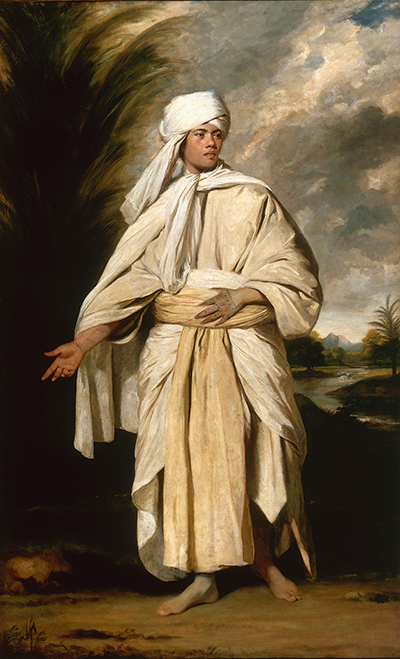
This is one reason he became so powerful within the profession. He did not depend on one kind of patron. His circle included old families, new political figures, performers, writers and imperial celebrities. The variety protected him commercially and enriched him artistically. It allowed his studio to become a crossroads of Georgian ambition.
Portraiture and social intelligence
Reynolds's biography is inseparable from portraiture because portraiture was the means through which he entered, shaped and benefited from Georgian society. The National Portrait Gallery records him as artist associated with 1,441 portraits.[2] That number reflects a vast professional enterprise. It also reveals the scale at which Reynolds became part of the visual record of his age.
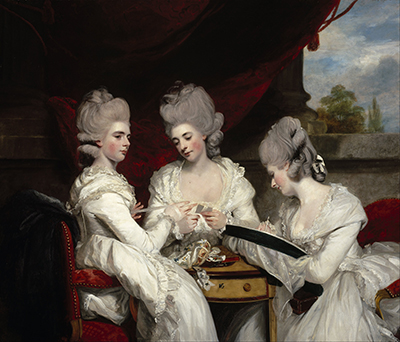
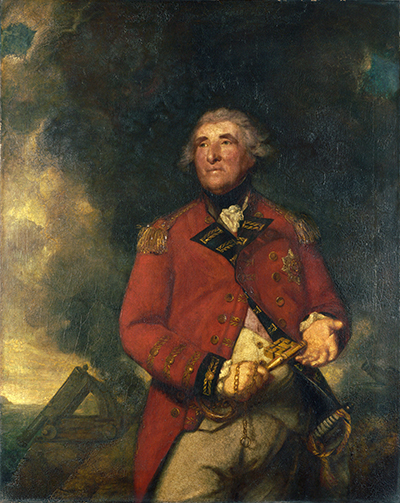
Portraiture required more than making a likeness. Reynolds had to understand how sitters wanted to appear, how families wanted to be remembered, how actors wanted to be celebrated, how soldiers wanted to be honoured and how aristocrats wanted their rank to seem natural. His gift lay in making those ambitions pictorially persuasive.
This is why his career is sometimes described in terms of social climbing or self-promotion.[2] Those words can sound dismissive, but in Reynolds's case they point to real professional intelligence. An eighteenth-century portraitist needed to be socially legible to patrons. Reynolds learned how to move among elite circles without surrendering his identity as an artist. He made sociability part of his profession.
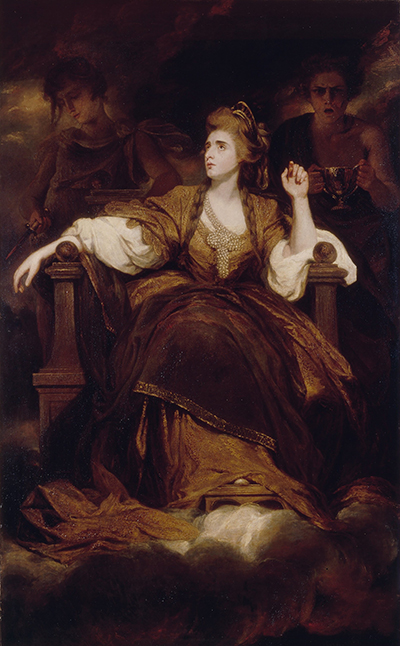
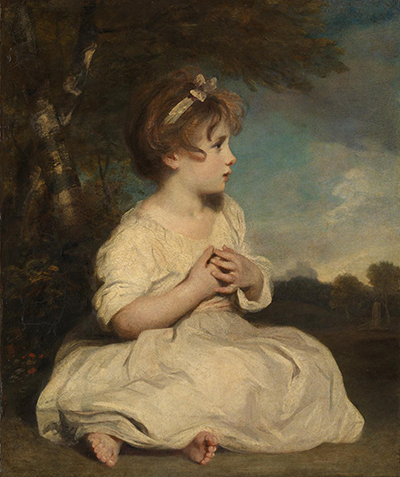
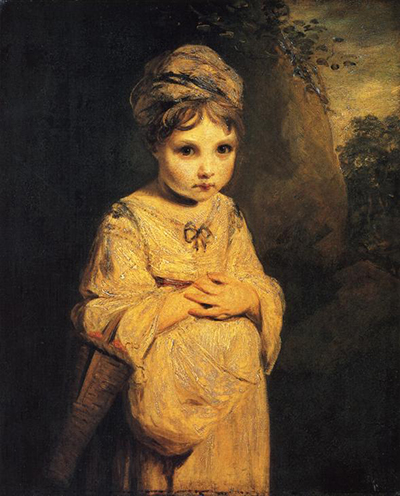
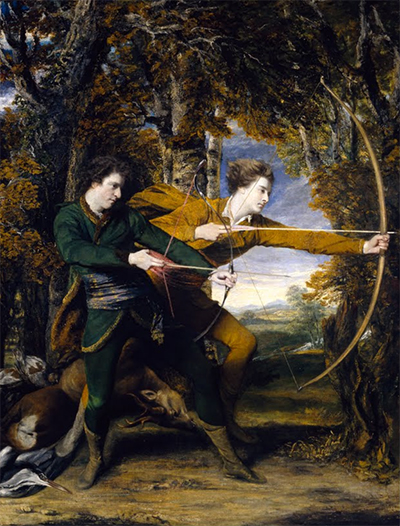
His portraits also raised the status of the sitter by raising the status of the art. Instead of treating a portrait as a simple record, Reynolds could give it old-master reference, allegorical weight, theatrical scale or moral association. A sitter in Reynolds's hands might become more elegant, heroic, maternal, learned or tragic than in life, but that transformation was part of the commission's power.
The biography of Reynolds therefore has a double movement. He paints society, and society elevates him. He gives sitters public form, and those sitters give him public standing. This reciprocal structure is one of the reasons he became so dominant.
It also explains why his life cannot be told only through institutions and dates. Reynolds's biography is made of encounters: painter and sitter, artist and critic, president and student, host and guest, friend and rival. The human texture of his career is inseparable from its public success. He read faces for a living, but he also read the room.
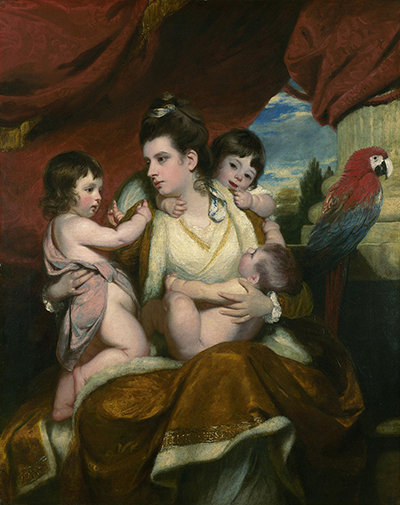
This social intelligence had an artistic consequence. Reynolds could adapt tone from one sitter to another. A child did not need the same register as a general; an actress did not need the same register as a scholar; an aristocratic mother did not need the same register as a naval officer. His biography as a portraitist is therefore a biography of responsiveness, even when the paintings are highly staged.
The Royal Academy
The most important institutional event in Reynolds's life was the founding of the Royal Academy in 1768. The Royal Academy's own institutional text states that Reynolds played a central role in organising the group of 34 artists and architects who petitioned for an academy that would hold annual exhibitions of living artists' work and establish a free art school.[7] After George III approved the petition, Reynolds was unanimously elected President and knighted the following year.[7]
The National Portrait Gallery and National Gallery both identify him as the first President of the Royal Academy.[2][4] This position gave Reynolds national authority. He was no longer only a successful portrait painter. He became the public face of British artistic education and institutional ambition.
The presidency suited him because it fused art, society and thought. Reynolds could preside over exhibitions, address students, represent the profession and use his own authority to argue for the intellectual dignity of painting. His social polish, ambition and conversational skill all served the role.
The Academy also sharpened one of the central tensions of his career. Reynolds gave history painting the highest theoretical rank, but the National Gallery makes clear that his enduring achievement lay chiefly in portraits rather than large historical scenes.[4] As President, he taught a hierarchy of art that his own career complicated. The result was not hypocrisy so much as a productive mismatch between theory and practice.
His Academy role also gave British art a new institutional rhythm. Annual exhibitions, teaching, lectures and public debate helped create a more visible national art culture. Reynolds's biography cannot be separated from that transformation. He helped make the artist a public intellectual within Britain.
The founding of the Academy also changed the audience for art. The annual exhibition made living artists more visible as a professional community. The free school gave instruction a formal structure. The presidency gave Reynolds a role that combined diplomacy, ambition and public performance. He had to represent artists to patrons, students to authority and British art to itself.
This is why the Academy years are central to his biography even when individual portraits remain the most loved works. Reynolds did not only produce pictures during these decades. He helped organise the conditions under which pictures would be shown, discussed, taught and valued. That institutional labour is one of his lasting achievements.
The Discourses
Between 1769 and 1790, Reynolds delivered the lectures now known as the Discourses on Art.[6][8] Project Gutenberg's public-domain text preserves them as Fifteen Discourses Delivered in the Royal Academy, and its opening discourse is dated 2 January 1769.[8] The National Portrait Gallery treats these lectures as a major force in eighteenth-century artistic theory and in the wider standing of British art.[2]
The Discourses reveal Reynolds as a teacher of artistic ambition. He urged students to study great models, think in general principles and avoid being satisfied with merely mechanical skill. His opening address presented the Academy as an event important not only to artists but to the nation.[8] This is not modest language. Reynolds wanted British art to believe in its own seriousness.
His theory often emphasised ideal form, selection and the study of established masters. He encouraged artists to learn from the past rather than mistake novelty for greatness. Yet the lectures are most interesting when read beside his paintings, because his own practice was not always as austere as his theory. He admired grandeur of form, but his portraits often depend on colour, texture, theatre and social immediacy.
This tension gives the Discourses their biographical value. They show Reynolds thinking himself into a role larger than painter of patrons. He wanted to define the profession's values. He wanted students to see art as disciplined, learned and public. He wanted the Royal Academy to become a repository of artistic authority.
The lectures also helped make Reynolds a writer. The Paul Mellon Centre describes him not only as painter and collector, but as writer.[1] That matters because his reputation has always rested on both image and text. Few British painters of the eighteenth century left such an extensive theoretical voice alongside such a visible body of work.
The Discourses also reveal the kind of authority Reynolds wanted to possess. He does not write as a solitary genius confessing private inspiration. He speaks as the head of an institution, addressing students and colleagues in the name of standards. His voice is instructional, public and often corrective. That tone tells us much about the man. Reynolds wanted painting to be teachable because he wanted it to be intellectually serious.
Yet the lectures should not be read as a complete explanation of his art. They are part of his biography because they show how he wished art to be understood, not because they describe every force that moved his brush. His own paintings often contain more warmth, theatre and sensual richness than his theory fully admits. The gap between lecturer and painter is one of the most revealing features of his career.
Honours, office and public standing
Reynolds's honours mark the public success of his self-fashioning. The National Portrait Gallery extended entry records him as FRS in 1761, knighted in 1769 and awarded a DCL by Oxford in 1773.[3] These distinctions show how far he had moved from the provincial apprentice of 1740. He became a figure recognised by scientific, royal and academic institutions.
The knighthood is especially significant. Reynolds was knighted by George III in 1769, in the wake of his election to the Royal Academy presidency.[1][7] It linked artistic office to royal recognition and helped fix his public identity as Sir Joshua Reynolds rather than simply Joshua Reynolds, fashionable portrait painter.
Reynolds was not, however, simply a court favourite. The National Gallery notes that he was never popular with George III.[4] Wallace Collection material states that he was appointed principal painter to George III in 1784, replacing Allan Ramsay, despite the king not being particularly fond of his work.[6] The appointment therefore recognised status and office more than intimate royal preference.
These mixed facts are important. Reynolds's authority did not depend on royal affection alone. It came from a broader system: patrons, exhibitions, academy, clubs, publications, engravings, collections and public reputation. He became a national artistic figure even without being the king's favourite painter.
His public standing was also visible in the scale of his Academy activity. The Wallace Collection records that between 1769 and 1790 he exhibited 244 paintings at the Royal Academy, the vast majority portraits, with only 32 paintings of other subjects.[6] This numerical detail helps clarify the relationship between theory and practice. Reynolds praised history painting, but his public career remained overwhelmingly portrait-based.
The honours also show that Reynolds's social ascent was not one-dimensional. He did not simply become wealthy, or simply become famous, or simply become official. He accumulated overlapping forms of recognition. Learned society, university honour, royal knighthood, academy presidency and professional dominance all reinforced one another. By the 1770s, Reynolds had become an institution in his own right.
This public standing also affected how other artists encountered him. He was not merely a competitor for commissions. He was a model, authority, obstacle and reference point. Younger painters had to decide whether to follow his Grand Manner, resist it, revise it or define themselves against it. His biography therefore belongs not only to his own career but to the structure of British art after 1768.
Friendship, clubs and conversation
Reynolds's social life was not incidental decoration around the painting. It was central to his biography. He lived and worked in a London where art, literature, politics and theatre overlapped. The National Portrait Gallery places him in Johnson's Literary Club and the Bluestocking circle among its group categories.[2] Wallace Collection material names Garrick, Johnson and Burke as significant cultural connections.[6]
These relationships gave Reynolds access to intellectual prestige and public conversation. Johnson offered moral and literary authority. Burke brought political and philosophical range. Garrick brought theatre and celebrity. Reynolds painted such figures, but he also benefited from their friendship and conversation. His studio and social world reinforced one another.
The National Portrait Gallery extended entry quotes Edmund Malone describing Reynolds as cheerful, eager to please, fond of literary company, observant of character and well read in mankind.[3] That phrase “well read in mankind” is particularly apt for a portraitist. Reynolds's art depended on reading people, but also on understanding how people wished to be read by others.
His sociability also helped him navigate the delicate status of the artist. Painters were paid professionals, yet Reynolds wanted them to be treated as intellectual equals of writers, statesmen and scholars. By moving among literary men and public figures, he modelled the gentleman-artist identity he wanted British culture to accept.
There is calculation here, but not calculation alone. Reynolds seems genuinely to have enjoyed conversation and company. His friendships supplied not only patrons and prestige, but also the intellectual atmosphere in which the Discourses made sense. He painted faces, but he lived among talk.
Johnson's friendship is especially suggestive. Johnson valued conversation as moral and intellectual exercise; Reynolds valued it as social contact and character study. Their friendship joined literature and painting within the same London culture. Reynolds's portraits of literary figures should be understood against that world, where reputation could be made by speech as well as by print or paint.
Garrick's presence points in another direction. The actor's world was one of performance, gesture and public emotion, all elements that Reynolds could translate into portraiture. Burke's presence adds political and philosophical seriousness. Together, these friendships show how Reynolds moved among different kinds of public talent and learned from all of them.
Work, reputation and the studio
Reynolds's studio was a place of labour as well as glamour. The Paul Mellon Centre notes that facsimiles of his sitters books from 1757-90 survive within the wider research record.[1] These books are crucial because they remind us that portraiture involved appointments, repeated visits, scheduling and practical management. Behind the polished image stood a working system.
The scale of his career required organisation. Sitters had to be received, poses chosen, paintings developed, payments managed, prints arranged and reputations sustained. Reynolds's ability to maintain this system was part of his success. He did not merely paint well; he ran a portrait enterprise.
Modern Reynolds scholarship depends on this record. The Paul Mellon Centre describes extensive Reynolds archive resources, including the Waterhouse Archive, Hayes Archive, Edgcumbe Archive, photo archives arranged according to Mannings catalogue numbers, sitters books and sketchbook facsimiles.[1] Such material shows how intensely Reynolds has been studied and how much evidence surrounds his career.
The same institutional record also explains why David Mannings's catalogue raisonné, with Martin Postle cataloguing the subject pictures, matters so much.[1][10] Reynolds's paintings exist in a world of versions, copies, prints, sitter identities and collection histories. His biography is not only a sequence of events; it is the history of a vast and complicated body of work.
The studio also produced a public image of abundance. Reynolds seemed everywhere: at exhibitions, in prints, in elite houses, in club conversation and in academy leadership. That omnipresence made him the painter against whom others were measured.
The studio was also where Reynolds's ambition met practical limits. A great portrait painter had to negotiate likeness, time, costume, materials, sitter availability and patron expectation. Even the most elevated portrait began with human logistics. This practical world matters because it keeps Reynolds from becoming a purely theoretical figure. His authority was built by daily work.
The survival of sitters books and archival material also shows how portraiture leaves a different kind of evidence from history painting. The names, appointments and traces of contact form a social map. Reynolds's biography can therefore be reconstructed not only from finished works and public honours, but from records of who came to sit, when, and within what network of acquaintance.
Collecting, catalogues and artistic memory
Reynolds was not only a painter who looked at old art. He was a collector and a student of pictures, and that habit of looking shaped the way he made himself. The Paul Mellon Centre identifies him as painter, collector and writer, a combination that helps explain the intellectual density of his career.[1] His biography is partly the story of a man who turned looking into authority. He did not want old-master art to remain a distant inheritance. He wanted it to become usable in Britain, in the studio, in teaching and in the public language of art.
This collecting mind matters because Reynolds's paintings are full of visual memory. A pose, a gesture, a lighting effect or a compositional arrangement might carry the echo of antique sculpture, Raphael, Titian, Rembrandt, Rubens or Van Dyck without becoming simple quotation. The National Gallery emphasises his interest in ancient art, Italian painting and later European masters, while the Paul Mellon Centre notes that his poses were frequently drawn from Old Masters and antique models.[1][4] That kind of borrowing was central to his idea of elevation. Reynolds did not think originality meant isolation from the past. He thought an artist should absorb great examples and transform them.
The habit can make his biography difficult to separate from art history. Reynolds lived in Georgian London, but he painted with Rome, Venice, Antwerp and seventeenth-century court portraiture in his imagination. This gave his career its international ambition. He wanted British portraiture to speak in a language that European viewers would recognise as grand, learned and durable. The result was a career built on translation: old forms into modern likeness, continental prestige into British practice, private commission into public art.
Modern cataloguing makes the scale of that ambition visible. David Mannings's complete catalogue of Reynolds's paintings, with Martin Postle responsible for the subject pictures, is treated by the Paul Mellon Centre as a central ordering tool for the artist's oeuvre, and the Centre notes that its photographic archive is arranged according to Mannings catalogue numbers.[1][10] That detail is more than bibliographic convenience. It shows that Reynolds's work is too large and complex to understand casually. The biography of the artist now depends on careful identification of sitters, versions, copies, dates, collections and changing attributions.
Such cataloguing also changes how we think about Reynolds's achievement. He was not a painter of a handful of famous images alone. He sustained a long professional career across a vast field of portraits and subject pictures, many of them connected to families, estates, exhibitions, engravings and later collections. Mannings helps recover that full working world. It places celebrated works beside less familiar commissions and shows how reputation is formed not only through masterpieces, but through accumulated practice.
This is especially important for a biography because Reynolds often appears as a polished public monument: Sir Joshua, President of the Royal Academy, theorist of the Grand Manner. The catalogue record brings him back to labour, repetition, adjustment and professional volume. It reminds us that public authority was built from many individual sittings, negotiations and pictorial solutions. Reynolds's life was made not only in great institutional moments, but in the steady return to the easel.
The archival record preserved and described by the Paul Mellon Centre reinforces this picture. The Waterhouse, Hayes and Edgcumbe materials, together with sitters books and sketchbook facsimiles, place Reynolds within a long chain of scholarship.[1] He is an artist whose biography has itself been repeatedly reconstructed. Each generation inherits the public legend, but then returns to documents, images and catalogues to test it.
That is why Reynolds remains both familiar and unsettled. The broad facts of his life are clear, yet the detail of his career continues to demand disciplined attention. His public image can look almost too coherent: Devon, Italy, London, Academy, knighthood, St Paul's. The catalogue and archive complicate that smooth arc by restoring the density of practice behind it. Reynolds's biography is a grand public story, but it is also a documentary puzzle made from appointments, pictures, names, collections and the lingering memory of older art.
Technique and contradiction
Reynolds's biography includes a material contradiction. He admired old-master richness and sought to imitate historic effects, but some of the methods he used proved unstable. The National Gallery records problems such as faded reds, paler flesh tones and cracked blacks, while National Galleries of Scotland gives a broader warning about the poor ageing of many works.[4][5]
The Wallace Collection gives the broader explanation: Reynolds's pursuit of old-master appearance led him to experiment with pigments and glazes, and some of those materials became unstable, producing cracking and discoloration.[6] The National Gallery Technical Bulletin develops this technical story through research on works in the Wallace Collection and the National Gallery, describing fragile paint structures, fading flesh paints and complex media.[9]
This technical history belongs in the biography because it reveals a deep tension in Reynolds's ambition. He wanted modern portraits to possess the depth and glow of older paintings. He studied the masters, admired their effects and tried to recover their authority. Yet the very pursuit of those effects sometimes damaged the long-term condition of his work.
The contradiction should not be treated as a simple flaw. It is part of who Reynolds was as an artist. He was experimental, ambitious and sometimes technically reckless. His paintings can be fragile because his ambition was material as well as intellectual. He wanted surfaces to carry history.
For modern viewers, this means that Reynolds's career survives unevenly. Some pictures retain extraordinary force; others bear the visible costs of experiment. Biography and conservation meet on the surface of the painting.
The technical problem also complicates the image of Reynolds as pure academic order. In theory, he praised disciplined study and general principles. In practice, he could be restless with materials, chasing effects that did not always remain stable. This restlessness makes him more interesting. It shows an artist whose reverence for old painting was active, experimental and sometimes hazardous.
His failures of preservation are therefore biographical evidence. They reveal what he valued: glow, depth, richness, layered surface and the visual memory of older art. They also reveal the pressures of competing with the past. Reynolds wanted British portraiture to stand beside the masters he admired. Some of his pictures still carry the scars of that desire.
Later years
In the later part of Reynolds's life, public honour and physical limitation increasingly coexisted. He remained President of the Royal Academy until his death in 1792, according to the Wallace Collection.[6] He continued to occupy a central institutional position, but his ability to paint declined as his eyesight worsened.
The Wallace Collection states that in his later years poor eyesight affected his ability to paint.[6] This should be understood as a practical and emotional crisis. For an artist whose identity had been built on seeing, handling, judging and finishing paintings, failing vision was not merely a medical inconvenience. It threatened the central act of his profession.
Reynolds's final years also sharpen the difference between reputation and production. His status remained immense even as his working capacity diminished. By then, he had already become the emblem of British academic portraiture. He had painted generations of sitters, shaped the Royal Academy, delivered the Discourses, collected and studied art, and built a public identity that outlasted his physical ability to work.
The loss of sight also adds poignancy to the Academy presidency. Reynolds had spent decades arguing for judgment, study and cultivated seeing. To be limited in vision near the end of such a career was more than bodily decline; it touched the foundation of his art. Yet his authority did not disappear, because it had already been transferred into institutions, texts, portraits and public memory.
He died after a short illness on 23 February 1792.[1][6] He was 68. The Wallace Collection describes the ceremony that followed: he was laid in state at the Royal Academy and then taken in a grand procession to St Paul's Cathedral, with members of the Academy participating.[6] London Museum confirms that celebrated painters including Joshua Reynolds and J. M. W. Turner were buried at St Paul's.[11]
The funeral marked more than personal grief. It recognised Reynolds as a public figure of national art. He had helped make the Royal Academy a central institution; after death, that institution helped carry him into national commemoration.
St Paul's and legacy
Reynolds's memorial afterlife confirms his public importance. St Paul's Cathedral notes that the first three monuments added to the Cathedral floor were for John Howard, Samuel Johnson and Joshua Reynolds.[12] That grouping is telling: prison reform, literature and art were being monumentalised together. Reynolds entered a public pantheon of eighteenth-century moral, intellectual and cultural figures.
His burial and monument also connect him to the city whose art world he had helped create. London had been the stage of his ascent: the studio, the Academy, the clubs, the exhibitions, the patrons and the print culture. St Paul's gave that public life a ceremonial end.
The ceremonial quality of his death shows how far British art had moved during his lifetime. A painter born in Devon in 1723 could, by 1792, be honoured through the Academy and St Paul's as a national cultural figure. Reynolds did not create that change alone, but he embodied it with unusual clarity.
Reynolds's legacy is not simple hero worship. The National Gallery now notes ongoing research into his relationship to histories of enslavement, including a Black servant in his household who was probably formerly enslaved and sitters or images connected with slavery and empire.[4] That research matters because Reynolds painted in a world shaped by colonial wealth, social hierarchy and imperial expansion. His biography must include the splendour of his achievement and the historical systems in which that splendour operated.
At the same time, his artistic and institutional importance remains undeniable. He raised the ambitions of British portraiture, helped found the Royal Academy, gave British artists a theory of professional seriousness and left one of the most extensive portrait records of eighteenth-century public life. His paintings can be beautiful, theatrical, fragile, problematic and learned all at once.
The best biography of Reynolds therefore keeps the contradictions alive. He was a provincial Devonian who became a London institution; a portraitist who praised history painting; a theorist of ideal form drawn strongly to colour; a social operator with genuine intellectual range; an academy president whose own materials could fail; a painter of elite society whose work now demands wider ethical scrutiny. His life is not only the story of one artist's success. It is a biography of British art learning to present itself as national culture.
Frequently Asked Questions
Discussion
Which part of Reynolds’s life most changes how you read his portraits?
Reader Insights
How does Reynolds’s ability to read social ambition change the way you interpret a sitter’s pose and role?
Where do the disciplined ideals of the Discourses meet the colour, theatre and immediacy of the portraits?
How should academy leadership, technical experiment and the wider histories of elite Georgian society be held together?
Join the Conversation
Share your reading below.
References
- Paul Mellon Centre, “Joshua Reynolds (1723-1792)”, https://www.paul-mellon-centre.ac.uk/archives-and-library/artist-subject-guides/joshua-reynolds
- National Portrait Gallery, “Sir Joshua Reynolds”, https://www.npg.org.uk/collections/search/person/mp03755/sir-joshua-reynolds
- National Portrait Gallery, “Sir Joshua Reynolds: Mid-Georgian Portraits Catalogue”, https://www.npg.org.uk/collections/search/personExtended/mp03755/sir-joshua-reynolds?tab=biography
- National Gallery, London, “Sir Joshua Reynolds 1723-1792”, https://www.nationalgallery.org.uk/artists/sir-joshua-reynolds
- National Galleries of Scotland, “Sir Joshua Reynolds”, https://www.nationalgalleries.org/art-and-artists/artists/sir-joshua-reynolds
- Wallace Collection, “Reynolds”, https://www.wallacecollection.org/explore/explore-in-depth/reynolds/the-artist/reynolds/
- Royal Academy shop/product story, “Joshua Reynolds RA 300th Birthday Red Blue Pin Badge”, https://shop.royalacademy.org.uk/joshua-reynolds-ra-300th-birthday-red-blue-pin-badge
- Sir Joshua Reynolds, Fifteen Discourses Delivered in the Royal Academy, Project Gutenberg edition, https://www.gutenberg.org/files/52436/52436-h/52436-h.htm
- Alexandra Gent, Ashok Roy and Rachel Morrison, “Practice Makes Imperfect: Reynolds's Painting Technique”, National Gallery Technical Bulletin, vol. 35, 2014, https://www.nationalgallery.org.uk/technical-bulletin/vol-35-essay-2-2014
- David Mannings, Sir Joshua Reynolds: A Complete Catalogue of His Paintings, with subject pictures catalogued by Martin Postle, Yale University Press / Paul Mellon Centre for Studies in British Art, 2000.
- London Museum, “A history of St Paul's Cathedral”, https://www.londonmuseum.org.uk/collections/london-stories/a-history-of-st-pauls-cathedral/
- St Paul's Cathedral, “Our monuments”, https://www.stpauls.co.uk/our-monuments