 by Tom Gurney
Tom Gurney BSc (Hons) is an art history expert with over 20 years experience
Published on June 19, 2020 / Page Updated on November 6, 2026
Email: tomgurney1@gmail.com / Phone: +44 7429 011000
Introduction
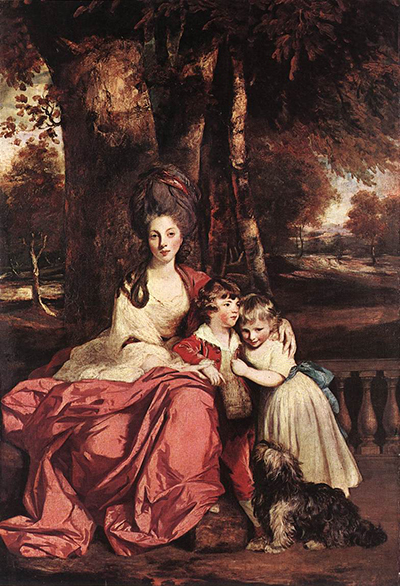
Joshua Reynolds's Lady Elizabeth Delmé and Her Children is one of his most elegant late-1770s family portraits, and one of the clearest examples of how he could turn a domestic group into a statement of rank, taste and cultivated feeling. Painted between 1777 and 1779, the work is an oil on canvas measuring 238.4 by 147.2 cm, now in the National Gallery of Art, Washington, as part of the Andrew W. Mellon Collection, accession 1937.1.95.[1] The National Gallery of Art records it as on view in the West Building, Main Floor, Gallery M59.[1]
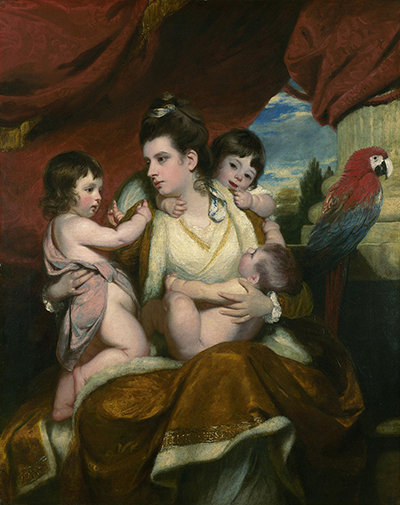
The painting presents Lady Elizabeth Delmé with her son John and daughter Isabella Elizabeth. The National Portrait Gallery identifies Lady Elizabeth “Betty” Delmé, née Howard, later Garnier, as living from 1747 to 1813, and identifies the children as Isabella Elizabeth Delmé, born in 1770 or 1771 and died in 1794, and John Delmé, born in 1772 and died in 1809.[3] Reynolds places them on a veranda before a glowing landscape. Lady Elizabeth sits before a low balustrade, loosely embracing the children as they lean into her lap, while a shaggy dog looks on.[1]
That arrangement could easily have become formulaic. Reynolds instead makes the image work on several registers at once. It is a portrait of an aristocratic mother and heirs, a display of modern fashion, a picture of touch and affection, and an ambitious exercise in the elevated family portrait. The National Gallery of Art's interpretation connects the triangular grouping and maternal gesture to Renaissance examples such as Raphael's The Alba Madonna, while Google Arts & Culture's National Gallery of Art partner record also notes the warmth of the landscape and light associated with Titian.[1][2] Reynolds is not simply borrowing prestige from Italian art. He is adapting its authority to the social needs of a British family portrait.
At a Glance
- TitleLady Elizabeth Delmé and Her Children
- ArtistJoshua Reynolds
- SittersLady Elizabeth Delmé, Isabella Elizabeth Delmé and John Delmé
- Date1777-1779 [1]
- MediumOil on canvas [1]
- CollectionNational Gallery of Art, Andrew W. Mellon Collection [1]
- Accession1937.1.95 [1]
- Dimensions238.4 × 147.2 cm [1]
- Commissioned forPeter Delmé of Titchfield Abbey
- CatalogueMannings 504 [5]
Contents
- Introduction
- The painting in Washington
- Lady Elizabeth, Isabella and John
- Motherhood as rank and image
- Raphael, Titian and the Grand Manner
- Fashion, fabric and familial presence
- The dog and the everyday detail
- Provenance and print afterlife
- Why Lady Elizabeth Delmé and Her Children matters
The painting in Washington
The Washington painting is a large vertical canvas. Its scale matters because it gives the Delmé group the presence usually reserved for figures of public consequence. Lady Elizabeth is not a small private likeness set apart from history; she appears nearly life-size within a carefully staged world of fabric, architecture, trees and distant hills. The picture asks to be read as a family statement as well as a scene of maternal intimacy.
Its confidence is immediate.
The National Gallery of Art's description is unusually rich. Lady Elizabeth wears a parchment-white gown and a dusty rose mantle, with her hair piled high and tied by a garnet-red scarf.[1] John, at her side, has chestnut curls and blue eyes, wearing a cranberry-red jacket and breeches with a striped gold and yellow vest.[1] Isabella Elizabeth, held within the circle of arms, smiles in a cream-white gown with a celestial-blue sash.[1] A small shaggy dog turns toward the family group, while the landscape behind them opens into trees and distant lilac-purple mountains.[1]
Those colours do much of the painting's work. The white dress gives Lady Elizabeth a cool commanding centre, but the rose mantle and garnet scarf warm the figure, preventing her from appearing merely statuesque. John's red costume makes him visually emphatic, while Isabella's blue sash gives the child's white dress a clear accent. Reynolds creates a pattern of answering hues: rose, red, gold, blue, white, gray and the deeper greens and purples beyond.
The setting also matters. The low balustrade suggests a noble threshold between cultivated house and open countryside. It places the family in a world of property and leisure, but without enclosing them in a formal interior. The outdoor view brings air and movement into the portrait. Reynolds lets aristocratic order and natural warmth occupy the same space, which is why the picture feels grand without becoming stiff.
Lady Elizabeth, Isabella and John
Lady Elizabeth was born into the Howard family, one of the most prominent aristocratic families in Britain. The National Portrait Gallery records her as the daughter of Henry Howard, 4th Earl of Carlisle, and as later Lady Elizabeth Garnier after her second marriage.[3] In Reynolds's painting, however, her identity is centred on the Delmé household. She appears with Isabella Elizabeth and John, the children of her marriage to Peter Delmé.
The National Gallery of Art's provenance states that the painting was made for Peter Delmé, Lady Elizabeth's husband, of Titchfield Abbey, Hampshire.[1] That commission context is important. The work was not simply an affectionate image of a mother with children; it was a household portrait made for a husband and father, and for the family world over which the painting would preside. In that sense, it combines tenderness with dynastic display.
John and Isabella are not accessories. Reynolds gives them distinctive roles within the group. John stands close to his mother, visually assertive in red, his arm and gaze helping to pull the viewer inward. Isabella is more enclosed, caught within the embrace of both her mother and brother. The group is bound by touch: arms curve across shoulders, bodies lean inward, and the children press toward Lady Elizabeth's lap.
The effect is carefully balanced. Reynolds wants the children to appear cherished, but he also wants them to stand for continuity. John and Isabella represent family succession, social inheritance and future alliances. Their presence makes Lady Elizabeth not only beautiful and fashionable, but central to a lineage. That is one reason the painting can be affectionate without being merely sentimental.
The use of the informal name “Betty” in the title of Valentine Green's later print, The Right Honble Lady Betty Delmé, is also revealing. The British Museum records Green's mezzotint under that title, while describing the image as a triple portrait after Reynolds with Lady Elizabeth seated beneath a tree, her arms around John and Isabella, and a dog at her feet.[5] The print title preserves a social familiarity, yet the composition itself insists on aristocratic consequence.
Motherhood as rank and image
Reynolds often found ways to make family portraiture carry more than likeness. In Lady Elizabeth Delmé and Her Children, maternity becomes both intimate and emblematic. Lady Elizabeth's arm drapes around John and Isabella, a gesture that reads as spontaneous affection, but it also organises the whole design. The mother holds the composition together. She is the emotional centre and the visual axis.
The National Gallery of Art notes that an eighteenth-century viewer would have recognised Lady Elizabeth's hair and clothing as highly fashionable.[1] This is not a timeless mother in a vague pastoral dream. She is a modern aristocratic woman, dressed in the latest manner, with the social polish expected of a sitter at the top of British society. Reynolds's achievement is to make that fashionable modernity compatible with an image of elevated maternal grace.
The picture does not erase status in the name of feeling. Lady Elizabeth's pose, dress, setting and family identity all signal rank. The low balustrade, ample canvas, refined costume and expansive view belong to a world of privilege. Yet Reynolds softens the social architecture by making the family touch believable. Rank is present, but not cold; affection is present, but not ordinary.
This is where the painting differs from a simple domestic scene. It does not show a casual private moment. It constructs a public image of the private virtues that aristocratic portraiture wanted to claim: grace, tenderness, lineage, taste and composure. Lady Elizabeth is not only shown loving her children. She is shown embodying the ideal conditions under which such love could be recognised as noble.
The dog adds another note. The National Gallery of Art identifies it as a Skye terrier and notes its attentive presence.[1] It is small, lively and close to the children, anchoring the group in familiar life. In a painting full of refined references, the animal's alert gaze keeps the composition near the ground. It reminds the viewer that this family group is meant to feel lived, not merely arranged.
Raphael, Titian and the Grand Manner
Reynolds's portrait belongs to the Grand Manner not because it is theatrical in a military or heroic sense, but because it elevates portraiture through art-historical memory. The National Gallery of Art explicitly links the painting to Renaissance examples such as Raphael's The Alba Madonna, citing the triangular composition, the mother's tender touch and the dramatic folds of fabric.[1] Google Arts & Culture's National Gallery of Art partner record makes the same broader point: Reynolds sought to raise British portraiture by drawing on classical values, Greek and Roman sculpture, and Renaissance painting.[2]
The Raphael connection is easy to see in the structure. Lady Elizabeth and the two children form a compact, pyramidal group. Arms circle inward, drapery falls in broad folds, and the mother's presence unifies the children around her. Reynolds does not turn Lady Elizabeth into the Virgin Mary; the painting remains a modern portrait of a fashionable woman and her children. But he borrows a recognisable language of maternal centrality and harmonious grouping.
That borrowing changes the nature of the commission. A family portrait could have recorded sitters and costume. Reynolds gives it a deeper ancestry. By allowing the Delmé group to echo Madonna composition, he gives aristocratic motherhood an old-master dignity. The viewer is invited to see the sitters as contemporary people and as participants in a long pictorial tradition.
The Titian connection is different. It lies less in the human grouping than in the warmth, light and landscape. Google Arts & Culture's National Gallery of Art record points to Titian in the rich, warm colours of the landscape and the handling of light.[2] The distant hills, trees and softened atmosphere give the painting a Venetian breadth, making the figures appear not pasted before a view, but held within a glowing world.
For Reynolds, these references were not museum labels attached after the fact. They belonged to his entire ambition as a painter. He wanted British portraiture to compete with the authority of the old masters, and he repeatedly argued that great art required selection, elevation and study. In this portrait, those ideals do not produce severity. Instead, they produce a family group that looks at once fashionable, affectionate and knowingly artful.
Fashion, fabric and familial presence
One of the painting's pleasures is the way fabric becomes feeling. Lady Elizabeth's white dress and rose mantle do more than advertise refinement. They create a field of movement around the children. The folds sweep across her lap, gather around the group and make the embrace feel continuous. Drapery is not decoration alone; it is part of the portrait's emotional grammar.
The National Gallery of Art notes the dramatic folds of fabric among the elements that recall Renaissance painting.[1] Reynolds uses them to give Lady Elizabeth's body a larger pictorial rhythm, allowing her figure to command the space while still seeming soft and responsive. The cloth supports the idea of maternal amplitude: she is visually spacious enough to gather the children into her orbit.
John's costume brings a different energy. The cranberry-red jacket and breeches make him the most visually forceful child in the group.[1] His colour answers Lady Elizabeth's rose and garnet tones while giving him a future masculine presence. Reynolds lets him remain a child, but he also marks him as heir. His place beside Lady Elizabeth is intimate and social at once.
Isabella's costume has a quieter role. Her cream-white dress and blue sash keep her within Lady Elizabeth's pale tonal world while making her distinct.[1] She smiles, leaning into the centre of the group, her youth presented as charm rather than future authority. Reynolds's arrangement therefore reflects the gendered expectations of an eighteenth-century aristocratic family, but it does so through compositional tenderness rather than overt symbolism.
The painting's fashion is specific to the late 1770s, yet Reynolds makes it look capable of carrying older ideals. That is one reason the portrait succeeds. It does not ask the viewer to choose between modern dress and old-master aspiration. Lady Elizabeth's high hair, scarf, mantle and gown belong to her own moment, while the composition gives those details a long visual pedigree.
The dog and the everyday detail
The Skye terrier is a small but important witness. In many large portraits, animals can become generic emblems of fidelity, luxury or charm. Here the dog helps pull the painting back from abstraction. It looks toward the group with an attention that mirrors the viewer's own. The family are not alone in their pose; they are being watched from within the world of the picture.
The National Gallery of Art notes that personal details enliven Reynolds's portraits, and that in this work the children's costumes, faces and Skye terrier give a worldly and familiar context to the elevated design.[1][2] That is an excellent way to understand the painting's double success. The Raphael-like grouping could have made the sitters remote. The dog, children's clothing and individual expressions keep them particular.
This balance is crucial to Reynolds's best family portraits. He often wanted more than likeness, but he could not afford to lose likeness entirely. Patrons paid for recognisable presence: faces, clothes, relationships and household meaning. Reynolds therefore had to elevate without erasing. In Lady Elizabeth Delmé and Her Children, the child in red, the girl with blue sash and the alert terrier all resist being swallowed by allegory.
The everyday details also temper the portrait's social polish. There is no disorder, but there is animation. The children lean, smile and gather. The dog turns. The landscape shifts behind them. The painting feels carefully composed, yet not frozen. Reynolds's art lies in making the arrangement appear inevitable rather than mechanically staged.
For modern viewers, this is where the painting becomes most persuasive. Its aristocratic code is unmistakable, and its old-master ambitions are deliberate, but its appeal is not only historical. The image still depends on the human plausibility of a mother drawing children close. Reynolds makes social theatre and family feeling reinforce rather than cancel one another.
Provenance and print afterlife
The painting's ownership history confirms its high status. The National Gallery of Art traces it from Peter Delmé at Titchfield Abbey through descent in the Delmé family, then through Charles J. Wertheimer, J. Pierpont Morgan, Mrs. Robert L. Satterlee, Duveen Brothers and the A. W. Mellon Educational and Charitable Trust before its 1937 gift to the National Gallery of Art.[1] That movement took the portrait from an English family commission into the transatlantic formation of a major public collection.
The National Gallery of Art also places the painting within its systematic catalogue of British pictures, where John Hayes discussed it in the museum's account of sixteenth- through nineteenth-century British painting.[6] That placement is more than bibliographic housekeeping. It confirms that the portrait belongs not only to Reynolds biography or Delmé family history, but to the institutional story of British painting as collected, classified and interpreted in Washington.
Its early print afterlife shows that the image circulated beyond the original canvas. The National Portrait Gallery records Valentine Green's mezzotint after Reynolds, published on 1 July 1779, with Lady Elizabeth, Isabella Elizabeth and John identified as sitters.[4] The British Museum records another impression of Green's The Right Honble Lady Betty Delmé, also dated 1 July 1779, describing the family group beneath a tree with the dog at their feet.[5]
That print evidence is especially useful because the British Museum connects the image to Mannings 504.[5] David Mannings's Sir Joshua Reynolds: A Complete Catalogue of His Paintings is the major catalogue raisonné backbone for Reynolds's painted portraits, and the British Museum record locks this Delmé image to that catalogue number through an institutional print entry.[7] The print does not replace the painting, but it helps stabilise its identity within Reynolds's large and complex output.
The mezzotint also tells us something about the painting's appeal. A family portrait of this kind was not only a possession for the Delmé household. Through Green's print, it became part of the wider culture of Reynolds reproduction, where aristocratic likeness, fashionable beauty and painterly reputation could travel in tonal black and white. The soft gradations of mezzotint were well suited to Reynolds's portrait style, especially to fabric, flesh and atmospheric landscape.
The result is a painting with two kinds of life. In oil, it was a grand family image made for a particular household. In print, it became an image that could be collected, compared and remembered by people far beyond Titchfield Abbey. That dual existence is central to Reynolds's fame. His portraits lived in houses, exhibitions, engravers' studios and collections at the same time.
Why Lady Elizabeth Delmé and Her Children matters
Lady Elizabeth Delmé and Her Children matters because it shows Reynolds solving one of the central problems of eighteenth-century portraiture: how to make a fashionable likeness feel elevated without stripping away personality. He gives Lady Elizabeth the dignity of old-master composition, the modernity of late-1770s dress, the social authority of family rank and the human warmth of maternal touch.
The painting also demonstrates why Reynolds cannot be reduced to formula. The ingredients are familiar: noble sitter, children, landscape, grand scale, borrowed Renaissance harmony and carefully managed costume. Yet the finished work has a particular tone. It is warmer than a dynastic display, more composed than a casual domestic scene, and more socially alert than a simple celebration of motherhood.
Its visual intelligence lies in the way everything serves the family group. The balustrade frames rank. The landscape gives breadth. The garments give colour and movement. The children create continuity. The dog supplies immediacy. The Raphael and Titian echoes give the portrait cultural ambition. None of these elements is incidental, and none overwhelms the others.
Reynolds's portrait finally asks the viewer to believe in a graceful fiction: that social status, family affection, artistic tradition and modern fashion can harmonise in one image. The fiction is historically revealing, but it is also beautifully made. In Lady Elizabeth Delmé and Her Children, Reynolds turns the Delmé household into a picture of aristocratic feeling that is at once personal, strategic and deeply painterly.
Frequently Asked Questions
Discussion
How does Reynolds make aristocratic rank, old-master ambition and believable family touch reinforce one another?
Reader Insights
How does the triangular composition elevate affection without turning it into allegory?
What do colour, costume and the children's different positions communicate about family continuity?
How does the dog keep this highly cultivated portrait connected to everyday household life?
Join the Conversation
Share your reading below.
References
- National Gallery of Art, Washington, Lady Elizabeth Delmé and Her Children, 1937.1.95. https://www.nga.gov/artworks/102-lady-elizabeth-delme-and-her-children
- Google Arts & Culture / National Gallery of Art, Lady Elizabeth Delmé and Her Children. https://artsandculture.google.com/asset/lady-elizabeth-delm%C3%A9-and-her-children-sir-joshua-reynolds/kAF3av6F6yUH-g?hl=en
- National Portrait Gallery, Lady Elizabeth Delmé and her children, D34365. https://www.npg.org.uk/collections/search/portrait/mw149453/Lady-Elizabeth-Delm-and-her-children
- National Portrait Gallery, Valentine Green after Reynolds, Lady Elizabeth Delmé and her children, D34861. https://www.npg.org.uk/collections/search/portrait/mw191471/Lady-Elizabeth-Delm-and-her-children
- British Museum, Valentine Green after Reynolds, The Right Honble Lady Betty Delmé, 1902,1011.2286. https://www.britishmuseum.org/collection/object/P_1902-1011-2286
- John Hayes, British Paintings of the Sixteenth through Nineteenth Centuries, National Gallery of Art systematic catalogue, 1992, pp. 213-215.
- David Mannings, Sir Joshua Reynolds: A Complete Catalogue of His Paintings, with subject pictures catalogued by Martin Postle, Yale University Press / Paul Mellon Centre, 2000.