

 Buy Art Prints Now
from Amazon
* As an Amazon Associate I earn from qualifying purchases.
Image reference [image]
 by Tom Gurney
Tom Gurney BSc (Hons) is an art history expert with over 20 years experience
Published on August 14, 2026 / Updated on August 14, 2026
Email: tomgurney1@gmail.com / Phone: +44 7429 011000
Lamia: Introduction
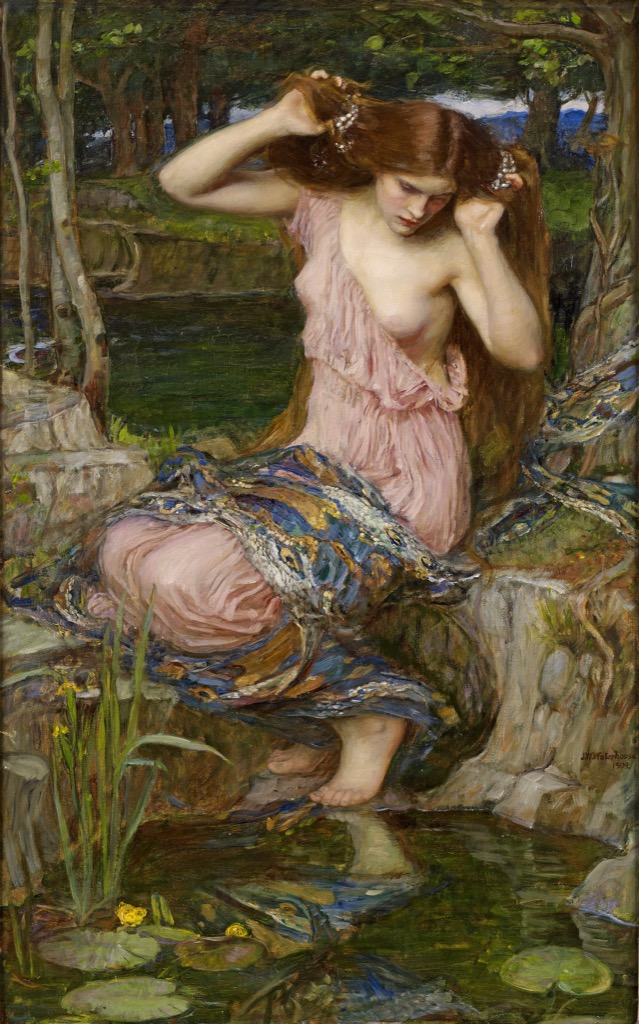
Lamia sits alone beside a woodland pool, drawing up her long hair as she looks towards the dark water. No lover bends over her, no philosopher exposes her and no discarded snakeskin proves what she was. John William Waterhouse has removed the narrative triangle that made his 1905 Lamia immediately legible and replaced it with solitary self-scrutiny.
Exhibited at the Royal Academy in 1909, the privately owned canvas is Waterhouse's second principal treatment of John Keats's serpent woman. Its quieter image asks a harder question: how can a painting represent transformation when the former body is no longer shown? [1] [2]
At a Glance
- ArtistJohn William Waterhouse (1849–1917)
- TitleLamia [1]
- DateCirca 1909 [1]
- MediumOil on unlined canvas [1]
- Dimensions91.5 × 57 cm [1]
- SignatureSigned at lower right, “J. W. Waterhouse” [1]
- CollectionPrivate collection [1]
- First exhibitedRoyal Academy, London, 1909, no. 114 [1]
- Literary sourceJohn Keats, Lamia, composed in 1819 and published in 1820 [2] [3]
- SubjectLamia in human form, seated alone beside a woodland pool [1] [4]
- Version warningThis is the one-figure 1909 composition, not the 1905 Auckland painting of Lamia kneeling before an armoured Lycius [1] [5]
- Related workThe Necklace is a preliminary idea for the 1909 composition, not the finished Lamia [4]
Contents
- Introduction
- A Serpent Woman without a Serpent Body
- Keats's Lamia: Transformation, Love and Exposure
- Solitude and the Invented Woodland Pool
- Hair, Reflection and Unstable Identity
- The Absent Lycius and Apollonius
- The 1905 and 1909 Paintings Distinguished
- Studies, Variants and the Royal Academy Exhibition
A Serpent Woman without a Serpent Body
Waterhouse gives Lamia an entirely human form. She sits at the edge of a pool in loose, pale or rose-toned classical drapery, one shoulder and much of the upper body exposed as her arms gather or arrange her hair.
The figure dominates the narrow vertical canvas. Rock, trees and water create a private enclosure rather than a road, palace or wedding hall.
Nothing in her anatomy announces a monster. There is no tail, scale, fang or hybrid transition. Unlike the 1905 composition, there is also no conspicuous moulted skin beside her.
The title therefore supplies information the image withholds. Without the word Lamia, the painting might appear to show a nymph, bather or solitary woman dressing beside water.
This dependence is not a weakness. It makes identification part of the viewing process. Knowledge of Keats changes an apparently quiet act of grooming into reflection upon a transformed body.
Lamia's arms lift the hair away from her back and face. The action can be practical, sensual or self-examining. It exposes rather than disguises the body, yet viewers know that the body's origin remains concealed.
The pool provides a possible surface of reflection. Waterhouse does not paint a large, perfectly legible mirror image; dark water keeps the relation uncertain. Lamia may be looking at herself, into depth or towards something outside the visible field.
The scene is still, but stillness does not mean peace. Keats's Lamia has gained the human form she wanted, fallen in love and entered a story whose public exposure will destroy both lovers. [2]
Waterhouse isolates the interval in which she can exist as a woman without anyone present to challenge that existence.
Keats's Lamia: Transformation, Love and Exposure
Keats begins with Hermes searching for a nymph hidden from him on Crete. He encounters Lamia as a magnificent serpent with a woman's mouth and voice. [2]
The creature's body exceeds ordinary zoology. Keats covers it with vermilion, gold, green and blue, zebra-like striping, leopard markings, peacock eyes, silver moons and shifting colour. [2]
Lamia knows where the nymph is. She agrees to reveal her if Hermes restores the human shape she previously possessed or desired. The god accepts, and her serpentine form dissolves in a violent metamorphosis. [2]
She then travels towards Corinth to meet Lycius, a young man she has already watched. At first she remains invisible to him; then she calls, appears and draws him into a relationship sustained inside an enchanted house. [2]
Lycius eventually demands a public wedding. Lamia fears the philosopher Apollonius and asks that he be excluded, but he enters the feast and fixes her with a penetrating gaze. [2]
Under that scrutiny, the magical splendour disappears. Apollonius identifies the bride as a serpent; Lamia vanishes, and Lycius dies. [2]
The poem divides sympathy. Lamia deceives Lycius about her nature, yet Keats gives her desire, fear and suffering. Apollonius speaks truth, yet his reason is cold, invasive and destructive. Lycius is deceived but also insists upon the public display that makes exposure possible. [2] [3]
Waterhouse's solitary picture removes the agents of that conflict while knowledge of them remains. Lamia's body is seen before Apollonius names it and outside Lycius's adoration.
The absence lets viewers ask what she is when no man is looking: serpent in disguise, woman restored, supernatural lover or an identity unstable among all three.
Keats does not place a scene of Lamia arranging her hair beside a woodland pool at the centre of his narrative. Waterhouse extracts the transformed heroine from the plot and invents a visual meditation upon her state.
Solitude and the Invented Woodland Pool
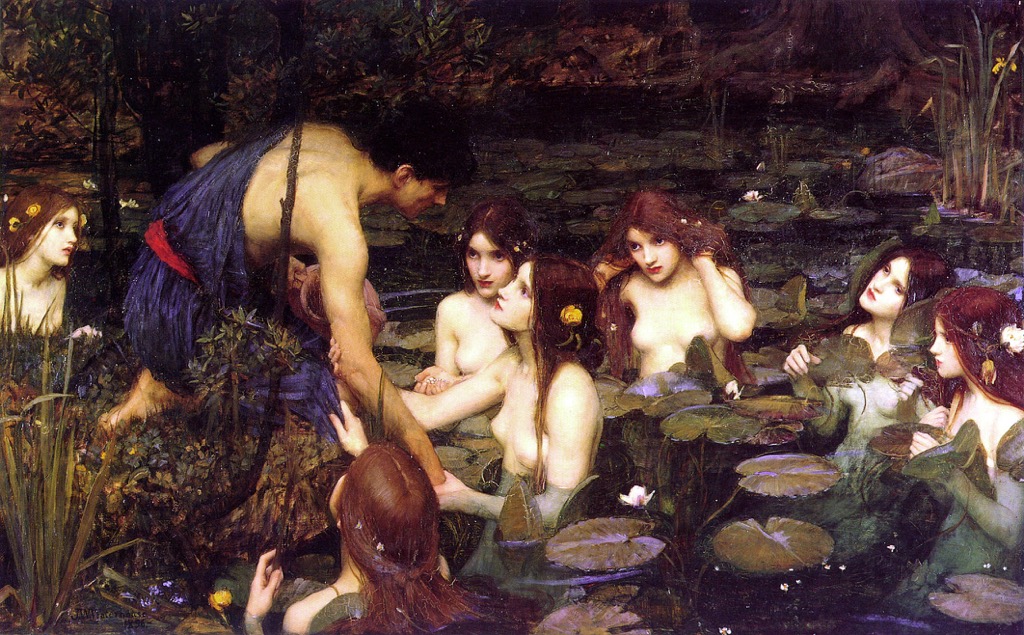
The pool belongs to a recurring setting in Waterhouse's mature work. Women sit on rocky edges beside water in Nymphs Finding the Head of Orpheus, Psyche Opening the Golden Box, The Charmer and related studies. [4] [6]
This recurrence does not make every figure interchangeable. Water changes function with the title and story: it can reveal a severed head, border a forbidden action, answer music or offer Lamia an unstable reflection.
In the 1909 Lamia, woodland and pool replace the urban and social spaces important to Keats's Corinth. No enchanted palace proves her power, and no wedding guests threaten exposure. [2]
The setting feels prior to public identity. Lamia occupies a place where she can look without being looked at—except by the viewer.
That exception is decisive. Waterhouse removes Lycius and Apollonius but cannot remove spectators. We may admire her like the lover, search for hidden monstrosity like the philosopher or hesitate between those positions.
The dark water supports hesitation. A clear reflection could confirm the human image; a serpent reflected beneath a woman would turn the picture into a fixed supernatural puzzle. Waterhouse supplies neither certainty.
The pool can therefore sustain several related readings without confirming one. Lamia may examine her present beauty, search for traces of the serpent, pause in private grooming or simply direct her face towards water while thinking elsewhere.
These alternatives are not equal claims about narrative fact. They describe what the arrangement permits. The title justifies connecting self-scrutiny to metamorphosis, but it does not tell us which thought occupies the figure.
The scene's restraint is especially striking beside Keats's chromatic excess. His serpent body flashes with impossible marks and colours; Waterhouse limits the finished canvas to flesh, fabric, hair, rock and shadowed water. [2] Transformation is represented by subtraction.
That economy shifts danger away from visible monstrosity. The viewer knows more than the body shows, and uncertainty accumulates in the gap.
Rock makes the body physically present. Lamia does not hover as an apparition. Her weight rests on a hard ledge, drapery folds around the seat and feet or lower garment connect her to the terrain.
Trees close the view and reduce narrative escape. The vertical trunks answer the tall format while the pool opens a small horizontal depth below.
The scene can resemble private bathing, but no water contact is necessary. Its significance lies in approach to a reflective surface and in the isolation of a body whose truth has become a matter of sight.
Waterhouse's invention is therefore psychological rather than episodic. He gives Lamia a moment Keats does not narrate so that transformation can be considered from inside the transformed figure.
Hair, Reflection and Unstable Identity
Long hair is one of Waterhouse's most persistent visual materials. It can signal beauty, intimacy, bodily freedom, mourning or preparation, depending upon the action around it.
Lamia's raised arms turn hair into a screen that is being moved. She both reveals and arranges herself.
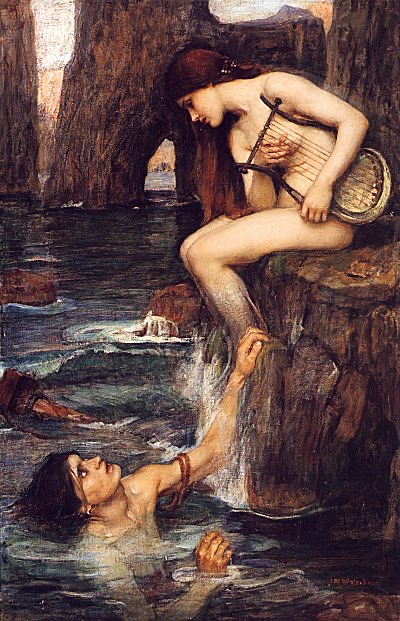
The action recalls images of mermaids combing beside water, but Lamia is not a mermaid. She has no visible aquatic body, and Keats's creature is serpentine rather than marine. [2]
The resemblance is useful because it places her among Waterhouse's self-attending supernatural women. Grooming can appear private and unguarded while also presenting beauty to the viewer.
Hair does not prove vanity. No surviving statement cited here says Lamia admires herself in narcissistic satisfaction. Looking towards water may suggest self-contemplation, but the expression remains enigmatic.
If the pool functions as a mirror, it reverses the role of Apollonius's gaze. In the poem, another person sees through Lamia and names her. In the painting, she may be the one examining the body that must survive such recognition.
Reflection also raises a question Keats leaves metaphysically open. Does the human form express Lamia's true self or conceal it? A mirror can reproduce appearance but cannot settle essence.
Waterhouse's 1905 snakeskin offers visible evidence of a former body. The 1909 pool offers only a surface on which the present body might appear.
This is the principal difference between the pictures. One makes transformation legible through residue; the other makes it uncertain through self-image.
The exposed shoulder and back intensify vulnerability. Armour protects Lycius in 1905, even though it cannot protect him from deception. The solitary Lamia possesses no comparable shell. The serpent has lost its skin and the woman has no social protection.
This does not make her innocent by composition alone. Vulnerability can coexist with concealment, just as beauty can coexist with supernatural power. Waterhouse's achievement is to prevent visible posture from delivering a complete moral verdict.
The lifted hair briefly behaves like a removable covering, echoing metamorphosis without literally repeating the snakeskin. Flesh is revealed beneath it, but revelation stops at appearance.
That limit is precisely what the absent philosopher would challenge and what the solitary picture allows Lamia, temporarily, to preserve.
The viewer receives knowledge without receiving the power to expose her inside the scene.
The Absent Lycius and Apollonius
Keats's narrative depends upon three forms of looking. Lamia watches Lycius before he sees her; Lycius falls into loving vision; Apollonius applies the gaze of exposure. [2]
Waterhouse's 1905 painting retains the first two within a couple. Lamia kneels and looks up at an armoured Lycius, their hands meet and a cast snakeskin allows viewers to know more than the young man. [5]
In 1909 every narrative counterpart is removed. Lamia's solitude changes her from an actor in seduction into the object and possible subject of reflection.
The absent Lycius prevents tenderness from defining her. We cannot judge whether she appears sincere because no lover receives her touch or speech.
The absent Apollonius prevents exposure from defining her. No philosopher names the serpent, and no magical setting collapses under rational scrutiny.
This leaves the viewer in an uncomfortable combination of roles. We know the literary secret like Apollonius but encounter Lamia at an intimate distance more like Lycius.
The painting also protects her from immediate moral judgement. A solitary woman arranging her hair has committed no visible harm. Condemnation depends upon narrative information imported from outside the frame.
At the same time, isolation can make the deception more complete. With no snakeskin and no victim, beauty occupies the entire human field.
Waterhouse does not tell us whether this is Lamia before meeting Lycius, during their private life or an imaginative state outside chronology. Precise placement would require an attribute or event the picture does not supply.
The scene is best understood as lyrical condensation rather than a missing paragraph from Keats.
The 1905 and 1909 Paintings Distinguished
Waterhouse first exhibited Lamia at the Royal Academy in 1905. That large two-figure canvas now belongs to Auckland Art Gallery Toi o Tāmaki. [5]
The 1905 painting measures 144.7 × 90.2 cm. Lamia kneels in a wood before an armoured man identified with Lycius; the pair exchange gaze and touch; a glittering moulted snakeskin lies near her. [5]
The 1909 Lamia is smaller, measuring 91.5 × 57 cm, and remains in private ownership. It shows one seated woman beside a pool, with no Lycius and no obvious cast skin. [1]
The first is a meeting. The second is a solitude.
The first lets narrative relations identify danger. The second relies much more heavily upon title, literary knowledge and the possibility of reflection.
The first dresses Lycius as a medieval-romantic knight even though Keats calls him a young Corinthian. The second removes that anachronistic armour and concentrates on a loose classical drapery closer to Waterhouse's poolside figures. [2] [5]
Online captions often call them Lamia I and Lamia II. Numbering can help, but date and description are safer because studies and further treatments complicate any simple count.
For production, the 1905 image must show two figures and snakeskin; the 1909 image must show one seated woman beside water. Mixing them would change every paragraph about moment, collection and meaning.
The later canvas is not a reduced copy or correction. It is a new conception that asks what remains of Lamia when the lover and evidence are removed.
Studies, Variants and the Royal Academy Exhibition
Christie's identifies The Necklace as a preliminary idea for an illustration to Keats's Lamia associated with the 1909 Royal Academy painting. [4]
The unfinished canvas shows a woman at the edge of a pool with a casket and necklace. Its landscape and silhouette relate closely to Waterhouse's recurring seated poolside type, while the face is more resolved than other passages. [4]
The casket and jewellery do not appear in the same role in the finished Lamia. Their removal demonstrates that Waterhouse did not simply complete every object established in the study.
The Necklace remained in the artist's studio and was sold after his death. It should not be presented as another finished Lamia or as evidence that the final heroine must be contemplating jewellery. [4]
Other studies and variants, including Vain Lamorna, further show Waterhouse developing related figures near reflective water. Titles assigned through labels and later scholarship require care; not every poolside woman began or ended as Lamia. [4]
Waterhouse exhibited the finished one-figure Lamia at the Royal Academy in 1909 as no. 114. [1] It appeared in the same exhibition as Thisbe, another solitary literary heroine whose body presses close to a surface while an absent lover structures the story. [7]
The pairing was noticed favourably in contemporary reception summarised by Christie's. [7] It situates Lamia within a deliberate 1909 presentation rather than as a private experiment alone.
Later exhibition history includes the 2008–10 Waterhouse retrospective in Groningen, London and Montreal and a loan to the Walker Art Gallery from 2018 to 2021. [1]
Private ownership has not prevented public loans, but current access can change. Grant Ford's record places the painting with a private collection and lists recent exhibition activity. [1]
The canvas's survival alongside preparatory alternatives gives unusual insight into selection. Waterhouse tested casket, necklace, pool and seated figure, then let the finished title carry the myth with striking economy.
Close looking should begin with silhouette. The seated figure and lifted arms form the most resolved sign against the woodland. That outline establishes a private action before literary knowledge changes it.
Next examine the hair and the hands that manage it. Their circuit keeps Lamia's attention near her own body rather than directing it towards an approaching lover.
Then move down to the pool and ask how much reflection is actually visible. The exercise is corrective: many summaries state that Lamia contemplates her image more confidently than the painted surface warrants.
Finally compare the finished work with The Necklace. Casket and jewellery make the study's action more legible, while their absence from Lamia leaves identity, not possession, as the central uncertainty. [4]
This comparison shows revision through removal. Waterhouse did not merely refine details; he stripped away explanatory objects until a woman, water and title had to bear the poem.
Related Pages
- Paintings: Return to the protected Waterhouse paintings hub.
- Literary and Mythological Sources: Read the literary and mythological context for Waterhouse's Lamia subjects.
- Technique and Style: Connect the late Lamia composition with Waterhouse's mature colour, texture and figure handling.
Frequently Asked Questions
In Keats's poem she is a brilliantly coloured serpent who persuades Hermes to restore her to human form, then loves the young Corinthian Lycius. [2]
It shows Lamia alone beside a woodland pool, seated and arranging or lifting her long hair. [1]
The conspicuous cast snakeskin belongs to the 1905 painting. The 1909 work does not use the same visible evidence of Lamia's former body. [5]
The pool makes self-reflection a strong visual possibility, but the water does not provide a perfectly explicit mirror image and the exact direction of her thought remains open.
Not as this precise episode. Waterhouse invents a solitary poolside image from Lamia's transformed identity rather than illustrating one narrated action. [2]
No. It is an unfinished preliminary idea related to the 1909 composition, with a casket and jewellery absent from the final conception. [4]
It measures 91.5 × 57 cm. [1]
It is privately owned, though it has appeared in major public exhibitions and loans. [1]
Discussion
1. How does Lamia's identity change when Lycius and the snakeskin are removed? 2. Does the woodland pool reveal the self, multiply appearance or conceal depth? 3. Is arranging hair an act of privacy, display, control or uncertainty in this context? 4. How does the viewer combine Lycius's attraction with Apollonius's knowledge? 5. What does the human body's complete beauty imply about transformation in Keats and Waterhouse? 6. Compare the visible evidence of 1905 with the ambiguous reflection of 1909. 7. Why might Waterhouse have exhibited Lamia with Thisbe in 1909? 8. How do unfinished studies alter—but not settle—interpretation of the final painting?
Reader Insights
Which visible detail most changes the way you read this page?
Which source or comparison helps the work feel less familiar and more specific?
What question would you bring back to the painting after reading?
Join the Conversation
Share your reading of this page below.
References
- Main image: John William Waterhouse, Lamia, 1909, public-domain faithful reproduction via Wikimedia Commons.
- Grant Ford Ltd, “John William Waterhouse, Lamia,” object record with dimensions, signature, exhibition history and private-collection status, accessed 6 August 2026, View source.
- John Keats, Lamia, complete text, Project Gutenberg, accessed 6 August 2026, View source.
- Poetry Foundation, “John Keats,” biography and critical discussion of Lamia, its publication and divided sympathies, accessed 6 August 2026, View source.
- Christie's, “John William Waterhouse, R.A., The Necklace,” catalogue record and essay identifying it as a preliminary idea for the 1909 Lamia, View source.
- Auckland Art Gallery Toi o Tāmaki / Google Arts & Culture, “Lamia,” collection record for the 1905 two-figure painting, accessed 6 August 2026, View source.
- Christie's, “John William Waterhouse, R.A., The Charmer,” catalogue essay on Waterhouse's poolside figure motif, View source.
- Christie's, “John William Waterhouse, R.A., Thisbe,” catalogue essay recording the 1909 Royal Academy pairing and reception, View source.