

 Buy Art Prints Now
from Amazon
* As an Amazon Associate I earn from qualifying purchases.
Image reference [image]
 by Tom Gurney
Tom Gurney BSc (Hons) is an art history expert with over 20 years experience
Published on August 14, 2026 / Updated on August 14, 2026
Email: tomgurney1@gmail.com / Phone: +44 7429 011000
Ophelia: Introduction
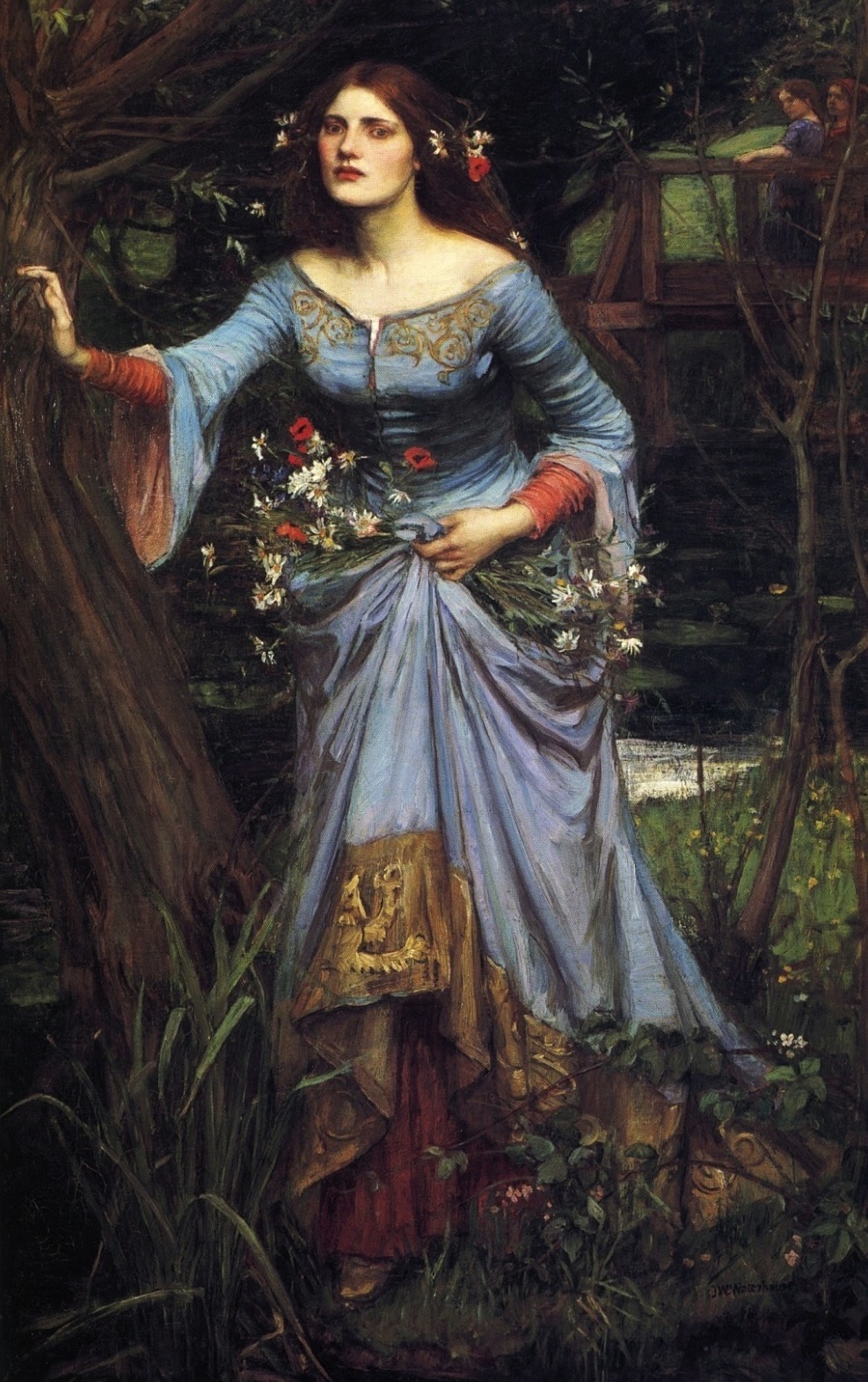
Ophelia has reached the willow beside the brook. She grips the old trunk with one hand and gathers flowers in the other, looking outward with an intensity absent from John William Waterhouse's earlier versions. Behind her, two women cross a narrow bridge. The world is close enough to witness her and still too distant to intervene.
Exhibited at the Royal Academy in 1910, this is Waterhouse's third completed major Ophelia. It does not show the drowned body. Instead it enlarges the last unstable approach to the place Gertrude will describe after the event. [1] [2]
At a Glance
- ArtistJohn William Waterhouse (1849–1917)
- TitleOphelia
- Date1910 [2] [3]
- MediumOil on canvas [3]
- Dimensions101.5 × 63.5 cm in the 2008–10 retrospective literature [3]
- CollectionAndrew Lloyd Webber Collection / private collection [3]
- First exhibitedRoyal Academy, London, 1910 [2]
- Literary sourceWilliam Shakespeare, Hamlet, especially Act 4, scenes 5 and 7 [1]
- SubjectOphelia beside the willow and brook, holding flowers before the drowning narrated by Gertrude [1] [2]
- SequenceThird of Waterhouse's completed major Ophelia paintings, after 1889 and 1894 [2]
- Essential measurement warningThe 119 × 71 cm figure widely attached online to “Ophelia, 1910” belongs to Waterhouse's 1894 version; the retrospective catalogue records the 1910 canvas as 101.5 × 63.5 cm [2] [3]
Contents
- Introduction
- Ophelia Upright at the Edge of Crisis
- Gertrude's Report and the Event No Audience Sees
- Willow, Flowers and the Approaching Water
- The Distant Women on the Bridge
- Distress, Agency and the Question of Drowning
- The Final Work in Waterhouse's Ophelia Trio
- Royal Academy Exhibition and Catalogue Cautions
Ophelia Upright at the Edge of Crisis
The 1910 Ophelia occupies a tall, narrow canvas. Her body rises beside the tree, but the pose is not stable. One arm reaches back or sideways to the willow for support while the other gathers drapery and flowers close to her body.
Waterhouse's earlier Ophelias lie in a meadow or sit upon a bough. Here the heroine stands, and the change makes distress confrontational.
Her face is turned towards the viewer's side of the scene rather than absorbed wholly by flowers. The eyes appear alert, strained and difficult to avoid. Madness is not translated into dreaminess.
The body is richly dressed but physically unsettled. Blue or blue-grey fabric, warmer underlayers and embroidered details preserve her courtly identity while the woodland begins to close around it.
Flowers appear in the hair and hands. They connect the public distribution scene in Act 4 to the garlands beside the brook, but Waterhouse does not transform Ophelia into a passive bouquet.
The willow trunk is both attribute and support. Its rough, pollarded form contrasts with the smooth face and fabric, making her grip look urgent rather than ornamental.
No branch is visibly breaking at the selected moment. Waterhouse suspends Ophelia before the fall Gertrude narrates, when approach can still be seen as action rather than consequence.
This interval creates dramatic uncertainty. The viewer knows the ending but cannot point to the instant when it becomes unavoidable.
The painting is therefore not simply “Ophelia before death.” It is a study of a person whose body still acts in a story that other characters will soon turn into a beautiful report.
The tall format strengthens this resistance to retrospective prettifying. Ophelia is not spread as a horizontal element within a broad landscape; she interrupts it. Woman and willow create a joint obstruction that the viewer must confront before reaching the gentler distance of bridge and stream.
Her scale also makes the encounter less voyeuristic than a remote pastoral scene. The face is near enough to demand an account of distress even though the painting cannot supply words for it.
Gertrude's Report and the Event No Audience Sees
Shakespeare does not stage Ophelia's drowning. In Act 4, scene 7, Gertrude enters with news for Laertes and tells him what happened beside the willow. [1]
According to that speech, Ophelia makes garlands from crowflowers, nettles, daisies and long purples. She climbs or reaches to hang them on the drooping bough; the branch breaks, and both she and the flowers fall into the brook. [1]
Her clothes initially spread upon the water and keep her afloat. She sings fragments of songs, seeming not to recognise the danger, until the wet garments pull her down. [1]
The account is visually extraordinary, but its status remains complex. Gertrude speaks with confidence and precise detail, yet the play does not identify the witness who supplied it or show her present at the brook.
Waterhouse inherits that gap. His painting can appear to reveal what Gertrude describes, but it is another act of imaginative reconstruction rather than evidence from within the fictional event.
He chooses a moment just before the report's central action. The willow, water and garlands are assembled, yet Ophelia remains on land.
That choice avoids competing directly with John Everett Millais's famous image of Ophelia afloat. It also lets Waterhouse concentrate on the last bodily interval in which she can meet the viewer's gaze.
Gertrude's language aestheticises the death through flowers, song, spreading garments and “weeping brook.” Waterhouse preserves beauty but adds strain. The grip on the tree and direct expression resist turning drowning into effortless surrender.
The difference reminds us that a beautiful account is not a transparent event. Ophelia dies in the space between what happens and how survivors narrate it.
Willow, Flowers and the Approaching Water
The willow is the composition's strongest vertical partner to Ophelia. In the play it grows askant over the brook, its leaves reflected in the water. [1]
Waterhouse paints an old, cut or pollarded trunk whose irregular mass can support the figure and bring age into contact with youth. It is not merely a slender symbol of forsaken love.
Ophelia's hand makes the tree tactile. She uses it to steady herself, linking the body directly to the structure that will soon place her above the water.
The brook appears beyond and below, its route partly interrupted by bank, foliage and bridge. Water is not the canvas's largest area, but narrative knowledge gives it disproportionate force.
Flowers concentrate around Ophelia. Shakespeare associates her with rosemary, pansies, fennel, columbines, rue, daisies and violets in the earlier distribution scene, then lists a partly different group in Gertrude's drowning report. [1]
The painting does not permit every bloom to be identified securely. Poppies and daisies are often noted in the image, but a responsible reading distinguishes recognisable forms from a complete botanical claim.
Poppies can evoke sleep and death, while daisies can evoke innocence. Those associations were available to Waterhouse's audience, yet no flower dictionary should replace the play's shifting language or the visible composition.
The key fact is that Ophelia holds what she has gathered. Flowers record purposeful movement through the landscape even when her speech and judgement no longer conform to courtly expectations.
Dress, flowers, bark and water establish four textures: cultivated identity, fragile collection, rough support and fluid danger. Ophelia stands where they meet.
The painting's late moment depends upon approach. Nothing pushes her from behind. The river draws narrative attention because she has come to it carrying the materials Gertrude will describe.
The Distant Women on the Bridge
Two small female figures cross a wooden bridge in the background. [4] They are easy to miss because Ophelia dominates the foreground.
Waterhouse does not identify them. They may be attendants, villagers or simply passers-by. Giving them names from the play would exceed the evidence.
Their distance creates an ethical problem. Ophelia is not completely alone, yet the people who might see her are separated by scale, water, trees and the direction of their movement.
The bridge offers safe passage over the stream. The women use a constructed route from one bank to another while Ophelia remains beside the natural bough. Civil order exists in the same landscape but does not contain her.
They also provide a measure of time. Walking figures will soon leave the frame; Ophelia's crisis is held still. The world proceeds in ordinary sequence around an event that will become extraordinary only after death is announced.
It is possible to interpret the women as witnesses, but the painting does not show them looking clearly at Ophelia. Presence is not the same as attention.
This ambiguity echoes Gertrude's report. Someone seems to know the drowning in detail, yet the play withholds a clear witness. Waterhouse supplies possible observers without confirming that they observe.
The figures enlarge Ophelia's isolation more effectively than an empty background might. Complete solitude could appear chosen; unrecognised distress within sight of others is socially sharper.
The bridge is therefore not only landscape furniture. It stages proximity without rescue.
It also makes the brook part of a shared environment rather than a private symbol belonging only to Ophelia. Other people have crossed and will cross this water safely. Tragedy arises from her particular condition and route, not from a landscape uniformly coded as fatal.
That contrast prevents the setting from becoming an enchanted death-world. The bridge is practical, the women ordinary and the water traversable. Ophelia's crisis occurs inside common life.
The two scales—foreground emergency and background routine—can be held together only in painting, where distant walkers and a near face remain permanently simultaneous.
Distress, Agency and the Question of Drowning
Was Ophelia's death an accident or suicide? Hamlet deliberately refuses a simple answer. [1]
Gertrude's account emphasises the breaking bough and Ophelia's failure to understand her peril. This supports accidental drowning shaped by mental collapse. [1]
In the graveyard scene, however, the gravediggers discuss whether she drowned herself and whether social privilege has secured Christian burial. The priest says her death was doubtful enough to limit the rites. [1]
These conflicting perspectives are part of the play, not a puzzle that the painting must solve.
Waterhouse's 1910 image sustains uncertainty by stopping before immersion. Ophelia has chosen or wandered to the willow and gathered flowers. She has not yet been shown deliberately entering the water.
Her direct, distressed look can imply awareness, but expression alone cannot establish intent. Treating it as proof of a decision to die would collapse Shakespeare's ambiguity into modern psychological diagnosis.
The grip on the trunk can even suggest resistance or need for support. A body holding fast does not offer an uncomplicated image of surrender.
At the same time, the painting grants Ophelia physical agency missing from many passive death images. She stands, holds, gathers and looks. The tragedy is not that she lacks all action; it is that action occurs within grief, madness and a social world that has failed her.
Ophelia's madness should not be romanticised as mystical freedom. Her songs and flowers communicate, but they emerge after bereavement and prolonged control. The court reads her while providing little protection.
Waterhouse makes that exposure immediate. We face the person whom Gertrude's later speech will transform into a distant aesthetic object.
The Final Work in Waterhouse's Ophelia Trio
The 1910 canvas completes a group begun more than twenty years earlier. [2]
In 1889 Waterhouse painted Ophelia lying among wildflowers in a broad meadow, with the fatal stream visible through willow stems. The treatment is horizontal, low and naturalistic. [2] [3]
In 1894 he seated her on a slanting bough above a lily-filled pool, arranging flowers in her hair. That vertical composition is richly decorative and elegiac. [2]
In 1910 he made her upright beside the willow, carrying garlands and looking outward. Christie's calls the final treatment powerfully dramatic in contrast with the realism of 1889 and the poetry of 1894. [2]
The sequence can be summarised through posture—lying, sitting, standing—but the emotional movement is not simply upward. The body becomes more vertical while the confrontation with viewers becomes more intense.
Water also changes position. It is distant in 1889, immediately below the branch in 1894 and threaded through a socially inhabited landscape in 1910.
Flowers remain the constant. They move from meadow abundance and gathered folds, to self-adornment above the pond, to a clutched group carried towards the willow.
Costume changes the emotional temperature as well. The 1889 pale dress stretches across the meadow; the 1894 white and gold garment contributes to an elegiac, almost ceremonial beauty; the 1910 blue-toned dress creates a denser vertical mass against bark and foliage. These are visible compositional differences, not proof of three separate historical moments or ranks.
In 1910, folds gather around the moving body rather than spreading serenely. Warmer fabric beneath the blue interrupts any funereal coolness, making the figure appear physically alive even as the story directs viewers towards death.
Hair and flowers create smaller colour accents around the face. Their nearness keeps attention on expression before the eye travels down towards water or back towards the bridge.
Waterhouse reportedly planned a further composition, sometimes called Ophelia in the Churchyard, but no finished fourth major canvas joined the trio. Studies and variant titles should not be counted automatically as completed works.
The 1910 painting is therefore final in two senses: it is the latest completed Ophelia and the image that brings her closest to direct encounter before Waterhouse left the subject.
It does not supersede the earlier versions. Each retains a different balance among literary source, landscape, beauty and distress.
Royal Academy Exhibition and Catalogue Cautions
Waterhouse exhibited the 1910 Ophelia at the Royal Academy. [2] By then he had been a full Academician for fifteen years and was an established interpreter of Shakespeare, Tennyson, Keats and classical myth.
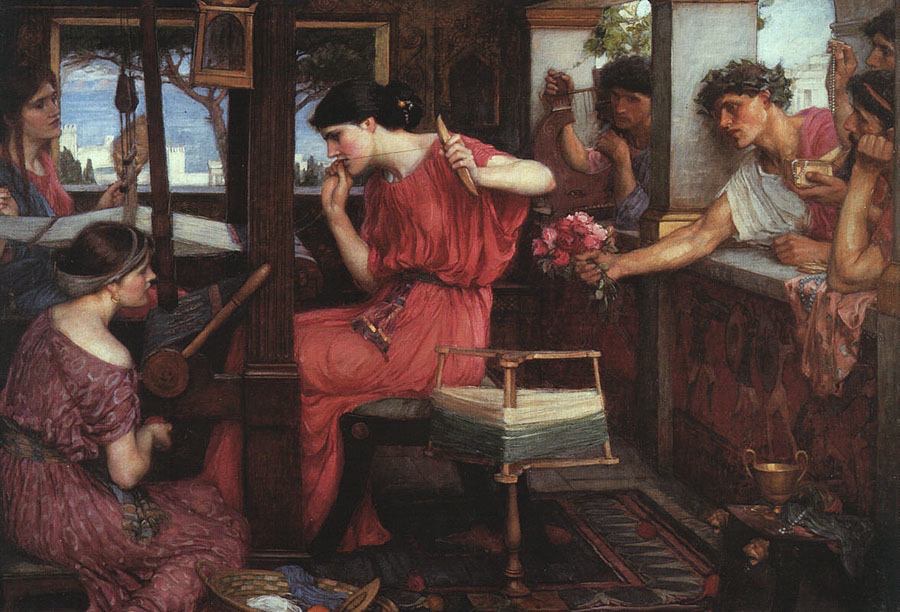
The work appeared after Lamia and Thisbe in 1909 and before the late group including Penelope and the Suitors, “I Am Half-Sick of Shadows” and Miranda. It belongs to a period of renewed solitary heroines placed at thresholds, pools and windows.
Modern reproductions frequently mislabel the 1894 and 1910 Ophelias. A Wikimedia record currently assigns the 119 × 71 cm dimensions and Andrew Lloyd Webber collection to an image labelled 1910, while established catalogue sources assign 119 × 71 cm to 1894 and 101.5 × 63.5 cm to 1910. [2] [3]
The visual distinction provides the safest check. The 1894 Ophelia sits on a branch in a white, gold-ornamented dress above lilies. The 1910 Ophelia stands beside a rough willow in blue-toned dress, and two women appear on a bridge behind.
For this version, the retrospective catalogue dimensions reported in academic literature are 101.5 × 63.5 cm. [3]
The painting is recorded in the Andrew Lloyd Webber Collection. As a privately owned work, it does not have a permanent public display status comparable with a museum object. [3]
Exhibition history and collection association should therefore be separated from present accessibility. A work can be well documented and much exhibited without being continuously available.
The catalogue problem is itself instructive. Three paintings with one title, recurring flowers and related settings require description, date and dimensions to travel together. “Waterhouse's Ophelia” is not enough.
A disciplined viewing order helps preserve this painting's particular design. Begin with Ophelia's eyes and the line of the arm braced against the tree. The first establishes emotional encounter; the second shows the physical effort supporting it.
Then compare her hand on bark with the hand holding flowers. One grasps a durable living structure, the other a fragile group already cut from its roots. The opposition does not require a secret symbolic key to be effective.
Follow the willow down towards the bank and find the water. Its partial concealment makes it a discovered danger rather than a decorative blue field.
Only after reading the foreground should the two women on the bridge be located. Their smallness is the point: social life is present at a scale that cannot answer Ophelia's face.
Finally step back and compare the verticals of woman and tree with the horizontal passage of bridge and stream. The body appears held at the crossing of support, movement and descent.
This sequence also guards against treating every natural detail as a coded omen. Waterhouse's strongest meanings arise from position and relation: near and far, held and carried, upright and flowing.
Related Pages
- Ophelia, 1889: Compare Waterhouse's wider, landscape-format first Ophelia.
- Ophelia, 1894: Compare the vertical 1894 Ophelia with the later 1910 version.
- Literary and Mythological Sources: Place Waterhouse's Ophelia paintings within his literary subjects.
Frequently Asked Questions
Ophelia stands beside the willow and brook carrying flowers, before the drowning Gertrude later narrates. [1] [2]
No. She remains on the bank and uses the willow for support.
Waterhouse does not securely identify them. They cross a bridge at a distance and may function as possible but inattentive witnesses.
The play keeps the death uncertain. Gertrude describes a broken branch and apparent unawareness, while the gravediggers and priest discuss the possibility of self-destruction. [1]
The 1894 Ophelia sits on a bough above water and arranges flowers in her hair. The 1910 Ophelia stands beside a willow, clutching flowers, with two figures on a bridge. [2]
That measurement belongs to the 1894 canvas. The 2008–10 retrospective literature records the 1910 painting as 101.5 × 63.5 cm. [2] [3]
Yes, in 1910. [2]
It is recorded in the Andrew Lloyd Webber Collection, a private collection. [3]
It is his third and last completed major Ophelia. A further churchyard composition was planned but not completed as a comparable finished canvas.
Discussion
1. How does Ophelia's upright position change the emotional force of the subject? 2. Does her grip on the willow suggest support, restraint or preparation? 3. What is the effect of placing possible witnesses on a distant bridge? 4. How does Waterhouse respond to an event Shakespeare narrates but never stages? 5. Does the painting preserve the play's uncertainty around accident and suicide? 6. Compare the role of flowers in the 1889, 1894 and 1910 versions. 7. Why might Waterhouse have moved from realism to elegy to direct drama across the trio? 8. How do catalogue errors alter interpretation when related paintings share one title?
Reader Insights
Which visible detail most changes the way you read this page?
Which source or comparison helps the work feel less familiar and more specific?
What question would you bring back to the painting after reading?
Join the Conversation
Share your reading of this page below.
References
- Main image: John William Waterhouse, Ophelia, 1910, public-domain faithful reproduction via Wikimedia Commons.
- William Shakespeare, Hamlet, especially Act 4, scenes 5 and 7 and Act 5, scene 1, Folger Shakespeare Library, accessed 6 August 2026, View source.
- Christie's, “John William Waterhouse, R.A., Ophelia,” catalogue record and essay for the 1894 version, comparing the three major paintings and recording the 1910 Royal Academy exhibition, View source.
- Akiko Kawasaki, “J. W. Waterhouse's Ophelia,” Bulletin of Tokyo Kasei University Museum (2016), p. 51, dimensions and collection data drawn from Peter Trippi and the 2008–10 retrospective catalogue, View source.
- Howard Oakley, “Is There a Willow? Paintings of Ophelia from 1890,” The Eclectic Light Company, 4 August 2019, visual discussion of the willow, bridge and two distant women, View source.