

 Buy Art Prints Now
from Amazon
* As an Amazon Associate I earn from qualifying purchases.
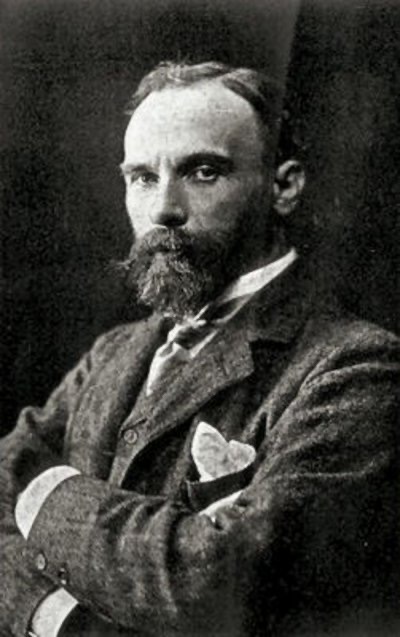
Image reference [image]
 by Tom Gurney
Tom Gurney BSc (Hons) is an art history expert with over 20 years experience
Published on August 14, 2026 / Updated on August 14, 2026
Email: tomgurney1@gmail.com / Phone: +44 7429 011000
John William Waterhouse: Introduction
John William Waterhouse brought ancient myth, medieval legend and nineteenth-century poetry into the exhibition culture of Victorian and Edwardian Britain. His best-known pictures are often remembered as visions of solitary women beside water: the Lady of Shalott loosening her boat, Circe tipping poison into a luminous sea, Ophelia among flowers, or a mermaid combing her hair on a rocky shore. Yet his career was broader than that familiar image suggests. It began with scenes of the ancient world, developed through ambitious narrative paintings for the Royal Academy and ended with increasingly concentrated treatments of poetry, enchantment, danger and desire.
Waterhouse is frequently called a Pre-Raphaelite, but the label needs care. The Pre-Raphaelite Brotherhood was founded in 1848, just before his birth, and Waterhouse did not belong to it. [1] [2] He was trained in the Royal Academy system and first made his name with classical and historical subjects. Only later did he draw conspicuously on the colour, emotional intensity, literary interests and medievalising subjects associated with artists such as Dante Gabriel Rossetti, John Everett Millais and William Holman Hunt. The description “modern Pre-Raphaelite,” used for the major 2008–2010 retrospective of his work, captures that inheritance without pretending that he was an original Brother. [3]
This introduction follows Waterhouse across his career: from Rome and the Royal Academy Schools to the classical paintings of the 1870s and 1880s, the literary subjects of his maturity, the works held in public collections and the modern debates that continue to surround them. It is a route into the paintings rather than a substitute for their individual histories.
At a Glance
- BornJanuary 1849 in Rome, as recorded by the National Portrait Gallery [1]
- Died10 February 1917, London [1]
- Nationality and practiceBritish figure painter working principally in oil [1] [4] [6] [7]
- Trainingthe National Portrait Gallery dates his entry to the Royal Academy Schools as a sculpture student to 1871 [1]
- Royal Academy careerfirst exhibited there in 1874; elected Associate in 1885 and Royal Academician in 1895 [1]
- Principal studiosPrimrose Hill Studios, 1878–1900, followed by 10 Hall Road, St John’s Wood [1]
- Major sourcesGreek and Roman history and mythology; Homer and Ovid; Shakespeare; Alfred Tennyson; John Keats; Percy Bysshe Shelley [3]
- Best-known subjectsthe Lady of Shalott, Ophelia, Circe, Psyche, mermaids, nymphs, sirens and women engaged in prophecy, weaving or magic
- Often associated withacademic classicism, later Pre-Raphaelitism and Symbolism
- Eight-work starting pointThe Lady of Shalott, Hylas and the Nymphs, The Magic Circle, Circe Invidiosa, Ulysses and the Sirens, Saint Eulalia, A Mermaid and Penelope and the Suitors
- Where to begin with the lifethe full John William Waterhouse biography
Contents
- Introduction
- Waterhouse in context: artistic connections
- Waterhouse’s journey in works and places
- A career between academy and enchantment
- Rome, London and Royal Academy training
- The classical world of the early paintings
- From Saint Eulalia to The Lady of Shalott
- Homer, Ovid and the dangerous classical heroine
- Tennyson, Shakespeare and the poetry of suspended action
- How Waterhouse builds a picture
Waterhouse in context: artistic connections
Waterhouse’s career makes most sense as a network rather than a single movement label.
Sources and artistic languages
- The Royal Academytraining, annual exhibition and professional membership gave his career its institutional structure. [1]
- Classical art and literatureancient history, Homer, Ovid and archaeological objects supplied subjects and visual evidence. The Greek vase behind the sirens in Ulysses and the Sirens is a particularly clear case. [9] [15]
- The original Pre-RaphaelitesRossetti, Millais and Hunt offered a precedent for saturated colour, literary subject matter and emotionally charged beauty, but Waterhouse belonged to a later generation and developed those interests through academic history painting. [2] [3]
- French paintingcontemporary testimony and later collection interpretation connect his broader, more direct handling with French practice, though the exact sources and weight of that influence vary by work. [4] [15]
- Symbolismthe Groninger Museum places his mature concentration on magic, mirrors, transformation and female power alongside Symbolist developments rather than treating it as Pre-Raphaelitism alone. [3]
Collections, revival and debate
- Early public collectingAdelaide, Sydney and Melbourne acquired important paintings during Waterhouse’s lifetime, helping make his career international from the outset. [6] [7] [9] [10]
- The modern retrospectivethe 2008–2010 exhibition travelled from Groningen to London and Montreal; Groningen called it the largest Waterhouse survey yet mounted, and the Montreal Museum of Fine Arts records it as J. W. Waterhouse: Garden of Enchantment. [3] [20]
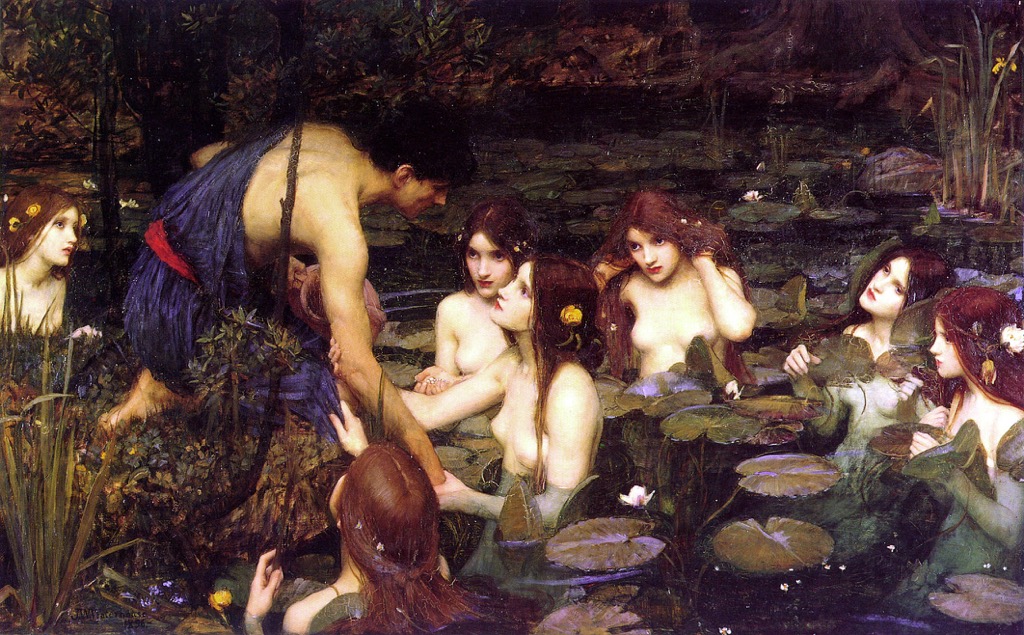
- Contemporary reinterpretationin 2018, Sonia Boyce’s project Six Acts used the temporary removal of Hylas and the Nymphs at Manchester Art Gallery to provoke discussion about gender, race, sexuality and the way historic paintings are displayed. [21] The episode did not settle what the painting means. It demonstrated that museum presentation is itself part of a work’s continuing history.
These connections help explain why Waterhouse feels both firmly Victorian and unexpectedly current. His subjects come from inherited texts, his professional life belonged to the Academy and his visual language looked backward to earlier art. Yet the questions raised by his pictures—who looks, who acts, who is endangered and how beauty shapes judgement—remain open to new viewers.
Waterhouse’s journey in works and places
Works: six turning points
- 1849–1873: Rome remembered, London training. Born in Rome, raised largely in Britain and trained at the Royal Academy Schools. [1]
- 1874–1884: classical and historical narrative. First Academy exhibition, Italianate scenes, Diogenes, The Favourites of the Emperor Honorius and Consulting the Oracle establish an ambitious figure painter. [1] [6] [7]
- 1885–1888: recognition and change. Election as an Associate, followed by Saint Eulalia, The Magic Circle and The Lady of Shalott. [1] [11] [12] [13]
- 1891–1900: mature myth and poetry. Ulysses and the Sirens, the Circe paintings, Hylas and the Nymphs and A Mermaid join classical learning to a modern Pre-Raphaelite and Symbolist atmosphere. [3] [9] [10] [19] [22]
- 1901–1912: sequences and return subjects. Echo, Narcissus, Psyche, the Danaids, flowers and weaving sustain related but distinct groups, culminating in Penelope and the Suitors. [4]
- 1913–1917: late Tennyson and Shakespeare. Waterhouse revisits the Lady of Shalott and Miranda while continuing to work near the end of his life. [1] [17]
Places: from Rome and London to Australian collections
- RomeWaterhouse’s birthplace in 1849, and an apt beginning for a career deeply engaged with classical history and myth. [1]
- Londonthe Royal Academy Schools, annual Academy exhibitions, Primrose Hill Studios and Hall Road formed the main professional geography of his career. [1]
- AdelaideThe Favourites of the Emperor Honorius entered the South Australian collection in 1883, followed by Circe Invidiosa in 1892. [7] [10]
- Sydneythe Art Gallery of New South Wales purchased Diogenes in 1886. [6]
- Melbournethe National Gallery of Victoria purchased Ulysses and the Sirens from the artist in 1891. [9]
A career between academy and enchantment
Waterhouse’s paintings stand at a productive intersection. Their large scale, legible narratives and regular appearance at the Royal Academy belong to the public world of late nineteenth-century history painting. Their subjects often come from texts that educated viewers were expected to recognise. At the same time, the pictures do not operate like diagrams of a story. They select charged moments, withhold outcomes and give colour, gesture and setting as much expressive work as plot.
That combination explains why several labels attach to him without completely containing him. “Academic” describes his training and professional route, but not the strange concentration of The Magic Circle. “Classical” fits Diogenes, The Favourites of the Emperor Honorius and Ulysses and the Sirens, but says little about the Tennysonian melancholy of The Lady of Shalott. “Pre-Raphaelite” identifies his return to literary subjects, jewel-like colour and elaborately staged beauty, yet his handling is frequently broader and less minutely finished than that of the original Brotherhood. Aberdeen Art Gallery, for example, describes the loose brushwork of his late Penelope and the Suitors as a quality associated with French influence. [4]
The 1911 Encyclopaedia Britannica characterised Waterhouse as a figure painter of classical myths with imaginative power, strong colour and a personal style. [5] That contemporary judgement shows that he was no forgotten outsider: he was an Academician whose pictures entered public collections while still new. His development was not a simple switch from classical to Pre-Raphaelite subjects. Homer and Ovid remained important after he embraced Tennyson and Shakespeare.
Rome, London and Royal Academy training
Waterhouse was born in Rome in January 1849. His father, William Waterhouse, was a painter, and the family returned to Britain while John was young. [1] The Roman birth later seemed fitting for an artist whose early career would be crowded with ancient architecture, marble, togas and episodes from classical history. It would be too neat, however, to treat childhood geography as a complete explanation for adult subject matter. Classical culture was also central to Royal Academy training and to the wider British art world in which he developed.
The National Portrait Gallery dates his entry to the Royal Academy Schools as a sculpture student to 1871; he began exhibiting paintings at the Academy in 1874. [1] The sculptural start matters even though painting became his profession. Across the later work, bodies are often organised as strongly modelled masses: the sprawled martyr in Saint Eulalia, the bound Ulysses twisting against the mast, Penelope turning away from the suitors, or the single upright magician enclosed by her circle. This does not prove that every figure was conceived like a statue. It does suggest why pose, contour and the distribution of bodily weight are such important carriers of meaning.
The Royal Academy was more than a school. Its annual exhibition gave Waterhouse a recurring public stage, a place where a new painting could be judged against hundreds of others and where titles, catalogue quotations and literary recognition helped viewers identify a subject. The National Portrait Gallery records that he exhibited there almost every year from 1874 until his death, with the exceptions of 1890 and 1915. [1] He became an Associate in 1885 and a full Royal Academician in 1895, evidence of sustained institutional success rather than a single popular triumph.
In 1883 Waterhouse married Esther Maria Kenworthy, herself a flower painter. They lived and worked within the artistic geography of north London, first at Primrose Hill Studios and later at Hall Road in St John’s Wood. [1] Beyond these outline facts, the personal record is unusually thin. The National Portrait Gallery notes the shortage of anecdotes and biographical information despite his Academy position and wealthy patrons. [1] That scarcity should shape interpretation. Similar faces across several canvases do not by themselves identify a model, and a tragic heroine should not be treated as a coded episode from the painter’s private life without evidence.
The classical world of the early paintings
Waterhouse’s early reputation grew through scenes of antiquity. Some show episodes of daily or ceremonial life; others select historical figures whose stories allowed a Victorian audience to contemplate power, luxury, belief or withdrawal. Architectural settings and archaeological-looking objects establish the imagined period, while human behaviour supplies the drama.
Diogenes of 1882 is a particularly useful starting point. The large canvas, now at the Art Gallery of New South Wales, shows the Cynic philosopher in his tub while richly dressed women approach and look down toward him. The museum records that it was exhibited at the Royal Academy in 1882 and purchased for the Sydney collection in 1886. [6] Waterhouse turns philosophical renunciation into a social encounter: Diogenes occupies the low, shadowed edge of the picture, while curiosity, status and city life gather above him. The setting looks convincingly antique, but the structure of looking is immediate and theatrical.
The following year brought The Favourites of the Emperor Honorius, a wide composition now in Adelaide. The Art Gallery of South Australia dates it to about 1883 and records that it was painted in London and acquired that year with a South Australian government grant. [7] Honorius, the late Roman emperor, is absorbed by the birds around him while officials wait. The picture’s polished surfaces and carefully furnished chamber do not merely reconstruct a court. They make political withdrawal visible through scale and attention: urgent human business is displaced by the emperor’s secluded interest.
Public acquisition formed part of this early success. Adelaide states that The Favourites of the Emperor Honorius was the first Waterhouse painting to enter a public institution. [8] Australian collections would remain important to his international history: Diogenes went to Sydney, Ulysses and the Sirens was purchased for Melbourne in the year it was shown, and Circe Invidiosa was bought for Adelaide soon after it was painted. [6] [9] [10] Waterhouse’s current geography is therefore not a late scattering of secondary works. Some of his central paintings became public objects on the other side of the world almost immediately.
From Saint Eulalia to The Lady of Shalott
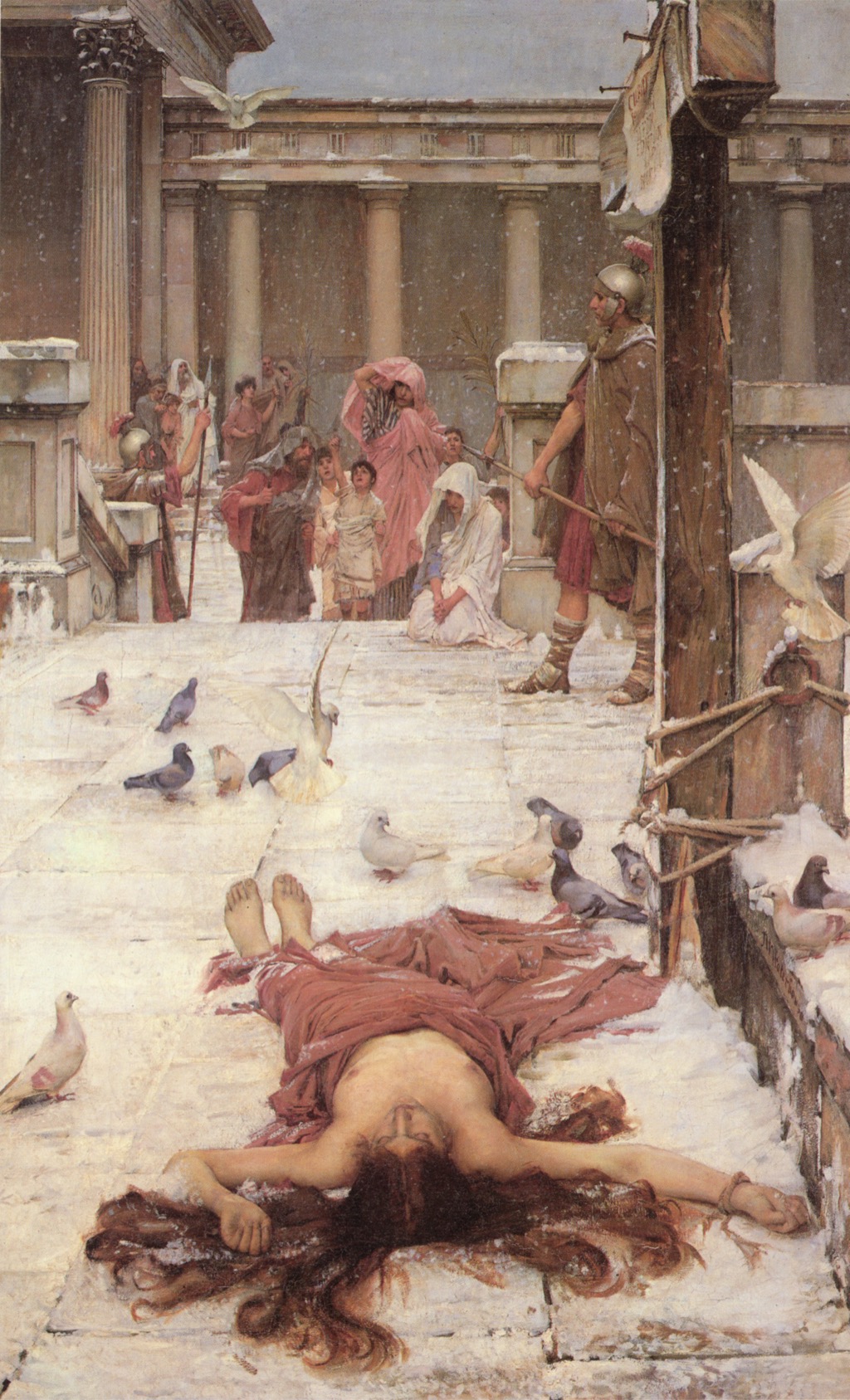
The middle of the 1880s sharpened Waterhouse’s focus on a solitary central figure and an uncanny event. Saint Eulalia, exhibited in 1885, depicts the aftermath of the young Christian martyr’s death. Tate identifies the subject as the twelve-year-old Eulalia, killed after refusing to sacrifice to the Roman gods, and records the miraculous dove and snowfall associated with her story. [11] Waterhouse makes the body a forceful diagonal across a wide vertical canvas. The low viewpoint opens a large space of stone and sky above her, while the falling snow changes the atmosphere without cancelling the physical fact of death.
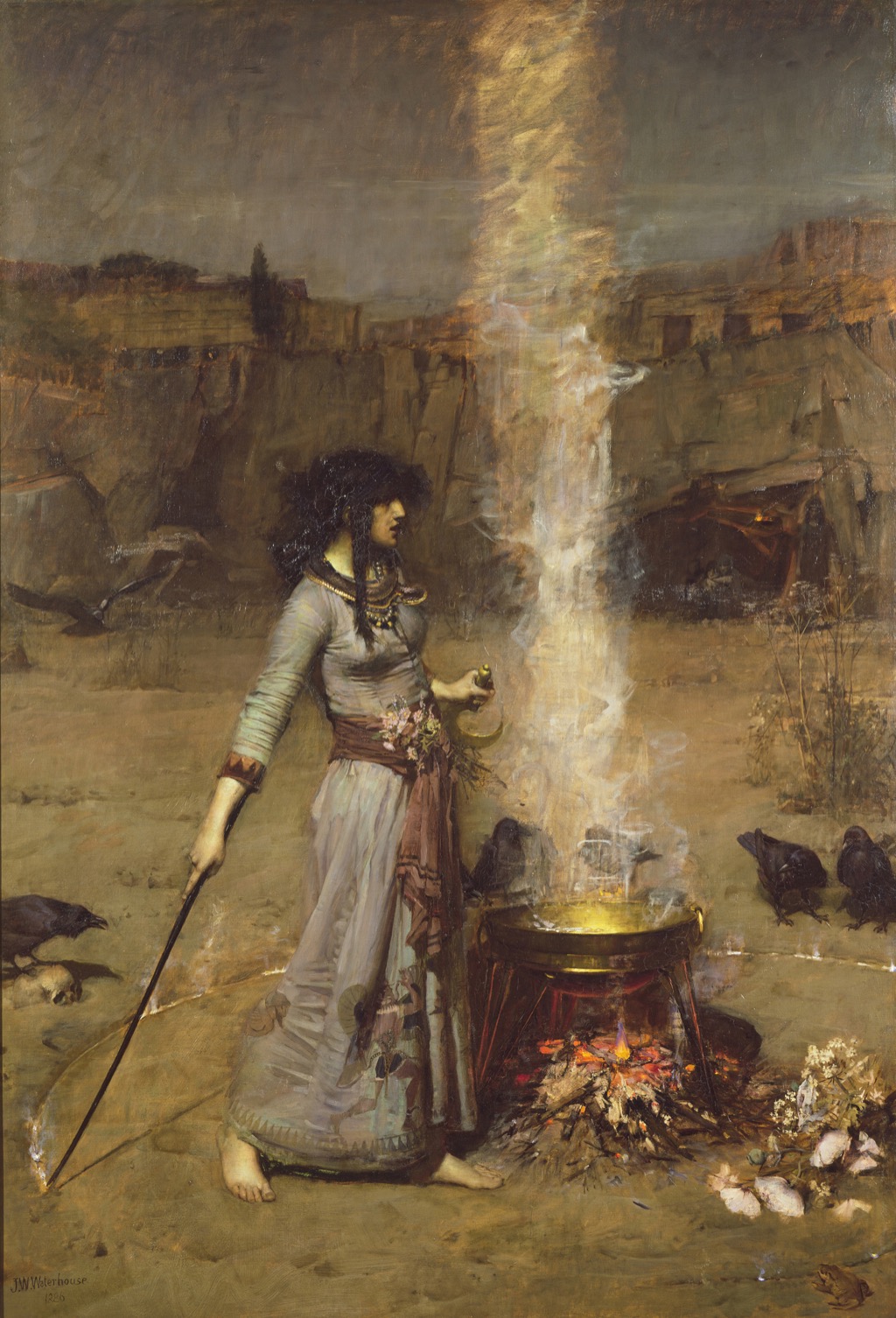
In The Magic Circle of 1886, sacred miracle gives way to enacted magic. A standing woman draws a circle around herself while smoke rises from a vessel and birds remain outside the boundary. The scene offers no named literary heroine and no single explanatory text. Its power comes from concentrated action: the wand touches the ground; the enclosing line is still being made; the figure controls a space that the viewer can see but not enter. [12] It is tempting to decode every animal and object as a fixed symbol. A more secure first reading begins with the visible structure of inclusion and exclusion.
Waterhouse’s election as an Associate of the Royal Academy in 1885 coincided with this period of growing distinction. [1] The Groninger Museum’s retrospective account identifies 1886 as the point from which he emerged as a “modern Pre-Raphaelite,” absorbing the colourful emotionalism of Rossetti, Millais and Hunt while continuing to work through his own academic formation. [3] The phrase is especially apt because it describes a direction rather than a conversion. Classical subjects remained, but their atmosphere, colour and female protagonists increasingly overlap with Symbolist and Pre-Raphaelite concerns.
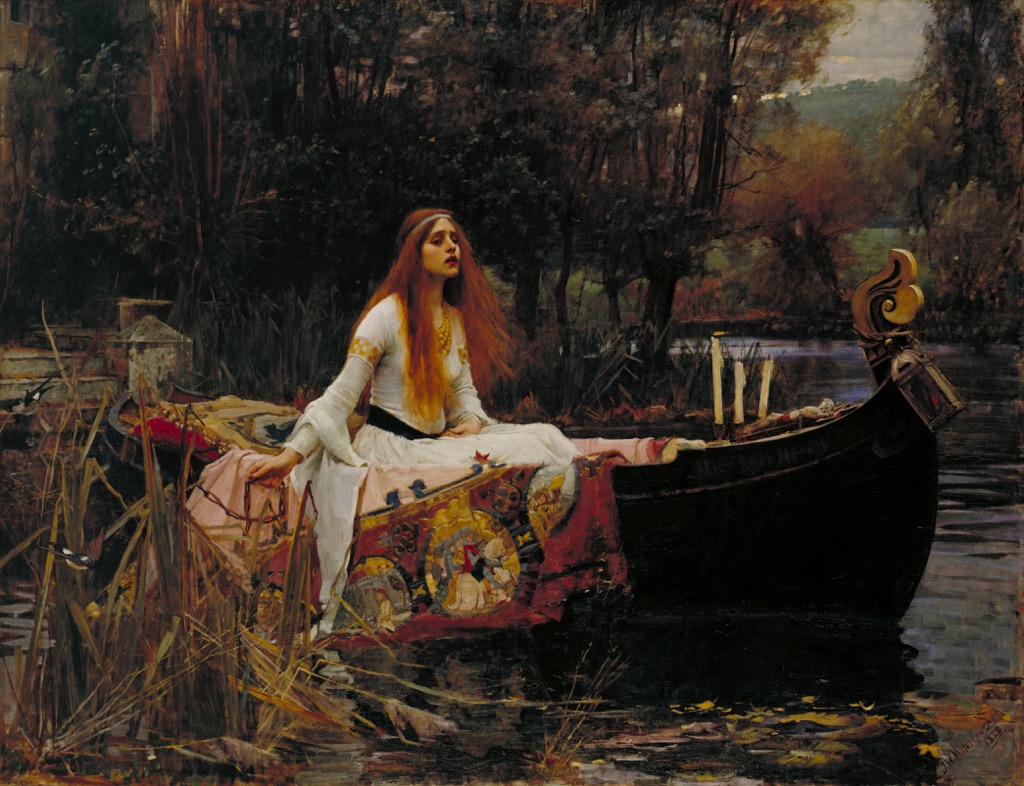
Then came The Lady of Shalott in 1888. Tate’s large oil painting illustrates Tennyson’s Arthurian poem at the moment when the Lady has left her tower and committed herself to the river journey that will end in death. [13] The tapestry lies over the side of the boat, a chain is near her hand and Camelot remains unseen downstream. Tennyson’s 1842 poem moves from reflected “shadows of the world” to a direct look at Lancelot, the breaking of the mirror and the Lady’s final voyage. [14] Waterhouse does not attempt to show that whole sequence. He selects departure, when freedom and doom have become inseparable.
The painting is rightly central to his reputation, but it should not make everything before it look like preparation. Saint Eulalia and The Magic Circle are already fully realised statements. What The Lady of Shalott adds is a durable synthesis: literary recognition, landscape, material detail, emotional suspense and a heroine whose action can be read as both release and catastrophe.
Homer, Ovid and the dangerous classical heroine
Waterhouse’s mature classicism is less concerned with furnishing an ancient room than with testing the emotional force of inherited stories. Homer and Ovid provide characters at moments when desire alters perception or threatens bodily safety. The pictures remain narrative, yet they invite viewers to experience attraction and danger simultaneously.
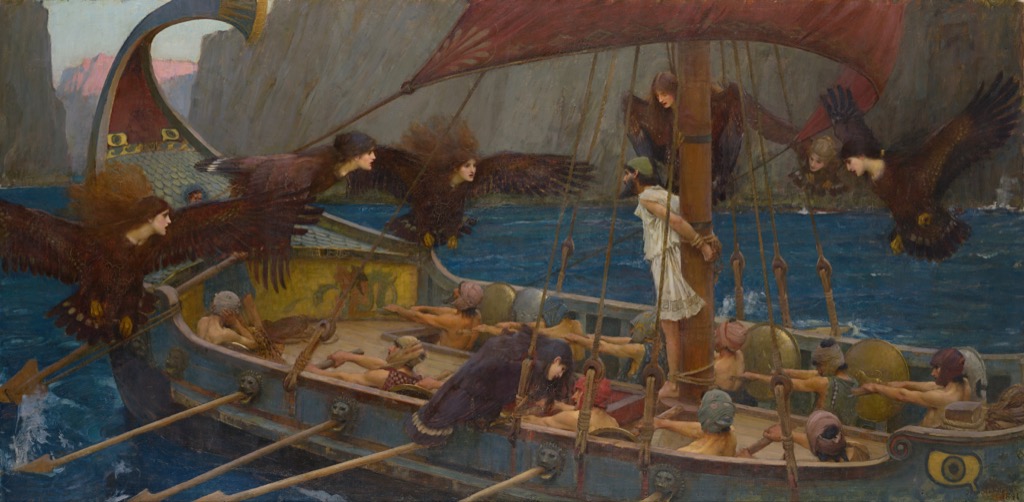
Ulysses and the Sirens of 1891 spreads the encounter across a long maritime canvas. Ulysses is tied to the mast; his crew row with their ears stopped; bird-bodied sirens press around the ship. The National Gallery of Victoria records that Waterhouse borrowed the form of the sirens from an ancient Greek vase in the British Museum and that the painting was purchased from the artist in the year of its Royal Academy exhibition. [9] The archaeological reference gave the fantasy a claim to classical authority, but contemporary critics still disputed how closely the painting followed Homer.
That dispute is part of the work’s history. An NGV study of the painting traces responses that praised its colour and imaginative force while objecting to the aggressive bird-women or to departures from the text. It also quotes the Gallery’s adviser Hubert von Herkomer describing Waterhouse’s direct method and linking it to French influence. [15] These records warn against the idea that Victorian viewers received academic myth pictures passively. They argued about source fidelity, public spending, style and the frightening power given to the sirens.
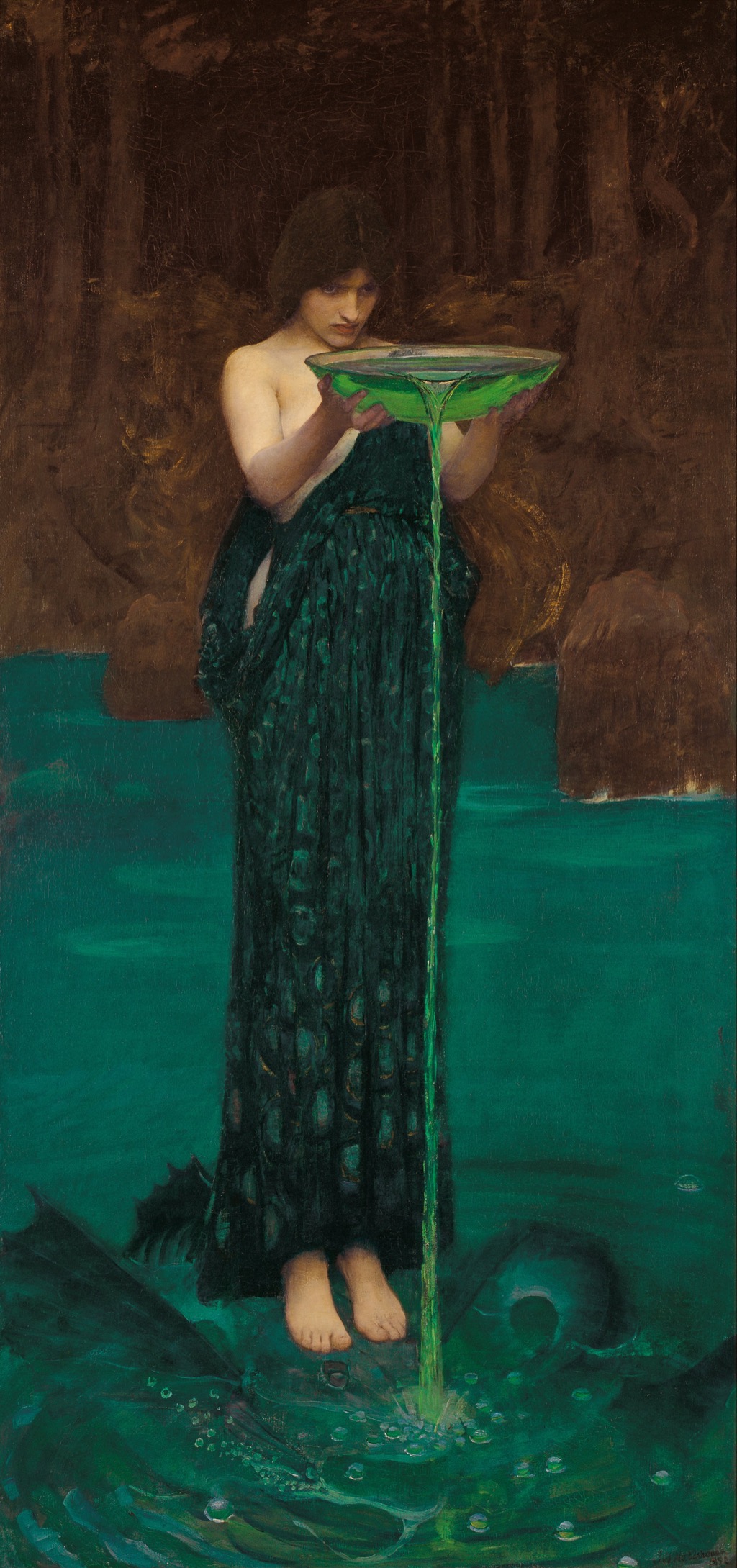
Waterhouse returned repeatedly to Circe, the enchantress of Homeric and Ovidian tradition. In Circe Invidiosa of 1892, held in Adelaide, she pours a vivid liquid into the sea in order to transform Scylla. Ovid describes Circe infecting the inlet with drugs and incantations before Scylla enters the water. [16] Waterhouse compresses the transformation story into the act of poisoning. The tall format, dark figure and unnatural aquamarine water make the environment seem to change before the victim appears.
The Art Gallery of South Australia calls attention both to this otherworldly colour and to the painting’s mixed reception when it was acquired in 1892. [10] That history complicates the modern habit of treating Waterhouse only as a painter of easily consumed beauty. The mature images can be seductive, but they repeatedly join attraction to threat: voices lure sailors to destruction; herbs weaponise jealousy; a pool conceals abduction; a mirror brings forbidden knowledge.
The women in these myths are not all the same type. Circe acts; Penelope resists; Psyche seeks; Echo is refused; the Danaids labour; the Sirens attack. Yet Waterhouse often frames their power through a late Victorian fascination with female beauty and danger. Modern viewing can acknowledge that historical pattern without declaring one timeless verdict on every figure. The first obligation is to identify the source, the chosen action and the relation among the bodies on the canvas.
Tennyson, Shakespeare and the poetry of suspended action
Waterhouse’s literary paintings rarely illustrate a story from beginning to end. They depend on viewers knowing, or wanting to discover, what surrounds the selected moment. This is especially clear in the groups devoted to the Lady of Shalott and Ophelia.
Tennyson’s Lady occupied Waterhouse across nearly three decades. The 1888 Tate picture shows the river departure. A later composition, The Lady of Shalott Looking at Lancelot, turns to the breaking of the prohibition, while the 1915 painting in the Art Gallery of Ontario depicts the heroine at her loom beneath the line “I am half sick of shadows.” The AGO records the later work’s full quoted title, date, medium and dimensions. [17] Together, the pictures move backwards through the narrative: final voyage, fatal look, confined weaving. They are not three attempts at a single definitive image. Each gives a different form to the conflict between mediated vision and lived experience.
The same serial attention appears in the Ophelia paintings. Shakespeare’s Hamlet associates Ophelia with court surveillance, rejected love, song, flowers and death by water. [18] Waterhouse often approaches her before the drowning familiar from Millais’s painting. The figure may sit on a branch, gather blossoms or turn toward the viewer with flowers in her hair. These moments preserve uncertainty. Is she arranging beauty, acting out remembered meanings, or already separated from ordinary social life? The play supplies the tragic arc; the painting holds the viewer just before it closes.
Keats’s La Belle Dame sans Merci, Tennyson’s St Cecilia and Shakespeare’s Miranda widened this literary field. What attracts Waterhouse is often a threshold rather than an event at full climax: enchantment beginning, music being heard, a decision forming, a spell taking effect. Hands touch chains, threads, combs, flowers, cups, wands and looms. These objects are not decorative inventory. They make thought and action bodily.
This is also why his women should not be reduced to a single biographical “muse.” Repeated facial types may reflect the use of favoured models, artistic idealisation or both, but the present evidence does not securely name every sitter. The literary identities are usually clearer than the models’ identities. Calling a figure Circe, Ophelia or the Lady of Shalott explains her role in the pictured story; it does not reveal the life of the woman who posed.
How Waterhouse builds a picture
Waterhouse’s mature compositions often look immediately legible, yet their clarity is carefully staged. A large figure or group occupies a decisive zone; strong diagonals direct attention; a restricted set of bright colours carries emotional weight; and landscape or architecture establishes a world just deep enough for the action.
Consider the range of openings. Saint Eulalia begins at the pavement, so that the viewer confronts the martyr’s body before the city. The Lady of Shalott opens across the broad boat and riverbank, making the heroine part of a horizontal journey. Circe Invidiosa compresses figure and falling liquid into a narrow vertical channel. Ulysses and the Sirens stretches danger across the length of a vessel. The formats are not neutral containers. They determine how the story reaches the eye.
His paint handling also resists the stereotype that all Pre-Raphaelite-associated art is uniformly minute. Certain objects and faces are sharply defined, but foliage, water and fabric can loosen into visible touches. The result is a selective vividness: the part of the world needed for recognition comes forward while other passages remain atmospheric. The broader handling noted in relation to French painting does not make Waterhouse an Impressionist; it helps explain why his surfaces can feel more mobile than those of some earlier Victorian history painters. [4] [15]
Colour frequently carries a change that cannot be proved by gesture alone. The blue-green stream in Hylas and the Nymphs makes the pool inviting and enclosed. The toxic turquoise in Circe Invidiosa turns natural water into an agent of harm. The Lady of Shalott’s white dress stands against autumnal river growth, while the tapestry introduces saturated fragments of another, woven world. Such observations begin in the visible painting. Claims that a specific colour always means death, sexuality or spiritual power require stronger evidence than recurrence.
Waterhouse also uses partial knowledge. We cannot hear the Sirens, see the whole of Camelot, know the words of the magician’s spell or witness Scylla’s transformation. That withholding gives the pictures room to work after their narrative has been identified. The viewer arrives at a charged interval, not at a completed explanation.
Water, flowers, mirrors and thresholds
Water is Waterhouse’s most recognisable setting, but it does not have one fixed meaning. It can be route, boundary, reflective surface, habitat, trap or weapon. The Lady of Shalott enters the current; Hylas disappears into a pool; Narcissus turns toward his reflection; Circe contaminates the sea; a mermaid inhabits the shore between human and marine worlds. Repetition creates a family resemblance, not a universal symbol.
Flowers are equally active. They locate seasons, build colour and connect several heroines to literary texts, especially Ophelia. In Hylas and the Nymphs, water lilies make the nymphs appear to emerge from the same surface that conceals them. Manchester Art Gallery identifies the 1896 painting as an episode in which Hylas is drawn toward death by water nymphs. [19] The image’s beauty is therefore structurally dangerous: what pleases the eye also disguises depth and consequence.
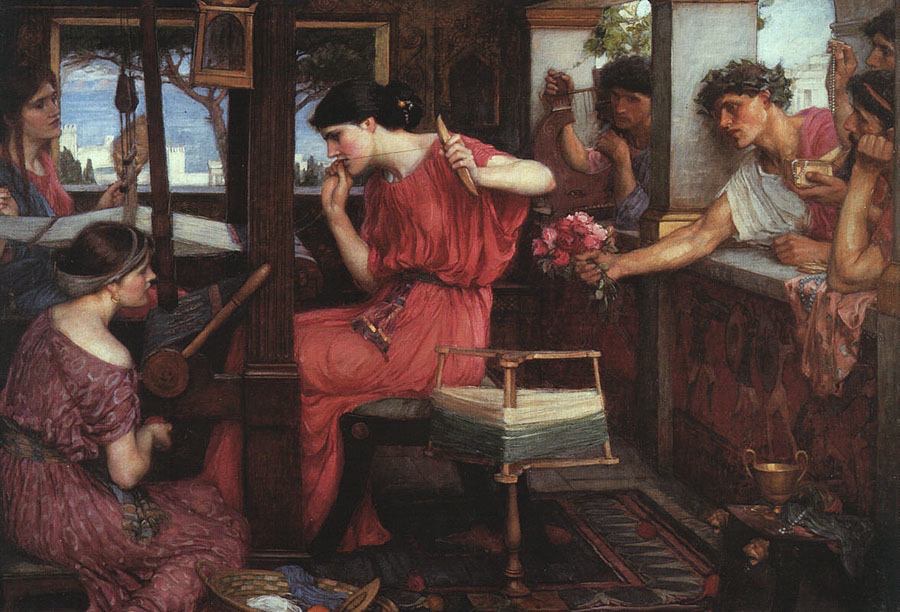
Mirrors, pools, windows and picture-like openings repeatedly divide kinds of vision. The Lady of Shalott is cursed to experience the outside through a mirror until she looks directly. Circe’s power can be staged before a reflective surface. Penelope works at a loom while suitors press toward the opening behind her; Aberdeen’s record explains that she delays remarriage by weaving in daylight and undoing her work at night. [4] These are women pictured not simply as objects of sight but as viewers, makers and agents whose relation to seeing or being seen drives the story.
The tension is not necessarily emancipatory. Many bodies conform to a narrow ideal of youthful beauty, and many stories link female desire or knowledge to punishment. Waterhouse’s art can sustain pleasure and criticism together. To look closely is not to excuse the gender assumptions of the period, nor is critical attention a reason to stop looking. The paintings remain valuable precisely because their beauty, narrative intelligence and historical limits are so entangled.
Eight paintings with which to begin
The Lady of Shalott, 1888
Waterhouse’s best-known painting selects the beginning of the heroine’s fatal voyage rather than the breaking mirror or her arrival at Camelot. Look first at the chain, boat, tapestry and river current; then read Tennyson’s poem and ask what the painting preserves, compresses or changes. [13] [14]
Hylas and the Nymphs, 1896
Hylas kneels at a pool while seven nymphs emerge among water lilies. The repeated faces and enclosed surface make attraction collective and claustrophobic. Manchester’s interpretation identifies the episode as an abduction toward death, but the image arrests the story before Hylas disappears. [19]
The Magic Circle, 1886
A woman draws a boundary while tending a smoking vessel. Instead of beginning with a catalogue of occult symbols, follow the geometry: upright body, angled wand, circle, smoke and excluded birds. The painting makes authority visible through controlled space. [12]
Circe Invidiosa, 1892
Circe pours poison into the sea to harm Scylla. The narrow composition and aquamarine water turn an Ovidian transformation into a study of jealousy enacted on the environment. Its initially mixed reception in Adelaide is part of its public history. [10] [16]
Ulysses and the Sirens, 1891
The bound hero and rowing crew are surrounded by bird-bodied attackers derived from ancient vase imagery. The work rewards comparison among Homer, Greek visual tradition and Victorian criticism, especially because early viewers disagreed about Waterhouse’s artistic licence. [9] [15]
Saint Eulalia, 1885
The martyr’s body lies at the base of a steep urban space as snow falls. Scale and viewpoint prevent the miracle from becoming sentimental decoration. The painting marks a central point between Waterhouse’s early historical reconstruction and the solitary, visionary figures of his maturity. [11]
A Mermaid, 1900
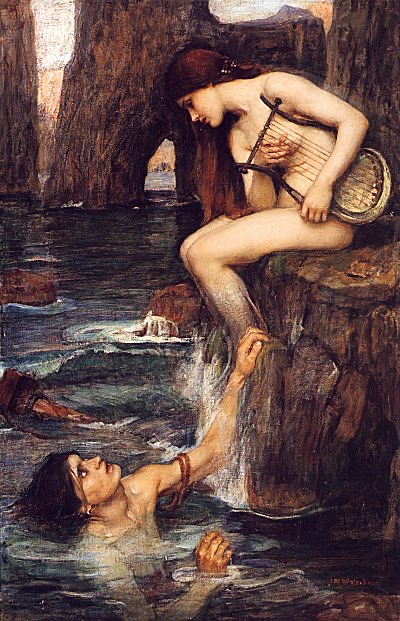
Waterhouse’s Royal Academy Diploma Work shows a mermaid seated by the sea, combing her long hair. The Academy accepted it as his Diploma Work in 1901. [22] It gathers several recurring interests—water, female self-absorption, dangerous beauty and a threshold between worlds—without requiring a single named narrative.
Penelope and the Suitors, 1911–1912
Penelope turns from the men and their gifts toward her loom. Aberdeen Art Gallery records that the painting was purchased in 1912 and relates the weaving to her strategy of delay in Homer’s Odyssey. [4] The late work answers the passive-beauty stereotype with a heroine whose intelligence is expressed through making, unmaking and refusal.
Public collections and modern reception
Waterhouse’s major paintings are widely dispersed. Tate, the Royal Academy and Manchester Art Gallery hold key works in England; Melbourne, Adelaide and Sydney hold major classical paintings; and important later works are in Aberdeen and Toronto. [4] [6] [7] [9] [10] [11] [12] [13] [17] [19] [22] Some were bought from the artist or at the moment of exhibition, while others entered museums later. Current display status can change, so check the collection record before visiting.
Waterhouse’s reputation has also changed without following a simple fall-and-rise curve. He was honoured by the Royal Academy and collected internationally during his career. [1] [6] [7] [9] The 1911 Britannica ranked him highly within British painting. [5] Later modernist accounts often treated Victorian narrative art as outdated, while reproductions kept certain images widely familiar. The touring retrospective of 2008–2010 reasserted his range and gave the phrase “modern Pre-Raphaelite” scholarly and public prominence. [3] [20]
Popularity is not the same as uncomplicated approval. Hylas and the Nymphs has become a site for debate about gender and museum display; Ulysses and the Sirens generated arguments about mythology and public acquisition from the beginning; Circe Invidiosa moved from a hostile early response to being described by Adelaide as one of the collection’s most beloved and reproduced works. [10] [15] [21] Reception is not a final verdict added after the painting. It is a continuing history of looking, ownership, display, reproduction and disagreement.
How to explore Waterhouse
For chronology and documentary evidence, continue with the biography. For the career’s starting language, look at the early classical paintings before moving to Saint Eulalia and The Magic Circle. For poetry, follow the Lady of Shalott and Ophelia as sequences rather than isolated masterpieces. For classical myth, compare Ulysses and the Sirens, the Circe paintings, Hylas and the Nymphs, Echo and Narcissus and Penelope and the Suitors.
On any painting, ask: What is the source? Which moment has Waterhouse chosen? What do the hands and gaze do? How do format, colour and setting control the encounter? Which meanings come from a museum or scholar, and which are your own observations? Evidence makes the beauty of these pictures more, not less, interesting.
Related Pages
- Paintings: Follow the career through classical scenes, myth, poetry and major public collections.
- The Lady of Shalott: Begin with Waterhouse's best-known Tennysonian painting.
Frequently Asked Questions
John William Waterhouse was a British figure painter born in Rome in 1849. Trained at the Royal Academy Schools, he became known for large narrative paintings based on classical history and mythology, medieval legend and literature. He was elected a Royal Academician in 1895 and continued exhibiting almost until his death in 1917. [1]
No. The Brotherhood was founded in 1848, before Waterhouse’s birth, by a group that included Rossetti, Millais and Hunt. [2] Waterhouse belonged to a later generation. “Modern Pre-Raphaelite” is a useful description of how his mature colour, literary subjects and emotional atmosphere renewed parts of that legacy within an academic career. [3]
He is most famous for The Lady of Shalott and for images of Circe, Ophelia, Psyche, Penelope, mermaids and nymphs. Hylas and the Nymphs, The Magic Circle and Ulysses and the Sirens are also central. [9] [12] [13] [19]
These sources allowed him to stage moments of choice, knowledge, desire, danger and transformation within late Victorian interests in classical culture, poetry, Pre-Raphaelitism and Symbolism. [3] Penelope’s resistance, Circe’s agency and the Lady of Shalott’s fatal departure remain distinct narrative problems.
Repeated facial types suggest artistic preferences and probably favoured models, but many sitters are not securely identified. Distinguish the named fictional character from the often-unknown person who posed. [1]
Major sources include Homer, Ovid, Shakespeare, Tennyson, Keats and Shelley. [3] Waterhouse selected charged moments and sometimes drew on earlier visual traditions, as in the Greek vase imagery behind Ulysses and the Sirens. [9] [15]
Water bears the Lady of Shalott toward Camelot, hides the nymphs who lure Hylas, reflects Narcissus, receives Circe’s poison and marks the mermaid’s habitat. Its meaning depends on the individual story.
His style combines Royal Academy history painting with classical subject matter, later Pre-Raphaelite colour and literary interests, broad passages of handling associated by some commentators with French painting, and themes that overlap with Symbolism. [3] [4] [15] A single label is less useful than following how those elements change across the career.
Major public holdings include Tate and the Royal Academy in London, Manchester Art Gallery, Aberdeen Art Gallery, the National Gallery of Victoria, the Art Gallery of South Australia, the Art Gallery of New South Wales and the Art Gallery of Ontario. [4] [6] [7] [9] [10] [11] [12] [13] [17] [19] [22] Check the institution’s current display information before visiting.
His work is a major record of how late Victorian and Edwardian painting reimagined inherited texts for a modern exhibition public. It also exposes questions that remain active: how beauty can conceal danger, how women are represented as viewers and agents, how museums frame historic art and how an artist can look backward while making a distinctive contemporary language. The continuing debate around Hylas and the Nymphs shows that these are not closed historical questions. [21]
Discussion
Waterhouse rewards comparison. Use the prompts below to test how the paintings change when they are viewed as a connected body of work.
Reader Insights
Does “modern Pre-Raphaelite” clarify Waterhouse’s art, or does it make his academic and classical formation too easy to overlook?
How does the meaning of water change among The Lady of Shalott, Hylas and the Nymphs, Circe Invidiosa and A Mermaid?
Which gives the women in these paintings greater agency—action, looking, making, refusal or control over space—and how should museums discuss the gendered limits of their representation?
Join the Conversation
Share the comparison, detail or interpretation that most changed how you see Waterhouse’s art.
References
- Main image: H. S. Mendelssohn, John William Waterhouse, c. 1886, public-domain photograph via Wikimedia Commons.
- National Portrait Gallery, “John William Waterhouse (1849–1917), Figure painter,” Later Victorian Portraits Catalogue. View source.
- Delaware Art Museum, “British Pre-Raphaelites,” account of the Pre-Raphaelite Brotherhood’s formation and literary interests. View source.
- Groninger Museum, Annual Report 2009, pp. 7–8, “J. W. Waterhouse, Betoverd door vrouwen,” retrospective account of Waterhouse’s classicism, modern Pre-Raphaelitism, literary sources and relation to Symbolism (in Dutch). View source.
- Aberdeen Archives, Gallery & Museums, “Penelope and the Suitors,” collection record, 1911–1912, oil on canvas. View source.
- Encyclopaedia Britannica, “Waterhouse, John William,” 11th edition, 1911, contemporary biographical and critical notice. View source.
- Art Gallery of New South Wales, “Diogenes,” collection record, 1882, oil on canvas. View source.
- Art Gallery of South Australia, “The Favourites of the Emperor Honorius,” collection record, c. 1883, oil on canvas. View source.
- Art Gallery of South Australia, “Circe Invidiosa,” collection interpretation noting the Gallery’s 1883 acquisition of The Favourites of the Emperor Honorius as the first Waterhouse work to enter a public institution. View source.
- National Gallery of Victoria, “Ulysses and the Sirens,” collection record, 1891, oil on canvas, provenance and interpretive note. View source.
- Art Gallery of South Australia, “Circe Invidiosa,” collection record and curatorial interpretation, 1892, oil on canvas. View source.
- Tate, “Saint Eulalia,” collection information for the 1885 oil painting and its martyrdom subject. View source.
- Tate, “The Magic Circle,” collection record, 1886, oil on canvas. View source.
- Tate, “The Lady of Shalott,” collection record, 1888, oil on canvas. View source.
- Alfred, Lord Tennyson, “The Lady of Shalott (1842),” text published by the Poetry Foundation from Poems (W. D. Ticknor, 1842). View source.
- Michelle Bonollo / National Gallery of Victoria, “J. W. Waterhouse’s Ulysses and the Sirens: breaking tradition and revealing fears,” study of classical sources, technique and contemporary reception. View source.
- Ovid, Metamorphoses, Book 14, Scylla and Circe episode, translated by Brookes More. View source.
- Art Gallery of Ontario, “‘I am half sick of shadows,’ said The Lady of Shalott,” collection record, 1915, oil on canvas. View source.
- Folger Shakespeare Library, Hamlet, complete text, including Ophelia’s flower and death sequence. View source.
- Manchester Art Gallery, “Hylas and the Nymphs,” collection display description, 1896. View source.
- Montreal Museum of Fine Arts, “Archives of Past Exhibitions,” entry for J. W. Waterhouse: Garden of Enchantment, 2009–2010. View source.
- Manchester Art Gallery, Sonia Boyce, long label for Six Acts, describing the 2018 temporary removal and reinterpretation of Hylas and the Nymphs. View source.
- Royal Academy of Arts, “A Mermaid,” Diploma Work given by John William Waterhouse and accepted in 1901. View source.