

 Buy Art Prints Now
from Amazon
* As an Amazon Associate I earn from qualifying purchases.
Image reference [image]
 by Tom Gurney
Tom Gurney BSc (Hons) is an art history expert with over 20 years experience
Published on August 14, 2026 / Updated on August 14, 2026
Email: tomgurney1@gmail.com / Phone: +44 7429 011000
The Lady of Shalott: Introduction
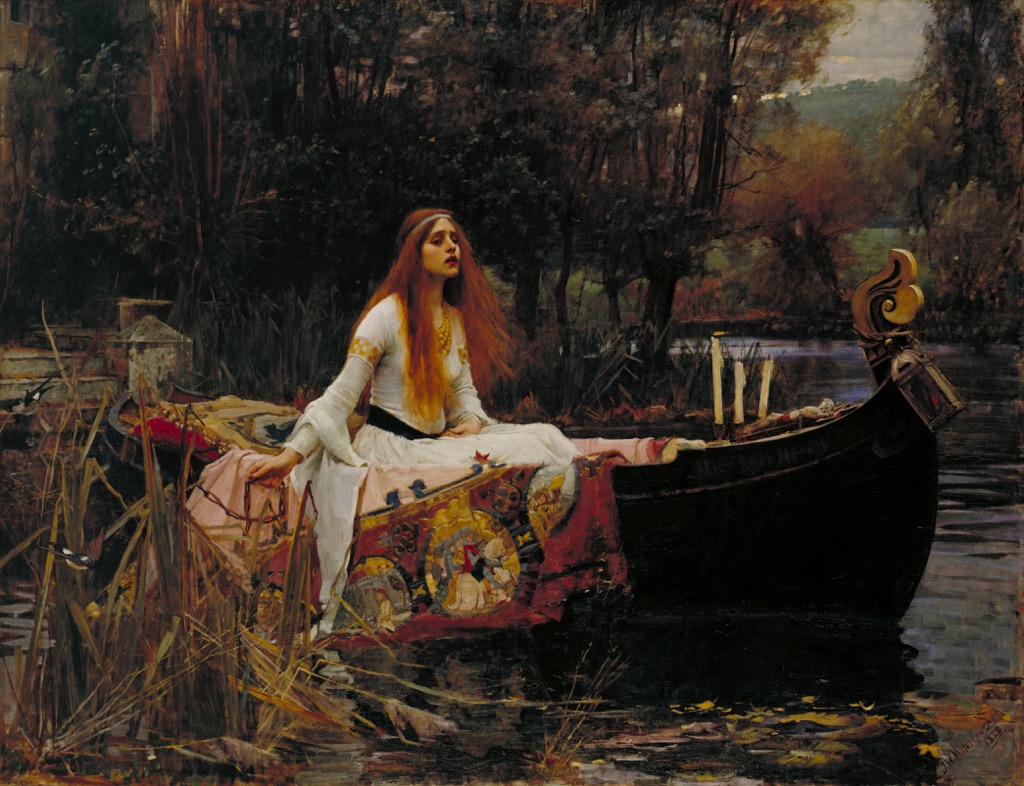
John William Waterhouse’s The Lady of Shalott shows a departure that already contains its ending. A young woman sits in a low wooden boat, one hand still near the chain that held it to the bank. Behind her, reeds and autumnal woodland close around the river. Before her stand a crucifix, three candles and a lantern. An embroidered textile spills across the boat and into the water. Her lips are parted as if in song, but the voyage is not a rescue. Viewers who know Alfred Tennyson’s poem understand that she is travelling towards Camelot and towards death.
Painted in 1888, the work is an oil on canvas measuring 153 × 200 cm. It was exhibited at the Royal Academy that year and entered the national collection when Sir Henry Tate presented it in 1894. It is now among the best-known paintings in Tate’s collection, with the accession number N01543. [1] [4]
Waterhouse does more than select an episode from a celebrated poem. He gives physical weight to a psychological threshold: the interval between confinement and experience, obedience and self-determination, representation and life. The painting’s power lies partly in its refusal to make that threshold simple. The Lady moves freely only after the curse has fallen. Her first direct encounter with the world is also her final journey through it.
At a Glance
- ArtistJohn William Waterhouse (1849–1917)
- TitleThe Lady of Shalott
- Date1888
- MediumOil paint on canvas
- Dimensions153 × 200 cm
- CollectionTate, London
- Accession numberN01543
- AcquisitionPresented by Sir Henry Tate, 1894
- First exhibitedRoyal Academy, London, 1888 [1] [4]
- Literary sourceAlfred Tennyson’s The Lady of Shalott, first published in 1833 and substantially revised in 1842 [2] [3]
Contents
- Introduction
- The Moment Waterhouse Chose
- Tennyson’s Mirror, Web and Curse
- A Composition Built Around Departure
- The Lady’s Face, Body and Song
- The Chain and the Boat
- The Tapestry Carried into the World
- Candles, Crucifix and Lantern
- A Landscape at the Edge of Winter
- Paint Handling and the Limits of Technical Evidence
The Moment Waterhouse Chose
Tennyson’s Lady lives in a tower on an island called Shalott, separated from the road to Camelot. A mysterious prohibition prevents her from looking directly out of the window. Instead she watches the world through a mirror and weaves its reflected appearances into a web. The arrival of Sir Lancelot breaks this closed arrangement. At the sight and sound of him she turns from the mirror, looks towards Camelot and declares that the curse has come. She later finds a boat, writes her name upon it, releases it from its mooring and drifts downstream while singing. She dies before reaching the city. [2] [3]
Waterhouse chooses the river journey rather than the sensational instant when the mirror cracks. That decision matters. The transgression has already occurred, but the consequences are still unfolding. The Lady has crossed from the tower into the landscape and from indirect sight into physical experience. Yet the island has not fully released her. The chain still runs from boat to bank, and the textile associated with her former existence weighs upon the vessel. Her action is poised between past and future.
The painted scene does not correspond mechanically to a single line. Tennyson describes the Lady lying in the boat, dressed in snowy white, while the stream bears her away and she sings until her blood freezes. Waterhouse seats her upright and places the moment of unmooring before us. He turns the poem’s sequence into an image that can be read all at once: the chain records the decision to leave, the textile recalls the tower, and the candles anticipate the diminishing life ahead. The result is an interpretation, not a diagram.
This is also why the painting remains suspenseful even when its ending is known. Nothing visibly violent is happening. The boat has scarcely begun to move. The tragedy is concentrated in small changes: slack water disturbed beside the hull, fabric slipping over the edge, a hand that no longer grips the world behind it, and a face absorbed in a song whose conclusion lies beyond the frame.
Tennyson’s Mirror, Web and Curse
Tennyson published an early version of The Lady of Shalott in 1833 and extensively revised it for his 1842 collection. The two texts alter details, rhythms and emphasis, but retain the central movement from enclosure to forbidden sight and fatal voyage. Reading them side by side is useful because nineteenth-century artists encountered a poem with its own history rather than a single unchanging script. [2] Tennyson returned to the same legendary figure in a different form in Lancelot and Elaine, part of Idylls of the King. [3]
The poem’s governing devices are also its central ideas. The mirror allows sight but removes immediacy. The web gives the Lady an active art, yet that art depends upon reflections. The curse is never explained in practical terms: neither its origin nor the authority enforcing it is disclosed. What matters is the structure it produces. She can observe passing life, transform it into images and sing so that reapers hear her, but she cannot participate in what she represents.
Lancelot’s appearance exposes the cost of that separation. Tennyson’s decisive sequence—“She left the web, she left the loom”—describes both a physical movement and an abandonment of the system through which she has known the world. [2] Her statement, “The curse is come upon me,” makes consequence immediate, although the poem leaves open whether the deeper cause is desire, disobedience, direct perception or the attempt to enter social life. [2]
Waterhouse paints after all of this. There is no mirror and no loom in view. Nevertheless, their effects remain present. The bright textile is displaced from the tower into the boat, and the Lady’s forward gaze no longer depends upon a reflection. By making the invisible earlier episode materially present in the later one, Waterhouse asks the viewer to hold both captivity and release in mind.
The poem’s openness should restrain any claim that the painting has one decipherable moral. The Lady can be seen as an artist leaving the protected realm of images, as a woman rejecting restriction, as a person exchanging safety for experience, or as a figure whose desires have been made fatal by forces she did not create. Each reading grows from real elements in poem and painting. None is an artist’s documented explanation of every object.
A Composition Built Around Departure
The canvas is wider than it is high, giving the river journey room to unfold horizontally. Waterhouse places the Lady near the centre, but the composition does not settle into calm symmetry. The boat angles into the water towards the right. The chain pulls back towards the bank at the left. Fabric drops over the near side, while reeds and branches lean into the vessel’s path. Nearly every major line converts stillness into a question of direction.
The viewer’s position is unusually close. We do not see the tower or survey the river from a distant bank; we appear to stand near the mooring as the Lady leaves it. Her boat fills much of the lower half of the picture. Its side forms a dark boundary against the paler water, and the richly worked textile hangs close enough for its decorative passages to be studied. This proximity makes departure intimate. We are not inhabitants of Camelot awaiting a mysterious body. We are witnesses at the last place from which she could still turn back.
Depth develops through overlapping bands rather than an expansive panorama. Boat and figure occupy the foreground; dark water, reeds and a narrow passage lead away; woods compress the middle distance. The restricted view makes the river feel less like an open road than a channel through enclosing growth. Even outside the tower, the Lady is hemmed in.
Colour binds the human drama to its setting. The white of her dress gathers available light, making her face and torso the clearest area. Against it, the dark interior of the boat and the saturated textile seem especially heavy. Greens, russets and straw colours circulate between woodland, reeds and embroidery. The work does not separate a pristine heroine from a decorative backdrop. It creates exchanges between dress, water, fabric and foliage while allowing the Lady’s pallor to suggest fragility.
The closest objects also organise time. The chain belongs to the immediate past, the textile to the life left behind, and the candles to the life that remains. The unseen destination lies ahead. Waterhouse therefore creates narrative without showing several episodes. The composition behaves like a hinge on which the whole story turns.
The Lady’s Face, Body and Song
Waterhouse’s Lady is neither a frantic fugitive nor a passive corpse. She sits upright, although her posture is not firm. Her shoulders slope and her head inclines slightly. Long hair falls around a face whose parted lips suggest singing. One arm extends towards the chain; the other settles nearer her lap and the textile. The body is balanced, but its balance feels temporary.
The expression is deliberately difficult to name. Downcast eyes and a tightened face can suggest fear, grief, concentration or exhausted resolve. It would be easy to impose a modern psychological diagnosis upon her, but the painting offers no secure warrant for one. What can be said is that Waterhouse refuses theatrical panic. The Lady’s inward attention creates a powerful contrast with the dense, sharply observed world around her.
Tennyson makes the final song central to the voyage. In the revised poem she continues “singing her last song” as the boat passes downstream. [2] Waterhouse’s parted lips translate that auditory event into paint. The viewer cannot hear a melody, but the visible act of singing makes silence charged rather than empty. It also reconnects the travelling Lady with her earlier identity: even while secluded, she had been known beyond the island by her song.
Her white clothing comes from Tennyson’s description, but Waterhouse avoids turning it into an immaculate emblem. The dress gathers into folds, its bodice is closely fitted, and shadows move through its sleeves and skirt. A metal belt or girdle crosses the waist. The costume looks archaic without offering a historically exact reconstruction of Arthurian dress. Like much nineteenth-century medievalism, it evokes a past assembled through poetry, theatre, illustration and material imagination rather than archaeological certainty.
The Lady’s individuality is intense, yet the sitter’s identity is not securely established by the evidence used here. Claims that a particular woman posed for the figure should therefore be treated as proposals rather than object facts. The painting’s meaning does not depend on turning the model into the fictional character or the fictional character into an episode from Waterhouse’s private life.
The Chain and the Boat
The chain is one of the painting’s least spectacular objects and one of its most important. It runs across the front of the boat and back towards the bank. Tennyson writes that the Lady “loos’d the chain” before the current bears her away. [2] Waterhouse converts that brief action into the scene’s governing tension. The boat is made for movement, yet the chain still connects it to land.
As a literal object, it is simply a mooring. As a visual form, it links the Lady’s hand to the place she is leaving. Its weight and repeated metal links oppose the flow of water and the soft folds of fabric. Because Waterhouse shows the action before complete release, he gives agency a visible form: the voyage begins through her hand, even if its outcome is governed by current and curse.
The boat is both vehicle and bier. Its low, dark hull encloses the white-clad figure and carries objects that can suggest a private funeral procession. Yet it is not fitted out as a historically documented burial craft. That association arises from the narrative—the Lady will die during the journey—and from Waterhouse’s arrangement of crucifix, candles and pale body. It should be understood as a visual resonance, not a statement about medieval ritual.
Tennyson has the Lady write her name around or upon the prow before she departs. [2] [3] The name is also visible on Waterhouse’s boat. This detail matters because it turns the vessel into a bearer of identity. In the poem, the people of Camelot encounter an unknown dead woman whose name they can read. In the painting, the inscription identifies her to us before the city sees her. It is a signature within the story: after a life mediated by reflected images, she makes herself legible in the world.
The river supplies the motion she has chosen but can no longer control. No oar is visible in use, and the boat’s progress depends upon the stream. Freedom and fatalism are therefore not opposites here. Waterhouse joins them in a single action: she releases the chain, but the current determines the course.
The Tapestry Carried into the World
The large textile draped across the boat is Waterhouse’s boldest transformation of Tennyson’s narrative. In the poem, the Lady weaves a colourful web from the reflections in her mirror. When she turns to look directly at Lancelot, the web flies out and the mirror breaks. Tennyson does not describe her carefully gathering that web and carrying it into the boat. Waterhouse brings it with her. [2]
That departure from literal illustration allows the painting to make thought visible. The textile is the material record of her former way of seeing: images made from images, the world converted into pattern at a distance. Once carried outside, it no longer hangs securely on a loom. It slides over the gunwale, touches the water and appears vulnerable to staining, snagging and loss.
The tapestry also changes the boat’s visual weight. Its reds, golds, blues and patterned figures make the lower foreground denser than the quieter water around it. The Lady’s white dress rises above this chromatic field, while parts of the fabric gather around her legs. She has left the loom, but she has not escaped the work it produced.
Several interpretations follow from this arrangement. The textile may suggest memory, artistic labour, the burden of representation, or an identity that cannot simply be discarded. It may also distinguish the Lady’s creative work from the direct environment she now encounters: woven birds and figures meet actual reeds, water and woodland. Yet these are readings prompted by Waterhouse’s visual invention. No surviving statement cited here records him assigning a fixed allegorical meaning to every embroidered form.
The passage of the fabric into water is especially poignant because it complicates any simple opposition between artificial tower and authentic world. The woven object is beautiful, skilful and real in its own right. The tragedy is not that art has no value. It is that the system surrounding the Lady allowed art to substitute for all other contact. Waterhouse preserves the web even as he depicts the cost of leaving it.
Candles, Crucifix and Lantern
At the front of the boat Waterhouse gathers a small cluster of objects: a crucifix, three candles and a lantern. They do not all derive from Tennyson’s description of the departure. Their presence makes the voyage feel ceremonial and turns the prow into something like a compact shrine.
Two candles appear extinguished while one remains alight. Because the Lady is travelling towards death, the surviving flame is often read as the life still left to her. Smarthistory likewise connects the dwindling light with the fatal journey. [5] This is a persuasive visual reading, but it is not a code whose precise terms Waterhouse documented. The painting does not prove, for example, that each candle represents a named stage of life or a specific theological idea.
The crucifix adds a Christian sign to an Arthurian story written by a Victorian poet. It can suggest prayer, sacrifice, suffering or preparation for death. Its small scale is important. Waterhouse does not make it the picture’s dominant answer; it stands among other objects whose meanings overlap without resolving one another. The Lady’s gaze does not clearly fix upon it, and no attendant performs a rite.
The lantern is equally practical and symbolic. A light would belong in a boat moving towards evening, while an enclosed flame also extends the contrast between illumination and encroaching darkness. The scene seems to occur under muted daylight rather than full night, so the lantern anticipates conditions further along the journey. Like the candles, it carries future time into the present.
Together these objects encourage the viewer to approach the departure as more than transport from one place to another. They frame it as passage. Yet the difference between observation and interpretation remains essential: a crucifix and flames are demonstrably painted; their exact private meanings are not recoverable from appearance alone.
A Landscape at the Edge of Winter
The Lady’s surrounding world is sensuously particular. Water bends around the dark side of the boat. Reeds rise in clumps, some green and some dry. Leaves collect on the bank and float near the hull. Tree trunks, tangled growth and a shadowed river passage fill the background. The landscape offers direct contact with the natural world she had previously seen only in a mirror.
It is not, however, a scene of springlike liberation. Tennyson sets the final voyage as leaves fall and the weather turns. [2] Waterhouse builds that seasonal decline into the colours and textures of the bank. Russet foliage, pale reeds and heavy air establish a late moment in the year. Autumn works with the narrative without requiring a hidden symbolic dictionary: both poem and painting connect the journey with ending.
The landscape’s detail also slows the eye. Individual stems, leaves and water plants compete with the story’s forward pull. This produces a painful disparity between human and natural time. The Lady’s remaining life is measured in a short drift downstream, while the bank continues to grow, decay and renew itself. The river receives her without changing its course.
Waterhouse avoids giving Camelot a commanding visible presence. The destination is chiefly supplied by the poem and the viewer’s expectation. The narrow waterway disappears among trees, leaving what lies ahead uncertain. This choice strengthens the work’s focus on departure rather than arrival. The city may structure the Lady’s desire, but the painting holds us within the threshold she has just crossed.
The setting should not be assigned a precise real-world location without documentary support. Waterhouse could study natural forms closely while constructing an imagined Arthurian environment in the studio. What matters within the work is not whether one can identify a particular English riverbank, but how carefully described vegetation makes a legendary death seem physically near.
Paint Handling and the Limits of Technical Evidence
Waterhouse balances controlled description with visibly freer handling. The Lady’s face, bodice, metal belt and the principal objects in the boat receive concentrated definition. The textile’s designs are legible enough to carry narrative importance without becoming a uniformly sharp inventory. Around them, reeds, reflections and foliage are built from more open, broken strokes.
This variation directs attention. Tight edges help the figure hold the centre, while loosened marks allow water and vegetation to shimmer or dissolve. Smarthistory has drawn attention to the difference between Waterhouse’s freer handling in the natural setting and the minute precision associated with earlier Pre-Raphaelite painting. [5] The distinction helps explain why the work could appear both indebted to the movement and responsive to later nineteenth-century painting.
Oil paint enables transitions between opacity and translucency. Pale fabric is modelled through layered light and shadow; dark passages inside the boat absorb detail; thin-looking reflections allow the colour beneath them to participate in the river’s surface. These statements describe visible effects. They do not establish the order in which every layer was applied or identify particular pigments.
That boundary is important because Tate’s archive catalogue lists an open 1993 file of conservation-science material and analysis documentation concerning N01543, but the online entry does not publish the file’s findings. [9] Its existence confirms that technical study was recorded. It does not justify claims about underdrawing, paint samples, X-radiographs or changes beneath the surface unless those records are directly consulted.
The responsible account therefore remains modest: the support is canvas and the medium is oil paint; the surface shows selective finish and varied brushwork; detailed material conclusions require evidence not available in the cited public record. [1] [9] This limitation does not weaken close looking. It clarifies the difference between what a viewer can observe and what conservation analysis would be needed to establish.
The Royal Academy Exhibition of 1888
Waterhouse exhibited The Lady of Shalott at the Royal Academy in 1888. [4] [5] By then he was not an obscure beginner. He had entered the Royal Academy Schools in 1871, begun exhibiting at the Academy in 1874 and been elected an Associate of the Royal Academy in 1885. The National Portrait Gallery records that he exhibited there annually from 1874 to 1917 with only two exceptions. [4]
This institutional context corrects a common oversimplification. The painting may summon the literary subjects and sensuous detail associated with Pre-Raphaelitism, but it was made by an Academy-trained artist and presented within the most prominent annual exhibition structure in British art. It belongs to the later Victorian art world, not to the rebellious circumstances in which the original Pre-Raphaelite Brotherhood announced itself four decades earlier.
Contemporary response recognised both inheritance and difference. Later discussion collected by Smarthistory notes that critics related Waterhouse’s subject, figure and costume to Pre-Raphaelite art while also noticing qualities that seemed French in his technique. [5] The combination is visible in the painting: medieval literary material and dense natural description coexist with patches of broad, atmospheric handling.
The work’s first public setting would also have changed how it was read. In an Academy exhibition crowded with paintings, sculpture and viewers, its large horizontal format and bright central figure had to assert themselves at a distance. Up close, the chain, fading flames and woven images reward slower attention. Waterhouse thus builds the composition for two encounters: the immediate recognition of a solitary white figure in a boat, and the gradual discovery of details that darken her journey.
Waterhouse and the Pre-Raphaelite Legacy
Waterhouse is often called a Pre-Raphaelite, but the term needs qualification. The Pre-Raphaelite Brotherhood was founded in 1848 by a small group including William Holman Hunt, John Everett Millais and Dante Gabriel Rossetti. Its first phase had already dispersed by the middle of the 1850s, although its subjects, visual practices and union of painting with poetry continued to influence later artists. [7] Waterhouse was born in 1849 and was never a member of the original Brotherhood. [4]
He is better understood as a later artist who renewed parts of its legacy. The Lady of Shalott shares the movement’s attraction to literary narrative, concentrated colour, emotionally significant natural detail and women placed within states of suspension or danger. It also belongs to a culture in which Tennyson’s poetry had been made visual through illustrated books and earlier paintings.
At the same time, Waterhouse does not imitate a single Pre-Raphaelite formula. His riverbank is richly observed but not uniformly crisp. His heroine is psychologically suggestive without being explained through a crowd of meticulously coded accessories. Atmospheric unity matters as much as individual detail. The painting absorbs a tradition and reshapes it for the exhibition culture of the 1880s.
The label “modern Pre-Raphaelite,” used for the major 2008–09 Waterhouse exhibition and its catalogue, captures this mixture of retrospect and renewal. [12] It should not be taken to mean that Waterhouse simply arrived late to an unchanged movement. Rather, his work shows how Pre-Raphaelite ways of joining word and image remained productive long after the Brotherhood itself had ceased to operate.
From Sir Henry Tate to the National Collection
The painting’s documented collection history is concise but consequential. Tate’s record states that Sir Henry Tate presented The Lady of Shalott in 1894. [1] That year matters within the history of the national collection of British art: the work entered public ownership only six years after its Royal Academy exhibition.
The accession number N01543 identifies the canvas within Tate’s collection. [1] It is safer to state this documented transfer than to embellish it with an unsupported story of the exact circumstances in which Tate first saw or obtained the work. The collection record establishes donor and year; a fuller chain of ownership would require further documentary evidence.
Public ownership changed the scale of the painting’s audience. A work first encountered within a temporary exhibition could be revisited, reproduced and placed in dialogue with the development of British art. Its large dimensions make the original a bodily encounter in a way that small reproductions cannot convey: the boat extends across two metres, and the Lady approaches human scale.
Reproduction has nevertheless become part of the work’s modern life. The central figure, horizontal boat and recognisable textile remain legible even when reduced. Familiarity can make the image seem self-explanatory, but the original’s details resist that ease. The name on the boat, the contact between fabric and water, the chain’s direction and the uneven candle flames turn a familiar icon back into a sequence of choices.
Waterhouse’s Three Shalott Paintings
Waterhouse returned to the Lady of Shalott over nearly three decades. The 1888 Tate painting is the best-known of three major treatments. A painting of about 1894 in Leeds presents the Lady at the moment of looking towards Lancelot, while “I am half-sick of shadows,” said the Lady of Shalott, painted in 1915 and now in the Art Gallery of Ontario, shows her seated at the loom before the transgression. [10] [11]
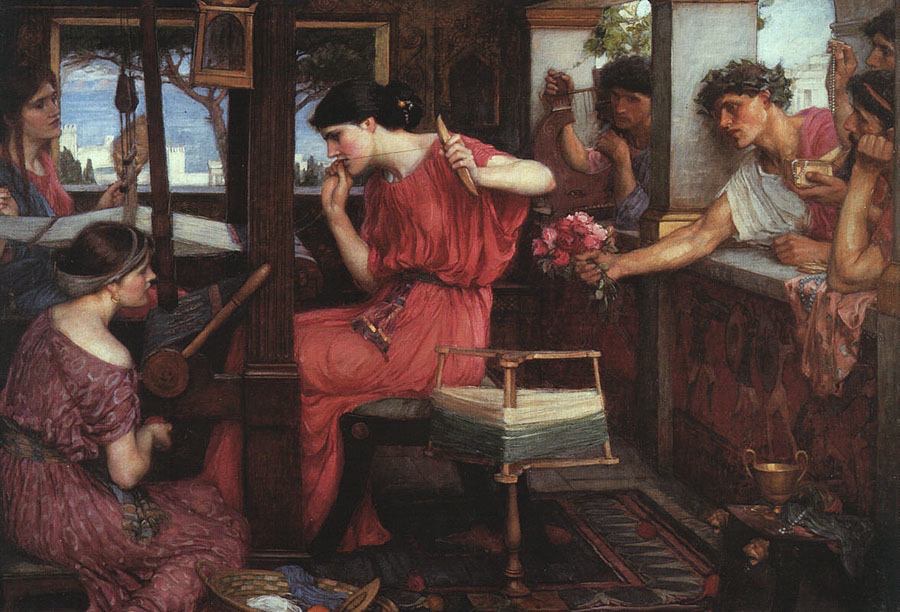
Seen together, the works do not simply repeat a favourite heroine. They isolate different relations between desire, sight and action. The 1915 painting remains inside the tower. The loom and reflected or distant world define a life whose limitations the Lady has begun to articulate. The title takes its dissatisfaction directly from Tennyson: reflected “shadows” no longer suffice. [10]
The Leeds painting concentrates on the forbidden look and its immediate disturbance. The Tate painting moves later, to the physical consequence of that choice. Its Lady has passed beyond mirror and window; she now occupies the landscape itself. Waterhouse’s return to earlier narrative moments in later years suggests that the story offered more than a single climactic image. Each phase creates a different kind of suspense.
The group also warns against treating one heroine as a fixed portrait. Costume, setting, pose and emotional emphasis change as Waterhouse revisits the subject. Continuity lies in the poem and its structure of constrained vision, not in an attempt to make three canvases behave like consecutive stills from one production.
The 1888 painting gains depth from this comparison. It is the only one of the three to place the Lady fully on her fatal journey. The loom has vanished, the mirror has already failed and Lancelot is nowhere to be seen. What remains are the woman, the things she has carried and a river that transforms a decisive act into irreversible movement.
Earlier Victorian Images of the Lady
Waterhouse entered a long visual conversation. [8] Tennyson’s 1857 illustrated edition, commonly known by the publisher Edward Moxon’s name, brought together designs by eight artists, including leading Pre-Raphaelites. [6] William Holman Hunt represented the instant of transgression, with the Lady entangled by threads as her ordered world breaks apart. A later print after Hunt’s design preserves the famous movement away from web and loom. [13]
Dante Gabriel Rossetti chose another episode for the same publication: Lancelot bends over the dead Lady in the boat after it reaches Camelot. [14] These illustrations established contrasting possibilities—the violent crisis in the tower and the encounter after death. Waterhouse positioned his 1888 canvas between them. The mirror has cracked offstage, but Camelot has not yet received her.
Another useful comparison is Millais’s Ophelia. Waterhouse’s white-clad woman amid detailed river vegetation invites the association, and Smarthistory notes that he saw the important Millais retrospective of 1886, two years before The Lady of Shalott. [5] The resemblance should not erase the works’ differences. Ophelia is already in the water, her body opening into the surrounding current; Waterhouse’s Lady remains upright in a constructed vessel and has initiated the journey by releasing it.
These precedents help identify Waterhouse’s originality. He did not invent the Lady as a Victorian art subject, the close union of poetry and painting, or the image of a doomed woman beside water. His achievement was to find a new narrative interval and give it an unforgettable material structure: chain, tapestry, inscribed boat, flames and autumn river all gather around the instant after choice but before fulfilment.
What Has the Painting Been Understood to Mean?
One enduring reading treats the Lady as a figure for the artist. She converts reflected life into a woven image, lives apart from ordinary society and risks destruction when she abandons protected representation for direct experience. The poem’s early critical history encouraged such interpretations, and the Rochester Camelot Project summarises scholarship connecting the tale with artistic isolation. [2] Waterhouse’s decision to bring the tapestry into the boat makes this reading especially vivid.
A second approach focuses on gender and confinement. The Lady’s law is unexplained, her space restricted and her desire punished. From this perspective, the tower resembles a social order in which a woman may observe and produce beautiful work but cannot freely enter the public world. Her release of the chain becomes an act of agency even though the narrative makes it fatal.
These readings can coexist, but both require care. Calling the Lady an artist does not reduce her to Waterhouse’s self-portrait in disguise. Calling her a rebel does not turn the voyage into uncomplicated emancipation. The painting holds self-determination and doom together. Her choice is real, the curse is real within the fiction, and the river offers experience without granting survival.
Desire is another central force. Lancelot triggers the turn in the poem, but Waterhouse removes him from the painted scene. This absence shifts attention from the desired man to the woman who bears the consequence. The viewer is not asked to admire Lancelot’s brilliance. Instead, we study the Lady’s face, hand, work and remaining light.
The religious objects introduce further possibilities—sacrifice, spiritual passage, Victorian Christian framing—without dictating a final theology. The autumn landscape adds natural decline, while the tapestry makes creativity impossible to separate from memory and loss. The painting’s strength lies in this controlled plurality. Its objects reinforce a tragic direction, but they do not collapse into a single sentence that solves the work.
Why the Work Still Matters
The Lady’s predicament remains recognisable because it is built from a conflict that outlives its medieval setting: the difference between observing life and participating in it. Tennyson imagined that difference through mirror and web. Waterhouse made it bodily through the move from tower to boat and emotionally immediate through the last contact with the chain.
The painting also asks what freedom means when available choices have been cruelly narrowed. The Lady can remain safe only by accepting permanent separation; she can enter the world only under a curse. Her journey is therefore not a cautionary tale with an easy lesson about obedience. It exposes the violence of a condition in which experience and survival have been made incompatible.
For modern viewers surrounded by mediated images, the mirror and tapestry can feel newly relevant. That relevance should not be used to pretend the work predicted present-day technology. Its deeper structure is enough: reflected information becomes a substitute for contact, and creative production can both enrich a life and participate in its enclosure.
The work matters equally as painting. Its scale, controlled colour, varied surface and precisely staged objects turn an already famous poem into an independent visual argument. A reader may know Tennyson’s conclusion; a viewer may recognise the reproduction instantly. Yet the painted moment still remains open long enough for looking. The flame has not gone out. The chain has not quite disappeared from sight. The river has begun to move.
A Closer-Looking Guide
Begin with the Lady’s right hand and follow the chain towards the bank. Notice how this small diagonal counters the boat’s forward direction. Then trace the edge of the textile. Where does it cease to be safely contained by the boat, and where does it meet water or vegetation?
Move next to the prow. Count the candles and compare their states rather than treating them as one decorative group. Look at the relation between the crucifix, lantern and the Lady’s line of sight. The objects create a devotional atmosphere, but do they command her attention or ours?
Step back and consider the white dress as a shape. It is the largest pale area in a painting of dark greens, browns and river shadows. From a distance it creates immediate visibility; close up it breaks into seams, folds, metal ornament and shadow. This alternation between emblem and person is central to the work.
Now compare the handling of her face and bodice with the reeds at the lower edge and the dense growth behind her. Waterhouse changes the degree of finish across the canvas. Those changes organise vision as effectively as the composition does.
Finally, imagine the episodes that are absent: the mirror cracking behind her, Lancelot passing beyond the window, Camelot downstream and the boat arriving after her death. The painting depends on these unseen events but refuses to show them. It gives us the interval in which the Lady is no longer confined and not yet a legend discovered by others.
Related Pages
- John William Waterhouse: Return to the artist overview and wider cluster route.
- Paintings: Compare the Shalott painting with Waterhouse's other mythological and literary works.
Frequently Asked Questions
The Lady has left her tower after looking directly at Sir Lancelot and triggering a mysterious curse. She is releasing a boat from its mooring and beginning the journey towards Camelot. In Tennyson’s poem she sings as she drifts downstream and dies before reaching the city. [2] [3]
Waterhouse shows the departure, after the mirror has cracked but before the current has carried the Lady far from Shalott. He combines details from the later journey with the act of unmooring, so the image is a compressed interpretation rather than an exact transcription of one line.
Two appear extinguished and one remains burning. In the context of the Lady’s fatal voyage, the remaining flame can reasonably be read as her dwindling life, an interpretation also discussed by Smarthistory. [5] No evidence cited here demonstrates that Waterhouse supplied a precise separate meaning for each candle.
It recalls the web the Lady wove from images seen in her mirror. Tennyson does not describe her carrying it into the boat; Waterhouse adds it to connect the river journey with her enclosed existence and creative labour in the tower. [2]
No. He was born in 1849, after the Brotherhood’s foundation in 1848, and trained at the Royal Academy Schools. [4] [7] He is described as a later Pre-Raphaelite or modern Pre-Raphaelite because he renewed its literary subjects, visual intensity and dialogue between poetry and painting. [12]
It belongs to Tate in London, with accession number N01543. Sir Henry Tate presented it in 1894. [1] Display arrangements can change, so the collection record is the most reliable source for current viewing information.
Yes. In addition to the 1888 Tate canvas, he painted a Shalott scene around 1894 now in Leeds and “I am half-sick of shadows,” said the Lady of Shalott in 1915, now in the Art Gallery of Ontario. [10] [11]
The sitter is not securely identified by the collection and scholarly records cited here. Specific names sometimes attached to the figure should not be treated as established fact without documentary evidence.
Discussion
Waterhouse chose a moment in which departure, artistic labour and foreknowledge remain unresolved. The strongest interpretations begin with details that are visibly present and then test them against Tennyson’s poem.
Reader Insights
What is gained by showing the voyage instead of the mirror’s breaking or the boat’s arrival in Camelot?
How does the painting change when the tapestry is understood as the product of the Lady’s work rather than simply decoration?
Does the Lady appear to be escaping, surrendering, performing a ritual, or doing several of these things at once, and which details support that response?
Join the Conversation
Share the object, gesture or line from the poem that most changed your reading of the painting.
References
- Main image: John William Waterhouse, The Lady of Shalott, 1888, Tate, public-domain photographic reproduction via Wikimedia Commons / Google Art Project.
- Tate, The Lady of Shalott, 1888, John William Waterhouse (N01543), official collection record. View source
- University of Rochester, The Camelot Project, Alfred Lord Tennyson, The Lady of Shalott: 1833 and 1842 Versions, parallel primary texts. View source
- University of Toronto, Representative Poetry Online, Alfred Lord Tennyson, The Lady of Shalott, primary text with publication and literary notes. View source
- National Portrait Gallery, London, John William Waterhouse: Biography, training, exhibition and Royal Academy chronology. View source
- Smarthistory, Chloë Portugeis, John William Waterhouse, The Lady of Shalott, object study and historical interpretation. View source
- The Metropolitan Museum of Art, Allison Rudnick, The Pre-Raphaelites and The Morte d’Arthur, account of the 1857 illustrated Tennyson volume. View source
- The Metropolitan Museum of Art, The Pre-Raphaelite Legacy, historical overview of the Brotherhood and its later influence. View source
- Art UK, Tennyson: the favoured subject, overview of Victorian artists’ treatments of Tennyson, including Waterhouse’s Shalott paintings. View source
- Tate Archive, Conservation science materials and analysis documentation concerning N01543, catalogue record for an open 1993 archive file. View source
- Art Gallery of Ontario, “I am half-sick of shadows,” said the Lady of Shalott, 1915, official collection record. View source
- Art UK and Leeds Museums and Galleries, The Lady of Shalott, about 1894, national collection record. View source
- University of Bristol Research Portal, Elizabeth Prettejohn, Peter Trippi, Robert Upstone and Patty Wageman, J. W. Waterhouse, 1849–1917: The Modern Pre-Raphaelite, exhibition-catalogue record, 2008. View source
- National Gallery of Art, Washington, The Lady of Shalott, 1909 mezzotint by John Douglas Miller after William Holman Hunt, object record. View source
- The Metropolitan Museum of Art, Dante Gabriel Rossetti, The Lady of Shalott, designed 1857 and reissued 1903, official collection record. View source