

 Buy Art Prints Now
from Amazon
* As an Amazon Associate I earn from qualifying purchases.
Image reference [image]
 by Tom Gurney
Tom Gurney BSc (Hons) is an art history expert with over 20 years experience
Published on August 14, 2026 / Updated on August 14, 2026
Email: tomgurney1@gmail.com / Phone: +44 7429 011000
Circe Offering the Cup to Ulysses: Introduction
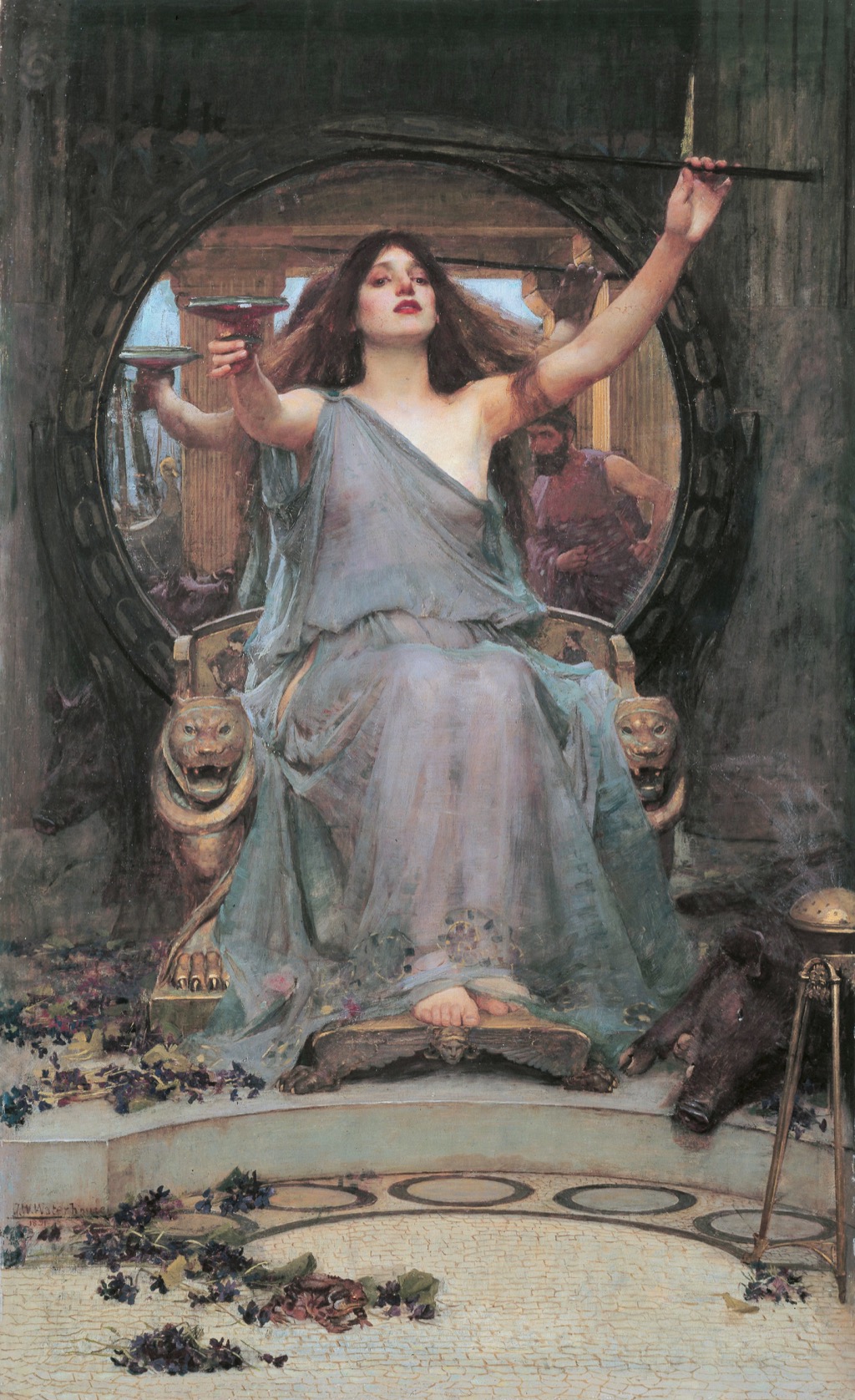
John William Waterhouse places the viewer where a spell is about to fail. Circe sits frontally upon a raised throne and extends a cup into our space. A wand rises in her other hand. Swine—men already transformed by her drugs—remain beside the seat. Behind her, a circular mirror reflects Ulysses approaching the confrontation.
Painted in 1891, Circe Offering the Cup to Ulysses translates Book 10 of Homer’s Odyssey into an encounter with female power. Circe appears monumental, self-possessed and certain of success, while Ulysses is distant and enclosed within reflection. Yet readers of Homer know something the painted sorceress does not: Hermes has warned the hero and given him the herb moly, which will protect him. The cup is offered at the instant when visual authority and narrative outcome diverge. Circe controls the picture; she will not control the man who stands before her.
At a Glance
- ArtistJohn William Waterhouse (1849–1917)
- TitleCirce Offering the Cup to Ulysses
- Date1891
- MediumOil on canvas
- Dimensions148 × 92 cm
- CollectionGallery Oldham, Oldham
- Accession number3.55/9
- First exhibitedNew Gallery, London, 1891 [1] [2]
- Early provenanceBought by Charles Edward Lees in 1892
- Public acquisitionGifted to the gallery by his daughter Marjory Lees in 1952 [1]
- Literary sourceHomer’s Odyssey, Book 10: Circe’s attempt to enchant Odysseus or Ulysses with a drugged cup [3]
- Related major paintingCirce Invidiosa (1892), Art Gallery of South Australia, based upon the Scylla episode in Ovid [4] [5]
Contents
- Introduction
- An Offer That Behaves Like a Challenge
- Homer’s Circe Before the Cup Is Offered
- Ulysses or Odysseus?
- Circe’s Frontal Authority
- The Circular Mirror and Ulysses’s Reflected Body
- The Cup: Hospitality Turned into a Weapon
- The Wand and the Sequence of Enchantment
- The Transformed Men Beside the Throne
- Throne, Herbs and the Material World of Magic
An Offer That Behaves Like a Challenge
Circe’s arm brings the cup forward. Although it is a relatively small object, its foreshortened position makes it the first term of the encounter. The viewer does not merely observe one mythological figure offering something to another. The offer crosses the painted boundary.
Waterhouse keeps Circe’s body almost directly facing us. She does not turn in profile towards a hero standing visibly at the side. Her gaze, cup and elevated position create a confrontation in which the spectator temporarily occupies the recipient’s place.
The title restores the absent partner: this is the cup offered “to Ulysses.” Yet his body appears only in the mirror behind her. The grammar of the title and the structure of the image pull in different directions. Ulysses is necessary to the action but visually subordinate.
An offer usually permits refusal. In Homer, this drink is prepared with an intention to deprive its recipient of human agency. Circe has already transformed the hero’s companions and expects the same result. The extended hand can therefore appear gracious while the cup functions as a weapon.
That double character makes the gesture compelling. Waterhouse does not paint Circe lunging, threatening or forcing the liquid upon him. Ritual hospitality, seduction and attack occupy the same action. A welcome into the palace conceals a movement towards the sty.
The viewer’s knowledge changes the tension. If the myth is unknown, Circe appears overwhelmingly powerful and Ulysses endangered. If Book 10 is known, her confidence becomes dramatic irony. The moly in Ulysses’s possession means that the potion cannot work. [3]
Waterhouse freezes the last moment in which Circe seems to control every term. She possesses throne, cup, wand, palace and visible proof of earlier transformations. Ulysses possesses knowledge she cannot see. The painting’s suspense lies between displayed power and concealed protection.
Homer’s Circe Before the Cup Is Offered
In Book 10 of the Odyssey, Odysseus reaches the island of Aeaea after disaster among the Laestrygonians. Smoke leads his men towards Circe’s house, built of polished stone within the woods. Enchanted wolves and lions gather outside without attacking. [3]
Inside, the men hear Circe singing as she moves before a great web. Her first appearance joins voice, weaving, beauty and supernatural mastery. She opens the doors and invites the party in. Eurylochus alone remains outside because he suspects a trap.
Circe seats the men and prepares a mixture of cheese, barley meal, honey and wine. She adds drugs that will make them forget their native land. After they drink, she strikes them with her wand and drives them into pens. Their bodies become swine while their human minds remain unchanged. [3]
Eurylochus returns to the ship and reports the disappearance. Odysseus sets out to rescue them. On the way, Hermes appears in the form of a young man, explains Circe’s plan and gives the hero a protective herb called moly, black at the root and white in flower. [3]
Hermes also supplies exact instructions. Odysseus must drink, withstand the spell, and when Circe strikes with her wand, draw his sword as though to kill her. She will then yield and invite him to her bed; he must first compel her to swear that she will do him no further harm.
At the palace, events follow this pattern. Circe seats Odysseus upon a richly worked chair, prepares a drugged potion in a golden cup and gives it to him. He drinks but remains human. She strikes him with the wand and commands him to join the swine. He draws his sword; she recognises the hero foretold by Hermes and submits. [3]
Circe then changes roles. After the oath, she becomes host, lover and helper. She restores the crew to human form, receives them for a year and eventually directs Odysseus towards the Underworld and the instructions necessary for his voyage.
Waterhouse’s picture condenses the sequence around the cup. The transformed crew establishes what has already happened. Ulysses’s presence establishes the rescue attempt. Cup and wand anticipate the failed enchantment. Hermes and moly are absent, so the crucial advantage remains invisible.
Ulysses or Odysseus?
The hero’s Greek name is Odysseus; Ulysses is the Latin form familiar in English and Roman tradition. Waterhouse’s title uses “Ulysses,” while modern translations and classical scholarship commonly use “Odysseus.” They refer to the same character.
The title does not make the painting a Roman episode. Its principal literary source is Book 10 of the Greek Odyssey. “Ulysses” reflects the naming convention through which many nineteenth-century British readers encountered the hero.
This matters because names guide searches and comparisons. The work may appear in catalogues or discussion as Circe Offering the Cup to Odysseus, but Gallery Oldham and Art UK record Circe Offering the Cup to Ulysses. [1]
The Latinised name also places the painting within a long afterlife. Circe and Ulysses had appeared in translations, operas, dramas, prints and paintings far beyond Homer’s text. Waterhouse could assume that the encounter belonged to a shared classical culture even when viewers did not remember every line.
Yet the precise sequence rewards return to Homer. Circe is not simply a permanent enemy. The failed potion begins a renegotiation in which threat, oath, sex, hospitality, restoration and guidance follow one another. A fixed label such as “evil witch” cannot describe her complete role.
Waterhouse paints the adversarial threshold, before that change. His Circe does not yet know that the hero will survive. Ulysses has not yet exposed the sword or forced the oath. The painting therefore represents one aspect of a character whom the epic will complicate.
Circe’s Frontal Authority
Circe sits above the viewer’s implied eye level. Throne and step lift her body, while her head remains close to the upper part of the narrow canvas. We look towards her as a petitioner, guest or threatened recipient might.
The pose is stable. Her torso faces forward, one arm advances with the cup and the other controls the wand. These asymmetrical gestures animate a body otherwise aligned with the vertical axis. She appears able to act in two ways at once: drug and command.
Her chin and gaze intensify the hierarchy. She looks outward with confidence rather than down at the vessel. The potion requires no inspection; it is already prepared. Her attention belongs to the person she expects to transform.
The throne’s upright sides frame her body. Animal-headed or feline-like carvings at its arms strengthen the impression of controlled ferocity. The circular mirror completes the enclosure behind her head and shoulders, giving the seated woman an almost emblematic presence.
This frontality is unusual because it collapses historical distance. A figure shown in profile can remain safely inside a legendary scene. Circe’s direct orientation acknowledges the space outside the canvas. The ancient enchantress becomes a contemporary encounter.
Her authority is not the same as final victory. In Homer, Circe is moments from discovering that this man cannot be treated like his companions. Waterhouse makes her most visually commanding when her knowledge is incomplete.
That discrepancy prevents a simple image of empowerment. Circe has real magical power, evidenced by the swine, but the narrative has arranged its limit. She occupies the centre and dominates vision while a male hero, aided by a male god, carries the means of reversal.
The painting neither cancels her power nor lets it remain unchallenged. It makes the tension visible by separating composition from plot: authority belongs to Circe in the image; future action belongs to Ulysses in the story.
The Circular Mirror and Ulysses’s Reflected Body
The mirror is the painting’s most ingenious narrative device. It allows Circe to remain frontal while confirming that another figure stands before her. Ulysses appears behind her only because the surface reflects the space occupied by the viewer and hero.
This arrangement places spectators close to Ulysses’s position without turning the painting into a literal first-person view. We see the cup as he would, but we also see his reflected body. The image makes us participant and observer at once.
The reflected hero is smaller than Circe. Scale usually follows distance, but here it also creates hierarchy. Her body commands the material foreground; his becomes an image within an image.
The mirror’s circular frame surrounds Circe’s upper body while containing Ulysses at its edge or depth. It can resemble a halo, shield or disc, but no single symbolic identity is required. Its secure function is optical and compositional: it joins opposed spaces.
Mirrors often confirm the power of the person who looks into them. Waterhouse reverses that expectation. Circe does not visibly study herself. The mirror serves the spectator by revealing her target and enlarging the palace without turning her away.
It also introduces uncertainty about gaze. Is Circe looking directly at Ulysses, through the viewer, or beyond him? The reflected man appears wary, but the exact relation between their eyes is difficult to settle. The picture sustains confrontation without providing a simple exchanged glance.
George P. Landow has associated Waterhouse’s circular mirror with a wider art-historical tradition that includes Jan van Eyck’s Arnolfini Portrait and notes Waterhouse’s later use of mirrors in the Lady of Shalott interiors. [6] The comparison is suggestive, but it should not become a claim of direct borrowing without documentary evidence.
Within Waterhouse’s own art, the device returns because it solves recurring problems. A mirror can make an absent figure present, divide direct from mediated sight and place the viewer inside a relationship. In the Circe painting it does all three.
The Cup: Hospitality Turned into a Weapon
Homer specifies a golden cup containing a potion and a drug added “with evil purpose.” [3] Waterhouse makes the vessel visually prominent through extension rather than size. Its rim approaches the front of the composition.
The cup belongs to hospitality. A guest is seated, welcomed and offered drink. Circe weaponises that familiar sequence. Transformation can occur because the action first resembles civilised care.
Waterhouse preserves the ambiguity by making the vessel beautiful. It is not marked like a poison bottle and no skull announces death. Danger depends upon narrative knowledge and upon the swine around the throne.
The offer is also a test of trust. Ulysses must accept the drink despite knowing the trap because Hermes has instructed him. His apparent vulnerability conceals strategic obedience. Circe sees compliance; the audience sees a counter-plan.
The cup’s position converts the viewer’s look into a decision. To follow its curve outward is to imagine receiving it. Refusal remains psychologically available even though Homer’s hero drinks.
Paint cannot show the drug’s chemical action, and Waterhouse does not attempt a supernatural glow. The potion’s power is displaced into Circe’s posture, the transformed men and the cup’s relation to the picture plane.
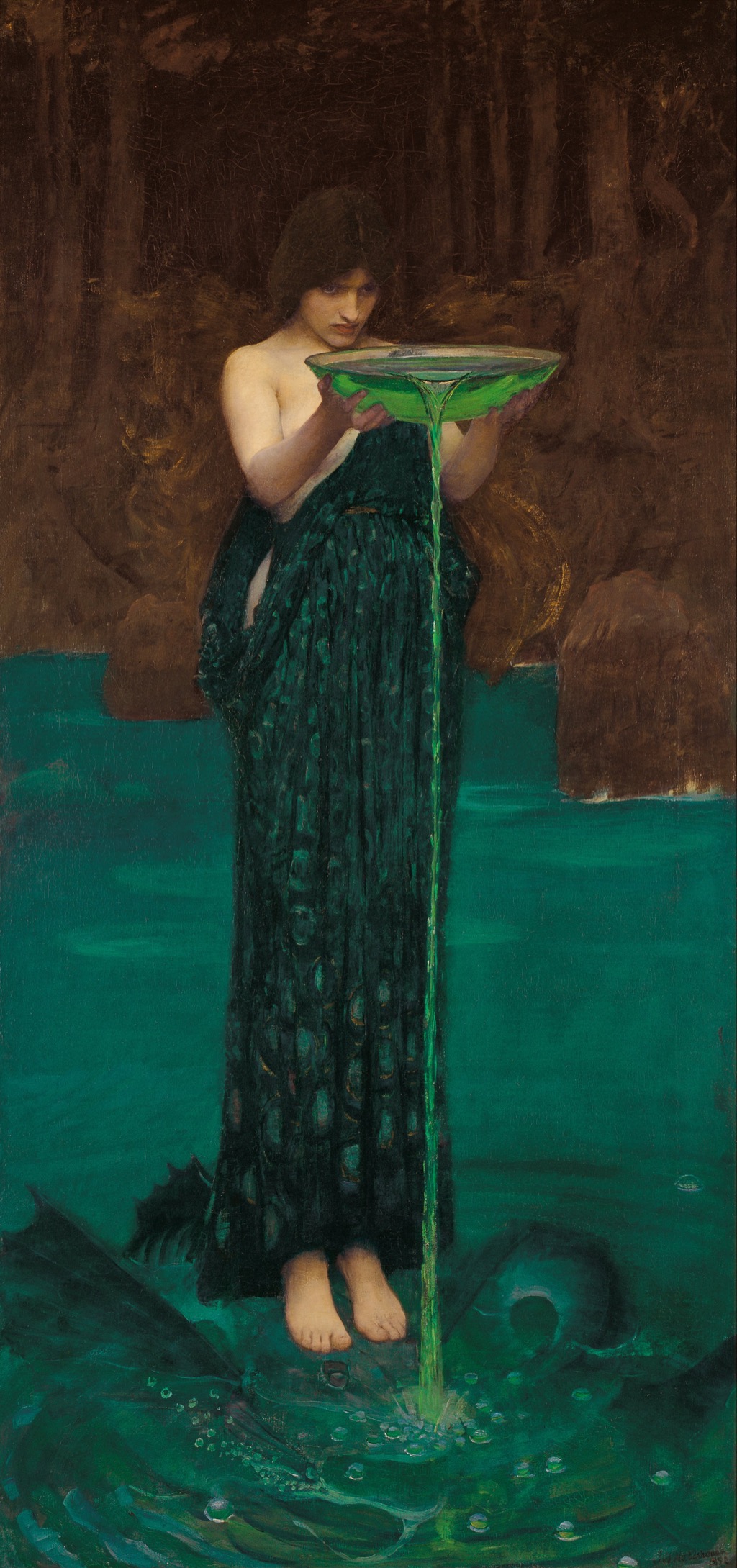
The vessel also begins a sequence of transformations in Waterhouse’s Circe paintings. Here liquid remains contained until offered. In Circe Invidiosa, a luminous stream descends visibly into the sea. Container and pour become different ways of picturing magic at the threshold of release.
The Wand and the Sequence of Enchantment
The wand appears in Circe’s other hand. In Homer, she first gives the potion and then strikes the drinker with the wand, commanding him to the sty. [3] Waterhouse combines successive instruments within one image.
That combination lets the viewer read before and after. Cup is the immediate offer; wand anticipates the command that will follow. The transformed companions establish the result expected from both.
The wand’s long line counters the projecting cup. One arm moves into depth or towards the viewer; the other creates a stronger vertical or diagonal beside the body. Circe appears to control both spatial directions.
Unlike a modern stage magician’s prop, the wand is not decorative proof of generic witchcraft. It performs a precise action in the source. Waterhouse’s fidelity lies in selecting an object that Homer specifically names.
The raised wand can still look ceremonial. Together with throne and cup, it turns the encounter into a ritual of Circe’s authority. She presides rather than merely attacks.
The British Museum’s 2022 Feminine Power exhibition used the painting to prompt a modern practising witch, Laura Daligan, to discuss chalice, wand, magical labour and the persistent cultural association between female power, sexuality and fear. [7] Her response is a contemporary interpretation, not evidence of Waterhouse’s private belief or of ancient Greek ritual.
That distinction is productive. Modern viewers can recognise how strongly cup and wand resemble later magical symbols while still returning to their specific Homeric functions. The painting has acquired new audiences without ceasing to be a nineteenth-century reading of an ancient epic.
The Transformed Men Beside the Throne
Swine appear at or behind the throne, evidence of Circe’s earlier success. Their presence identifies the stakes before a viewer reads the title. Human guests can lose their bodies while remaining conscious within them.
Homer’s description is especially cruel: the men acquire the heads, voices, bristles and shape of swine, but their minds remain as before. They are penned while weeping and fed acorns and other animal food. [3]
Waterhouse does not show a crowded sty. By bringing a small number of transformed figures into the throne room, he condenses cause and result around Circe. The animals behave like trophies, attendants or warnings.
Their scale and low position intensify her elevation. Human intelligence has been pushed to floor level and denied human form. Circe alone remains upright and fully visible.
It is common to call the animals “boars,” but Homer calls the transformed men swine. The painted forms may look boar-like, and modern discussions use both terms. What matters narratively is their identity as Ulysses’s companions under enchantment.
They also prove that the scene cannot be a neutral ceremonial offering. Even without the epic, the juxtaposition of cup, wand and transformed men makes threat legible.
The animals do not prove that Circe has killed or sacrificed them. In Homer they are alive, retain their minds and are later restored. [3] Interpreting the seated or recumbent form as a corpse would contradict the source without visual necessity.
Their future restoration further complicates Circe’s role. The same goddess who transforms the men will undo the spell. Waterhouse shows power in its punitive form before it becomes restorative.
Throne, Herbs and the Material World of Magic
Circe’s seat behaves like a throne even if it also belongs to the richly furnished palace described by Homer. Its raised platform, upright frame and animal forms establish rule over an interior domain.
Plants or purple flowers lie near the step. They can plausibly evoke the herbs and drugs through which Circe works, but identifying a precise species from appearance alone would be unsafe. They are not necessarily moly, which belongs to Ulysses and is described by Homer as black-rooted with a milk-white flower. [3]
The distinction matters. Circe’s botanical knowledge and Hermes’s protective herb operate on opposing sides of the encounter. Waterhouse shows materials associated with her practice but omits the plant that will defeat it.
The stone or tiled interior gives magic a physical setting. Waterhouse does not place Circe in an undefined cloud of fantasy. Throne, vessel, wand, mirror, flowers and animals make supernatural action materially organised.
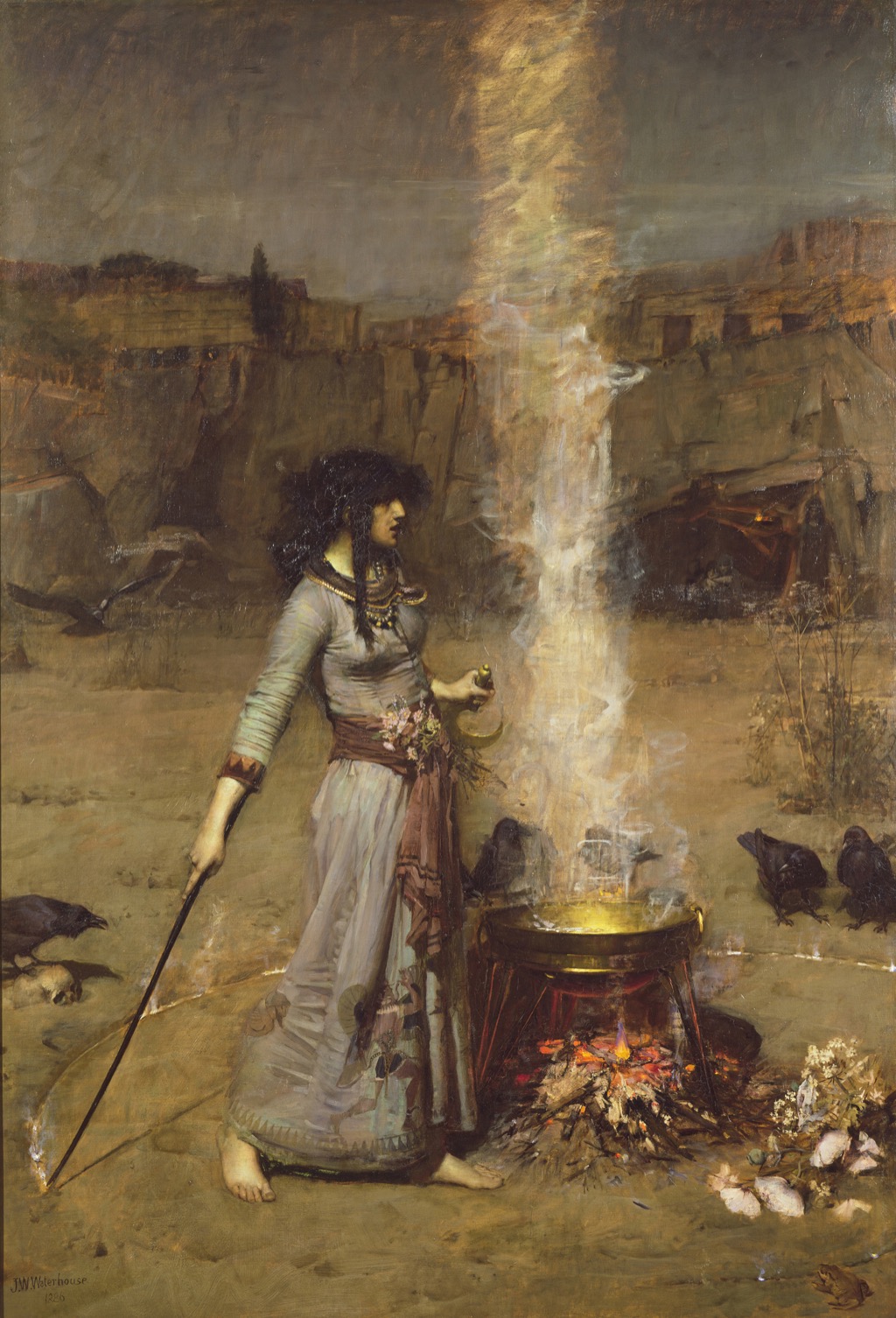
This attention links the picture to his larger interest in magic as work. In The Magic Circle, a woman draws a boundary with a wand while smoke rises from a vessel. In later sorceress subjects, books, containers and plants surround concentrated figures. Power requires objects, sequence and knowledge.
The glamorous body should not obscure this practical dimension. Circe has prepared the potion, transformed earlier guests and arranged the encounter. Her authority is exercised through craft as well as beauty.
At the same time, Waterhouse’s room is not an archaeological reconstruction verified object by object. Classical source and imaginative design cooperate. The palace must feel ancient and enchanted, not document one excavated interior.
The material setting makes the myth credible while remaining theatrical. Circe occupies something between a throne room, ritual chamber and domestic place of reception. That ambiguity lets hospitality, sovereignty and sorcery converge.
Beauty, Exposure and the Femme-Fatale Tradition
Waterhouse presents Circe as beautiful and sexually charged. Her costume reveals or emphasises the upper body, while dark hair, jewellery and translucent or finely draped fabric heighten sensuous presence. Her attractiveness is part of the danger offered to Ulysses and to the viewer.
Late nineteenth-century art frequently cast powerful women as enchantresses, sirens, sphinxes or femmes fatales. Art UK places Waterhouse’s Circe within this broader fascination with the “woman as witch,” in which female power could become a focus for desire and social fear. [8]
That context is useful but not complete. Circe is not dangerous simply because Waterhouse invented an independent woman for a nervous Victorian public. She drugs and transforms men in Homer. The painting adapts a genuinely threatening ancient action.
Nor does beauty make her power illusory. The swine confirm that transformation has occurred. Cup and wand are active instruments. She is not merely dressed as a witch for visual consumption.
The image nevertheless makes power available through a sexualised female body. Viewers are asked to look at the exposed or closely draped figure while fearing the consequences of approach. Attraction and threat are structurally joined.
This double demand can be read critically. Circe commands the encounter but remains arranged for a spectator’s gaze. Her frontal body dominates the canvas, yet the myth will ultimately affirm the hero’s resistance and negotiation.
Modern response need not choose between “empowered goddess” and “dangerous seductress” as exclusive labels. The painting contains both female authority and the cultural framing of that authority as alluring peril.
The best interpretation also remembers change. Homer’s Circe becomes lover, host and guide after the confrontation. A femme-fatale label freezes her at the cup and ignores the intelligence she later contributes to the voyage.
Composition: Circle, Vertical and Outstretched Arm
The canvas is tall and narrow. Circe’s seated body, wand and throne fill its vertical axis, while the outstretched arm advances into the viewer’s space. The format makes one figure monumental without requiring her to stand.
The circular mirror introduces a second geometry. Its curve gathers the upper composition, frames Circe and opens another space. Straight throne and wand meet round mirror and cup.
Symmetry is strong but incomplete. Circe sits centrally; the mirror centres behind her; throne sides balance. The unequal arms, displaced Ulysses and swine prevent ceremonial stillness from becoming static.
Perspective supports authority. The raised seat and visible step put the viewer below her. The cup’s projection exaggerates depth, making a narrow interior feel confrontational rather than flat.
The reflected Ulysses complicates the apparent axis. He stands in front of Circe within the fictional space but appears behind her on the painted surface. Waterhouse converts optical reversal into narrative subordination.
Edges concentrate around face, hands, cup and wand. Fabric and architectural areas can broaden without losing the encounter. The hierarchy keeps the painting legible from a distance and psychologically active at close range.
No published technical examination cited here supplies infrared imaging, pigment analysis or a complete record of revision beneath the surface. Exact claims about underdrawing and named pigments would therefore go beyond the accessible evidence.
Visible construction is sufficient to show Waterhouse’s skill. The image feels frontal and immediate while containing several depths: cup before body, body before mirror, reflected Ulysses beyond. One stationary figure generates a complex spatial drama.
Colour: Dark Hair, Pale Flesh and the Golden Cup
Waterhouse concentrates contrast around Circe. Dark hair and drapery frame pale skin; the cup catches light; purple flowers or herbs gather low in the scene; the mirror contains cooler distance.
This colour hierarchy isolates the face, torso and offering hand. The viewer reads body and action before inventorying the room.
The golden or warm-toned cup carries Homer’s description and separates the potion from the darker costume. [3] Its brightness can resemble precious hospitality even though its contents are hostile.
Pale flesh against dark material also intensifies exposure. Circe appears luminous and physically present, while Ulysses in the mirror is reduced in scale and tonal force.
The animals occupy earthier, darker values near the base. Their bodies belong visually to the floor, a degradation that answers the myth’s transformation of men into creatures kept in pens.
Purple flowers contribute both richness and unease. Their colour can suggest exotic ingredients without requiring a symbolic dictionary. They connect beauty to the practical materials of enchantment.
The mirror prevents the palette from closing into darkness. Reflected architecture or landscape extends light behind Circe, making her silhouette clearer. She is supported by a world beyond her throne even as she blocks direct view of it.
Colour therefore repeats the narrative hierarchy. Circe is immediate, Ulysses mediated, transformed men low and subdued, the cup small but bright. Waterhouse makes power readable before the story is known.
Circe Offering the Cup and Circe Invidiosa
One year later Waterhouse painted Circe Invidiosa, now in the Art Gallery of South Australia. The two works share a mythological enchantress, vertical format, vessel and vivid supernatural action, but they depict different texts and different powers. [4]
The 1891 painting comes from Homer. Circe offers a drugged cup to Ulysses after transforming his crew. The intended victim is present in the mirror and protected by moly. The scene is an encounter whose outcome depends upon resistance. [3]
The 1892 painting comes from Ovid’s Metamorphoses. Circe poisons the water where Scylla will bathe after Glaucus rejects her love. Scylla is absent; the sea receives a visible stream; the magic will later transform the innocent rival. [5]
Direction changes meaning. In 1891, the cup moves outward towards a man who faces Circe. In 1892, liquid pours downward into an environment while the victim remains elsewhere. Offer becomes contamination.
Space changes too. Palace, throne and mirror in the Homeric picture give way to rock, open sea and narrow shoreline. Circe’s authority no longer depends upon a royal interior. She acts upon nature itself.
Emotion is also different. Homeric Circe displays calm confidence in a familiar method. Ovidian Circe acts from jealousy after rejection. The title Invidiosa identifies envy as a driving condition.
The comparison prevents the idea of one fixed “Waterhouse Circe.” He uses the character to explore confrontation, frustrated power, desire, poison and transformation across distinct episodes.
Later seated sorceress subjects return to books, vessels and contemplation, but they should not all be merged into these two canonical narratives. A recurring magical woman is not automatically Circe unless title or source establishes her identity.
Circe Beside Ulysses and the Sirens
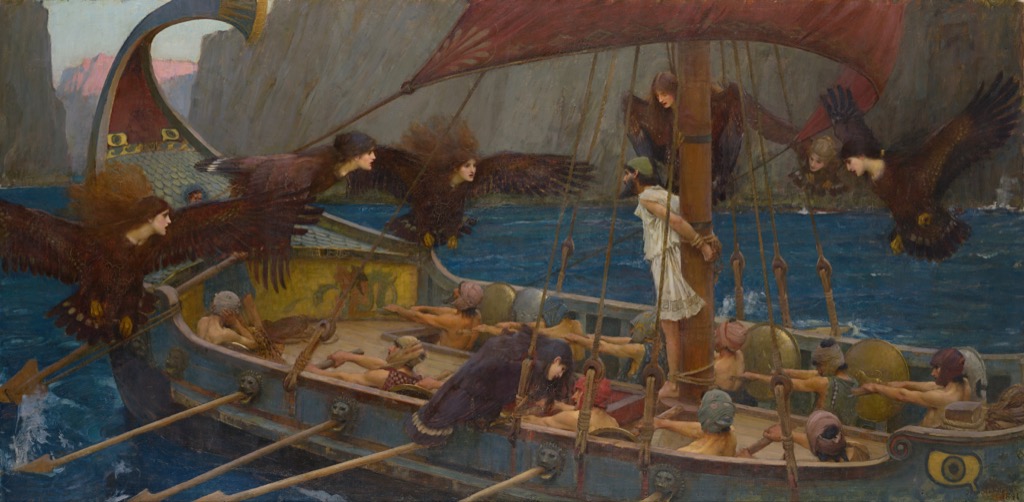
Waterhouse also completed Ulysses and the Sirens in 1891, now in the National Gallery of Victoria. It presents the hero bound to the mast while bird-bodied sirens attack the ship. [9]
The two canvases show different ways of defending male identity against enchantment. With the sirens, Ulysses orders his crew to bind him while their ears are stopped. His body yields to the song even as ropes and command preserve the voyage. With Circe, a god-given herb protects his body from transformation.
Sound dominates the Sirens. Cup, drug and wand dominate Circe. One danger surrounds the ship in violent multiplicity; the other is concentrated in a single frontal woman.
Ulysses is central and physically large in the Sirens painting. In the Circe work he is small and reflected. The shift demonstrates how format and viewpoint can redistribute heroic importance even when the same man survives both encounters.
Both paintings rely on source knowledge. A viewer who knows Homer understands why Ulysses is bound and why he can safely take the cup. Waterhouse selects moments that make peril visible while leaving the mechanism of survival partly outside the image.
The pair also complicates the phrase “femme fatale.” The sirens are non-human attackers drawn from ancient vase imagery; Circe is a goddess who will become an ally. Female danger takes different bodies and narrative roles.
Seen together, the works make 1891 a crucial year in Waterhouse’s mature classicism. Archaeology, literature, colour and psychological confrontation replace the more detached historical interiors of some earlier paintings.
The New Gallery Exhibition of 1891
Circe Offering the Cup to Ulysses was exhibited at the New Gallery in London in 1891. [2] The venue had opened in 1888 and provided an important alternative exhibition space for artists associated with aesthetic, classical and later Pre-Raphaelite currents.
A later Temple Newsam loan catalogue records the work as “Circe,” describes the charmed cup and identifies the New Gallery display. [2] Its condensed story shows how exhibition catalogues helped viewers recognise a mythological scene before widespread digital or illustrated access.
Waterhouse was an Associate of the Royal Academy at the time, but this painting’s first documented display was not the Academy’s Summer Exhibition. The distinction matters because “Victorian exhibition painting” did not mean one institution alone.
The tall format and frontal offer would have been effective on a crowded wall. Cup, pale body, dark drapery and circular mirror produce an immediate visual emblem. The Homeric detail could be understood after the confrontation had already attracted attention.
The 1891 date places the work beside Ulysses and the Sirens, exhibited at the Royal Academy that year. [9] Waterhouse explored two episodes from the same epic through radically different formats and exhibition settings.
Circe also marks a transition in his female mythological figures. The painting combines the large, institutionally ambitious scale of academic subject painting with the intense single-figure presence and magical atmosphere central to his mature reputation.
Contemporary reception requires more evidence than the surviving display record cited here. It would be unsafe to invent universal praise or scandal. What can be established is that the work moved rapidly from exhibition into a documented Oldham collection.
Charles and Marjory Lees: From Private Purchase to Oldham
Charles Edward Lees bought the painting in 1892, the year after its New Gallery exhibition. Art UK records him as its early purchaser and identifies the later transfer to Gallery Oldham. [1]
Lees belonged to an Oldham family whose collecting and civic interests shaped the painting’s local history. He died in 1894. The canvas remained within the family rather than entering repeated auction circulation.
In 1952 his daughter Marjory Lees gave the painting to the gallery. [1] The gift converted a privately held work by a nationally prominent artist into a public object in the town connected with its collector.
The accession number 3.55/9 identifies it within Gallery Oldham’s collection. The museum’s wider fine-art holdings range from late Victorian and Pre-Raphaelite-related painting to modern work, giving Circe a local collection context rather than leaving it isolated as an internet icon. [10]
This provenance is unusually direct. Artist’s exhibition, purchase in 1892, family descent and gift in 1952 create a more secure history than the broken chains surrounding many privately held Waterhouse paintings.
The story also demonstrates how regional British collections acquired major Victorian art. Circe’s current public identity depends upon an industrial town, a collecting family and a mid-twentieth-century act of donation—not only upon Waterhouse’s London career.
The painting may travel for exhibitions, and permanent display is never guaranteed. Art UK advises visitors to contact the venue before making a journey specifically to see it. [1]
What the Painting Can—and Cannot—Be Said to Mean
The painting securely represents a contest of knowledge. Circe believes cup and wand will transform another man. Ulysses, protected by moly and instructed by Hermes, knows the spell will fail. The viewer may share that knowledge while Circe does not. [3]
It can also be read as a contest of visibility. Circe controls the foreground, meets the spectator and occupies the throne. Ulysses appears only as a reflection. Narrative privilege and pictorial privilege belong to different figures.
Sexual power is part of the image, but not its only subject. Circe’s body is displayed and her offer can seem seductive. Her authority also rests upon preparation, objects, prior success and command of a domain.
The mirror may suggest self-knowledge, deception, doubled identity or the spectator’s complicity, but none of these should be presented as Waterhouse’s documented code. Its certain purpose is to reveal Ulysses while preserving Circe’s frontality.
The animals represent transformed companions, not necessarily moral proof that men reveal an innate swinish nature. That later allegorical reading has cultural appeal, but Homer states that their minds remain human. [3]
Nor is Circe simply defeated. Her potion fails, but the epic does not remove her from the story. She restores the crew and becomes indispensable to the next stages of the voyage. Waterhouse chooses the pivot before adversary becomes ally.
The strongest conclusion holds visual and narrative truths together. Circe is powerful; her power has a limit. Ulysses is endangered; his danger is strategically managed. The viewer is invited to feel the force of an offer whose outcome is already changing.
Related Pages
- Circe Invidiosa: Compare Waterhouse's second major Circe painting and its Ovidian revenge episode.
- Literary and Mythological Sources: Place Homer, Ovid and Waterhouse's mythological subjects together.
- Paintings: Return to the wider Waterhouse paintings hub.
Frequently Asked Questions
It belongs to Gallery Oldham. Charles Edward Lees bought it in 1892, and his daughter Marjory Lees gave it to the gallery in 1952. [1]
Yes. He appears in the circular mirror behind Circe. The device allows her to face the viewer while the person receiving the cup remains present within the scene.
In Book 10 of the Odyssey, she puts a drug into a potion intending to transform him as she transformed his companions. Hermes has already given Odysseus the protective herb moly, so the spell fails. [3]
Yes. Odysseus is the Greek name; Ulysses is the Latin form widely used in English. Gallery Oldham’s title uses Ulysses.
They represent members of Ulysses’s crew transformed into swine. Homer says that their bodies changed while their minds remained human. [3]
She extends the drugged cup and holds a wand. In Homer she gives the drink, then strikes Odysseus with the wand and orders him to the sty, expecting the transformation to have occurred. [3]
It should not be confidently identified as moly. Homer describes moly as Ulysses’s protection, given by Hermes, with a black root and milk-white flower. [3] The visible plants may evoke Circe’s herbs without depicting that exact divine plant.
No. Circe Invidiosa was painted in 1892 and is in Adelaide. It shows Circe poisoning the sea before Scylla’s transformation in Ovid, not offering Ulysses a cup in Homer. [4] [5]
She begins as a dangerous enchantress who transforms the crew. After Ulysses resists and compels an oath, she restores the men, hosts them and gives essential guidance. Her role changes significantly within Book 10. [3]
Discussion
At first sight the answer seems obvious. Circe is large, frontal, elevated and armed with two magical instruments. Ulysses is small, distant and reflected. The transformed men lie at her feet.
Knowledge reverses that hierarchy. Ulysses knows the cup cannot transform him. Circe does not. Hermes’s absent intervention is stronger than every visible sign of her control.
Reader Insights
Which visible detail most changes the way you read this page?
Which source or comparison helps the work feel less familiar and more specific?
What question would you bring back to the painting after reading?
Join the Conversation
Share your reading of this page below.
References
- Main image: John William Waterhouse, Circe Offering the Cup to Ulysses, 1891, Gallery Oldham, public-domain photographic reproduction via Wikimedia Commons.
- Art UK and Gallery Oldham. “Circe Offering the Cup to Ulysses,” object record: date, medium, dimensions, accession number, Charles Edward Lees’s purchase and Marjory Lees’s 1952 gift. View source
- Temple Newsam. Descriptive Catalogue of the Loan Collection of Pictures, entry 21, “Circe,” recording the Homeric subject and New Gallery exhibition of 1891. View source
- Homer. Odyssey, Book 10, translated by A. T. Murray: Circe’s palace, transformation of the crew, Hermes and moly, the drugged cup, wand, failed enchantment, oath and restoration. View source
- Art Gallery of South Australia. “Circe Invidiosa,” object record and curatorial interpretation, 1892, oil on canvas. View source
- Ovid. Metamorphoses, Book 14, translated by Brookes More: Glaucus, Circe and the poisoning of Scylla’s pool. View source
- *George P. Landow / The Victorian Web.* “Circe Offering the Cup to Ulysses,” object note and art-historical observation on Waterhouse’s mirror device. View source
- British Museum. “What Waterhouse’s representation of magic means to Laura Daligan, a practising witch,” transcript created for Feminine Power: The Divine to the Demonic, 2022; a clearly attributed modern response to cup, wand, magical labour and female power. View source
- Victoria Ibbett / Art UK. “Witches: the Pre-Raphaelite femme fatale,” historical interpretation of Waterhouse’s Circe within nineteenth-century images of female magic and social fear. View source
- National Gallery of Victoria. “Ulysses and the Sirens,” collection record, 1891, oil on canvas, with provenance and interpretive note. View source
- Gallery Oldham / Art UK Shop. Gallery profile describing the range and public character of the Oldham fine-art collection. View source