

 Buy Art Prints Now
from Amazon
* As an Amazon Associate I earn from qualifying purchases.
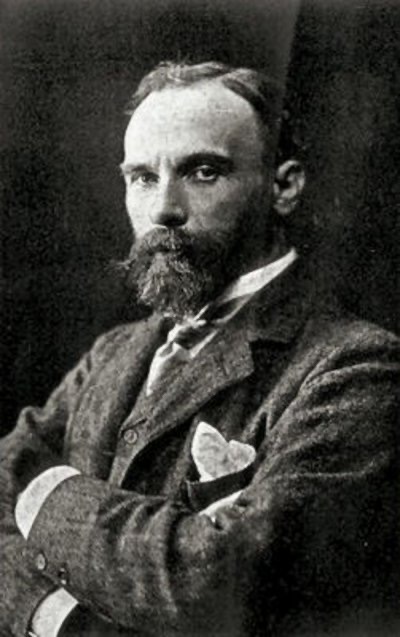
Image reference [image]
 by Tom Gurney
Tom Gurney BSc (Hons) is an art history expert with over 20 years experience
Published on August 14, 2026 / Updated on August 14, 2026
Email: tomgurney1@gmail.com / Phone: +44 7429 011000
John William Waterhouse Timeline: Introduction
John William Waterhouse’s career unfolded through an unusually sustained relationship with the Royal Academy. From his first accepted picture in 1874 to works shown in the year of his death, he used the Academy exhibition as the principal public stage for paintings drawn from classical history, Greek and Roman myth, medieval legend and English poetry. The chronology below follows that public career alongside the quieter facts of training, studios, marriage, travel, professional status, collecting and reputation.
It also shows why Waterhouse cannot be understood simply as a late Pre-Raphaelite. He began as an Academy-trained painter of classical and historical scenes, absorbed newer approaches to colour and handling, and only gradually made Tennyson, Shakespeare, Keats and the dangerous women of myth central to his art. His present fame rests on that mature synthesis, but it was built over more than forty years of exhibiting, revising and returning to subjects.
At a Glance
- January 1849Born in Rome to British artistic parents; the exact day is uncertain [1]
- 1870–1871Entered the Royal Academy Schools, initially in sculpture; sources use both years for the beginning of his Academy training [1] [4]
- 1874First exhibited at the Royal Academy, with Sleep and His Half-Brother Death [1] [4]
- 1878Took a studio at Primrose Hill Studios, London [1] [2]
- 1883Married the flower painter Esther Maria Kenworthy; Adelaide acquired The Favourites of the Emperor Honorius, the first Waterhouse painting to enter a public institution [1] [6]
- 1885Elected an Associate of the Royal Academy [1]
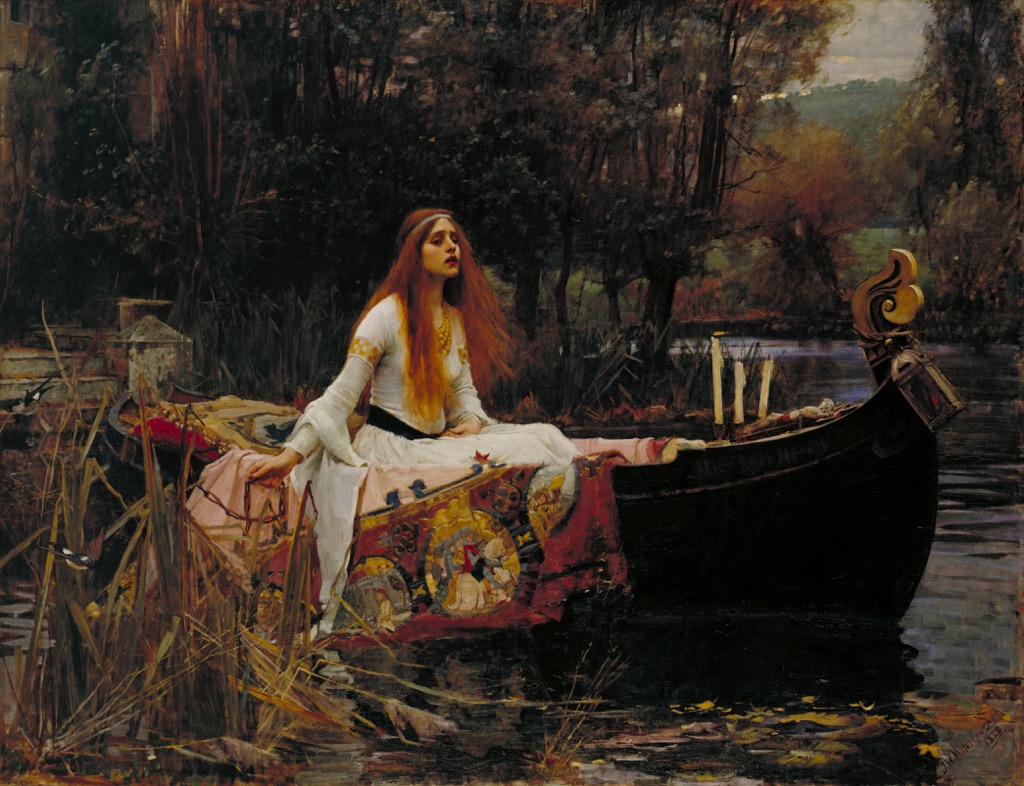
- 1888Exhibited The Lady of Shalott [1] [10]
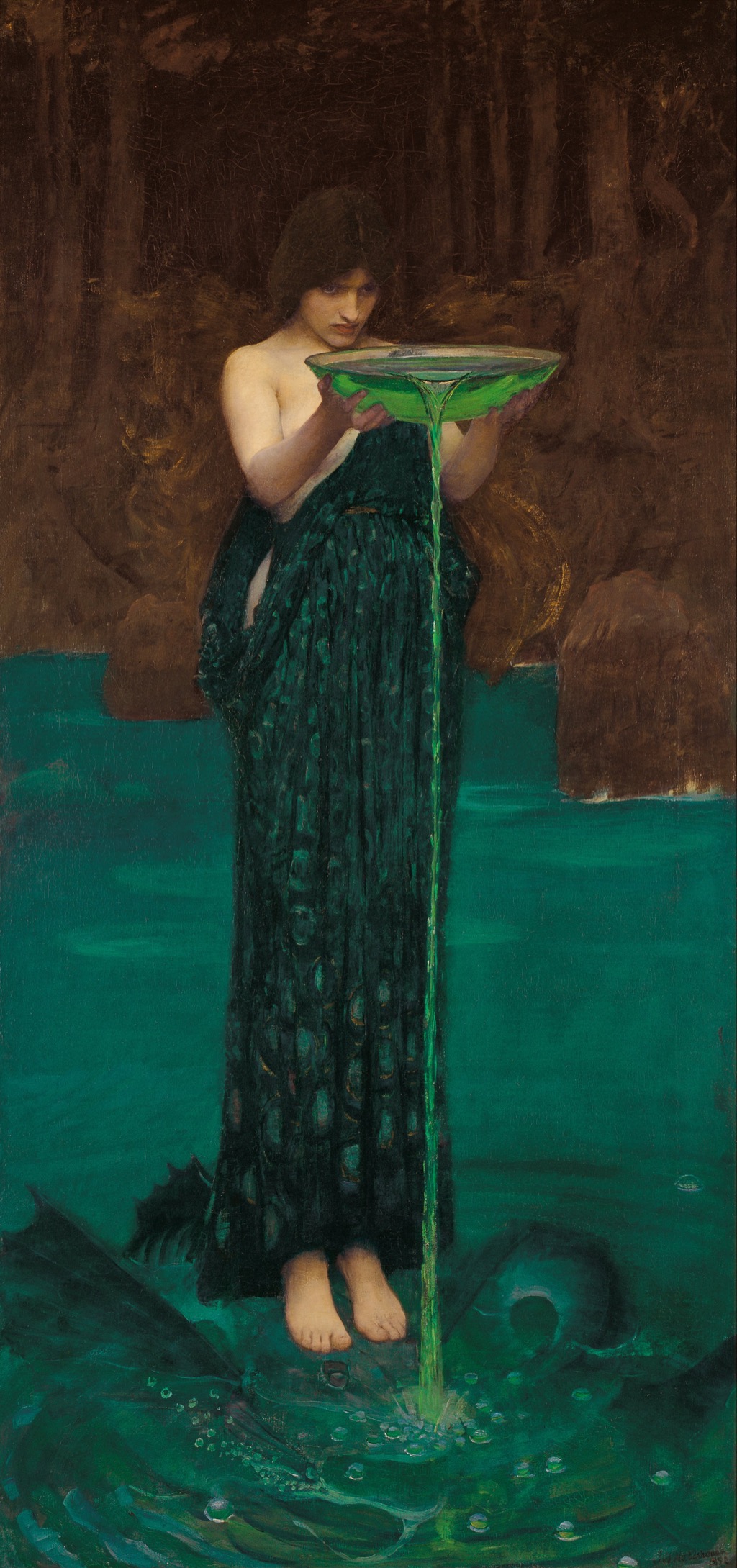
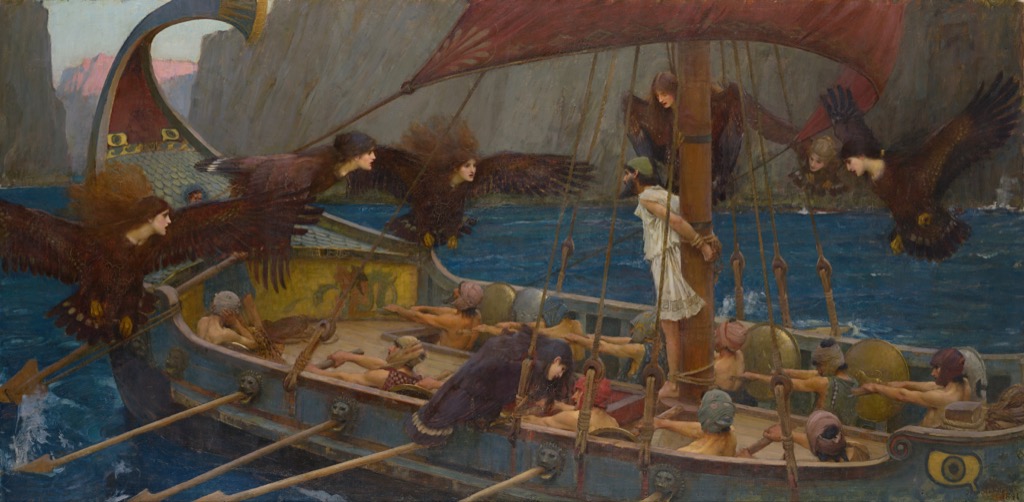
- 1891–1892Produced Ulysses and the Sirens and two major Circe paintings; museums in Melbourne and Adelaide bought key works directly from him [11] [12] [13]
- 1895Elected a Royal Academician [1]
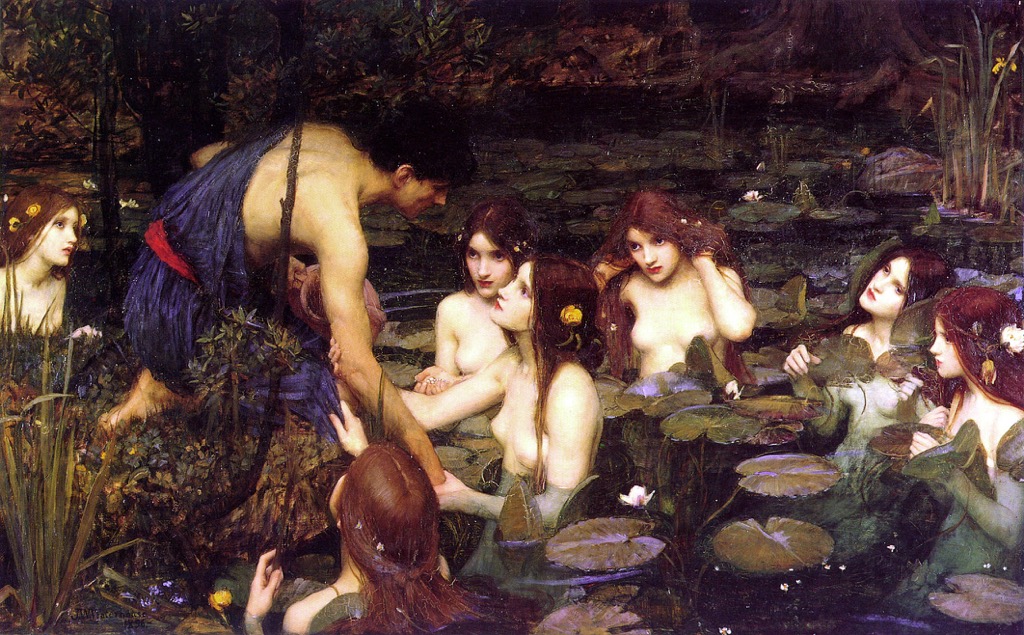
- 1896Manchester purchased Hylas and the Nymphs from the artist [14]
- 1900Moved to 10 Hall Road, St John’s Wood, and completed A Mermaid [1] [15]
- 1901The Royal Academy accepted A Mermaid as his Diploma Work [15]
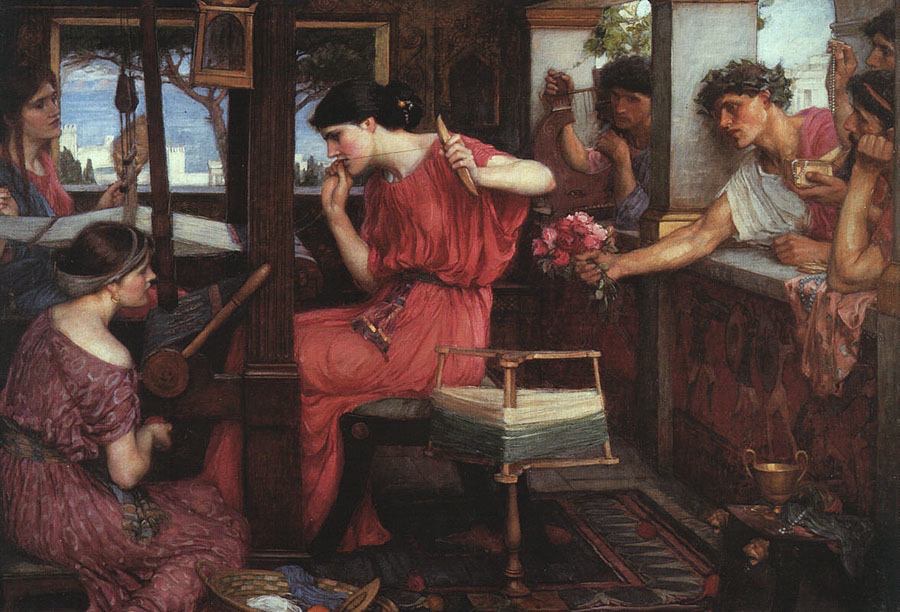
- 1912Aberdeen purchased Penelope and the Suitors [17]
- 1915Painted his final major treatment of the Lady of Shalott [18]
- 10 February 1917Died at his Hall Road home in London [1]
- 1917The unfinished Enchanted Garden was shown posthumously at the Royal Academy [19]
- 2008–2010A major retrospective travelled from Groningen to London and Montreal, consolidating his modern reassessment [20]
Contents
- Introduction
- How to read the dates
- 1849–1873: Rome, London and artistic training
- 1874–1882: First exhibitions and a professional studio
- 1883–1888: Public collecting, Academy rank and The Lady of Shalott
- 1889–1895: Reinvention, international prizes and full Academicianship
- 1896–1901: Hylas, Hall Road and the Diploma Work
- 1902–1909: An established painter revisits myth and poetry
- 1910–1914: Late ambition and institutional standing
- 1915–1917: War, final pictures and death
How to read the dates
Waterhouse’s public career is better documented than his private life. Royal Academy exhibition records, dated paintings, museum acquisitions and known studio addresses provide a dependable framework. Personal evidence is thinner. The National Portrait Gallery notes the shortage of anecdotal information despite his success and wealthy patrons, while the Yale Center for British Art preserves an individual letter to the critic Harry Quilter rather than the kind of extensive correspondence from which a daily life can be reconstructed. [1] [24]
Some dates therefore need qualification. The National Portrait Gallery gives Waterhouse’s birth only as January 1849. Sources also place his entry into the Royal Academy Schools in either 1870 or 1871, probably because probationary admission and formal student status were recorded differently. [1] [4] Paintings may have a production date, an exhibition date and an acquisition date in successive years: Hylas and the Nymphs, for example, is dated and was purchased in 1896 but appeared at the Royal Academy in 1897. [14] Where such distinctions matter, the timeline states them rather than forcing every event into a single date.
1849–1873: Rome, London and artistic training
January 1849: birth in Rome
John William Waterhouse was born in Rome in January 1849. His father, William Waterhouse, was a painter; modern biographical accounts also identify his mother, Isabella, as an artist. The exact day of birth is not securely established in the principal public catalogues, so January is the most responsible precision. [1] Rome gave Waterhouse an Italian beginning, but no surviving statement by him turns that childhood fact into a simple explanation for the classical subjects of his maturity.
The 1850s and 1860s: an artistic household in London
The family returned to Britain while Waterhouse was young, and he grew up in London. The contemporary Encyclopædia Britannica described him as the son of an artist and said that his father provided much of his training. [3] That notice printed the wrong birth year, a reminder that even a source published during Waterhouse’s lifetime must be checked against later research. Its evidence for his early artistic formation is nevertheless valuable: before institutional study, painting was already the work of the household.
Little firm evidence survives for particular childhood visits, exercises or ambitions. Later paintings demonstrate informed attention to ancient art and literature, but they do not prove every story told about a precocious boy sketching in museums. The securely documented transition is from family instruction to the Royal Academy Schools.
1870–1871: the Royal Academy Schools
Waterhouse entered the Royal Academy Schools initially as a sculpture student. Tate’s biographical summary places his entry in 1870, while the National Portrait Gallery records him as a student of sculpture in 1871. [1] [4] The difference is best treated as an administrative one rather than as a biographical mystery. Sculpture was not a mistaken beginning. Training the eye to understand bodily weight, contour and three-dimensional form remained relevant to the commanding figures of his mature canvases.
He moved towards painting without abandoning that concern for physical presence. The Academy offered more than tuition: it provided a competitive annual exhibition, a professional network and, for successful artists, a route from student to Associate and eventually Royal Academician. That institutional sequence became the spine of Waterhouse’s career.
1874–1882: First exhibitions and a professional studio
1874: the first Royal Academy exhibit
Waterhouse first appeared at the Royal Academy with Sleep and His Half-Brother Death. The painting presents the personifications of Sleep and Death as closely related bodies distinguished through light, shadow and detail. More important to the chronology than any single interpretation is its institutional consequence: this was the beginning of an exhibiting relationship that continued, with only two recorded exceptions, until 1917. [1] [4]
The National Portrait Gallery states that Waterhouse exhibited at the Academy every year from 1874 to 1917 except 1890 and 1915. [1] That record does not mean that every picture received equal attention or survives in a public collection. It does show remarkable professional continuity. The annual exhibition deadline imposed a rhythm of conception, preparation, display, review and sale that shaped his working life.
The mid-1870s: Italian and classical subjects
During the middle and later 1870s, Waterhouse established himself with scenes of ancient life and contemporary Italian genre. Travel in Italy is generally placed in the later 1870s and early 1880s, but accessible institutional sources do not supply a complete itinerary. The paintings confirm repeated engagement with Italian settings and classical material without establishing every stop or date.
1878: No. 3 Primrose Hill Studios
In 1878 Waterhouse leased No. 3 at Primrose Hill Studios, a development of twelve purpose-built artist houses around a quadrangle near Regent’s Park. He remained within the complex until 1900, moving from No. 3 to No. 6 in 1887. [1] [2] The address marked a decisive professional step: Waterhouse now had a substantial working space suited to large exhibition pictures.
The studios were also a community. The National Portrait Gallery’s research into William Logsdail’s small portrait of Waterhouse documents neighbours modelling for one another, visiting across the courtyard and sharing meals and conversation. [2] This evidence replaces the romantic image of an isolated dreamer with a more credible picture of a working artist embedded in a sociable London network.
1882: Diogenes and an Australian destination
Waterhouse exhibited the tall, crowded Diogenes at the Royal Academy in 1882. The signed and dated canvas shows the Cynic philosopher seated in his tub as curious women lean down towards him. The Art Gallery of New South Wales records the Academy exhibition and the painting’s later purchase for Sydney in 1886. [5]
That acquisition is an early sign of the international geography Waterhouse’s work would acquire. Pictures shown in London could be bought for emerging public collections thousands of miles away. Diogenes was not exported as a neglected remainder at the end of his career; it became a public work in Australia while Waterhouse was still establishing his Academy rank.
1883–1888: Public collecting, Academy rank and The Lady of Shalott
1883: marriage and the first public museum acquisition
Waterhouse married Esther Maria Kenworthy in 1883. Esther was a flower painter who exhibited her own work, and the marriage was childless. [1] The surviving record says little about the daily workings of their household or Esther’s involvement in his studio. It is more accurate to recognise two practising artists in the marriage than to invent either collaboration or passivity.
The same year brought a major institutional milestone. The Art Gallery of South Australia acquired The Favourites of the Emperor Honorius, painted in London and purchased with a South Australian government grant. Adelaide identifies it as the first Waterhouse painting to enter any public institution. [6] [13] The emperor’s absorption in his birds while officials wait makes private inattention the subject of a large historical canvas. Its early purchase established a relationship between Waterhouse and Australian public collecting that soon expanded.
1884: Consulting the Oracle
In Consulting the Oracle, a group of women gather around a priestess listening to a severed, embalmed head. The painting made supernatural knowledge into a disciplined composition of repeated profiles, verticals and concentrated attention. It later entered the national collection through Sir Henry Tate’s gift, alongside several other major Waterhouse pictures. [3] [7]
The work shows that the mature Waterhouse did not appear suddenly in 1888. By 1884 he was already joining archaeological atmosphere, an all-female group and psychological suspense. The setting supplies credibility without resolving the oracle’s mystery.
1885: Saint Eulalia and election as an Associate
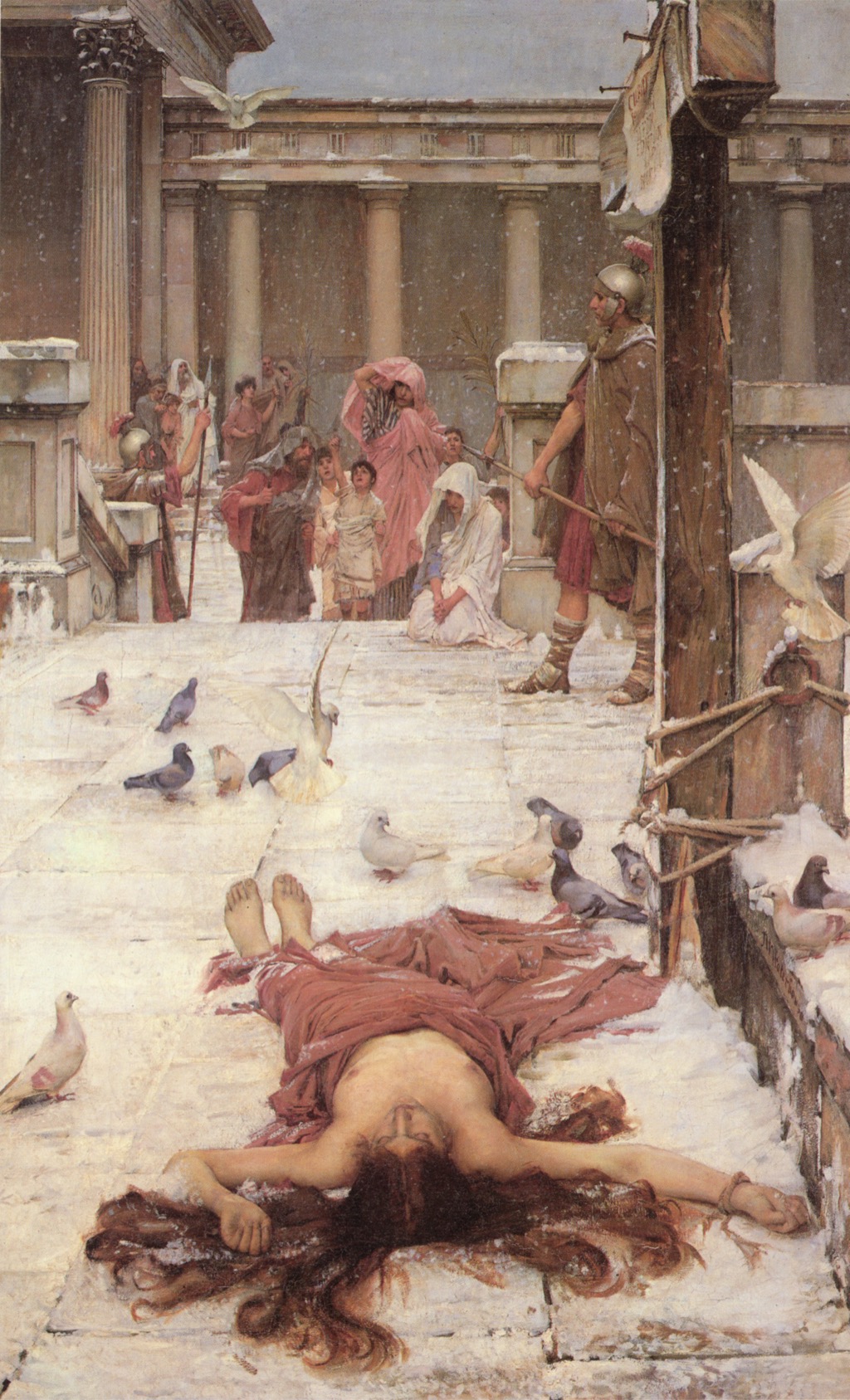
Waterhouse exhibited Saint Eulalia in 1885. The large painting imagines the young Christian martyr after death, her body placed low across a steep field of pavement as snow descends. Tate dates the work to 1885, and it was among the pictures Sir Henry Tate presented to the national collection in 1894. [8]
Waterhouse was elected an Associate of the Royal Academy in 1885. [1] [3] It is tempting to describe a single picture as the direct cause, but Academy elections reflected a developing professional reputation rather than a mechanical award for one canvas. Saint Eulalia nevertheless demonstrates the scale, gravity and compositional assurance he had achieved by the time of the election.
1886: The Magic Circle enters the national collection
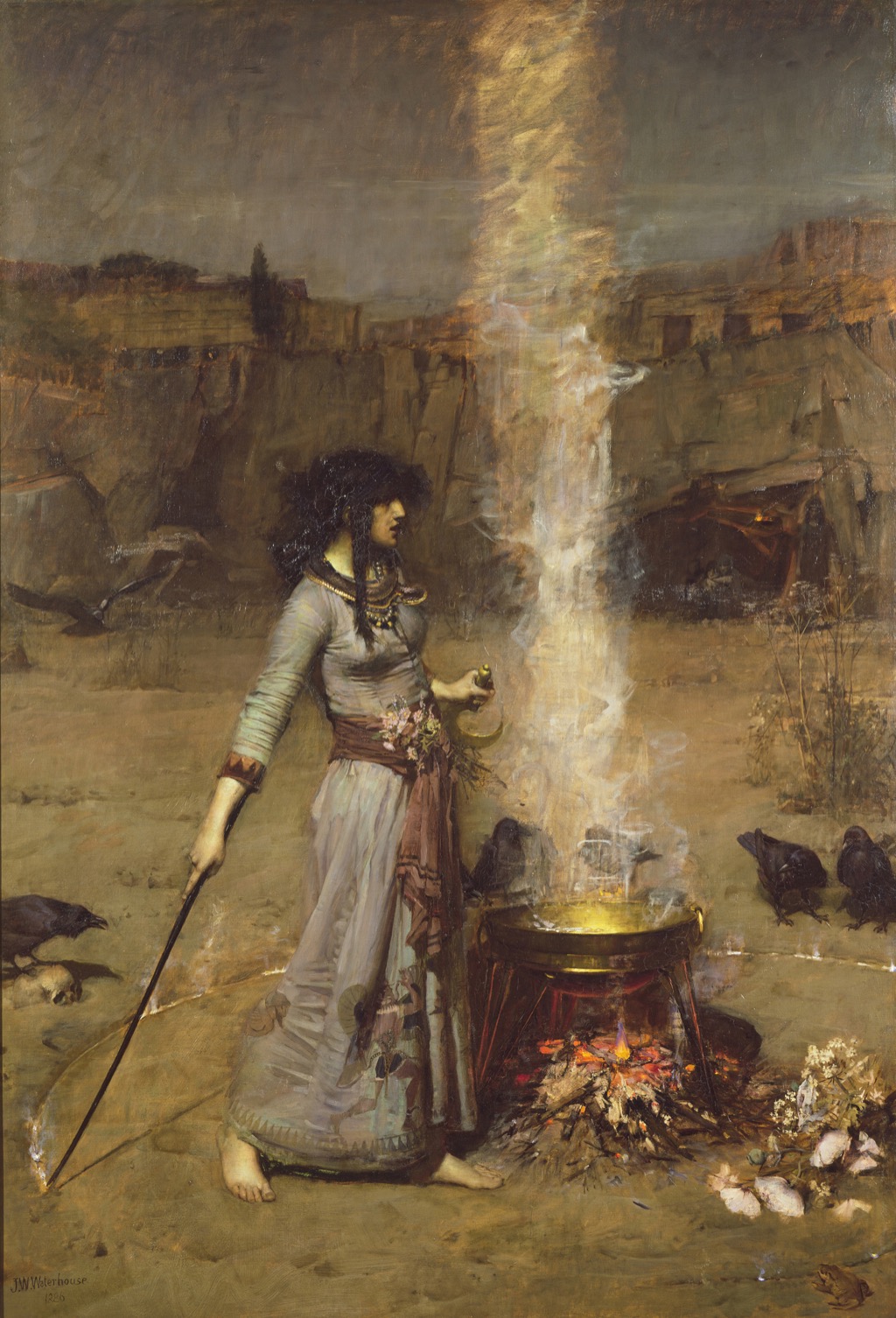
The following year Waterhouse exhibited The Magic Circle, in which a standing woman draws a boundary around herself while tending a smoking vessel. The finished picture was purchased for the nation under the Chantrey Bequest after its Royal Academy exhibition. [9] This was a particularly visible form of recognition: Academicians administering the bequest selected a work by the newly elected Associate for a national collection.
The Academy title supplied no literary quotation, but an 1881 review of an earlier version linked the subject with Theocritus. Recent scholars have persuasively proposed Simaetha’s love spell in the poet’s second Idyll as the source. [30] The finished painting is not a mechanical illustration: the woman’s action controls the composition, and many details extend beyond the poem. Waterhouse’s recurring interest in enchantment was now attached to agency, ritual and the tension between the space inside the circle and the birds excluded from it.
1887: a studio move and Mariamne
Waterhouse moved within Primrose Hill Studios from No. 3 to No. 6 in 1887. His neighbour William Logsdail worked at No. 4, and the artists’ reciprocal modelling for Logsdail’s The Bank and Royal Exchange belongs to this year’s studio culture. [2]
At the Academy, Waterhouse exhibited Mariamne Leaving the Judgement Seat of Herod. Its later itinerary made it one of the clearest measures of his international standing: the picture went on to exhibitions in Paris in 1889, Chicago in 1893 and Brussels in 1897, receiving awards. [1] Its circulation demonstrates that Waterhouse’s reputation was not confined to British readers’ affection for English poetry.
1888: The Lady of Shalott
Waterhouse’s The Lady of Shalott appeared at the Royal Academy in 1888. He chose the heroine’s departure by boat in Tennyson’s poem, after the forbidden look at Lancelot has activated the curse. The painting joined landscape, tapestry, literary narrative and emotional uncertainty with exceptional clarity. [10]
Later familiarity can obscure how carefully the moment is chosen. The work does not illustrate the breaking mirror or the discovery of the Lady’s body. It suspends her between confinement and Camelot, agency and doom. Sir Henry Tate presented it to the nation in 1894, placing it within the founding public collection from which Tate developed. [10] That acquisition secured a national audience beyond the changing fortunes of private taste.
1889–1895: Reinvention, international prizes and full Academicianship
1889: Mariamne in Paris and an unsold Ophelia
In 1889 Mariamne was exhibited in Paris, the first of its documented foreign appearances. [1] Waterhouse also produced an ambitious Ophelia. Later scholarship has associated the failure to sell that painting, followed by his father’s death and travel in Italy, with a period of reassessment around 1890. [22] Because this argument reconstructs motives from circumstances, it should be treated as a persuasive scholarly interpretation rather than a statement Waterhouse left in his own words.
The Ophelia nevertheless marks a lasting expansion of his literary field. Shakespeare’s heroine would return in later compositions, as Waterhouse repeatedly revisited a story from different moments instead of seeking a single final version.
1890: the first break in the Academy sequence
The National Portrait Gallery lists 1890 as one of only two years between 1874 and 1917 in which Waterhouse did not exhibit at the Royal Academy. [1] The pause matters precisely because the sequence was otherwise so regular. It coincides with the biographical disruptions identified by modern scholars, but absence from one exhibition does not by itself prove crisis. What follows is visible: the early 1890s brought bolder mythological designs, increasingly concentrated on enchantment and dangerous attraction.
1891: Homer, Circe and direct purchase for Melbourne
Waterhouse exhibited Ulysses and the Sirens at the Royal Academy in 1891. The National Gallery of Victoria purchased it from the artist that year, and the original frame remains with the painting. [11] Waterhouse represented the Sirens with women’s heads and birds’ bodies, adapting an ancient Greek vase type rather than the fish-tailed form familiar from later art. Contemporary argument over the picture’s relationship to Homer shows that its learned detail did not protect it from criticism. [11]
The same year he painted Circe Offering the Cup to Ulysses, now at Gallery Oldham. Charles Edward Lees bought it in 1892; his daughter Marjory later gave it to the gallery in 1952. [12] The picture places the viewer in Ulysses’ position before the enthroned enchantress. Together, the two works made Homeric danger immediate through radically different formats: a panoramic attack at sea and a vertical face-to-face confrontation.
1892: Circe Invidiosa goes to Adelaide
In Circe Invidiosa, Circe pours poison into the sea to harm Scylla. The Art Gallery of South Australia bought the painting from Waterhouse in 1892 on the advice of Frederic Leighton, Edward Poynter and Hubert von Herkomer; it was shipped to Adelaide early the following year. [13] The museum records a mixed initial response, including a local complaint that the picture repelled the average viewer.
That reception is useful evidence against the idea that Waterhouse’s success depended on uncomplicated prettiness. The tall figure, unnatural aquamarine water and descending stream of poison were beautiful and disturbing together. Adelaide’s purchase also confirmed Waterhouse as an artist whom an international public institution would collect repeatedly and at the point of production.
1893: Chicago and the Primrose Hill circle
Mariamne travelled to the World’s Columbian Exposition in Chicago in 1893 and gained further international recognition. [1] A group portrait drawing associated with the Primrose Hill artists also dates from around this time, preserving the communal identity of painters whose careers are often narrated separately. [2]
1894: a second Lady of Shalott and the Tate gift
Waterhouse returned to Tennyson in the 1894 Lady of Shalott, commonly distinguished as The Lady of Shalott Looking at Lancelot, shifting backwards in the story from the 1888 river journey to the prohibited look that breaks the heroine’s mirror-world. [26] The sequence reveals a characteristic method: he revisited narratives by isolating different thresholds rather than repeating an earlier success.
In the same year, Sir Henry Tate presented the 1888 Lady of Shalott and other Waterhouse paintings to the nation. [8] [10] Public ownership grouped his supernatural, Christian and literary works within a developing account of modern British art. This mattered to his later visibility: even when Victorian narrative painting lost critical standing, major canvases remained accessible in national and municipal collections.
1895: Royal Academician and Saint Cecilia
Waterhouse was elected a full Royal Academician in 1895, ten years after becoming an Associate. [1] [3] His Academy painting Saint Cecilia, inspired by Tennyson, joined music, spiritual absorption and decorative colour. The National Portrait Gallery’s chronology places it among the best-known literary works of the year. [1]
Full membership confirmed Waterhouse’s position within the institution that had trained him and displayed his work for two decades. It also complicates the modern label “Pre-Raphaelite.” Waterhouse was never a member of the original Brotherhood; by 1895 he was an established Academician who had absorbed and renewed aspects of its literary and visual legacy.
1896–1901: Hylas, Hall Road and the Diploma Work
1896–1897: Hylas and the Nymphs
Waterhouse dated Hylas and the Nymphs 1896, and Manchester purchased it directly from him that year. The painting was then shown at the Royal Academy in 1897. [14] The sequence is a useful example of why creation, acquisition and exhibition dates should not be collapsed.
The picture arrests Hylas at the edge of disappearance. Seven nymphs emerge among water lilies, their near-repeated faces making the invitation collective and uncanny. Immediate municipal acquisition placed a major mature work in a British public collection, while its subsequent display history made it one of Waterhouse’s most contested as well as most recognisable images.
In 1897 Mariamne also reached Brussels, completing its documented series of prize-winning foreign exhibitions. [1] Waterhouse’s career at this point combined Academy authority, civic purchases in Britain, long-established Australian representation and international honours.
1898–1899: studies and the visible labour behind the paintings
The later 1890s brought mythological and poetic figures in which Waterhouse increasingly balanced sharply studied heads and hands against freer foliage, water and fabric. Surviving drawings and oil studies demonstrate that the apparent immediacy of the finished pictures was prepared rather than effortless.
In 1899 Waterhouse gave the Art Gallery of South Australia a charcoal and brown-chalk study for Circe Invidiosa. [29] The gift is significant beyond its date. Adelaide had bought major finished works; it now also held evidence of his process. Study and painting together make the careful construction of Circe’s elongated pose available to public view.
1900: Hall Road and A Mermaid
After twenty-two years at Primrose Hill Studios, Waterhouse moved in 1900 to 10 Hall Road, St John’s Wood. He lived and worked there for the rest of his life. [1] The new address placed him in another area strongly associated with artists and art schools, but it ended the particular courtyard community documented at Primrose Hill.
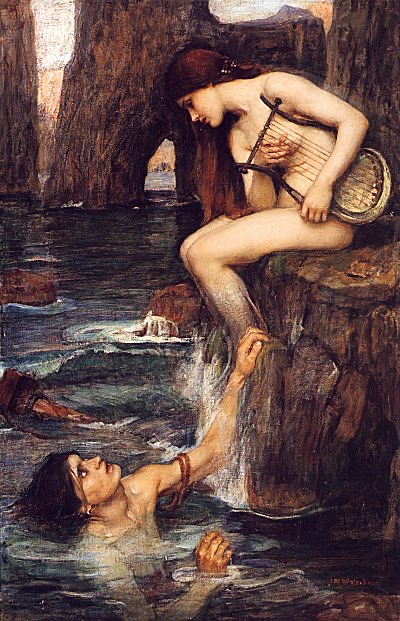
Waterhouse completed A Mermaid in 1900. The solitary figure combing her hair on the shore gathers together several long-running interests: water as a threshold, female self-absorption, literary and folkloric suggestion, and beauty carrying an undertone of danger. He gave the painting to the Royal Academy as his Diploma Work. [15]
1901: acceptance of the Diploma Work
The Royal Academy accepted A Mermaid in 1901. [15] Diploma Works form part of the Academy’s own collection, so the painting marked membership materially as well as through the letters “RA” after Waterhouse’s name. The five-year interval between his election and the work’s acceptance should not be converted into a story of delay or difficulty without firmer documentary evidence.
1902–1909: An established painter revisits myth and poetry
1902–1904: nature, reflection and Psyche
Waterhouse’s early Edwardian pictures often move away from monumental public history towards figures absorbed in a landscape, garden or private task. This was not a rejection of narrative. Wind, flowers, pools, doors and thresholds became the means through which a story was made visible.
Echo and Narcissus of 1903, now in the Walker Art Gallery, spreads Ovid’s linked tragedy across a wide landscape. Echo sits apart while Narcissus bends over his reflection; flowers anticipate the ending. [16] The picture returns to the fatal water of Hylas but changes its function. The pool is no longer inhabited by active seducers: it traps Narcissus through his own gaze.
Waterhouse’s Psyche compositions of the following period similarly select moments of approach, looking and prohibited knowledge. Their scale may be more intimate than Saint Eulalia or Ulysses and the Sirens, but they continue the career-long interest in a single action at the edge of consequence.
1905–1907: Lamia, Isabella and Medea
The middle of the decade deepened Waterhouse’s engagement with women from classical and English literary sources. He exhibited a first treatment of Keats’s Lamia in 1905, while the signed and dated Isabella and the Pot of Basil followed in 1907. [27] Lamia turns on supernatural beauty and mortal desire; Isabella turns towards mourning and a private object.
In 1907 Jason and Medea returned to the Greek world of magic. Waterhouse shows Medea preparing the potion that will enable Jason to meet the tasks imposed by her father. [25] The emphasis is on knowledge and preparation, not the later murders that define Medea’s most notorious reputation. As in The Magic Circle, practical action—mixing, measuring, concentrating—makes supernatural power intelligible.
These works resist a simple decline narrative. They do not reproduce the largest Academy spectacles of the 1880s, but they refine a mode in which a familiar text, a concentrated figure and a few significant objects carry the narrative. The painter’s late style is evolutionary: broader passages and decorative colour coexist with closely controlled faces and gestures.
1908–1909: gardens, roses and contemporary recognition
The 1908 Soul of the Rose and Gather Ye Rosebuds While Ye May, both exhibited at the Royal Academy, made the enclosed garden an increasingly important setting. [28] Flowers may evoke literary language, sensory absorption and the passing of time, but their meanings vary from picture to picture. The chronology reveals recurrence, not a single code.
Waterhouse remained the subject of serious contemporary attention. The Art Gallery of New South Wales bibliography records Rose E. D. Sketchley’s illustrated Art Journal survey of his work, published as an Art Annual in 1909. [5] Such a publication indicates that his career was substantial enough to merit retrospective treatment while he was still producing new work.
At the same time, newer forms of modernism were changing the terms by which ambitious painting was judged. Waterhouse did not respond by abandoning narrative or the figure. His persistence was both the basis of his continuing popularity and, for later critics, a reason to place him outside the principal story of twentieth-century innovation.
1910–1914: Late ambition and institutional standing
1910–1911: reputation in his own lifetime
The 1911 Encyclopædia Britannica praised Waterhouse’s imaginative power, individual style, drawing and colour, ranking him highly within the British school. [3] Its incorrect birth year shows the limits of contemporary reference works, but its critical tone records genuine status. Waterhouse was not rescued from complete obscurity only after death; he had been an internationally collected Royal Academician with a recognised public manner.
An advertisement in Pictures of 1911 named him on the honorary advisory council of the St John’s Wood Art Schools, alongside prominent artists including Lawrence Alma-Tadema and George Clausen. [23] The notice does not tell us what Waterhouse taught on a given day, but it places his name within the educational and professional life of the local art community.
1911–1912: Penelope and the Suitors
Aberdeen’s collection dates Penelope and the Suitors to 1911–1912 and records its purchase in 1912. [17] The wide composition shows Penelope at her loom while suitors crowd the opening behind her with gifts and attention. Weaving becomes strategy: in Homer’s story she delays choosing a new husband by undoing at night the work completed by day.
The painting connects late Waterhouse to his own earlier Homeric world. Yet the relation of power has changed. Ulysses was bound and surrounded at sea in 1891; Penelope is confined at home but controls time through making and unmaking. Aberdeen’s direct purchase continued the pattern by which important Waterhouse paintings entered civic collections at or near the moment of production.
1913–1914: continuity before the wartime interruption
Waterhouse continued to explore Shakespeare, medieval romance and classical myth as Europe approached war. Exact dating of some late private pictures varies among catalogues, and the best-known titles do not always survive with complete exhibition or ownership histories. It is therefore safer to follow securely dated public objects than to invent a comprehensive year-by-year list.
1915–1917: War, final pictures and death
1915: the second break in Academy exhibiting
The National Portrait Gallery identifies 1915 as the other year, after 1890, in which Waterhouse did not exhibit at the Royal Academy. [1] Nevertheless, the year produced one of his most important late works: “I am half sick of shadows,” said the Lady of Shalott. [18]
The Art Gallery of Ontario dates the painting to 1915. Waterhouse returned to Tennyson for the third major time, now moving backwards to the Lady at her loom before she looks directly at Lancelot. The 1888 picture shows the fatal voyage; the later work shows enclosure and dissatisfaction. Across twenty-seven years, the sequence changes the emphasis from consequence to the condition that makes rebellion imaginable.
1916: Boccaccio and the final Academy season
In 1916 Waterhouse painted A Tale from the Decameron, showing young Florentines gathered in a garden around a storyteller. Its literary source and sociable composition differ from the isolated heroines with which he is most readily associated. The painting also forms a late pair in subject and atmosphere with The Enchanted Garden, derived from another part of Boccaccio’s work. [19]
The National Portrait Gallery’s record indicates that Waterhouse resumed exhibiting at the Academy in 1916. [1] He was working during wartime and in declining health, but the public record does not justify turning every late brushstroke into a direct confession of illness. The paintings remain constructed responses to literature.
Early 1917: The Enchanted Garden left unfinished
Waterhouse was still at work on The Enchanted Garden near the end of his life. A surviving head study is dated 1916, and the large picture remained incomplete at his death. [19] Its subject—a garden made to flower impossibly in winter—gave the late artist another opportunity to join storytelling, seasonal abundance and psychological choice.
The unfinished state is revealing because it exposes a working surface usually hidden by completion. It should not, however, be treated as a deliberate aesthetic statement. The picture was interrupted by death.
10 February 1917: death at Hall Road
Waterhouse died at 10 Hall Road, St John’s Wood, on 10 February 1917. He had lived there since 1900. [1] He was nearly sixty-eight and had maintained a public exhibiting career for more than four decades. Esther survived him and managed the works that remained in the studio.
The modest quantity of surviving personal testimony means that the end of his life is documented more securely through address, date and unfinished work than through intimate last statements. This reserve is appropriate to the evidence. Waterhouse’s paintings may invite biographical feeling, but they cannot supply missing conversations.
Later in 1917: a posthumous Academy showing
The Royal Academy exhibited The Enchanted Garden later in 1917 despite its unfinished condition. [19] The gesture acknowledged Waterhouse’s standing and closed the Academy sequence that had begun with Sleep and His Half-Brother Death in 1874. The first picture joined sleep to mortality; the last major canvas remained a garden suspended before completion. The parallel is evocative, but it is a historical accident rather than a programme designed by the artist.
1917 to the present: The changing reputation
1922: the studio legacy and Leverhulme
In 1922 Esther Waterhouse sold The Enchanted Garden to the collector and industrialist William Hesketh Lever, first Viscount Leverhulme. It is now at the Lady Lever Art Gallery alongside A Tale from the Decameron. [19] The transaction transferred an unfinished studio work into a major collection of Victorian art and ensured that Waterhouse’s final project remained publicly accessible.
Mid-twentieth century: visibility without critical centrality
Waterhouse’s major public paintings did not disappear. They remained in national and municipal collections in Britain and Australia, while reproductions kept The Lady of Shalott, Hylas and the Nymphs and the Circe pictures in circulation. Yet visibility and art-historical prestige are not the same. For much of the mid-twentieth century, literary narrative, Academy success and polished figure painting could be treated as symptoms of a superseded Victorian culture.
This period should not be described as total oblivion. Museums retained the works; viewers continued to encounter them; catalogues and specialist studies preserved information. What changed was their position within dominant histories of modern art.
1978–1979: the first major modern reassessment
The Mappin Art Gallery in Sheffield and the Central Art Gallery in Wolverhampton organised John William Waterhouse R.A. 1849–1917 in 1978–1979. The National Portrait Gallery cites its catalogue as a major biographical source and records the exhibition history of the Logsdail portrait then still considered a self-portrait. [1] [2]
The exhibition helped rebuild a documented career from scattered public and private works. It also established a foundation for the later scholarship of Anthony Hobson, Peter Trippi, Elizabeth Prettejohn and others. Reassessment did not mean returning uncritically to Victorian praise; it meant making Waterhouse available for serious historical analysis.
2008–2010: The Modern Pre-Raphaelite
The major retrospective J. W. Waterhouse: The Modern Pre-Raphaelite opened at the Groninger Museum in December 2008, travelled to the Royal Academy in London in 2009 and continued to the Montreal Museum of Fine Arts until February 2010. Its catalogue was written by Elizabeth Prettejohn, Peter Trippi, Robert Upstone and Patty Wageman and won the Historians of British Art prize for the best multi-authored book of 2010. [20]
The title offered a productive contradiction. Waterhouse was “Pre-Raphaelite” in his mature literary subjects, emotional colour and dialogue with an earlier British tradition; he was “modern” in his later date, broader handling and engagement with French-influenced painting. The retrospective positioned him as an artist negotiating tradition and innovation rather than as a belated copyist.
2018: Hylas and the Nymphs and a new kind of public debate
Manchester Art Gallery temporarily removed Hylas and the Nymphs from display in 2018 as part of Sonia Boyce’s participatory project Six Acts. The intervention asked how museums present the female body and how inherited categories of beauty shape display. The painting returned after seven days, and the event became part of its modern history. [21]
The controversy shows that Waterhouse’s pictures remain active public objects. Debate moved beyond whether he followed Homer or deserved Academy honours to questions of gender, curatorial authority and the ethics of looking. A career chronology therefore continues after the artist’s death: acquisition, display, reproduction, scholarship and reinterpretation all change what a painting can mean in public.
What the chronology reveals
The Royal Academy was the career’s backbone
Waterhouse’s relationship with the Academy was not a conservative afterthought. It began with training in sculpture, continued through annual exhibition from 1874, and progressed through election as Associate in 1885 and Royal Academician in 1895. His Diploma Work entered the Academy collection in 1901, and an unfinished final painting was shown there after his death. [1] [15] [19]
This continuity explains both his opportunities and his working rhythm. The Academy supplied visibility, competition, institutional rank and access to buyers. It also meant that large narrative canvases had to communicate within crowded annual exhibitions. Waterhouse’s clarity of gesture and his preference for charged, recognisable moments were professional strengths as well as aesthetic choices.
The familiar literary painter emerged gradually
The early Waterhouse concentrated on classical history, Italian genre and archaeologically inflected interiors. Supernatural women became prominent in the mid-1880s, and The Lady of Shalott brought English poetry decisively into the public image of his career in 1888. Homer, Ovid, Tennyson, Shakespeare, Keats and Boccaccio then coexisted rather than replacing one another.
The timeline also shows repeated return. The Lady of Shalott occupied him in 1888, 1894 and 1915. Circe appears in distinct actions and formats. Homer’s marriage is divided between Ulysses in danger and Penelope resisting at home. Waterhouse’s practice was serial without being repetitive: the source remained while the chosen moment changed.
Public collecting was international from an early date
Adelaide’s acquisition of The Favourites of the Emperor Honorius in 1883 was the first by a public institution. Sydney purchased Diogenes in 1886; Melbourne bought Ulysses and the Sirens directly in 1891; Adelaide acquired Circe Invidiosa in 1892; Manchester purchased Hylas and the Nymphs in 1896; and Aberdeen bought Penelope and the Suitors in 1912. [5] [6] [11] [13] [14] [17]
This history changes the mental map of Waterhouse. His central works are not concentrated in one London museum or dispersed only by later sales. Australian civic collections participated in constructing his public reputation while he was alive, often buying near the moment of exhibition. The current global geography is part of the original career.
The private man remains less visible than the public artist
Exact exhibition dates can create an illusion of total knowledge. In reality, the timeline is dense around institutions and sparse around personal conviction. We know where Waterhouse worked, when he married, what he exhibited and when museums bought important paintings. We know much less about his private responses to success, bereavement, war or changing taste. [1] [24]
That imbalance should shape interpretation. It is legitimate to study recurring themes of enchantment, confinement and dangerous looking. It is not legitimate to present those themes as a private diary without corroborating evidence. The chronology is most useful when it makes the boundary between documented career and inferred psychology visible.
Related Pages
- Biography: Read the narrative account behind the chronology.
- Paintings: Move from career dates to the major works.
- The Lady of Shalott: Open the key 1888 painting in its career context.
Frequently Asked Questions
The National Portrait Gallery gives January 1849 in Rome but does not supply a securely established day. [1] Some sources provide baptismal information or different birth years, and the 1911 Britannica printed 1847. [3] January 1849 is therefore the responsible public wording unless a specific claim is tied to stronger archival evidence.
Both dates appear in institutional summaries. Tate uses 1870, while the National Portrait Gallery records him as a sculpture student in 1871. [1] [4] The difference probably reflects probationary and formal status. What is certain is that he began in sculpture before establishing himself as a painter.
His first accepted Royal Academy picture was Sleep and His Half-Brother Death in 1874. [1] [4] The Academy remained his principal exhibition venue for the rest of his life.
The National Portrait Gallery records only 1890 and 1915 as exceptions between 1874 and 1917. [1] In both cases Waterhouse continued to work; absence from the annual exhibition should not be mistaken for the end of production.
He was elected an Associate of the Royal Academy in 1885 and a full Royal Academician in 1895. [1] [3] The Academy accepted A Mermaid as his Diploma Work in 1901. [15]
He worked at Primrose Hill Studios from 1878 to 1900, first at No. 3 and, from 1887, at No. 6. In 1900 he moved to 10 Hall Road, St John’s Wood, where he lived and worked until his death. [1] [2]
The Art Gallery of South Australia identifies its 1883 purchase of The Favourites of the Emperor Honorius as the first Waterhouse work to enter a public institution. [6] [13]
The painting is signed and dated 1896, and Manchester purchased it from Waterhouse that year. It was exhibited at the Royal Academy in 1897. [14] Both years are therefore correct, but they refer to different events.
The Enchanted Garden, begun in 1916 and left unfinished at his death in February 1917, is generally treated as the final major studio project. The Royal Academy exhibited it posthumously later in 1917. [19]
J. W. Waterhouse: The Modern Pre-Raphaelite ran from 2008 to 2010, travelling from the Groninger Museum to the Royal Academy and the Montreal Museum of Fine Arts. [20] It was the most important international reassessment of his career in recent decades.
Discussion
A timeline encourages comparison across works that reproductions often isolate. Place The Lady of Shalott beside the Academy elections and it becomes part of a professional ascent, not an accidental masterpiece. Place Ulysses and the Sirens beside its immediate Melbourne purchase and it becomes part of Australian museum history as well as British classicism. Place the three Lady of Shalott paintings in order and Waterhouse’s movement backwards through Tennyson’s story becomes visible.
The chronology also invites questions that dates cannot settle alone. Did institutional success enable experiment, or encourage Waterhouse to remain within a recognisable field? Why did he repeatedly choose moments before an irreversible act? How does the early international dispersal of his work affect the way a British artist’s career should be narrated? And when a museum reinterprets Hylas and the Nymphs, is it changing the picture’s meaning or adding a new chapter to a meaning that was never fixed?
Reader Insights
Which visible detail most changes the way you read this page?
Which source or comparison helps the work feel less familiar and more specific?
What question would you bring back to the painting after reading?
Join the Conversation
Share your reading of this page below.
References
- Main image: H. S. Mendelssohn, John William Waterhouse, c. 1886, public-domain photograph via Wikimedia Commons.
- National Portrait Gallery, “John William Waterhouse (1849–1917), Figure Painter,” Later Victorian Portraits Catalogue. View source
- National Portrait Gallery, “John William Waterhouse, by William Logsdail, circa 1887,” extended catalogue entry on the portrait and Primrose Hill Studios. View source
- Encyclopædia Britannica, “Waterhouse, John William,” 11th edition, 1911, contemporary biographical and critical notice transcribed by Wikisource. View source
- Tate, “John William Waterhouse,” artist record and institutional biographical summary. View source
- Art Gallery of New South Wales, “Diogenes,” collection record, exhibition history, provenance and bibliography. View source
- Art Gallery of South Australia, “The Favourites of the Emperor Honorius,” collection record. View source
- Tate, “Consulting the Oracle,” collection record. View source
- Tate, “Saint Eulalia,” collection record. View source
- Christie’s, “Study for The Magic Circle,” catalogue essay on the 1886 Royal Academy exhibition and Chantrey Bequest purchase. View source
- Tate, “The Lady of Shalott,” collection record for the 1888 painting presented by Sir Henry Tate in 1894. View source
- National Gallery of Victoria, “Ulysses and the Sirens,” collection record, provenance, exhibition history and frame research. View source
- Art UK / Gallery Oldham, “Circe Offering the Cup to Ulysses,” collection record and acquisition history. View source
- Art Gallery of South Australia, “Circe Invidiosa,” collection record, provenance and curatorial commentary. View source
- Art UK / Manchester Art Gallery, “Hylas and the Nymphs,” collection record and acquisition information. View source
- Royal Academy of Arts, “A Mermaid,” record of Waterhouse’s Diploma Work, accepted in 1901. View source
- Art UK, “An Introduction to Classical Mythology in Art,” including Echo and Narcissus in the Walker Art Gallery. View source
- Aberdeen Archives, Gallery & Museums, “Penelope and the Suitors,” collection record, 1911–1912, purchased 1912. View source
- Art Gallery of Ontario, “‘I am half sick of shadows,’ said The Lady of Shalott,” collection record. View source
- Christie’s, “Head Study for The Enchanted Garden, 1916,” catalogue essay prepared with assistance from Peter Trippi. View source
- University of Bristol, “J. W. Waterhouse 1849–1917: The Modern Pre-Raphaelite,” publication and exhibition record for the 2008–2010 retrospective catalogue. View source
- Manchester Art Gallery, “Sonia Boyce,” interpretive text for Six Acts and the 2018 temporary removal of Hylas and the Nymphs. View source
- Journal of Victorian Culture, “Between Innovation and Nostalgia: Rethinking the Paintings of J. W. Waterhouse,” review of the 2008 retrospective catalogue. View source
- Pall Mall Magazine, Pictures of 1911, advertisement for the St John’s Wood Art Schools naming Waterhouse on its honorary advisory council. View source
- Yale Center for British Art, “John William Waterhouse letter to Harry Quilter,” archival collection record, MSS 84. View source
- Art UK, “Representing Medea: The Tale of a Mythical Murderess,” discussion of Waterhouse’s Jason and Medea, 1907. View source
- Art UK / Leeds Museums and Galleries, “The Lady of Shalott,” collection record for Waterhouse’s 1894 painting. View source
- Christie’s, “Isabella and the Pot of Basil,” dated object record and scholarly catalogue essay discussing Waterhouse’s 1905 Lamia. View source
- Christie’s, “The Soul of the Rose,” dated object record, Royal Academy exhibition history and bibliography. View source
- Art Gallery of South Australia, “Study for ‘Circe Invidiosa’,” collection record for the drawing given by Waterhouse in 1899. View source
- Mark Williams and Jennifer Williams, “The Inspiration behind The Magic Circle,” summary of their 2023 Pre-Raphaelite Society Review study connecting the subject with Theocritus’s second Idyll and an 1881 Pall Mall Gazette notice. View source