

 Buy Art Prints Now
from Amazon
* As an Amazon Associate I earn from qualifying purchases.
Image reference [image]
 by Tom Gurney
Tom Gurney BSc (Hons) is an art history expert with over 20 years experience
Published on August 14, 2026 / Updated on August 14, 2026
Email: tomgurney1@gmail.com / Phone: +44 7429 011000
Ophelia: Introduction
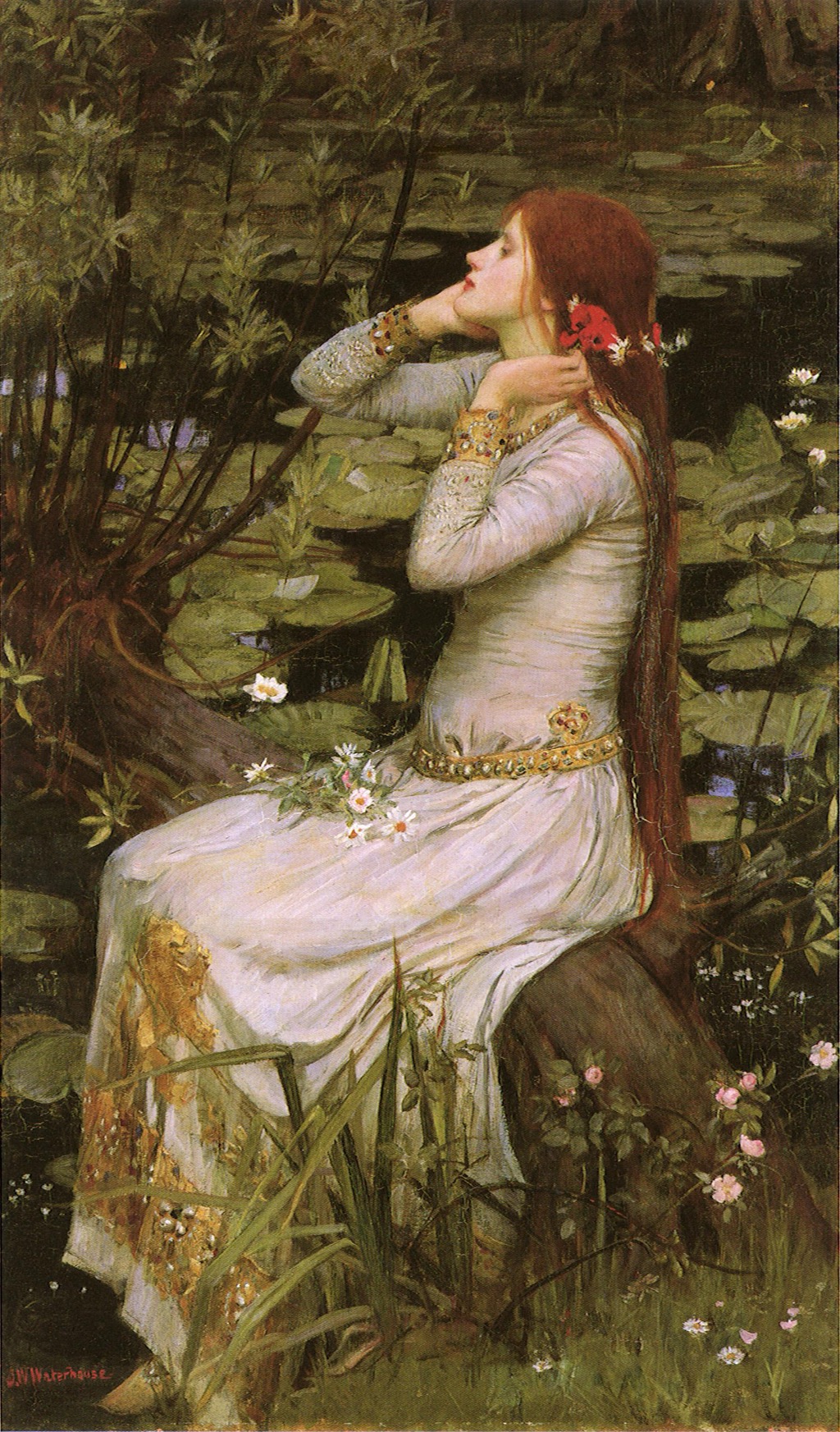
Ophelia sits on a branch above a dark, weed-filled pool. Flowers lie across her lap and clothing; more grow around the bank. She has not yet fallen into the water, and John William Waterhouse gives no single gesture that tells us whether she is resting, arranging garlands or already moving beyond ordinary awareness. The tragedy is certain because Shakespeare has told it. The painted moment remains open.
Waterhouse completed three major Ophelia paintings, in 1889, 1894 and 1910. The 1894 version, exhibited at the New Gallery, is the quietest of the three and the one most closely balanced between lyrical beauty and approaching death. Its flowers and water do not merely identify Shakespeare's heroine. They create a world in which thought, body and landscape are becoming difficult to separate.
At a Glance
- ArtistJohn William Waterhouse (1849–1917)
- TitleOphelia
- Date1894
- MediumOil on canvas
- Dimensions124.4 × 73.6 cm
- SignatureSigned “J.W. Waterhouse”
- Current statusPrivate collection
- First exhibitedNew Gallery, London, 1894, no. 173
- Also exhibitedLiverpool Autumn Exhibition, 1894; Royal Academy exhibition of the McCulloch Collection, 1909 [1]
- Literary sourceWilliam Shakespeare's Hamlet, especially Act 4, scenes 5 and 7 [2]
- Related Waterhouse paintingsOphelia (1889, present location unknown) and Ophelia (1910, private collection) [1]
- Early provenanceGeorge McCulloch, followed by H. W. Henderson and Lady Hayter [1]
- Royal Academy connectionOffered as a temporary Diploma Work before A Mermaid was completed [1]
Contents
- Introduction
- Before the Branch Breaks
- Ophelia in Hamlet
- Flowers as Speech
- Branch, Bank and Dark Pool
- A Face Between Composure and Distress
- Court Surveillance and the Solitude of the Riverbank
- Singing, Clothing and the Slow Logic of Drowning
- Flowers, Water and the Question of Agency
- Colour and the Weed-Strewn Water
Before the Branch Breaks
Queen Gertrude's report of Ophelia's death begins with a willow leaning over a brook. Ophelia arrives with “fantastic garlands,” climbs to hang them on the branches, and falls when a bough breaks. Her clothes briefly hold her afloat while she sings, until the saturated fabric pulls her down. [2]
Waterhouse selects the interval before that fall. Ophelia is already positioned over water and surrounded by flowers, but branch and body still hold. Narrative danger has become physical balance.
This timing gives the figure a limited dignity unavailable in the drowning scene. She is upright, clothed and still able to arrange the world around her. Yet every stable element contains its opposite. The branch can break, fabric can become weight, flowers can become funeral emblems and water can close above her.
The spectator knows more than the painted figure appears to acknowledge. This produces dramatic irony rather than direct horror. We look for the point at which stillness will become accident.
Waterhouse refuses to show that point. The image can be contemplated indefinitely while Ophelia's time remains painfully short. Painting suspends the event that the play will not prevent.
The result is not a neutral portrait beside a river. Title, garlands and overhanging position make catastrophe structurally present. Beauty is organised around what has not yet happened.
Ophelia in Hamlet
Ophelia enters Shakespeare's tragedy as daughter of Polonius, sister of Laertes and the young woman Hamlet has courted. The men around her repeatedly direct how she should understand and conduct that relationship. Polonius orders her to reject Hamlet's access, while Claudius and Polonius use her in an attempt to observe the prince. [2]
After Hamlet kills Polonius, Ophelia re-enters singing fragments about death, love and sexual betrayal. Her speech no longer answers the court's questions directly. Songs and flowers become an alternative language through which grief, memory and accusation circulate. [2]
Gertrude then reports the drowning rather than the audience witnessing it. This distance creates uncertainty. Ophelia's fall is described as an accident caused by a breaking branch, but her passivity in the water and continued singing make intention difficult to settle. [2]
The graveyard scene preserves that uncertainty through religious dispute over her burial. The gravediggers imply that a person suspected of self-destruction would not ordinarily receive Christian rites, while Laertes protests the reduced ceremony. [2]
Waterhouse does not decide whether Ophelia intends death. She is close to the fatal water and appears withdrawn, but no explicit leap or self-destructive gesture occurs. The painting respects the play's ambiguity.
It also removes the court. Father, brother, prince, king and queen are absent. Ophelia is alone with the natural forms that will become her final vocabulary. That solitude can feel like release from surveillance or the final result of abandonment.
Flowers as Speech
In Act 4, scene 5, Ophelia distributes rosemary, pansies, fennel, columbines, rue and a daisy, while mentioning violets that withered after her father's death. [2] The exact recipient of every flower varies with staging and editorial interpretation, but the scene clearly turns plants into charged acts of remembrance and address.
Gertrude's death speech names another group used for garlands: crow-flowers, nettles, daisies and long purples. [2] Waterhouse draws upon this floral world without presenting a botanically labelled inventory.
The blossoms in Ophelia's lap are handled and gathered rather than merely growing nearby. They are evidence of an activity that bridges the flower-distribution scene and the later garland-making described by Gertrude.
Flowers permit Ophelia to communicate indirectly. Court language has been used to test and control her; plants carry meanings that can be intimate, traditional, unstable and resistant to interrogation.
Their beauty should not reduce them to decoration. Some are associated with memory, faithfulness, sorrow or forsaken love, but fixed Victorian “flower dictionary” readings can become too mechanical. Shakespeare's named plants, their dramatic placement and Waterhouse's visual arrangement provide firmer ground than assigning one secret sentence to every petal.
Garlands also turn transient flowers into deliberate form. Ophelia gathers things that will wilt and arranges them just before she dies. This makes her activity parallel to art: temporary natural materials are ordered against loss.
Branch, Bank and Dark Pool
The branch supports Ophelia while projecting over water. It is seat, threshold and future cause. Waterhouse makes the literary “sliver” physically credible without showing it break.
Her body is compressed into the vertical format. Knees, skirts and flowers gather near the lower centre, while head and torso rise against foliage. She belongs to the bank but leans into the pool's spatial field.
Water lilies and weed cover parts of the surface. They make the water beautiful and difficult to read. Depth is concealed beneath reflection and growth, just as death is concealed beneath the painting's lyrical surface.
The pool is not an open river rushing dramatically through the landscape. Its darkness feels enclosed and still. A quiet surface can receive Ophelia without visual warning.
Sunlight reaches leaves, fabric and water in broken patches. This refuses the easy convention in which tragedy is announced by storm. The natural day continues to be beautiful.
The bank also crowds the figure. Vegetation presses close, reducing any clear route away. Ophelia appears held by nature before she is taken by water.
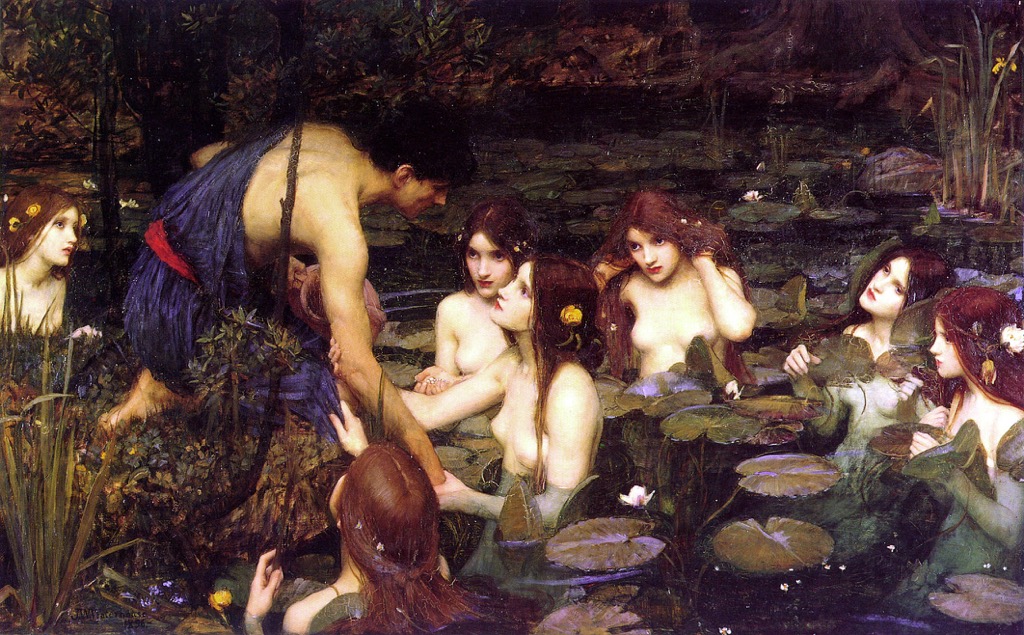
Waterhouse would later use water lilies in Hylas and the Nymphs, where flowers help supernatural bodies emerge from and merge with a fatal pool. In Ophelia, no nymph pulls the heroine down. Landscape alone is enough to make danger intimate.
A Face Between Composure and Distress
Ophelia's expression was controversial from the beginning. F. G. Stephens complained in the Athenaeum that the 1894 painting showed too little of her madness, distress, pain or sorrow, while praising its colour and the force of the pool. [1]
That criticism identifies Waterhouse's choice accurately even if it judges it harshly. His Ophelia does not perform madness through wild eyes or violent posture. Her inward expression makes emotion difficult to name.
The ambiguity can appear poetic, aestheticising or psychologically sensitive depending on the viewer. A clearly anguished face would direct sympathy quickly. This quieter face asks whether withdrawal itself is the visible sign of crisis.
She may be listening to an inner song, attending to flowers or looking beyond the immediate world. None can be established as an exact action. The face supports the painting's suspended tense.
Waterhouse preserves beauty, and this carries risk. Ophelia's mental collapse can become a refined mood for spectators to enjoy. The painting belongs to a nineteenth-century tradition that often made female illness and death aesthetically desirable.
Yet composure should not be mistaken for health. The dangerous position, dark pool and obsessive floral activity make unease legible even without theatrical expression. Waterhouse relocates distress from face into setting.
Court Surveillance and the Solitude of the Riverbank
Ophelia's solitude in the painting is not simply a pastoral preference. In Hamlet, her relationship with the prince is repeatedly observed, reported and used by others. Laertes advises her, Polonius commands her, and Claudius and Polonius arrange for her to meet Hamlet while they listen unseen. [2]
The “nunnery” encounter is therefore not a private conversation between lovers. Ophelia has been placed where the court can gather evidence from Hamlet's behaviour. Her speech occurs under pressure from people the prince suspects are nearby.
Waterhouse removes every observer. No father stands behind an arras and no king converts intimacy into intelligence. The riverbank seems to grant the privacy the court denied.
That apparent freedom is double-edged. Solitude releases Ophelia from direct instruction, but it also records the collapse of human support. Polonius is dead, Hamlet is absent, Laertes is away until after her distress begins, and the court receives her songs as a problem to manage.
Nature in the painting does not interrogate. Branch, flowers and water accept her presence without demanding coherent explanation. This helps explain why the landscape can feel compassionate even though it contains the means of death.
The move from court to river also changes language. In the palace, men value declarations, evidence and obedience. At the bank, meaning passes through gathered plants, position and song remembered from Gertrude's report. Waterhouse paints that alternative vocabulary.
Yet viewers reintroduce surveillance. We observe a woman alone at an acutely vulnerable moment and search her face for symptoms, intentions and narrative proof. The painting makes us heirs to the court's interpretive pressure even as it removes the courtiers.
This is why a diagnosis such as “madness” is insufficient on its own. Shakespeare's stage direction and other characters identify Ophelia as distracted, but her broken speech also responds to identifiable losses and structures of control. Waterhouse's ambiguous expression leaves those causes present without turning the figure into a clinical illustration.
Her place on the branch is outside ordinary social categories. She is neither court daughter nor graveyard corpse, neither securely on land nor yet in water. The position is precarious because no durable social place has replaced the roles taken from her.
The image grants Ophelia visual centrality when her political and familial agency has become smallest. That is both an act of attention and a warning: art can restore presence to a silenced figure while still presenting her vulnerability for contemplation.
Singing, Clothing and the Slow Logic of Drowning
Gertrude's account is remarkable because Ophelia does not immediately struggle after she falls. Her clothes spread and keep her afloat “mermaid-like,” and she sings fragments of old songs as though unaware of danger or native to the water. [2]
The same garments then become the cause of descent. Once saturated, they grow heavy and pull her from song into the muddy stream. Clothing changes from support to weight without being replaced by a visible attacker.
Waterhouse paints before this reversal, but the volume of Ophelia's dress makes it imaginable. Fabric gathers around the seated body as colour, protection and physical mass. Viewers who know the speech can see future buoyancy and future burden at once.
This temporal transformation is one reason clothing matters more than historical costume. It is part of the death sequence. A beautiful dress becomes a mechanism through which water acts slowly.
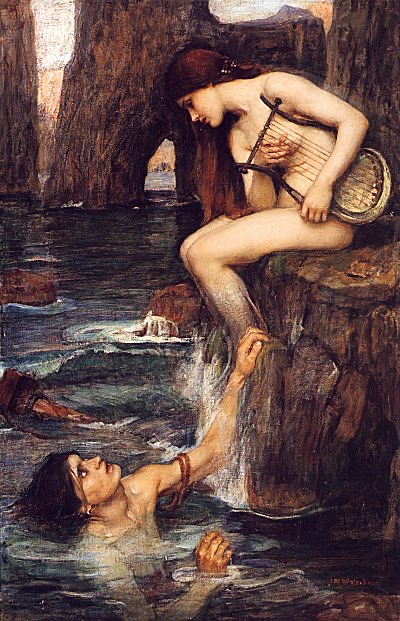
Gertrude's “mermaid-like” image temporarily gives Ophelia an impossible adaptation to the stream. She appears as if she belongs to another element, but only until cloth is wet. Waterhouse's later mermaids and nymphs truly inhabit water; Ophelia remains human and cannot sustain the resemblance.
Song likewise occupies the interval. It continues after the fall and before submersion, joining the fragmentary performance in the court to the private brook. Her voice does not summon rescue because no witness is described as intervening.
The 1894 painting cannot represent this music directly. Instead it prepares song through the inward face, flowers and still pool. Silence in the image becomes anticipatory rather than empty.
Waterhouse also avoids showing rescue as an available narrative. No passer-by enters, and no hand reaches towards the branch. The landscape is full of life but without a human community capable of acting.
The drowning described by Shakespeare is slow enough to create moral discomfort. Gertrude narrates what Ophelia did in the water, yet the play does not explain who observed it or why intervention failed. Waterhouse intensifies that discomfort by placing the spectator close before the accident, when action seems conceptually possible but pictorially forbidden.
Looking cannot prevent the branch from breaking. The painting makes spectators aware of foreknowledge without agency, a condition that parallels tragedy itself: the ending is known, but the performance still asks us to witness every avoidable step.
Flowers, Water and the Question of Agency
Ophelia's garland-making is purposeful work. She gathers, selects and arranges plants. Even in distress, she is not represented as physically inert.
The activity complicates interpretations of the riverbank as a direct suicide scene. Shakespeare's account gives a practical reason for climbing the willow: she is hanging the coronet weeds. The branch breaks through accident, however ambiguous her response in the water becomes. [2]
Waterhouse emphasises this practical sequence. Flowers are present in her lap, and the branch supplies a plausible place from which to reach over the pool. The composition does not require a hidden leap.
At the same time, choosing to sit in such a precarious place establishes danger before the break. Whether Ophelia understands that danger cannot be recovered from her expression.
Agency here is not a simple choice between “accident” and “suicide.” Her behaviour occurs after bereavement, rejection and social collapse. The tragedy lies partly in how little protection surrounds any choice she can make.
Waterhouse leaves the hands engaged with flowers rather than folded in resignation. This preserves a final relation to making. Ophelia orders colour at the edge of disorder.
That activity also distinguishes her from a passive corpse. Millais's floating Ophelia remains visually active through open hands and song, but the river already carries her. Waterhouse keeps weight and arrangement on the side of the living.
The flowers will fall with her as “weedy trophies.” [2] Their fate mirrors hers: gathered from the bank, briefly arranged, then returned to water. The word “trophies” gives the garlands a ceremonial character without providing a victory.
In the painting, flowers are still trophies of attention. Waterhouse lets their colour spread across dress and bank, making them visually successful even as their narrative purpose approaches failure.
This double status is central to the work. Ophelia's actions have meaning, beauty and intention, but none can secure survival. Agency remains real within conditions that make its outcome tragically small.
Colour and the Weed-Strewn Water
Contemporary critics admired the painting as colour. Stephens called the weed-filled, sun-flecked pool forceful and the total colour bold, harmonious and complete. A. Lys Baldry likewise connected its refinement to sensitive handling of leaves, branches and accessories. [1]
Ophelia's clothing stands apart from the green and brown landscape while still receiving its light. Colour makes her visible, but the scattered flowers and moving tonal patches begin to integrate body with vegetation.
The water is built from darkness, reflected light and plant forms. It does not operate as a mirror in the precise sense of returning a complete human reflection. Instead it breaks vision into fragments.
Edges vary in emphasis. Face, hands and key flowers hold attention; foliage can broaden or dissolve. This allows the environment to feel abundant without becoming an illustrated botanical plate.
No cited conservation study supplies a pigment analysis or map of changes beneath the surface. Exact claims about named colours or underdrawing would exceed the accessible evidence. Christie's securely records oil on canvas and dimensions. [1]
Visible design is sufficient to show the achievement. Waterhouse makes a vertical figure painting feel saturated by horizontal water and branching growth. The heroine remains distinct at the same time that the landscape prepares to absorb her.
Three Ophelias
Waterhouse's first major Ophelia, exhibited at the Royal Academy in 1889, showed the heroine lying in a meadow near the brook. Its present location is unknown, and it is known through an old photograph and records. [1]
The 1894 version brings her onto the branch. She sits with flowers and water close below, the tragedy nearer but not yet visibly active.
The 1910 version shows Ophelia standing against a tree or moving towards the water while clutching garlands. Her body and expression carry more obvious strain. The late picture does not continue chronologically from the 1894 scene so much as reconsider the approach to the same end.
These are independent compositions, not copies or three frames of a formally declared series. Nevertheless, comparison shows Waterhouse testing different distances from death: meadow, branch and troubled approach.
The Folger Shakespeare Library likewise distinguishes the three compositions and their differing positions before the drowning. [3] Their recurrence is evidence of sustained artistic return, not of one lost “original” followed by replicas.
The returns resist a final authoritative Ophelia. Shakespeare's character cannot be contained by one moment because her tragedy includes obedience, surveillance, bereavement, fragmentary speech, flowers and reported drowning.
Waterhouse's practice also differs from an artist refining one pose. Each version reorganises the body and landscape, making narrative timing the subject of invention.
The 1894 picture is the most lyrical because balance has not visibly failed. It gains beauty from delay and unease from the viewer's certainty that delay cannot last.
Waterhouse After Millais
John Everett Millais's Ophelia of 1851–52 had made the drowning heroine a defining image of Pre-Raphaelite art. Millais shows her already floating, arms open, mouth parted, surrounded by minutely observed riverbank plants.
Waterhouse did not try to outdo that image by repeating it. All three major versions remain before immersion. His distinction is temporal: he paints anticipation rather than the famous event.
The 1894 landscape still acknowledges the tradition. Detailed vegetation, flowers, water and a beautiful doomed woman make comparison unavoidable. Christie's placed Waterhouse within a sequence of earlier Ophelias by Joseph Severn, Delacroix, Millais, Arthur Hughes, Rossetti and G. F. Watts. [1]
This history shows that Ophelia had become a visual tradition as well as a Shakespearean character. Each new painting responded not only to the play but to earlier images that audiences might remember.
Waterhouse's decision to work before immersion is therefore a claim of difference. He returns narrative weight to the willow, garlands and approach rather than treating Millais's waterborne body as the only paintable moment.
The comparison also reveals two kinds of naturalism. Millais's riverbank is famous for concentrated botanical observation; Waterhouse's pool uses broader sun-flecked colour and a more enveloping atmosphere. Contemporary critics singled out the landscape's force without requiring exact plant-by-plant description. [1]
Both artists make nature beautiful enough to complicate death. Neither provides a bleak setting that tells viewers to recoil. Tragedy arrives through knowledge of what the environment will do.
Waterhouse's Ophelia is more visibly capable of movement, yet the composition makes that apparent freedom fragile. Millais paints a body already surrendered to current; Waterhouse paints the last structure that might support her.
Where Millais gives the water physical possession of Ophelia, Waterhouse leaves a residual choice or uncertainty. The body still has muscular relation to branch and ground.
This does not necessarily give Waterhouse's heroine greater agency. Shakespeare's court has already damaged the conditions in which agency could operate. The painting's openness is tragic precisely because viewers know how little future remains.
Waterhouse's allegiance to Romantic and Pre-Raphaelite subject matter was therefore selective. He inherited the literary heroine and natural intensity while finding a distinct pictorial tense.
Exhibition, Reception and Provenance
The 1894 Ophelia appeared at the New Gallery and later that year at Liverpool's Autumn Exhibition. [1] Its reception acknowledged both Waterhouse's colour and the perceived emotional restraint that remains central to interpretation.
When Waterhouse became a full Royal Academician in 1895, he was expected to provide a Diploma Work. According to the documented account, Ophelia was accepted temporarily while he worked on A Mermaid, which was not completed until 1900 and accepted in 1901. [1]
The painting then entered George McCulloch's major collection of Victorian and contemporary art. After its 1913 sale it passed to H. W. Henderson, then Lady Hayter and later owners. [1]
Its private ownership has limited continuous public access, but exhibition and engraved reproduction helped circulate the image. It has appeared in later displays devoted to Romanticism, Shakespeare and Waterhouse.
The provenance is also an important warning against conflating versions. The 1894 canvas measures 124.4 × 73.6 cm and carries the McCulloch-Henderson history. [1] The 1889 and 1910 paintings have different appearances and records.
Its temporary use at the Academy connects the picture to Waterhouse's professional standing, but A Mermaid is the final Diploma Work. Calling Ophelia his Diploma painting without qualification would be misleading.
How to Look at Ophelia
Find the point where branch meets body and imagine its weight. The tragedy begins as a question of support.
Then look at the flowers as handled objects. They join the speech of Act 4 to Gertrude's account of the garlands.
Study the face without demanding one clinical label. Waterhouse paints an expression whose uncertainty is part of the work.
Let your eye move from bright fabric to the dark pool. The heroine has not fallen, but the composition is already transferring attention from body to water.
Finally compare the image mentally with Millais. One shows the water after it has received Ophelia; the other shows the last sustained interval in which it has not.
Related Pages
- Paintings: Return to the protected Waterhouse paintings hub.
- Literary and Mythological Sources: Place Ophelia beside Waterhouse's literary subjects and Shakespearean source material.
- Exhibitions and International Reception: Follow the exhibition and reception frame around Waterhouse's major works.
Frequently Asked Questions
This is the 1894 canvas first shown at the New Gallery, with Ophelia seated on a branch above the pool. Waterhouse also painted major versions in 1889 and 1910. [1]
It visualises the period associated with Ophelia's flower gathering and the branch above the brook described by Gertrude in Act 4, scene 7, before the fall. [2]
Shakespeare preserves ambiguity. Gertrude describes an accidental fall, while Ophelia's behaviour in the water and the later reduced burial rites leave questions about intention. Waterhouse does not settle them. [2]
It is privately owned. Its recorded provenance includes George McCulloch, H. W. Henderson and Lady Hayter. [1]
It was apparently accepted as a temporary substitute after his election as a full Royal Academician. A Mermaid became the completed Diploma Work. [1]
They connect Ophelia's fragmented speech, memory and accusations in Act 4, scene 5 with the garlands she carries to the brook in Gertrude's death report. [2]
Discussion
Waterhouse makes Ophelia's tragedy a problem of beautiful delay. Every flower and sunlit leaf can be admired, but each belongs to the narrative that will end in water. The quiet face does not tell viewers how to feel; the landscape carries the knowledge she cannot or will not express.
The painting may soothe Shakespeare's pain into lyricism, as its first critics suspected. It may also recognise that crisis is not always legible through spectacle. Ophelia is alone after being repeatedly interpreted by others. Waterhouse gives her no final speech, only an interval in which the viewer must decide whether looking can become a form of witness rather than another act of possession.
Reader Insights
Which visible detail most changes the way you read this page?
Which source or comparison helps the work feel less familiar and more specific?
What question would you bring back to the painting after reading?
Join the Conversation
Share your reading of this page below.
References
- Main image: John William Waterhouse, Ophelia, 1894, private collection, public-domain faithful reproduction via Wikimedia Commons.
- Christie's. “John William Waterhouse, R.A., Ophelia,” object record and catalogue essay for the 1894 painting, with provenance, exhibitions, reception and comparison of the three versions. View source
- Folger Shakespeare Library. William Shakespeare, Hamlet, complete text, especially Act 4, scenes 5 and 7 and Act 5, scene 1. View source
- Folger Shakespeare Library. “Ophelia in nineteenth-century English art,” discussion of Waterhouse's 1889, 1894 and 1910 treatments. View source