

 Buy Art Prints Now
from Amazon
* As an Amazon Associate I earn from qualifying purchases.
Image reference [image]
 by Tom Gurney
Tom Gurney BSc (Hons) is an art history expert with over 20 years experience
Published on August 14, 2026 / Updated on August 14, 2026
Email: tomgurney1@gmail.com / Phone: +44 7429 011000
Study for The Lady of Shalott: Introduction
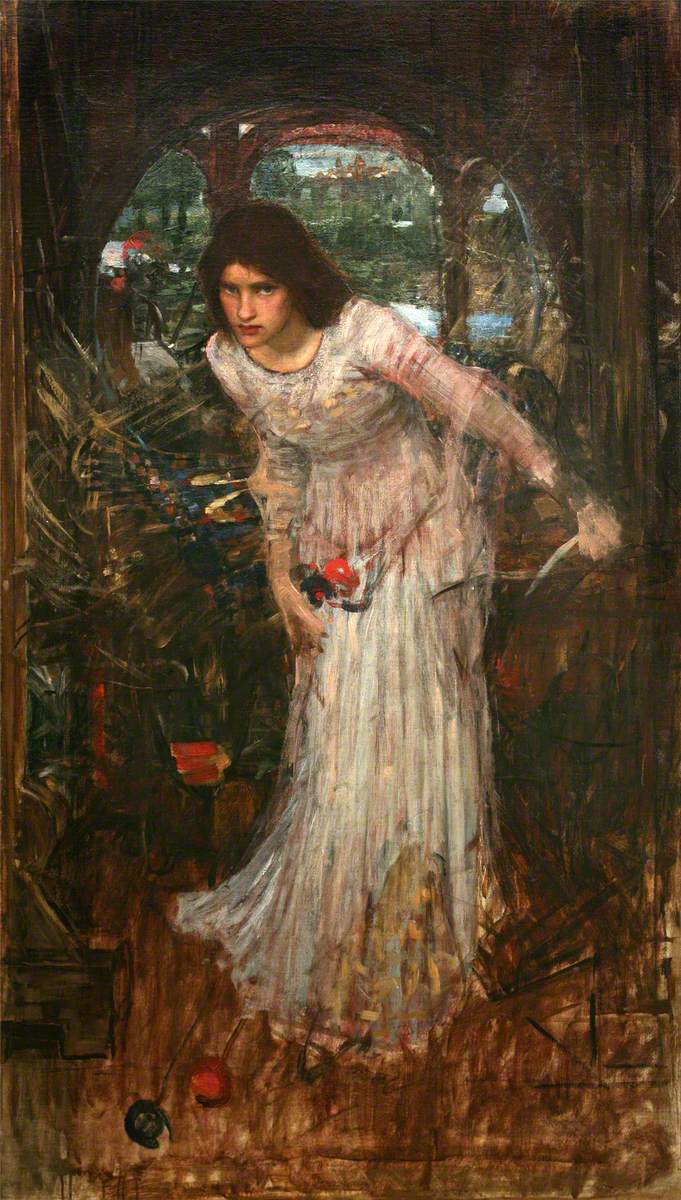
John William Waterhouse's Falmouth Study for the Lady of Shalott captures the heroine at the instant she turns from her loom towards Lancelot. Tangled in wool and clutching her large scissors, she pitches through an interior that seems to move with her. Beyond the window are river, horseman and Camelot—the forbidden world she has previously known only through reflection.
Painted between 1891 and 1894, the oil is a preparatory composition for Waterhouse's finished 1894 painting in Leeds Art Gallery. [1] [2] It is also a major public work in its own right, acquired directly from the artist by Alfred A. De Pass and presented to Falmouth Art Gallery in 1923. [1]
At a Glance
- ArtistJohn William Waterhouse
- TitleStudy for the Lady of Shalott [1]
- Date1891–94 [1]
- MediumOil on canvas [1]
- CollectionFalmouth Art Gallery [1]
- Accession numberFAMAG: 1923.15 [1]
- DonorAlfred A. De Pass, 1923 [1]
- SubjectThe Lady turning from her loom to look directly at Lancelot
- Related finished workThe Lady of Shalott Looking at Lancelot, 1894, Leeds Art Gallery [2]
- Version distinctionNot the 1888 boat painting or the 1915 loom painting
Contents
- Introduction
- What the study shows
- The moment in Tennyson's poem
- Looking directly at Lancelot
- Wool, loom and scissors
- Mirror, window and Camelot
- Changes in the Leeds painting
- What an oil study reveals
- De Pass and Falmouth
- Place in Waterhouse's Shalott sequence
What the study shows
The Lady occupies a richly worked chamber dominated by loom, threads and a large window.
She twists or rises abruptly towards the opening. Her body is caught between the work she abandons and the sight she chooses.
Lengths of wool wrap around her legs and clothing, translating sudden movement into visible entanglement.
One hand holds large scissors. Their pointed form can resemble a short sword, an association Falmouth's curator explicitly notes. [1]
Outside, Lancelot rides past. Camelot and the river are clearer in the study than in the finished Leeds canvas. [1]
The interior is crowded with woven colour and objects. The outer world appears brighter and more open.
This contrast makes looking a physical crossing. The Lady does not leave the room, but her attention breaches its rules.
The study is fluid in finish. Some forms are established strongly while other passages remain broad or provisional.
That variability records Waterhouse working through storytelling rather than producing a reduced copy after the final painting.
The scene is not the Lady's death voyage. It is the earlier climax when direct sight activates the curse.
The moment in Tennyson's poem
Alfred Tennyson's The Lady of Shalott exists in versions published in 1832 and revised in 1842. [3]
The Lady lives under an unexplained curse in a tower on the island of Shalott. She must weave continually and may not look directly towards Camelot.
She sees the world in a mirror and incorporates its “shadows” into her web.
When Sir Lancelot rides beside the river, his brilliant appearance and song draw her away from mediated vision.
She leaves loom and web, crosses the room and looks down towards Camelot. The mirror cracks and the web flies outward. [3]
She recognises that the curse has come upon her.
Waterhouse chooses the fraction before or during catastrophe. The turn, falling threads and scissors anticipate rupture.
The painting does not illustrate every textual detail simultaneously. It converts a sequence of crossing, looking, cracking and flying into one compressed movement.
Falmouth describes the Lady as Elaine, influenced by the Arthurian Lily Maid of Astolat tradition. [1] Tennyson's Shalott poem, however, keeps her unnamed.
It is useful to explain the Arthurian genealogy without replacing the poem's deliberate anonymity.
The curse's origin is likewise not defined by Tennyson. Waterhouse does not invent an explanatory sorcerer.
Looking directly at Lancelot
The Lady's decisive act is not romantic meeting but direct sight. Lancelot remains outside, possibly unaware of her existence.
Until this instant, the mirror has protected and confined her. She experiences life as reflection.
Turning to the window rejects that system. Her body follows her gaze with such force that she loses balance.
The act can be read as desire, curiosity, artistic rebellion or a demand for unmediated life.
It also triggers death. The poem makes liberation and catastrophe inseparable.
Waterhouse gives Lancelot relatively small scale. The painting's emotional centre is not his heroic body but her response.
His passage remains ordinary within the outer world. Inside the tower it transforms everything.
This asymmetry challenges a simple love-story reading. The Lady sacrifices safety for a man who does not knowingly summon her.
Her turn can therefore be understood as choosing reality more broadly, with Lancelot as its most brilliant sign.
Modern readers may question a curse that punishes female looking and movement. Waterhouse's dynamic figure makes the prohibition feel bodily restrictive.
Yet the painting does not show regret. Fear, urgency and determination can coexist within the turn.
Wool, loom and scissors
Threads are the most important material link between poem and painting. They record the Lady's art and become obstacles when she leaves it.
Tennyson's web is both creative work and mechanism of confinement. She weaves images taken from the mirror, producing art from shadows. [3]
Waterhouse makes wool visibly catch around her. The work does not simply fall behind; it clings to the body crossing away from it.
This entanglement can represent habit, vocation, curse or the material consequences of abandoning a constructed life.
The scissors intensify ambiguity. As a tool, they belong to textile work and offer the possibility of cutting free.
Held upright during her turn, they also resemble a weapon. Falmouth compares them with a knight's sword. [1]
That visual rhyme grants the Lady a form of agency normally associated with Lancelot.
She does not attack anyone. The point is compositional and symbolic: domestic tool acquires heroic silhouette.
The loom fills the interior with verticals, horizontals and tensioned lines. Her diagonal body breaks their order.
Wool turning loose transforms controlled weaving into uncontrolled movement.
The study therefore pictures an artist at the moment her medium rebels. The web no longer represents reflected life; it becomes a physical force within lived experience.
Mirror, window and Camelot
Tennyson opposes mirror and direct view. The mirror makes the outside world visible while preserving distance.
Waterhouse's study emphasises the window and view beyond. Camelot can be seen clearly behind the river, according to Falmouth. [1]
This clarity gives the Lady's desire a visible destination. The forbidden world is not abstract.
The finished Leeds composition makes Camelot less apparent, shifting attention more strongly towards figure, loom and passing knight. [1]
The mirror's role may be less immediately legible in a reproduction of the study than the window. Its poetic importance should still be explained from the source.
Window and mirror are competing image technologies. One offers reflected representation; the other promises direct sight.
Waterhouse, as a painter, necessarily turns both into painted images. The viewer receives the “real” Lancelot through another mediation.
That paradox gives the subject special relevance to visual art. Can any painted view be direct?
Camelot also represents social life beyond the isolated female artist. Its distance makes the tower's confinement spatially clear.
The river connects the study with Waterhouse's 1888 painting, where the Lady later floats towards Camelot in a boat.
Here it remains the boundary she has not yet crossed.
Changes in the Leeds painting
The Falmouth oil was made in preparation for the finished 1894 The Lady of Shalott Looking at Lancelot in Leeds. [1] [2]
Falmouth identifies two particularly important changes. Camelot is clearer in the study, and Lancelot's position is reversed in the final picture. [1]
Reversing a moving rider alters the direction in which outer action meets the Lady's turn.
Reducing Camelot can simplify background storytelling and concentrate the climax.
These changes show why preparatory work matters. Waterhouse did not merely refine surfaces; he revised narrative emphasis.
The broad study allowed him to test the body's fall, the path of wool and the relation between interior and passing horseman.
The finished painting clarifies selected elements but may lose some of the study's immediacy.
Neither should be ranked automatically above the other. One preserves decision-making; the other records a public final solution.
The Falmouth work is substantial enough to have its own exhibition and collection history.
Calling it an “1891–93 version” is understandable in image lists, but “Study for the 1894 Leeds painting” gives the relation more accurately. [1]
Its date range extends through 1894 in Falmouth's record, so a firm 1891 completion should not be asserted.
What an oil study reveals
An oil study can solve composition, colour and light at a scale and material closer to the final canvas than a pencil drawing.
Waterhouse uses it to coordinate multiple moving parts: turning figure, flying or tangled thread, scissors, window, rider and landscape.
Areas of looser paint are not automatically unfinished defects. They show priorities at a particular stage.
The Lady's movement must read immediately; minor architectural detail can remain provisional.
Oil also lets Waterhouse test how bright exterior light competes with saturated interior textiles.
The study preserves alternatives later removed. Clear Camelot and reversed Lancelot are visible evidence of revision. [1]
It therefore documents thought through paint.
At the same time, the work was acquired by De Pass directly from Waterhouse, indicating that the artist allowed it an independent life beyond the studio. [1]
A preparatory function does not make an image disposable.
The continued emotional response reported by Falmouth confirms that viewers experience it as more than technical residue. [1]
Its fluidity may intensify the subject because the curse is itself a moment when stable order breaks.
De Pass and Falmouth
Alfred A. De Pass purchased the painting from Waterhouse and later presented it to Falmouth Art Gallery. [1]
The gift formed part of the 1923 foundation of the gallery's collection, to which De Pass contributed generously. [1]
Falmouth records the accession as FAMAG: 1923.15. [1]
De Pass was a South African businessman who settled in Falmouth and regarded it strongly as home. [1]
The direct artist-to-collector link anchors provenance and corrects the assumption that every study remained in Waterhouse's studio until death.
The painting has become Falmouth's most famous and requested work, according to the gallery's curator. [1]
It regularly travels to exhibitions, which can disappoint visitors expecting permanent display. [1]
Anyone planning a visit should therefore confirm current location.
Its Cornish setting has also encouraged local connection with Tennyson's 1860 journey in Cornwall while retracing Arthurian associations. [1]
That later geographical resonance belongs to reception, not the painted location of Shalott.
Public ownership ensures that a preparatory Waterhouse oil receives institutional care and interpretation rather than remaining visible only through market reproduction.
Place in Waterhouse's Shalott sequence
Waterhouse treated three different moments from Tennyson across major finished paintings.
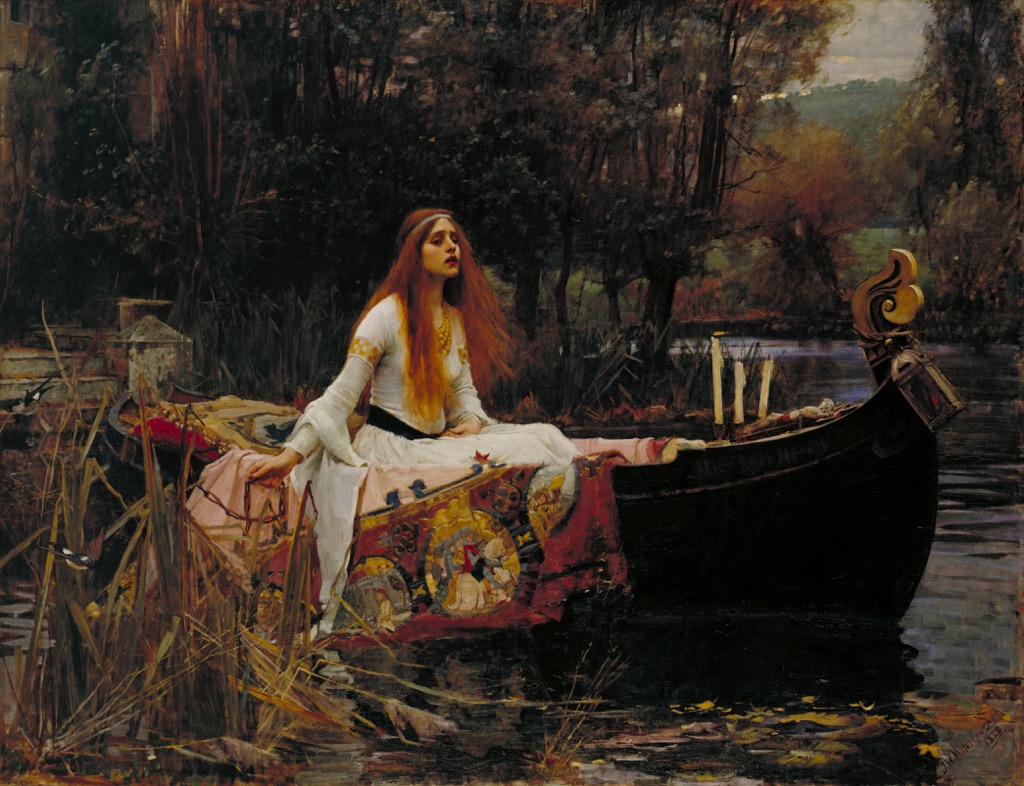
The 1888 Tate canvas shows the Lady beginning her final boat journey towards Camelot. [4]
The 1894 Leeds painting, prepared by the Falmouth study, shows the fatal direct look at Lancelot. [2]
The 1915 “I Am Half-Sick of Shadows,” Said the Lady of Shalott shows her weary at the loom before she sees him.
The finished sequence was painted in reverse narrative order: voyage, look, then earlier dissatisfaction.
The Falmouth study belongs to the central causal moment.
Its threads link backwards to confinement and forwards to the broken web.
It should be distinguished from Waterhouse's finished 1894 Leeds canvas and from the 1888 Tate boat painting.
Separate pages allow readers to follow revision as well as story.
The study also demonstrates the subject's long hold on Waterhouse. He returned to the Lady not to repeat one famous image but to explore distinct states of artistic isolation, desire and consequence.
Interpretation and close looking
Begin with the scissors. Their sharp vertical announces both textile labour and the possibility of severance.
Then follow the wool around the Lady's body. It converts the invisible curse into material resistance.
Next look through the window to Lancelot and Camelot. Their relative smallness makes clear how little outer stimulus is needed to overturn the entire room.
Finally compare finished and provisional passages. The difference shows Waterhouse allocating attention as he tests the story.
A feminist reading can see a woman punished for direct sight and departure from prescribed work.
An artistic reading can see the danger of replacing mediated images with experience.
A psychological reading can emphasise the body moving before consequence can be rationally weighed.
These interpretations remain grounded in the same visual facts.
The study's strength is that decision has not settled into pose. Everything seems still capable of changing, even though readers know the curse cannot be recalled.
The Lady as artist
Tennyson makes the Lady's confinement productive. She does not simply wait; she creates a woven image of the reflected world. [3]
That structure encouraged Pre-Raphaelite and later artists to read the poem as a story about artistic mediation. Smarthistory places Waterhouse's paintings within this larger problem of seeing, making and separation. [5]
The mirror supplies images, the loom translates them and the Lady remains physically isolated from their source.
Her art is accomplished but conditional. She may represent life only so long as she does not join it.
Waterhouse's study intensifies the crisis by making wool catch around the artist's body. The medium that gave purpose to captivity becomes an obstacle when she chooses experience.
The scissors can therefore signify more than domestic work. They offer the theoretical power to sever thread, rule and representation.
Whether she succeeds is another question. The poem's web flies out and the curse begins; cutting does not grant a safe future.
This makes the subject unusually self-reflexive for painting. Waterhouse offers a beautiful mediated image of a woman rejecting mediation.
Viewers resemble the Lady before her turn: we see Camelot, Lancelot and interior through an art object rather than direct encounter.
Her choice can inspire admiration while also troubling the spectator's pleasure in remaining safely outside the curse.
Movement across the room
The study is structured by a path. Attention begins at the loom, crosses the entangled figure and exits through the window.
The Lady's body occupies the middle as both traveller and obstruction. Her torso turns faster than her feet can free themselves.
Threads make speed visible because they lag behind the motion that disturbs them.
The large scissors add a counter-direction. Their pointed vertical or diagonal interrupts the horizontal pull towards Lancelot.
Interior objects appear to participate in the crisis. Orderly craft becomes a field of slippage, crossing and loose line.
The window is not simply background. It is the composition's destination and the mechanism through which literary temptation becomes visible.
Lancelot's small horse continues smoothly outside while the Lady's movement becomes unstable inside. His freedom of passage is contrasted with her dangerous attempt to look.
Camelot deepens that contrast. A whole social world lies beyond the tower, but the curse attaches lethal consequence to one woman's entry into sight.
The study's fluid paint heightens motion because edges have not hardened uniformly. Figure, wool and surrounding colour seem temporarily unsettled.
The finished Leeds painting refines this movement, but the preparatory canvas lets viewers feel composition still negotiating its own balance.
Gender, prohibition and agency
The poem can be read as a warning against female desire, but it can also expose the violence of the rule that makes desire fatal.
Waterhouse does not personify the authority behind the curse. No jailer stands beside the loom.
Confinement has been internalised through routine and fear, much as the Danaids' sentence operates without visible guards.
The Lady nevertheless acts. She turns, crosses, looks and holds a cutting tool.
Her agency does not save her, but the painting centres it. Lancelot remains visually secondary and narratively ignorant.
Modern viewers should avoid describing her as simply weak before male beauty. Years of isolation and dissatisfaction precede the look.
The later 1915 painting gives that dissatisfaction explicit title through “I am half sick of shadows.” The Falmouth study shows the moment feeling becomes action.
The sword-like scissors complicate gendered roles. Waterhouse gives the imprisoned weaver an object shaped like knightly force while the actual knight merely rides past. [1]
She cannot wield it against the curse as a conventional enemy. Its power is symbolic and incomplete.
That incompletion makes the study compelling: agency is visible even where the narrative makes survival impossible.
Why Falmouth's study deserves its own page
Preparatory works are often reduced to comparisons beneath a famous finished image. Falmouth's canvas resists that treatment through provenance, scale of ambition and public reception.
De Pass bought it directly from Waterhouse, and the gallery now describes it as its most requested work. [1]
It preserves information the Leeds canvas does not: clearer Camelot and the earlier direction of Lancelot. [1]
It also makes process available to viewers. Revision is not an abstract statement but a visible choice between two narrative arrangements.
Because the study travels frequently, it has acquired an exhibition life beyond Cornwall. [1]
Its independent fame does not erase preparatory purpose. The two identities reinforce one another: it is powerful partly because thought remains visible within the finished-enough image.
For the Waterhouse cluster, a separate page also solves search confusion. Users encountering the Falmouth image receive its accession, donor and relation to Leeds rather than facts borrowed from the finished canvas.
That accuracy is itself a form of interpretation. It lets readers see not a blurry duplicate but a decision-making stage in Waterhouse's longest literary engagement.
Related Pages
- The Lady of Shalott: Compare the Falmouth study with Waterhouse's 1888 Tate boat painting.
- The Lady of Shalott Looking at Lancelot: Follow the finished Leeds composition for which the Falmouth oil was preparatory.
- Literary and Mythological Sources: Place Waterhouse's Shalott sequence within Tennyson and Arthurian source material.
Frequently Asked Questions
It belongs to Falmouth Art Gallery, accession FAMAG: 1923.15. [1]
Falmouth dates it 1891–94. [1]
Camelot became less distinct and Lancelot's direction was reversed. [1]
They belong to her textile work but also resemble a sword in the dynamic pose, suggesting agency and possible release from the web. [1]
Alfred A. De Pass, who had purchased it from Waterhouse, presented it in 1923. [1]
Discussion
The Falmouth study makes the fatal look feel less like a posed moral illustration and more like a bodily accident of desire. Wool catches, balance shifts and scissors rise before thought can stabilise the room.
Its differences from Leeds are not footnotes. Clear Camelot increases the pull of the outer world; reversing Lancelot changes the directional collision between rider and Lady. Revision is part of storytelling.
Reader Insights
Which visible detail most changes the way you read this page?
Which source or comparison helps the work feel less familiar and more specific?
What question would you bring back to the painting after reading?
Join the Conversation
Share your reading of this page below.
References
- Main image: John William Waterhouse, Study for The Lady of Shalott, 1891–94, Falmouth Art Gallery, FAMAG:1923.15, public-domain faithful reproduction via Wikimedia Commons / Art UK.
- Falmouth Art Gallery, Natalie Rigby, “John William Waterhouse RA: Study for the Lady of Shalott, 1891–1894,” collection guide, accession FAMAG: 1923.15. View source
- Art UK, “John William Waterhouse: The Lady of Shalott,” Leeds Art Gallery record for the finished 1894 painting. View source
- Alfred Tennyson, “The Lady of Shalott,” 1842 text, Poetry Foundation. View source
- Tate, “John William Waterhouse: The Lady of Shalott,” collection record for the 1888 painting. View source
- Smarthistory, “John William Waterhouse, The Lady of Shalott,” literary and visual context. View source