

 Buy Art Prints Now
from Amazon
* As an Amazon Associate I earn from qualifying purchases.
Image reference [image]
 by Tom Gurney
Tom Gurney BSc (Hons) is an art history expert with over 20 years experience
Published on August 14, 2026 / Updated on August 14, 2026
Email: tomgurney1@gmail.com / Phone: +44 7429 011000
Flora and the Zephyrs: Introduction
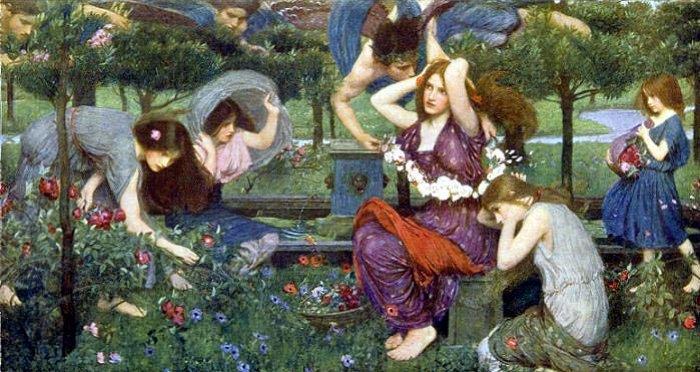
Women gather flowers beside a stream when winged winds break into the garden. At the centre of John William Waterhouse's Flora and the Zephyrs, the west wind reaches for Flora and encircles her with white roses. The wide 1897 canvas, first exhibited at the Royal Academy in 1898, makes spring arrive as beauty, motion and sexual danger at once. [1] [2] [3]
Its source in Ovid's Fasti should not be sentimentalised. Flora says that she was once Chloris; Zephyr saw her, pursued her and was stronger. Marriage, flowers and divine office follow an abduction. Waterhouse turns this difficult sequence into one suspended encounter. [2]
At a Glance
- ArtistJohn William Waterhouse (1849–1917)
- TitleFlora and the Zephyrs [1] [3]
- DateSigned and dated 1897; first exhibited in 1898 [1] [3]
- MediumOil on canvas [3]
- DimensionsApproximately 110 × 206 cm; early records describe a canvas about 42½ × 80 in. [3]
- CollectionPrivate collection; formerly George McCulloch and later recorded in the Schaeffer Collection, Sydney [1] [3] [4]
- First exhibitedRoyal Academy, London, Summer Exhibition, 1898 [1] [4]
- Primary literary sourceOvid, Fasti, Book 5 [2]
- SubjectFlora or Chloris and four maidens interrupted while gathering flowers by Zephyr and accompanying winged winds
- Major visual precedentSandro Botticelli's Primavera in the Uffizi [1] [5]
- Essential distinctionOvid's union of Chloris and Zephyr begins in pursuit and force, even though the narrative later presents marriage and a flowering garden
Contents
- Introduction
- Spring Enters by Force
- Chloris Becomes Flora in Ovid
- What Waterhouse Chooses to Show
- Flora, Her Attendants and the Winged Winds
- Flowers, Garland, Water and Garden
- Botticelli's Primavera and Waterhouse
- Scale, Colour and Moving Air
- Exhibition, Ownership and Preparatory Studies
Spring Enters by Force
The painting extends across a long, low garden. Flora sits or bends near a fountain or stream while four young women gather blossoms around her. Their ordinary work is interrupted from above and behind.
Winged male figures emerge through foliage. One reaches Flora and brings his face close to her arm while a garland of white roses crosses or encircles her body. Others repeat his approach across the upper field.
The attendants respond differently. Some turn, recoil or pause; one continues to hold gathered flowers. Their multiplied reactions make the wind visible as disturbance.
Flora looks upward towards the nearest Zephyr. Waterhouse makes their exchanged gaze the centre of the encounter. [1] Her lifted arms can suggest instinctive defence, startled awareness or openness, but no single gesture cancels the source's coercion.
Nothing has yet fully transformed. Flora is already named by the painting's title, but Ovid says she was Chloris before Zephyr took her and made her his wife. [2] The image compresses maiden, pursued nymph and goddess into one figure.
The plural “Zephyrs” expands one west wind into a band. Ovid speaks primarily of Zephyr as husband, while Waterhouse gives the wind followers or repeated forms. Atmospheric force becomes a male chorus.
This multiplication changes emotional pressure. One figure might appear as a lover entering a garden. Several winged bodies surrounding women look more like collective invasion.
It also resists a merely portrait-like reading of the myth. Zephyr is not only a particular man pursuing a particular woman; he is the season's pressure passing through the whole garden. Waterhouse can therefore suggest at once an individual encounter and the impersonal arrival of weather. That double meaning does not excuse the pursuit. It explains why the scene can feel both enchanted and unsafe.
The long composition delays our arrival at the central contact. A viewer reads across scattered blossoms, bending attendants and separate winged figures before recognising the garland around Flora. The story is not delivered as one emblem placed at the centre. It is discovered through accumulating signs of interruption.
That discovery matters when the painting is reduced in reproduction. The first impression may be a luxuriant assembly of beautiful figures. Only sustained looking reveals defensive arms, halted work and the imbalance between airborne intruders and earthbound gatherers. Waterhouse makes decorative pleasure the entrance to a more difficult narrative.
At the same time, Waterhouse makes them beautiful and nearly identical. Threat arrives through visual harmony rather than monstrosity. The picture's ethical tension lies in that attractiveness.
Chloris Becomes Flora in Ovid
In Book 5 of the Fasti, the poet asks Flora to explain her rites and identity. The goddess answers that she was once Chloris, a nymph of the blessed fields, and that the Latin form of her name has changed. [2]
She describes spring and the gathering of flowers. Zephyr sees her; she withdraws, he pursues and proves stronger. Flora explicitly compares his conduct with the abduction committed by his brother Boreas. [2]
Zephyr makes amends through marriage. Flora says she has no complaint about the marriage and receives perpetual spring as her dowry. Her garden is filled with flowers, watered by a clear fountain and warmed by her husband's wind. [2]
The sequence reflects ancient and later narratives that convert sexual pursuit into marriage and compensation. A modern reader need not treat that conversion as retroactive consent. The first action remains force.
Flora becomes sovereign over blossoms. She names or presides over flowers born from transformed figures and claims a role in the generation of divine births. Her domain extends beyond decoration to fertility and reproduction. [2]
She also describes games celebrated in her honour. The Fasti is a poem about the Roman religious calendar, so the narrative joins personal myth to festival, season and civic ritual. [2]
Waterhouse does not illustrate the full speech, Roman festival or settled marriage. He returns to the unstable encounter from which Flora's later power is said to arise.
That choice preserves a question Ovid's retrospective goddess appears to resolve: what did the approach feel like before compensation, marriage and divine status were known?
Ovid's first-person narration creates a further complication. The goddess tells her own history after she has received a garden, honour and lasting spring. Her present security shapes the remembered violence without erasing it. Waterhouse removes that retrospective voice. His Flora cannot explain the event to us; expression and gesture must carry everything.
The loss of speech increases the viewer's responsibility. A lifted face can be called fascinated, fearful or ambivalent, depending on what one expects the myth to mean. The written source prevents ambiguity from becoming amnesia: it records flight, pursuit and superior force. The image and poem therefore correct each other's limitations. The painting keeps emotional response open, while the poem anchors the action that produced it.
Nor does divine promotion automatically repair personal harm. Becoming goddess of flowers grants Chloris power within the story, but the sequence is still one in which a stronger god determines the conditions of her changed life. Waterhouse's concentration on the threshold lets beauty and inequality remain visible together.
The four attendants are not individually named in the poem. They allow Waterhouse to turn Flora's personal recollection into a communal interruption of women gathering spring flowers.
What Waterhouse Chooses to Show
Waterhouse avoids the obvious image of Flora enthroned as a mature goddess distributing blossoms. He chooses the instant when external force enters a female space.
The title uses her completed Roman identity even though the action recalls Chloris. This is comparable to calling the transformed heroine Daphne while bark already covers her: name spans the person's changing states.
Zephyr's wind is embodied. Painting cannot make air blow, so wings, hair, drapery, garland and startled turns register it across bodies and objects.
The white rose garland is Waterhouse's addition or elaboration rather than a literal line that dominates Ovid's account. It gives Zephyr a visible means of surrounding Flora before arms or marriage enclose her. [1]
Garland can signify courtship, festival and honour. Here it can also resemble a soft restraint. Beauty performs the work that a chain would make too explicit.
The nearest Zephyr's kiss or close contact with Flora's arm eroticises the encounter. [1] Waterhouse stops before an embrace that would settle the bodies into one unit.
The attendants widen the temporal field. One might notice the wind before Flora, another after. Their poses distribute surprise in sequence even though the painting is still.
Waterhouse also keeps the garden flourishing before the abduction. Spring does not begin only after Flora's marriage. Flowers already exist to be gathered, making her divine office a transformation of relation rather than creation from nothing.
By suppressing later content, the artist lets viewers experience ambivalence. Spring is desirable; the way its myth personifies arrival is not innocent.
Flora, Her Attendants and the Winged Winds
Flora is central but not isolated. The four maidens resemble her closely enough to form what Christie's calls an almost sisterly group. [1] Similar faces and bodies turn them into a community rather than portrait studies of named individuals.
The Zephyrs are even more alike. [1] Repetition visualises a current of air: one wind seen at several points or several beings moving with one intention.
Their wings distinguish them from Cupid. No arrows or single child-god control the action. These are adult or youthful male personifications of wind.
Flora's attendants gather, carry and select. Their downward relation to flowers contrasts with the Zephyrs' airborne descent. Women work within the garden; winds enter from outside and above.
The vertical imbalance matters. Winged figures possess speed and surprise. The women are close to earth and water, burdened with bouquets or seated.
Flora nevertheless raises her gaze and occupies the strongest central exchange. Waterhouse does not make her faint or disappear. Her consciousness is the point against which the winds are measured.
The attendants' fear is more explicit than Flora's response in some readings. Christie's describes the maidens as terrified by beating wings while interpreting Flora's final pose as balancing defence and awareness. [1]
This range prevents the central gaze from being used as proof that the whole encounter is welcomed. Other bodies register alarm that an idealised heroine may contain.
No documented source securely names the models used for each figure. Similarity to recognised Waterhouse types is not enough to assign identities.
Flowers, Garland, Water and Garden
Flowers are action, property and identity. Before the winds arrive, the women gather them. Zephyr uses roses to encircle Flora. Ovid's Chloris receives a flowering garden and becomes the Roman goddess of blossoms. [2]
The picture therefore moves from flowers as collected objects to flowers as the heroine's divine domain. What is held in bouquets spreads across ground, garland and name.
The stream or fountain recalls Flora's description of her garden being watered by a clear spring. [2] Water counterbalances wind: one sustains growth continuously, the other arrives as disruptive movement.
Waterhouse's meandering stream also belongs to an ideal Renaissance-derived landscape vocabulary. [1] It leads the eye laterally and separates clusters without dividing the garden into rigid compartments.
The flower-strewn ground creates tapestry-like density. Individual species may carry associations, but the painting's private status and variable reproductions make exhaustive botanical certainty unwise.
White roses are most narratively prominent. Their apparent innocence makes the garland's enclosing action more unsettling, not less.
Flowers also carry time. They bloom, are cut and fade. Flora's gift of perpetual spring imagines continuity, yet every individual bouquet contains mortality.
This theme connects the picture with Waterhouse's later Gather Ye Rosebuds While Ye May. There, gathering responds to time's passage. Here, gathering is interrupted by mythic transformation.
The garden has no visible wall strong enough to repel air. It can feel enclosed to human movement while remaining permeable to the element Zephyr personifies.
Botticelli's Primavera and Waterhouse
Christie's identifies Botticelli's Primavera as a major inspiration. [1] The comparison is visually and narratively persuasive, though it need not imply direct copying of every pose.
At the right of Botticelli's great panel, blue Zephyr seizes the fleeing Chloris. Flowers emerge from her mouth, and the richly dressed Flora appears beside her scattering blossoms. One woman is represented twice across successive states. [5]
Waterhouse compresses those states into one central heroine. His Flora is simultaneously gathering nymph, desired woman and future flower goddess.
Botticelli's garden contains nine mythological figures, including Venus, Cupid, the Three Graces and Mercury. Waterhouse narrows the cast to Flora, attendants and winds. Spring becomes a confrontation rather than a cosmic court. [5]
Both works stretch horizontally across flowered ground and use repeated upright figures in a grove. Waterhouse adds a visible watercourse and brings figures closer to the viewer. [1]
The Uffizi notes that Botticelli's exact meaning remains debated even while the work celebrates love, peace and prosperity. [5] Waterhouse's relation to it should be framed as informed echo, not a solved key.
Waterhouse was born in Rome and travelled in Italy; his mature art repeatedly absorbed Renaissance memories into looser late-nineteenth-century paint handling. Flora and the Zephyrs joins Italian subject, Ovidian text and English exhibition culture.
The comparison also reveals ethical continuity. Both artists aestheticise pursuit within extraordinary floral beauty. Modern interpretation can admire invention while naming the coercion the compositions transform.
Scale, Colour and Moving Air
At roughly two metres wide, the painting is one of Waterhouse's major horizontal exhibition canvases. [3] Its breadth lets separate reactions unfold across one garden.
The low format is suitable for wind. Movement travels laterally through wings, hair, fabric and branches rather than rising into a single supernatural apparition.
Green provides the continuous field, while pale skin, white flowers and stronger drapery colours punctuate it. The repeated figures can merge with vegetation until gestures bring them forward.
Flora's face and raised arms create a central light pattern. Zephyr's wings and the rose garland frame rather than fully conceal her.
The painting balances decorative repetition with narrative interruption. Similar women and winds make a rhythmic frieze; the nearest contact breaks rhythm into event.
Waterhouse's brushwork is broader than Botticelli's tempera precision. Flowers can register as colour notes within massed growth rather than individually outlined specimens.
This handling helps air feel mobile. Hard contours everywhere would freeze the wind into figures. Looser passages let bodies emerge and dissolve within leaves.
The image remains legible from a distance through major groupings. Close viewing reveals bouquets, faces and adjustments of pose. Reproduction at small size tends to turn the complex encounter into a generic flower scene.
Exhibition, Ownership and Preparatory Studies
Waterhouse signed the painting in 1897 and exhibited it at the Royal Academy in 1898. [1] [3] [4] The dual dating explains why references may call it either an 1897 or 1898 work.
George McCulloch acquired it by the time of its Academy appearance. [1] His collection also included Waterhouse's Saint Cecilia and the 1894 Ophelia.
The Royal Academy displayed McCulloch's collection in 1909. Its catalogue describes Flora seated with four attendant maidens and being courted by Zephyrs visible in overhanging foliage; it also records the wide canvas and the 1897 signature. [3]
Later records associate the painting with the Schaeffer Collection in Sydney, and it remains privately owned. [1] [4] These labels describe successive ownership rather than a public Australian museum collection.
Several preparatory drawings survive. A large black-chalk study of Flora documents the final central pose and gaze. [1]
A charcoal sheet measuring 71.8 × 44.5 centimetres carries figure studies on both sides. Christie's identifies them with attendants in the finished painting and notes that Waterhouse reversed directions and changed a kneeling figure into a standing one. [4]
Smaller sketchbook drawings may represent still earlier explorations. [1] Together, they show that the apparent flow of figures depended on substantial revision.
Preparatory evidence is especially valuable because the finished painting is privately held. It reveals Waterhouse's decisions without supporting unwarranted claims about every hidden layer of paint.
The drawings confirm that female protagonists and gestures received concentrated attention. They also show that Waterhouse could reverse a pose between study and canvas, prioritising compositional rhythm over literal transfer.
The ownership history has consequences for interpretation as well as access. A privately held work is often known through photographs of different dates, colour balance and resolution. Apparent botanical details, facial expressions and even the strength of particular hues may change between reproductions. Firm claims should therefore rest on recorded composition, provenance and surviving studies rather than on a single digital image.
Its Royal Academy appearance supplied the picture's first public setting. The scale, horizontal sweep and repeated figures were designed to register among many competing exhibits. Yet McCulloch's acquisition also placed it within a major private collection, where close and repeated viewing could disclose the narrative beneath its floral surface. The work operates at both distances: spectacle across a gallery and psychological encounter at close range.
Related Pages
- Apollo and Daphne: Compare another Ovidian pursuit-and-transformation subject in Waterhouse's mythological work.
- Literary and Mythological Sources: Follow the Ovidian and classical source framework behind Waterhouse's myth paintings.
- Paintings: Return to the protected Waterhouse paintings hub.
Frequently Asked Questions
Flora is the Roman goddess of flowers and spring. In Ovid's Fasti, she says she was originally the nymph Chloris. [2]
Zephyr is the west wind. Ovid describes him pursuing Chloris, overcoming her and later marrying her. [2]
Waterhouse shows the principal wind accompanied or multiplied by several similar winged figures, turning moving air into a chorus.
It is approximately 110 × 206 centimetres, though published conversions of the early inch measurements vary slightly. [3]
It is in a private collection and has been associated with the Schaeffer Collection in Sydney. [1] [4]
Botticelli is an important visual precedent, especially his adjoining Chloris and Flora figures, but Waterhouse creates a different, more concentrated composition. [1] [5]
Her painted expression is ambiguous. Ovid's narrative is not: he pursues and overpowers Chloris before their later marriage. [2]
Discussion
1. Does the rose garland appear celebratory, restraining or both? 2. How do the attendants change the meaning of Flora's gaze? 3. Why might Waterhouse multiply one wind into several Zephyrs? 4. Can a garden represent spring and danger at the same time? 5. Compare Waterhouse's compression with Botticelli's separate Chloris and Flora. 6. How does the painting make invisible air visible? 7. What is lost when Ovid's pursuit is described only as courtship? 8. How do the surviving studies alter our understanding of the apparently spontaneous composition?
Reader Insights
Which visible detail most changes the way you read this page?
Which source or comparison helps the work feel less familiar and more specific?
What question would you bring back to the painting after reading?
Join the Conversation
Share your reading of this page below.
References
- Image reference
- Christie's, “John William Waterhouse, Flora,” catalogue essay for a black-chalk study, including the finished painting's chronology, George McCulloch ownership, Ovidian subject, Botticelli comparison, imagery and working process, View source.
- Ovid, Fasti, Book 5, Theoi Classical Texts Library, Flora's account of Chloris, Zephyr, marriage and her garden, View source.
- Royal Academy of Arts, Exhibition of Modern Works in Painting and Sculpture Forming the Collection of the Late George McCulloch, 1909, no. 66, catalogue entry for Flora and the Zephyrs, View source.
- Christie's, “John William Waterhouse, Studies for Flora and the Zephyrs,” charcoal sheet record documenting figure changes, Schaeffer Collection and 1898 Royal Academy exhibition, View source.
- Uffizi Galleries, “Sandro Botticelli, Spring,” collection essay identifying Zephyr, Chloris and Flora and describing the garden composition, View source.