



 by Tom Gurney
Tom Gurney BSc (Hons) is an art history expert with over 20 years experience
Email: tomgurney1@gmail.com / Phone: +44 7429 011000
Portrait of an Artist in His Studio — Circle of Géricault: Introduction
A young man sits sideways on a chair, his head resting against one hand, his eyes turned towards the viewer. A palette hangs on the wall; a skull occupies the shelf above it. This painting has circulated as a self-portrait of Théodore Géricault, but the Louvre calls it Portrait of an Artist in His Studio and attributes it to his circle or entourage. The sitter remains unidentified in the museum's record. Dated about 1820, the oil painting on canvas measures 147 × 114 cm and bears inventory number RF 1225. [1]
That distinction changes the encounter with the picture. The face can be studied as an individual likeness without assuming that every feature reveals something about Géricault. The room, too, deserves attention as a carefully arranged painted space. Its small collection of objects frames a person associated with artistic work, while the pose makes his present activity harder to name: he appears to have paused, but neither the length nor the reason for that pause is visible.
At a Glance
- AttributionCircle or entourage of Théodore Géricault [1]
- DateAbout 1820 [1]
- Medium and sizeOil on canvas, 147 × 114 cm [1]
- CollectionMusée du Louvre, RF 1225 [1]
This work across Théodore Géricault’s career
The Severed Heads
1810s [2]Charging Chasseur
1812 [3]Horse Frightened by Lightning
c.1813–14 [4]The Raft of the Medusa
1818–19 [6]Portrait of a Kleptomaniac
c.1820–24 [8]The Epsom Derby
1821 [9]Contents
- A body turned across the chair
- The studio objects
- Wall, ceiling and light
- An older title and a qualified attribution
A body turned across the chair
The chair is essential to the portrait's design. Instead of sitting upright with his back against its backrest, the man turns across the seat. His raised arm finds support near the chair's upper rail; his other arm crosses in front of his body. The arrangement brings head, hands and chair into a compact group at the left, while the legs extend towards the right edge. The figure consequently occupies the room on a diagonal, loosening the upright framework supplied by the canvas and wall.
Follow the outline from the head down the shoulder and along the coat. The dark silhouette broadens as it descends, with a projecting fold or skirt of fabric stretching towards the right. Against the comparatively pale wall, this contour is easier to read than the separate folds inside the clothing. The face and white neckcloth rise from that large dark mass. Their small areas of brightness have unusual force because so much of the body remains close in tone.
The hand at the temple creates an impression of weight: the head appears supported rather than simply touched. Yet the face does not disappear into the hand. It stays available to the spectator, with the eyes directed out of the picture. Rest and attention coexist. Calling the expression thoughtful is a reasonable response to the pose; diagnosing despair, illness or exhaustion would require evidence the painted gesture cannot supply. The portrait gives us a posture with several possible emotional readings, rather than a written account of a state of mind.
The studio objects
The palette is placed on the bare wall to the right of the sitter. Its rounded shape and thumb hole make it recognisable even though it is not being used. No raised brush connects the hand to an easel within the visible composition. Artistic occupation is suggested through the surroundings, while the body is shown at rest. This division gives the room an active part in the portrait: objects provide information that the man's immediate gesture withholds.
Above the palette, a narrow shelf supports a skull. The two objects establish a vertical sequence beside the figure, balancing the much larger dark area of his clothing. Their different shapes also reward comparison. The palette is broad and flat, with a conspicuous opening; the skull is rounded and interrupted by dark sockets. These patches of darkness echo, on a smaller scale, the contrast between the man's pale face and dark hair. Such visual correspondences bind the still objects to the human presence without requiring them to carry a fixed symbolic message.
Near the lower left edge stands a small pale figure, partly cut off by the boundary of the picture. It brings another version of the human body into the room, reduced in size and light in colour beside the seated man. Its placement encourages the eye to travel down from the face, through the arms and chair, to the floor. Together, palette, skull and small figure make an intelligible studio setting. They do not identify the artist who owned the room or prove that every object was copied from a particular interior.
Watch: Géricault and The Raft of the Medusa
Three perspectives on Géricault’s best-known painting, its making and its historical setting.
Gericault, Raft of the Medusa
Smarthistory examines the composition and historical setting of The Raft of the Medusa.
Watch on YouTubeWall, ceiling and light
Much of the upper half of the painting is given to the wall. Its uneven pale surface prevents the background from becoming an empty colour field. At the top, dark overhead timbers form an irregular band, with angled edges cutting into the lighter plaster. The shelf introduces a second horizontal line below them. The room therefore has a visible structure even though the portrait offers only a restricted view of it.
Light differentiates surfaces rather than illuminating everything equally. The forehead, cheek and white cloth draw attention first; the chair's seat supplies a warmer, lower accent. The wall lets the outline of the coat remain legible, while the lower part of the composition becomes harder to separate into distinct forms. Looking from top to bottom, one moves from a relatively open background into a more crowded overlap of body, chair and shadow. This change in clarity gives the painting depth without a long view into another room.
The interior can appear modest, but a painted wall and an ordinary chair cannot establish a person's finances. Neither can the informal pose settle whether this was a home, a hired workspace or an invented arrangement. The useful question is what these features do within the image. Here they allow the sitter to appear physically at ease, close enough to address the viewer, surrounded by a few legible objects rather than a detailed inventory of possessions.
An older title and a qualified attribution
The Louvre records the painting in Antoine Vollon's collection from 1887 and its purchase at his posthumous sale in 1901. The sale title was Portrait de l'artiste. The same museum record notes a signature, “T.Géricault,” at the lower centre, while retaining its circle attribution. [1]
A signature, a maker's name and a sitter's name answer different questions. A recorded inscription tells us what lettering is present. An attribution expresses a judgement about authorship. A sitter identification concerns the person represented. One cannot substitute for the others. Here the signature has not led the museum to catalogue the work without qualification, and the current title does not name the seated man. The older title belongs to the painting's documented history; it should not silently determine the identity of the face we see today.
This also affects how the image accompanies writing about Géricault. Reproduced beside a biography without a careful caption, the portrait can seem to offer direct access to his appearance, studio and private circumstances. Its current identification supports a more precise use: a portrait of an unnamed artist, associated through attribution with Géricault's circle. The picture remains compelling under that description. The supported head, outward gaze, hanging palette and small sculpted body offer a sustained study of artistic presence, even while the names of maker and sitter remain unresolved.
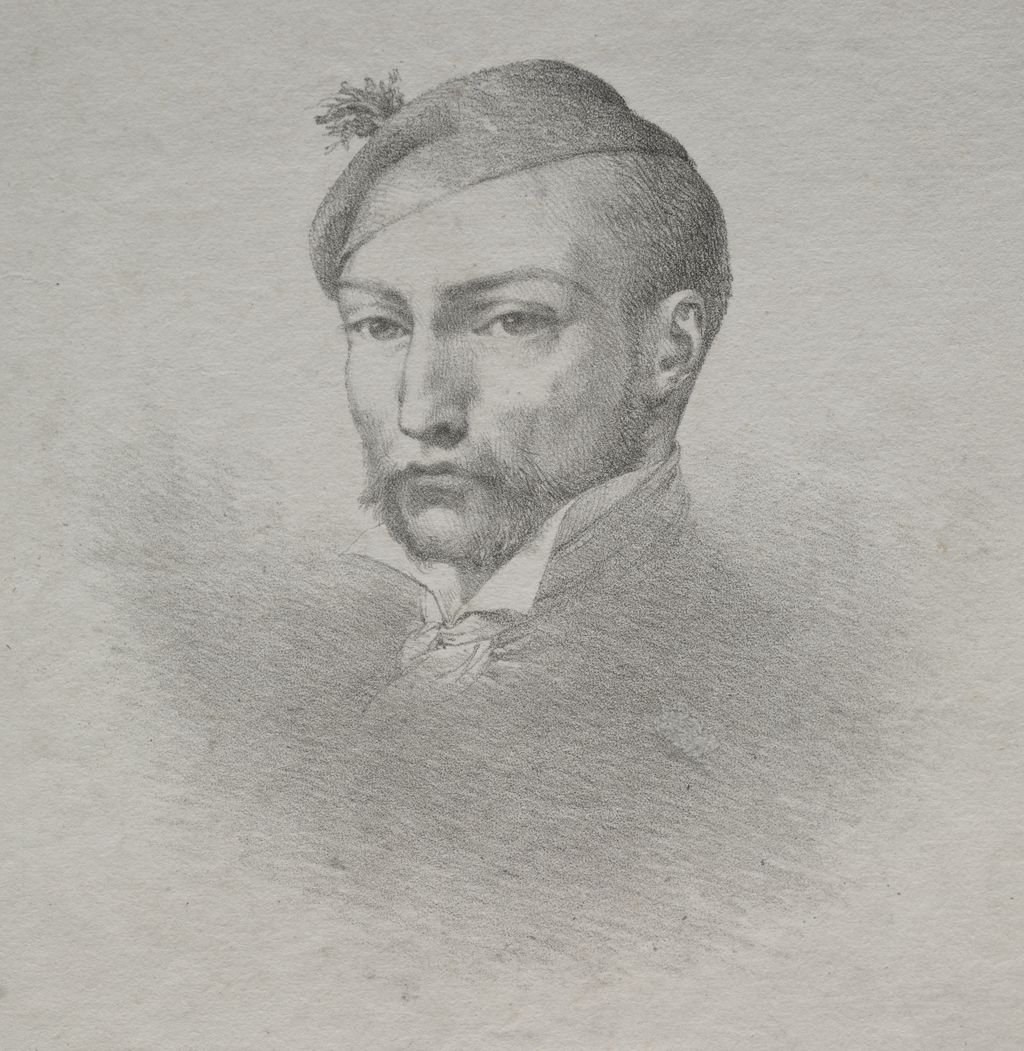
Théodore Géricault, by Léon Cogniet, c.1824 — an identified portrait of the artist; Cleveland Museum of Art Image source. CC0 / Public domain.
Géricault collection records
Seventy collection records include paintings, drawings and individual print impressions. Different impressions remain separate records; this selection is not a complete catalogue raisonné.
Frequently Asked Questions
No. The Louvre uses Portrait of an Artist in His Studio, attributes it to Géricault’s circle or entourage, and does not identify the sitter by name. [1]
The Louvre records T.Géricault at the lower centre while retaining its circle attribution. The inscription and the museum’s judgement of authorship must both be reported. [1]
The Louvre’s ownership history records the title Portrait de l’artiste at Antoine Vollon’s posthumous sale in 1901, when the museum acquired the painting. [1]
Discussion
Look again at the images and ideas explored in Portrait of an Artist in His Studio — Circle of Géricault. These editorial prompts invite your observations.
Reader Insights
How does sitting sideways change the relationship between the man and the viewer?
Which studio object most strongly shapes your reading of the portrait, and why?
How does knowing that the sitter is unidentified change what you notice in his expression?
Join the Conversation
Share a detail, comparison or question about Portrait of an Artist in His Studio — Circle of Géricault below.
References
- Musée du Louvre, Portrait d'un artiste dans son atelier, RF 1225, about 1820; French collection record, including attribution, inscriptions and ownership history. View source.
- Nationalmuseum, The Severed Heads, NM 2113; collection metadata and museum interpretation (Swedish). View source.
- Louvre, Charging Chasseur, INV 4885; collection metadata and museum interpretation (French/English interface). View source.
- National Gallery, Horse frightened by Lightning; collection metadata and museum interpretation (English). View source.
- Louvre, Wounded Cuirassier, INV 4886; collection metadata and museum interpretation (French). View source.
- Louvre, The Raft of the Medusa, INV 4884; collection metadata and museum interpretation (French). View source.
- Gary Tinterow / The Metropolitan Museum of Art, Géricault’s Heroic Landscapes: The Times of Day, Met Bulletin 48/3, Winter 1990–91; consulted main essay and relevant object entries (English). View source.
- Vlaamse Kunstcollectie, Portrait of a Kleptomaniac; collection metadata and museum interpretation (Dutch). View source.
- Louvre, Epsom, MI 708; collection metadata and museum interpretation (French/English interface). View source.


