



 by Tom Gurney
Tom Gurney BSc (Hons) is an art history expert with over 20 years experience
Email: tomgurney1@gmail.com / Phone: +44 7429 011000
The Race of the Riderless Horses: Introduction
A pale horse rises above a press of human bodies. In front of it, a naked man plants his feet far apart and throws his arms upward; beyond him, another horse twists against the men around its head. Théodore Géricault makes the preparation for a race look like a struggle that can scarcely be contained. His small study of The Race of the Riderless Horses, now at the J. Paul Getty Museum, depicts the tense interval before the animals are released during the Roman Carnival. Painted in 1817, it belongs to an ambitious project that never became the large exhibition painting he envisaged. [1]
The scene rewards attention to two very different scales. At first it seems expansive: muscular bodies, rearing horses and a massive architectural background suggest an event fit for a monumental canvas. Yet the actual work measures just 19.8 × 29.1 cm. It combines oil with pen and ink on paper laid on canvas. This is the Getty's study, accession 85.PC.406, one particular object within a larger group of race compositions. Its compressed dimensions make the collision of bodies feel more intense, while its broad handling allows a great deal to remain unsettled. [1]
At a Glance
- Date1817 [1]
- MediumOil and pen and ink on paper laid on canvas [1]
- Dimensions19.8 × 29.1 cm [1]
- CollectionJ. Paul Getty Museum, 85.PC.406 [1]
This work across Théodore Géricault’s career
The Severed Heads
1810s [2]Charging Chasseur
1812 [3]Horse Frightened by Lightning
c.1813–14 [4]The Raft of the Medusa
1818–19 [6]Portrait of a Kleptomaniac
c.1820–24 [8]The Epsom Derby
1821 [9]Contents
- A Roman race before the release
- The central body and the rearing horse
- Modern grooms, ancient athletes
- A nearly monochrome study with flashes of colour
- Other studies show other possibilities
- A small work carrying a large ambition
- Annotated details
A Roman race before the release
Géricault encountered the carnival races during his stay in Italy. Mar Borobia's catalogue essay for the Museo Nacional Thyssen-Bornemisza places him in Florence in October 1816 and Rome the following month, and identifies the races he witnessed with the February 1817 Carnival. The spectacle generated painted studies and numerous drawings concerned with different phases of the event. These surviving works belong to a sustained investigation rather than the casual recording of a passing amusement. [10]
The horses ran without riders along Rome's Corso. The Louvre's record for a related drawing describes the course as extending from the Piazza del Popolo to the Piazza Venezia. This urban setting matters: the animals were being directed through a human environment, and their release required people to bring them to the starting point and manage their agitation. The subject offered an encounter between animal energy and organised public spectacle. [11]
In the Getty study the horses have not yet escaped their handlers. The museum identifies the moment as immediately before the start and describes grooms struggling with the excited animals. The title can initially mislead a viewer expecting horses already galloping down an open street. Here the race exists as an approaching event. What fills the picture is the difficulty of getting to that instant of release. [1]
This distinction changes how the movement reads. An ordinary race composition might give the animals a clear direction and an unobstructed stretch of ground. Géricault blocks those possibilities. Heads turn, bodies overlap, arms reach across necks, and legs push against the ground at competing angles. The centre is crowded by a horse and a man almost on the same vertical axis. The viewer encounters accumulated resistance before any easy sense of forward travel.
There is also little space for a spectator to stand apart from the struggle. The foreground opens into pale ground, but the figures immediately beyond it form a densely occupied barrier. The left edge cuts through another group of men and horses; the right brings the action close to the boundary again. Rather than presenting a single performer with an attentive audience, Géricault distributes the effort across the width of the sheet. The pressure seems to continue beyond what he has shown.
The central body and the rearing horse
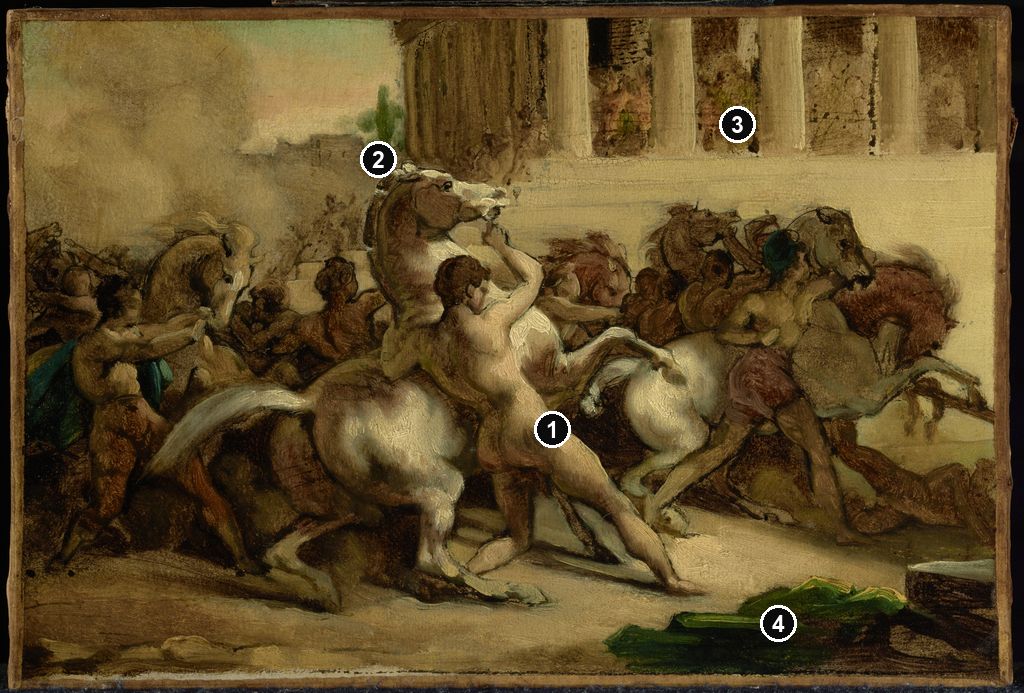
The central man's back gives the composition its clearest human shape. Light runs across his shoulders, torso and extended leg. His head turns away, withholding the facial expression that might make him a portrait or a named protagonist. We understand him through his posture: the wide base of his legs, the bend and reach of his arms, and the way his body answers the rising animal. The scene's drama is carried by physical relationships rather than individual identities.
Above him, the pale horse's head is sharply lifted. Its dark mane and open mouth break the bright outline; the neck gathers into a much larger light mass below. Man and animal are close enough for their contours to compete. It takes a moment to disentangle an arm from a horse's neck and the human torso from the surrounding bodies. That effort of looking becomes part of the subject. The viewer has to find structure inside the same crowded encounter the men are trying to control.
The horse to the left of the central man is seen largely from behind, its rounded hindquarters brightly lit and its pale tail sweeping sideways. This broad curved form anchors the lower half of the group. It also prevents the central encounter from becoming a simple silhouette of man against horse. Several bodies occupy different angles at once: a back, a flank, a raised neck, a turned head. Géricault keeps changing the orientation of the bodies so that movement feels three-dimensional even within a shallow, tightly packed space.
On the right, a pale horse extends its legs while men crowd around its head and shoulders. The large light shape of its flank is set against dark limbs and warm brown shadow. The opposing directions are especially clear here: the horse's body stretches one way while the human group pulls the viewer's attention back towards its head. The painting's energy comes from such divided forces. A single diagonal would make the action easier to follow, but it would lose the sense of several wills struggling together.
Annotated Details from The Race of the Riderless Horses
The numbered points identify visible features discussed in this article. Return from each detail to the whole composition. The Race of the Riderless Horses — Getty study Image source. CC0 / Public domain.
Details from THE RACE OF THE RIDERLESS HORSES
Compare the cropped details with the complete images above. Notice how their colours, shapes and positions contribute to the larger compositions.
A body braced against movement
The central figure’s wide stance anchors his body while his arms reach into the struggle above.
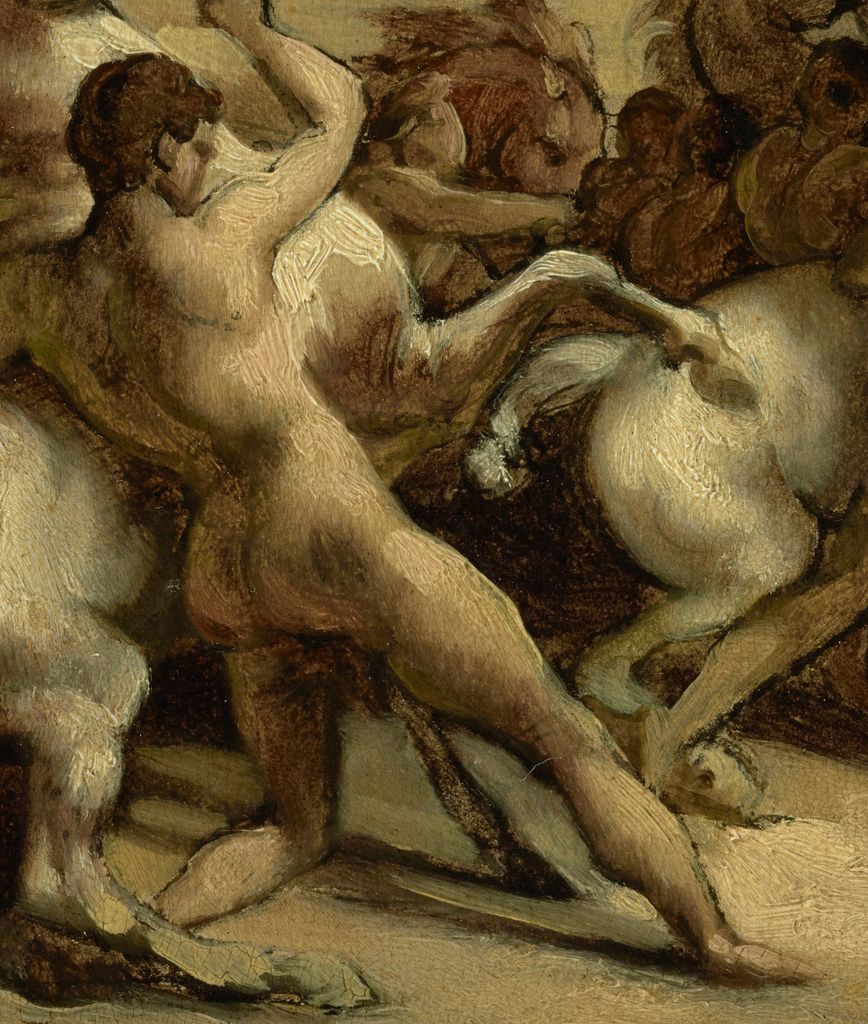
The raised horse’s head
Dark accents sharpen the mouth and eye against the broad pale shape of the horse’s neck.
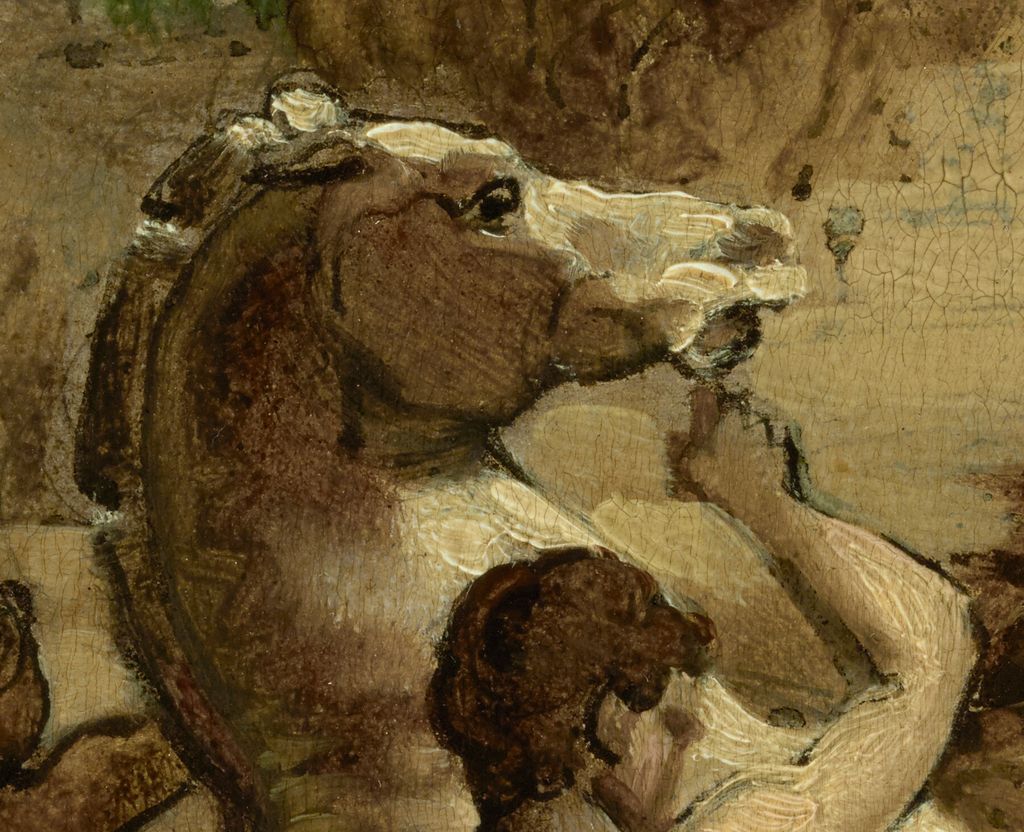
A stable frame for unstable bodies
The upright architectural divisions stand still above horses and men moving at competing angles.
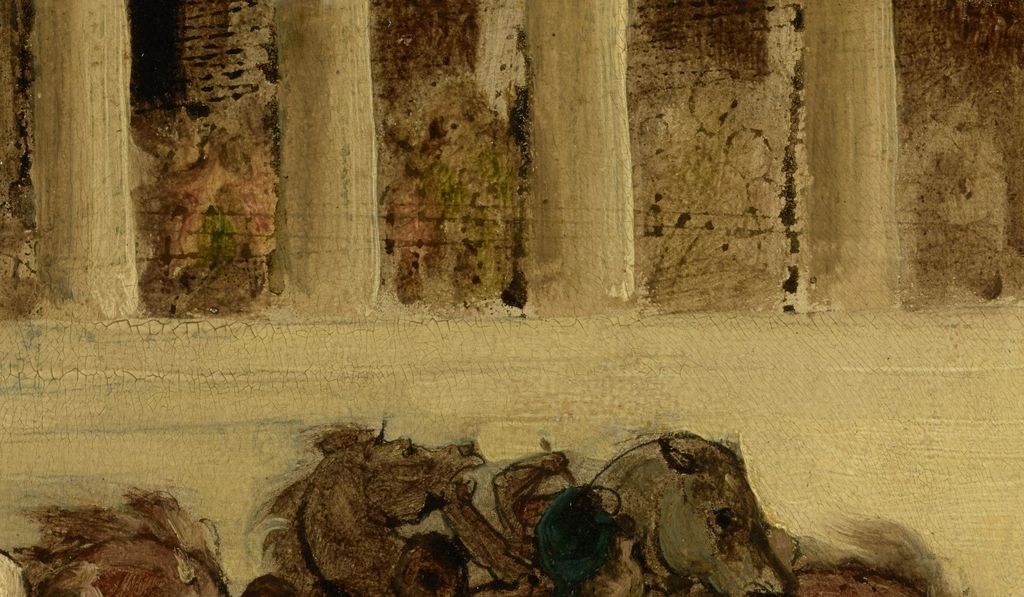
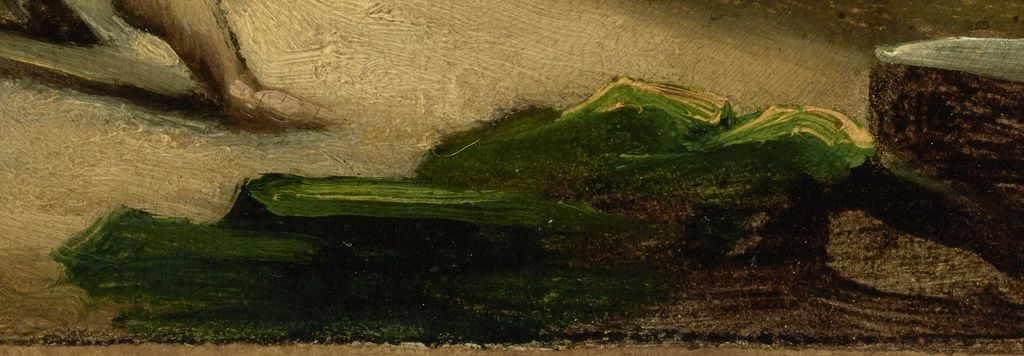
Colour beyond the crowd
A folded green shape interrupts the pale foreground and the otherwise muted colour range.
Modern grooms, ancient athletes
The men's nakedness makes this more than an image of contemporary carnival preparations. The Getty interprets the central muscular figure through the example of ancient Greek athletes and compares the horses with the Parthenon frieze associated with Phidias. In the museum's reading, Géricault transforms a modern event through classical models. These comparisons explain the study's unusual mixture of immediate physical excitement and carefully displayed bodies. [1]
The comparison with sculpture is particularly useful when looking at the background. Tall architectural divisions rise behind the horses, while a long pale horizontal band crosses the middle distance. In front of this stable framework the bodies form a broken, irregular sequence. The setting gives the struggle something like the shallow stage of a relief. Light picks out backs and flanks as separate projecting masses, and deep shadow presses into the gaps between them.
Yet the figures do not settle into a calm classical procession. The central man's legs stretch across the lower foreground, and the horses' heads interrupt the orderly divisions behind them. A frieze offers a way of organising a crowd across a long surface; Géricault subjects that order to strain. The architecture stands upright and still, while nearly everything beneath it bends, turns or braces. The contrast makes the human and animal effort easier to feel.
It would therefore be too simple to treat the naked bodies as evidence that Géricault had forgotten the real event. Their visibility is central to what the study does. Clothing would conceal the articulation of shoulders, backs and thighs; here those parts show how force travels through a body. The antique comparison and the practical act of restraint meet in the same pose. A figure can recall an athlete while also appearing fully occupied with keeping his footing beside an unpredictable animal.
The picture likewise gives no secure basis for identifying these men as particular mythological characters. Its classical associations operate through form, scale of gesture and bodily display. The carnival supplies the action, and the antique supplies a visual language in which that action can acquire the weight of a major figure composition. The result holds observed spectacle and artistic transformation together without requiring an invented ancient story.
Watch: Géricault and The Raft of the Medusa
Three perspectives on Géricault’s best-known painting, its making and its historical setting.
Gericault, Raft of the Medusa
Smarthistory examines the composition and historical setting of The Raft of the Medusa.
Watch on YouTubeA nearly monochrome study with flashes of colour
Brown, cream, grey and muted gold dominate the work. The Getty describes its colour as almost monochromatic and emphasises the vigorous application of paint and dramatic light and shade. The restrained range allows human skin and horses' coats to share a system of light masses and dark recesses. Differences between species remain legible, but neither group receives a separate, decorative colour scheme. [1]
Look more slowly and small interruptions become conspicuous. Blue-green fabric appears among the men at the left. A deep green accent sits near the right-hand horse's head. In the lower right foreground, a folded green shape edged with warmer strokes lies on the ground. These isolated colours make the surrounding earth tones seem more continuous. The foreground shape also gives the eye a brief resting place outside the press of moving bodies, though its precise identity need not be guessed to see its compositional effect.
The surface preserves a productive difference between suggestion and definition. The central horse's mouth and eye receive pointed dark accents; elsewhere bodies are established by broad passages of light, brown shadow and rapidly turning contours. Some background forms barely emerge from the painted atmosphere. Géricault directs attention through these changing degrees of clarity. He does not give the distant setting the same insistence as the illuminated bodies at the front.
The recorded combination of pen, ink and oil places the study across the conventional boundary between drawing and painting. That description does not, by itself, establish which marks came first or identify every dark line as ink. What is visible is the importance of line within the painted masses: contours catch a head, separate a bent arm or sharpen the meeting of light and shadow. The material description and the experience of looking both point to an image that explores structure while testing a broad arrangement of tones. [1]
Other studies show other possibilities
The Getty work should be distinguished from the Louvre's painted study of the riderless races, RF 2042. The Louvre identifies that separate object as oil on paper mounted on canvas, 45 × 60 cm, painted in Rome around 1817. It entered the collection in 1912. Its larger dimensions and different accession establish that a similar subject and title do not make it the Getty picture. Each composition needs to be read on its own terms. [12]
The Thyssen painting provides an especially clear contrast in narrative moment. Borobia identifies its horse as the winner, wearing green and gold cloth and led by a young man carrying a yellow flag. The youth, in traditional Roman dress, conducts the animal in a ceremonial display after the competition. That is a later phase of the event, not another view of the tense pre-start struggle in the Getty study. The essay also connects the winner motif with drawings in Besançon and Orléans. [10]
This range matters because it shows that the race project was not confined to one repeated formula. Restraining horses before release and parading a winner produce different relations between men and animals. In one, the human figure must resist; in the other, the pair can proceed together in public display. These are different dramatic possibilities within the same festival, rather than a sequence that can automatically be reconstructed as stages towards a single surviving final design.
The Louvre's preparatory sheet, La course des chevaux libres, INV 26736, offers another kind of evidence. Executed in brown pen and ink on buff paper, it measures 29.5 × 46 cm. The museum relates it to the group of painted race studies represented in several collections, including Paris, Rouen, Lille and Baltimore. It confirms the importance of drawing in Géricault's practice while remaining a separate work, with its own materials and history. [11]
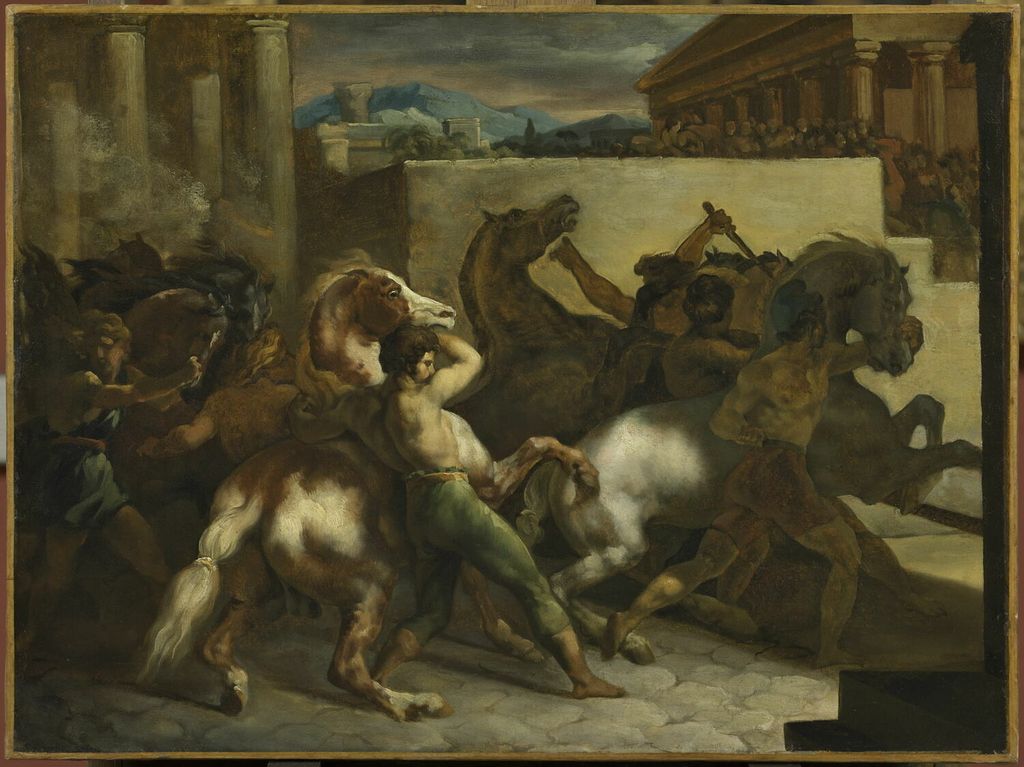
Riderless Horse Races — Louvre study Image source. Public domain.
A small work carrying a large ambition
According to the Getty, Géricault intended the study to contribute to a grand painting for submission to the Salon, but abandoned the project when recalled to France at short notice. Borobia's account likewise describes a body of studies that did not reach a definitive large canvas. The surviving Getty picture consequently has a double character: it is a compelling image in itself and evidence of an ambition whose completed form cannot be inspected. [1] [10]
That absence should not encourage us to treat every unresolved passage as a deficiency. The study concentrates on the relation between a mass of figures and an architectural setting, the alternation of illuminated bodies and dark intervals, and the conversion of a public spectacle into a heroic subject. Its small scale permits those decisions to be grasped together. Enlarging it in the imagination helps explain the ambition, but the extant object has its own pace and physical presence.
The last impression is of control continually being tested. Architecture contains the crowd; dark outlines contain light bodies; men attempt to contain horses. None of these boundaries seems completely secure. Before a single animal has begun its riderless course, Géricault has found a drama in the effort to hold movement still.
Géricault collection records
Seventy collection records include paintings, drawings and individual print impressions. Different impressions remain separate records; this selection is not a complete catalogue raisonné.
Frequently Asked Questions
The Getty study shows the preparations immediately before release. Grooms restrain the excited animals; the horses will run the race without riders. [1]
The Getty interprets the muscular central nude through ancient Greek athletes and compares the horses with the Parthenon frieze. The naked figures help transform a modern carnival spectacle into a composition with classical associations. [1]
Discussion
Look again at the images and ideas explored in The Race of the Riderless Horses. These editorial prompts invite your observations.
Reader Insights
Follow the central man’s planted feet and raised arms. Where does his pose make the horse’s resistance easiest to feel?
Compare the still vertical divisions of the architecture with the changing angles of the bodies. How does the background affect the apparent movement?
Find the isolated green accents within the brown and cream palette. Where does your eye pause, and where does it return to the struggle?
Join the Conversation
Share a detail, comparison or question about The Race of the Riderless Horses below.
References
- J. Paul Getty Museum, The Race of the Riderless Horses, 1817, accession 85.PC.406. Object metadata and museum interpretation, English. View source.
- Nationalmuseum, The Severed Heads, NM 2113; collection metadata and museum interpretation (Swedish). View source.
- Louvre, Charging Chasseur, INV 4885; collection metadata and museum interpretation (French/English interface). View source.
- National Gallery, Horse frightened by Lightning; collection metadata and museum interpretation (English). View source.
- Louvre, Wounded Cuirassier, INV 4886; collection metadata and museum interpretation (French). View source.
- Louvre, The Raft of the Medusa, INV 4884; collection metadata and museum interpretation (French). View source.
- Gary Tinterow / The Metropolitan Museum of Art, Géricault’s Heroic Landscapes: The Times of Day, Met Bulletin 48/3, Winter 1990–91; consulted main essay and relevant object entries (English). View source.
- Vlaamse Kunstcollectie, Portrait of a Kleptomaniac; collection metadata and museum interpretation (Dutch). View source.
- Louvre, Epsom, MI 708; collection metadata and museum interpretation (French/English interface). View source.
- Mar Borobia / Museo Nacional Thyssen-Bornemisza, Carrera libre de caballos, about 1817, inventory 157 (1979.40). Object metadata and catalogue essay, Spanish. View source. (in Spanish).
- Musée du Louvre, Département des Arts graphiques, La course des chevaux libres, INV 26736, recto. Materials, dimensions, commentary and history, French; record updated 24 September 2024. View source. (in French).
- Musée du Louvre, Département des Peintures, Course de chevaux libres à Rome, RF 2042, about 1817. Object fields and history, French; record updated 27 October 2023. View source. (in French).


