



 by Tom Gurney
Tom Gurney BSc (Hons) is an art history expert with over 20 years experience
Email: tomgurney1@gmail.com / Phone: +44 7429 011000
Head of a Guillotined Man by Théodore Géricault: Introduction
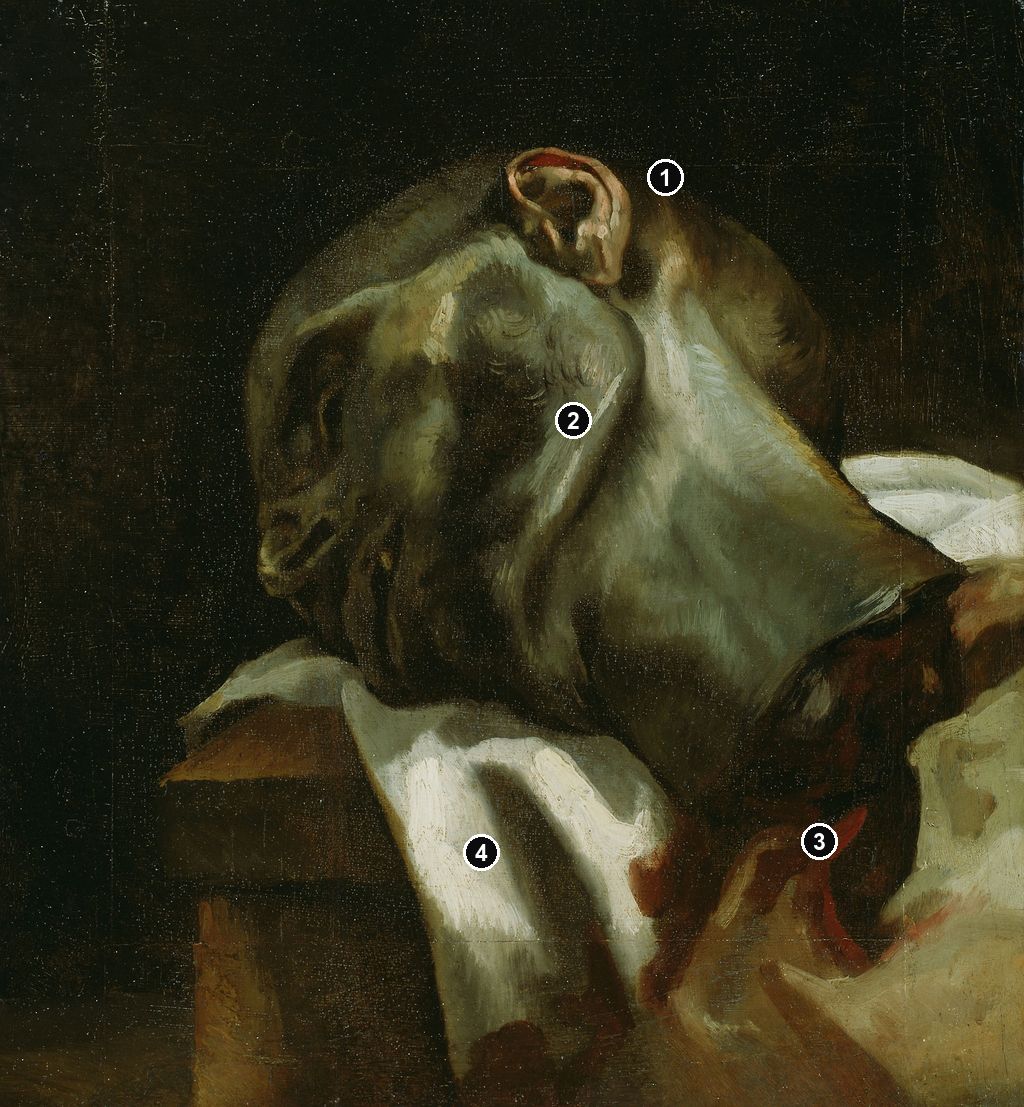
A man's head lies on its side, with the ear uppermost and the face turned towards the lower left. Pale light travels across the temple and cheek before meeting the dark hollow around the eye. Below, white cloth bunches beside the exposed neck, interrupted by deep reds and browns. Géricault brings the head close enough for its separate features to remain recognisable, while making its separation from the body impossible to overlook.
Head of a Guillotined Man, painted in 1818–19, belongs to the Art Institute of Chicago. It is an oil painting on panel, measuring 41 × 38 cm, with the accession number 1992.628. These details identify the particular work: a compact, almost square painting of a single head, rather than the paired heads in Stockholm or one of Géricault's other anatomical subjects. The Chicago museum describes it as painted from an actual corpse and considers the man probably to have been a convicted criminal. His name is not supplied. [1]
The painting holds together two kinds of attention. Its light, colour and arrangement invite the sustained looking familiar from a still life. Its subject makes that looking uncomfortable. The head retains the specificity of a human face even as it rests among folds of cloth and the hard edges of a table. That tension gives this small panel an intensity beyond the shock of its title.
At a Glance
This work across Théodore Géricault’s career
The Severed Heads
1810s [2]Charging Chasseur
1812 [3]Horse Frightened by Lightning
c.1813–14 [4]The Raft of the Medusa
1818–19 [6]Portrait of a Kleptomaniac
c.1820–24 [8]The Epsom Derby
1821 [9]Contents
- A face turned out of its familiar position
- Cloth, blood and the table
- What the title can tell us
- Studying death during the years of the Raft
- A different encounter from the Stockholm heads
- Science, horror and punishment
- From private collections to Chicago
- Annotated details
A face turned out of its familiar position
The tilt is crucial. To read the face as a face, the eye has to adjust to an orientation that a conventional portrait rarely demands. The forehead slopes down towards the left; the nose projects into darkness; the mouth sits below it near the cloth. The ear occupies a conspicuously high position. The composition makes the viewer reconstruct an ordinary human head from a deeply unfamiliar presentation.
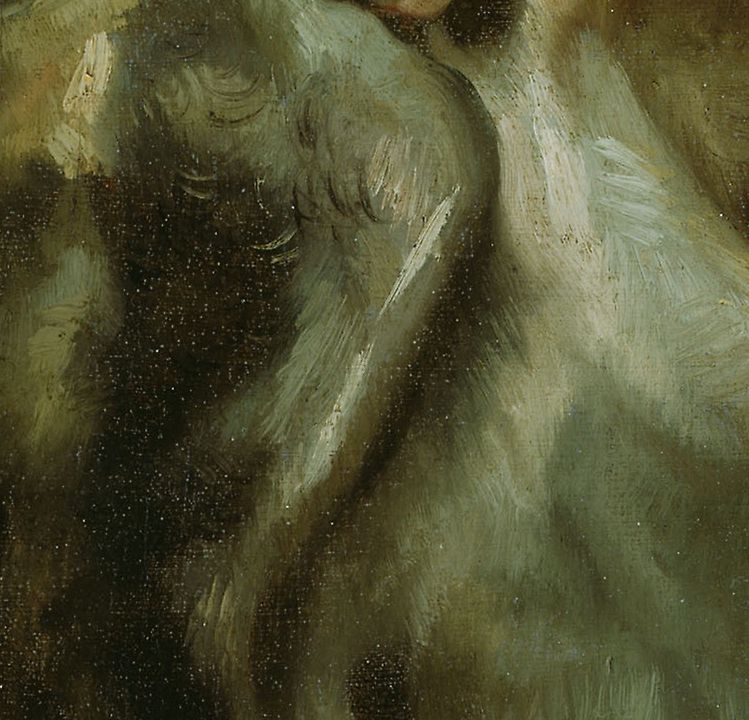
Géricault does not light every feature equally. A broad, grey-green passage across the side of the face provides the main expanse of flesh, while warmer touches pick out the ear and smaller areas around the mouth. The eye remains recessed. Fine, curved marks describe hair at the temple, contrasting with the wider strokes modelling the cheek. Within a narrow range of colour, these differences keep the head from becoming a single inert shape.
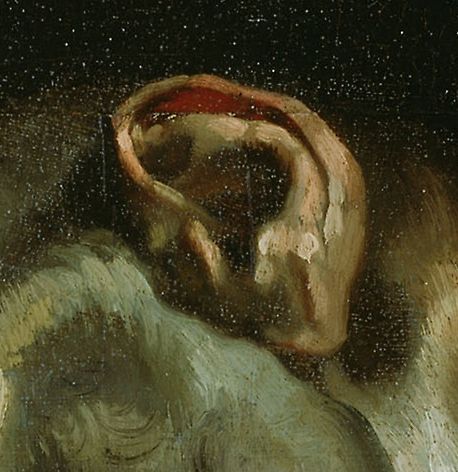
The ear is particularly arresting because its rim catches the light against the dark background. Its warm interior and folded structure offer a concentration of recognisable detail near the top of the head. From there, the illuminated side of the face broadens downwards. The spectator's attention can move between a small anatomical feature and the larger weight of the head, between something minutely observed and the overall fact of a body fragment.
Much of the upper part of the picture is dark. There is no room to explore behind the head, no window, observer or explanatory action. The darkness offers little relief from the subject. It also allows selected edges to emerge sharply while other areas merge with their surroundings. What first looks like a blunt confrontation becomes, on closer inspection, a carefully varied pattern of visibility and obscurity.
Cloth, blood and the table
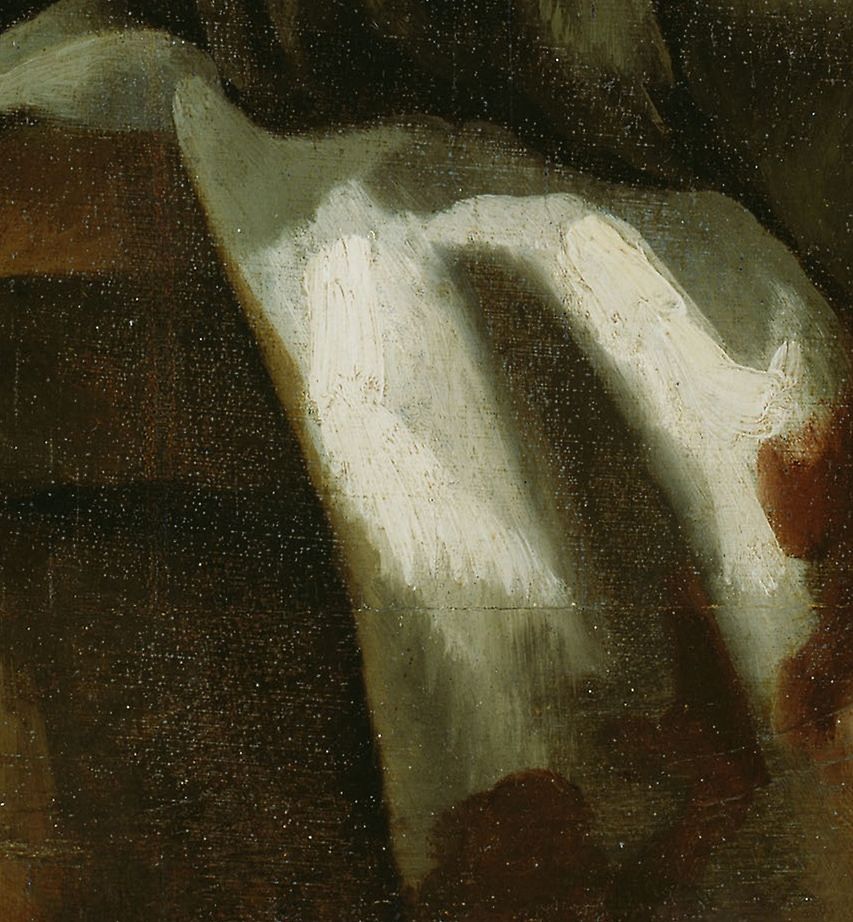
The cloth prevents the head from floating in an abstract dark space. A bright fold rises in the foreground, bends towards the face and drops towards the bottom edge. At the right, another white passage meets the neck. These areas establish a surface on which the head has been placed, while their folds make the arrangement feel close and tangible.
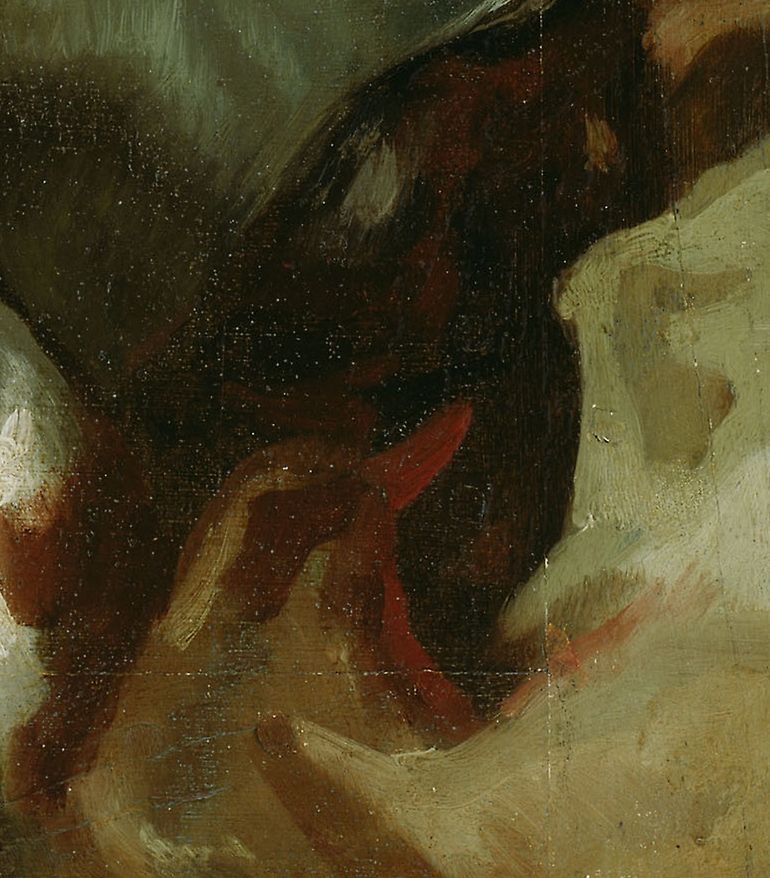
The strongest contrast is between these pale ridges and the reds around the cut neck. Géricault gives the wound a place within the composition without turning it into a fully exposed anatomical diagram. Dark passages interrupt the boundary between head and cloth; red strokes spread into the foreground fabric. The eye cannot follow a completely clean outline, and that uncertainty of edges contributes to the material weight of the scene.
A brown, angular table edge appears towards the lower left. Its relative straightness matters beside the curves of the face and the supple fabric. The Art Institute explicitly connects the head, the blood-stained cloth and the wooden table with the Western tradition of still-life painting, suggesting that the reference may be ironic. This is the museum's interpretation of the arrangement, rather than a recorded explanation by Géricault. [1]
Seen in that light, the cloth does more than provide a practical resting place. It supplies folds, highlights and intervals of colour of the kind a painter might study around ordinary objects. Here, however, the object at the centre of that arrangement is a person’s severed head. The familiar pleasures of painted light and texture remain available, but they cannot be separated comfortably from the subject. The picture makes the act of looking part of its difficulty.
Annotated Details from Head of a Guillotined Man
The numbered points identify visible features discussed in this article. Return from each detail to the whole composition. Head of a Guillotined Man Image source. Public domain.
Details from HEAD OF A GUILLOTINED MAN
Compare the cropped details with the complete images above. Notice how their colours, shapes and positions contribute to the larger compositions.
The elevated ear
Light catches the folded ear above the face, making the head’s unfamiliar orientation especially clear.
Hair and the side of the face
Curved marks at the temple meet broad grey-green modelling across the cheek, varying the treatment within the flesh.
White cloth beside the neck
White fabric, red strokes and deep shadows meet around the severed neck; their broken edges resist a clean anatomical outline.
The foreground fold
A bright fold bends towards the face and falls downwards beside the brown table edge, anchoring the head on a tangible surface.
What the title can tell us
The title identifies a mode of death; it does not identify an individual. Chicago's description says that the head probably belonged to a convicted criminal. That qualification matters. It supports a connection with execution while leaving the man's identity and the circumstances of his death unresolved. Neither his offence nor his personal history can be recovered simply by examining the face. [1]
The face nevertheless resists complete anonymity. The shape of the ear, the projecting nose, the hair and the modelling around the mouth distinguish it from a general emblem of mortality. A viewer can recognise individuality without knowing a name. Géricault's close attention makes this distinction especially pressing: the painting offers abundant visible information about the head and almost no biographical information about the person.
Colour also has its limits as evidence. The grey-green flesh differs markedly from the white cloth and the warm reds nearby, but a painted surface cannot establish a precise medical condition or the interval since death. Its tones belong to an image constructed through paint, lighting and composition. The Art Institute places the work within Géricault's study of anatomy and decomposition; that account does not make every brushstroke a clinical measurement. [1]
Watch: Géricault and The Raft of the Medusa
Three perspectives on Géricault’s best-known painting, its making and its historical setting.
Gericault, Raft of the Medusa
Smarthistory examines the composition and historical setting of The Raft of the Medusa.
Watch on YouTubeStudying death during the years of the Raft
The date places the panel within the period when Géricault was working on The Raft of the Medusa. Chicago describes his acquisition of corpses from a local morgue and his production of several paintings of severed heads and limbs. Such studies gave him access to bodies very different from the active living models of conventional figure painting. Their stillness, discolouration and weight presented their own demands of observation. [1]
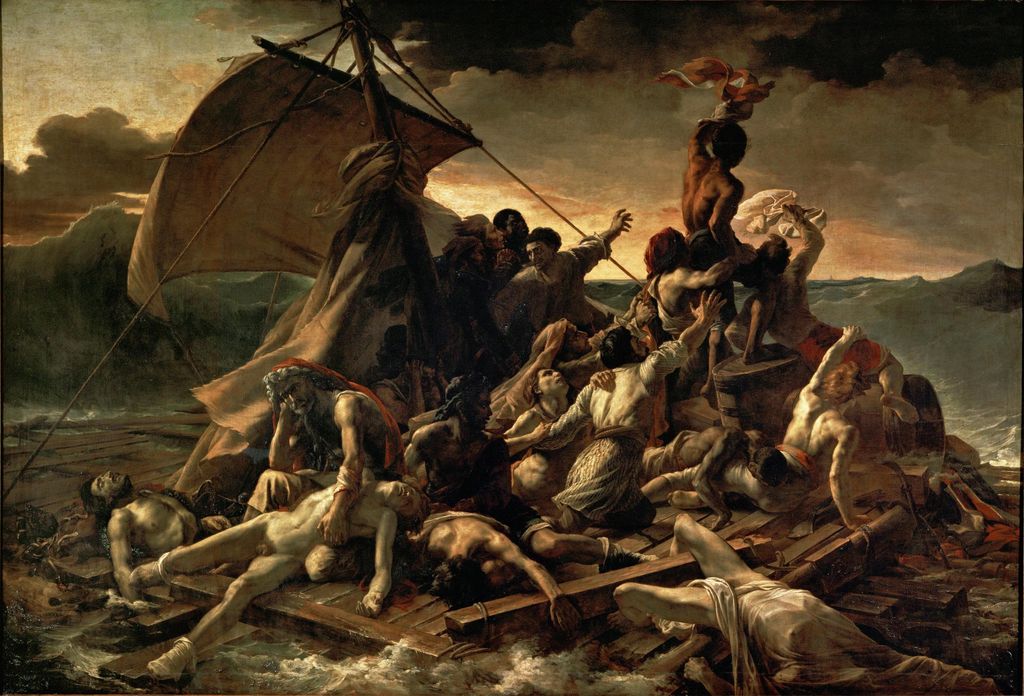
The relation to the Raft needs to remain proportionate. Nationalmuseum, discussing its own The Severed Heads, proposes a probable connection between these anatomical pictures and Géricault's effort to depict death convincingly in the shipwreck painting. That is a useful account of a broader artistic investigation. It does not demonstrate that Chicago's head was a design for a particular figure in the final composition, or that its entire purpose was preparation for another work. [2]
The distinction becomes clear in the experience of viewing. The Raft places dead and living bodies within a collective emergency. This panel isolates one head, removes surrounding action and gives the cloth almost as much compositional importance as the face. Even if observation of a corpse contributed to Géricault's larger project, the resulting painting has its own organisation and its own demands on a spectator.
The 2006 Géricault exhibition dossier from the Musée des Beaux-Arts de Lyon also sets anatomical fragments beside his wider interest in executions. Its checklist includes a drawing of four studies of a guillotined head, dated there to 1818–20. This establishes a broader field of related subjects; it does not identify that drawing's model with the man in Chicago. Similar subjects should not be treated as documents of the same person without further evidence. [10]
The Raft of the Medusa Image source. Public domain.
A different encounter from the Stockholm heads
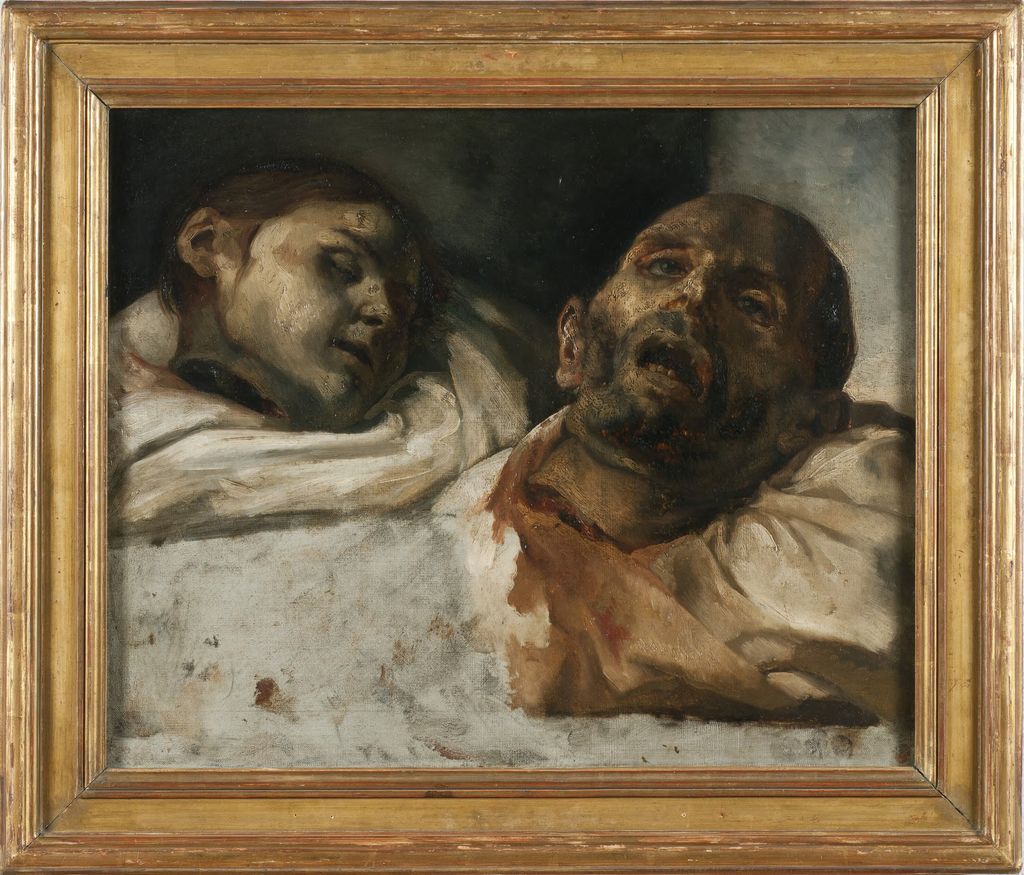
In The Severed Heads, now at Nationalmuseum in Stockholm, two heads occupy a wider field of white cloth. The faces can be compared with one another, and the more frontal head on the right creates an encounter quite unlike the sideways face in Chicago. The Stockholm painting is oil on canvas, 50 × 61 cm, and the museum dates it to the 1810s. Those are the details of a separate work. [2]
Chicago's panel concentrates the experience. With no second face to distribute attention, the tilted head dominates the narrow space. The elevated ear and broad side of the cheek become particularly prominent, and the dark upper field presses the subject towards the cloth below. The comparison shows how much depends on arrangement: related anatomical material can produce different relationships between spectator and face. It also explains why the single panel deserves to be considered beyond its membership of a macabre group.
The Severed Heads Image source. Public domain.
Science, horror and punishment
Later exhibitions have offered different ways of understanding Géricault's attention to bodily fragments. The Schirn Kunsthalle Frankfurt's 2013–14 exhibition Géricault: Images of Life and Death placed these subjects between scientific observation and the Romantic attraction to horror. Its accompanying account argued that realism and Romanticism could coexist in such images rather than operate as opposing styles. The published exhibition summary supports that interpretive framework; it is not testimony from the painter about this panel. [11]
The Chicago painting makes the framework useful. The differentiation of flesh, hair, ear and fabric suggests concentrated observation. At the same time, the isolation of the head and the exclusion of any explanatory setting heighten its disturbing presence. An interest in bodily structure and an image's emotional force can operate together. Neither requires the viewer to imagine that Géricault looked without feeling, or to diagnose him from his choice of subject.
The Lyon dossier offers a more political reading. In its section on sacrifice and execution, Bruno Chenique interprets the arrangement of Géricault's anatomical fragments as a rejection of capital punishment associated with liberal abolitionism. That interpretation gives the cut body a place within debates about state violence. It should remain attributed to Chenique: the panel itself contains no written declaration, named execution or narrative identifying a particular political event. [10]
The absence of a spectacle is striking nonetheless. There is no scaffold, official, crowd or moment of execution. What remains is a face and the physical aftermath of violence. The painting allows an ethical response to that aftermath without supplying a complete story about the person or a single compulsory explanation of the artist's motives.
From private collections to Chicago
The work's later history is better documented than its earliest ownership. The Art Institute tentatively associates it with Géricault's estate sale in November 1824, possibly among studies of human body parts or heads. The identification is uncertain, so the sale cannot provide an unbroken starting point for the panel's provenance. [1]
The museum records the painting in the collection of the painter Auguste Boulard and in his estate sale of 1900. It subsequently belonged to the duc de Trévise, who lent it to the Géricault centenary exhibition in Paris in 1924. Pierre Dubaut owned it by 1952; it passed to his niece Jacqueline Dubaut-Bellonte before the Art Institute purchased it in 1992. These documented stages preserve the distinction between known owners and uncertain transitions. [1]
Its exhibition history includes the 1953 Géricault exhibition in Winterthur and the 1991–92 retrospective at the Grand Palais in Paris. Long before its acquisition by Chicago, it therefore circulated as a work to be considered within the artist's achievement. [1] That history does not settle its original function. It does help explain why the panel is encountered today as a sustained painting rather than merely a surviving anatomical exercise. Its small format rewards close attention, while its unresolved human identity keeps that attention from becoming easy familiarity.
Géricault collection records
Seventy collection records include paintings, drawings and individual print impressions. Different impressions remain separate records; this selection is not a complete catalogue raisonné.
Frequently Asked Questions
His name is not supplied in the Art Institute of Chicago’s record. The museum considers him probably to have been a convicted criminal; that identification remains qualified. [1]
Discussion
Look again at the images and ideas explored in Head of a Guillotined Man by Théodore Géricault. These editorial prompts invite your observations.
Reader Insights
How does the head’s sideways orientation change the way you recognise the face?
Follow the brightest folds of cloth. Where do they carry your eye, and how do they alter the surrounding dark areas?
What changes when you look at the painting as a still life, and what remains difficult to reconcile with that category?
Join the Conversation
Share a detail, comparison or question about Head of a Guillotined Man by Théodore Géricault below.
References
- Art Institute of Chicago, Head of a Guillotined Man, 1818–19, accession 1992.628; object description, medium and dimensions, provenance and exhibition history. View source.
- Nationalmuseum, Stockholm, The Severed Heads (De avhuggna huvudena), NM 2113; collection record, object description and exhibition text, Swedish. View source. (in Swedish).
- Louvre, Charging Chasseur, INV 4885; collection metadata and museum interpretation (French/English interface). View source.
- National Gallery, Horse frightened by Lightning; collection metadata and museum interpretation (English). View source.
- Louvre, Wounded Cuirassier, INV 4886; collection metadata and museum interpretation (French). View source.
- Louvre, The Raft of the Medusa, INV 4884; collection metadata and museum interpretation (French). View source.
- Gary Tinterow / The Metropolitan Museum of Art, Géricault’s Heroic Landscapes: The Times of Day, Met Bulletin 48/3, Winter 1990–91; consulted main essay and relevant object entries (English). View source.
- Vlaamse Kunstcollectie, Portrait of a Kleptomaniac; collection metadata and museum interpretation (Dutch). View source.
- Louvre, Epsom, MI 708; collection metadata and museum interpretation (French/English interface). View source.
- Musée des Beaux-Arts de Lyon / Bruno Chenique, Géricault: La folie d'un monde, exhibition press dossier, 2006, p. 6, “Sacrifices et mises à mort,” and related checklist, p. 10, French. View source. (in French).
- Schirn Kunsthalle Frankfurt, Géricault: Images of Life and Death, exhibition, 18 October 2013–26 January 2014; exhibition summary and catalogue description, English. View source.


