



 by Tom Gurney
Tom Gurney BSc (Hons) is an art history expert with over 20 years experience
Email: tomgurney1@gmail.com / Phone: +44 7429 011000
Riderless Horse Races: Géricault’s Louvre Study: Introduction
A man in green trousers leans backwards between two powerful horses. His bare torso catches the light, his feet spread across the paving, and his raised arms struggle to hold the animals close. Around him, more men and horses press into the same narrow foreground. Théodore Géricault’s Riderless Horse Races concentrates on the effort required to contain movement before it becomes a race. The work belongs to the Musée du Louvre, where it is catalogued as Course de chevaux libres à Rome, inventory RF 2042. Painted in Rome around 1817, it is an oil study on paper mounted on canvas, measuring 45 × 60 cm. [1]
The title promises freedom, but almost everything visible concerns restraint. Hands grip, bodies brace and horses turn against one another. The architecture holds this turbulence inside a firm framework: columns at the left, a pale wall behind the animals, and a crowded colonnade at the upper right. Géricault makes the men’s work as absorbing as the horses’ strength. The result is a study of physical relationships, in which the release of the animals remains an expectation rather than a completed action.
At a Glance
- DateAbout 1817 [1]
- CollectionMusée du Louvre, Paris [1]
- InventoryRF 2042 [1]
- MediumOil on paper mounted on canvas [1]
This work across Théodore Géricault’s career
The Severed Heads
1810s [2]Charging Chasseur
1812 [3]Horse Frightened by Lightning
c.1813–14 [4]The Raft of the Medusa
1818–19 [6]Portrait of a Kleptomaniac
c.1820–24 [8]The Epsom Derby
1821 [9]Contents
- A Roman spectacle and its different moments
- The central handler: strength under pressure
- The pale wall and the pressure of the foreground
- An oil study with a developed composition
- The Getty and Thyssen paintings are separate works
- Drawings, an unrealised project and a later museum life
- Annotated details
A Roman spectacle and its different moments
Géricault travelled to Italy at his own expense after his unsuccessful attempt at the Prix de Rome in 1816. The Roman carnival and its horse races supplied material for an ambitious painting project. The surviving drawings and painted studies show sustained work on the subject, although the proposed monumental painting was never completed. The Musée des Beaux-Arts de Lyon’s 2006 exhibition dossier places these works within his encounter with Roman public life, alongside his study of heroic bodies and established painting traditions. [10]
These were races without riders. The Louvre’s drawing catalogue describes the course along the Corso, from the Piazza del Popolo to the Piazza Venezia, and identifies the animals as barbes, or barberi. Men still played an essential part in preparing and managing the event. Their presence in a painting of riderless horses is therefore no contradiction: the spectacle depended on a difficult passage from human control to animal motion. [11]
The phrase “horse race” can conceal several different subjects. A study may concern the restraint before release, the recovery of the animals, or the celebration of a winner. The Lyon exhibition checklist identifies the Louvre painting specifically as La Course des chevaux libres: la Mossa, while applying la Ripresa to the Lille painting and related drawings. These distinctions matter when comparing works with similar English titles. The present Louvre catalogue uses the broader title Course de chevaux libres à Rome. [10]
The Louvre study’s straining men and crowded horses make pre-start restraint its compelling subject. It contains neither a clear winner nor an unobstructed view down a racing course. The paved space is occupied by bodies pulling in different directions. Looking first for the contest itself can obscure the more immediate drama: how long the men can maintain their hold, and what will happen when that hold gives way.
The central handler: strength under pressure
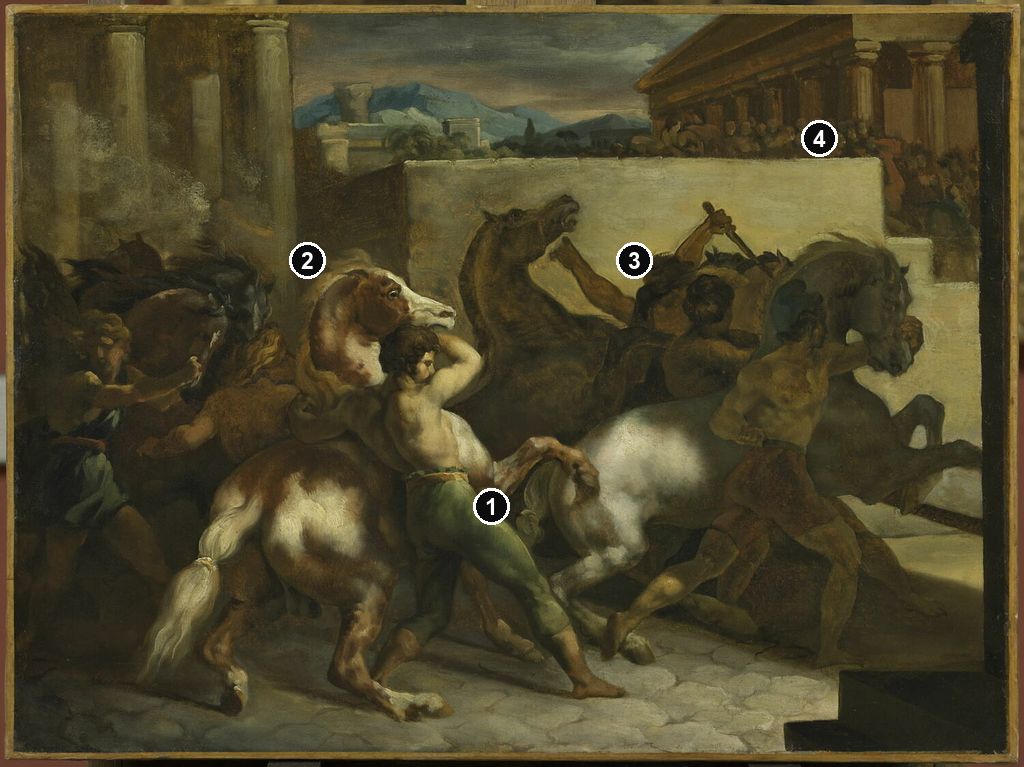
The central man provides a way into a composition that initially appears congested. His green trousers divide the pale horses and flesh tones from the darker ground around them. The colour is restrained, yet it gives his lower body a clear shape. One leg extends towards the right; the other supports him nearer the chestnut horse. His stance forms a wide base, while his torso bends away from the animals. The body appears to be resisting a pull that could upset that balance at any moment.
Above the waist, the movement is less easy to disentangle. One arm rises beside the chestnut horse’s head; the other bends over his own. His head turns into this compressed knot of hands, mane and muzzle. Géricault does not isolate the man against an empty background. The point of contact is partly hidden by the very animals he is trying to manage. That obstruction makes the struggle convincing: the handler has little room in which to work, and the viewer has little room in which to separate the participants.
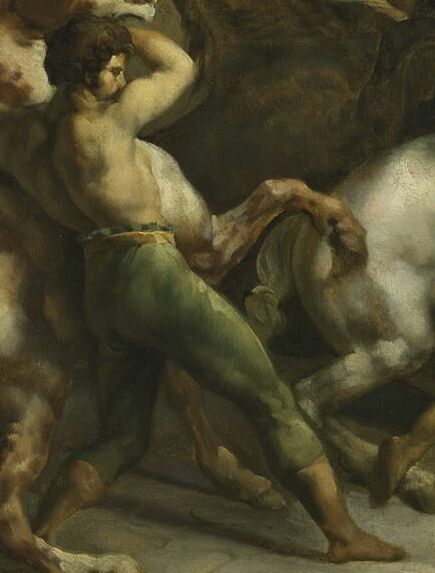
The chestnut horse beside him is particularly vivid. Its white face turns across the man’s upper body, while broad white patches illuminate its chest and flank. Its pale tail falls towards the paving. These light passages let the eye follow the animal through an otherwise dark cluster, but its outline remains interrupted by the man and neighbouring horses. Géricault gives it a substantial body without allowing it a self-contained space.
At the right, another bare-chested handler adopts a different posture. He bends and turns with a dark horse whose head curves sharply down towards him. His extended legs and the horse’s projecting forelegs create a succession of diagonals. The central man seems to lean against the force bearing on him; the right-hand man seems caught within a turning movement. Their contrast gives the struggle variety. Physical power is expressed through different acts of balance, resistance and adjustment rather than through a row of identical muscular poses.
Annotated Details from Riderless Horse Races: Géricault’s Louvre Study
The numbered points identify visible features discussed in this article. Return from each detail to the whole composition. Riderless Horse Races — Louvre study Image source. Public domain.
Details from RIDERLESS HORSE RACES: GÉRICAULT’S LOUVRE STUDY
Compare the cropped details with the complete images above. Notice how their colours, shapes and positions contribute to the larger compositions.
The braced handler
The central man leans backwards and spreads his legs to resist the horses’ pull. His green trousers make his stance easy to follow.
A white face in the crush
The chestnut horse’s white face turns across the handler’s body, compressing human and animal movement into the same small space.
Hands against the wall
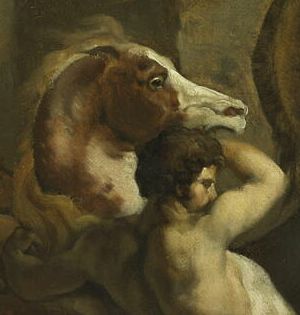
The pale masonry makes the raised muzzle, bent arms and clenched hands easier to distinguish.
The spectators above
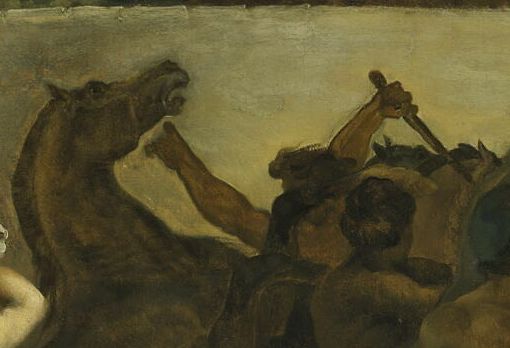
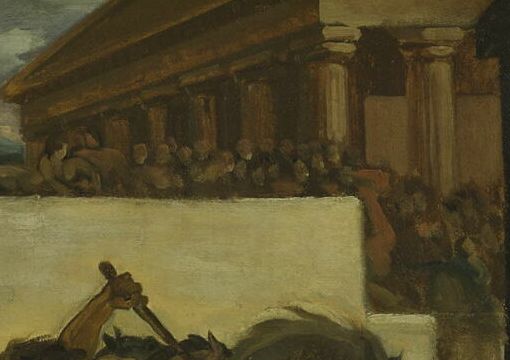
Spectators gather beneath the colonnade, separated from the handlers by the wall.
The pale wall and the pressure of the foreground
The pale wall is one of the painting’s most effective devices. Its long horizontal top cuts across the scene behind the horses’ heads. Against it, a raised muzzle, an arm and a clenched hand become unusually legible. Below, the foreground is full of intersecting curves; above, the wall offers a broad area of comparative stillness. It allows the viewer to register small changes in gesture without clearing away the crowd of bodies.
The wall also separates the handlers from the spectators. At the upper right, small figures gather beneath a receding colonnade and look down towards the action. Their compressed heads and shoulders make a dark band above the light masonry. The difference in scale is striking. The men closest to us must use their whole bodies, while the people behind the barrier are reduced to watching faces and silhouettes. This division makes the race a public spectacle without letting the audience displace the practical work in the foreground.
At the left, tall columns interrupt the view and deepen the shadows. Between the architecture, blue-grey hills appear in the distance. That opening supplies a brief release from the congestion, but the dominant space remains enclosed. The horses are not silhouettes galloping across an open landscape. They fill a constructed arena of paving, walls and spectators. It would be misleading to treat every architectural feature as a securely identified record of the actual race setting; within the image, their clearest role is to frame and concentrate the encounter.
Even the ground participates. Pale irregular paving makes the central handler’s bare foot and the horses’ hooves stand out, while the dark steps at the lower right introduce a hard, angular edge. These fixed surfaces give the bodies something to push against. The painted commotion becomes easier to understand when the eye follows the points of support as well as the raised heads and arms.
Watch: Géricault and The Raft of the Medusa
Three perspectives on Géricault’s best-known painting, its making and its historical setting.
Gericault, Raft of the Medusa
Smarthistory examines the composition and historical setting of The Raft of the Medusa.
Watch on YouTubeAn oil study with a developed composition
The Louvre identifies the support precisely as paper glued to canvas. The paint is therefore on paper, although the sheet has a canvas backing. Its historical note calls the work a study painted in Rome around 1817 for a composition inspired by the Corso’s barberi race. The catalogue’s general date field gives the wider first quarter of the nineteenth century; the more specific dating comes from that historical account. [1]
“Study” need not mean a few tentative marks. Here, the architectural framework, lighting and distribution of bodies form an extensive pictorial argument. The central horse’s white markings, the green trousers and the wall are placed so that the reader can navigate a crowded group. The spectators and distant hills establish further levels of space. The image works as a whole even though it belongs to the preparation for a larger undertaking.
Its handling remains varied. Broad passages of brown and grey bind the horses together; lighter paint describes the central man’s torso and the rounded flank of the pale horse at the right. Some spectators emerge from only small touches. The difference between a strongly modelled foreground body and a barely differentiated head in the background creates depth without giving every part equal finish. These are visible effects in the surviving painting; they do not, by themselves, establish an exact working sequence or the time Géricault spent on it.
The study also shows how much the subject depended on combination. A convincing horse, a convincing human figure and a plausible architectural setting were only parts of the problem. Their arrangement had to make opposing forces readable across the entire surface. This gives the painting a particular interest within Géricault’s work: the drama emerges from contact between bodies, rather than from one isolated figure carrying the action.
The Getty and Thyssen paintings are separate works
The much smaller Getty study of the riderless horses belongs to the same Roman undertaking but has its own composition and identity. Dated 1817, inventory 85.PC.406, it measures 19.8 × 29.1 cm and uses oil, pen and ink on paper laid on canvas. The Getty describes its scene as the moment before the start and interprets its nude groom and thrusting horses through ancient Greek athletes and the Parthenon frieze. Those comparisons belong to the museum’s account of that particular study. [12]
The distinction sharpens what is distinctive about RF 2042. In the Louvre work, the green trousers, pale wall, distant spectators and enclosing columns all contribute to the pressure around the handlers. The shared subject should not make either study a substitute for the other. Nor does their difference prove that one must be an earlier or later step in a fully recoverable sequence.
The Thyssen-Bornemisza painting offers a more decisive change of episode. In Mar Borobia’s account, it shows a victorious horse wearing a green-and-gold cloth, led by a Roman youth carrying a yellow flag. This is a ceremonial display after the competition. The work, inventory 157 (1979.40), is about 1817 and measures 44 × 59 cm. [13]
Its green cloth should not be confused with the Louvre handler’s green trousers. The colour belongs to different participants and different actions. In Madrid, the horse’s distinction as a winner gives the movement a ceremonial purpose; in Paris, the central man’s stance shows the strain of holding animals in check. Géricault’s interest extended across the event, but the surviving pictures do not form an illustrated timetable in which every sheet can be assigned a certain place.
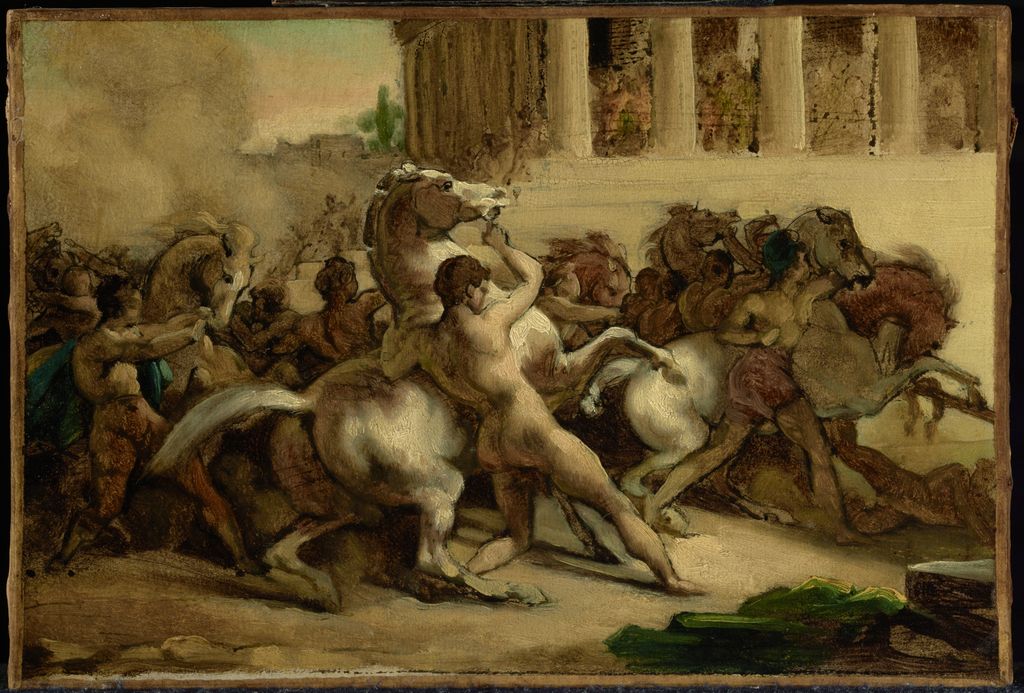
The Race of the Riderless Horses — Getty study Image source. CC0 / Public domain.
Drawings, an unrealised project and a later museum life
A related drawing in the Louvre makes the range of this work tangible. La course des chevaux libres, INV 26736, is executed in brown pen and ink on buff paper, measuring 29.5 × 46 cm. The museum identifies it as preparatory to one of the painted studies and points to related race compositions in Paris, Rouen, Lille and Baltimore. That wording establishes a preparatory relationship without securely making the sheet a direct design for every detail of RF 2042. [11]
Drawing and painting offered different ways to investigate the encounter. The painted Louvre study makes colour and light central to the separation of bodies; a pen drawing could address their contours and interconnections through another medium. The documented spread of related works helps explain why a single surviving picture should be approached as one concentrated solution within a wider exploration. It does not authorise an invented account of all the stages that led towards the proposed final painting.
The Getty connects its own study with a grand painting intended for the Salon and says the plan was abandoned when Géricault was called back to France. The Lyon dossier likewise describes an abandoned monumental project. The evidence supports a major ambition that remained unrealised, rather than a finished large canvas of which these works are reduced copies. [12] [10]
The two Louvre objects entered the collection at different times. The drawing passed from Alexandre Colin to Horace His de La Salle and was purchased from His de La Salle in 1851 as part of a group of nine drawings. RF 2042 was acquired in 1912 through a purchase funded by accrued income from a bequest. Their association in the museum today should not erase those separate histories. [11] [1]
What survives in the painting is more than evidence of an uncompleted ambition. The eye can move from the watching crowd to the hand raised against the wall, down through the central man’s bent torso, and out along his extended leg. Each passage makes force visible through a different relationship: spectator and participant, hand and horse, foot and ground. The event remains poised before release, held together by an arrangement whose apparent instability is precisely what makes it compelling.
Géricault collection records
Seventy collection records include paintings, drawings and individual print impressions. Different impressions remain separate records; this selection is not a complete catalogue raisonné.
Frequently Asked Questions
Discussion
Look again at the images and ideas explored in Riderless Horse Races: Géricault’s Louvre Study. These editorial prompts invite your observations.
Reader Insights
Follow the central man’s extended leg up to his raised arms. Where does his balance appear most vulnerable?
How does the pale wall change your ability to distinguish hands, heads and horses?
Compare the watching crowd with the handlers below. How does their distance from the animals affect the scene?
Join the Conversation
Share a detail, comparison or question about Riderless Horse Races: Géricault’s Louvre Study below.
References
- Musée du Louvre, Course de chevaux libres à Rome, RF 2042, collection record, object details and history, updated 27 October 2023 (French catalogue fields). View source. (in French).
- Nationalmuseum, The Severed Heads, NM 2113; collection metadata and museum interpretation (Swedish). View source.
- Louvre, Charging Chasseur, INV 4885; collection metadata and museum interpretation (French/English interface). View source.
- National Gallery, Horse frightened by Lightning; collection metadata and museum interpretation (English). View source.
- Louvre, Wounded Cuirassier, INV 4886; collection metadata and museum interpretation (French). View source.
- Louvre, The Raft of the Medusa, INV 4884; collection metadata and museum interpretation (French). View source.
- Gary Tinterow / The Metropolitan Museum of Art, Géricault’s Heroic Landscapes: The Times of Day, Met Bulletin 48/3, Winter 1990–91; consulted main essay and relevant object entries (English). View source.
- Vlaamse Kunstcollectie, Portrait of a Kleptomaniac; collection metadata and museum interpretation (Dutch). View source.
- Louvre, Epsom, MI 708; collection metadata and museum interpretation (French/English interface). View source.
- Musée des Beaux-Arts de Lyon, Géricault: La folie d’un monde, exhibition press dossier, 2006, “Rome: carnaval et peuple libre,” p. 5, and exhibition checklist, pp. 9–10 (French). View source. (in French).
- Musée du Louvre, La course des chevaux libres, INV 26736, recto, collection record, description, materials and acquisition history, updated 24 September 2024 (French). View source. (in French).
- J. Paul Getty Museum, The Race of the Riderless Horses, 1817, 85.PC.406, collection record, structured object metadata and interpretive text (English). View source.
- Mar Borobia / Museo Nacional Thyssen-Bornemisza, Carrera libre de caballos, about 1817, inventory 157 (1979.40), collection entry and essay (Spanish). View source. (in Spanish).


