



 by Tom Gurney
Tom Gurney BSc (Hons) is an art history expert with over 20 years experience
Email: tomgurney1@gmail.com / Phone: +44 7429 011000
Théodore Géricault: Introduction
Théodore Géricault made human effort the subject of monumental painting. A cavalry officer twists in the saddle while his horse rears; shipwrecked people pull themselves towards a distant possibility of rescue; labouring horses move beneath the arch of a London wharf. Across these different settings, bodies carry the action. Their weight, strain and precarious balance make history something the viewer can feel. Géricault brought the ambition of the Old Masters to the people and events of his own time, helping to shape the art later called French Romanticism. [1]
His fame rests above all on The Raft of the Medusa, but that vast canvas is one part of an unusually varied career. Large landscapes, concentrated portraits, horse studies, drawings and lithographs reveal an artist who repeatedly changed his scale and audience. The small picture could be a place for sustained thought rather than a preliminary step towards the large one. The public exhibition, the private studio and the printed sheet offered different ways to ask who deserved attention, how a body could express emotion, and what painting could make of contemporary experience.
Born in Rouen on 26 September 1791, Géricault grew up mainly in Paris and died there on 26 January 1824, aged thirty-two. His short life has encouraged a legend of impulsive genius, suffering and early death. The surviving work rewards a more patient account: of training as well as rebellion, financial independence as well as later difficulty, and deliberate composition as well as forceful handling. [2]
At a Glance
- Born26 September 1791, Rouen [2]
- Died26 January 1824, Paris, aged 32 [2]
- TrainingCarle Vernet, Pierre-Narcisse Guérin and Old Master study [2]
- MediaPainting, drawing and lithography [1] [3]
Géricault’s artistic connections
Teachers, admired predecessors and later responses connect different parts of his work.
- Carle Vernet: Training with Carle Vernet connected Géricault with equestrian and military painting. [1]
- Pierre-Narcisse Guérin: Guérin’s studio provided formal training; the Chasseur departed conspicuously from its restrained colour and handling. [1]
- Antoine-Jean Gros: Tinterow identifies Gros’s contemporary military imagery as one of the resources transformed in the Chasseur. [1]
- Peter Paul Rubens: Rubens’s forceful movement contributes to Tinterow’s account of Géricault’s cavalry debut. [1]
- Michelangelo: Géricault’s Italian study included Michelangelo’s monumental bodies, part of the art he brought back to modern subjects. [1]
- Claude-Joseph Vernet: The aqueduct landscapes draw on Claude-Joseph Vernet, a different painter from Géricault’s teacher Carle Vernet. [1]
- Eugène Delacroix: Delacroix admired the force of the Raft and the cadaver studies; his response challenged idealising definitions of beauty. [1]
- Edgar Degas: The 2018 Chantilly exhibition placed Géricault’s racing canvas beside the racing art of Stubbs and Degas. This is a documented comparison, rather than proof of a direct influence. [4]
- Léon Cogniet: Guérin’s pupil and a friend of Géricault, Cogniet made the lithograph portrait shown at the centre, dated around 1824. [5]
Théodore Géricault in context
The Raft of the Medusa
1818–19 [7]Charging Chasseur
1812 [8]The Epsom Derby
1821 [4]Portrait of a Kleptomaniac
c.1820–24 [10]Horse Frightened by Lightning
c.1813–14 [11]The Severed Heads
1810s [12]Contents
- Learning to paint, learning to look
- A cavalry painter changes direction
- Italy and the uses of the classical body
- The Raft of the Medusa: modern history on a vast canvas
- Landscape as a major ambition
- Printed images and the work of everyday life
- Portraits and the limits of their names
- Death, influence and the work in collections
Learning to paint, learning to look
Géricault's family moved to Paris around 1795–96. After his mother's death in 1808, he began to pursue painting with Carle Vernet, whose interests included horses and military subjects. Around 1810–11 he entered the studio of Pierre-Narcisse Guérin, an established history painter. He also studied pictures at the Louvre. These overlapping forms of education matter: the animal observed at close range, the posed human figure and the composition copied from an earlier master would remain active resources throughout his career. [2]
The opposition between a supposedly rule-bound teacher and a naturally rebellious pupil can obscure what this education supplied. Guérin's studio gave Géricault access to the disciplines and ambitions of history painting, the prestigious art of large compositions treating elevated subjects. The Louvre offered a much wider education in colour, movement and the organisation of figures. Gary Tinterow identifies the combination of Rubens, Antoine-Jean Gros and Vernet behind the young painter's cavalry debut. Its novelty emerged through the transformation of existing art, rather than through ignorance of it. [1]
Family resources also complicate the familiar image of the neglected, impoverished Romantic. An inheritance from his grandmother in 1812 strengthened Géricault's financial independence. It helped make possible ambitious work and travel outside the normal sequence of official rewards. His later difficulties were real, but they should not be projected backwards over his entire formation. The ability to choose a project, hire space and work without an immediate buyer was a consequential part of his artistic freedom. [2]
This freedom did not mean indifference to recognition. The Salon, the major public exhibition in Paris, remained a crucial destination. A large painting there could bring an artist before critics, officials, fellow painters and a broad public at once. Géricault's career moves between attempts to command that arena and work made with less public circumstances in mind. Understanding both makes his paintings more varied, and more purposeful, than a succession of dramatic personal gestures.
Four stages of Théodore Géricault’s career
These periods group related projects; subjects and working methods overlap.
A public debut through horse and soldier
Training with Carle Vernet and Guérin led to the Chasseur’s 1812 Salon success and the changed military predicament of the Cuirassier in 1814. [2]
Ancient bodies and modern spectacle
Study in Italy brought Renaissance art and Roman horse-racing into a sustained investigation of human and animal force. [2]
Modern disaster on a monumental scale
Preparatory studies and survivor testimony informed the Raft, exhibited at the 1819 Salon as a Scene of Shipwreck. [1]
Racing, labour and individual faces
English travel and lithography widened the social uses of the horse. Work continued on prints and ambitious new history subjects after the return to Paris. [2]
A cavalry painter changes direction
Géricault's first great public statement was the painting now known as The Charging Chasseur. Exhibited in 1812 as an equestrian portrait of Monsieur Dieudonné, it measures 349 by 266 centimetres. Those dimensions turn a mounted officer into an overwhelming presence. The Louvre's record also preserves a change in title when it reappeared in 1814 as a charging hussar, a reminder that the familiar modern name is not the only way the picture has been identified. [8]
The central action is more complicated than a simple forward charge. The horse rises and turns to the right while the rider looks back across his shoulder. The curving sabre, streaming tail, raised forelegs and brilliant red accents carry the eye around the canvas. Beneath the elaborate uniform and spotted saddle covering, the horse's body remains an immense source of pressure. The officer's command depends on an animal whose agitation is visible in its eye, mouth and tense neck. The distant military activity occupies only a small portion of the scene.
This is a portrait of authority made unstable by movement. Tinterow describes its success at the Salon, where Géricault received a gold medal, and relates its energetic handling to the work of Rubens and Gros. Such connections help explain how the painting could be both recognisably ambitious and startling. It used familiar languages of cavalry display and Baroque animation, then made their combination unusually immediate. [1]
Two years later, The Wounded Cuirassier offered a markedly different military presence. A dismounted soldier and his horse replace the commanding equestrian figure. Tinterow records a much less favourable critical response, especially to the painting's handling and apparent lack of finish. He also connects its retreating officer with the experience of French defeat in 1814. That historical reading is persuasive context, rather than proof that the canvas records a particular incident Géricault witnessed. [1]
Seen together, these paintings begin a question that runs through the later work: what happens when the heroic body can no longer guarantee mastery? Géricault did not simply abandon military imagery after the fall of Napoleon. His later prints repeatedly returned to the physical consequences of campaigning. The movement from a decorated officer towards exposed, injured or exhausted people is a change in emphasis, not a clean division between an early military artist and a later humanitarian one.
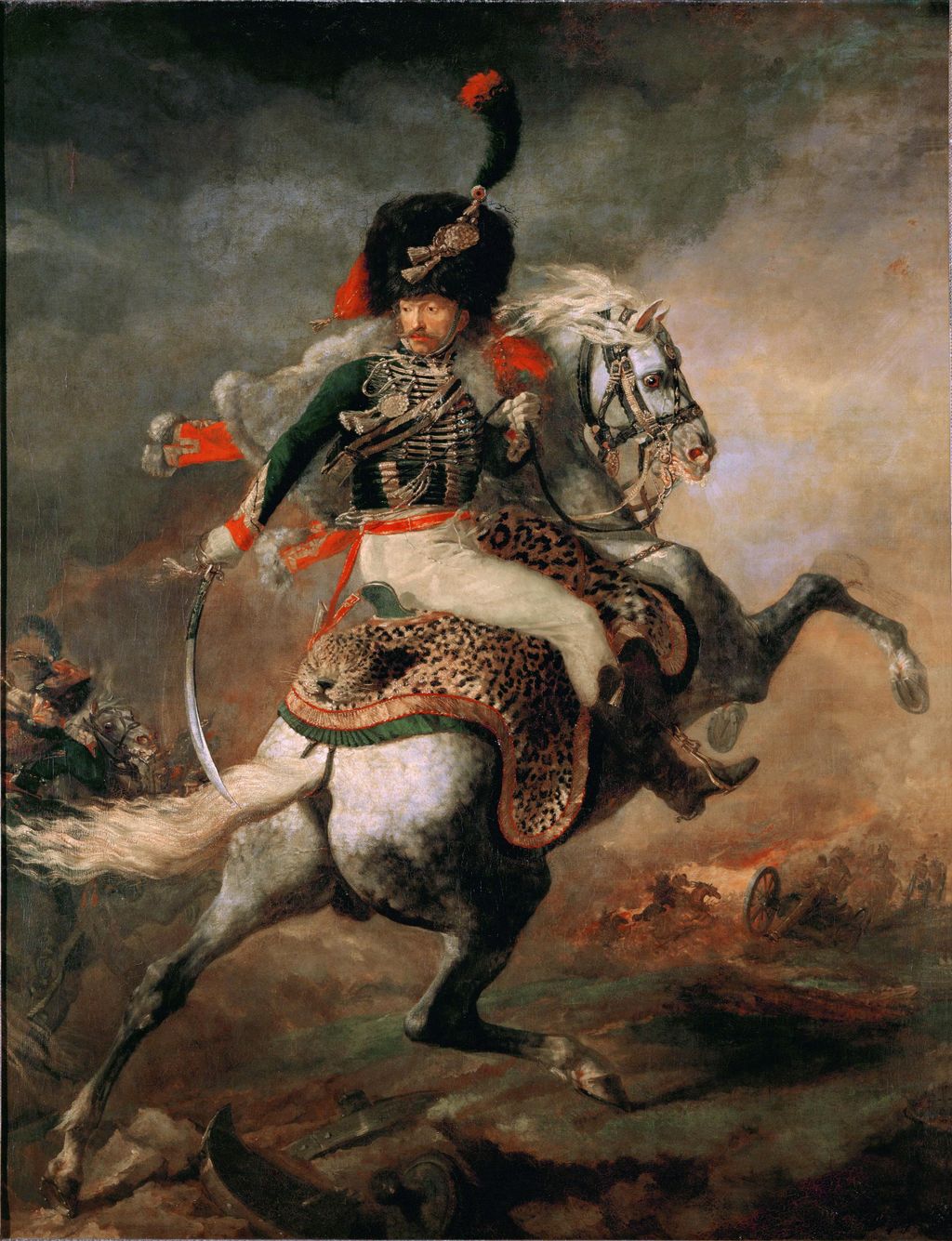
The Charging Chasseur Image source. Public domain.
Italy and the uses of the classical body
After an unsuccessful attempt at the Prix de Rome in 1816, Géricault travelled to Italy at his own expense. He visited Florence, Rome and Naples before returning to France in 1817. His journey brought him into contact with Renaissance art and the life of contemporary Italy. It also followed a period of renewed concentration on the academic nude, so the encounter with Michelangelo developed an interest already present in his studio work. [2]
The Nude Warrior with a Spear, now in the National Gallery of Art in Washington, makes that sustained study especially clear. Lorenz Eitner's catalogue essay places the painting around 1815–16 and treats it as a private academic exercise. Its familiar title has no secure historical authority: the presence of a spear does not establish a particular warrior, battle or literary episode. Eitner finds no evidence that it prepared a larger composition. A work that looks like the fragment of a heroic story can therefore be understood as an independent exploration of the figure. [13]
This distinction changes how one approaches Géricault's smaller paintings. A concentrated study could test a pose, a contour, an effect of light or the expressive tension of a body without serving a future masterpiece. Eitner describes the Nude Warrior as a calculated arrangement of opposed movements and light against shadow. The subject is partly the act of making a model's pose into a compelling painted form. Its discipline makes it difficult to sustain any picture of Géricault as an artist who worked through instinct alone. [13]
In Rome, the carnival's riderless horse race offered another meeting between observed life and inherited form. The Getty's Race of the Riderless Horses, dated 1817, is a small study in oil, pen and ink on paper laid on canvas. Its museum interpretation connects the central nude groom with ancient athletes and the horses with the Parthenon frieze. A modern public spectacle was being reimagined through the visual language of antiquity. The intended grand Salon painting remained unrealised. [14]
The study also demonstrates why Géricault's drawings belong within an account of his painting. The Getty identifies both oil and pen and ink in this work on paper: the distinction between a drawn idea and a painted one could be productive rather than absolute. Such a sheet preserves the search for a composition at a scale a viewer can take in closely, even when the intended public work never followed. [14]
That unfinished project is important without needing to be treated as a lost achievement. It shows Géricault seeking a composition in which men and animals share the same field of effort. The grooms must restrain the horses through physical contact; the animals' force determines the men's positions. This reciprocity would take other forms in cavalry paintings and English lithographs. His interest in horses concerned their relation to people as much as their independent beauty or speed.
The Raft of the Medusa: modern history on a vast canvas
Painted in 1818–19, The Raft of the Medusa brought Géricault's experiments before the public on an exceptional scale. The Louvre canvas measures 491 by 716 centimetres. Its source was a recent catastrophe: the French frigate Méduse grounded off the west coast of Africa in July 1816, and approximately 150 people were placed on an improvised raft. Only fifteen were rescued after the ordeal at sea. Géricault made their exposure and struggle the material of a painting large enough to rival an official account of national triumph. [7]
The composition places the viewer close to the raft's broken edge. Bodies lie across the foreground, so near that the space between them and the spectator feels insufficient. Behind them, people gather, turn, point and rise. At the upper right, a Black man waves fabric towards the horizon. The eye moves from inert weight towards urgent action, yet the distant ship is tiny. Nothing about the scale of the foreground guarantees that its appeal will be seen.
The result depends on the contrast between the strength of the bodies and the weakness of their situation. Many figures retain the muscular grandeur associated with classical and Renaissance art. Their setting strips that grandeur of security. A powerful back or outstretched arm can help organise collective effort, but it cannot control the sea or compel a rescue vessel to approach. This is one reason the painting exceeds a straightforward illustration of a disaster: the forms that traditionally made human beings look commanding are made to express dependence.
Its making was correspondingly deliberate. The Louvre records the delivery of the enormous canvas in February 1818, work in a rented studio in the rue du Faubourg-du-Roule, and completion at the Théâtre-Italien in July 1819. These practical details counter the impression of a single outpouring of emotion. The final canvas required sustained preparation, considerable space and the organisation of a physically demanding project. Its apparent immediacy is an achieved effect. [7]
Among the works associated with that preparation is the Getty's Study of the Model Joseph, painted about 1818–19. Its scale, 47 by 38.7 centimetres, asks for close attention. Small lights on the eyes, nose, lips and chin bring the face forward from the dark surroundings. The open pale collar separates the head from the blue clothing, while the brushwork changes character between the face and the more broadly stated garments. The museum identifies it as a study made in preparation for the Raft. [15]
Joseph was a professional model from Saint-Domingue, the former French colony that became Haiti. Paul Bernard-Nouraud's account distinguishes the portrait's individual face from the back of the signalling figure for which Joseph posed. The distinction matters: the person who helped give a monumental figure its body also exists in a painting that allows us to encounter his features. Joseph's later admission as a model at the École des Beaux-Arts dates to 1832, so that institutional role should not be projected backwards into Géricault's lifetime. The surviving evidence does not give us his own account of these sittings. [16]
The Raft appeared at the Salon of 1819 under the generic title Scène de naufrage, or Shipwreck Scene. Its position in the exhibition changed: initially hung high, it was lowered towards the end of October. It was then exhibited commercially in London's Egyptian Hall in 1820 and in Dublin in 1821. These different settings made the painting part of several publics, from the Paris Salon to a British exhibition organised around a single spectacular work. Its history is a history of presentation as well as production. [7]
The catastrophe's association with a French colonial expedition and failures of authority gave it political force. Yet its reception should not be reduced to a single assured message. The Louvre's account leaves open more than one explanation for the failure to secure a state purchase during Géricault's lifetime, including disagreement over price and discomfort with the subject. The exhibition title alone cannot establish censorship. The picture could confront viewers with responsibility and abandonment while resisting a tidy translation into a political slogan. [7]
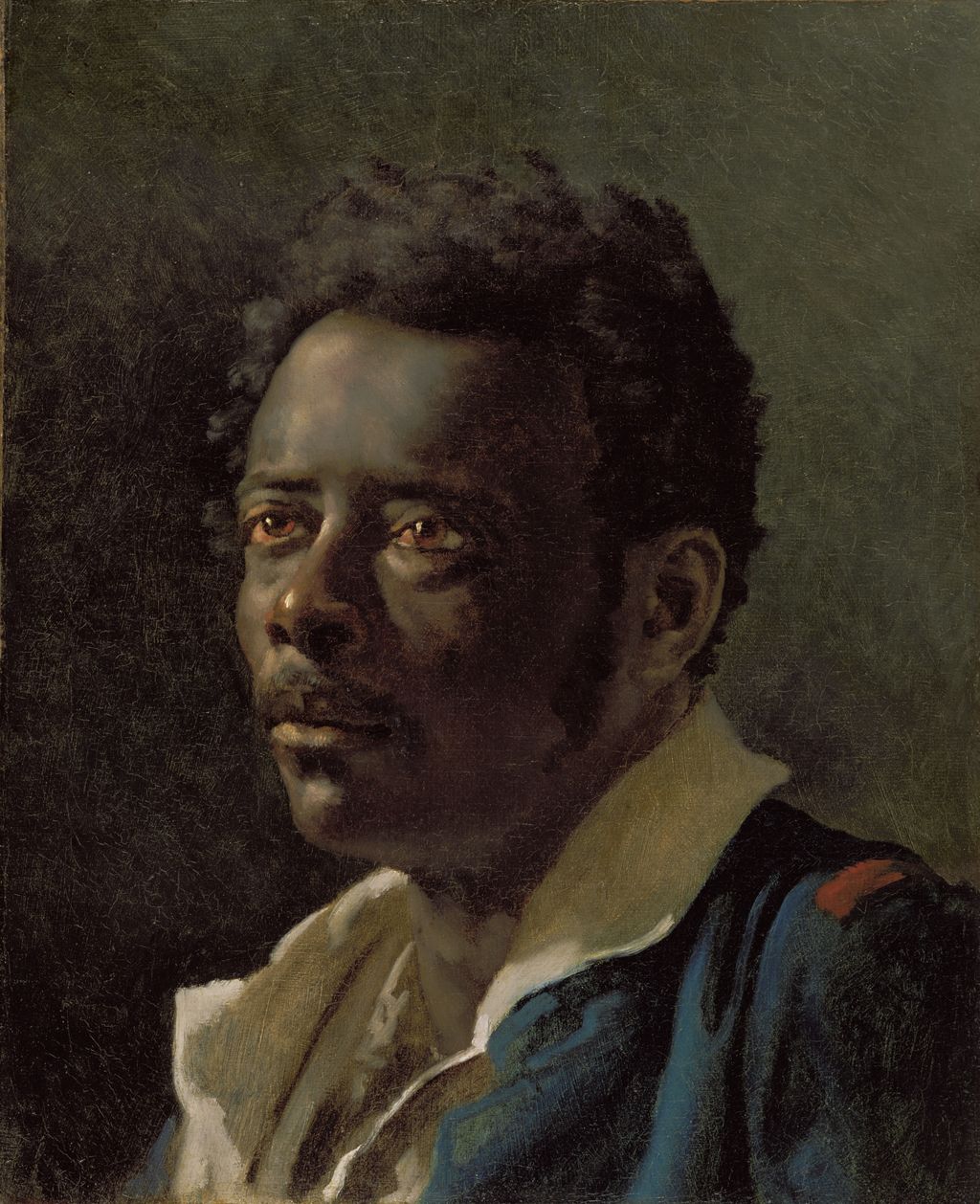
Study of the Model Joseph Image source. CC0 / Public domain.
Watch: Géricault and The Raft of the Medusa
Three perspectives on Géricault’s best-known painting, its making and its historical setting.
Gericault, Raft of the Medusa
Smarthistory examines the composition and historical setting of The Raft of the Medusa.
Watch on YouTubeLandscape as a major ambition
While developing the Raft, Géricault also painted three large landscapes known as the Times of Day: Morning, Noon and Evening. They are central works, not a brief escape from his serious interests. Tinterow's study connects them with an invoice for three canvases delivered in July and August 1818. Their roughly matching dimensions, around two and a half metres high, gave landscape a presence comparable to that of a large figure painting. [1]
In Evening: Landscape with an Aqueduct, a dark structure and an enormous tree hold the left side of the picture. Beyond them, light passes through a double tier of arches and strikes the rocky slopes. Farther away, towers and mountains rise beneath a heavy sky. At the bottom, bathers occupy a narrow band of water and stone. The architecture and terrain take possession of the vertical canvas; the people are small enough that a viewer may notice the splendour of the setting before registering their separate activities.
Their smallness produces a different relationship between body and world from that of the Raft. The bathers are not shown surviving a catastrophe. They converse, sit and move in the water. Yet their ordinary actions give a measure to surroundings that dwarf them. Géricault can make human presence consequential without placing it at the centre of the picture's power. The landscape's disproportion becomes expressive in its own right.
This is also a constructed Italy. Tinterow traces the aqueduct to an invention by Joseph Vernet, combining features of the medieval Ponte delle Torri at Spoleto with a double tier of Roman arches. Géricault was drawing on earlier images as well as memories of travel. The picture should not be read as a faithful view of one surviving monument. Its persuasive space is assembled to govern movement, light and the relative scale of human beings and nature. [1]
Technical observations in Tinterow's catalogue reinforce the balance of preparation and freedom. In Evening, the broad compositional masses appear to have been established while the ground was being applied. Relatively thin paint is animated by more raised highlights on figures, vegetation and buildings. This is evidence about one painting's construction, rather than a formula for everything Géricault made. It nevertheless shows how a grand effect can emerge from differences in the density and handling of the painted surface. [1]
The landscapes retain important uncertainties. Their patron, intended room and original destination have not been established. Nor should the familiar idea of four times of day turn a conjectural Night into a securely documented fourth canvas. Tinterow subjects the later stories about such a work to close scrutiny. Three known paintings are enough to demonstrate the scope of Géricault's landscape ambition without an invented completion of the set. [1]
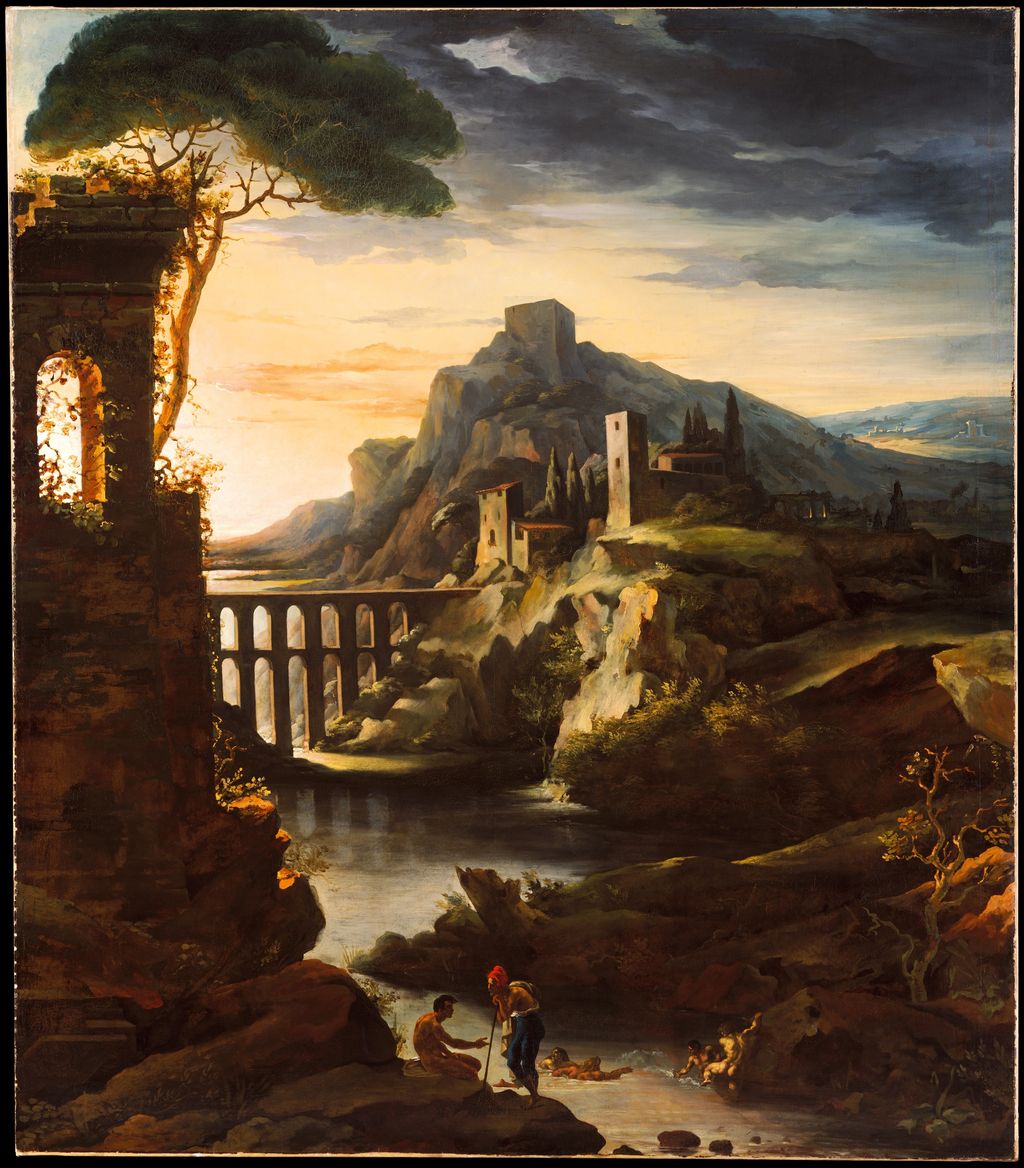
Evening: Landscape with an Aqueduct Image source. Public domain.
Printed images and the work of everyday life
Lithography gave Géricault another kind of reach. A drawing made with greasy materials on a prepared surface could be inked and printed in multiple impressions. Chantilly's museum account emphasises the medium's relative speed and economy, qualities that made it useful for images addressed to a wider public. Géricault used it for military suffering, sporting encounters, horses and street subjects. His lithographs form a substantial part of his art, with their own visual possibilities and histories of collaboration. [3]
In Boxers, dated 1818, two men occupy the foreground with raised fists and widely planted feet. Their answering poses create a charged interval between them. The Black fighter's dark torso and light trousers contrast with the white fighter's pale body and striped trousers. Around this commanding pair, spectators lean, crouch and watch. The distinction between the powerful fighters and the compact, sometimes awkward onlookers makes spectatorship part of the scene.
Chantilly interprets the equality between the Black and white boxers as a republican and antislavery statement. That is a curatorial reading worth considering, while keeping the interpretation distinct from a surviving declaration by the artist. What the composition visibly establishes is a contest in which both bodies possess force and presence. Its symmetry invites thought about equality without supplying the men's identities or a complete account of Géricault's political intentions. [3]
The military prints approach bodily effort from another direction. Chantilly describes Return from Russia as an image concerned with the misery of the Napoleonic campaigns. Exhaustion becomes as compelling a subject as the excitement of an officer's charge. The attention given to animals in these works broadens the cost of war beyond the human combatant: horses are participants in military movement and casualties of it. Neither the uniform nor the animal's strength can protect a body from attrition. [3]
During his English stays in 1820–21, Géricault extended this attention to the demands of civilian life. Chantilly's survey places beggars, illness and working animals alongside more picturesque subjects such as the farrier's shop. The range prevents any easy description of the English period as simply a celebration of sport or an excursion in social protest. It is an investigation of how different lives become visible in a modern city, and of how much expression a relatively small printed image can carry. [3]
Painting offered another way to represent English equestrian life. In The Epsom Derby, four horses stretch across the canvas beneath a huge bank of cloud. Their extended legs and low, elongated bodies create a collective sweep to the left; the riders' separate colours and postures punctuate its rhythm. The Louvre dates the painting to 1821 but carefully identifies Epsom as its traditional title. The image does not securely identify a particular race or winner. It is more rewarding to attend to how Géricault makes speed visible than to treat it as a record from which an exact sporting result can be recovered. [4]
Entrance to the Adelphi Wharf, published in London in 1821, is a particularly concentrated example. A man walks out from beneath a broad brick arch beside three harnessed horses. Their rounded hindquarters and heavy harness face the viewer as the animals move into the opening. The arch encloses the group, while the pale coat of the central horse catches the light against the darkness ahead. The picture turns the work of moving through the city into a procession of substantial, individual bodies. The Metropolitan Museum records Charles Joseph Hullmandel as lithographer and Rodwell & Martin as publisher, making visible the production network behind the image. [17]
That network is part of the change in audience. A monumental canvas depended on exhibition space and the movement of an unwieldy physical object. A printed composition could exist in multiple sheets, enter different collections and be studied at close range. Its making also depended on skills beyond the artist's drawing. The museum's credits remind us that Géricault's public was reached through working relationships, rather than through a solitary act of expression alone.
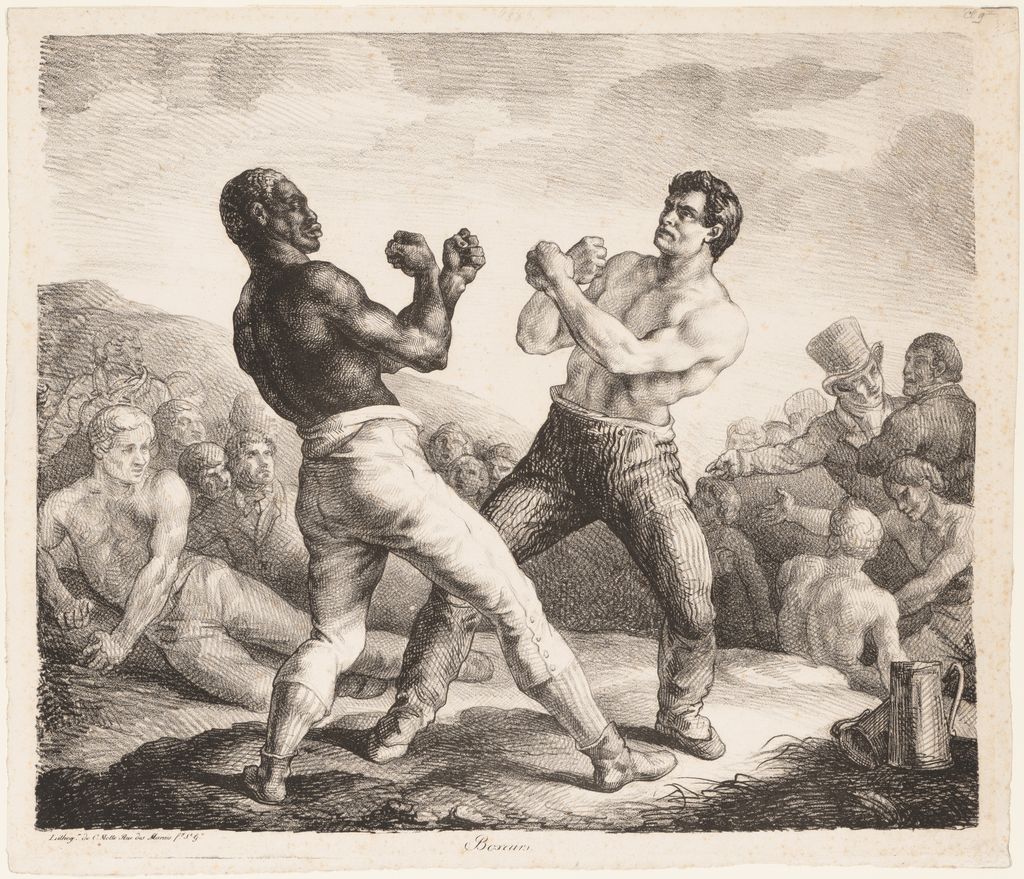
Boxers Image source. Public domain.
Portraits and the limits of their names
The portraits commonly grouped as the Monomanes present another challenge to the way an image is explained. Their traditional titles name forms of obsession or disorder, encouraging the viewer to search each face for confirming symptoms. Yet the history of those names is much less secure than their familiarity suggests. The Musée des Beaux-Arts de Lyon dates its portrait traditionally called The Monomaniac of Envy to about 1819–22 and traces the group of five portraits to Louis Viardot's account of their discovery in 1863, decades after Géricault's death. [18]
Lyon explicitly questions the often-repeated claim that the portraits were commissioned by the physician Étienne Georget. No document establishes the link between the two men or Georget's interest in commissioning images of this kind. The pictures belong to the history of early nineteenth-century ideas about mental illness, but that context cannot replace missing evidence about their original purpose. Nor can historical titles supply reliable present-day diagnoses of the people represented. [18]
The man traditionally called a Kleptomaniac has a sharply lit face, dark clothing and a pale wrapping at the neck. His eyes look beyond the viewer rather than directly out of the picture. The setting provides little distraction. It is possible to spend time with the uneven fall of light across his face, the angular cheek and the loosely described clothing without turning any one of those features into medical evidence. The painting's concentration on a person survives the uncertainty of its label.
Lyon reads its own portrait as an elevation of an anonymous, socially marginalised sitter into a subject worthy of representation. That interpretation connects the portraits with a wider question in Géricault's art: who can occupy the space and attention once reserved for the exemplary hero? The answer is not confined to these faces. A professional model, a person asking for help, a wounded soldier and a labouring animal all receive a degree of pictorial seriousness that unsettles a simple hierarchy of grand and minor subjects. [18]
Death, influence and the work in collections
Géricault's last years included riding injuries, periods of recovery and a prolonged final illness. He continued to work on prints and consider ambitious contemporary subjects, but several large projects remained unrealised. He died in January 1824, after repeated operations. The sequence is more complex than the story that a single fall from a horse ended his life, and the evidence does not require a retrospective medical diagnosis to make its severity clear. [2]
His relation to Eugène Delacroix gives the idea of influence a specific human and artistic setting. They shared connections through Guérin's studio, and Delacroix posed for him. Tinterow discusses Delacroix's admiration for the Raft and his defence of Géricault's studies of the dead as works possessing pictorial strength and beauty. This was an inheritance of possibilities: contemporary experience, extreme emotion and uncompromising physical subjects could sustain the ambition of major painting. It does not mean that the younger artist simply repeated Géricault's style. [1]
Collections helped determine what later viewers could recognise as his achievement. The French state bought the Raft at the estate sale in November 1824, and it entered permanent display at the Louvre in 1826. The two great cavalry pictures followed a different path: acquired by the duc d'Orléans at the estate sale, they were purchased together for the national collections in 1851. The proximity of these works in the history of French public collecting helped establish the monumental Géricault familiar today. [7] [8]
Other collections reveal different concentrations. Chantilly's nearly complete group of lithographs was acquired by the duc d'Aumale in 1866. The Metropolitan Museum's Evening, acquired in 1989, anchors the landscape achievement, while the Getty's Joseph and Roman race study make the smaller work essential to an understanding of the career. The Washington Nude Warrior preserves the importance of concentrated figure study. Together these holdings offer a dispersed account of Géricault that no single celebrated canvas can provide. [3] [1] [15] [14] [13]
Géricault's most enduring achievement lies in the meeting of close observation and pictorial invention. He could make a single face absorb our attention, or let immense architecture reduce people to a handful of small movements. He could transform the poised academic body into the survivor's reaching body, and the horse of military display into an animal carrying the weight of daily work. Following those changes across his art reveals how much the struggle for balance, recognition and survival can communicate without a promised resolution.
Essential Théodore Géricault works

The Raft of the Medusa
1818–19 · Bodies rise from the dead and exhausted towards a distant chance of rescue.

Charging Chasseur
1812 · A mounted officer turns against the movement of his rearing horse.

Wounded Cuirassier
1814 · A dismounted soldier negotiates an uneven descent beside his horse.

The Epsom Derby
1821 · Four mounted racers become a compressed sweep across an open field.

Portrait of a Kleptomaniac
c.1820–24 · A concentrated likeness survives under a retrospective diagnostic title.

Evening: Landscape with an Aqueduct
1818 · Small bathers give human scale to an imagined monumental landscape.

Horse Frightened by Lightning
c.1813–14 · The horse’s turn brings alarm into a storm-darkened landscape.

The Severed Heads
1810s · Two distinct faces retain human likeness within an arrangement of bodily fragments.
Géricault collection records
Seventy collection records include paintings, drawings and individual print impressions. Different impressions remain separate records; this selection is not a complete catalogue raisonné.
Frequently Asked Questions
His art gave exceptional force to emotion, movement and the experience of contemporary people. He combined the scale and figure traditions of earlier painting with shipwreck, military suffering, street work and closely observed individuals. Tinterow places these choices at the beginning of French Romantic painting. [1]
That is a familiar theory, but Lyon states that no document establishes the supposed connection with Étienne Georget. The portraits’ traditional labels were recorded decades after Géricault died and should not be treated as modern diagnoses. [18]
Discussion
Look again at the images and ideas explored in Théodore Géricault. These editorial prompts invite your observations.
Reader Insights
Compare the Chasseur with Adelphi Wharf: how does the horse’s relation to the person change the image’s sense of power?
In Evening, look for the bathers after studying the architecture. How does their small scale change the landscape around them?
Look at Joseph and a Monomanes portrait before reading their titles. Which details establish a person’s presence, and which assumptions arrive with the label?
Join the Conversation
Share a detail, comparison or question about Théodore Géricault below.
References
- Gary Tinterow / The Metropolitan Museum of Art, Géricault's Heroic Landscapes: The Times of Day, The Metropolitan Museum of Art Bulletin, vol. 48, no. 3, Winter 1990–91, especially pp. 8–10, 18–33, 52–55 and relevant catalogue entries; English. View source.
- Bruno Chenique / Musée des Beaux-Arts de Lyon, Géricault: La folie d'un monde, exhibition press dossier, 2006, especially “Biographie”, pp. 15–21; French. View source. (in French).
- Château de Chantilly, Géricault et la lithographie, virtual exhibition drawn from the 2018 exhibition curated by Nicole Garnier-Pelle, substantive essay and credits; French. View source. (in French).
- Musée du Louvre, Course de Chevaux, dit traditionnellement Le derby de 1821 à Epsom, 1821, MI 708; object title, dating and metadata; French record with English interface. View source.
- Cleveland Museum of Art, Théodore Géricault, by Léon Cogniet, c.1824, 1941.211; collection metadata (English). View source.
- SCHIRN, Images of Life and Death; collection metadata and museum interpretation (English). View source.
- Musée du Louvre, Le radeau de la Méduse, 1818–19, INV 4884; object fields and detailed exhibition and acquisition history; French. View source. (in French).
- Musée du Louvre, Officier de chasseurs à cheval de la Garde impériale, chargeant, 1812, INV 4885; object fields and exhibition, ownership and acquisition history; French record with English interface. View source.
- Louvre, Wounded Cuirassier, INV 4886; collection metadata and museum interpretation (French). View source.
- Vlaamse Kunstcollectie, Portrait of a Kleptomaniac; collection metadata and museum interpretation (Dutch). View source.
- National Gallery, Horse frightened by Lightning; collection metadata and museum interpretation (English). View source.
- Nationalmuseum, The Severed Heads, NM 2113; collection metadata and museum interpretation (Swedish). View source.
- Lorenz Eitner / National Gallery of Art, French Paintings of the Nineteenth Century, Part I: Before Impressionism, 2000, “Nude Warrior with a Spear”, pp. 254–259; English. View source.
- J. Paul Getty Museum, The Race of the Riderless Horses, 1817, 85.PC.406; object record and interpretive description; English. View source.
- J. Paul Getty Museum, Study of the Model Joseph, about 1818–19, 85.PA.407; object record and description; English. View source.
- Paul Bernard-Nouraud / Histoire par l'image, “Joseph, modèle pour Géricault”, December 2023, historical context, image analysis and interpretation; French. View source. (in French).
- The Metropolitan Museum of Art, Entrance to the Adelphi Wharf, 1821, 22.63.25; object metadata, production credits and inscription; English. View source.
- Musée des Beaux-Arts de Lyon, La Monomane de l'envie, about 1819–22, B 825; object record and account of the portraits' uncertain origins; French. View source. (in French).