



 by Tom Gurney
Tom Gurney BSc (Hons) is an art history expert with over 20 years experience
Email: tomgurney1@gmail.com / Phone: +44 7429 011000
Three Lovers: Introduction
Three people occupy a couch, but they do not share the same rhythm. At the right, a woman turns into a man's embrace; at the left, a reclining woman watches them. White fabric falls across the furniture and gathers around the figures, catching light against a room almost swallowed by brown and black. Géricault makes the encounter legible through the turn of a shoulder, the meeting of arms and the difference between a body at rest and bodies in motion.
Three Lovers, in the J. Paul Getty Museum, is an oil painting on canvas measuring only 22.5 × 29.8 cm. The museum dates it to about 1817–1820 and identifies it as Géricault's only known erotic painting. [1] Its smallness shapes the experience. An enlarged reproduction can make the figures seem monumental, but the actual painting draws the viewer close. Within that narrow field, Géricault brings together erotic immediacy, an antique reference and a restless play of cloth and limbs.
At a Glance
- DateAbout 1817–1820 [1]
- MediumOil on canvas [1]
- Dimensions22.5 × 29.8 cm, unframed [1]
- CollectionJ. Paul Getty Museum, 95.PA.72 [1]
This work across Théodore Géricault’s career
The Severed Heads
1810s [2]Charging Chasseur
1812 [3]Horse Frightened by Lightning
c.1813–14 [4]Three Lovers (current article)
c.1817–20 [1]The Raft of the Medusa
1818–19 [6]Portrait of a Kleptomaniac
c.1820–24 [8]The Epsom Derby
1821 [9]Contents
- A room made for close attention
- Two tempos on one couch
- Cloth, colour and the path of movement
- Venus at the edge of the scene
- The surviving female study
- Another use of the studied body
- An intimate painting in public collections
- Annotated details
A room made for close attention
The setting is both enclosed and selectively described. The couch extends across most of the picture, with its long cushion and decorated wooden base providing a continuous platform for the three bodies. Above it, a dark red hanging marks a broad horizontal band. A blue curtain descends at the right, partly screening the embracing pair. At the opposite side, a statue stands on a pedestal. Together, these upright forms frame the couch like the edges of a shallow stage.
Yet this is a stage without a public action to explain. There is no procession, battle or clearly identified story unfolding beyond the room. The furniture gives the bodies a place to recline, while the hangings close off any distant prospect. The brightest passages belong to skin and fabric. Attention returns to the encounter because the surrounding space offers so few competing incidents.
The Getty describes the painting as an independent work intended for private, close viewing, despite its sketchlike handling. [1] That distinction matters. A small canvas with freely worked passages need not be a preliminary design awaiting enlargement. Here the room, the distribution of light and the relation of the three figures make a complete pictorial situation. The painting asks to be looked into at its own scale.
Its compact format also changes the force of a detail. A dark touch at the man's face or a light stroke along a fold occupies very little actual canvas. From normal viewing distance those marks must combine quickly into a head, a hand or a gathered sleeve. Moving closer reveals the painted construction, but does not dissolve the scene: the most economical passages still contribute to a carefully controlled arrangement.
Two tempos on one couch
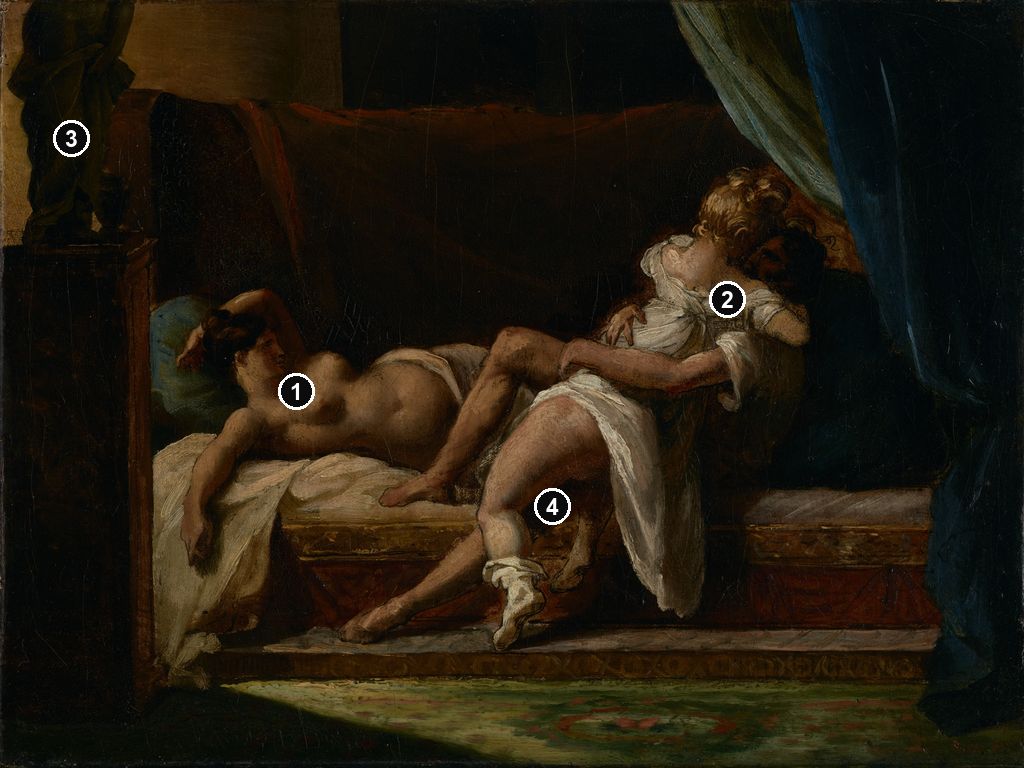
The reclining woman at the left establishes the picture's slower tempo. Her head rests against a blue cushion and one arm bends above it. The other arm extends down over the hanging cloth. Her upper body is open to the light, while her face turns towards the pair beside her. The supported head and loosely lowered hand give her a settled weight. She occupies the couch rather than appearing about to leave it.
Her body also provides a long movement across the picture. The pale torso leads towards the central tangle of limbs, so the watching figure is visually connected to the embrace even where her activity differs from it. Géricault has not placed two separate subjects side by side. The couch and the overlapping forms bind all three people into one compressed space.
At the right, the woman in white is defined by a turn. Her back and shoulder face the viewer, while her head moves towards the man behind her. The light catches the gathered material around her upper body. Below, exposed legs and trailing white cloth introduce strong diagonals, cutting across the steadier horizontal line of the couch. Her bent limbs make the embrace a physical action rather than an arrangement of two adjacent portraits.
The man's presence is more shadowed. His face appears beside hers, partly obscured by her head and the curtain, while his arms help enclose her body. This unequal visibility strengthens the composition. The encounter is unmistakable, yet it is conveyed through fragments: a profile, an arm, a contact between bodies. His hidden torso does not weaken the action, because the woman’s turning body gives it direction.
The three figures therefore offer different ways of inhabiting the same moment. One watches, two embrace; one stretches across the couch, another twists upright; a relatively open torso contrasts with a closely entangled pair. These differences create the composition's energy without requiring a sequence of events before or after the depicted instant. We can follow the movement of the bodies without deciding what anyone is thinking.
The title gives the group a collective identity, but the participants remain unidentified. Their poses do not establish names, relationships or a particular episode in Géricault's life. Nor can the third figure's expression settle her emotional response. The visible distinction is between her repose and the couple's activity; jealousy, indifference or a precise personal history would each require evidence beyond the image.
Annotated Details from Three Lovers
The numbered points identify visible features discussed in this article. Return from each detail to the whole composition. Three Lovers Image source. CC0 / Public domain.
Details from THREE LOVERS
Compare the cropped details with the complete images above. Notice how their colours, shapes and positions contribute to the larger compositions.
Reclining observer
A supported head and a loosely lowered arm give the reclining figure a slower rhythm than the couple beside her.
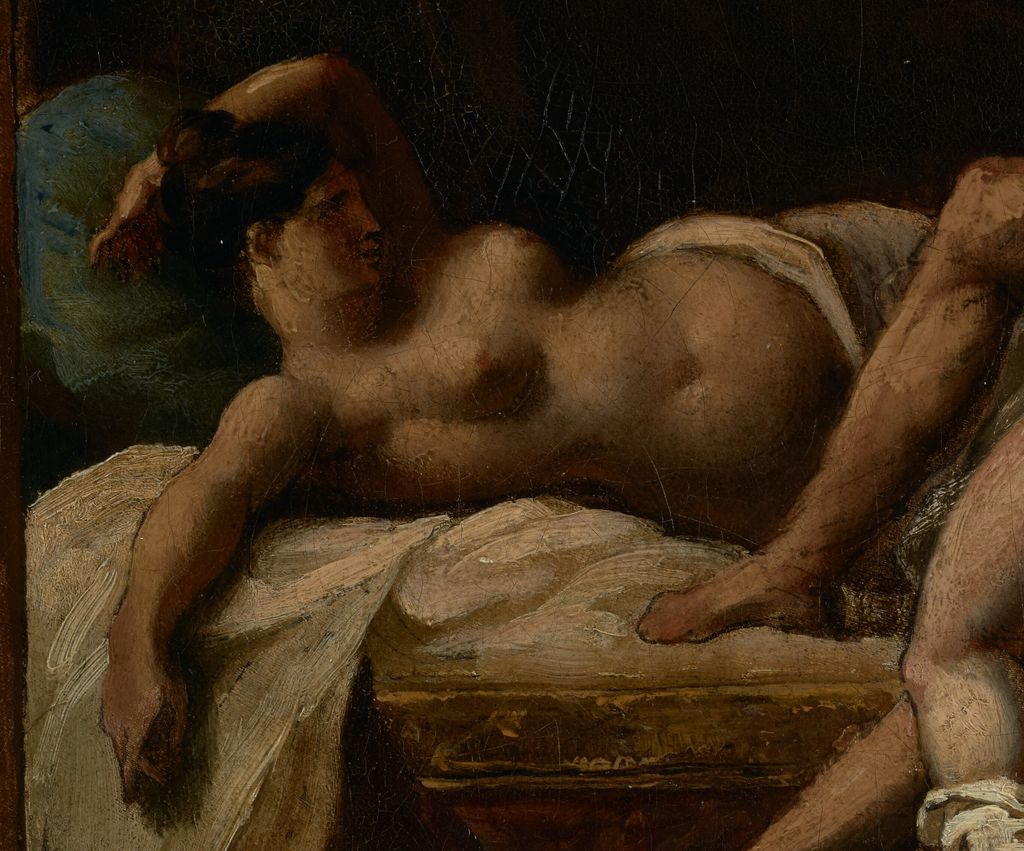
The embrace and turning shoulder
The woman’s illuminated shoulder and gathered sleeve bring the turn of her body forward; the man’s face remains partly hidden.
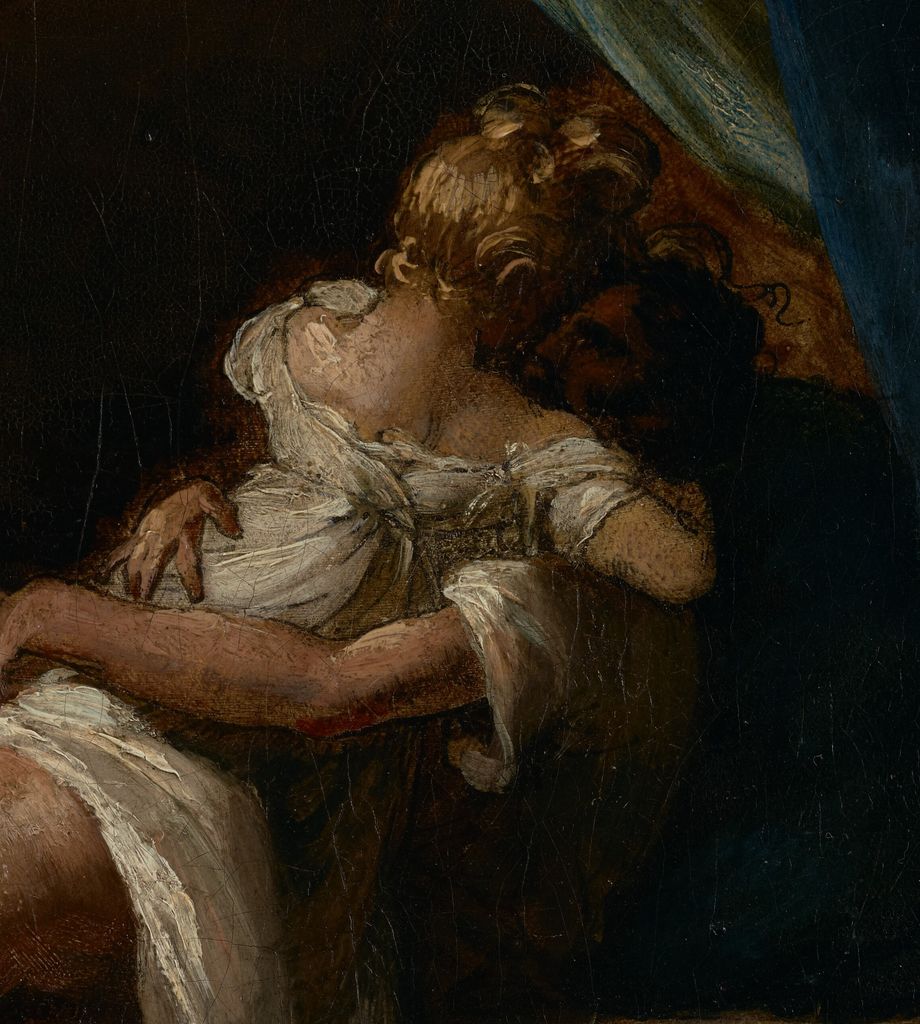
Venus above the couch
The Getty identifies the dark statue as Venus. Its upright form introduces an antique presence beside the reclining bodies.
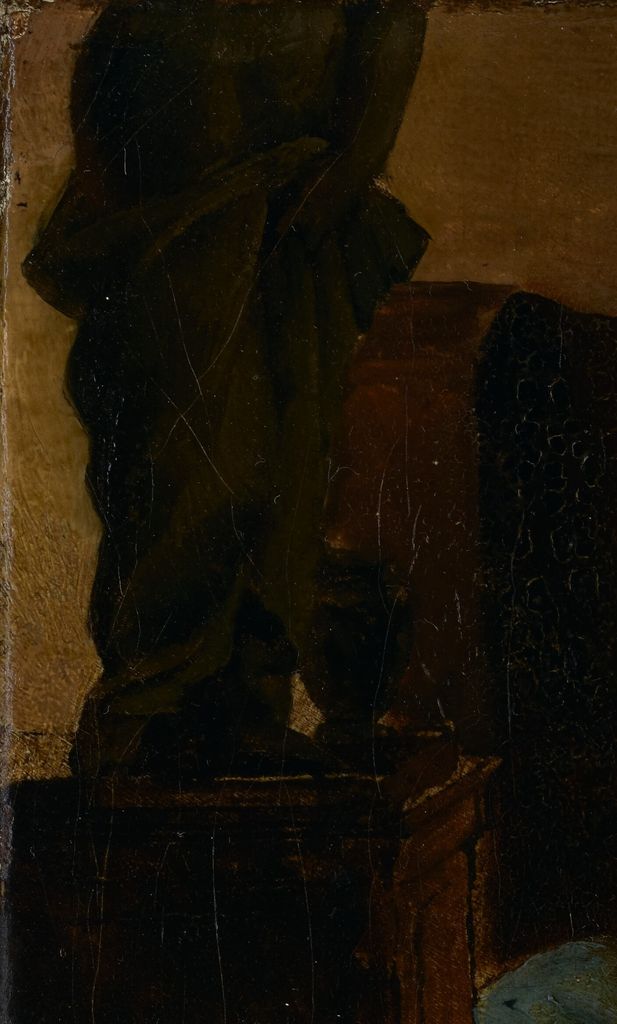
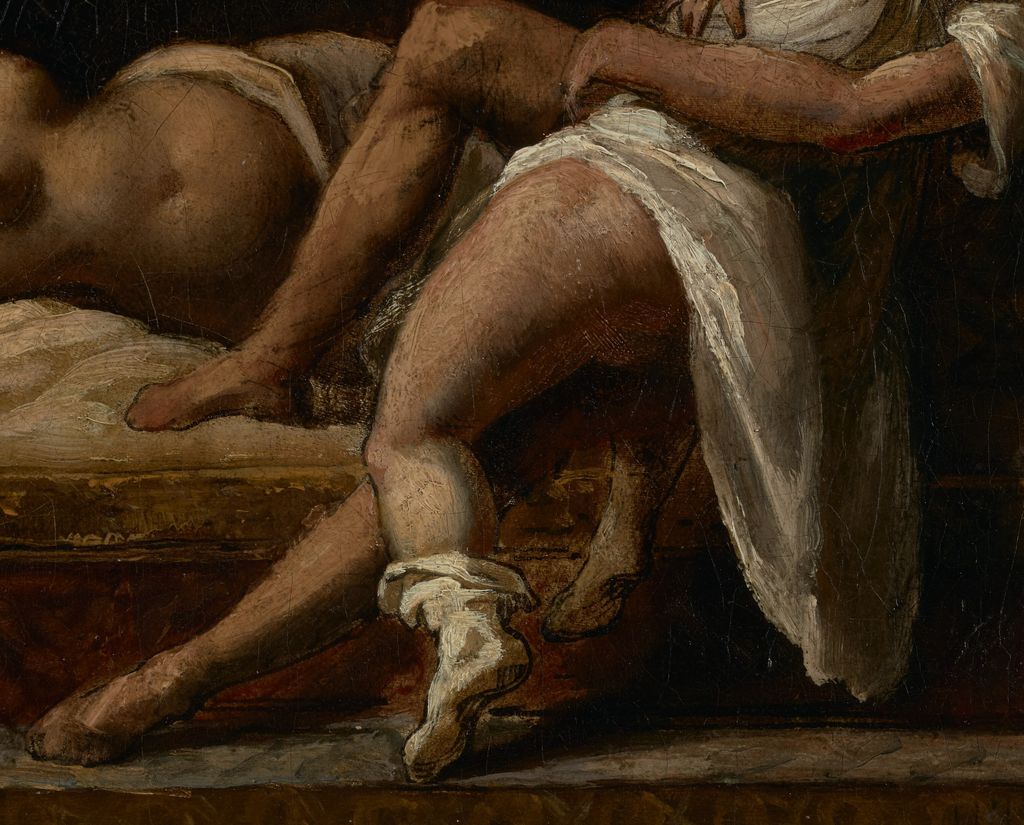
White cloth and bent legs
Long falls of white fabric cross the bent legs, making the centre of the couch a meeting point of diagonals.
Cloth, colour and the path of movement
White cloth performs several different tasks. Under the reclining woman it spreads into a broad, rumpled surface. Over the front of the couch it hangs in a long fall, making her lowered arm stand out. Around the woman at the right it gathers into short, broken folds before descending in a longer strip. The same light colour can suggest a resting place, displaced clothing and a twisting movement.
Following these passages is a useful way to read the composition. Begin with the pale cloth beneath the left-hand figure, move across the warm skin towards the centre, then rise to the woman's white sleeve and illuminated shoulder. From there, her bent legs bring the eye down towards the front edge of the couch. The action circulates within the frame rather than escaping towards an open doorway or landscape.
The palette strengthens that containment. Warm flesh and ivory fabric emerge from deep reds and browns, with cooler blue at the cushion and curtain. Blue appears at both ends, but in different proportions: a small support for the reclining head at the left, a much larger hanging beside the couple at the right. The colour links the edges while the unequal shapes preserve the imbalance between repose and activity.
Line is equally important. Long contours describe the reclining body and the couch; more abrupt bends occur where knees, elbows and folds meet. Some edges seem firm, others merge into shadow. The distinction helps prevent the grouping from becoming a uniformly outlined diagram. We recognise bodies through selected boundaries, while the darker passages compress them together.
These are visible effects of paint, rather than evidence for a complete account of how the canvas was made. The surface does not, by itself, tell us the order in which Géricault painted the figures or whether he completed each one before beginning the next. What it does reveal is a close relation between handling and subject: broken lights animate the white clothing, while broader shadow holds the embrace together.
Watch: Géricault and The Raft of the Medusa
Three perspectives on Géricault’s best-known painting, its making and its historical setting.
Gericault, Raft of the Medusa
Smarthistory examines the composition and historical setting of The Raft of the Medusa.
Watch on YouTubeVenus at the edge of the scene
The small statue at the upper left can be missed on a first look. It occupies a darker zone above the reclining woman, well away from the brightest flesh. Its pedestal and upright body provide a formal counterweight to the curtain on the other side. Even before identifying it, we can see that this still, elevated figure differs from the bodies spread across the couch.
The Getty identifies the statue as Venus and connects the reclining woman's pose with the classical tradition of erotic repose. [1] The reference gives the room an antique presence without turning the people into named mythological characters. A goddess appears as an object within the setting; the living figures remain the centre of attention.
The contrast between statue and flesh is especially suggestive. Venus stands apart, darkened and comparatively rigid. The reclining woman below is horizontal, softly lit and physically supported by cushions and cloth. At the right, the woman's turn produces still another kind of body: active, partly dressed and caught in contact with someone else. The picture brings these bodily states into proximity rather than making them identical.
The classical element consequently does more than decorate a luxurious interior. It supplies a point of comparison for looking at the human figures. The eye can move from a standing sculptural nude to a reclining painted one, and from there to the entangled couple. Erotic experience and inherited artistic forms meet within the room. Nothing in that relation requires the scene to illustrate a specific ancient text.
The surviving female study
A drawing in the Museum of Fine Arts, Houston provides a concrete connection with Géricault's preparation. The museum catalogues its front as a Study of a Female Nude for the Erotic Trio. Dated 1816–1817, it is in black chalk on wove paper; the sheet, including its mount, measures 12.8 × 20.6 cm. The reverse carries The Combat of Hercules and Hippolyta, Queen of the Amazons, together with underlying female sketches in a reversed orientation. [10]
The drawing changes how the painting's freedom should be understood. There is surviving preparatory evidence, so the sketchlike appearance of the canvas cannot support a claim that the scene sprang directly into paint without prior study. A freely handled painting and a considered development of a figure are entirely compatible. The sheet does not provide a complete sequence of designs.
Its two sides also bring different treatments of the body into the same working object: a female nude related to the intimate painting and a mythological combat on the reverse. That conjunction is valuable precisely because it need not be converted into a symbolic explanation. The presence of Hercules and Hippolyta on the back does not make them the hidden identities of the lovers. The museum's catalogue titles distinguish the subjects.
Houston's date for the drawing begins earlier than the Getty's approximate range for the painting. The two museum datings should remain attached to their respective objects, rather than being forced into a single exact year. A preparatory relationship helps explain artistic development; it does not remove every chronological uncertainty.
Another use of the studied body
Géricault's Nude Warrior with a Spear offers a useful comparison. In the National Gallery of Art's collection catalogue, Lorenz Eitner interprets that large, carefully developed nude as an independent academic study associated with Géricault's renewed classical training around 1815–1816. It measures 93.6 × 75.5 cm, substantially larger than Three Lovers. Eitner finds no evidence that it was preparation for a larger composition. [11]
Both paintings therefore complicate an easy division between a study and a finished work. A picture can draw on the practice of studying the model while possessing an independent purpose. Their visual demands, however, differ. The Warrior isolates a single body, making the articulation of limbs and torso carry the composition. Three Lovers disperses attention among three bodies whose forms overlap, turn away and disappear into darkness. Here bodily contact is the organising problem.
The contrast in finish should not become a claim that Géricault abandoned training in favour of spontaneous feeling. Eitner's account presents study and artistic invention as connected activities. The Houston drawing gives that connection particular relevance to Three Lovers. Its animated painted surface belongs to an art that could make use of preparatory thought while leaving the final touch visibly alive.
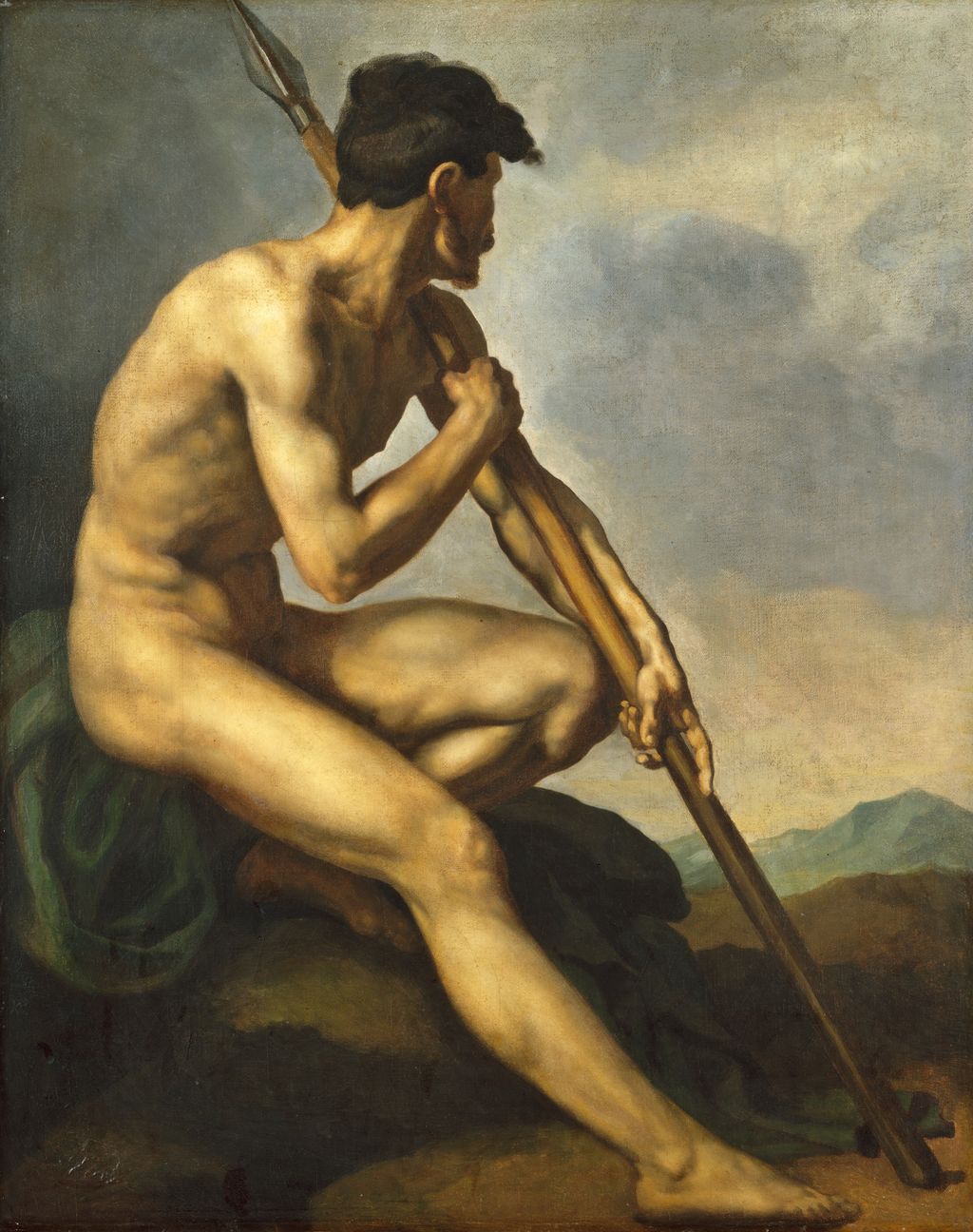
Nude Warrior with a Spear Image source. Public domain.
An intimate painting in public collections
The Getty's ownership record places Three Lovers with the sculptor Jean-Pierre Dantan before 1868, records a Paris auction in 1992, and documents its purchase by the museum through Matthiesen Fine Art in 1995. Earlier retention in Géricault's studio is described as probable, not certain. The museum also lists the painting in the 2006 Lyon exhibition Géricault: la folie d'un monde. [1]
That passage into public exhibition gives a small, intimate image a different setting for attention. We encounter it as part of a museum collection and an artist's career, yet its visual scale still favours closeness. The room remains shallow, the man's face remains partly hidden, and the reclining woman continues to watch an encounter whose personal circumstances we cannot recover.
The painting's force lies in how much those few visible relationships achieve. Stillness makes the embrace more active; the dark room intensifies the light on skin and cloth; the statue sets living bodies against an inherited form. Géricault does not need a large canvas or an identified narrative to concentrate attention on the body's expressive possibilities.
Géricault collection records
Seventy collection records include paintings, drawings and individual print impressions. Different impressions remain separate records; this selection is not a complete catalogue raisonné.
Frequently Asked Questions
The participants are unidentified. The painting distinguishes a reclining observer from an embracing couple, but the visible poses do not establish their names or a specific episode in Géricault’s life.
The Getty describes the small, freely handled canvas as an independent work intended for close private viewing. Its sketchlike appearance does not establish that a larger version was planned. [1]
Yes. The Museum of Fine Arts, Houston catalogues a female nude study for the Erotic Trio, dated 1816–1817. The reverse includes Hercules and Hippolyta and underlying female sketches. [10]
Discussion
Look again at the images and ideas explored in Three Lovers. These editorial prompts invite your observations.
Reader Insights
How does the reclining woman’s stillness change the apparent speed of the embrace?
Trace the white cloth from left to right: where does it support a body, and where does it suggest movement?
What changes when you compare the dark statue of Venus with the lit, reclining figure below it?
Join the Conversation
Share a detail, comparison or question about Three Lovers below.
References
- J. Paul Getty Museum, Three Lovers, Théodore Géricault, about 1817–1820, oil on canvas, 95.PA.72. Collection description, object metadata, provenance and exhibition history; English. View source.
- Nationalmuseum, The Severed Heads, NM 2113; collection metadata and museum interpretation (Swedish). View source.
- Louvre, Charging Chasseur, INV 4885; collection metadata and museum interpretation (French/English interface). View source.
- National Gallery, Horse frightened by Lightning; collection metadata and museum interpretation (English). View source.
- Louvre, Wounded Cuirassier, INV 4886; collection metadata and museum interpretation (French). View source.
- Louvre, The Raft of the Medusa, INV 4884; collection metadata and museum interpretation (French). View source.
- Gary Tinterow / The Metropolitan Museum of Art, Géricault’s Heroic Landscapes: The Times of Day, Met Bulletin 48/3, Winter 1990–91; consulted main essay and relevant object entries (English). View source.
- Vlaamse Kunstcollectie, Portrait of a Kleptomaniac; collection metadata and museum interpretation (Dutch). View source.
- Louvre, Epsom, MI 708; collection metadata and museum interpretation (French/English interface). View source.
- Museum of Fine Arts, Houston, Étude de femme nue pour le Trio érotique (Study of a Female Nude for the Erotic Trio) [recto]; The Combat of Hercules and Hippolyta, Queen of the Amazons and underlying female sketches [verso], 1816–1817, 2016.212.A,.B. Collection record; English. View source.
- Lorenz Eitner / National Gallery of Art, French Paintings of the Nineteenth Century, Part I: Before Impressionism, 2000, “Nude Warrior with a Spear,” pp. 254–259. Collection catalogue; English. View source.


