



 by Tom Gurney
Tom Gurney BSc (Hons) is an art history expert with over 20 years experience
Email: tomgurney1@gmail.com / Phone: +44 7429 011000
Nude Warrior with a Spear: Introduction
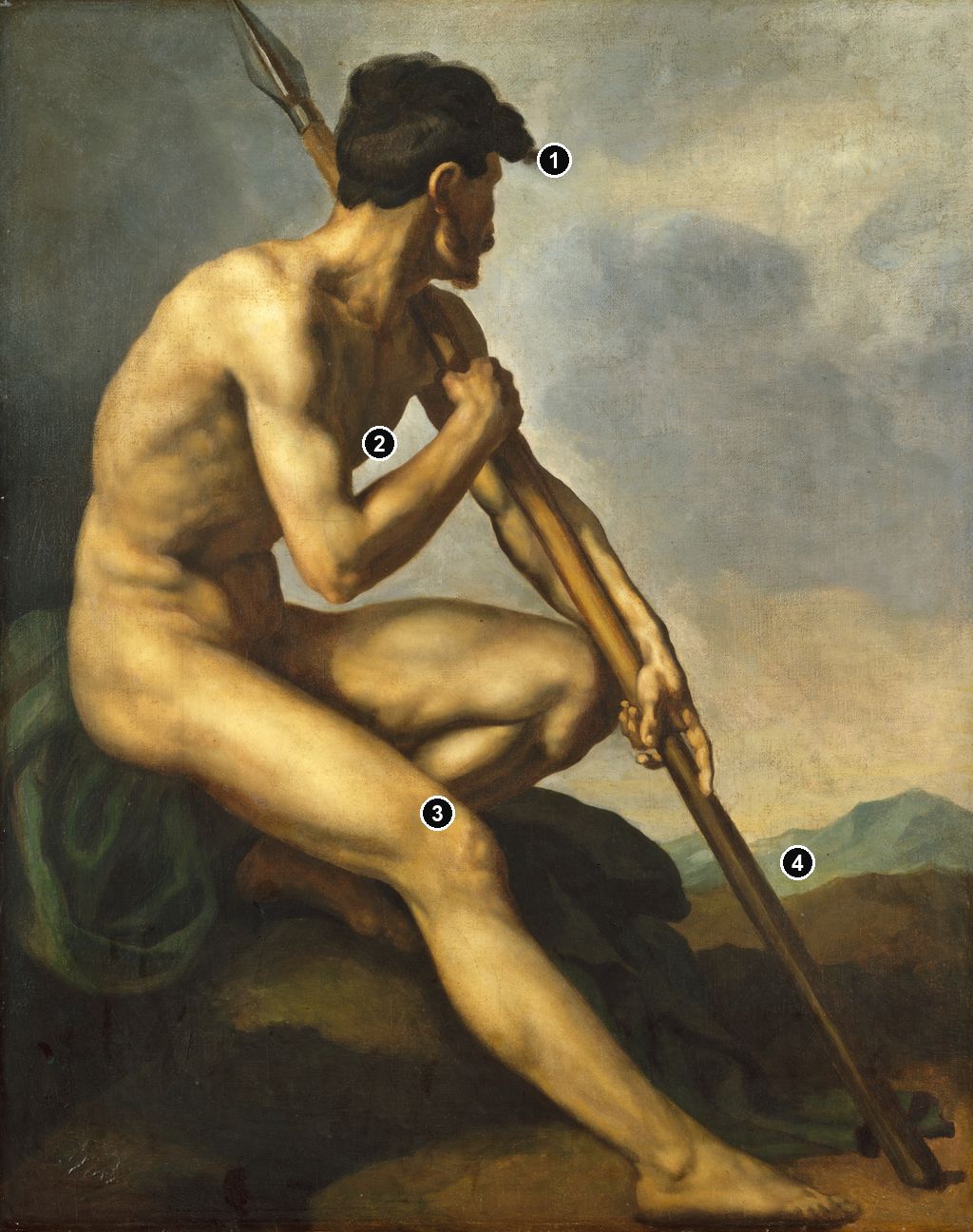
A seated man grips a spear, yet nothing in Théodore Géricault’s Nude Warrior with a Spear tells us that a battle is taking place. His body fills the canvas; a low line of mountains opens behind him. The nearer leg stretches almost to the bottom edge, while the other folds beneath the torso. A turned head withholds much of his expression. The National Gallery of Art in Washington dates this oil painting to about 1816 and records its dimensions as 93.6 × 75.5 cm, accession 1963.10.29. [1]
The tension between a carefully posed body and an apparently momentous situation is central to the picture. It began in the practice of the académie: a study of a nude model through which artists developed their command of anatomy, proportion and pictorial form. Géricault carried that exercise towards an independent painting. Its current title, however, supplies more narrative certainty than its history warrants. As Lorenz Eitner explains in the National Gallery’s collection catalogue, the title is modern, and no particular mythological episode has been established. [2]
At a Glance
- Datec. 1816 [1]
- MediumOil on canvas [1]
- Dimensions93.6 × 75.5 cm [1]
- CollectionNational Gallery of Art, Washington, Chester Dale Collection [1]
This work across Théodore Géricault’s career
The Severed Heads
1810s [3]Charging Chasseur
1812 [4]Horse Frightened by Lightning
c.1813–14 [5]The Raft of the Medusa
1818–19 [7]Portrait of a Kleptomaniac
c.1820–24 [9]The Epsom Derby
1821 [10]Contents
- A body held between movement and rest
- Why Géricault returned to academic study
- A warrior, a shepherd or an unnamed model?
- What the empty landscape contributes
- Beneath the painted skin
- Related figures in paint and on paper
- From an uncertain early history to Washington
- Annotated details
A body held between movement and rest
The figure is seated, but the pose scarcely suggests repose. The upper body leans forward while the long foreground leg reaches away from it. The bent arm brings the nearer hand towards the chest; the other arm follows the spear down towards the lower hand. These competing directions keep the figure active even though he remains in place. His weight appears gathered over the rock, with the shaft providing a long, rigid counterweight to the flexible body.
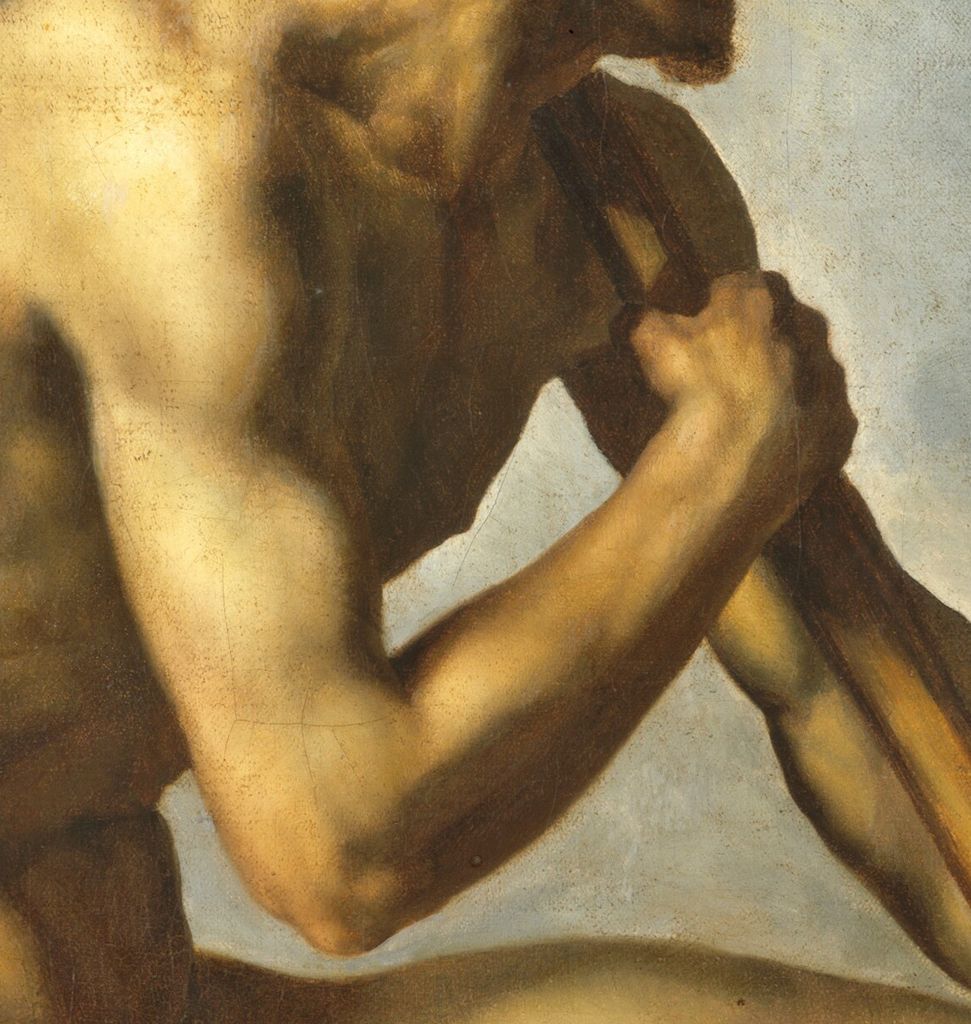
Follow that shaft from the spearhead at the upper left to its lower end near the opposite corner. It almost cuts across the entire picture. Alongside it, the extended arm and the nearer shin repeat its downward inclination. Across those long lines, the bent elbow and folded knee make shorter, sharper turns. The small triangular opening beneath the bent arm contains sky, bringing the background into the heart of the figure. Géricault has made the spaces between the limbs as useful to the composition as the limbs themselves.
Light gives the body a second structure. A bright shoulder leads into the upper arm; the nearer thigh and shin form another broad illuminated passage. Between these areas, dark hollows compress the waist, the underside of the arm and the folded leg. The chest is partly turned away, whereas the back is exposed enough for ribs, shoulder blade and changes in muscle to remain legible. The face, by comparison, receives little direct illumination. We encounter the body’s arrangement before we can read an individual’s mood.
Eitner places this deliberate balance of contour, light and opposing movements within Géricault’s pursuit of heroic figure painting. The limbs are notably long and slender despite their muscular definition. The effect depends on selection and exaggeration as well as observation: this is a living model reorganised into an imposing pictorial presence. Eitner’s comparison with Michelangelo’s figures is useful here, provided it remains a comparison of artistic ambition rather than an identification of a specific borrowed pose. [2]
The green cloth under the man also matters. Its folds fall heavily around the rock, making a dark, irregular support for the comparatively continuous surface of the skin. At the lower right, flesh, spear and cloth converge near the ground. At the upper left, the spearhead passes beyond the level of the man’s hair towards the edge of the canvas. These outward pressures make the figure seem larger than the space comfortably contains.
Why Géricault returned to academic study
An academic nude need not be a beginner’s work. By the time Eitner places this painting, Géricault had already trained with Pierre Guérin in 1810–11 and established himself through military painting. In Eitner’s account, renewed life study in 1815–16 was a deliberate effort by an experienced but irregularly trained artist to impose greater discipline on his figure construction. The catalogue relates this campaign to his preparation for the Prix de Rome competition in March 1816. [2]
The contrast with the spectacular uniforms and horses of The Charging Chasseur helps explain the change in emphasis. Here there is no costume to supply rank, profession or historical setting. The body must sustain the image almost alone. Studying a model offered Géricault a way to test whether weight, articulation and light could carry the authority expected of ambitious figure painting.
Eitner discusses a surviving record of Géricault’s intentions that combined painting a figure at his friend Dedreux-Dorcy’s studio, drawing from antique sculpture and returning to Guérin to work from life. That programme brought observation and inherited artistic models together. It also complicates the familiar image of Géricault as an artist governed entirely by spontaneous feeling: sustained practice was part of the means by which he made powerful figures. The historical documents are discussed through Eitner here, rather than treated as independently examined manuscripts. [2]
The competition ended unsuccessfully. Géricault passed the initial compositional-sketch test but failed at the academic figure study and did not reach the final round. This fact gives the painting’s context a particular sharpness, but it does not make Nude Warrior the rejected competition entry. Eitner regards it as a private académie, probably painted in the weeks before the contest, with a pose apparently chosen by Géricault himself. The proposed close dating is a scholarly reconstruction; the museum’s broader date of about 1816 remains appropriate. [2]
Dating has itself been debated. In his notes, Eitner explains that other cataloguers placed the painting after Géricault’s Italian journey, seeing its forceful modelling as a consequence of that experience. His own argument locates the development of this classicist approach earlier, through drawings and studies associated with 1815–16. The distinction changes the work’s place in the artist’s development: in Eitner’s reading, it shows a direction already established before Italy, rather than a manner acquired there. [2]
The distinction matters because an institution’s judgement of a prescribed exercise and an artist’s purpose in a private painting need not coincide. Géricault was not simply recording anatomical information. The pronounced silhouette, the emphatic muscles and the carefully contained energy already turn practice into a statement about what a figure can do within a painting.
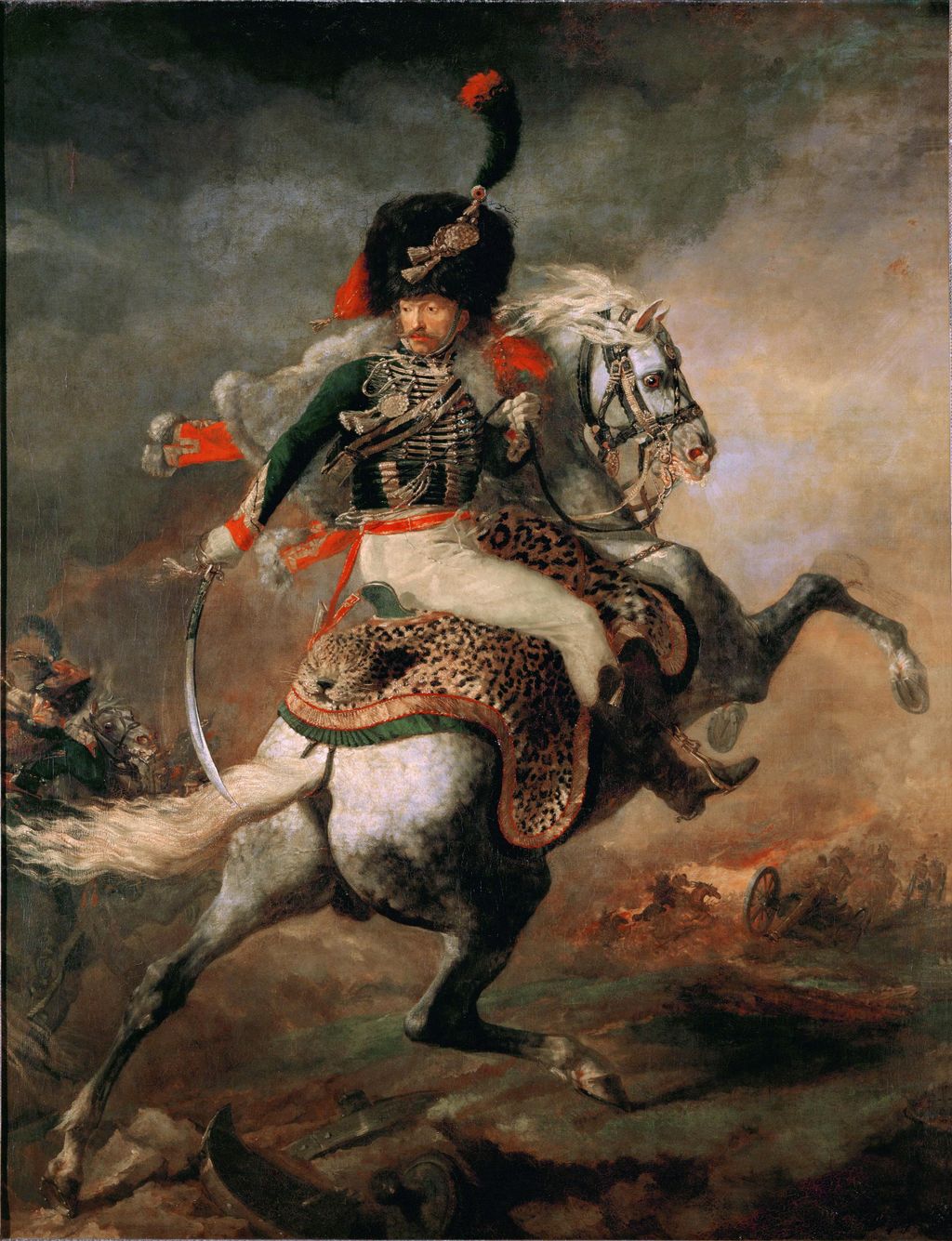
The Charging Chasseur Image source. Public domain.
Annotated Details from Nude Warrior with a Spear
The numbered points identify visible features discussed in this article. Return from each detail to the whole composition. Nude Warrior with a Spear Image source. Public domain.
Details from NUDE WARRIOR WITH A SPEAR
Compare the cropped details with the complete images above. Notice how their colours, shapes and positions contribute to the larger compositions.
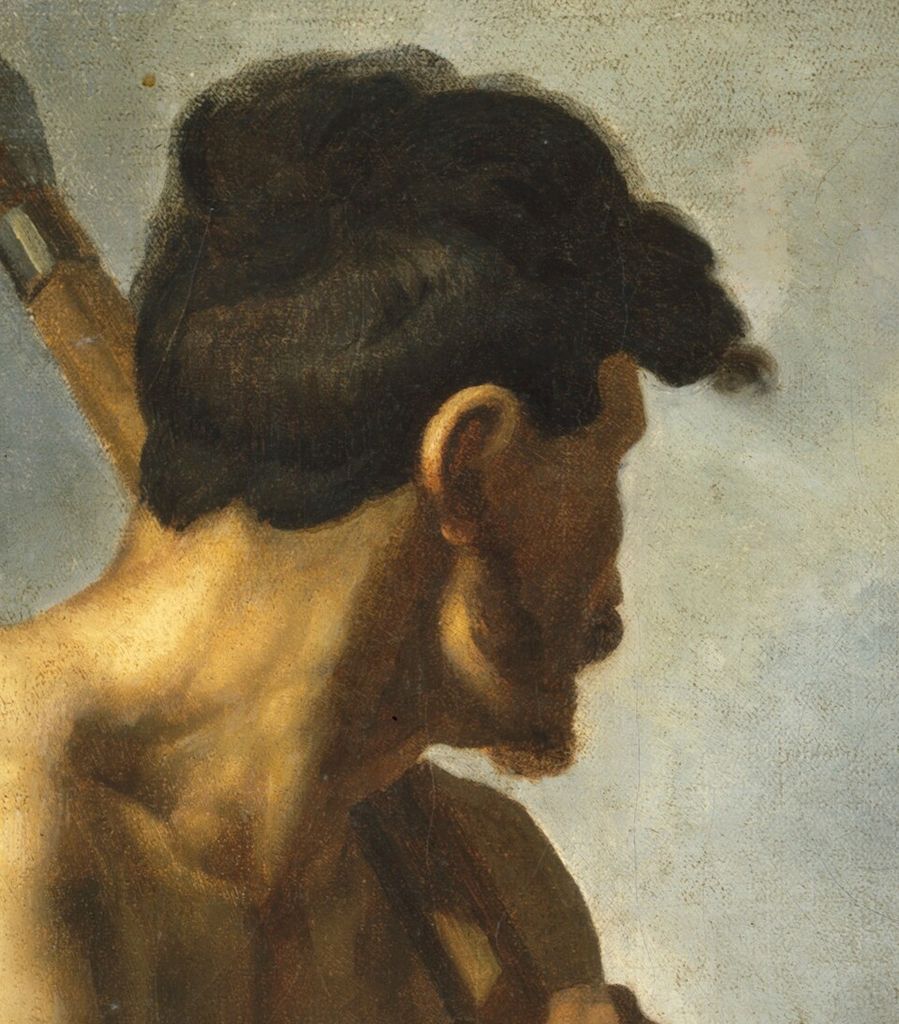
A silhouette strengthened in paint
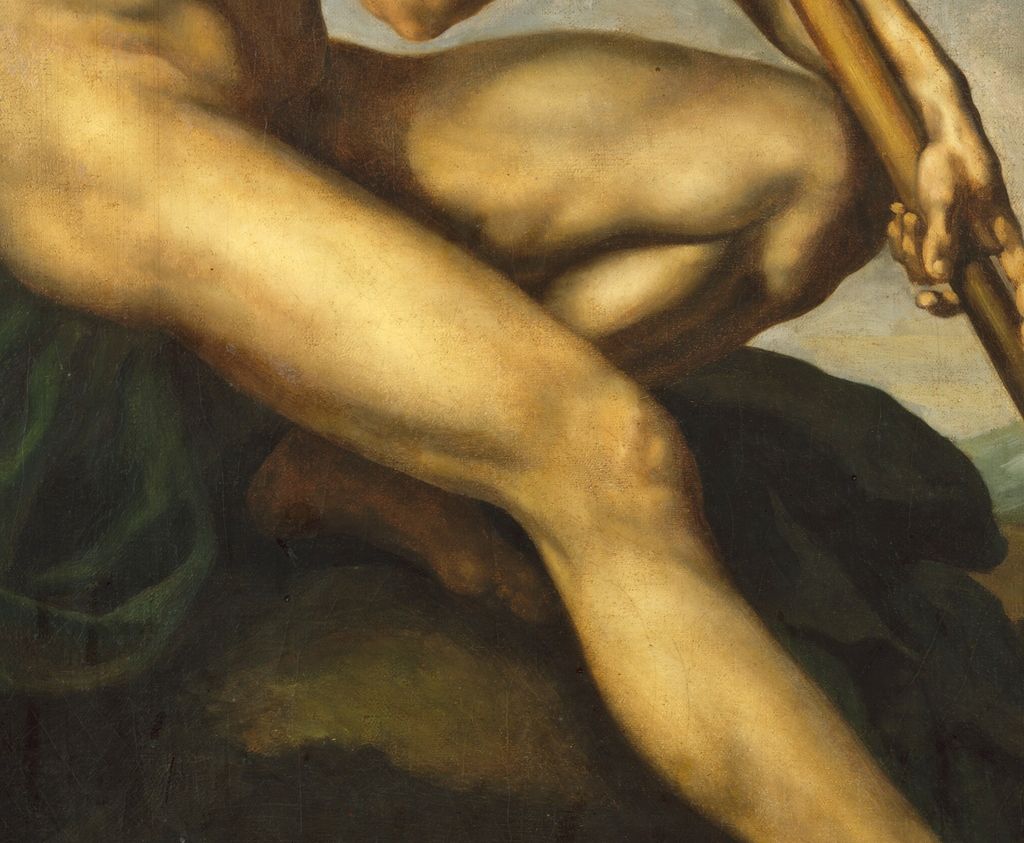
The dark hair makes the averted head stand out against the sky. Technical study links its enlarged outline and longer forelock to Géricault’s revisions.
The open triangle beneath the arm
Sky enters the figure through the space beneath the bent arm, while bright muscle and deep shadow give the elbow’s turn its force.
Folded and extended legs
The folded knee checks the long sweep of the nearer leg, holding movement and stillness together within the seated pose.
A small horizon behind a large body
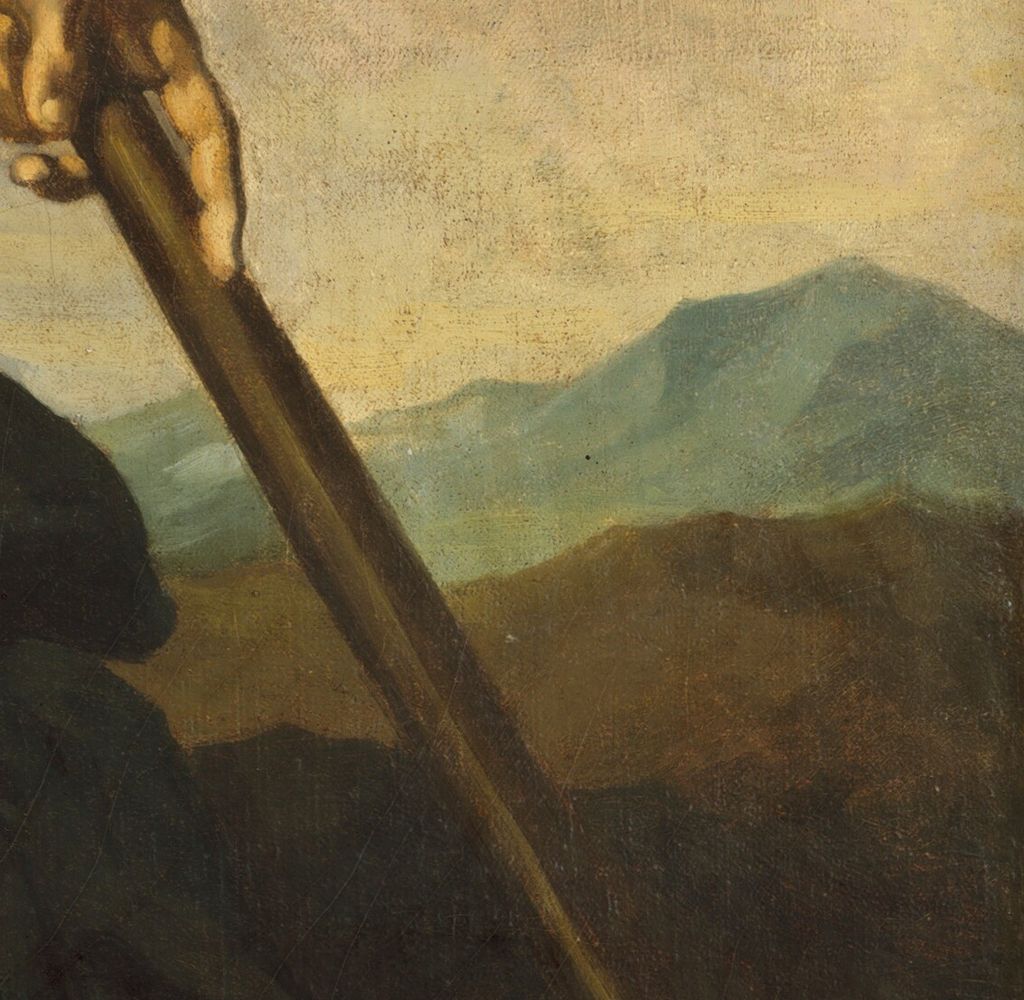
Distant blue-green ridges sit low behind the figure. Their small scale makes the space around him feel remote.
A warrior, a shepherd or an unnamed model?
The painting’s names changed as it entered public discussion. Eitner traces a possible early mention in Charles Blanc’s 1845 account to a large studio figure study. Georges Sortais’s description in 1919 likewise identified a seated male nude with a lance and mountain setting, without naming a hero. The work subsequently appeared under a shepherd title. Its owner Léon Abel Gaboriaud introduced the present warrior title in 1939. [2]
Gaboriaud also proposed an episode involving Oedipus. Eitner finds no substantiation for that identification. Neither the spear nor the distant mountains securely distinguishes Oedipus from other possible figures, and no accompanying character or unmistakable narrative attribute settles the question. A modern owner’s suggestion is evidence about the painting’s reception, rather than proof of what Géricault intended. [2]
The older shepherd name and the later warrior name reveal how readily an accessory can redirect a viewer’s expectations. Call the man a shepherd and his solitude may look pastoral; call him a warrior and the same isolation can suggest vigilance, exhaustion or defeat. The visible figure supports a range of responses, but the title cannot decide among them on the artist’s behalf.
Nor does the painting’s ambitious finish establish a lost commission. Eitner argues that it was made as an independent académie, rather than as a preparatory work for a larger narrative composition. He discusses a somewhat similar spear-bearing figure in a drawing at Besançon, but does not treat that resemblance as evidence of a shared, developed project. A resemblance between poses is a starting point for comparison, not a commission history. [2]
Watch: Géricault and The Raft of the Medusa
Three perspectives on Géricault’s best-known painting, its making and its historical setting.
Gericault, Raft of the Medusa
Smarthistory examines the composition and historical setting of The Raft of the Medusa.
Watch on YouTubeWhat the empty landscape contributes
The setting changes the meaning of the studio exercise without providing a story. The rock and cloth anchor the man in the foreground, but the mountains are distant and small. Their subdued blue-green ridges lie far below the level of his head. Clouded sky occupies much of the space into which he turns. There is no companion to return his gaze and no visible event to explain his attention.
This distance between the prominent body and the remote landscape makes solitude tangible. The man is strongly present to the viewer while looking elsewhere. His face is partly concealed, so the open country becomes an uncertain destination for his thoughts as well as his gaze. Alertness, contemplation and fatigue are possible responses to the arrangement; none requires the invention of a battle just beyond the frame.
The National Gallery offers a more historical reading, suggesting that the contrast between physical strength and an empty setting can evoke France’s defeat after the Napoleonic wars and a redirection of energy into imagination. This is the museum’s interpretation, not a documented explanation by Géricault. It gains plausibility from the work’s approximate date and atmosphere, but does not identify the seated man as a particular defeated soldier. [1]
The painting can therefore be read on two connected levels. Its academic organisation remains visible in the carefully sustained pose. Its landscape gives that pose emotional scope. Eitner’s account emphasises the way a life study acquired poetic content through its setting, while resisting a fixed narrative identification. The resulting openness is part of the picture’s force: the figure seems capable of action, but the painting leaves that action suspended. [2]
Beneath the painted skin
Technical examination shows how deliberately the body was built. A thick white ground, applied by the artist, covers the woven support and has a texture of vertical striations. Infrared examination revealed a forceful underdrawing outlining the upper torso and limbs. Over the ground, thin, partly transparent brown paint established the modelling. Some of that brown remains visible along contours and within shadows. Opaque paint worked wet into wet and translucent glazes together produced the flesh, sky and landscape. [2]
These findings help explain why the anatomy can appear both solid and finely articulated. The body did not emerge solely from a final outline filled with flesh colour. Its volumes developed through successive kinds of mark: a drawn structure, brown tonal preparation, more opaque illumination and transparent adjustments. The strongly lit shoulder and shaded flank belong to the same construction, even though their surfaces meet the eye differently.
The head also changed during painting. According to the catalogue, Géricault enlarged its initially rounder outline with thicker, darker hair and extended the forelock. Eitner regards these changes as the artist’s own part in turning the life study into a more expressive composition. The strengthened mass of hair makes the head more emphatic against the sky and gives the averted profile greater definition. Paint around the extended arm also records revision; the catalogue suggests that the sky may conceal earlier changes along its contour. [2]
The feet present a different question. Their comparatively cursory treatment, particularly the flat brown handling of the extended right foot, led Eitner to suggest possible completion by a later hand. This remains a possibility. It should not be confused with his attribution of the expressive revisions to Géricault, or expanded into a claim that an identified restorer repainted the entire figure. The picture may have been left unevenly finished even while its central forms were highly developed. [2]
Its present surface also has a history of wear and repair. The catalogue records abrasion, substantial inpainting in the lower right foreground and extensive reglazing in the right part of the sky. The original canvas was lined, its tacking margins removed, and approximately one centimetre added around each edge by filling and painting the lining fabric. Examination did not suggest that the original image had been appreciably cut down. These alterations caution against treating every visible transition in the sky or foreground as Géricault’s untouched paint. [2]
Related figures in paint and on paper
Eitner’s closest painted comparison is Seated Nude in Back View in Brussels. Both paintings develop a posing model into a carefully organised, substantial figure. The Brussels work also helps him consider Géricault’s willingness to leave extremities less resolved than the principal masses. That comparison supports a question about finish; it cannot by itself identify who painted a particular passage of the Washington canvas. [2]
Two drawings widen the comparison. A rapid pencil study at Bayonne, inventory 2057, records a broadly similar pose and physique. Eitner allows that it may have contributed to the painting’s development, without establishing a direct preparatory sequence. A more elaborate seated male nude at the British Museum, inventory 1920,0216.2, uses black chalk, wash and white gouache. Eitner treats it as a graphic counterpart to the painted académies, related in pose and treatment to both Washington and Brussels. It is a separate drawing, not another name or medium for Nude Warrior. [2]
These works belong to a wider relationship between Géricault’s drawings and paintings: observation could be transformed through several media without every sheet serving as a fixed step towards a final canvas. Eitner also distinguishes the large academic nudes from the smaller, more rapidly executed oil studies associated with the riderless-horse race project. His argument that Nude Warrior was independent does not mean that Géricault never painted preparatory nude studies for other compositions. [2]
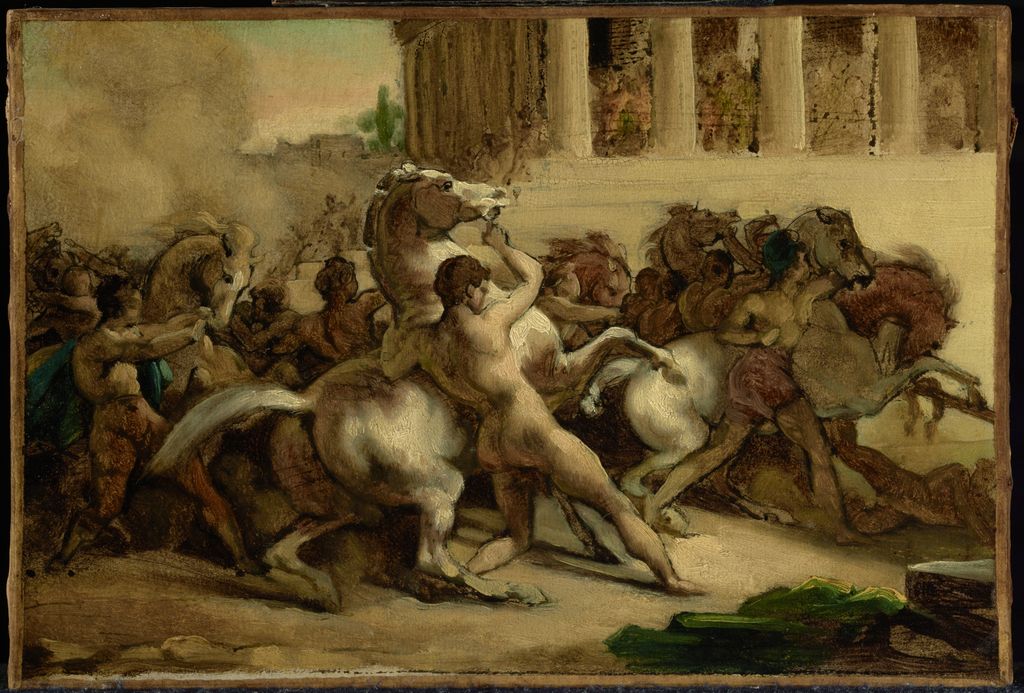
The Race of the Riderless Horses — Getty study Image source. CC0 / Public domain.
From an uncertain early history to Washington
The early ownership story is less secure than the painting’s modern identity. A certificate issued by Sortais in 1919 claimed that Géricault had given it to the painter Philippe Comairas, after whom it passed through other owners. Eitner notes a possible supporting reference in Blanc’s 1845 text but stresses the weakness of the documentation. The alleged gift should therefore remain a reported tradition. [2]
A firmer public history begins with Gaboriaud, who owned the painting by 1919 and lent it to the Géricault centenary exhibition in Paris in 1924. Eitner records its immediate acceptance there as a work by Géricault. Its absence from an earlier catalogue and its incomplete provenance are separate issues from the quality and coherence of the attribution established through later study. [2]
Chester Dale acquired the painting through the New York dealer Julius H. Weitzner on 10 October 1950. It entered the National Gallery through Dale’s bequest in 1963. [1] In the museum, its bodily strength and uncertain narrative remain equally apparent. Looking closely reveals an artist testing the discipline of academic form, then using scale, light and landscape to make a single posing model carry the weight of an independent painting.
Géricault collection records
Seventy collection records include paintings, drawings and individual print impressions. Different impressions remain separate records; this selection is not a complete catalogue raisonné.
Frequently Asked Questions
No named hero or model has been securely identified. The present title was introduced by the owner Léon Abel Gaboriaud in 1939. His proposed Oedipus identification is unsubstantiated. [2]
Lorenz Eitner links it to Géricault’s preparation for the 1816 competition and considers it a private académie. It has not been established as the figure study rejected by the jury. [2]
The catalogue suggests that the feet, especially the extended right foot, may have been completed later. That remains a possibility. The darker hair and longer forelock are treated separately as Géricault’s own revisions. [2]
Discussion
Look again at the images and ideas explored in Nude Warrior with a Spear. These editorial prompts invite your observations.
Reader Insights
Trace the spear, extended arm and foreground shin. Where do the bent elbow and knee interrupt their repeated direction?
Imagine the same pose against a plain studio wall. What does the low mountain horizon add to your sense of the man’s situation?
How would the earlier shepherd title change your response to the figure compared with the present warrior title?
Join the Conversation
Share a detail, comparison or question about Nude Warrior with a Spear below.
References
- National Gallery of Art, Nude Warrior with a Spear, c. 1816, accession 1963.10.29, online collection record: identity, interpretive overview and modern acquisition history, English, accessed 27 October 2026. View source.
- Lorenz Eitner / National Gallery of Art, French Paintings of the Nineteenth Century, Part I: Before Impressionism (Washington, 2000), “Nude Warrior with a Spear,” pp. 254–259, with continuation of notes on p. 260; technical notes, provenance, essay and comparative illustrations, English. View source.
- Nationalmuseum, The Severed Heads, NM 2113; collection metadata and museum interpretation (Swedish). View source.
- Louvre, Charging Chasseur, INV 4885; collection metadata and museum interpretation (French/English interface). View source.
- National Gallery, Horse frightened by Lightning; collection metadata and museum interpretation (English). View source.
- Louvre, Wounded Cuirassier, INV 4886; collection metadata and museum interpretation (French). View source.
- Louvre, The Raft of the Medusa, INV 4884; collection metadata and museum interpretation (French). View source.
- Gary Tinterow / The Metropolitan Museum of Art, Géricault’s Heroic Landscapes: The Times of Day, Met Bulletin 48/3, Winter 1990–91; consulted main essay and relevant object entries (English). View source.
- Vlaamse Kunstcollectie, Portrait of a Kleptomaniac; collection metadata and museum interpretation (Dutch). View source.
- Louvre, Epsom, MI 708; collection metadata and museum interpretation (French/English interface). View source.


