



 by Tom Gurney
Tom Gurney BSc (Hons) is an art history expert with over 20 years experience
Email: tomgurney1@gmail.com / Phone: +44 7429 011000
The Raft of the Medusa: Introduction
A man raises a cloth above his head. Beneath him, other men pull themselves upright, reach towards the horizon or turn to tell their companions what they have seen. Across the foreground, bodies lie beyond the reach of that excitement. The tiny ship in the distance might save the living, but it cannot restore the dead. In The Raft of the Medusa, Théodore Géricault makes the difference between seeing help and receiving it feel almost unbearable.
Painted in 1818–19, the canvas measures 491 × 716 cm and belongs to the Louvre. Its subject was a recent disaster: the loss of the French frigate Méduse in 1816 and the abandonment of approximately 150 people on a makeshift raft. Géricault gave this contemporary catastrophe the dimensions and bodily grandeur associated with ambitious history painting. He also withheld the kind of ending that such grandeur might lead a viewer to expect. The painting presents an appeal whose answer remains a speck on the sea. [1]
Its force depends on several kinds of truth meeting without becoming identical. There is the historical disaster, reconstructed through contested accounts. There are the bodies studied in the studio, living and dead. There is the painted arrangement that brings those bodies into a powerful collective movement. Understanding the work means keeping all three in view: a survivor's evidence cannot simply be read off a painted figure, and the picture's departures from literal appearance are central to what it makes visible.
At a Glance
- Date1818–19 [1]
- MediumOil on canvas [1]
- Dimensions491 × 716 cm [1]
- CollectionMusée du Louvre, Paris [1]
This work across Théodore Géricault’s career
The Severed Heads
1810s [2]Charging Chasseur
1812 [3]Horse Frightened by Lightning
c.1813–14 [4]Portrait of a Kleptomaniac
c.1820–24 [7]The Epsom Derby
1821 [8]Contents
- A colonial expedition becomes a public disaster
- What happened to the tow ropes?
- Thirteen days, fifteen rescued
- An immense foreground and a minute horizon
- The living do not all look in one direction
- The first painted sketch: bringing the Argus into view
- Choosing the moment: drawings and oil sketches
- Joseph at the summit
- Real people, studied bodies and heroic anatomy
- Making a painting more than seven metres wide
A colonial expedition becomes a public disaster
The Méduse was travelling to Saint-Louis in Senegal as part of an expedition to re-establish French colonial possession after the Napoleonic wars. It carried sailors, soldiers, officials and civilian passengers. Its captain, Hugues Duroy de Chaumareys, was a returned émigré whose long absence from active navigation made his appointment politically charged. The Lyon museum's 2006 exhibition dossier places the disaster within the conflicts of the Bourbon Restoration: the question was not only how a ship had been lost, but how authority had been assigned and exercised. [9]
On 2 July 1816 the frigate grounded on the Arguin Bank, off the coast of present-day Mauritania. Grounding did not immediately mean abandoning ship. Attempts to free the vessel continued before evacuation became unavoidable. At daybreak on 5 July, according to the published narrative of the survivors Henri Savigny and Alexandre Corréard, water had risen inside the frigate and those aboard prepared to leave. The dates mark distinct events: the wreck began on 2 July; the raft's separate ordeal began with the evacuation on 5 July. [1] [10]
The available boats could not accommodate everyone. A raft assembled from the ship's materials became the place assigned to roughly 150 people, most of them soldiers, together with sailors and passengers. Savigny and Corréard themselves give an uncertain initial total, discussing 147 and 150 rather than supplying an exact, consistently verified passenger list. Their uncertainty is a reason to retain the approximate figure, especially when reconstructing a hurried evacuation from conflicting recollections. The plan was for the boats to tow the raft towards land. [10]
This setting matters to the painting even though almost none of its administrative machinery is shown. There is no captain on a quarterdeck, no official handing down an order and no legible emblem explaining the expedition. The men have reached the point at which organised protection has failed them. The absence of those responsible allows the crowd on the raft to occupy the whole field of attention. A disaster rooted in appointments, decisions and unequal access to safety appears as an immediate human emergency.
Calling the expedition colonial also changes the geographical frame. The sea is not an empty stage on which an abstract tragedy happened. The frigate was carrying French power towards an African possession. The Black figures whom Géricault placed within the raft therefore belong to an image whose history already crosses France, Africa and the Atlantic. That context does not settle every political meaning in the composition, but it prevents its apparent universality from erasing the journey that produced the catastrophe. [9]
What happened to the tow ropes?
The raft was separated from its towing boats and left to drift. Beyond that essential fact, the mechanics and responsibility require care. Familiar summaries often turn the episode into a single action in which all the ropes were cut at once. Savigny and Corréard's account describes a more complicated sequence of boats breaking formation, ropes being released and attempts or promises to regain position. It is an accusation, supported by their experience and by testimony they report, rather than an impersonal record made from outside the event. [10]
In their narrative, one boat released its connection while avoiding a collision with the overloaded longboat. The line then came apart further. They maintained that the last boat deliberately let go the rope connecting it to the raft. They explicitly rejected the governor's explanation that men on the raft had pulled the boat towards them and that a subsequent shock broke the rope. The published text preserves both the rival explanation and the authors' refusal to accept it. Reducing this to an uncontested image of simultaneous cutting discards the dispute that made the account politically explosive. [10]
The survivors also recognised the danger facing the people in the small boats. Their argument was that those dangers did not justify abandoning the raft when concerted action might still have brought it nearer land. That makes the testimony more revealing than a simple division between wholly safe officials and wholly helpless victims. It describes a collapse of coordination in which separate groups acted for their own preservation and those least able to move independently suffered the consequences. Their claim of impartiality should itself be read as part of their effort to win a public hearing. [10]
Géricault did not paint the release of the ropes. He selected a later moment, when the boats and the initial decision have disappeared from view. The viewer meets the consequences before encountering an identifiable perpetrator. This choice gives the painting a different operation from an illustrated accusation. It can be understood without recognising a particular official, while knowledge of the abandonment makes the survivors' dependence on a distant vessel more painful.
The remnants of maritime equipment make that dependence visible. Planks, ropes, a mast, sailcloth and a barrel remain, but their original system has been broken apart. They no longer belong to a ship capable of conducting its passengers to a destination. They have become surfaces on which to lie, supports on which to stand, and objects through which a group improvises another appeal for help. The raft is at once a fragment of failed organisation and a structure the living must keep using.
Annotated Details from The Raft of the Medusa
The numbered points identify visible features discussed in this article. Return from each detail to the whole composition. The Raft of the Medusa Image source. Public domain.
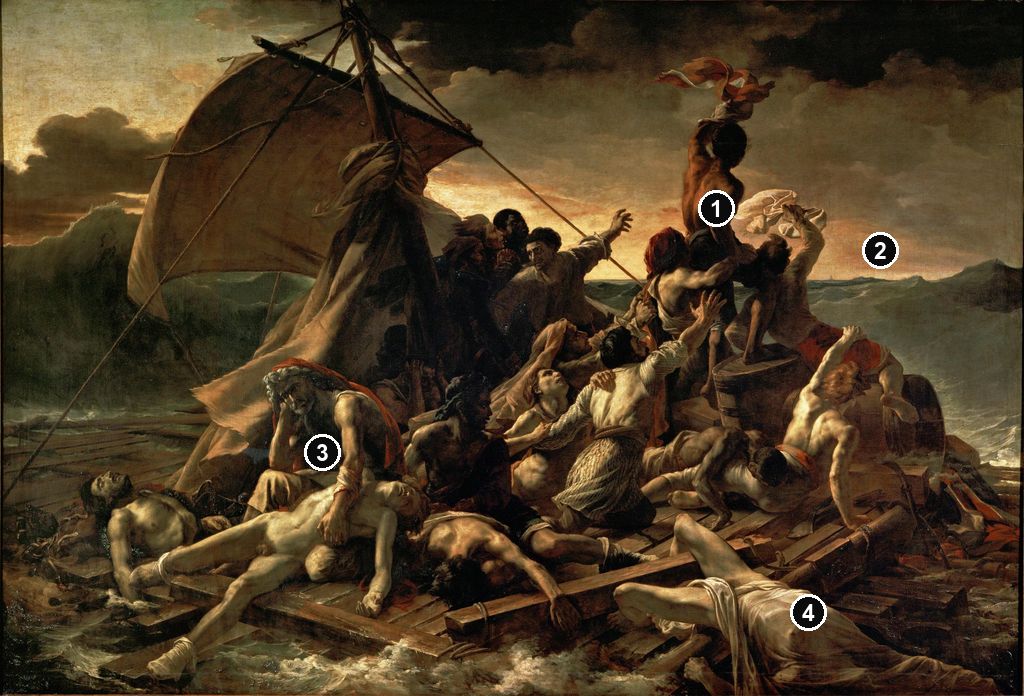
Details from THE RAFT OF THE MEDUSA
Compare the cropped details with the complete images above. Notice how their colours, shapes and positions contribute to the larger compositions.
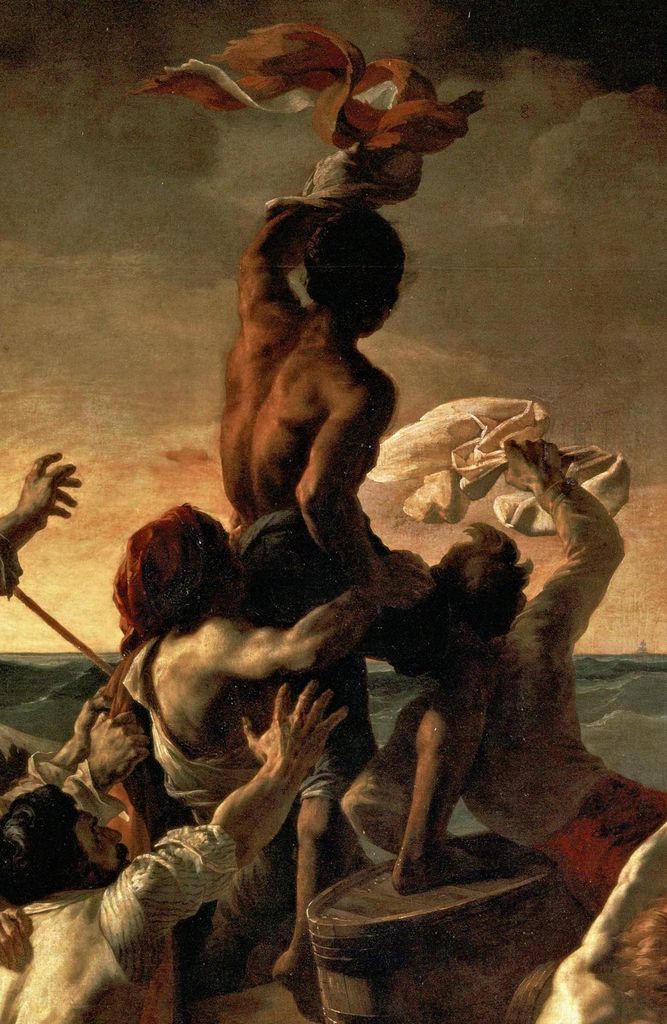
A signal made by many people
The raised cloth is carried by a man whose elevated position depends on the bodies beneath him. A shared effort becomes the highest point of the composition.
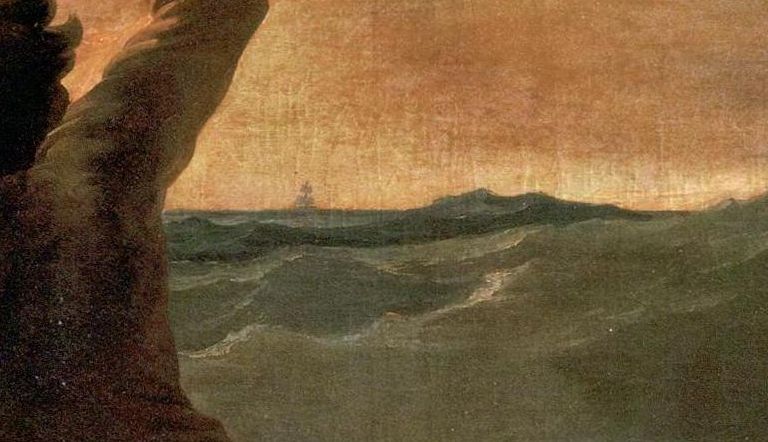
The nearly invisible Argus
A tiny vessel on the horizon offers a possibility rather than a completed rescue. Its scale makes the raft’s appeal seem urgently difficult to see.
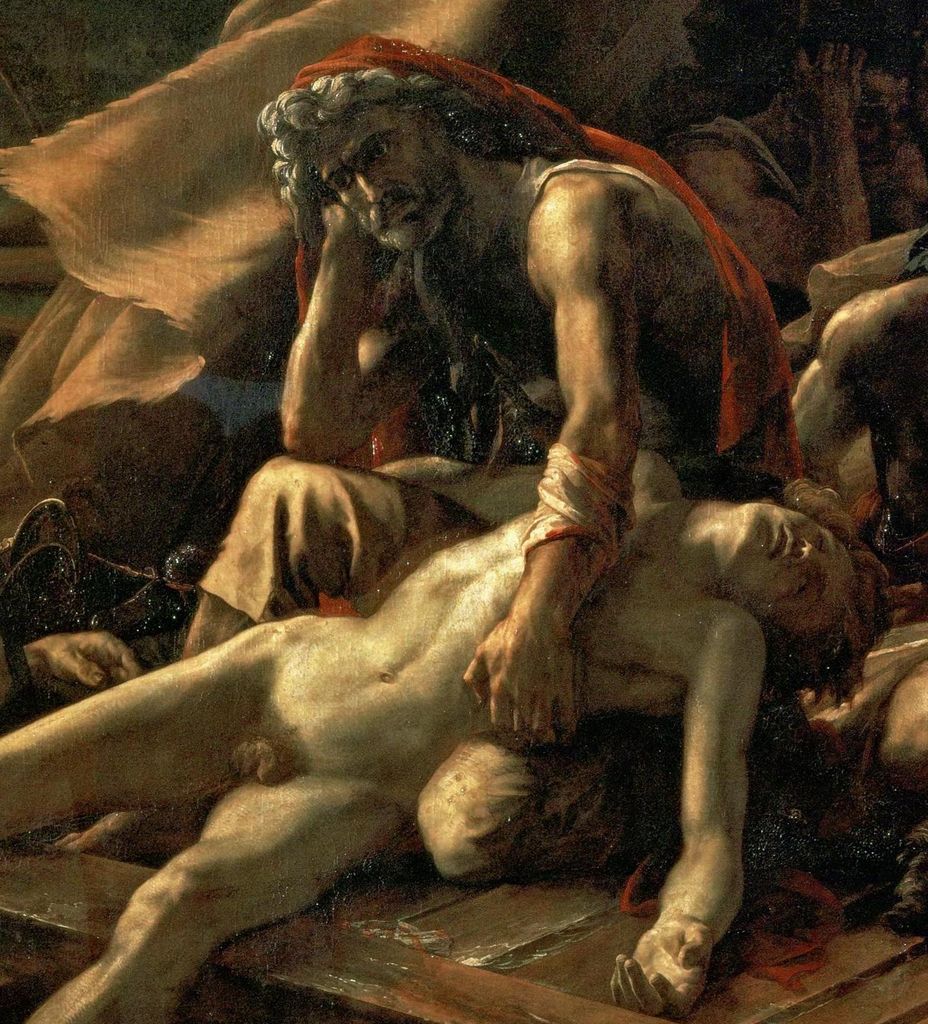
Grief apart from the signal
The seated bearded man supports a younger body and looks away from the general rush towards hope. His stillness interrupts the upward movement.
A body across the edge
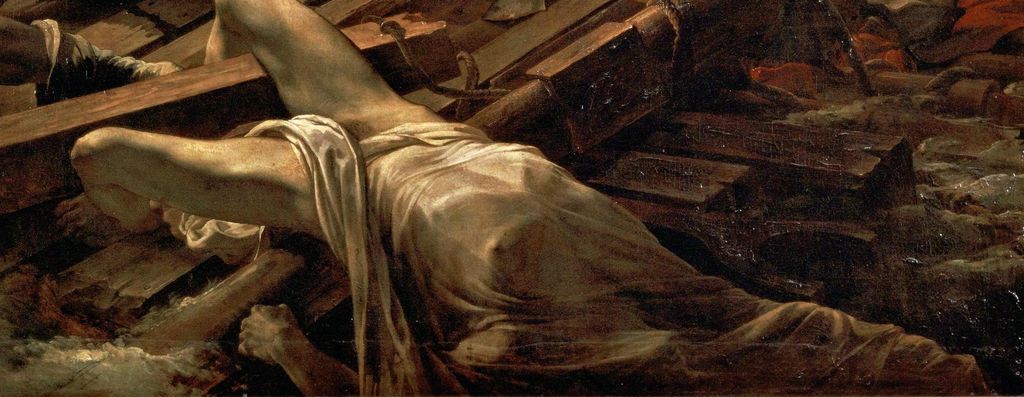
The pale foreground body lies partly beyond the raft. Flesh, planks and water meet where the improvised shelter can no longer provide a firm boundary.
Thirteen days, fifteen rescued
The drift brought exposure, thirst, hunger, violent conflict and cannibalism. These are essential to the disaster's history, but they should not become a sensational substitute for looking at the painting. Savigny and Corréard's account describes extreme deprivation and the disintegration of the group; Géricault's preparatory work considered several episodes before he settled on the sighting of a possible rescue ship. The final painting retains dead bodies and exhausted men while directing its main action towards the possibility of survival. [9] [6]
On the morning of 17 July, a man on the raft saw a brig at a great distance. According to the survivors, they could initially distinguish only the tops of its masts. They fastened coloured handkerchiefs to straightened hoops from casks and raised signals. For more than half an hour they argued over whether the vessel was approaching or receding. It then disappeared. Hope gave way to despair, and the men sheltered beneath a makeshift tent. [10]
Roughly two hours later, the master gunner looked out and saw the brig near the raft. This time its approach led to rescue. It was the Argus, which sent a boat to remove the fifteen remaining people. Savigny and Corréard described ten of those fifteen as scarcely able to move, their bodies wounded, their eyes hollow and their appearance transformed by suffering. Their reckoning was that the ordeal had lasted thirteen days. Inclusive counting helps explain why summaries do not always use the same duration, but grounding, evacuation and rescue should never be merged into one date. [10]
Fifteen rescued also does not mean fifteen people restored to health. Gary Tinterow's Metropolitan Museum study records that five subsequently died. The rescue total refers to those taken from the raft, whereas the later death toll describes what followed. These figures are often confused because a short account uses “survivors” for both moments. Géricault's picture holds survival open as an immediate possibility; the historical aftermath reminds us that removal from danger was not the same as recovery. [6]
The interval between the first sighting and secure rescue gives the painting its central tension. The brig is visible but very small. Men signal, yet the picture supplies no answering gesture that can be confidently read across the water. We know the eventual result; the figures do not possess that retrospective certainty. Géricault makes the viewer occupy the gap between an object noticed on the horizon and a shared future that has not yet arrived.
The weather is another reminder of transformation. Savigny and Corréard describe the sun rising clear of clouds on 17 July; Géricault gives the scene a sky heavily darkened above the raft and a sea that threatens its edges. His scene should not be used to reconstruct the exact weather, viewpoint or disposition of every survivor at the first sighting. The uncertainty comes from the witnesses; its visible concentration into this atmosphere and this arrangement belongs to the painter. [10]
An immense foreground and a minute horizon
The most immediate imbalance is one of scale. A bare foot, a hanging hand and a pale torso are close enough to inspect. The rescue ship is almost too small to notice. The foreground therefore demands a kind of attention that the horizon resists: the dead are materially present, while the means of saving the living can barely be distinguished from the sea. A reproduction makes this harder to experience because the whole canvas shrinks to a convenient rectangle. At its full size, the disparity between the bodies and the distant vessel becomes a physical part of looking.
The raft is set obliquely, its timbers advancing towards the lower edge rather than forming a calm platform parallel to the frame. Water presses around and between its exposed edges. On the left, a wave rises close to the sail. On the right, the group of signalling men stands above a tilted arrangement of planks and bodies. Nothing about this base promises secure footing. The upward movement towards the cloth therefore remains precarious: height has been gained from a structure that might fail at any moment.
Two large arrangements organise the crowded surface. The mast, rigging and sail establish a triangular structure towards the left. To the right, bodies rise through a second, less regular pyramid culminating in the man waving the cloth. The first is a surviving piece of the vessel's equipment; the second is made from human effort. They overlap, but their upper points do not coincide. The composition gives the group an imposing architecture while showing that its energy has to be generated by people bracing, lifting and holding one another.
The sail does not make the raft look capable of purposeful progress. Its heavy curve occupies a large part of the sky, and the diagonal ropes cut across the figures. At the summit of the human group, by contrast, the cloth twists into a light, irregular shape. One fabric surface belongs to the damaged means of navigation; another has become a signal. Their different weights and positions help distinguish transport from communication. The men cannot simply travel to safety, so they must make themselves visible to someone who can reach them.
The light follows no easy equation in which brightness guarantees hope. A yellow opening in the sky illuminates the distance, but dark clouds stretch above the signalling figure. Pale bodies in the foreground catch a strong light despite their helplessness. A white cloth waved lower down on the right stands out more sharply than the distant ship. Géricault repeatedly offers visible brilliance without a secure resolution. The eye can travel through the painting quickly; the meaning of what it encounters remains uncertain.
The living do not all look in one direction
From a distance, the picture can seem to move in a single rising sweep from death to hope. Close looking interrupts that movement. An older, bearded man sits low at the left with his head supported by a hand. A younger body rests across his lap. He faces out towards the viewer's side of the picture rather than joining the men scanning the sea. The traditional description of this group as a father and dead son gives it an intelligible human relationship, but it should not be mistaken for identification of two documented passengers. The Lyon dossier records that such a group was developed in preparatory studies. [9]
His stillness is different from the stillness of the dead. He remains upright, able to support another body, but his pose offers no visible participation in the new excitement. This is one reason the painting refuses a clean ascent from despair to salvation. A survivor may be physically alive and yet absorbed by a loss that the distant ship cannot remedy. The red cloth around his head and shoulders connects him to the warmer colours elsewhere, while his inward posture holds him apart from their forward movement.
Near the middle, faces and hands transmit news unevenly. One man turns towards his companions with an arm extended; another leans forward; others emerge only partially from the shadow under the rigging. A prominent raised arm does not belong to the highest figure. The gesture chain is therefore more intricate than an arrow pointing to the vessel. The scene contains the work of communicating within the raft as well as the attempt to communicate beyond it.
The lower bodies complicate identification still further. A limb that first appears to belong to one figure may lead the eye towards another torso. Hands rest, grip, hang or reach, and it takes time to separate those actions. This interdependence makes the people appear crowded together without giving each an isolated portrait space. It also prevents suffering from being confined to a single exemplary victim. The composition asks the eye to move among different conditions of life, injury, exhaustion and death.
At the lower right, a pale body lies partly beyond the raft, with its upper half extending towards the water and its legs remaining on the structure. The figure gives the picture an unstable boundary. The raft is not a sealed stage with an audience safely outside it; a body crosses the edge that should separate human shelter from the sea. Near the lower left, another pair of legs reaches across the foreground. These projections make the painting's horizontal spread as consequential as its famous upward thrust.
The first painted sketch: bringing the Argus into view
In Géricault's first painted sketch for The Raft of the Medusa, the rescue vessel is readily visible at the right of the horizon. The men signal towards a ship whose masts can be distinguished above the water. This small canvas is the Louvre's RF 2229, dated 1818, painted in oil and measuring 38 × 46 cm. The museum explicitly places it before the second painted sketch, RF 1667, in the preparation of the monumental Raft. [11]
The raft offers a different surface to the eye here. Its front edge runs across much of the lower picture, displaying a broad patchwork of planks beneath the bodies. A long pale fabric spills over that edge and curves towards the water. In the finished composition, the platform turns more strongly into depth and the foreground bodies press closer to the viewer. Comparing the two arrangements makes the raft's angle a consequential choice: it determines how much floor can be seen and whether the figures appear spread across a platform or crowded towards its projecting corner.
Above that exposed floor, the first sketch gathers its most emphatic gestures into a relatively low cluster. Near the centre, a bare torso turns towards the right with an arm reaching across the group. Farther right, a dark standing figure lifts a pale signal against the sky, beside an upright barrel. These bodies make a lateral movement towards the vessel. They have yet to form the steep, elevated summit that dominates the finished painting. The distinction is visible even before individual poses are disentangled: the sketch carries the appeal across the raft, while the final design sends it upwards.
The sail contributes to the difference. In RF 2229 its broad, rounded surface occupies much of the left half, with its lower fabric dropping towards the seated and recumbent figures. It competes in size with the whole knot of active bodies. The standing signaller clears their heads but remains below the mast. In the finished canvas, the highest signalling figure rises to challenge the mast's dominance. Equipment and human action acquire a different balance as the arrangement changes.
RF 1667 records another stage: also dated 1818, it is a larger oil sketch, 64.3 × 81 cm, catalogued by the Louvre as the second in the sequence. Its elevated signalling group stands closer to the arrangement of the final painting. [12] The sequence establishes preparation, but it does not make every altered pose a documented statement of intention. What the comparisons allow us to see is more concrete: the vessel's visibility, the raft's orientation and the height of the figures could all change while the subject remained an appeal for rescue.

The Raft of the Medusa, first painted sketch, 1818 — Louvre RF 2229, 38 × 46 cm
Choosing the moment: drawings and oil sketches
Drawings explored other narrative possibilities. The Lyon exhibition dossier lists a scene of cannibalism in black chalk, brown wash and white gouache on paper, a combat study in graphite, and a pen drawing of the survivors' rescue. It also records a Rouen pen-and-brown-ink drawing of the Argus in view. Paper studies, painted sketches and the final oil canvas have different materials, dimensions and functions; calling them all “versions of the painting” obscures the range of decisions they preserve. [9]
The rejected or alternative episodes clarify the final choice. A scene of combat would place violence within the group at the centre of attention. A rescue scene could show assistance arriving and bodies being transferred to safety. Cannibalism would make a desperate act of survival the principal visible event. The distant sighting instead lets past violence remain present through its consequences while making the central action an appeal. It holds together the history of suffering and the possibility that the suffering might end.
The father-and-son group was also studied separately. That matters because it shows that the quiet counterweight to the signalling men was a compositional problem in its own right. Géricault was not merely filling the lower corner after arranging the heroic summit. He developed gestures of grief alongside gestures of collective effort. The finished painting is powerful because those different experiences coexist, rather than because every figure expresses a single emotion at the same instant. [9]
Preparation did not end with the Salon canvas. Tinterow catalogues a small watercolour and graphite reduction, dated 1820, made in preparation for a lithograph illustrating the survivors' narrative in 1821. He observes that it raises the horizon, enlarges the rescue ship and brings the raft closer to the foreground. This later work on paper must be distinguished from the earlier oil sketches. It shows the composition being reconsidered for another medium and another encounter with the survivors' text. Tinterow reads its adjustments as a possible final correction; that interpretation does not make the Louvre canvas an unfinished version. [6]
Watch: Géricault and The Raft of the Medusa
Three perspectives on Géricault’s best-known painting, its making and its historical setting.
Gericault, Raft of the Medusa
Smarthistory examines the composition and historical setting of The Raft of the Medusa.
Watch on YouTubeJoseph at the summit
The Black man who waves the cloth occupies the highest point of the human group. Joseph, a Haitian immigrant who worked as a model in Paris, posed for this figure. The Getty's account identifies that connection and stresses how little written evidence survives about Joseph's life, despite his importance to nineteenth-century painters. He should be understood as a professional participant in the making of the image, even though the historical record preserves far more about the painter than about the person whose body helped shape its most commanding gesture. [13]
The outline of his career requires a chronological distinction. Paul Bernard-Nouraud records that Joseph arrived in Marseille as a child in 1804, worked in a circus and later became a professional model. His admission as a model at the École des Beaux-Arts dates to 1832. He was therefore not already an officially registered École model when Géricault painted the Raft in 1818–19. His later institutional standing belongs to a longer career, documented at least into the 1860s. [14]
Joseph's role as a studio model is also distinct from the identity of a passenger on the historical raft. To say that he posed for the signalling figure is not to say that he survived the wreck. Bernard-Nouraud discusses the possibility that Joseph modelled more than one Black figure in the painting, but presents this with qualification. The secure connection at the summit should not be expanded into a fully documented allocation of every figure to a named model. [13] [14]
The painted figure's back is turned. His face cannot establish a personal exchange with the viewer, yet his action dominates the scene. He needs the men beneath him to maintain his elevated position, and the benefit of his signal would be shared by the group. The composition gives a Black figure a central, active place in a monumental contemporary subject. That is a visible decision with political significance in the colonial setting of the disaster, even though it does not supply a written explanation of Géricault's complete intentions.
In the related Study of the Model Joseph, the face becomes the focus. The Getty dates that oil painting to about 1818–19 and gives its dimensions as 47 × 38.7 cm. Small touches of light articulate the eyes, nose, mouth and chin. Bernard-Nouraud reads the portrait as a counterpoint to the heroic, largely anonymous back in the Raft: the model who supplies a public gesture also has an individual face. This is a useful interpretation because it arises from the difference between two ways of depicting the same sitter. [15] [14]
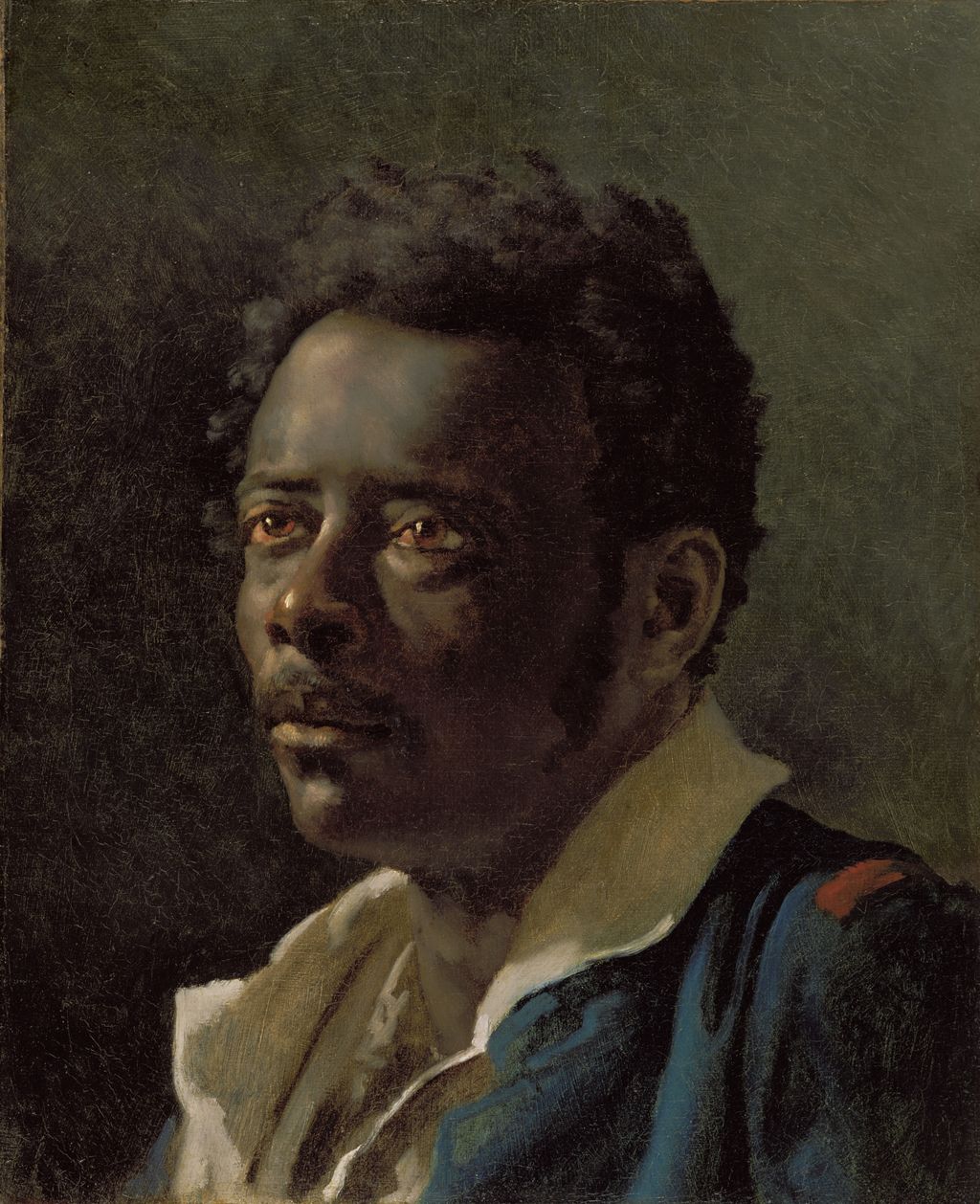
Study of the Model Joseph Image source. CC0 / Public domain.
Real people, studied bodies and heroic anatomy
Savigny and Corréard were not merely names in a book Géricault happened to read. The Lyon dossier records that he met the survivors and painted them in their roles within the composition. Their presence connects the studio undertaking to living witnesses. It does not turn the whole canvas into a set of recoverable portrait identifications: many bodies remain unnamed, and their poses belong to a carefully constructed arrangement. The painting combines contact with particular people and the transformation of those people into a larger scene. [9]
The men who reach upwards retain extraordinary muscular definition. Shoulders, backs and thighs make powerful curved surfaces, articulated by the light. Compare that appearance with the survivors' description of rescue: hollow eyes, damaged limbs and bodies reduced by privation. The difference is not a minor discrepancy. Géricault needed bodies capable of bearing the visual weight of a monumental composition, while the account describes bodies approaching physical collapse. The painting intensifies effort through anatomy that exceeds the likely condition of the actual survivors. [10]
Tinterow situates this combination within Géricault's use of heroic figure painting. The artist drew on an inherited language of powerful bodies while directing it towards contemporary vulnerability. Muscular form no longer guarantees mastery of a situation. The men have strength enough to make a collective gesture, yet their future depends on whether someone at an immense distance sees them. That contradiction gives the anatomy its expressive purpose: human grandeur remains visible at the very point when human self-sufficiency has failed. [6]
Studies of dead bodies belong to the same preparation but should be described without invented identities. The Louvre catalogues RF 579, now on long-term loan in Rouen, as a lamp-lit study of arms and legs for the Raft, dating it to about 1818–19. It measures 37.5 × 46 cm. This is the work discussed as Anatomical Pieces; it is distinct from the other anatomical painting in Montpellier. The current museum record supports the relationship to the Raft, but does not identify the people whose remains were studied. [16]
The connection between such studies and the final painting is more serious than a story about an artist's taste for horror. The foreground bodies require attention to weight, slackness, joints and the way light passes across flesh deprived of active movement. Living models can adopt a pose, but a limp arm or unsupported hand has another physical character. At the same time, a study of a limb does not prove that a particular corpse was copied into a particular figure. The preparatory evidence establishes an investigation of bodily states; the completed composition recombines that investigation.
The Schirn's 2013–14 exhibition framed Géricault's work through the meeting of physical suffering, scientific observation and Romantic interest in extreme experience. That curatorial view helps explain why close study and emotional force need not be treated as opposites here. The Raft is constructed from observed bodies, yet its effect depends on their artificial concentration and enlarged scale. Looking hard at the human body supplies the material for an image that could never have been witnessed in this exact arrangement. [17]
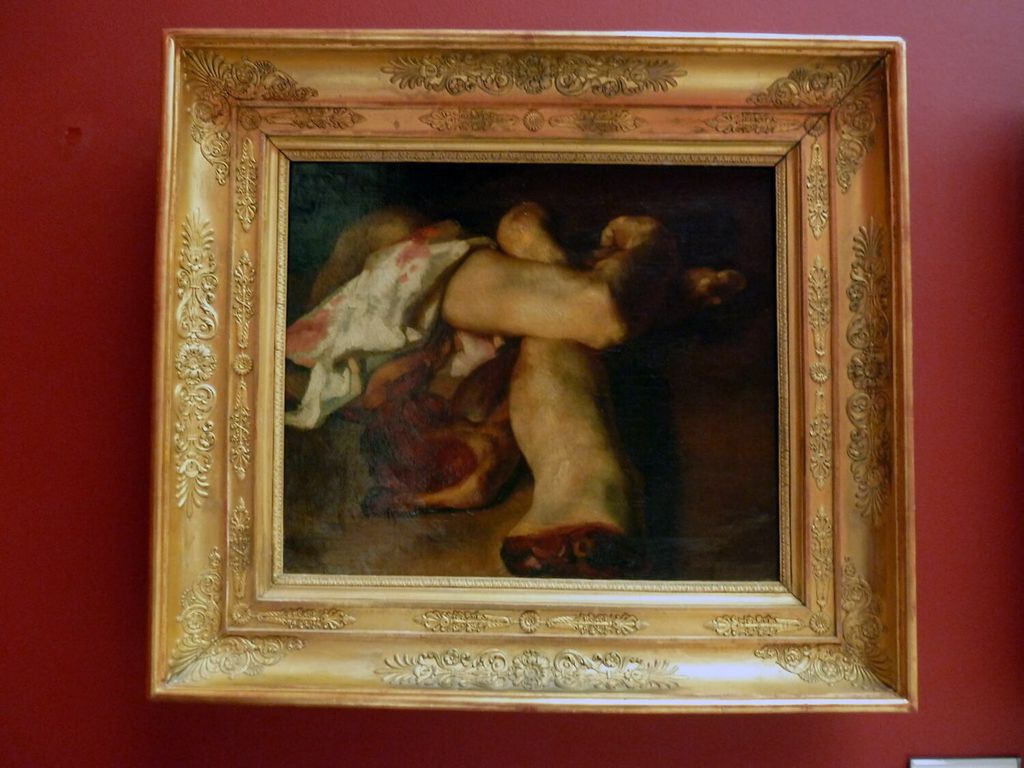
Anatomical Pieces Image source. Public domain.
Making a painting more than seven metres wide
The scale began as a material commitment. The Louvre records that the supplier and restorer Étienne Rey delivered the enormous canvas on 24 February 1818 for 440 francs. Géricault worked on it in a rented studio in the rue du Faubourg-du-Roule, then moved it to the foyer of the Théâtre-Italien, where he finished it in July 1819. In early August it was taken to the Louvre for stretching adjustments and varnishing before the Salon. A work of this size required space, money, transport and specialised handling as well as sustained painting. [1]
Those practical demands help place the sketches in proportion. The two Louvre oil studies are small objects beside the final canvas. At the monumental scale, a torso that can be taken in with a glance in a sketch becomes a substantial field of modelling; a crowded grouping has to remain coherent across several metres. The bodily arrangement had to work both as a whole and as a series of local encounters. Géricault's design allows the eye to grasp a rising group quickly, then discover that no single movement accounts for all the figures.
Colour supports that coherence. Browns, ochres, olive greens and deep shadows bind the raft to the sea and sky. Red cloths create separated accents rather than covering the surface evenly. White and pale fabric are concentrated around vulnerable flesh or lifted as signals. The limited range makes differences of light and bodily position carry much of the drama. The dead do not recede into an indistinct background; their illuminated surfaces repeatedly interrupt the eye's journey towards the living.
The present dark appearance also invites a distinction between what is visible and what is technically established. A reproduction cannot determine the recipe of a paint mixture, isolate original colour from later surface changes or measure the contribution of varnish. Descriptions that diagnose the whole canvas from its darkness alone claim more than the image can prove. The documented history instead supplies specific episodes of damage and treatment. These can be stated securely without turning a complex painted surface into a single story of deterioration. [1]
In 1848 a falling ladder tore the canvas and the damage was repaired. The Louvre records a stretcher change and work on the canvas edges in 1948, partial varnish cleaning in 1949, and renewed edge treatment and tensioning in 2018. These are different interventions addressing different problems. They remind us that the object has survived through active care; they do not by themselves establish how every pigment has changed since 1819. The painting before us is both Géricault's monumental image and a large, vulnerable material object with a subsequent history. [1]
The Salon of 1819: who deserved this scale?
The painting appeared at the Paris Salon from 25 August to 30 November 1819 under the title Scène de naufrage, or Scene of Shipwreck. It was first hung above the doorway leading to the Grande Galerie, then lowered to the first rank late in October. The change matters because the size and proximity of the foreground bodies are fundamental to its effect. A high position asks the viewer to look up at the composition as a whole; a lower one makes the projected bodies and the raft's edge more immediately confrontational. [1]
The generic Salon title did not prevent viewers from recognising the Méduse. The Lyon dossier recounts contemporary identification of the subject, while interpreting the exhibition within the politics of the Restoration. The surviving title is evidence of how the work was listed, however, rather than sufficient proof in itself that an official censor imposed that wording. It is possible to discuss the political charge without supplying an undocumented administrative explanation for every decision surrounding its exhibition. [9]
One of the central difficulties was the canvas's claim to public importance. Tinterow discusses Charles-Paul Landon's objection to its colossal dimensions: such proportions were conventionally associated with national celebrations, victories and sovereigns. Here a recent catastrophe and its helpless victims occupied the space expected for exemplary deeds. The challenge concerned not only the ugliness of suffering but the distribution of artistic honour. Who could command a wall of this size, and what kind of event deserved to shape a public's memory? [6]
The figures complicate any easy answer. They are elevated through anatomy, arrangement and scale, but no ruler or victorious commander controls the action. A collective of abandoned people supplies the principal gesture. The dead retain an obstructive prominence rather than becoming a decorous border to the achievement of a hero. The painting uses the resources of grand public art while unsettling the kinds of authority that those resources had commonly served.
Political reception did not require a single fixed allegory. The failures of a royal expedition could make the scene an indictment of Restoration government; its larger account of dependence and collective suffering could exceed that immediate controversy. Tinterow describes reception as strongly affected by political allegiance, while also noting criticism of the dark palette. Such responses show how politics and formal judgement could overlap. A viewer's discomfort might concern the government, the subject's claim to grandeur, the paint's tonal character, or several of these at once. [6]
London and Dublin: the canvas as a public attraction
No state purchase followed during Géricault's lifetime. The Louvre's account allows more than one explanation: disagreement over the price or official embarrassment about the subject. It records the efforts of Auguste de Forbin, director of the royal museums, to secure the work. This history does not support the idea that every official simply refused to recognise it. Interest, negotiation and failure coexisted, leaving the artist with an enormous painting whose future remained unsettled. [1]
In April 1820 Géricault contracted with the British entrepreneur James William Bullock to exhibit and promote it in the British Isles. Rolled for transport, the canvas travelled to London, where it was shown at the Egyptian Hall from 12 June to 30 December 1820. It then went to the New Rotunda in Dublin in February–March 1821. These dates distinguish the commercial exhibition history from the Salon and from its later life in a national museum. [1]
The change of setting altered the relationship between the painting and its public. At the Salon, it competed with other ambitious works within an official exhibition. In Britain and Ireland, its size, notorious subject and dramatic suspense could sustain a promoted attraction in their own right. This did not remove its artistic or political content. It made that content available through another form of spectatorship, in which visitors came to encounter a celebrated disaster image on a monumental scale.
The spectacle contains an uncomfortable doubling. The men at the top of the raft strain to be seen, while the painting asks a large audience to inspect their suffering. Looking can lead to action within the pictured scene, but looking at the painting offers no such simple intervention. The audience cannot rescue the bodies nearest it. The work's public success therefore turns on a tension already built into its subject: visibility can become a means of survival, an appeal to justice or a compelling sight consumed by strangers.
Géricault's time in England also produced lithographs of working life, including Entrance to the Adelphi Wharf. The Lyon dossier places this production alongside the travelling Raft. It would be misleading to make all those later images illustrations of the shipwreck, but the connection enlarges the account of his interests. A painter exhibiting a vast scene of exceptional suffering was also studying everyday labour, animals and material dependence at much smaller scales. [9]
From an unsold painting to the Louvre
After Géricault's death in January 1824, the Raft was offered at the estate sale on 2 November as lot 1. His friend Pierre Joseph Dedreux-Dorcy bought it for 6,005 francs, acting on Forbin's instructions for the state. The purchase was formally approved on 12 November 1824. Acquisition therefore belongs to 1824, rather than to the following year, and should be distinguished from the date at which it entered sustained public display at the Louvre, beginning in 1826. [1]
That transition changed its status without cancelling its earlier difficulty. An image associated with a scandal of royal administration entered the royal collections under Charles X. The process depended on an advocate within the museum administration and on action at a public sale. The painting's eventual institutional position was not the automatic consequence of its first exhibition. It was achieved through a particular sequence of negotiation, ownership and acquisition.
Its later museum history continued to involve movement. The Louvre records protective removals during wars, including its evacuation during the Second World War and return in July 1946. In 1859–60 Eugène Ronjat and Pierre Désiré Guillemet made a full-size copy, now in Amiens. These events are reminders that the familiar museum masterpiece has never been an immobile image detached from practical circumstances. Its enormous surface had to be copied, moved, protected, repaired and displayed. [1]
The institution also preserves the work's stages of thought. The final canvas and the two oil sketches entered the Louvre by different routes: RF 1667 came through Étienne Moreau-Nélaton's donation in 1906, while RF 2229 was acquired in 1919. Their coexistence allows viewers to understand making as a process rather than treating the monumental canvas as an isolated miracle. The sketches' later collecting histories should not be confused with the 1824 state purchase of the final painting. [12] [11]
Landscape, Romanticism and the limits of human power
Géricault painted the Raft during the period in which he also developed the large landscapes known as the Times of Day. Tinterow establishes their shared chronology and relates both undertakings to the problem of human beings confronting environments beyond their control. The connection is useful because the Raft can otherwise be discussed as though the sea were only a backdrop for figure painting. Its waves, sky and remote horizon are active conditions of the drama. [6]
In Evening: Landscape with an Aqueduct, small people inhabit an immense invented landscape. In the Raft, the figures grow monumental, yet they remain powerless to close the expanse between their platform and the brig. The two approaches arrive at a related disproportion through opposite means. People can be made small beside their surroundings or made large enough to command attention while remaining unable to master them. The latter is among the Raft's most unsettling achievements.
Tinterow interprets the painting as a decisive challenge to confidence in human reason and control, while tracing its importance for Delacroix and the following generation. This account of its Romantic character is more precise than simply associating Romanticism with strong feelings. The work retains discipline, studied anatomy and a deliberate architecture. It uses them to show an emergency that discipline alone cannot resolve. Formal order exists in the painting even where reliable order has failed in the event. [6]
The difference also explains why factual corrections do not diminish its power. Recognising the dispute about the tow ropes, separating the first sighting from rescue, or noticing the survivors' actual emaciation makes the painting's choices clearer. Géricault did not provide a transparent window onto 17 July 1816. He built an image in which history, bodily study and the demands of public painting confront one another.
Return to the small vessel on the horizon after looking at the foreground. It now has to bear the weight of everything the near bodies have disclosed. The men who signal cannot know whether it will return. The seated mourner cannot recover what he holds. The viewer knows more about the outcome than either, yet still has to search the distance for help. That unequal distribution of knowledge, hope and loss keeps the Raft suspended between a historical rescue and a human appeal that the painting never allows to become routine.
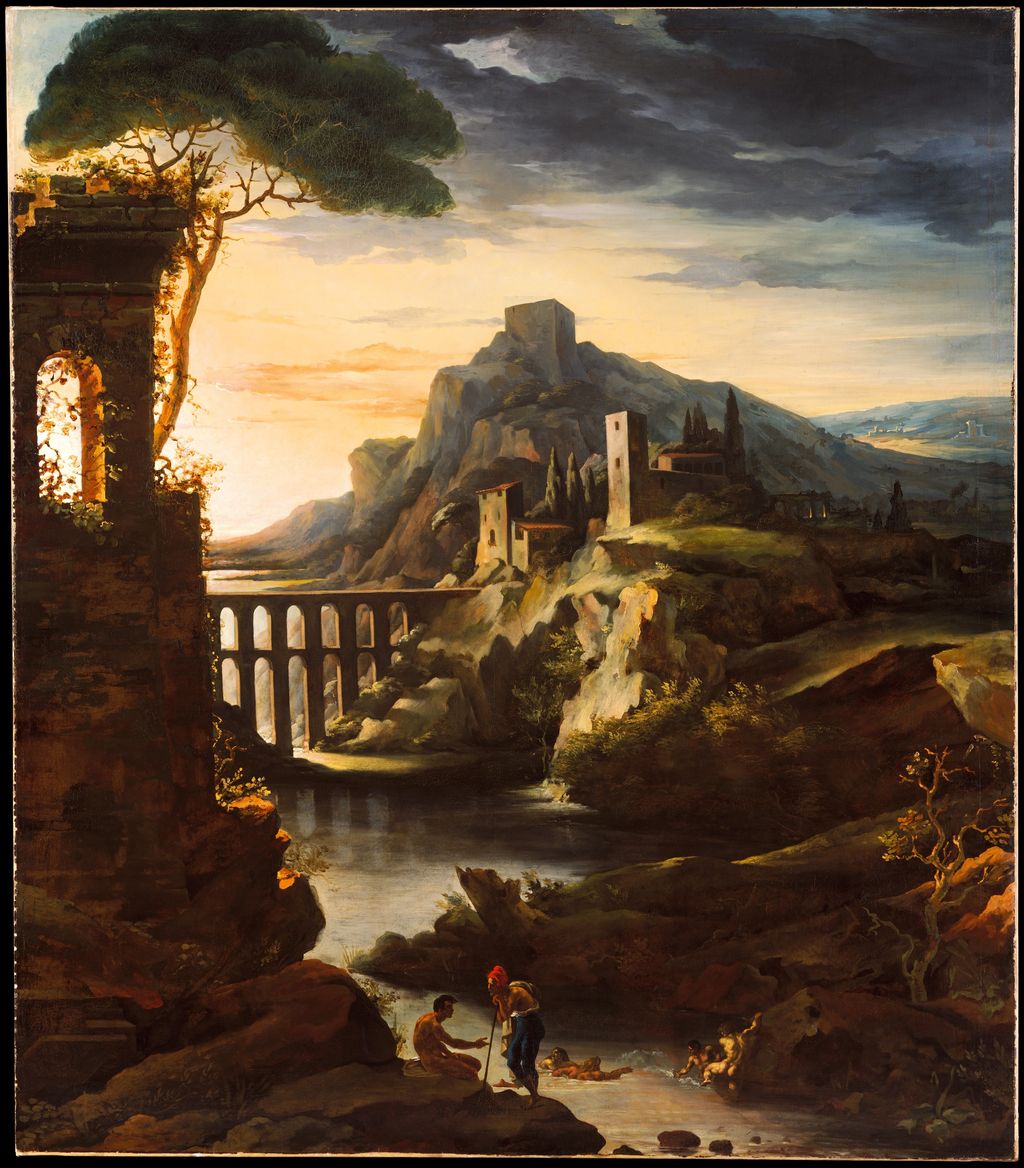
Evening: Landscape with an Aqueduct Image source. Public domain.
Géricault collection records
Seventy collection records include paintings, drawings and individual print impressions. Different impressions remain separate records; this selection is not a complete catalogue raisonné.
Frequently Asked Questions
It shows the sighting of a tiny ship and the attempt to signal it, before rescue is secure. The survivors described a distant brig disappearing and then returning roughly two hours later. Géricault transformed their testimony into an organised, monumental scene rather than a literal illustration of every detail. [10] [6]
Discussion
Look again at the images and ideas explored in The Raft of the Medusa. These editorial prompts invite your observations.
Reader Insights
Begin with the tiny brig, then look at the nearest bodies. How does the difference in scale change your sense of what hope means here?
Follow the hands across the raft. Which gestures communicate, which support another person, and which have ceased to act?
Compare Joseph’s turned back in the Raft with his face in the Getty study. What changes when a professional model becomes a largely anonymous public hero?
Join the Conversation
Share a detail, comparison or question about The Raft of the Medusa below.
References
- Musée du Louvre, Le radeau de la Méduse, INV 4884 / C 51, 1818–19; object metadata and detailed historical account, French, record updated 24 April 2026. View source. (in French).
- Nationalmuseum, The Severed Heads, NM 2113; collection metadata and museum interpretation (Swedish). View source.
- Louvre, Charging Chasseur, INV 4885; collection metadata and museum interpretation (French/English interface). View source.
- National Gallery, Horse frightened by Lightning; collection metadata and museum interpretation (English). View source.
- Louvre, Wounded Cuirassier, INV 4886; collection metadata and museum interpretation (French). View source.
- Gary Tinterow / The Metropolitan Museum of Art, Géricault's Heroic Landscapes: The Times of Day, The Metropolitan Museum of Art Bulletin, vol. 48, no. 3, Winter 1990–91, especially printed pp. 8–10, 16–17 and 60–61; English. View source.
- Vlaamse Kunstcollectie, Portrait of a Kleptomaniac; collection metadata and museum interpretation (Dutch). View source.
- Louvre, Epsom, MI 708; collection metadata and museum interpretation (French/English interface). View source.
- Musée des Beaux-Arts de Lyon, Géricault: La folie d'un monde, exhibition dossier, 2006, substantive exhibition text and checklist, pp. 1–21, especially the preparatory-work entries and chronology sections V–VI; French. View source. (in French).
- Henri Savigny and Alexandre Corréard, Narrative of a Voyage to Senegal in 1816, English edition, 1818; passages on evacuation, the towing dispute and rescue, Project Gutenberg transcription. View source.
- Musée du Louvre, Le radeau de la Méduse, first oil sketch, RF 2229, 1818; object metadata and history, French. View source. (in French).
- Musée du Louvre, Le radeau de la Méduse, second oil sketch, RF 1667, 1818; object metadata and history, French. View source. (in French).
- Unita Ahdifard / Getty, “Learn about Joseph, a Celebrated Haitian Model in 19th-Century Paris,” 9 February 2023; English. View source.
- Paul Bernard-Nouraud / Histoire par l'image, “Joseph, modèle pour Géricault,” December 2023; historical context, image analysis and interpretation, French. View source. (in French).
- J. Paul Getty Museum, Study of the Model Joseph, 85.PA.407, about 1818–19; object metadata and description, English. View source.
- Musée du Louvre, Étude de bras et de jambes, peinte à la lumière de la lampe, pour le Radeau de la Méduse, au Louvre, RF 579, about 1818–19; object record and deposit history, French. View source. (in French).
- Schirn Kunsthalle Frankfurt, Géricault: Images of Life and Death, exhibition, 18 October 2013–26 January 2014; exhibition summary and catalogue description, English. View source.


