



 by Tom Gurney
Tom Gurney BSc (Hons) is an art history expert with over 20 years experience
Email: tomgurney1@gmail.com / Phone: +44 7429 011000
Wagon Filled with Wounded Soldiers: Introduction
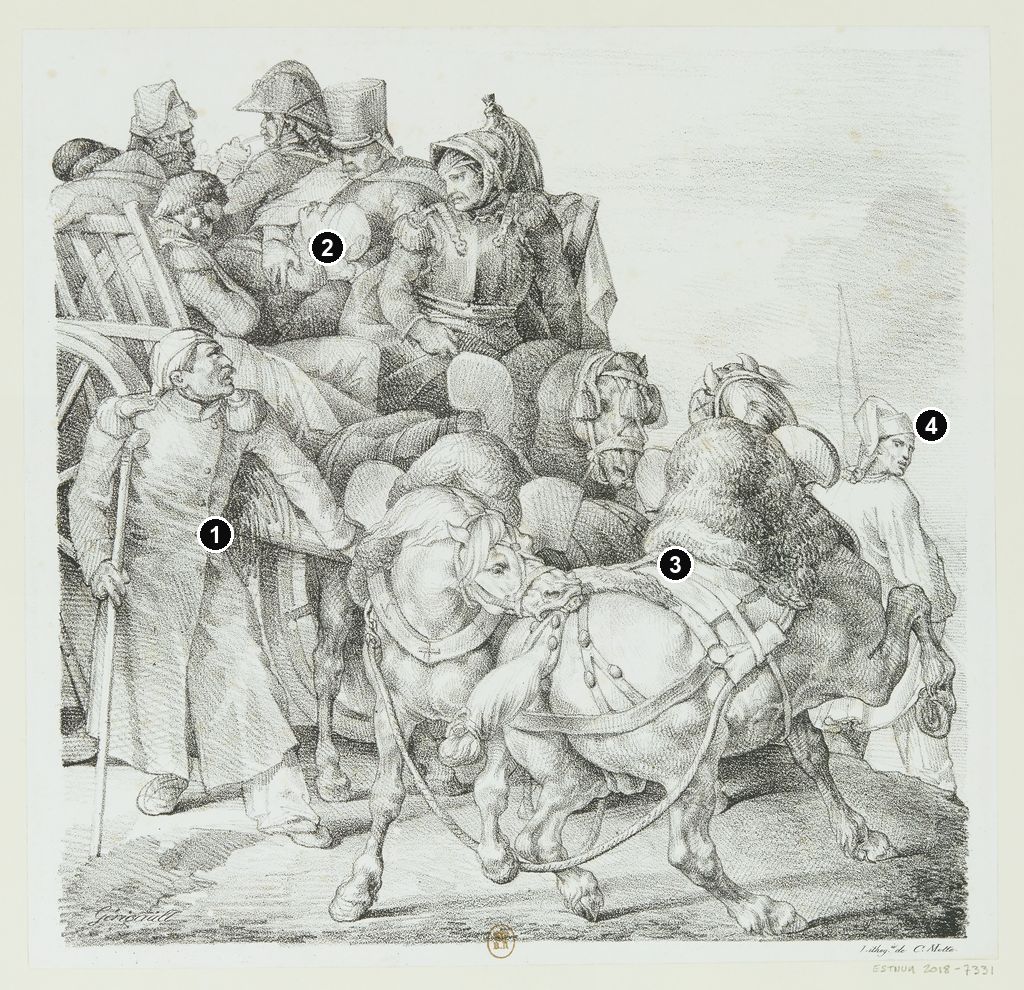
A wounded soldier stands beside a wagon, supporting himself with a crutch and reaching towards the vehicle. Above him, men are packed behind its wooden sides; below them, three harnessed horses fill the foreground. There is scarcely room for another passenger. Théodore Géricault’s Wagon Filled with Wounded Soldiers makes the difficulty of getting injured men away from war its subject. The Bibliothèque nationale de France catalogues this lithograph as Chariot chargé de soldats blessés, dated 1818, and records an impression in the second state, bearing the names of Géricault and the printer Charles Motte. [1]
Nothing here resembles a parade. The passengers do not form an orderly military unit, and the horses are entangled in an immediate quarrel. Yet the scene holds together with considerable force. The wagon, the man on crutches and the animals constitute a system of mutual dependence: the wounded need transport, the transport needs animals, and the driver must manage creatures whose behaviour threatens to interrupt the journey. Géricault gives these practical difficulties the visual weight usually reserved for a decisive military action.
At a Glance
- Date1818 (BnF catalogue date) [1]
- MediumLithograph [1]
- PrinterCharles Motte [1]
- Recorded stateSecond state, with the names of Géricault and Motte [1]
This work across Théodore Géricault’s career
The Severed Heads
1810s [2]Charging Chasseur
1812 [3]Horse Frightened by Lightning
c.1813–14 [4]The Raft of the Medusa
1818–19 [6]Portrait of a Kleptomaniac
c.1820–24 [8]The Epsom Derby
1821 [9]Contents
- The man beside the wagon
- Bodies, wheels and the limits of space
- The horses interrupt the journey
- A lithograph, a state and a particular sheet
- War remembered through its aftermath
- Looking closely at an unresolved scene
- Annotated details
The man beside the wagon
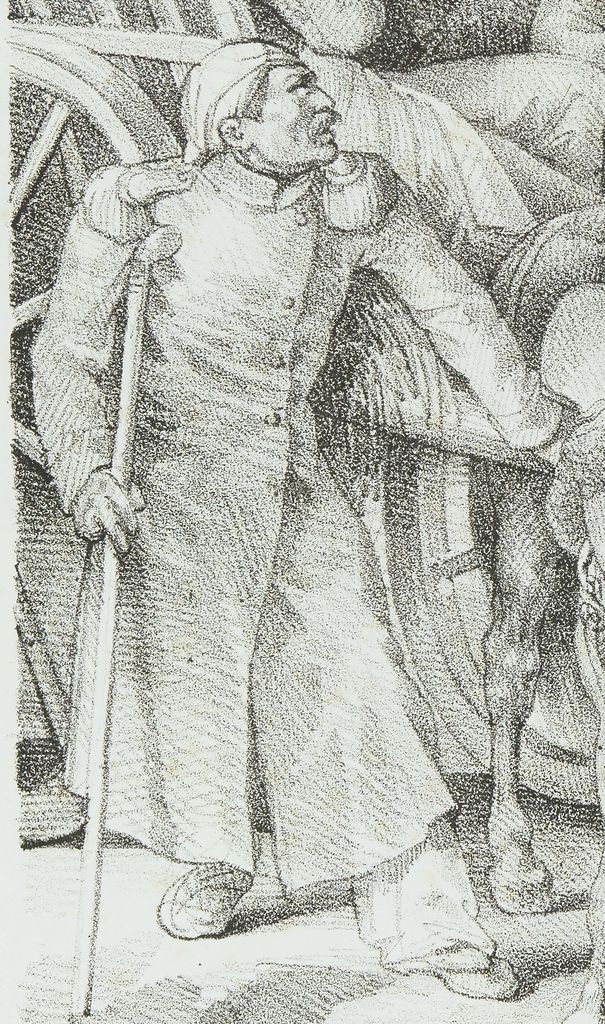
The standing soldier provides the clearest way into the picture. His crutch runs nearly the full height of his body, establishing a firm upright against the sloping shafts, straps and horses’ necks around him. His loose trousers and coat make his silhouette broad, but his support is precarious. One hand grips the crutch; the other rests against the wagon’s projecting shaft. His body occupies the narrow interval between the vehicle behind him and the animals in front.
His head turns up towards the passengers. His mouth is open, giving his face the appearance of an appeal, although the image supplies no words. Charles Clément’s 1866 catalogue describes him as seeming to ask for a place. That cautious formulation remains useful: the gesture suggests a request without telling us exactly what has been said or how the men will answer. Clément also identifies the vehicle as stopped. The subject is therefore a pause in transport, with a human decision still pending. [10]
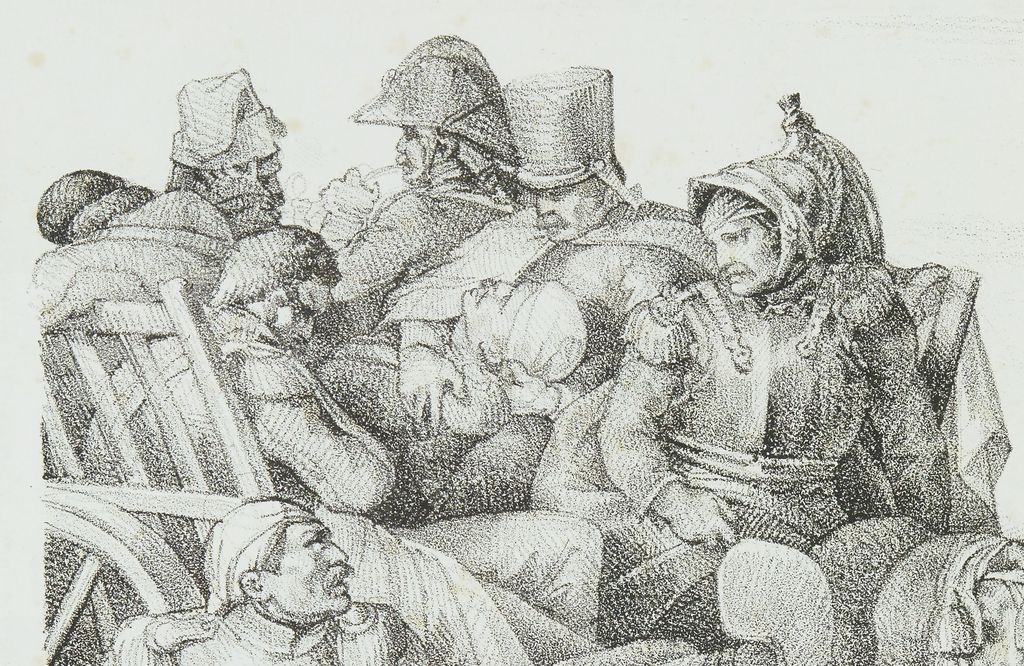
The passenger nearest him leans back against the side of the wagon, his head enclosed by cloth and a military cap. His lowered face contrasts with the upward gaze of the standing man. Behind him another figure holds an arm across his body, while further heads overlap towards the upper left. Different hats, turned shoulders and obscured faces preserve the sense of several individuals, even where their bodies become difficult to disentangle. Géricault does not give every man an equally legible expression. Crowding itself becomes part of what the viewer has to understand.
The encounter has no visible conclusion. There is no empty seat clearly waiting for the man, and no commanding figure who resolves the difficulty. It would go beyond the evidence to call the passengers cruel or to say that he has been refused. Their own restricted space and damaged bodies complicate the request. The image brings the viewer close enough to recognise need while withholding the reassuring moment in which need is met.
Bodies, wheels and the limits of space
The composition rises steeply on the left. A large wheel is partly visible at the edge, the slatted wagon side climbs above it, and the men’s heads form a crowded upper contour. This bulk is balanced by the horses’ enlarged bodies across the lower half. The landscape offers little distraction: pale sky and lightly indicated distance leave the transport group almost entirely responsible for the picture’s structure.
That compressed arrangement changes how the vehicle is understood. A wagon might ordinarily be treated as a setting or accessory, but here its usable space matters. Knees, elbows and coat sleeves meet its timber edges. The people are elevated above the horses, yet their position gives them no mastery over what happens below. Even the nearest passenger’s comparatively upright torso is enclosed by bodies and the wagon side. His place looks secured at the price of confinement.
The standing soldier is the exception to this dense upper grouping. We can follow his body down to the ground, where his feet and crutch disclose the physical effort of remaining upright. Around him, Géricault sets several different kinds of support in relation: the crutch, the shaft under his hand, the boards supporting the passengers, and the harness that connects the horses to the load. These are visible structures before they become an interpretation. Together, they make dependence the organising principle of the scene.
The print avoids a panoramic view of an army. It offers no ranks disappearing towards a horizon, no broad battlefield over which a spectator might survey the result. Its close viewpoint makes bodies difficult to separate from the equipment carrying them. War’s consequences appear at the scale of a hand needing purchase, a seat already occupied and a team that must somehow be kept moving.
Annotated Details from Wagon Filled with Wounded Soldiers
The numbered points identify visible features discussed in this article. Return from each detail to the whole composition. Wagon Filled with Wounded Soldiers Image source. Public domain.
Details from WAGON FILLED WITH WOUNDED SOLDIERS
Compare the cropped details with the complete images above. Notice how their colours, shapes and positions contribute to the larger compositions.
An unanswered appeal
The standing soldier braces himself with a crutch and the wagon shaft while looking towards its passengers.
A crowded place of refuge
Overlapping heads, arms and knees make the wagon’s limited space visible.
The bite within the team
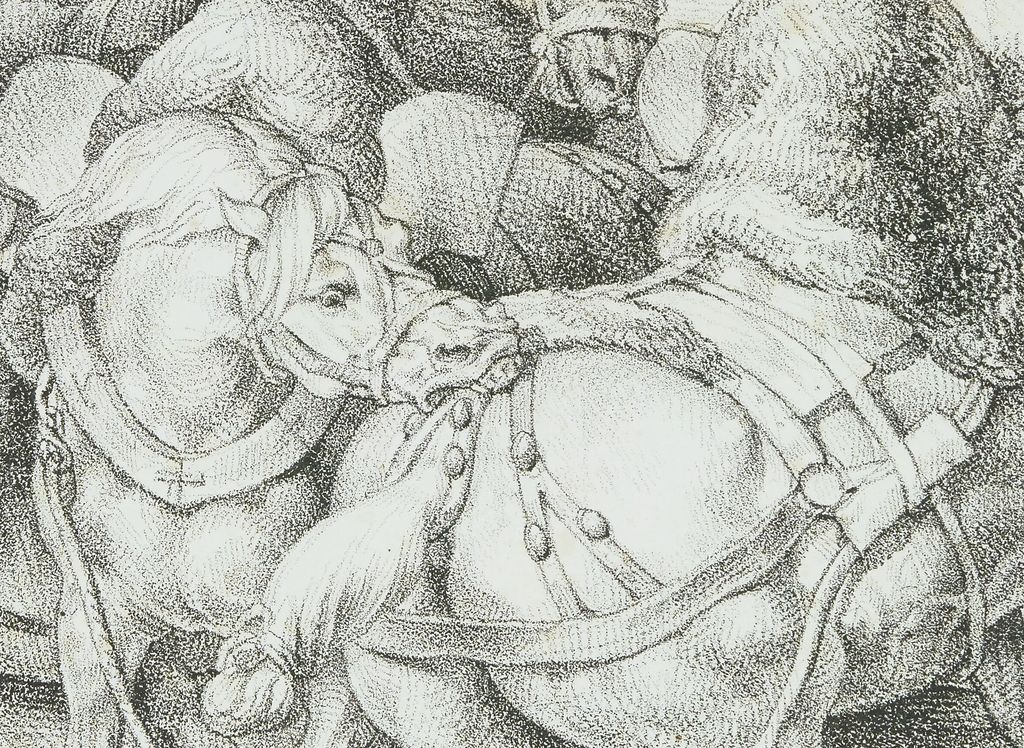
The middle horse turns towards the leading horse’s rump, interrupting the team’s common direction.
The driver turns back
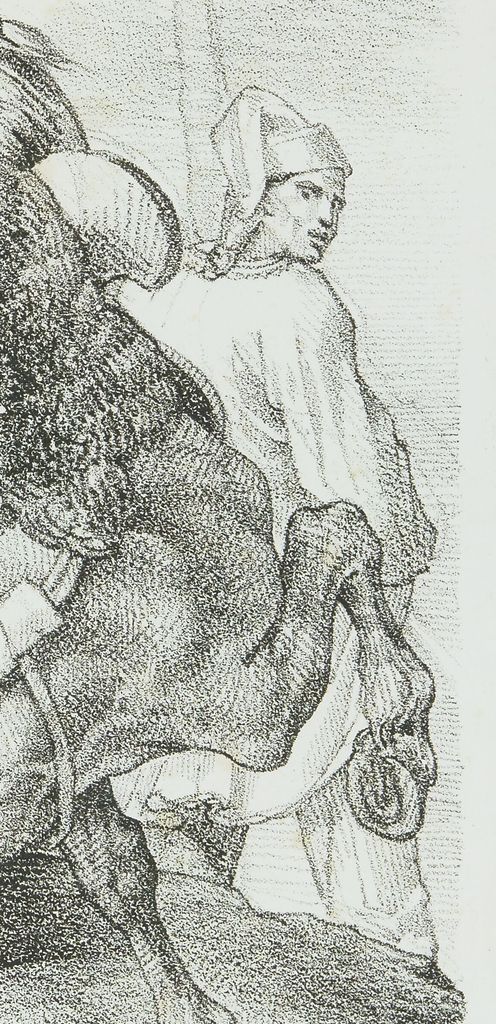
At the right edge, the driver turns towards the animals and extends an arm into their tangled movement.
The horses interrupt the journey
The horses introduce a second action at the front of the image. The central animal turns its head sharply towards the hindquarters of the horse to the right. Its mouth presses into the other animal’s body, and the answering twist of neck and head produces an abrupt change of direction within the team. Harness lines continue across the disturbance, reminding us that these animals are attached to the same vehicle even as they pull attention towards their separate movements.
Clément identifies the middle horse as biting the leading horse’s rump and describes the driver turning at the noise to scold the animals. In the image, the driver stands at the far right, his head turned back and his arm extended towards the team. His response belongs to the same suspended instant as the wounded man’s appeal. One person seeks access to the wagon while another tries to restore order in front of it. [10]
This incident prevents the animals from becoming anonymous pulling power. Their lowered and turned heads, different orientations and unevenly placed feet produce a tangle of intentions. The rear horse’s face points towards the viewer from between the larger foreground forms, adding another direction of attention. Géricault gives the team enough individual movement to make the difficulty of controlling it apparent.
There is a disquieting mismatch between the small cause of the interruption and the vulnerability of the passengers. A bite between horses may seem an ordinary occurrence, but here its consequences concern men who cannot easily continue on foot. The image does not require the animals to symbolise anything beyond themselves. Their behaviour is enough to expose the fragility of this means of rescue. The driver’s task, usually marginal in military imagery, becomes essential to whether the wounded can travel at all.
Watch: Géricault and The Raft of the Medusa
Three perspectives on Géricault’s best-known painting, its making and its historical setting.
Gericault, Raft of the Medusa
Smarthistory examines the composition and historical setting of The Raft of the Medusa.
Watch on YouTubeA lithograph, a state and a particular sheet
The BnF gives its sheet measurements as 30.5 × 31.5 cm. This is a compact physical object, quite different from the large canvases for which Géricault is best known. Clément lists the composition under number 10 and describes a first state before lettering and a second with Géricault’s signature and Motte’s name. The BnF identifies the work as Delteil 11 and likewise records the second state. These numbers belong to different catalogues; their difference does not indicate two different subjects. [1] [10]
A state is a stage in the printed design, rather than another name for every individual sheet pulled from it. That distinction matters here because catalogue information about a state and the appearance of a surviving impression answer different questions. The BnF reproduction shows Géricault’s name within the lower left of the image and Motte’s lithographic credit below it on the right, features consistent with the recorded second state. Its stamps and marginal marks belong to the history of that sheet; they are separate from the depicted roadside encounter.
The Château de Chantilly’s account of Géricault’s lithography explains the process through a drawing made with greasy chalk or ink on prepared limestone. During printing, water and printing ink are used so that the ink adheres to the drawn areas. The technique allowed relatively rapid and inexpensive multiplication of an artist’s drawing. It offered Géricault a means of bringing military subjects, and later scenes of social hardship, into circulation as works on paper. [11]
Here, the grain of the dark marks gives volume to coats and horses without suppressing the appearance of drawing. Dense shadow on an animal’s neck sits beside the much paler sky; fine outlines of straps cross more broadly modelled bodies. At close range, the viewer moves between the represented weight of the load and the light, broken marks that construct it. Lithography makes the drawing repeatable while retaining this sense of an image worked into being.
War remembered through its aftermath
The date 1818 places the print after the Napoleonic Wars. Chantilly situates Géricault’s military lithographs within his attention to the sufferings of soldiers of the Empire. That context helps explain the prominence of wounded men, but it does not establish a particular battle or campaign for this wagon. Neither the BnF title nor Clément’s description identifies a named encounter. The print can be understood historically without turning it into an eyewitness report. [1] [10] [11]
A comparison with Return from Russia makes that limit clearer. Cleveland dates its impression of that work to about 1818 and explicitly relates the subject to Napoleon’s retreat from Russia. Its museum account emphasises wounded soldiers and exhausted animals, interpreting their condition as a rejection of military glorification. The historical reference is more specific there than it is in Wagon Filled with Wounded Soldiers. What the two compositions share is a concern with how people and animals continue after military strength has been spent. [12]
The difference in printing is also instructive. Cleveland describes Return from Russia as printed from two stones, with black drawing and ochre tone, and notes hand-added white watercolour for snow on its impression. Those additions should not be transferred to this wagon image, or assumed to belong to every surviving Return from Russia. The comparison concerns related subjects made through distinct printed objects. [12]
In Artillery Caisson, another lithograph dated 1818, the Rijksmuseum describes a soldier standing on an ammunition wagon beside a dead horse, with a clenched fist and a burning fuse. There the vehicle becomes the site of an imminent violent act. In the wounded wagon, the difficulty is less spectacular: transport has paused, an injured man needs room, and the horses require attention. The comparison shows how differently Géricault could organise a military image around a wagon. One carries the threat of explosion; the other makes continued movement the urgent question. [13]
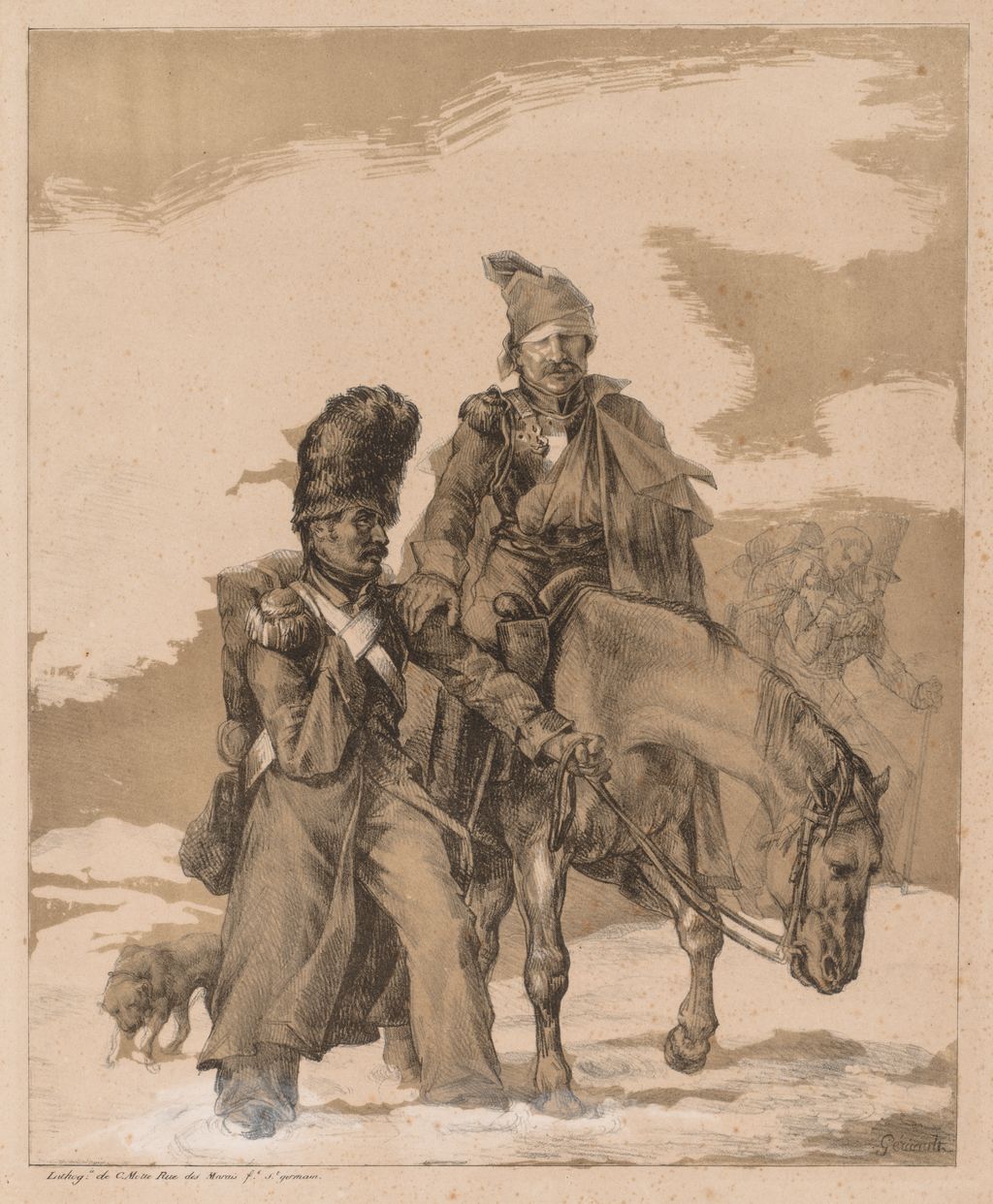
Return from Russia, c.1818 — Cleveland impression 1931.48, with hand-added colour Image source. CC0 / Public domain.
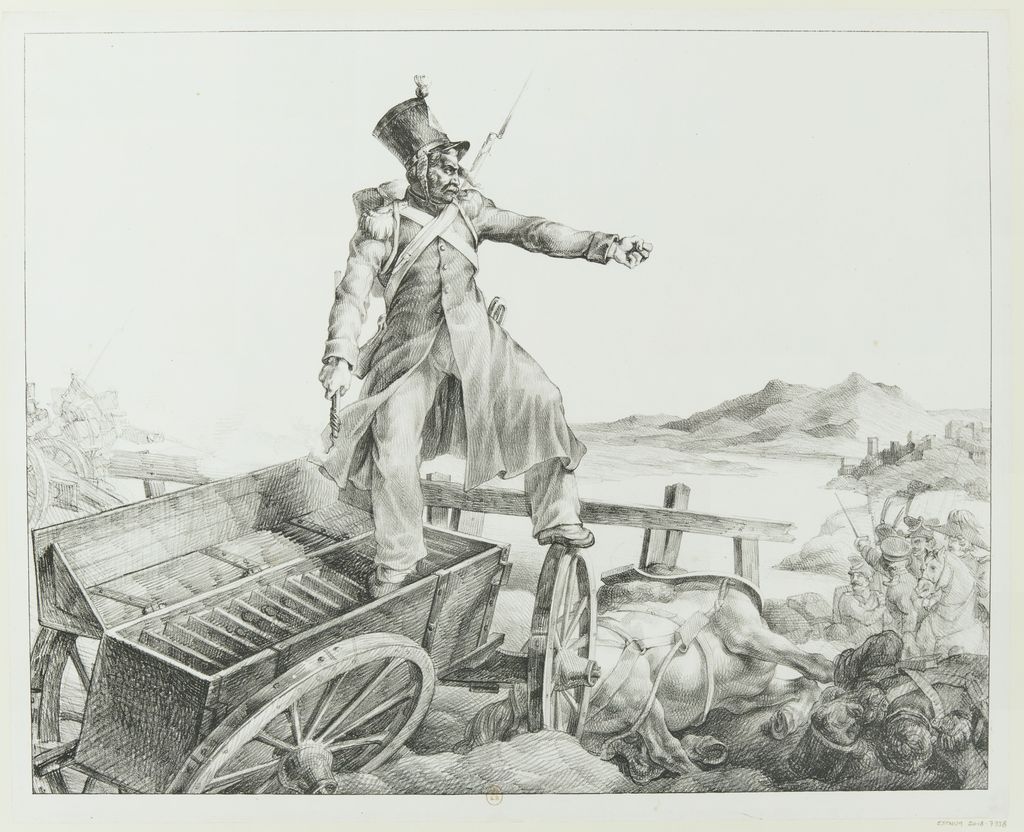
Artillery Caisson, 1818 — Bibliothèque nationale de France impression btv1b10029068f; distinct from the Rijksmuseum sheet cited for catalogue information. Image source. Public domain.
Looking closely at an unresolved scene
Clément argued in 1866 that lithography gave viewers access to Géricault’s own drawing in multiple impressions. He also recalled that the prints had attracted limited appreciation during the artist’s lifetime and for years afterwards. His testimony cautions against assuming that the capacity to circulate an image proves immediate popular success. It describes a later recovery of interest as well as the possibilities of the medium. [10]
The wagon print rewards exactly that attentive encounter. From a distance, the crowded passengers and foreground team register as a single load. Closer inspection separates the man asking to join them, the bent and wrapped figures above him, the biting horse and the driver turning back. Each discovery complicates the idea that evacuation simply follows injury. Getting away depends on space, equipment, animal cooperation and the actions of other people. Géricault leaves all of those relations visible, and none entirely secure.
Géricault collection records
Seventy collection records include paintings, drawings and individual print impressions. Different impressions remain separate records; this selection is not a complete catalogue raisonné.
Frequently Asked Questions
A wounded man supports himself with a crutch and the wagon’s shaft while turning towards its crowded passengers. Clément’s historical catalogue describes him as seeming to ask for a place; the image leaves the answer unresolved. [10]
Discussion
Look again at the images and ideas explored in Wagon Filled with Wounded Soldiers. These editorial prompts invite your observations.
Reader Insights
How does the standing soldier’s relatively clear silhouette affect your response to the men crowded above him?
Does the horses’ quarrel initially feel incidental, and does its meaning change when you consider the passengers’ dependence on them?
What changes when a military image asks whether a wagon can continue instead of showing who won a battle?
Join the Conversation
Share a detail, comparison or question about Wagon Filled with Wounded Soldiers below.
References
- Bibliothèque nationale de France, Chariot chargé de soldats blessés, catalogue record FRBNF45606659, dated 1818; second state with the names of Géricault and Motte; sheet 30.5 × 31.5 cm. French. View source. (in French).
- Nationalmuseum, The Severed Heads, NM 2113; collection metadata and museum interpretation (Swedish). View source.
- Louvre, Charging Chasseur, INV 4885; collection metadata and museum interpretation (French/English interface). View source.
- National Gallery, Horse frightened by Lightning; collection metadata and museum interpretation (English). View source.
- Louvre, Wounded Cuirassier, INV 4886; collection metadata and museum interpretation (French). View source.
- Louvre, The Raft of the Medusa, INV 4884; collection metadata and museum interpretation (French). View source.
- Gary Tinterow / The Metropolitan Museum of Art, Géricault’s Heroic Landscapes: The Times of Day, Met Bulletin 48/3, Winter 1990–91; consulted main essay and relevant object entries (English). View source.
- Vlaamse Kunstcollectie, Portrait of a Kleptomaniac; collection metadata and museum interpretation (Dutch). View source.
- Louvre, Epsom, MI 708; collection metadata and museum interpretation (French/English interface). View source.
- Charles Clément, Catalogue de l’œuvre de Géricault: Lithographies (Paris, 1866), introduction, pp. 3–4, and entries 10, 12 and 13, pp. 9–10; digitised scan, PDF pp. 11–12 and 17–18. French. View source. (in French).
- Château de Chantilly, Géricault et la lithographie: Le romantisme à la française, virtual exhibition based on the 2018 exhibition curated by Nicole Garnier-Pelle; sections “La lithographie” and “L’époque Napoléonienne,” with introduction and credits. French. View source. (in French).
- Cleveland Museum of Art, Return from Russia, about 1818, accession 1931.48; collection record, technique and interpretive description. English. View source.
- Rijksmuseum, Munitiewagen / Caisson d’Artillerie, 1818, RP-P-2008-69; collection record and description. Dutch. View source. (in Dutch).


