



 by Tom Gurney
Tom Gurney BSc (Hons) is an art history expert with over 20 years experience
Email: tomgurney1@gmail.com / Phone: +44 7429 011000
Théodore Géricault: A Biography: Introduction
Théodore Géricault lived for thirty-two years, but the familiar outline of his life can make it seem shorter still: a brilliant cavalry picture, the scandal of The Raft of the Medusa, horses, illness and an early death. That outline leaves out much of the artist who was born in Rouen on 26 September 1791 and died in Paris on 26 January 1824. He was a prosperous family's son who could finance experiments, an assiduous student of older painting, a traveller with connections among other artists, and a maker of prints as well as enormous canvases. His career developed through work, friendships, institutions and changing markets. [1]
Its most persistent artistic question concerned what a human or animal body could communicate. The horse's turn, the soldier's hesitation, the survivor's reach and the labourer's stoop became vehicles for experiences that public painting had often assigned to rulers or ancient heroes. Yet Géricault's interest in present experience did not displace his study of the past. His pictures repeatedly bring contemporary subjects into contact with the scale, figure design and emotional force of older art. Gary Tinterow's account of his career stresses this combination of modern subjects, classical grandeur and Baroque energy. [2]
His biography also requires a distinction between events and explanations. An inheritance, an exhibition or the delivery of a canvas can be documented. What an artist privately intended is harder to recover. The troubled genius of later legend should not obscure the resources and decisions that made Géricault's art possible, or turn every uncertain image into a confession.
At a Glance
- Born26 September 1791, Rouen [1]
- Died26 January 1824, Paris, aged 32 [1]
- Italy1816–17, independently funded [1]
- EnglandTwo stays in 1820–21 [1]
Théodore Géricault in context
The Raft of the Medusa
1818–19 [4]Charging Chasseur
1812 [5]The Epsom Derby
1821 [7]Portrait of a Kleptomaniac
c.1820–24 [8]Horse Frightened by Lightning
c.1813–14 [9]The Severed Heads
1810s [10]Contents
- A Rouen family in Paris
- Learning from Vernet, Guérin and the Louvre
- The success of 1812 and the difficult Salon of 1814
- A king's musketeer in a changing France
- Italy, 1816–17: study and an unfinished ambition
- Family secrecy and the work of 1818
- Making The Raft of the Medusa
- The Salon, the public and the search for a buyer
- London, 1820–21: exhibitions, horses and labour
- The uncertain history of the Monomanes portraits
A Rouen family in Paris
Géricault's parents were Georges-Nicolas Géricault, a lawyer, and Louise-Jeanne-Marie Caruel. The family moved from Rouen to Paris around 1795–96. There his father entered the tobacco business with the Robillard family and his brother-in-law Jean-Baptiste Caruel. This commercial setting matters: Géricault's childhood belonged to a household with substantial means, rather than to the poverty sometimes attached retrospectively to his reputation as a misunderstood artist. His schooling included the Lycée Impérial, now Louis-le-Grand, where he enrolled in 1806. [1]
His mother's death on 15 March 1808 was an important family loss and the source of an inheritance. In April 1812 his maternal grandmother's death brought further property. These resources gave the young painter financial independence unusually early. They helped make possible an Italian journey without a scholarship, ambitious work that had no guaranteed buyer, and a career whose development cannot be measured only through public commissions. Neither the freedom nor the grief supplies a complete explanation of the paintings; both belong to the conditions in which he worked. [1]
The family did not initially provide a straightforward route into art. Bruno Chenique's biography for the Musée des Beaux-Arts de Lyon describes Géricault as ostensibly apprenticed to bookkeeping in his uncle's tobacco concern while beginning to attend Carle Vernet's studio. Drawing horses was already a strong attraction. The eventual recognition of his artistic ambitions allowed a more formal education to follow. The transition was from a prosperous commercial household into professional training, with the family's resources continuing to support him. [1]
Financial independence did not mean complete independence from family relationships. His father remained an important presence, and the Caruel household would later be central to his private life. Nor did wealth guarantee success. It made choices possible; it could not determine how juries, critics or purchasers would respond. Keeping those distinctions in view helps explain why a painter with secure beginnings could nevertheless experience the rejection of a picture as a serious professional setback.
Four stages of Théodore Géricault’s career
These periods group related projects; subjects and working methods overlap.
A public debut through horse and soldier
Training with Carle Vernet and Guérin led to the Chasseur’s 1812 Salon success and the changed military predicament of the Cuirassier in 1814. [1]
Ancient bodies and modern spectacle
Study in Italy brought Renaissance art and Roman horse-racing into a sustained investigation of human and animal force. [1]
Modern disaster on a monumental scale
Preparatory studies and survivor testimony informed the Raft, exhibited at the 1819 Salon as a Scene of Shipwreck. [2]
Racing, labour and individual faces
English travel and lithography widened the social uses of the horse. Work continued on prints and ambitious new history subjects after the return to Paris. [1]
Learning from Vernet, Guérin and the Louvre
Carle Vernet offered a close acquaintance with horses and military imagery. Géricault then entered Pierre-Narcisse Guérin's studio around 1810–11. Guérin was an established history painter, and his teaching placed the young artist within an ambitious professional tradition. The studio also connected him with painters who would remain part of his artistic world, including Pierre-Joseph Dedreux-Dorcy, Léon Cogniet and the Scheffer brothers. Eugène Delacroix belonged to a later phase of this circle. [1]
The contrast between a supposedly rigid classical master and an instinctively rebellious pupil has often supplied a convenient origin story. Chenique argues that documents undermine that later legend. Guérin intervened on Géricault's behalf when the young man was excluded from the Louvre in 1811, and the artist's subsequent correspondence retained respect for his teacher. Their differences need not be denied, but disagreement over painting is not proof of an absolute personal rupture. [1]
The Louvre was another school. Géricault copied older paintings there while pursuing studio instruction, encountering a collection enlarged through Napoleon's campaigns. His training therefore joined practical exercises, the study of bodies and repeated attention to finished pictures. Tinterow identifies Rubens, Antoine-Jean Gros and Vernet as important components in the language of his first major public work. Its energy did not arrive from nowhere: it was developed through looking at different ways of organising colour, movement and military spectacle. [2]
The museum also preserves less flattering evidence of his behaviour. Disciplinary incidents led to exclusions, including a serious confrontation in 1812. These episodes document a difficult young visitor; they should not be recruited as proof that violence or disorder caused his talent. They also show how closely his working life depended on access to an institution whose rules he could breach. The artist of forceful gestures was still a student copying pictures under supervision. [1]
His ambitions extended beyond becoming a specialist in horses. He attempted the Prix de Rome competition, the route to an officially supported Italian education and a career in history painting. The Louvre/DNP chronology places an unsuccessful attempt in 1816, and Chenique documents an earlier failure in 1812. These attempts complicate any picture of Géricault as rejecting professional institutions from the outset. He sought entry to them while developing work that stretched their expectations. [11] [1]
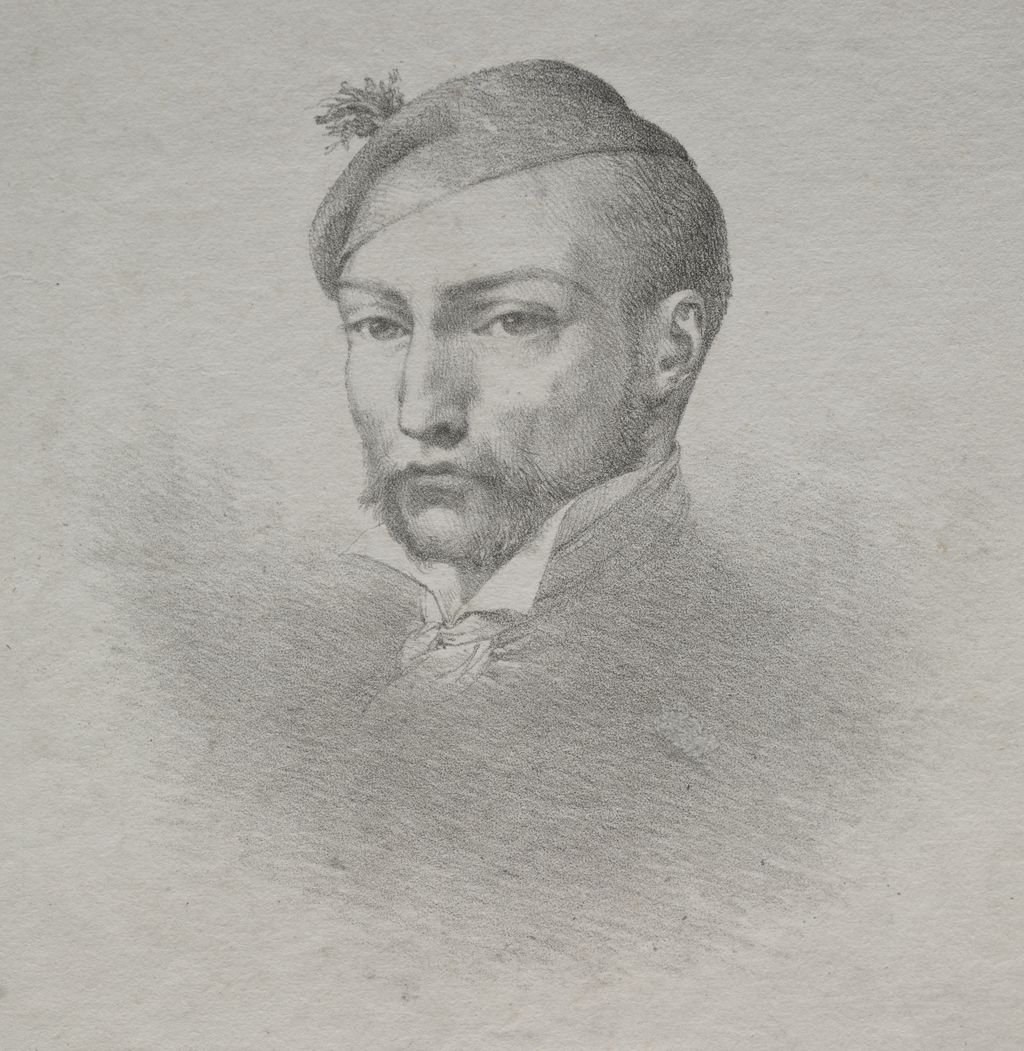
Théodore Géricault, by Léon Cogniet, c.1824, lithograph — Cleveland Museum of Art Image source. CC0 / Public domain.
The success of 1812 and the difficult Salon of 1814
At the Salon of 1812 Géricault exhibited the enormous equestrian canvas now known as The Charging Chasseur. The Louvre records its original exhibition title as Portrait équestre de M. D[ieudonné]. The canvas measures 349 by 266 centimetres: its presence was far beyond that of a modest likeness or a small cavalry study. Géricault had turned twenty-one shortly before the exhibition opened, and his debut earned a gold medal. [5] [2]
The picture's force comes partly from its crossed movements. The horse rears towards the right while the officer turns back, his curved sword extending down towards the left. The white horse, red trimmings and spotted saddlecloth give the foreground a vivid material density. Smoke and distant fighting establish war as an environment, but the central encounter is with a single rider and an animal whose energy is difficult to contain. The canvas makes military display immediate without resolving the officer into a simple emblem of victory.
Tinterow describes the reception as accepting the picture's exaggerations in return for its excitement. Two years later, that exchange proved less dependable. Géricault showed the Chasseur again in 1814, now listed as Un Hussard chargeant, alongside The Wounded Cuirassier. The second painting is larger still, at 358 by 294 centimetres. Its soldier has dismounted and leads his horse across difficult ground. Instead of a charge, there is the uncertain movement of withdrawal. [2] [5] [6]
The cuirassier's gleaming breastplate does not secure him against vulnerability. His head turns anxiously; a hand holds the bridle, and his sword helps extend the body down towards the ground. No clearly identifiable wound explains the title. This absence leaves the relationship between physical injury, fatigue and moral suffering open. Against the fall of Napoleon and France's defeat, it is understandable that later writers read the figure as an image of national loss. That is a historically grounded interpretation, rather than proof that he portrays a particular retreat Géricault witnessed. [1] [2]
Critics in 1814 objected especially to drawing, handling and insufficient finish. The change of reception was therefore aesthetic as well as political. A painting that seems powerfully expressive now could appear awkward or incomplete within contemporary expectations. Géricault's success in 1812 had not established an assured public career, and his next choices included renewed study as well as further experimentation. The two cavalry pictures remained unsold during his lifetime. [2] [5] [6]
A king's musketeer in a changing France
Géricault's military service resists the simplest political biographies. In July 1814, after Napoleon's abdication and the restoration of Louis XVIII, he joined the king's musketeers. During Napoleon's return in March 1815 he accompanied the royal household's movement north. He left the musketeers later that year. This was a real commitment within the unsettled sequence of imperial defeat, royal restoration, the Hundred Days and a second Bourbon return. It cannot be removed merely because his later work is often associated with liberal opposition. [1] [2]
Neither does the uniform fix every later allegiance. The surviving career contains military imagery made under different governments, sympathy for suffering soldiers, and subjects that challenged the conduct of authority. Chenique reads Géricault's development through political conflict and, in particular, through changing ideas of the nation. Other explanations have placed more emphasis on his attraction to horses and military appearance. These are interpretations of motive, not interchangeable documentary facts. [1]
The abandoned imperial commission of 1813–14 illustrates a practical consequence of political change. Géricault prepared a scene of Eugène de Beauharnais rescuing an aide-de-camp during the Russian campaign. The fall of the Empire removed the original setting for the commission before it became a finished Salon painting. Drawings and studies nevertheless occupied him. A project could be ambitious, officially encouraged and extensively developed, yet fail to reach the public because the regime that supported it disappeared. [1]
Such interrupted projects belong within the biography of his working life. The later concentration on a few famous completed canvases can make the rest appear peripheral. In fact, preparatory labour, changing subjects and abandoned designs were recurrent features of his career. They show a painter weighing different ways to make contemporary history visible, rather than moving along an inevitable path towards a single masterpiece.
Italy, 1816–17: study and an unfinished ambition
When the Prix de Rome did not provide a scholarship in 1816, Géricault paid for the journey himself. He travelled through Florence and reached Rome in November, later visiting Naples. He returned to France in the autumn of 1817. The journey brought him into direct contact with the work of Michelangelo and Raphael, but also with contemporary Italian life. Ancient and Renaissance art did not simply draw him away from modern subjects; it offered new ways to give those subjects physical weight. [1] [11]
He was not a scholarship holder living under the same conditions as the French Academy's pensioners. That distinction has sometimes hardened into an image of complete isolation. Chenique's account instead places him among artists and acquaintances, including French residents with whom he travelled to Naples. He could criticise the institutional system while participating in an artistic community. Independence of judgement and social solitude are different things. [1]
The Roman carnival supplied a possible subject for a major canvas: the races of riderless horses along the Corso. Mar Borobia's catalogue essay for the Museo Nacional Thyssen-Bornemisza identifies the February 1817 spectacle as the occasion behind numerous drawings and painted studies. The project explored more than the race itself. In the Thyssen painting, the winning horse is being paraded in green and gold cloth, accompanied by a young attendant with a flag. That ceremonial aftermath differs from the struggle before the start depicted in other studies. [12]
In the Getty's Race of the Riderless Horses, men restrain and drive the animals in a tightly packed field of bodies. A muscular nude at the centre stretches against a pale horse. The warm, restricted palette binds human and animal limbs into a continuous pressure of thrusts and counter-thrusts. The Getty relates the nude to ancient athletes and the horses to the Parthenon frieze: Géricault transforms a contemporary event through the forms of classical art. [13]
The monumental painting remained unrealised. Its studies should not be treated as fragments of an existing finished canvas or reduced to illustrations of a picturesque holiday. They preserve choices about which moment to represent, how much contemporary costume to retain and how to organise collective force. The Italian journey expanded Géricault's field of action while leaving several possible futures for his art unresolved. On returning to Paris, he would turn towards a recent French disaster, but the bodies he painted carried the consequences of this sustained encounter with older art. [12] [13]
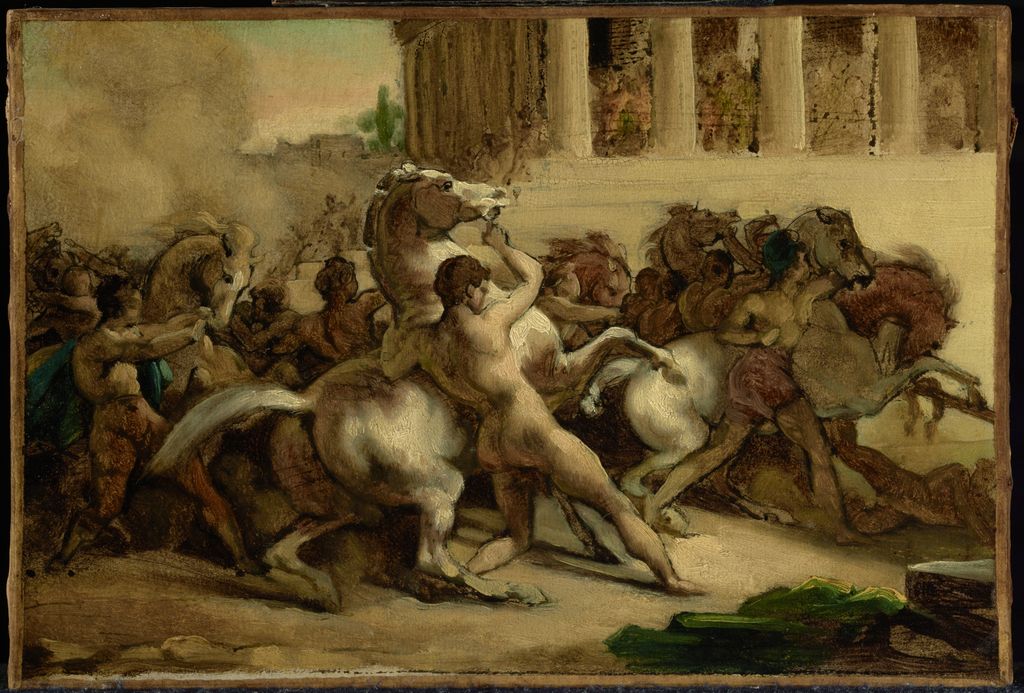
The Race of the Riderless Horses — Getty study Image source. CC0 / Public domain.
Family secrecy and the work of 1818
The return from Italy also brought Géricault back into a difficult private relationship. He had an affair with Alexandrine-Modeste Caruel, the wife of his maternal uncle Jean-Baptiste. Their son, Georges-Hippolyte, was born in August 1818. These facts entered modern biographical knowledge much later and altered accounts that had lacked this part of his family life. Both Tinterow and Chenique discuss the relationship, though their chronologies do not resolve every stage of its development in the same way. [1] [2]
The timing overlaps with preparations for The Raft of the Medusa, but an overlap is not an explanation. It is tempting to translate shipwreck into personal guilt, or to make a particular painted body stand for the child, the mother or the painter. Such readings go beyond what a delivery date or a birth record can establish. Chenique himself warns how easily the newly known relationship could be brought into an account of the Raft. The disaster had a substantial public history of its own. [1]
Nor was all Géricault's work in 1818 confined to that subject. Tinterow's research into the three great landscapes known as the Times of Day establishes deliveries of their canvases in July and August 1818. These works therefore belong alongside the Raft preparations, after the Italian journey. The evidence changes the image of an artist absorbed in only one gigantic undertaking. He was also developing landscapes of comparable ambition, bringing remembered and inherited Italian motifs into invented settings. [2]
The patron and intended destination of those landscapes remain unknown. Their buildings and small figures should not be turned into a securely decoded private narrative. What can be said is that they broaden the range of the career: monumental scale could serve an imagined landscape as well as a contemporary tragedy. Géricault's study of older art continued to generate new compositions while his family circumstances remained concealed from public view. [2]
Watch: Géricault and The Raft of the Medusa
Three perspectives on Géricault’s best-known painting, its making and its historical setting.
Gericault, Raft of the Medusa
Smarthistory examines the composition and historical setting of The Raft of the Medusa.
Watch on YouTubeMaking The Raft of the Medusa
The wreck of the French frigate Méduse in July 1816 became a political scandal under the Restoration. Its survivors' published account gave the catastrophe a public life beyond maritime reporting. Géricault encountered the story after returning from Italy and met survivors, including Alexandre Corréard and Henri Savigny. He chose a recent event in which abandonment, responsibility and desperate survival were inseparable from contemporary authority. Chenique's account places those meetings within the development of the picture, while acknowledging uncertainty about how the initial contact occurred. [1]
The physical commitment is unusually clear. The supplier Étienne Rey delivered the huge canvas on 24 February 1818 for 440 francs. Géricault worked in a rented studio in the rue du Faubourg-du-Roule and later moved the picture to the Théâtre-Italien, where it was completed in July 1819. The Louvre now records its dimensions as 491 by 716 centimetres. Preparation, working space and the movement of the canvas were substantial parts of the undertaking; this was an extended construction, not the immediate transcription of an emotional response. [4]
Preparation also involved attention to the dead body. A small canvas now on loan to Rouen, catalogued by the Louvre as a lamp-lit study of arms and legs for the Raft, brings severed limbs into a compact arrangement against darkness. The museum dates it to about 1818–19. The distance between this close study and the enormous final composition is instructive: Géricault could examine bodily material on an intimate scale while constructing an ambitious public image. The record does not recover the identities of those represented, and the study should not be made into evidence of a particular diagnosis or a private obsession. It belongs to the demanding preparation for painting suffering, with limits to what its subject can tell us about the painter. [14]
The finished composition offers no commanding official to explain or govern the scene. Bodies occupy the raft's unstable surface, some collapsed, others rising towards a distant chance of rescue. The foreground is heavy with the dead and exhausted. Farther back, reaching arms carry the eye towards the standing Black figure who waves a cloth. The tiny ship on the horizon is so remote that hope depends upon an almost negligible mark. The tension between bodily weight and outward reach gives the catastrophe a form viewers can follow without making rescue feel secure.
Géricault's academic education is present in the strength and arrangement of those bodies. Yet the figures have been placed in conditions that expose their dependence on one another and on events beyond their control. Tinterow sees the picture as a decisive reworking of the relationship between heroic figure painting and human vulnerability. Its modern force grows partly from this use of an inherited visual language for people whose ordeal offered no conventional model of triumph. [2]
The subject did not exhaust his attention to suffering during these years. In the lithograph Return from Russia, made around 1818, wounded soldiers and exhausted animals turn the Napoleonic past into an encounter with survival and dependence. The Cleveland Museum of Art describes the use of two stones, one for the black design and another for ochre tone; its impression also has added watercolour. The modest sheet and the immense canvas reach viewers through very different means, but both deny the body an uncomplicated role as an instrument of glory. [15]
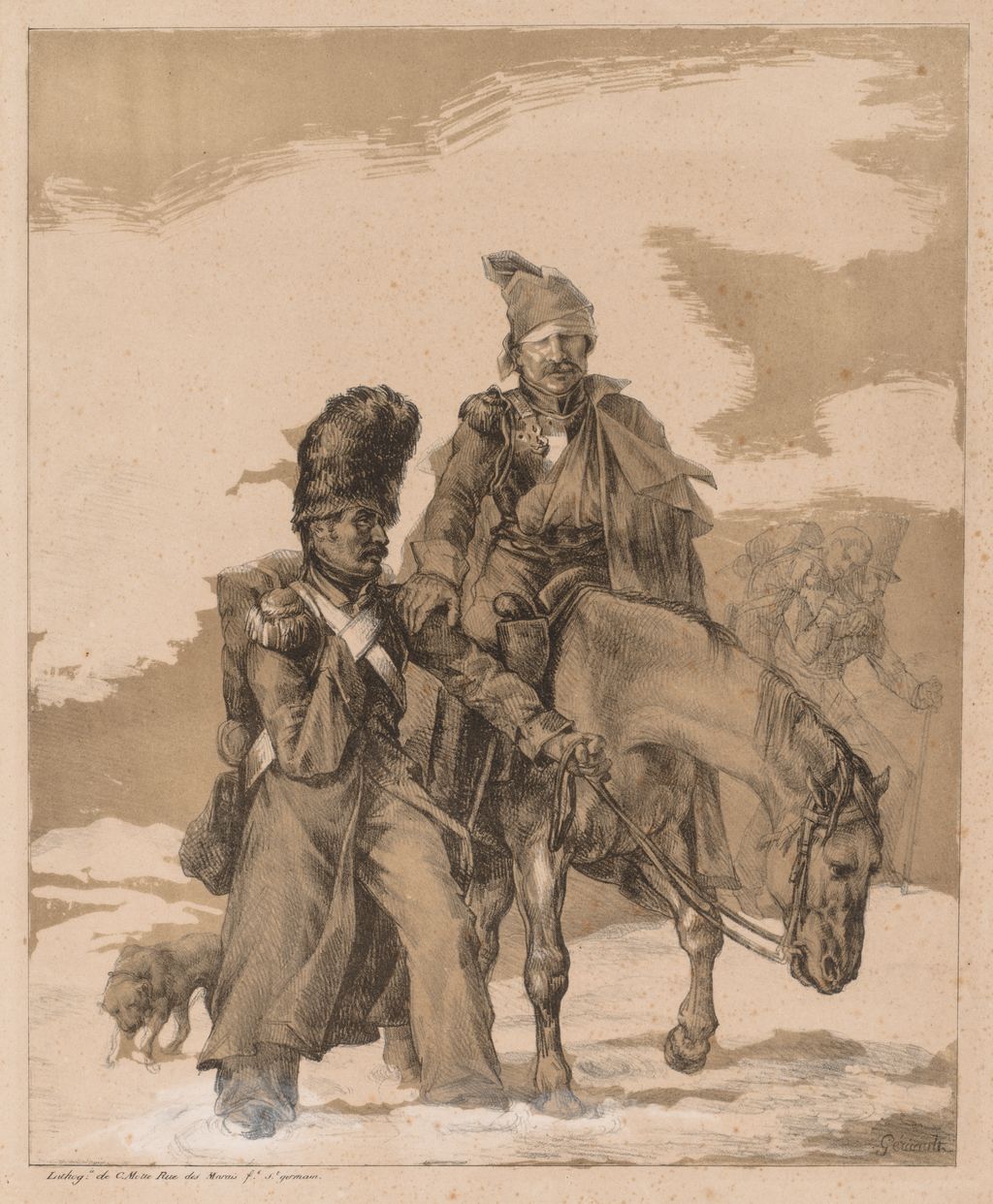
Return from Russia, c.1818 — Cleveland impression 1931.48, with hand-added colour Image source. CC0 / Public domain.
The Salon, the public and the search for a buyer
The Raft of the Medusa appeared at the Salon of 1819 under the title Scène de naufrage. The exhibition opened on 25 August and closed on 30 November. The Louvre's history records an initial position above a doorway in the Salon Carré and a move to the lower rank in late October. This change matters to the biography of the painting: the conditions under which an audience could confront the bodies were part of its first public reception. [4]
The generic title is documented. The stronger assertion that it proves an act of political censorship requires separate evidence, rather than being inferred from the words alone. The story of the wreck was already widely known, so an unspecific label did not make the subject unreadable. Its challenge also lay in the encounter between a recent catastrophe and the prestigious scale of history painting. The controversy cannot be reduced to a title or to a single hostile response. [4] [1]
Accounts differ in their emphasis on the reception: Tinterow stresses favourable criticism as well as Géricault's disappointment, while Chenique describes the difficulty critics had in accommodating the work. Public attention, critical praise and a satisfactory sale were different outcomes. The painting attracted the first two without securing the last. This is more precise than either a story of instant universal rejection or one of effortless triumph. [2] [1]
The state did not buy it during the painter's lifetime. The Louvre's current account allows for difficulty over price as well as official embarrassment over the subject, despite support from the museum director Auguste de Forbin. That balance is important. The failed sale belonged to the workings of patronage and negotiation as well as politics. Géricault's decision to send the painting abroad opened another route to an audience, with a different arrangement between artist, organiser and paying public. [4]
London, 1820–21: exhibitions, horses and labour
Géricault crossed to England in April 1820 with the artist and lithographer Nicolas-Toussaint Charlet. The Raft was placed with the exhibition entrepreneur James William Bullock, whose contract covered its display and promotion in the British Isles. The Louvre dates the London exhibition at the Egyptian Hall from 12 June to 30 December 1820, followed by Dublin in February–March 1821. The image that had failed to find a government purchaser could now be encountered as a separately promoted attraction. [1] [4]
His English experience comprised two stays rather than one uninterrupted absence from France. Between them he visited Brussels with Horace Vernet and saw the exiled Jacques-Louis David. He was back in London in early 1821 and returned to Paris that December. The movement joined professional curiosity, personal contacts and the circulation of his most famous canvas. It also placed his earlier training in a wider European setting: the young painter could visit the artist whose authority had loomed over French painting while seeking new lessons elsewhere. [1]
British exhibitions interested him as much as horses. Chenique reproduces correspondence in which Géricault admired the effects of colour he saw at the Royal Academy, including portraits, landscapes and animal painting. This evidence helps explain England as an artistic encounter rather than simply an escape after disappointment. He attended the Royal Academy's dinner at Thomas Lawrence's invitation in May 1821, evidence of a professional welcome that complicates the solitary outsider legend. [1]
Lithography became central to what he made there. The process allowed a drawing on stone to be printed in multiple impressions, bringing his own designed images to a wider audience. The Château de Chantilly's account connects his early military prints with the English subjects of horses and street life. It is a parallel career in a medium with its own resources, rather than a minor record of the paintings. [16]
The 1821 suite Various Subjects Drawn from Life and on Stone was printed by Charles Hullmandel and published by Rodwell & Martin. Entrance to the Adelphi Wharf places three working horses beneath a broad arch, their hindquarters turned towards the spectator. A man at the left steps forward while the animals enter the dark opening. Chantilly identifies the setting with the Thames coal trade and stresses the recurrent importance of difficult labour by men and horses. The sheet's publication inscription gives May 1821. [17]
The relationship to the early cavalry paintings is revealing. The horse remains physically imposing, but a soldier's equipment has been replaced by working harness, and public spectacle by movement through an industrial city. English life offered Géricault subjects in which effort was continuous and ordinary. His attention could encompass farriers, poverty, transport and the routines surrounding animals, without depending on a singular historical crisis. The suite contains twelve subject plates and a title page; counting the title as a thirteenth subject would misdescribe its structure. [17] [18]
Painting also continued. The 1821 canvas traditionally known as The Epsom Derby sets four mounted racers against an open course. The Louvre's title carefully preserves Epsom as a traditional identification, rather than a firmly documented race report. Its speed belongs to a different horse world from the wharf, but the two works coexist within the English period. Géricault's interests expanded across sporting display and working life; one did not simply replace the other. [7]
The uncertain history of the Monomanes portraits
Among the works associated with Géricault's later years are five surviving portraits traditionally known as the Monomanes. Their precise chronology and original purpose remain uncertain. The Musée des Beaux-Arts de Lyon dates its portrait, traditionally called The Monomaniac of Envy, to about 1819–22. It also gives an unusually explicit warning about the familiar account that the doctor Étienne Georget commissioned the group: no document establishes the supposed connection between the two men. [19]
The museum traces the historical labels to Louis Viardot's account of their discovery in 1863, long after Géricault's death. The names attached to the portraits belong to nineteenth-century ideas about mental illness and to their later reception. They are not sufficient grounds for diagnosing the people depicted. Nor does repeating a commission story in several biographies turn it into documentary evidence. The group must remain within Géricault's life as a major but incompletely explained undertaking. [19]
In the Lyon portrait, a white cap frames a face turned slightly away from the spectator. Reddish tones around the eyes and the red garment beneath a dark wrap hold the attention without the elaborate setting of a commissioned society portrait. Nothing in these visible features securely names the woman or explains her situation. Their force lies in the sustained attention given to her appearance. The museum reads this elevation of an anonymous sitter as part of the period's wider expansion of who could occupy painting's serious attention. [19]
It is equally unsafe to treat the paintings as medical evidence about Géricault himself. Their presence near the end of a short, painful life has encouraged connections between his suffering and theirs. The surviving record does not establish such a simple chain of cause and effect. The Monomanes portraits ask for careful looking and historical context while withholding much of the personal information a biographer would wish to possess. Their uncertainty is part of an honest account, rather than a blank to be filled with psychological invention.
Final projects, illness and death
After returning to Paris in December 1821, Géricault continued to make prints and develop subjects. Designs concerning the slave trade and the liberation of prisoners of the Inquisition point towards further ambitious contemporary history paintings that were never completed. The surviving work therefore does not present a settled final destination. Alongside the achievements visible to later audiences are directions interrupted before they could be realised. [1]
Riding falls in 1822 seriously damaged his health, and a prolonged illness followed. There were periods of work and improvement as well as decline; Chenique records convalescence with Dedreux-Dorcy, further lithographs and a renewed return to activity in early 1823. It is misleading to reduce the last years to one fatal accident followed immediately by death. It is also unnecessary to name a modern diagnosis from fragmentary historical accounts. What is clear is the length and severity of the illness and the operations he underwent. [1]
His financial position also deteriorated. The failure of his stockbroker Félix Mussard in August 1823 brought a major loss, described by Chenique as ruin. That late reversal should not be projected back over his entire career. The independent young traveller and the painter investing in large canvases had enjoyed resources unavailable to many contemporaries. His eventual losses make the biography more complicated; they do not validate a lifelong poverty legend. [1]
Family arrangements made during the final illness indicate the continuing importance of his son. Géricault's November 1823 will named his father as universal legatee; his father's ensuing will made Georges-Hippolyte his heir. Friends and fellow artists visited as his condition worsened, including Gros and Delacroix. These are traces of an active circle of relationships around the sick painter, rather than evidence of complete abandonment. [1]
Géricault died in Paris on 26 January 1824, aged thirty-two. His funeral took place on 28 January, two days later, and he was buried at Père-Lachaise. Keeping these dates distinct is essential: the funeral date has sometimes been mistaken for the date of death. His death ended a career still generating possible subjects, not a completed artistic programme whose last pictures can be read as a deliberate farewell. [1]
Dispersal and the making of a reputation
The studio sale in November 1824 changed the ownership and future visibility of the work. The Raft of the Medusa was acquired for the state through Dedreux-Dorcy, acting on Forbin's instructions, for 6,005 francs. The Louvre records the auction on 2 November and confirmation of the purchase on 12 November. The painting entered the national collection in the year of Géricault's death and was displayed at the Louvre from 1826. Its eventual institutional home was secured by people who had supported its acquisition during his lifetime. [4]
The two great cavalry canvases took another route. The duc d'Orléans bought both at the estate sale, and the state acquired them together in 1851. Their present proximity within a museum tradition can conceal these separate histories. Géricault did not live to see the three famous paintings established together as central monuments of French Romanticism. Their collective authority was formed through later collecting and display as well as through his original decisions. [5] [6]
Prints followed their own history of recognition. In his nineteenth-century catalogue, Charles Clément insisted that lithographs were indispensable to understanding the artist and noted that they had not always been widely valued. His testimony is historical rather than a statement of their present rarity. Chantilly's nearly complete group, acquired by the duc d'Aumale in 1866, is one example of the collecting that helped preserve this part of the career. The grand canvas and the printed sheet reached posterity through different channels. [18] [16]
Later writing also shaped the personality readers encountered. Tinterow places Clément's work at the foundation of Géricault scholarship while emphasising unresolved chronology and attribution. Chenique challenges traditions of isolation and the artist cursed by his own temperament. Neither the dramatic early death nor the disturbing subjects should erase the evidence of study, prosperity, professional recognition and friendship. These circumstances do not diminish the pictures' intensity. They make its achievement more intelligible. [2] [1]
Géricault's life emerges most clearly in the range of work he undertook: the rider turning in his saddle, the Roman groom struggling with a horse, the raft's survivors reaching towards the horizon, and the working animals moving into a London arch. Each was developed through choices of medium, scale and audience. The surviving documents leave much about private motive unresolved, but the works show an artist repeatedly testing how bodies could carry the weight of contemporary experience.
Géricault collection records
Seventy collection records include paintings, drawings and individual print impressions. Different impressions remain separate records; this selection is not a complete catalogue raisonné.
Frequently Asked Questions
He came from a prosperous family and inherited substantial resources, including property after his grandmother’s death in 1812. These means supported travel and ambitious work. A stockbroker’s failure caused a serious financial reversal in 1823; it should not be projected over his entire life. [1] [2]
He was 32. He was born 26 September 1791 and died 26 January 1824. The funeral followed on 28 January, a separate date sometimes mistaken for his death. [1]
Discussion
Look again at the images and ideas explored in Théodore Géricault: A Biography. These editorial prompts invite your observations.
Reader Insights
How does the change from a mounted officer to a dismounted soldier alter your response to the two early Salon paintings?
What changes when Géricault presents horses at a Roman festival, a racecourse and a London coal wharf?
Which parts of an artist’s life help you understand a painting, and where does biography begin to impose a story the picture cannot prove?
Join the Conversation
Share a detail, comparison or question about Théodore Géricault: A Biography below.
References
- Bruno Chenique / Musée des Beaux-Arts de Lyon, “Théodore Géricault (1791–1824), l'enfant terrible du romantisme français,” in Géricault, la folie d'un monde, exhibition press dossier, 2006, pp. 15–21. French. View source. (in French).
- Gary Tinterow / The Metropolitan Museum of Art, Géricault's Heroic Landscapes: The Times of Day, The Metropolitan Museum of Art Bulletin, vol. 48, no. 3, Winter 1990–91, chronology pp. 6–7, introduction pp. 8–10 and landscape-history discussion pp. 18, 24. English. View source.
- SCHIRN, Images of Life and Death; collection metadata and museum interpretation (English). View source.
- Musée du Louvre, Le radeau de la Méduse, 1818–19, INV 4884 / C 51, collection record and detailed history. French. View source. (in French).
- Musée du Louvre, Officier de chasseurs à cheval de la garde impériale chargeant, 1812, INV 4885 / MN 50, collection record and exhibition and ownership history. French/English interface. View source.
- Musée du Louvre, Cuirassier blessé, quittant le feu, 1814, INV 4886 / MN 51, collection record and exhibition and ownership history. French. View source. (in French).
- Musée du Louvre, Course de Chevaux, dit traditionnellement Le derby de 1821 à Epsom, 1821, MI 708, collection record. French/English interface. View source.
- Vlaamse Kunstcollectie, Portrait of a Kleptomaniac; collection metadata and museum interpretation (Dutch). View source.
- National Gallery, Horse frightened by Lightning; collection metadata and museum interpretation (English). View source.
- Nationalmuseum, The Severed Heads, NM 2113; collection metadata and museum interpretation (Swedish). View source.
- Musée du Louvre / DNP Museum Lab, “Chronologie,” Théodore Géricault, entries 1791–1824. French; later scholarship and current collection records qualify some details. View source. (in French).
- Mar Borobia / Museo Nacional Thyssen-Bornemisza, Carrera libre de caballos, about 1817, inv. 157 (1979.40), collection catalogue essay. Spanish. View source. (in Spanish).
- J. Paul Getty Museum, The Race of the Riderless Horses, 1817, 85.PC.406, collection record and interpretive text. English. View source.
- Musée du Louvre, Étude de bras et de jambes, peinte à la lumière de la lampe, pour le Radeau de la Méduse, au Louvre, about 1818–19, RF 579, on loan to the Musée des Beaux-Arts de Rouen, collection record. French. View source. (in French).
- Cleveland Museum of Art, Return from Russia, about 1818, 1931.48, collection record and discussion of two-stone printing. English. View source.
- Château de Chantilly, “Géricault et la lithographie,” virtual exhibition based on Nicole Garnier-Pelle's 2018 exhibition and catalogue, designed by Clara Voiry. French. View source. (in French).
- Musée Condé, Château de Chantilly, Entrance to the Adelphi Wharf, 1821, 2015-0-25, collection record, description and publication inscriptions. French. View source. (in French).
- Charles Clément, Catalogue de l'œuvre de Géricault: Lithographies, 1866, introduction pp. 3–5 and English-suite catalogue pp. 13–16, in digitised historical compilation. French. View source. (in French).
- Musée des Beaux-Arts de Lyon, La Monomane de l'envie, about 1819–22, B 825, collection record and discussion of uncertain origins. French. View source. (in French).


