



 by Tom Gurney
Tom Gurney BSc (Hons) is an art history expert with over 20 years experience
Email: tomgurney1@gmail.com / Phone: +44 7429 011000
Study of the Model Joseph: Introduction
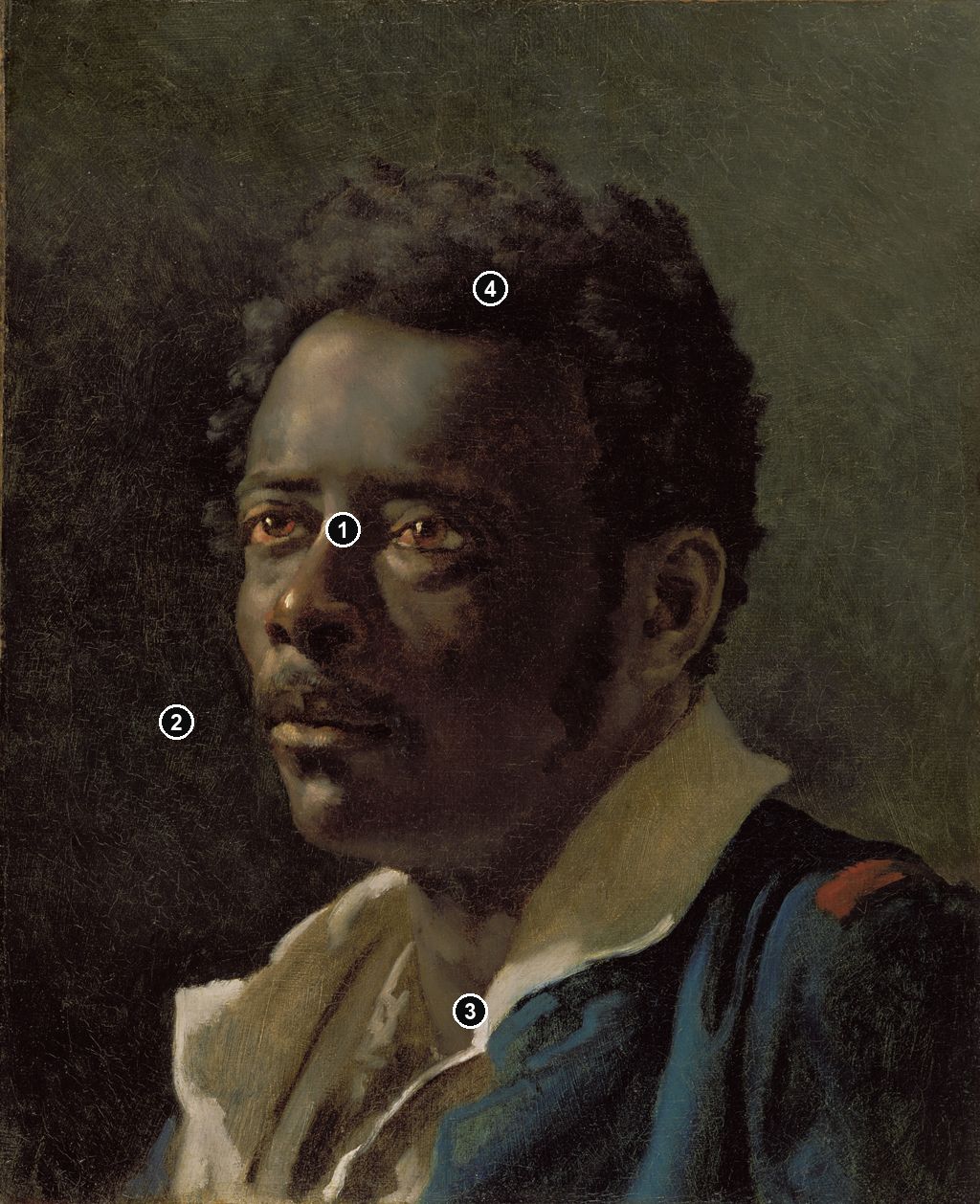
A few small touches of light make Joseph’s face the centre of this painting: a bright point in each eye, a narrow gleam on the nose, and softer accents on the lower lip and chin. Around them, brown, grey and warm beige build a head that seems remarkably substantial against its dark surroundings. Théodore Géricault painted Study of the Model Joseph about 1818–19, while preparing The Raft of the Medusa. The oil on canvas, now in the J. Paul Getty Museum, measures 47 × 38.7 cm and bears the accession number 85.PA.407. Its modest size brings us close to a person whose body would help shape one of the largest and best-known paintings of the nineteenth century. [1]
Joseph was a Haitian immigrant and a professional artist’s model. He is particularly associated with the man who raises a cloth at the summit of The Raft of the Medusa. In that enormous composition the figure turns away, directing his effort towards a distant ship. Here the face takes precedence. The two works offer different kinds of visibility: one gives a model a conspicuous role in a public drama; the other preserves his individual appearance. Getty’s identification of the sitter makes that relationship legible without allowing the famous history painting to absorb the smaller portrait completely. [2]
At a Glance
- DateAbout 1818–1819 [1]
- MediumOil on canvas [1]
- Dimensions47 × 38.7 cm, unframed [1]
- CollectionJ. Paul Getty Museum, 85.PA.407 [1]
This work across Théodore Géricault’s career
The Severed Heads
1810s [3]Charging Chasseur
1812 [4]Horse Frightened by Lightning
c.1813–14 [5]The Raft of the Medusa
1818–19 [7]Portrait of a Kleptomaniac
c.1820–24 [9]The Epsom Derby
1821 [10]Contents
- Looking at Joseph’s face
- An open collar and a change of pace
- What is known about Joseph
- From a studio sitter to the summit of the raft
- A face beside the heroic body
- Seeing the named model today
- Annotated details
Looking at Joseph’s face
Joseph’s head turns towards the viewer’s left, while enough of the nearer cheek and ear remains visible to give the face a rounded, three-dimensional presence. His gaze passes beyond us. The eyes are neither lowered nor arranged for direct conversation with a spectator. This slight displacement matters: we look at him without receiving a clear answering look. It leaves the expression open, encouraging attention rather than supplying an immediately readable emotion.
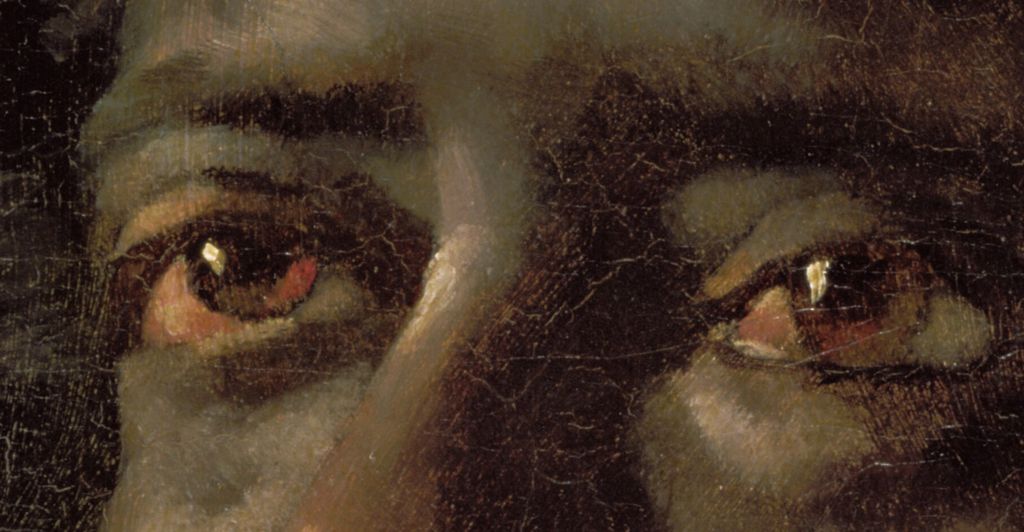
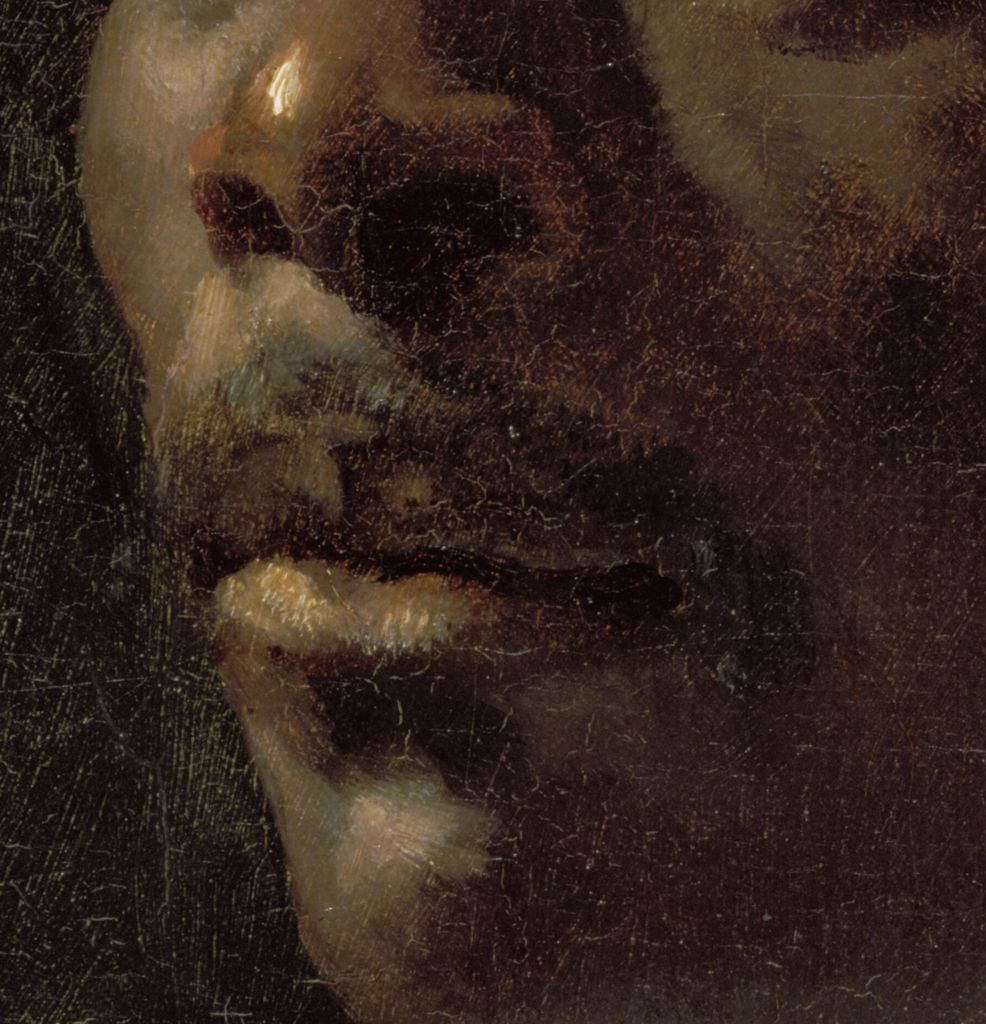
Light falls unevenly across the head. The broad forehead catches a muted illumination; smaller, sharper accents describe the nose and eyes. Across the cheek, lighter grey-brown passages meet warmer shadows. The shadow beside the nose is especially important, separating its projecting form from the cheek without enclosing either in an emphatic outline. The face is built through these changes of value and colour. Getty draws particular attention to the light touches around the eyes, nose, lower lip and chin, and to the range of browns, greys and beiges used to model the complexion. [1]
These highlights are easy to overlook as separate marks because they work together so persuasively. The tiny brightness in an eye makes the surrounding dark iris seem deeper; the accent on the nose gives a firmer location to a form whose sides dissolve into shadow. On the lower face, light does not spread across the whole mouth. It touches the lower lip and chin selectively, preserving the darker interval between them. Small differences of paint produce a face with weight and structure.
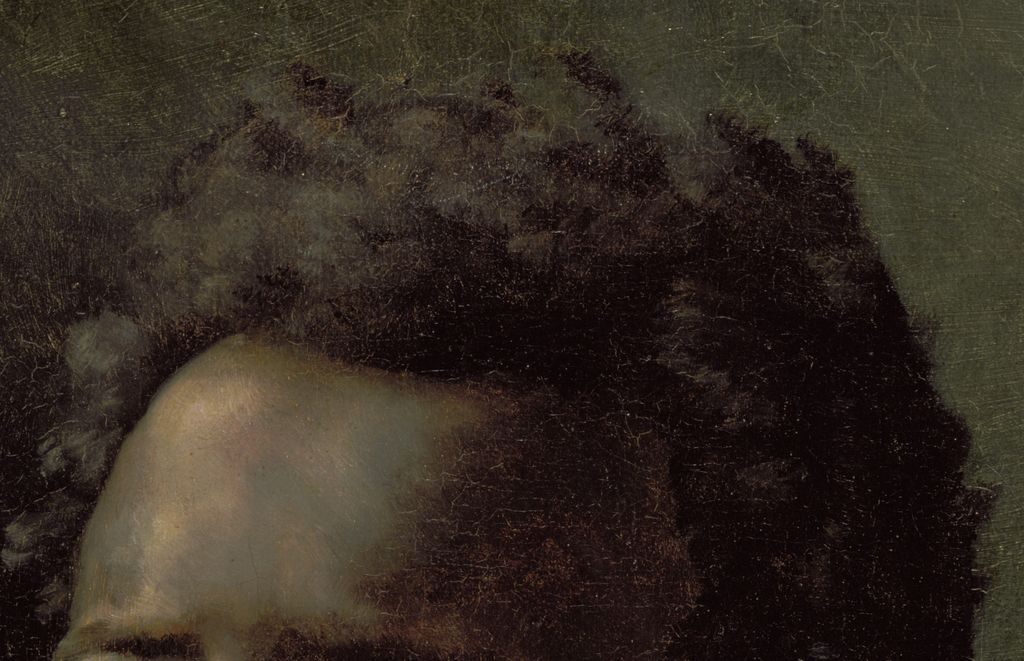
Hair adds a different rhythm. The loosely massed curls rise into an irregular silhouette, with subdued reflections catching isolated edges. The moustache and sideburns connect that dark framing to the more carefully articulated face. Behind the head, the background provides little information about a room or an activity. It is darker on the left and more green-grey towards the upper right. With no furniture or landscape to draw the eye away, the meeting of hair, skin and background becomes an essential part of the composition.
There is redness around the eyes, but the painting cannot tell us why it is there. Getty’s description interprets the gaze in terms of inward distress; Paul Bernard-Nouraud, writing for Histoire par l’image, allows for a more elusive expression, with eyes that seem slightly raised or unfocused and lips that might suggest the faintest smile. These readings show how much depends on the viewer’s attention to minute features. Neither supplies evidence of Joseph’s mental state during the sitting. The securely visible facts are the bright eyes, the reddish accents and the restrained movement of the mouth. [1] [11]
An open collar and a change of pace
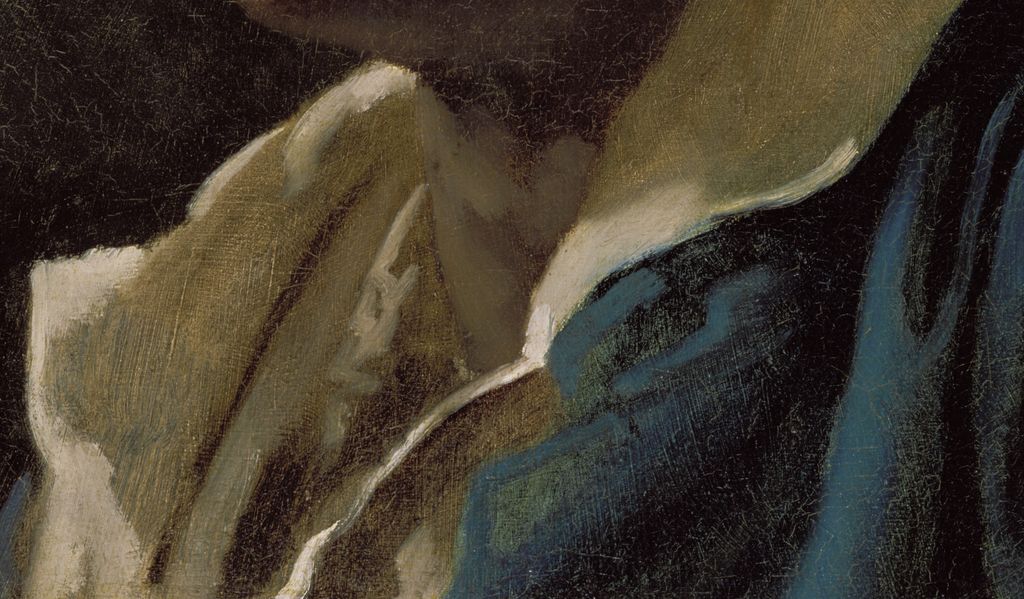
Below the head, Géricault loosens his handling. The white shirt opens at the throat and spreads into broad, irregular folds. Its light collar rises beneath the ear on the right, making a clear boundary against the skin, before dropping towards the centre of the chest. The dark blue outer garment is indicated with more sweeping passages, and a small reddish accent appears on the shoulder. The contrast in finish gives the portrait a distinct hierarchy: the face holds prolonged attention, while the clothes establish the body beneath it with greater economy.
The pale fabric also changes the distribution of light. Its strongest edges can appear brighter than much of the face, yet they lead back towards the neck and head. The V-shaped opening creates depth at the bottom of the picture; the upturned collar carries that movement towards Joseph’s cheek. The clothing therefore does more than furnish an informal appearance. Its folds and diagonals help support the comparatively still arrangement of the features above.
Identifying the costume precisely is less secure than describing it. Getty compares the shirt with clothing worn by the Medusa survivors. Bernard-Nouraud suggests that the outer garment could be naval clothing, while also connecting the open collar with earlier portraits of thinkers shown without formal neckwear. These are contextual comparisons, not proof that Joseph was a sailor or that Géricault assigned him a particular intellectual identity. No book, writing implement or other occupational attribute appears within the crop. [1] [11]
The difference between the face and clothing helps explain the word “study” in the title. The picture concentrates effort selectively, leaving some passages more abbreviated than others. But a study can also function as a portrait. Joseph’s particular features, hair and bearing carry an interest beyond the requirements of a larger composition. Bernard-Nouraud makes precisely this distinction, treating the Getty canvas as an individual portrait despite its preparatory purpose. The image gives a viewer ample reason to stay with the sitter before turning to the project for which he posed. [11]
Annotated Details from Study of the Model Joseph
The numbered points identify visible features discussed in this article. Return from each detail to the whole composition. Study of the Model Joseph Image source. CC0 / Public domain.
Details from STUDY OF THE MODEL JOSEPH
Compare the cropped details with the complete images above. Notice how their colours, shapes and positions contribute to the larger compositions.
Small lights in the eyes
Tiny bright accents stand out against the dark irises; reddish and grey tones describe the surrounding lids.
Light across the lower face
Separate highlights on the nose, lower lip and chin build projecting forms without outlining the whole face.
Open collar and loose brushwork
The pale collar frames the neck while broad blue strokes indicate the outer garment with less finish than the face.
Curls against the background
The uneven outline of the curls gives the head a lively edge against the subdued green-grey ground.
What is known about Joseph
The surviving account of Joseph’s life is fragmentary. Bernard-Nouraud records that he arrived in Marseille as a child in 1804 from Saint-Domingue, the Caribbean colony that became independent Haiti that year. As an adolescent he worked with a circus troupe before becoming a professional model. These points establish a life and a working history beyond Géricault’s studio, but they do not provide a continuous account of his childhood or explain the circumstances of his migration. [11]
His admission as a model at the École des Beaux-Arts in Paris dates to 1832. That date is essential to understanding the portrait correctly. When Géricault painted Joseph about 1818–19, the institutional appointment still lay more than a decade ahead. Joseph’s later association with the École demonstrates his standing within the profession; it should not be brought backwards in time to describe the circumstances of the Getty sitting. Bernard-Nouraud traces his modelling career at least as late as 1865, considerably beyond the period of his collaboration with Géricault. [11]
Getty’s 2023 account presents Joseph as a sought-after Black model in a profession that could be unwelcoming to people of colour. It also stresses the scarcity of written records about him. Both observations matter. His repeated employment gives substance to the word “professional,” while the documentary gaps resist attempts to turn his career into a fully recoverable personal story. The names of the painters who represented him survive more readily than his own words. [2]
Modelling was work through which a living person contributed to the making of an image. The Getty portrait lets us see one result of that labour, although it does not record the arrangements of the sitting. We do not know from these accounts what Joseph was paid for this particular work, what was said in the studio or how he understood the completed canvas. Recognising him by name need not be followed by invented dialogue or an imagined agreement with the painter’s aims. His documented profession and the evidence of the portrait already give him a firmer place in the story than the vague designation of an anonymous “type.”
Joseph’s arrival from Haiti also places him within a wider Black presence in France. Bernard-Nouraud situates his life alongside the histories of Black musicians, soldiers and political figures, including Joseph Bologne de Saint-George, Thomas-Alexandre Dumas and Jean-Baptiste Belley. These comparisons describe a historical setting rather than a circle of people Joseph is known to have met. They prevent his appearance in French painting from seeming an isolated exception, while leaving the limits of his own biography intact. [11]
Watch: Géricault and The Raft of the Medusa
Three perspectives on Géricault’s best-known painting, its making and its historical setting.
Gericault, Raft of the Medusa
Smarthistory examines the composition and historical setting of The Raft of the Medusa.
Watch on YouTubeFrom a studio sitter to the summit of the raft
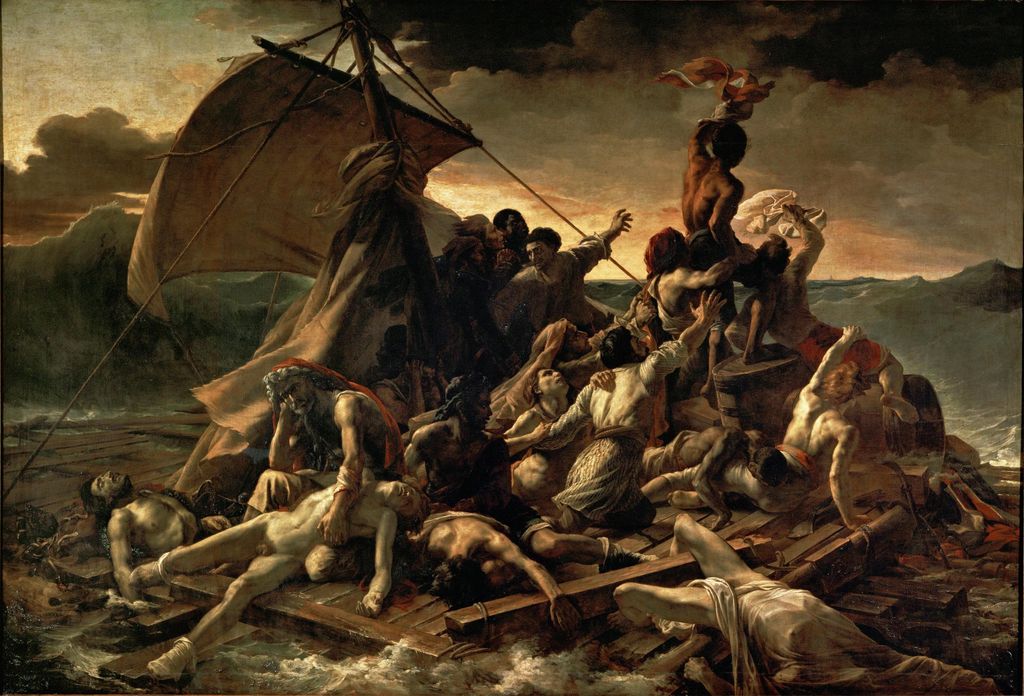
The preparatory relationship joins a small, closely observed face to a monumental public painting. The Louvre dates The Raft of the Medusa to 1818–19 and records its dimensions as 491 × 716 cm. It was shown at the Salon of 1819 under the title Scène de naufrage. The scale and exhibition setting place Joseph’s modelling within an undertaking very different from the quiet encounter offered by the Getty canvas. [7]
In the final painting, the highest signalling figure turns his bare back towards the spectator. He rises above a crowded chain of men whose reaching arms help carry the eye upwards. His raised cloth extends the movement beyond the body and into the sky. Joseph is associated with this figure by Getty, and Bernard-Nouraud discusses a related study of his back preserved at the Musée Ingres Bourdelle in Montauban. Taken together, portrait and back study indicate how attention to a model could address different needs: the particularity of a face and the construction of a figure in action. [2] [11]
The person who posed and the person represented within the shipwreck scene must be distinguished. Joseph was a model for Géricault; he was not thereby a passenger on the Medusa or a survivor of the raft. Bernard-Nouraud notes that survivor accounts refer to a Black soldier named Jean-Charles, and qualifies the suggestion that Joseph posed for all three Black figures in the painting. A single professional model could contribute to more than one painted body, but that possibility does not establish three portraits of Joseph or identify each figure with a particular historical passenger. [11]
The rescue narrative also helps explain what is at stake in the signalling pose. In the 1818 English account by survivors Jean-Baptiste Henri Savigny and Alexandre Corréard, the sighting of a distant brig on 17 July prompts improvised signals using handkerchiefs. The vessel then disappears before returning and rescuing fifteen people. The account describes an interval in which seeing a possible rescuer does not yet mean being saved. Géricault’s painting gives that uncertainty a powerful bodily form, without functioning as a literal reconstruction of every detail in the testimony. [12]
Seen against this episode, Joseph’s studio labour acquires a clear compositional consequence. A posed body becomes the means by which the painting holds out the possibility of rescue. Yet the Getty portrait offers no evidence that its gaze was intended as an exact rehearsal of the summit figure’s expression. We cannot inspect that figure’s face in the final work as we can Joseph’s here. The portrait and the history painting share a model and a project, while asking the spectator to look in different ways.
The Raft of the Medusa Image source. Public domain.
A face beside the heroic body
Bernard-Nouraud draws attention to a paradox: prominence in a history painting need not make the model recognisable. At the summit of the raft, the figure’s place is visually emphatic, but his turned back withholds the facial features through which a sitter might be identified. The Getty portrait acts as a counterpoint by making those features central. Knowing Joseph’s name connects the images; seeing his face allows us to recognise what the larger composition leaves out. [11]
This is also why the portrait should not be treated simply as a key for decoding the Raft. On its own terms it presents a man without an elaborate setting or a prescribed action. The slightly lifted gaze, open shirt and uneven curls make a specific appearance, but they do not fix a single narrative. His individuality emerges from the accumulation of observed differences: the contour of the ear, the division between moustache and upper lip, the balance of light across the cheeks. Those details can sustain attention independently of his contribution to the famous canvas.
The comparison with Chassériau extends that distinction beyond Géricault. Bernard-Nouraud records that Théodore Chassériau made an anatomical study of Joseph in 1836 at the request of Jean-Auguste-Dominique Ingres. The later work belongs to Joseph’s continuing professional career, after his registration at the École. It shows why he should not be treated solely as a person briefly encountered during the making of the Raft. It also reminds us that the purpose of an image matters: an anatomical study and a concentrated bust portrait can preserve different aspects of the same model’s presence. [11]
Descriptions of dignity are most useful here when they remain tied to pictorial choices. Bernard-Nouraud interprets the portrait as a representation that avoids reducing Joseph to an exotic emblem or subordinate accessory. The absence of an elaborate role, together with the sustained description of the face, supports that reading. It does not disclose the sitter’s thoughts or turn the painter’s apparent attention into proof of an equal social relationship. Dignity describes an effect of the image, not a recovered conversation between its makers. [11]
Seeing the named model today
The modern attention given to Joseph involves both looking and historical recovery. Getty’s 2023 presentation connects the portrait with an online exhibition about his life and nineteenth-century Paris, and points to research assembled for the Musée d’Orsay’s 2019 exhibition Le Modèle noir de Géricault à Matisse. Such work shifts attention towards the people whose appearances helped make celebrated paintings possible. Getty acknowledges that the written evidence remains sparse even as Joseph’s professional importance becomes clearer. [2]
Returning to the painting after learning that history changes its balance. The freely brushed clothing no longer belongs to an unnamed support for the artist’s ambition. It surrounds the face of Joseph, a professional whose career continued long after this sitting. At the same time, the picture does not become a transparent document of his life. Its highlights, shadows and selective finish remain decisions made in paint. The portrait’s enduring force lies in the meeting of those two kinds of evidence: enough historical knowledge to name the sitter, and enough particularity in the image to make continued looking worthwhile.
Géricault collection records
Seventy collection records include paintings, drawings and individual print impressions. Different impressions remain separate records; this selection is not a complete catalogue raisonné.
Frequently Asked Questions
Discussion
Look again at the images and ideas explored in Study of the Model Joseph. These editorial prompts invite your observations.
Reader Insights
How does recognising Joseph’s name change your response to the summit figure in The Raft of the Medusa?
Follow the small highlights in the eyes, nose, lip and chin. Which does most to give the face a sense of depth?
What changes when a model is shown as an individual face rather than as a body carrying out an action?
Join the Conversation
Share a detail, comparison or question about Study of the Model Joseph below.
References
- J. Paul Getty Museum, Study of the Model Joseph, about 1818–1819, oil on canvas, 47 × 38.7 cm, accession 85.PA.407; collection metadata and object description, English. View source.
- Unita Ahdifard, Getty, “Learn about Joseph, a Celebrated Haitian Model in 19th-Century Paris,” 9 February 2023, English. View source.
- Nationalmuseum, The Severed Heads, NM 2113; collection metadata and museum interpretation (Swedish). View source.
- Louvre, Charging Chasseur, INV 4885; collection metadata and museum interpretation (French/English interface). View source.
- National Gallery, Horse frightened by Lightning; collection metadata and museum interpretation (English). View source.
- Louvre, Wounded Cuirassier, INV 4886; collection metadata and museum interpretation (French). View source.
- Musée du Louvre, Le radeau de la Méduse, 1818–1819, INV 4884; object fields and historical account, French. View source. (in French).
- Gary Tinterow / The Metropolitan Museum of Art, Géricault’s Heroic Landscapes: The Times of Day, Met Bulletin 48/3, Winter 1990–91; consulted main essay and relevant object entries (English). View source.
- Vlaamse Kunstcollectie, Portrait of a Kleptomaniac; collection metadata and museum interpretation (Dutch). View source.
- Louvre, Epsom, MI 708; collection metadata and museum interpretation (French/English interface). View source.
- Paul Bernard-Nouraud, Histoire par l’image, “Joseph, modèle pour Géricault,” December 2023; historical context, image analysis and interpretation, French. View source. (in French).
- Jean-Baptiste Henri Savigny and Alexandre Corréard, Narrative of a Voyage to Senegal in 1816, English edition, 1818; account of the sighting, disappearance and return of the Argus on 17 July, Project Gutenberg transcription. View source.


