 by Tom Gurney
Tom Gurney BSc (Hons) is an art history expert with over 20 years experience
Published on June 19, 2020 / Page Updated on November 6, 2026
Email: tomgurney1@gmail.com / Phone: +44 7429 011000
Introduction
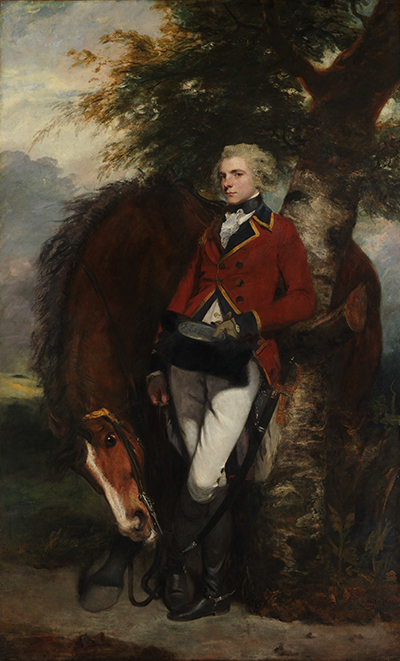
Joshua Reynolds's Captain George K. H. Coussmaker is one of his most polished statements of military elegance. The sitter is young, uniformed and full-length, but the portrait is not really about battle. It is about bearing. Coussmaker leans against a tree with his legs crossed, his horse beside him, and his body arranged with such controlled ease that military identity becomes a form of aristocratic style.
The painting was made in 1782 and is now in the Metropolitan Museum of Art, where it is on view at The Met Fifth Avenue. The Met records it as an oil on canvas measuring 93 3/4 by 57 1/4 inches, or 238.1 by 145.4 cm, with the object number 20.155.3 and the credit line “Bequest of William K. Vanderbilt, 1920.”[1] The title gives the sitter's dates as 1759-1801, fixing the portrait as an image of a man in his early twenties.
Google Arts & Culture's partner record with the Met corroborates the same basic object identity: title, maker, 1782 date, oil on canvas, dimensions and repository.[3] Mannings's catalogue remains the wider catalogue-control spine for Reynolds's paintings, but the Met record supplies the present object facts used here.[8] At first glance, the picture appears to offer a familiar eighteenth-century formula: officer, uniform, horse, landscape, full-length scale. But Reynolds makes the formula unusually charged. The horse expands the image beyond ordinary standing portraiture, while the sitter's relaxed posture prevents the portrait from becoming stiff ceremony. The result is a portrait of status without strain.
At a Glance
- TitleCaptain George K. H. Coussmaker
- ArtistJoshua Reynolds
- Date1782 [1]
- MediumOil on canvas [1]
- CollectionThe Metropolitan Museum of Art [1]
- Object number20.155.3 [1]
- Dimensions238.1 × 145.4 cm [1]
- Credit lineBequest of William K. Vanderbilt, 1920 [1]
- Regiment1st Regiment of Foot Guards
- Recorded sittingsTwenty-one for Coussmaker; as many as eight for the horse [1]
Contents
- Introduction
- The portrait and its effect
- Who was George K. H. Coussmaker?
- Reynolds and the full-length military portrait
- The horse and the problem of ease
- Studio labour behind visible confidence
- Uniform, rank and non-action
- American collecting and British elegance
- Why the portrait matters
The portrait and its effect
The Met describes Coussmaker as a young army captain whose crossed legs and lean against a tree embody aristocratic self-possession and nonchalance.[1] That sentence gets to the heart of the painting. The portrait does not present a dramatic episode, a military campaign or a moment of command. It presents a mode of being. Coussmaker appears as someone who has no need to prove that he belongs in the picture.
That ease is carefully manufactured. The crossed legs are not casual in any accidental sense. They break the vertical rigidity of a formal full-length portrait and turn the body into a long, elegant line. The tree gives him support, but it also becomes a theatrical prop, a natural column against which his assurance can be staged. The horse, meanwhile, supplies scale, rank and energy without requiring the sitter to ride.
Reynolds understood how to make a young sitter look complete. Coussmaker's youth could easily have made him seem decorative or slight. Instead, the portrait gives him command through composition. He occupies the foreground, holds the space around him, and seems untroubled by the size of the image or the viewer's attention. His nonchalance is the point.
The painting is therefore military only in a particular sense. It is not a record of combat service. It is a portrait of socialised military identity: uniform as rank, horse as cultivated command, landscape as aristocratic setting, body as confidence. Reynolds turns the captain into a public image of ease.
That transformation depends on the viewer believing in the sitter's comfort. Many military portraits use energy, danger or command to establish authority. Reynolds gives Coussmaker almost the opposite. The captain's authority is cool because the picture suggests that he can afford coolness. He is not caught in action, not required to perform courage, not hurried by any narrative pressure. The absence of urgency becomes its own form of privilege.
This is one reason the portrait feels so exact as a social document. It records the appearance of military rank, but it also records a fantasy of effortless rank. The full-length body, the horse and the landscape make the portrait expensive in both material and social terms. Reynolds's task was to make that expense look natural.
Who was George K. H. Coussmaker?
The Portuguese view of the Met's object text supplies unusually useful sitter detail. It states that Coussmaker joined the 1st Regiment of Foot Guards as ensign and lieutenant in 1776, was later promoted to lieutenant-colonel, and retired in 1795 without ever taking part in military action.[2] That last point is important. The painting's military glamour is not grounded in battlefield fame.
Coussmaker's regiment belonged to one of the most prestigious military formations in Britain. The National Army Museum identifies the Grenadier Guards as a senior infantry unit with origins in 1656; after Lord Wentworth's death in 1665, two guards units were merged to form the 1st Regiment of Foot Guards.[4] The regiment later became the Grenadier Guards, but in Coussmaker's day the older title still mattered.
The National Army Museum also notes that a detachment from the regiment served in America during the War of Independence, helping take New York in 1776 and later being captured at Yorktown in 1781.[4] Coussmaker's own career should not be folded into that action without evidence, but the regimental context helps explain the prestige of the uniform. The 1st Foot Guards carried both ceremonial and military associations.
The Met's Portuguese text also records a more personal contemporary description: Fanny Burney described Coussmaker as shy, quiet and well brought up.[2] That is a useful counterweight to the painting's air of aristocratic command. Reynolds does not show shyness directly. He transforms a young officer, remembered in those terms, into an image of public assurance.
This contrast should not be treated as contradiction. Portraiture often converts private temperament into public role. A shy sitter can be painted as composed; a quiet officer can be made visually commanding. Reynolds was especially good at this kind of conversion because he understood that portraiture is not biography alone. It is biography arranged for display.
Coussmaker's youth makes the conversion more interesting. He was not an old commander looking back on long service. He was a young Guards officer whose identity was still being made. The portrait does some of that making for him. It gives him the bearing, scale and pictorial authority of a man already secure in his world.
Reynolds and the full-length military portrait
Reynolds was the leading British portraitist of the eighteenth century. The National Gallery stresses his ability to enlarge British portraiture through antique example, Italian art and the great northern models of Rembrandt, Rubens and Van Dyck.[6] Captain George K. H. Coussmaker belongs to that ambition. It is a portrait designed to make the sitter appear more complete, more poised and more socially resonant than ordinary likeness could manage.
The full-length format gives the image a public ambition. A head-and-shoulders portrait can preserve likeness; a full-length portrait builds a social fiction around the person. Costume, pose, landscape, objects and scale all become part of the sitter's identity. In Coussmaker's case, the uniform and horse do not simply identify him. They stage him.
The National Gallery of Art's definition of the Grand Manner is useful here: late eighteenth-century Grand Manner portraiture was codified as full-length, life-size portraiture with impressive costume and attributes of rank and identity, and Reynolds is part of that English tradition.[5] Coussmaker fits the definition almost too neatly. He is full-length, life-size in ambition, impressively costumed and surrounded by signs of rank.
But Reynolds's best portraits rarely feel like diagrams of status. The difference lies in animation. Coussmaker is not standing at attention. He leans. He crosses his legs. The horse is present but not explosive. The scene is controlled, yet it has a rhythm that keeps grandeur from freezing into ceremony.
This is where Reynolds differs from a simpler painter of rank. He does not merely add attributes. He choreographs them. The tree is not simply scenery; it gives Coussmaker's body a reason to tilt and relax. The horse is not merely a sign of cavalry glamour; it fills the tall format and creates a living counterweight to the sitter's stillness. The uniform is not merely costume; it supplies colour, structure and social legibility.
The Grand Manner can sound heavy when described abstractly, but this portrait shows its lighter operation. Coussmaker is elevated, yet he remains plausible. The painting flatters by making rank seem instinctive. That is a subtler achievement than simple magnificence.
The horse and the problem of ease
Horses are dangerous props in portraiture. They can lend magnificence, but they can also overwhelm the sitter, especially when the sitter is not shown in action. Reynolds solves the problem by making the horse a partner in the picture rather than a narrative event. The animal increases scale and authority, yet the captain remains the psychological centre.
The horse also helps explain why the portrait required unusual labour. The Met records twenty-one appointments with Coussmaker between February and April 1782, and as many as eight with the horse.[1] That is a striking number because it reveals how carefully Reynolds constructed an effect that looks easy. Nonchalance, in this portrait, was hard work.
The sitter's pose depends on that paradox. If he stood too rigidly, the painting would become merely official. If he appeared too relaxed, the image might lose rank. Reynolds holds the middle. Coussmaker seems at ease because every element around him has been disciplined: tree, horse, uniform, boots, ground, light and scale.
The horse's presence also softens the military reading. This is not a cavalry charge. The horse stands as an emblem of polish, leisure and mastery. It connects military life to riding, property, training and masculine accomplishment. In Reynolds's hands, the animal makes the captain more aristocratic than martial.
The horse also complicates the portrait's emotional temperature. It brings animal life into a picture otherwise dominated by social codes. The sitter's crossed legs and controlled posture might risk excessive refinement, but the horse introduces weight, breath and physical presence. Reynolds uses that contrast to keep the composition from becoming brittle.
Equestrian portraiture traditionally carries power. Kings, generals and aristocrats had long used the horse to signal command over bodies, land and motion. Coussmaker is not mounted, which is the clever part. Reynolds borrows the prestige of equestrian portraiture without forcing the sitter into an action scene. The horse stands beside him like a reserve of energy, while Coussmaker's own authority remains calm.
That calm can be read as social mastery. He does not need to mount the horse to possess its significance. The animal's presence has already done the work. Reynolds turns potential movement into settled rank.
Studio labour behind visible confidence
The number of sittings recorded by the Met opens a window onto Reynolds's practice. The Wallace Collection explains that Reynolds's successful London studio relied on a wide range of pupils, assistants, drapery painters and copyists.[7] It also notes that he kept records of clothing, frames and other practical details, and that sitters' clothing and portraits could be sent to specialist drapery painters.[7]
Against that background, the Coussmaker portrait becomes especially interesting. The Met's Portuguese catalogue text says the portrait was painted with great freedom and flexibility in Reynolds's best manner, apparently without the help of studio assistants.[2] If so, the picture was not only socially ambitious but unusually personally handled.
That matters because full-length portraits were labour-intensive objects. Uniform, horse, landscape, flesh, fabric and accessories could all invite division of work. Reynolds often used studio systems because he was in demand and managing a large practice. To paint a full-length military portrait with this degree of directness suggests that the commission mattered artistically as well as socially.
The surface effect supports that idea. The portrait's authority does not come from minute detail everywhere. It comes from controlled emphasis. Reynolds gives the sitter and horse enough specificity to carry presence, while the broader handling keeps the whole composition alive. The picture looks confident because the painter's decisions are confident.
This point is easy to miss because Reynolds's portraits often look socially effortless. In reality, the ease is produced by labour, revision and coordination. The Met's twenty-one appointments for the sitter and multiple sessions for the horse suggest a long process of adjustment.[1] Reynolds had to solve likeness, posture, scale, uniform, animal form and landscape balance, then make the solution appear inevitable.
The portrait's apparent freedom is therefore not casualness. It is fluency. A stiffly finished version of the same arrangement might have made Coussmaker look trapped inside his own rank. Reynolds's looser, more flexible handling allows the sitter to breathe inside the performance.
Uniform, rank and non-action
One of the subtle pleasures of the portrait is the gap between image and career. Coussmaker appears as a splendid officer, but the Met's catalogue text indicates that he retired without active military action.[2] This is not a criticism of the sitter; it is a reminder of how eighteenth-century portraiture used military imagery. Uniform could signify station, aspiration, family investment and masculine identity even without battlefield distinction.
For an officer in the Foot Guards, ceremonial visibility and social standing were themselves powerful. Guards regiments were close to monarchy, court and London display. The National Army Museum describes the Grenadier Guards as both royal guards and soldiers in major campaigns, a dual identity that helps explain why a young officer's portrait could carry such prestige.[4]
Reynolds does not expose this duality as hypocrisy. He turns it into pictorial language. Coussmaker's uniform is not tested by war in the image; it is tested by style. Can it help produce an image of rank, breeding and confidence? Reynolds's answer is yes. The uniform works because it belongs to a broader choreography of elegance.
This is why the portrait should not be read as simple military heroism. It is closer to a society portrait in military dress. The captain's authority comes from posture, polish and composure. The painting is about the social image of an officer more than the experience of soldiering.
That distinction gives the painting much of its interest. Eighteenth-century Britain was full of overlapping roles: soldier and gentleman, court servant and officer, landowner and public performer. A Guards uniform could belong to real military structures and also to a culture of visibility. Coussmaker's portrait sits at that intersection.
The picture also reminds us that portraiture can make claims stronger than biography. The viewer sees command before learning that the sitter did not see active service. Reynolds's image succeeds precisely because it does not depend on a heroic story. It produces authority pictorially, through the signs of rank and the style of ease.
American collecting and British elegance
The painting's later history adds another layer. The Met states that portraits like this commanded exceptionally high prices from American collectors in the late nineteenth century, who sought the perceived elegance and refinement of the British upper classes.[1] The credit line records that the work came to the museum through William K. Vanderbilt's 1920 bequest.[1]
That history is not incidental. Reynolds's portrait had a second life far from the society that produced it. In America, a British full-length by Reynolds could signify ancestry, taste, old-world refinement and cultural aspiration. Coussmaker's nonchalance became collectible.
This helps explain why the portrait remains so legible. Even detached from the original family and regimental context, it communicates social ease instantly. The horse, uniform, tree and pose translate well into a later collecting culture that admired British aristocratic portraiture as a sign of inherited elegance.
There is an irony in this afterlife. The portrait presents an officer who apparently did not build his reputation through action, and it later appealed to collectors seeking the aura of a social class rather than the biography of one man. Reynolds's image was strong enough to carry that aura across time and geography.
The Vanderbilt bequest also places the portrait within the museum life of British aristocratic images in America. Once in the Met, Coussmaker became less a family likeness than an example of Reynolds, eighteenth-century portraiture and British social style. The painting's meaning widened. It could be admired as a masterpiece of handling, a study in class identity, an image of military fashion, or a clue to American collecting habits.
That widening is part of the work's modern appeal. Viewers do not need to know Coussmaker's family history to understand the force of the picture. Reynolds gives them enough: youth, uniform, horse, scale, confidence, leisure. The portrait communicates before it explains.
Why the portrait matters
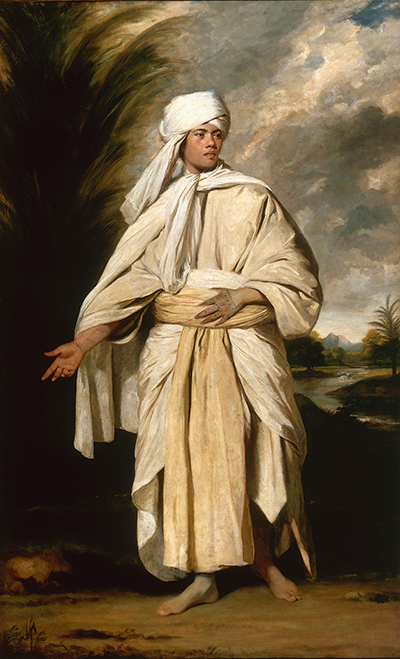
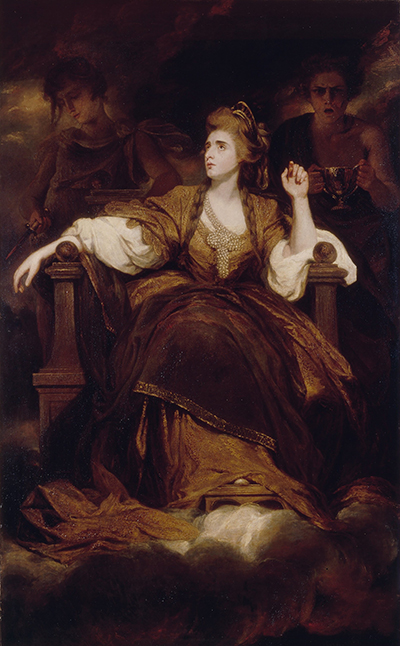
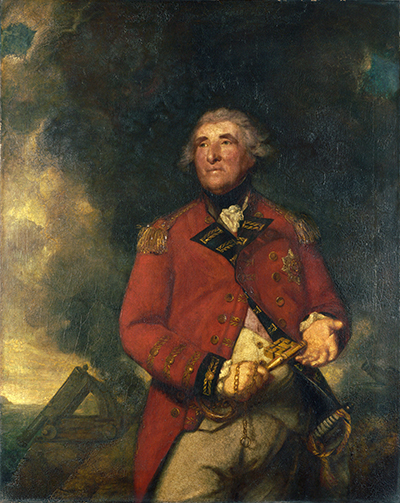
Captain George K. H. Coussmaker matters because it shows Reynolds at the height of his ability to turn social identity into pictorial theatre. The sitter is not famous like Johnson, not theatrically iconic like Siddons, not globally complex like Mai, and not a public hero like Lord Heathfield. His interest lies in the perfection of the type.
The type is young, elite, military, poised, self-possessed. Reynolds gives it elegance without letting it become empty. The crossed legs, leaning body and carefully present horse make the painting more dynamic than a conventional standing portrait. At the same time, the restraint of the composition keeps it from becoming theatrical in the wrong way.
The portrait also clarifies how Reynolds's Grand Manner could operate below the level of obvious allegory. There is no tragic muse, no Gibraltar key, no antique costume, no overt myth. Yet the work still elevates. It makes Coussmaker larger, calmer and more socially resonant than ordinary likeness would allow.
That is Reynolds's particular magic here. He does not need to invent a story of battle. He creates a story of bearing. The captain's real military career may have been quiet, but the portrait gives him a commanding afterlife: a young man in uniform, leaning against a tree, attended by a horse, permanently at ease before the world.
In the Reynolds cluster, Coussmaker is valuable because he shows a quieter branch of the artist's ambition. The great flagships display Reynolds handling celebrity, theatre, empire, family allegory, public heroism and institutional theory. Coussmaker shows him handling social poise. It is a smaller subject, but not a lesser one. Portraiture lives on such distinctions.
The picture is also a reminder that the Grand Manner was not only about grand ideas. It was also about grand behaviour: how to stand, lean, look, rest a hand, wear a uniform, occupy space and appear untroubled by scrutiny. Reynolds's portrait turns those behaviours into art. That is why Captain George K. H. Coussmaker remains more than a handsome military likeness. It is a study of confidence as a social form.
Frequently Asked Questions
Discussion
How does Reynolds make military rank feel effortless when the portrait offers no scene of battle or command?
Reader Insights
Which details make Coussmaker's crossed-leg pose appear natural rather than rehearsed?
How does the unmoving horse lend the sitter the prestige of equestrian portraiture?
Why did this image of British social confidence appeal to later American collectors?
Join the Conversation
Share your reading below.
References
- Metropolitan Museum of Art, Sir Joshua Reynolds, Captain George K. H. Coussmaker (1759-1801), https://www.metmuseum.org/art/collection/search/437447.
- Metropolitan Museum of Art, Portuguese object view, O capitão George K. H. Coussmaker, https://www.metmuseum.org/pt/art/collection/search/437447.
- Google Arts & Culture / The Metropolitan Museum of Art, Captain George K. H. Coussmaker (1759-1801), https://artsandculture.google.com/asset/captain-george-k-h-coussmaker-1759%E2%80%931801-sir-joshua-reynolds/OgE_bi2zS9f1fg?hl=en.
- National Army Museum, “The Grenadier Guards,” https://www.nam.ac.uk/explore/grenadier-guards.
- National Gallery of Art, Washington, “Thomas Eakins and the Grand Manner Portrait,” https://www.nga.gov/stories/videos/thomas-eakins-and-grand-manner-portrait.
- National Gallery, London, “Sir Joshua Reynolds 1723-1792,” https://www.nationalgallery.org.uk/artists/sir-joshua-reynolds.
- Wallace Collection, “Reynolds's Studio,” https://www.wallacecollection.org/explore/explore-in-depth/reynolds/the-artist/reynoldss-studio/.
- David Mannings, Sir Joshua Reynolds: A Complete Catalogue of His Paintings, with subject pictures catalogued by Martin Postle, Yale University Press / Paul Mellon Centre for Studies in British Art, 2000.