

 by Tom Gurney
Tom Gurney BSc (Hons) is an art history expert with over 20 years experience
Published on August 14, 2026 / Updated on August 14, 2026
Email: tomgurney1@gmail.com / Phone: +44 7429 011000
At Capri: Introduction
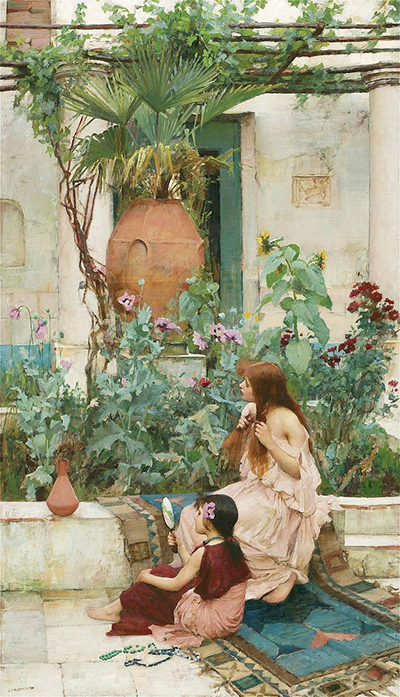
Two young women sit in a whitewashed courtyard crowded with vines, palms and potted flowers. One studies a small hand mirror while the other gathers or arranges her long hair. John William Waterhouse’s At Capri turns an everyday act of grooming into a tall Mediterranean garden composition where bodies, plants and architecture share the same sunlit enclosure. [1]
The painting is also known as The Toilet and Alfresco Toilet at Capri. It is dated 1890, painted in oil on canvas and measures approximately 84 × 47 cm. [1] Its present collection is private. The alternative title should not cause confusion with Luke Fildes’s separate An Al-Fresco Toilet of 1889, an important contemporary comparison rather than the same object. [2]
At a Glance
- ArtistJohn William Waterhouse (1849–1917)
- TitleAt Capri [1]
- Alternative titlesAlfresco Toilet at Capri; The Toilet [1] [2]
- Date1890 [1] [2]
- MediumOil on canvas [1]
- DimensionsApproximately 84 × 47 cm (33 × 18½ in) [1]
- CollectionPrivate collection [1]
- SubjectTwo young women grooming in a flower-filled courtyard
- SettingCapri, or a Capri-inspired Mediterranean garden
- Career contextWaterhouse’s naturalistic Italian sequence around 1889–91 [2] [3]
Contents
- Introduction
- Three Titles, One Painting
- Mirror, Hair and Shared Grooming
- Two Figures of Different Ages
- Capri as Observed and Imagined Place
- White Walls, Trellis and Potted Plants
- Naturalism Within Classical Genre
- The Local Model and the Travelling Artist
- Comparison with Flora and the Capri Group
- Mirror, Viewer and the Unseen Image
Three Titles, One Painting
At Capri, Alfresco Toilet at Capri and The Toilet all refer to the same tall canvas reproduced on this page. [1] [2]
“At Capri” emphasises place. “The Toilet” uses the historical sense of personal grooming and dressing, not a bathroom fixture. “Alfresco” clarifies that the activity occurs outdoors.
The titles work together: place, action and setting.
They also create catalogue risk. Luke Fildes exhibited a different large painting titled An Al-Fresco Toilet at the Royal Academy in 1889. Waterhouse knew the wider artistic context, and scholars have compared the works, but dimensions, artist and composition remain distinct. [2]
Fildes’s painting belongs to the Lady Lever Art Gallery. Waterhouse’s 84 × 47 cm At Capri is privately held. [1] [2]
Another Waterhouse painting may appear as The Toilet in records of payments or sales, so title alone is not enough. The featured image must be controlled through two seated figures, tall flower-filled courtyard and the established measurements.
The 1890 date places the work after Waterhouse’s probable 1889 Capri visit. Research on An Orange Garden includes it among a group of Italian subjects catalogued around 1890. [2]
The H1 uses At Capri because it is concise and established. Alternate titles remain essential for searching and provenance research.
This is a case where multiple names add history rather than demanding one be erased.
Mirror, Hair and Shared Grooming
The smaller dark-haired figure sits at lower left and raises a pale hand mirror. Her gaze is fixed on its unseen reflecting surface.
The taller red-haired woman kneels or sits behind her. She gathers her long hair with both hands, perhaps arranging it or preparing it for the younger companion.
Their actions differ but belong to one ritual of appearance.
The mirror shows its back to the viewer. Waterhouse makes reflection important while withholding the reflected face.
This creates a private circuit: the seated figure sees an image we cannot access.
The older figure looks towards her own hair or towards the companion. She is less enclosed by an object but equally absorbed in grooming.
Loose beads, a necklace or hair ornaments lie on the patterned textile in front of them. These small objects connect bodily preparation with adornment.
No man, servant or outside observer appears. The activity is shared within a female space.
That privacy is still constructed for public viewing. Waterhouse positions the bodies and mirror so that an art audience can look into the scene.
The title “toilet” historically carried precisely this tension: intimate preparation could become a conventional subject for display.
The painting neither documents an unobserved moment nor stages overt performance. It makes absorption appear self-contained.
Two Figures of Different Ages
The figures differ in height, hair colour and apparent age. The dark-haired sitter may be a girl, while the red-haired companion appears older.
The image shows two women of differing apparent ages, but no relationship is securely documented.
They should therefore be described as two young women or an older girl and younger companion, with family language kept qualified.
The age difference organises action. The smaller figure controls the mirror; the taller one has the reach and hair mass that dominate the right.
Their bodies form a compact group on the carpet. Bare feet and relaxed postures increase informality.
The older figure’s pale dress nearly merges with courtyard stone, while the younger figure’s red and pink clothing separates her from the lower wall.
This colour difference keeps the two bodies legible despite overlap.
The models are unnamed. They should not be identified with Waterhouse’s London sitters solely through facial resemblance.
Peter Trippi’s Capri research has connected recurring local models across nearby works, including the young woman in An Orange Garden and Under the Olives. No equally secure identification is attached to both figures here. [2]
Their anonymity is archival, not personal. They contributed faces, posture and time to Waterhouse’s Italian sequence.
The shared ritual gives them agency within the image. One looks, one handles hair; neither simply waits to be admired.
Capri as Observed and Imagined Place
Capri lies in the Bay of Naples and had long attracted artists and travellers. Its steep terrain, bright walls, gardens and Mediterranean plants offered British painters a setting distinct from London.
Waterhouse had been born in Rome and retained strong Italian connections through travel, even though his professional career developed in Britain.
Research places a significant Capri visit around 1889, probably supported by recent sales of major paintings. [2] [3]
The courtyard in At Capri contains credible local features: whitewashed masonry, a vine-covered trellis, terracotta vessels, palms and intense cultivated growth.
That credibility does not make the canvas a photograph of one address. Waterhouse could combine on-site sketches, local models and later London studio work.
The title asserts Capri, while the image turns Capri into a carefully organised idyll.
Daily Mediterranean life is filtered through the expectations of a British art audience. White walls and exotic-looking plants signal warmth, leisure and distance from industrial modernity.
The manuscript should recognise this travel gaze. The island is a lived place, not merely decorative scenery available to a visitor.
Waterhouse’s attention to grooming and plants makes the scene intimate, but it still participates in the nineteenth-century artistic construction of southern Europe as timeless and sensuous.
Observation and idealisation coexist. Neither cancels the other.
White Walls, Trellis and Potted Plants
Architecture fills the tall composition. White wall, columns or piers, blue-green doorway and overhead trellis create a layered courtyard.
The figures occupy only the lower third. Plants and masonry tower above them.
A large terracotta vessel stands near the centre, surrounded by palms. Its warm orange mass balances red clothing and flowerpots below.
Vines cross the upper field horizontally. Their trellis supplies a roof-like screen without enclosing the courtyard completely.
Sunflowers and smaller red, purple and white blooms fill the middle ground. Potted growth and beds blur the boundary between architecture and garden.
The white wall is not empty. Weathered tone, shadows and small recesses keep it alive.
A dark doorway or shutter provides depth. Against widespread brightness, it becomes one of the strongest geometric accents.
The patterned carpet extends diagonally under the women. It offers physical comfort over stone and introduces textile colour into the garden.
Its edge guides the eye from lower right towards the seated group.
Waterhouse’s vertical format makes the courtyard itself a protagonist. Viewers must look past figures into stacked pot, palm, wall and vine.
The title’s “At Capri” is therefore justified by more than an atmospheric label. Place is built through a dense inventory of cultivated material.
Naturalism Within Classical Genre
Waterhouse’s early career featured grand classical subjects with archaeological-looking objects and architecture. The Capri pictures move towards smaller incidents, natural light and freer handling. [2]
At Capri retains classical associations. Draped clothing, marble-like walls and outdoor grooming can suggest antiquity.
Yet the scene need not be set in ancient Rome or Greece. Capri in 1890 already provided whitewashed courtyards, local dress and everyday ritual.
This temporal ambiguity was commercially useful. Viewers could enjoy modern naturalism without losing the ideal distance of classical genre.
Waterhouse’s brushwork also mediates between modes. Faces and key objects receive clarity, while foliage can be built through broader colour touches.
The result feels observed rather than diagrammatically archaeological.
French naturalist painting had encouraged British artists to value outdoor light and the credible integration of figure and environment. Waterhouse adapted such lessons without becoming an Impressionist.
Edges remain controlled enough to preserve narrative readability. The mirror, hair and courtyard architecture are never dissolved into light alone.
Naturalism here is a method of immediacy. It makes an idealised scene feel temporarily encountered.
The classical and contemporary should not be forced into a choice. Their overlap is one reason the work marks a transition in Waterhouse’s career.
The Local Model and the Travelling Artist
Travel paintings depend upon unequal mobility. Waterhouse could visit Capri, hire or persuade local people to pose, make studies and return to London with marketable images.
The models’ names are not preserved in the public object record. Their local identity may be inferred from the series but not securely reconstructed. [2]
The painting presents them through beauty, leisure and grooming rather than labour or individual biography.
This choice suited a northern market’s idea of southern ease. It can be admired while its selectivity remains visible.
Capri was not outside modern economic and social life. Tourism itself was transforming the island.
The white courtyard may therefore be both genuine local environment and a product shaped for visiting eyes.
Waterhouse’s models contribute more than picturesque type. Their specific postures make the composition possible.
The seated figure must hold the mirror at a convincing angle. The companion gathers hair while balancing on the carpet. Their bodily coordination produces the scene’s quiet intimacy.
Responsible interpretation avoids claiming their names and avoids treating them as anonymous scenery.
It can instead acknowledge the incomplete archive: the travelling artist is documented; the people who helped embody Capri are not.
That asymmetry belongs to the painting’s history.
Comparison with Flora and the Capri Group
Waterhouse’s Italian group includes An Orange Garden, The Orange Gatherers, Under the Olives, Lady on a Balcony, Arranging Flowers and Flora. [2] [3]
The works repeat trellises, white walls, terracotta containers, local plants and women engaged in quiet activity.
At Capri is distinguished by two figures and the mirror. Its subject is self-presentation rather than fruit or flower gathering.
Flora, exhibited at the Royal Academy in 1891, uses a similarly narrow courtyard but centres one white-robed woman beside a small shrine. [3]
The comparison shows Waterhouse turning travel observation towards different degrees of classicism.
In At Capri, the women can be read as contemporary Caprese figures. In Flora, title, statue and floral offering encourage identification with a Roman goddess.
The architecture connects them even as title changes time.
This mobility is central to Waterhouse’s practice. One set of observed walls and plants could support genre, idyll or myth.
The Capri group also anticipates later garden paintings. Women among cultivated growth become a long-term motif even after explicit Italian setting recedes.
Gathering Summer Flowers in a Devonshire Garden translates the relation to a British family environment; the late flower-women make it more symbolic.
Capri was therefore not a decorative detour. It supplied compositional structures that continued through Waterhouse’s career.
Mirror, Viewer and the Unseen Image
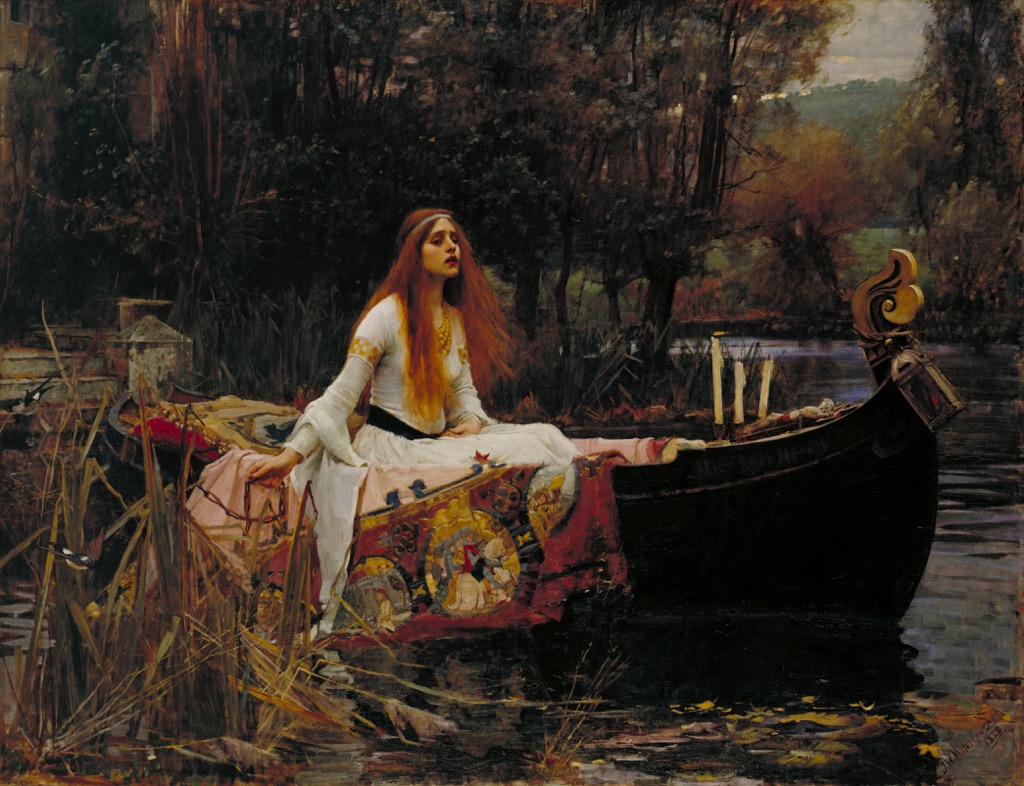
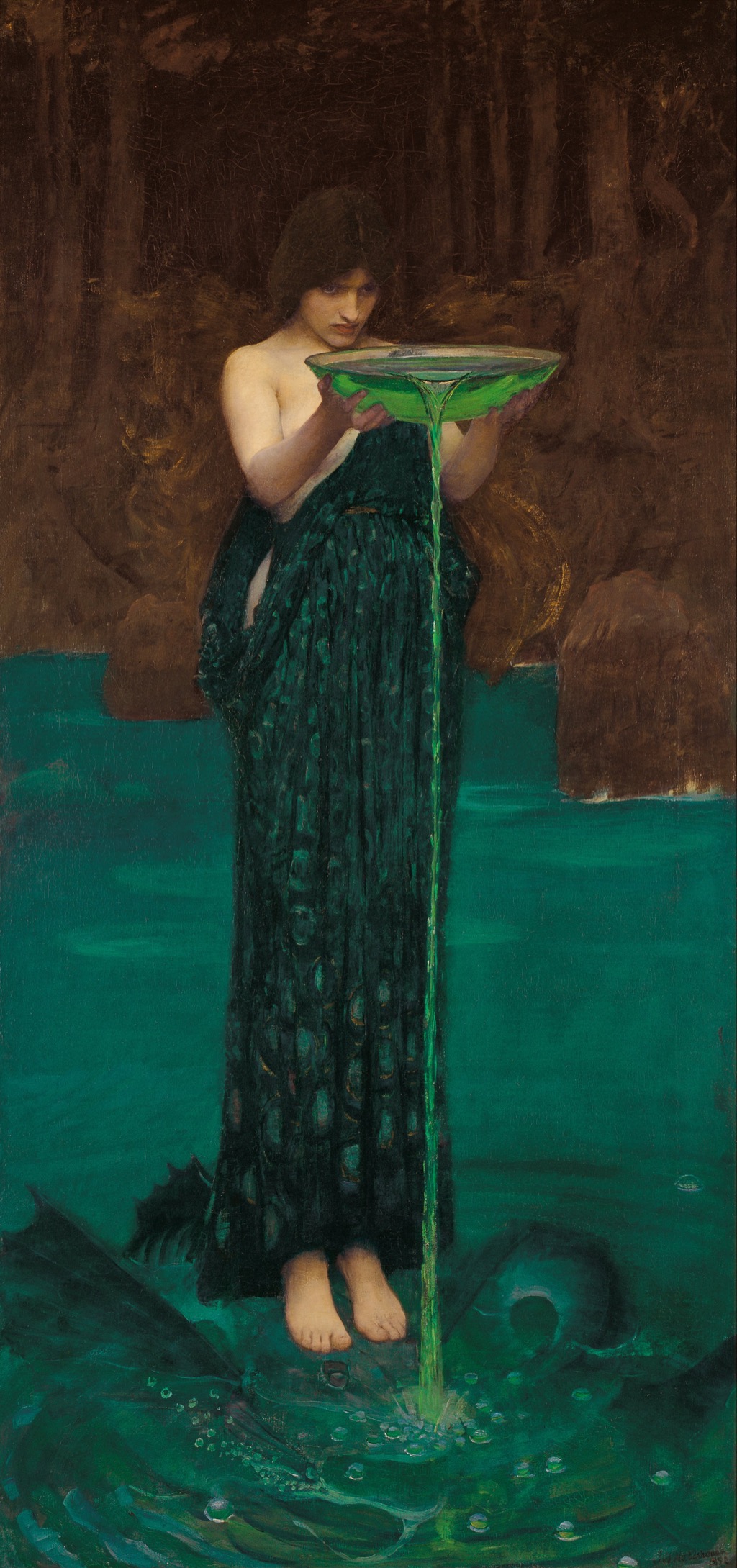
The hand mirror is one of Waterhouse’s recurrent devices. Mirrors appear in Circe Offering the Cup to Ulysses, The Lady of Shalott and Vanity, but each performs a different task.
Here the mirror belongs to grooming and self-scrutiny. It does not reveal an approaching lover or magically reflect the viewer.
Because its back faces us, we cannot evaluate the image the sitter sees.
This exclusion matters. The viewer observes the act but cannot occupy the woman’s optical position.
She possesses a private image inside a painting that otherwise makes her publicly visible.
The mirror also creates a small painting-within-the-painting. Its bounded surface contains a face, just as Waterhouse’s canvas does, but only one is available to us.
The difference encourages reflection on portraiture. Waterhouse controls the visible likeness; the sitter consults another.
No moral judgement about vanity is necessary. Grooming is a practical and social activity.
The alternative title The Toilet identifies ritual, not vice.
The beads and companion reinforce preparation as shared culture rather than solitary narcissism.
Object History and Present Limits
The work is recorded as oil on canvas, 84 × 47 centimetres, dated 1890 and privately owned. [1]
Peter Trippi’s research cites a Sotheby’s New York appearance on 20 November 1996. [2]
The public sources used here do not provide a continuous provenance back to Waterhouse or a documented lifetime exhibition.
It would therefore be unsafe to assign an original purchaser or Royal Academy catalogue number.
The alternate titles may reflect different market and scholarly records over time. Tracking them is essential to future provenance research.
Private ownership limits direct access to reverse labels, conservation findings and exact current location.
Reproduction nevertheless supports strong visual analysis because the tall composition and key actions are clear.
Technical claims must remain modest. Exact pigments, on-site execution and hidden revisions require physical evidence.
The painting’s object record is firm enough for date, medium and size; its making and ownership history remain partly open.
Grooming, Leisure and Social Position
The women have enough time, privacy and material comfort to sit on a patterned textile among ornaments and plants. That appearance can suggest leisure, but the painting does not identify their household or economic position.
Grooming itself is work. Long hair must be washed, dried, combed, divided and secured. The companion’s raised hands make that maintenance visible.
The mirror and beads imply resources, yet they need not be luxurious. Small personal objects can belong to ordinary routine as well as elite display.
Waterhouse selects the most graceful stage of the process. There is no tangled comb, discarded water or bodily discomfort.
This idealisation makes the activity suitable for an art market accustomed to beautiful domestic figures.
It may also distance the models from contemporary labour on Capri. Women who worked in agriculture, tourism or households could still be represented as timeless figures at leisure.
The gap should be recognised without assigning jobs that are not documented.
The carpet is especially important. It separates bodies from stone and turns a courtyard floor into a temporary intimate room.
Domestic interior and garden overlap. The women conduct a private ritual outdoors but within walls.
That ambiguity explains the title “alfresco toilet.” The scene is outside without being public landscape.
Waterhouse’s composition therefore stages leisure as cultivated enclosure. Plants, textile and architecture all contribute to the appearance of ease, while the physical action of arranging hair prevents complete passivity.
A Tall, Portable Capri Canvas
The 84 × 47 cm dimensions create a slender ratio well suited to stacked architecture. [1] The canvas is large enough for two figures and garden detail but far smaller than Waterhouse’s major Royal Academy narratives.
That intermediate scale may have been practical for travel-derived studio work and private sale, although no transport record proves where the final canvas was completed.
The narrowness requires vertical sequencing. Carpet and bodies form the base; flower beds fill the middle; trellis and wall complete the upper field.
A wider format might have turned the scene into a panorama. Waterhouse instead offers a slice of courtyard, increasing the sense of enclosure.
The figures’ placement low in the frame lets the place rise above them. Capri is not a decorative strip behind portraiture; it occupies most of the painted surface.
At normal viewing distance, the tall canvas would lead the eye upward much as the physical courtyard walls do.
Digital reproduction often fits the whole image to screen height, making human faces very small. Enlarged details reverse the problem and remove the architectural dominance.
Understanding original dimensions helps restore balance. This is neither a miniature figure study nor a monumental history painting.
Its scale belongs to an intimate but spatially ambitious genre picture, capable of carrying the memory of travel into a private interior.
From Looking Glass to Painted Surface
The image contains several forms of looking. The younger woman looks into the mirror, the older looks towards hair or companion, Waterhouse looked at his models and modern viewers look at the completed canvas.
Only the artist’s constructed view survives publicly. The reflected face remains hidden, and the models’ own perspectives are not recorded in words.
This hierarchy is worth noticing. The painting celebrates self-regard while controlling what the subjects can show us.
The mirror’s small blue-green back becomes a bright accent rather than a transparent opening. It announces reflection by denying it.
Waterhouse uses that denial to prevent a second face from complicating the composition. One profile and one partial face are enough.
The device also protects some privacy inside an exposed scene. The younger figure’s closest view of herself remains hers alone.
That subtle limit gives At Capri more depth than a simple decorative grooming picture. Looking is shared across the work, but access is unequal.
Related Pages
- The Lady of Shalott: Compare Waterhouse's best-known literary composition.
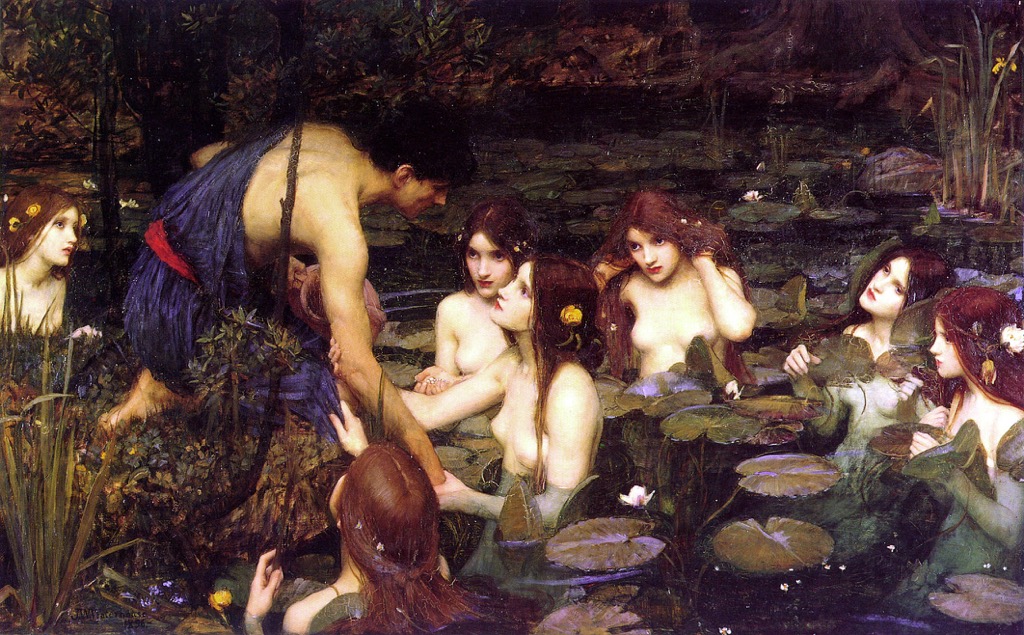
- Hylas and the Nymphs: Compare another major mythological scene.
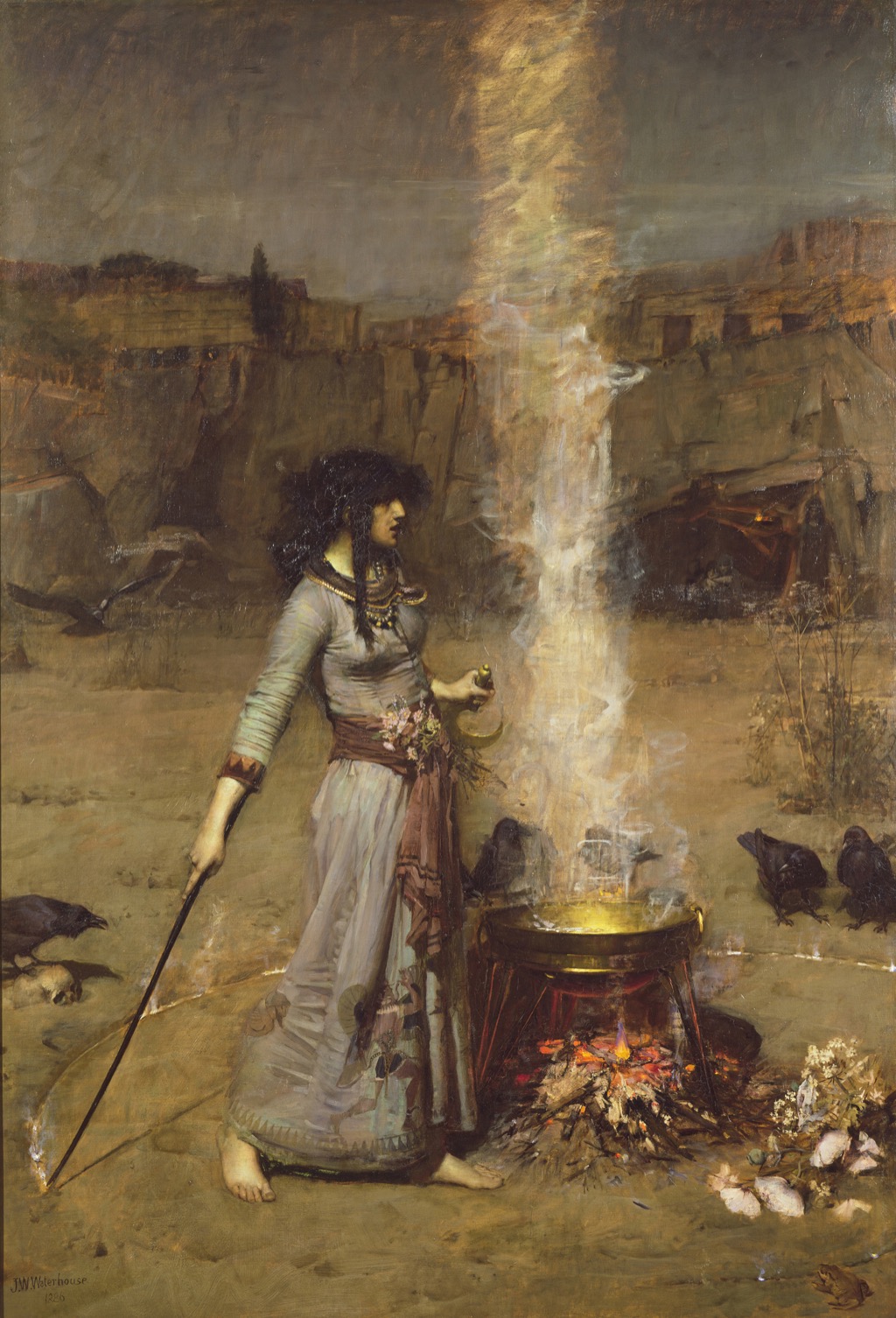
- The Magic Circle: Compare Waterhouse's treatment of ritual and symbolism.
Frequently Asked Questions
It refers to grooming, dressing and arranging appearance, not a bathroom fixture.
Approximately 84 × 47 cm. [1]
They may be, but their relationship and names are not securely documented.
No. Fildes painted a separate work with a related title in 1889. [2]
It is privately owned. [1]
Discussion
At Capri transforms grooming into place. Mirror, long hair and ornament occupy the foreground, but the tall garden of white wall, terracotta, palms and vines gives the scene its distinctive identity.
Its alternate titles reveal different approaches: Capri locates, toilet names the ritual and alfresco joins the two. Keeping those titles together while separating Luke Fildes’s painting is essential catalogue control.
Reader Insights
Which visible detail most changes the way you read this page?
Which source or comparison helps the work feel less familiar and more specific?
What question would you bring back to the painting after reading?
Join the Conversation
Share your reading of this page below.
References
- Wikimedia Commons, “John William Waterhouse: At Capri,” object summary recording alternate titles, 1890 date, medium, dimensions and private ownership. View source.
- Peter Trippi, “John William Waterhouse: An Orange Garden,” Kilgore Gallery research catalogue, discussion of the Capri group, titles, comparators and 1996 auction. View source.
- Sotheby’s, “John William Waterhouse, Flora,” lot record and essay on the 1890 Capri visit and related paintings. View source.