

 by Tom Gurney
Tom Gurney BSc (Hons) is an art history expert with over 20 years experience
Published on August 14, 2026 / Updated on August 14, 2026
Email: tomgurney1@gmail.com / Phone: +44 7429 011000
Esther Kenworthy Waterhouse: Introduction
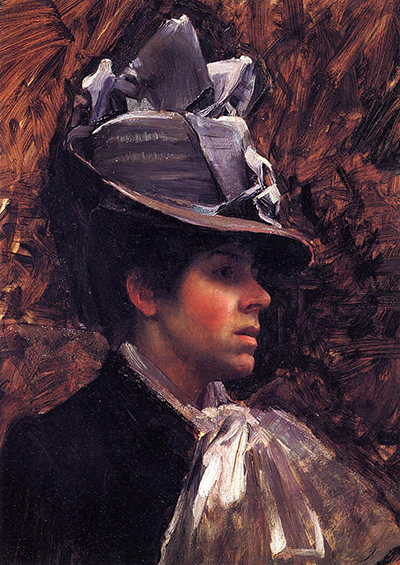
John William Waterhouse's Portrait of the Artist's Wife presents Esther Kenworthy Waterhouse at close range, wearing a dark hat and turning towards the viewer. Painted about 1885 in oil on board, it is an intimate object rather than a formal society portrait. Its loose surface and compressed format preserve the sense of one artist looking at another.
Esther should not be introduced only as “Waterhouse's wife.” Born Esther Maria Kenworthy in 1857, she exhibited flower paintings at the Royal Academy and other venues before and after their 1883 marriage. Nor should this portrait be confused with William Logsdail's larger image of Esther seated in the Primrose Hill studios. The Sheffield work is by John William Waterhouse; the studio portrait is by his friend Logsdail. [1] [2] [3]
At a Glance
- ArtistJohn William Waterhouse
- TitlePortrait of the Artist's Wife, also catalogued as Esther Kenworthy Waterhouse [1]
- DateAbout 1885 [1]
- MediumOil on board [1]
- Dimensions56.1 × 39 cm [1]
- SitterEsther Maria Kenworthy Waterhouse (1857–1944) [1]
- CollectionSheffield Museums [1] [2]
- Accession numberVIS.4431 [1]
- AcquisitionPurchased in 1978 with assistance from the Victoria and Albert Museum Purchase Grant Fund [1]
- Identity warningDistinct from William Logsdail's Portrait of Esther Kenworthy Waterhouse in the Artist's Studio, Primrose Hill [3]
Contents
- Introduction
- What the portrait shows
- Esther Kenworthy as an artist
- Marriage and the Primrose Hill studios
- Hat, gaze and compressed composition
- Oil on board and private portraiture
- Artist, wife, sitter and collaborator
- The separate Logsdail portrait
- Esther and the Waterhouse model question
- Later life and custodianship
What the portrait shows
Esther appears at bust or half-length scale within a narrow upright field. A dark, brimmed hat creates the largest strong shape around her head, while the face emerges in warmer light.
Her body turns at an angle rather than facing the picture plane symmetrically. The movement makes the encounter feel momentary, as if attention has shifted towards the painter.
The clothing is handled broadly. It establishes fashionable contemporary dress without becoming a catalogue of fabric and jewellery.
Background and body are not separated through elaborate furniture or landscape. The portrait depends upon head, hat, shoulder and the quick transition between them.
Esther's expression is alert but not theatrical. Directness comes from proximity rather than a staged smile or social role.
The portrait's informality differentiates it from Waterhouse's literary women. Esther is not costumed as a goddess, heroine or enchantress. Her identity is personal and modern.
The board support reinforces that intimacy. This is a finished collection object, but its immediacy suggests study, observation and domestic access.
Esther Kenworthy as an artist
Esther Maria Kenworthy was born in 1857. Her father, James Lees Kenworthy, was an artist and schoolmaster in Ealing, and her mother Elizabeth was a schoolmistress. [4]
She exhibited flower paintings before marrying Waterhouse. Published accounts place her Royal Academy debut in 1881 and record further appearances there during the 1880s. [4] [5]
Her preferred subject was floral still life. Titles such as Wallflowers and later flower works place her within a substantial field of professional women artists whose careers were visible through exhibition catalogues even when few objects entered public museums.
Calling her an “amateur” without evidence diminishes that record. Royal Academy exhibition did not guarantee financial independence or sustained fame, but it was a public professional act.
The limited survival or identification of her paintings creates a familiar archival problem. Biography can become dominated by marriage when the artist's own objects are lost, privately held or catalogued under changing names.
She exhibited under her birth and married names at different points, which complicates searches. “Esther Kenworthy,” “Esther M. Kenworthy” and “Esther Kenworthy Waterhouse” should be connected rather than treated as separate people.
The portrait gains depth when this career is remembered. Waterhouse did not paint a person unfamiliar with studio practice; he painted a fellow exhibitor who understood how a face and surface were constructed.
Flower painting occupied an ambiguous place in Victorian exhibition culture. It could be praised for colour, finish and botanical observation, yet it was also too easily treated as an appropriately “feminine” accomplishment rather than serious professional work. Esther's appearances at the Royal Academy matter because they place her on the public side of that divide: she submitted pictures to a juried institution under her own name and allowed them to be judged in the same crowded exhibition economy as other artists. [4] [5]
The titles preserved in catalogues do not by themselves reveal how she arranged flowers, handled paint or negotiated between botanical specificity and decorative design. Without securely located examples, it would be irresponsible to manufacture a style for her from the preferences of her husband. Documentary modesty is part of restoring her agency. What can be recovered is a pattern of production and exhibition, not yet a complete visual catalogue.
Her career also demonstrates why names are central to research. A search restricted to “Mrs John William Waterhouse” retrieves a wife; one that follows Esther Maria Kenworthy across maiden and married forms begins to retrieve an artist. The portrait page can therefore perform useful corrective work simply by indexing the full name, dates and profession together.
Marriage and the Primrose Hill studios
Esther married John William Waterhouse in 1883 at the parish church in Ealing. [4] The couple joined the artistic community around purpose-built studios in Primrose Hill.
These buildings enabled work and domestic life to occupy the same architectural environment. Neighbours included other painters whose professional and social networks overlapped.
William Logsdail's portrait of Esther in one of the studios records that community. Christie's describes him as a friend and fellow resident associated with Waterhouse and John Charles Dollman. [3]
Marriage did not automatically make Esther her husband's pupil, model or assistant. Specific evidence matters here: she had exhibited independently before the wedding.
The couple later moved to St John's Wood, an area closely associated with successful artists and studios. Their household formed part of Waterhouse's mature professional base.
They had no children. Claims about Esther's private reasons should be treated cautiously unless supported by reliable primary evidence; absence of children does not require invented explanation.
Shared travel and family connections also mattered. Christie's records that Esther's sister Emily married the landscape painter Peregrine Feeney and that the Waterhouses visited the Feeneys at Croyde in Devon. [6]
The marriage was therefore embedded in a wider artistic family. Portrait, exhibition and studio life intersected without erasing Esther's separate identity.
Purpose-built studio communities encouraged a permeability between private and professional life. A caller might encounter an easel, props and a sitting in premises that were also a home; neighbouring artists could exchange models, opinions and practical help. That setting explains why both Waterhouse and Logsdail could produce very different likenesses of Esther without requiring an elaborate commission narrative. It does not, however, license the assumption that every household interaction was artistic collaboration.
The date of about 1885 places Waterhouse's portrait near the beginning of the marriage and during a decisive phase of his career. He was moving from large Roman genre and historical subjects towards the psychologically concentrated narratives for which he became famous. Esther's likeness belongs to the same working life, yet its contemporary dress and small board keep it apart from those public inventions. The contrast is valuable evidence of range.
Hat, gaze and compressed composition
The dark hat gives the portrait immediate recognisability. Its brim both frames and partially shades the face.
Hats are social objects. This one places Esther in contemporary public dress rather than in the timeless garments of Waterhouse's imagined past.
Its broad shape also solves a compositional problem. Against the narrow board, the hat creates width near the top, balanced by the tapering torso below.
Esther's gaze meets or approaches the viewer directly. Because the painter was her husband, modern audiences may experience this as private exchange. The image itself cannot tell us the conversation or circumstances of the sitting.
Direct gaze does not necessarily signal cheerfulness, defiance or romantic intimacy. It establishes attention.
Waterhouse's literary women often look away, into mirrors, pools or approaching danger. Esther's portrait turns looking back into the subject.
The relative lack of accessories prevents biographical storytelling through objects. No palette declares her profession, and no bouquet advertises her flower painting. Knowledge of her career comes from records, not symbolic props.
That restraint gives the work unusual honesty within the cluster. Esther is represented as a presence before she is represented as a role.
Oil on board and private portraiture
The Sheffield record identifies the support as board rather than canvas. [1] [2] Board offers a firm, relatively portable surface suited to direct work.
At 56.1 by 39 centimetres, the portrait is neither a miniature nor a large Academy statement. Its scale accommodates close domestic viewing. [1]
The surface appears freer than the highly finished flesh and textiles of Waterhouse's major exhibition pictures. That difference may reflect purpose, support and working speed.
“Unfinished” should not be used casually. Broad handling can be intentional, and the work entered a public collection as a portrait rather than as studio debris.
Nor should quickness be equated with lack of care. The hat, face and body are organised with economical confidence.
The material distinction between board and canvas is important for cataloguing. Online captions often standardise every Waterhouse painting as oil on canvas, erasing object-specific evidence.
Close reproduction should retain the edges and proportion of the board where possible. Cropping the hat or shoulders diminishes the compressed design.
Board also changes the viewer's sense of touch. Canvas commonly leaves a regular weave beneath paint; a prepared panel or manufactured board can answer the brush more firmly. No technical examination is cited here, so the exact preparation and sequence of layers should not be guessed. Even so, the catalogue's support identification is more than administrative detail: it helps explain why the portrait can combine decisive contours with areas that seem lightly stated. [1]
The colour structure is economical. Dark clothing and hat concentrate attention on the warmer face, while the subdued field prevents the sitter from dissolving into surrounding narrative. Waterhouse does not need the polished marble, patterned textiles, water or flowers that organise many of his larger pictures. The material economy makes looking itself the event.
Artist, wife, sitter and collaborator
The title Portrait of the Artist's Wife defines Esther through Waterhouse. The alternate title using her name gives the sitter greater independent visibility.
Both are historically useful. The first identifies the personal relationship; the second supports discovery and refuses anonymity.
“Muse” is often applied to artists' wives, but the word can obscure labour and agency. Esther was a painter, exhibitor and later custodian of Waterhouse's estate.
Evidence that she sat for this portrait is secure because the museum identifies her. [1] Evidence that she modelled for numerous mythological heroines is much weaker.
Marriage made sitting convenient, not universal. Waterhouse used multiple professional and personal models across his career.
The portrait nevertheless suggests creative familiarity. A fellow artist can recognise the decisions behind her own representation even when she is not holding the brush.
We do not know whether Esther influenced pose, clothing or finish. Responsible interpretation acknowledges possible collaboration without turning it into documented co-authorship.
The strongest claim is simple: one exhibiting artist painted another, who was also his wife.
The separate Logsdail portrait
William Logsdail painted a different Portrait of Esther Kenworthy Waterhouse in the Artist's Studio, Primrose Hill. It shows Esther dressed in white and wearing a peaked cap, seated within the shared studio environment. [3]
That work has sometimes been confused with Waterhouse's own portrait or reproduced as proof that Waterhouse used Esther as a model.
Christie's explicitly attributes the studio picture to Logsdail and identifies Esther as his fellow artist and friend. [3] Artist and sitter must not be collapsed.
The distinction can be made visually and materially. Waterhouse's Sheffield portrait is an upright oil on board focused on head and dark hat. Logsdail's work is a wider studio scene on canvas, with Esther in white.
The two portraits are complementary documents. One records domestic immediacy; the other places Esther within an artistic community and physical workplace.
Logsdail's authorship also broadens her history beyond her marriage. She was visible to and represented by another painter in the circle.
Correct attribution is especially important because an image of Esther often serves as the main illustration for her biography. Mislabelled portraits silently rewrite who looked at her.
Esther and the Waterhouse model question
The confirmed Sheffield portrait provides a baseline for comparing faces, but resemblance alone is not identification.
Christie's notes that the woman in Gathering Summer Flowers in a Devonshire Garden may be Esther because she resembles the portrait and because the couple visited Croyde. It also states that exact identity is difficult to establish from features alone. [6]
That is the correct evidential model: contextual plausibility, explicit uncertainty.
Waterhouse idealised and repeated facial types. Hair colour, profile and expression could be altered for a subject. Multiple sitters can resemble one another after passing through the same artistic style.
No blanket claim should state that Esther was the model for all or most of his women. Such assertions erase professional models and convert a varied studio practice into romantic mythology.
Confirmed portrait, plausible family scene and unnamed fictional models belong to different categories.
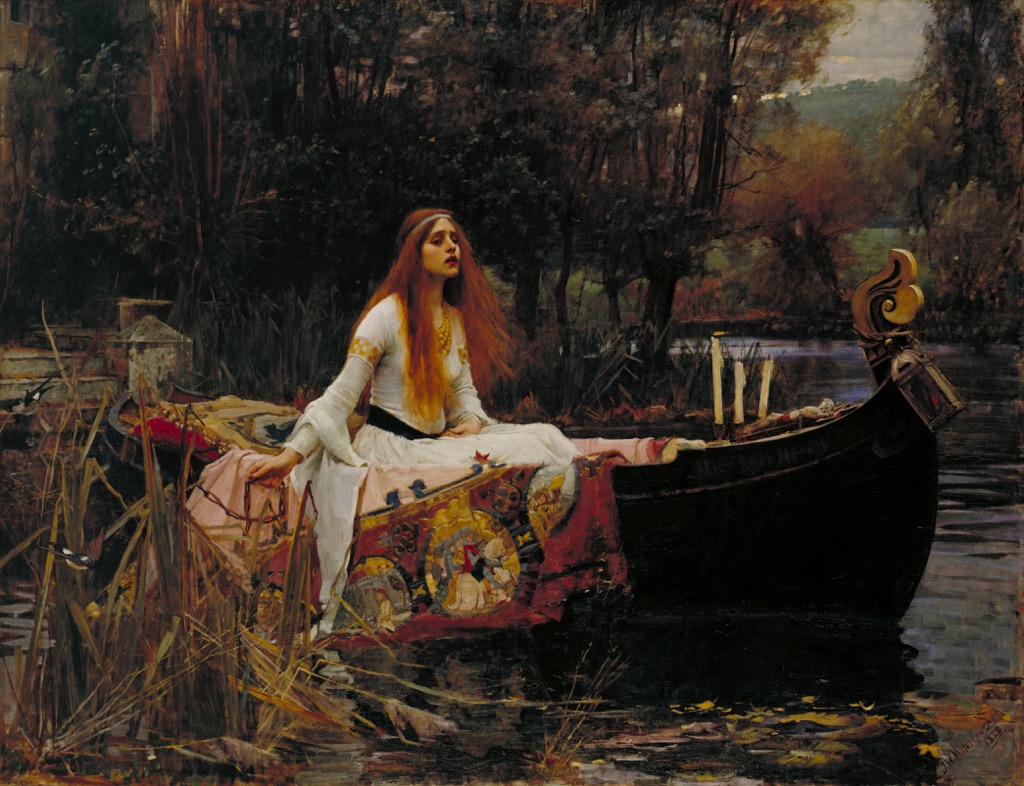
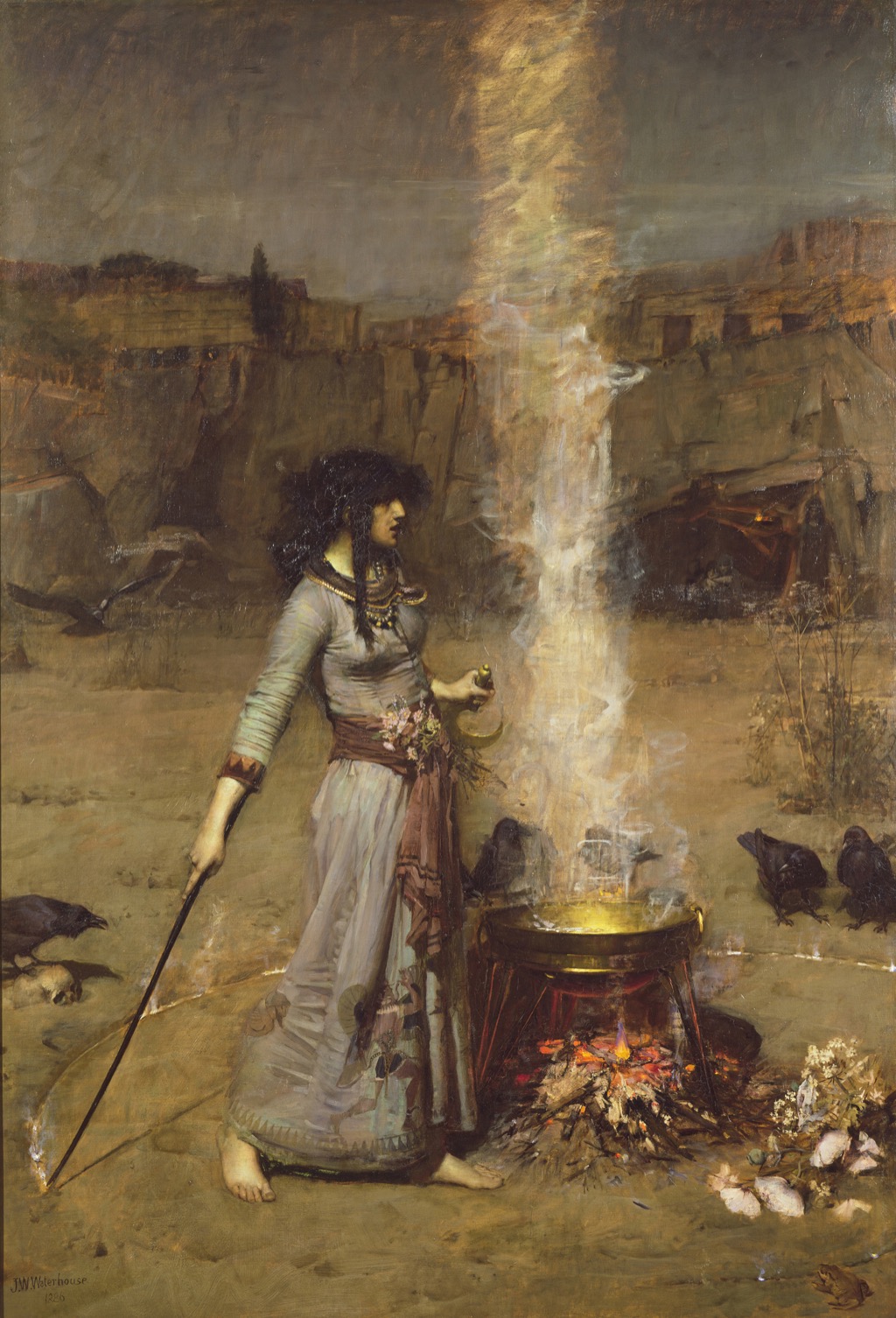
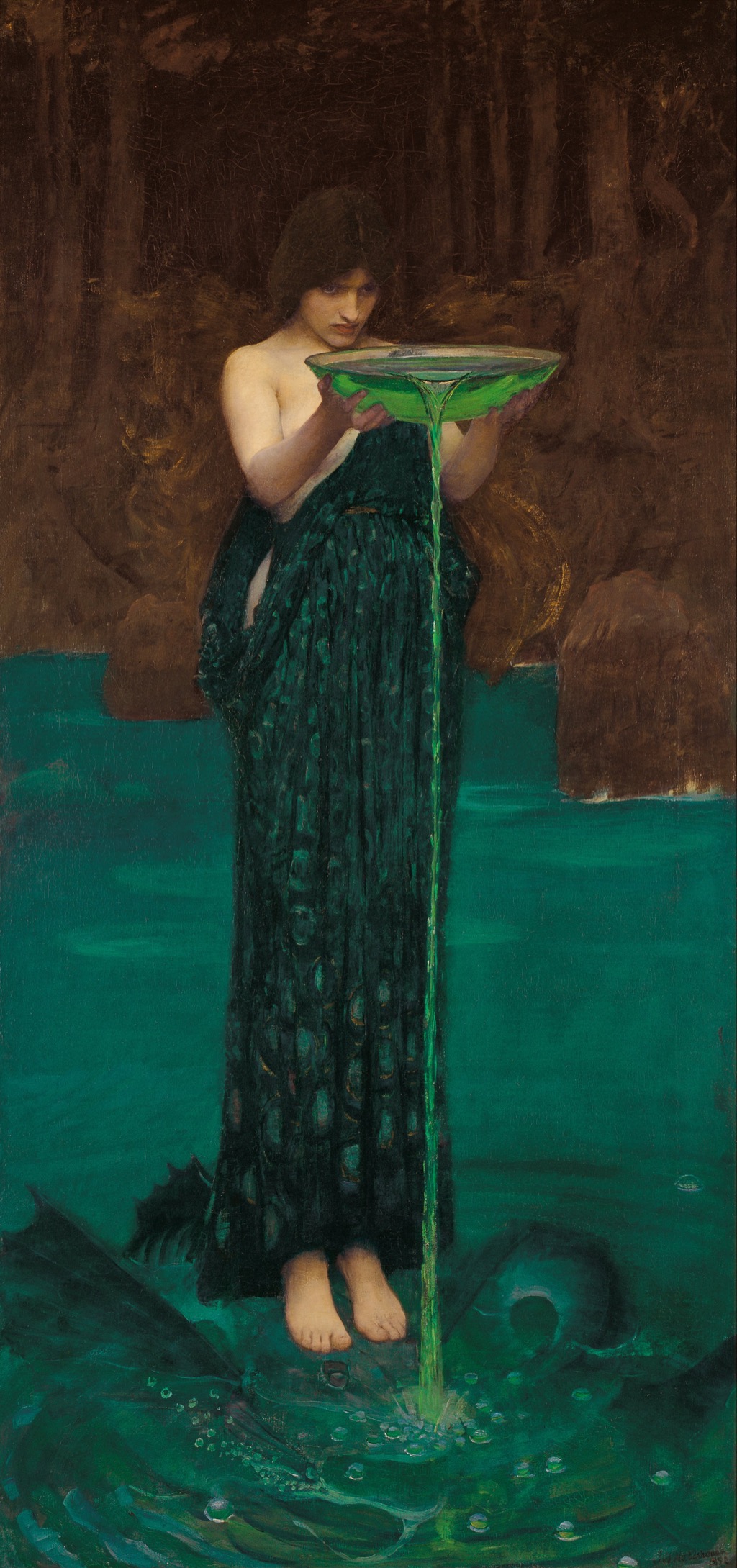
This distinction also protects Esther from being absorbed into characters whose actions or sexuality belong to texts. She was not Circe, Lamia or the Lady of Shalott because her husband painted them.
Her historical importance comes from her own life, not from speculative transformation into every heroine.
Later life and custodianship
Waterhouse died in February 1917. Esther survived him by more than twenty-seven years, dying in 1944. [4]
As his widow, she dealt with works remaining in the studio and with the practical consequences of an artistic estate. Paintings with provenance through “Mrs Waterhouse” should be recognised as passing through her legal and custodial role.
This work is often invisible in artist biographies. Preserving, selling, identifying and dispersing studio contents shapes what later scholars can study.
Esther's own exhibition history extended unevenly. A work titled Marigolds appeared at the Royal Academy in 1925, though available summaries do not establish when it was painted. [4]
Her long widowhood should not be reduced to financial decline. Evidence for particular hardships needs strong sourcing, and the absence of a comprehensive biography leaves gaps.
She was buried with Waterhouse at Kensal Green Cemetery. [4] Shared burial records their marriage; it does not merge their artistic identities.
The portrait now allows a public encounter with the person who outlived and helped mediate the material afterlife of Waterhouse's studio.
Survival creates its own imbalance. Waterhouse's large exhibition canvases were reviewed, sold and repeatedly reproduced; Esther's flower paintings are harder to trace. Her best-known public image is consequently a work made by somebody else. A responsible account must use that image while refusing to let it replace everything she made.
That is why the language of custodianship needs care. It recognises consequential activity after 1917 without turning Esther into a passive container for her husband's legacy. She remained a person with her own exhibition past, family relationships and legal decisions. Future discoveries of catalogues, letters or paintings may change the balance, and the biography should remain open to them.
Sheffield acquisition and public identity
Sheffield Museums acquired the portrait in 1978 from Jeremy Maas & Co., with assistance from the Victoria and Albert Museum Purchase Grant Fund. [1]
The accession number VIS.4431 anchors the object within a public collection. [1]
Acquisition transformed a private family image into a civic artwork. It also provided a securely identified likeness for scholarship.
Art UK's public record uses the relationship title Portrait of the Artist's Wife, while structured data also supplies Esther's name. [1] [2] Both forms are historically useful for identifying the object and the sitter.
Current display may change, so “in the Sheffield Museums collection” is safer than guaranteeing a permanent gallery position.
The purchase fund credit is not incidental. Public collecting often depends on external assistance, and that support determines which intimate objects become widely accessible.
Today the portrait performs two roles: a work by John William Waterhouse and a primary image of Esther Kenworthy Waterhouse. Its second role deserves equal care.
It also supplies a rare counterweight to retrospective legend. The museum object gives a named sitter, support, dimensions, accession and acquisition history; these particulars are more valuable than romantic claims based on facial resemblance. They allow Esther's page to begin with something securely known and to mark the limits of what remains uncertain.
Related Pages
- The Lady Clare: Compare another compact Waterhouse literary figure built around withheld identity.
- Windflowers: Compare a later Waterhouse figure where flowers and mood carry suspended feeling.
- The Shrine: Compare another classically framed early subject with public-facing source cautions.
Frequently Asked Questions
She was a British flower painter and exhibitor, born Esther Maria Kenworthy in 1857, who married John William Waterhouse in 1883. [4]
About 1885. [1]
56.1 by 39 centimetres. [1]
In the Sheffield Museums collection, accession VIS.4431. [1]
No evidence supports that claim. Some identifications are plausible, but most fictional models remain unnamed.
William Logsdail, not John William Waterhouse. [3]
Discussion
The Sheffield portrait is valuable because it interrupts the mythology around Waterhouse's women. Esther is neither a nameless ideal nor a literary character. She is an identified artist looking back from contemporary dress.
Its intimacy should not reduce her to wife or muse. Marriage explains access; exhibition records establish an independent professional identity.
Reader Insights
Which visible detail most changes the way you read this page?
Which source or comparison helps the work feel less familiar and more specific?
What question would you bring back to the painting after reading?
Join the Conversation
Share your reading of this page below.
References
- Wikimedia Commons / Art UK object data, “John William Waterhouse — Portrait of the Artist's Wife,” date, medium, dimensions, sitter, accession and acquisition. View source
- Art UK, “Portrait of the Artist's Wife by John William Waterhouse,” Sheffield Museums collection record. View source
- Christie's, “William Logsdail, Portrait of Esther Kenworthy Waterhouse in the Artist's Studio, Primrose Hill,” attribution, sitter and studio-circle context. View source
- Esther Kenworthy Waterhouse biographical summary, life dates, family, marriage and exhibition record, drawing on published Waterhouse scholarship. View source
- Royal Academy exhibition-record compilation, Esther Kenworthy's documented participation as a flower painter. View source
- Christie's, “John William Waterhouse, Gathering Summer Flowers in a Devonshire Garden,” Kenworthy family, Croyde visits and cautiously proposed Esther identification. View source