

 by Tom Gurney
Tom Gurney BSc (Hons) is an art history expert with over 20 years experience
Published on August 14, 2026 / Updated on August 14, 2026
Email: tomgurney1@gmail.com / Phone: +44 7429 011000
Vanity: Introduction
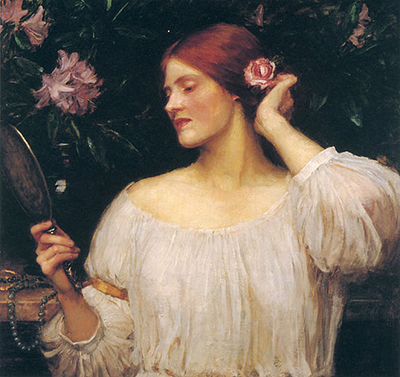
John William Waterhouse's Vanity shows a red-haired woman absorbed by her own reflection. Seated against dark foliage and flowers, she holds a small hand mirror while raising a rose towards her hair. Her pale, loosely painted dress makes face, arm and flower appear to emerge from a soft field of white.
The oil is signed but undated. It remained in Waterhouse's studio, was shown posthumously at the Royal Academy in 1922 and entered his studio sale in 1926. [1] Those facts place it securely within his surviving late work without justifying the precise 1912 or 1914 dates often assigned online. It must also be distinguished from Vain Lamorna, a separate painting related to Lamia and Mary De Morgan's fairy tale. [2]
At a Glance
- ArtistJohn William Waterhouse
- TitleVanity [1]
- DateUndated; generally associated with Waterhouse's late period
- MediumOil on canvas [1]
- Dimensions66 × 69.3 cm [1]
- SignatureSigned “J. W. Waterhouse” [1]
- CollectionPrivate collection [1]
- First documented exhibitionRoyal Academy, London, Works by Recently Deceased Members, 1922, no. 225 [1]
- Studio saleChristie's, London, 23 July 1926, lot 48 [1]
- SubjectA woman looking into a hand mirror while adjusting a rose in her hair
- Important distinctionNot the separate work Vain Lamorna
Contents
- Introduction
- What the painting shows
- What the title means
- Mirror, gaze and self-fashioning
- The rose and the dark garden
- White dress and late handling
- Vanity versus vanitas
- A woman alone with her image
- Dating and unfinished questions
- Exhibition and studio-sale history
What the painting shows
A young woman sits close to the front of a nearly square canvas. Her upper body turns slightly while her head bends towards a small hand mirror.
One hand holds the mirror near her lap or waist. The other lifts a pink or red rose to the side of her auburn hair.
Her dress is white and loosely draped, exposing parts of the shoulders and arms. Broad passages of fabric occupy much of the lower picture.
Behind her is dense, dark vegetation with scattered blossoms. The background has little architectural depth and functions as a shadowed floral screen.
No companion watches. The viewer sees the woman looking but cannot see the reflection that she sees.
That withheld image is fundamental. The mirror confirms self-inspection while denying us a duplicate portrait.
The action is quiet and practical: testing the placement of a flower. The title converts it into the more charged category of “vanity.”
Nothing in the visible scene provides an explicit narrative source. There is no named heroine, poem, mythic attribute or historical setting.
The painting asks attention to remain with a familiar act—looking at oneself while preparing an appearance—and with the meanings culture attaches to it.
What the title means
“Vanity” can refer to excessive pride in appearance. It can also mean emptiness, transience or the futility of worldly concerns, especially through the older vanitas tradition. [3]
Waterhouse's title most immediately activates the first meaning. The woman uses a mirror and flower to consider how she looks.
The painting does not visibly ridicule her. Her face is calm, the gesture delicate and the surrounding flowers beautiful.
Nor does it include the skull, extinguished lamp, watch or decaying objects commonly used to make mortality explicit in vanitas still life. [3] [4]
The title may therefore contain observation, mild moral judgement or poetic ambiguity rather than a full sermon on death.
It was recorded by Christie's for the posthumously exhibited and studio-sale work, but the accessible record does not state when or by whom the title was first attached. [1]
That limitation matters. Because the artist signed but did not date the canvas, it is unsafe to build a precise intention from title alone.
The word nevertheless shapes response. A woman “adjusting a rose” might seem merely absorbed; a woman in Vanity becomes part of a long visual argument about beauty and self-regard.
Mirror, gaze and self-fashioning
The hand mirror is both tool and image-making device. It permits the woman to become viewer of herself before she is viewed by others.
Waterhouse positions its reflective face away from us. We see the back or edge, not a miniature portrait.
This creates two versions of the figure: the painted body available to the spectator and the reflected image reserved for the sitter.
Her gaze is precise. Unlike Waterhouse heroines staring into distance, she attends to a practical visual problem: whether the flower suits its place.
The raised hand makes appearance an active construction. Beauty is not presented as wholly natural; it is arranged through flower, hair, mirror and decision.
Portable hand mirrors have long belonged to rituals of grooming and self-presentation. The Metropolitan Museum's history of the dressing table connects mirrors and adornment with changing ideas of privacy, beauty, identity and vanity. [5]
Waterhouse removes the furniture and cosmetics of a full toilette. One small mirror is sufficient to establish an intimate zone.
The mirror also excludes the spectator from the final judgement. We may evaluate the painted woman, but only she can compare the flower with her reflection.
This privacy complicates moral criticism. Looking at oneself can be narcissistic, but it can also be ordinary self-knowledge and preparation.
The rose and the dark garden
The rose carries colour from the background into the woman's hair. It is at once a real adornment and a conventional sign of beauty and love.
Its freshness creates comparison with the young face. Both are presented at a moment of visible bloom.
Flowers can also imply transience because they wilt. Vanitas traditions frequently use cut flowers to evoke the brevity of life. [4]
Waterhouse does not show the rose decaying. Any mortality reading arises from cultural association rather than depicted deterioration.
The surrounding blossoms multiply the comparison. The woman does not hold the only flower; she is seated within a dark garden of possible adornments.
Darkness makes pale skin, white cloth and pink petals luminous. It also removes social location: we cannot tell whether she sits outdoors, near a hedge or before a studio-arranged floral backdrop.
The lack of open landscape keeps the image psychologically close. There is no distant event to compete with the mirror.
Red and pink accents are distributed sparingly. Hair and flower draw the eye upward from the broad white dress.
It would be excessive to give every blossom a separate symbolic meaning. Their secure functions are to establish beauty, living abundance and the colour against which the act of self-adornment takes place.
White dress and late handling
The dress occupies a large area but is not described through intricate embroidery. Broad pale folds create volume and movement.
Its looseness contrasts with the precise action of fingers, rose and mirror. Waterhouse concentrates definition where narrative recognition depends upon it.
The garment's slipped or open shoulders increase informality. This is a private toilette rather than formal public portraiture.
White links cloth with illuminated skin, reducing hard boundaries between body and dress. Dark foliage then cuts a stronger contour around the upper figure.
The square-like format differs from Waterhouse's narrow standing heroines. It accommodates a seated, folding pose and prevents the flower garden from opening into a full scene.
Brushwork appears freer than in many Royal Academy canvases of the 1890s. This supports a late-period association, although stylistic appearance alone cannot supply an exact year.
Digital images can exaggerate either softness or contrast. No published conservation examination located here establishes pigments, underdrawing or degree of completion.
The work was signed, yet it remained in the studio. Those facts should be allowed to coexist. A signed canvas may still have been retained for revision, private satisfaction or lack of sale.
Vanity versus vanitas
The Latin-rooted vanitas tradition presents worldly action, possession and pleasure as transient beside faith and death. The National Gallery defines vanitas as a symbolic still-life type, often using objects to make that argument. [3]
Waterhouse's painting is not a still life, although mirror and rose invite comparison with the genre.
Most decisive memento-mori objects are absent. There is no skull, hourglass, extinguished flame or rotten fruit.
This changes the emotional balance. Beauty is not visibly cancelled by death; the title merely makes its self-conscious cultivation available for question.
One reading sees the rose as youth and the mirror as pride. Another sees both as tools through which the woman exercises agency over her presentation.
The picture can sustain both because her expression is neither comic nor alarmed. She does not discover an old face, skull or supernatural warning in the glass.
Traditional images often made female mirror-looking an emblem of moral weakness. Modern readers should recognise that gendered history rather than repeat its judgement uncritically.
The asymmetry is obvious when one asks who is permitted to look. The painted woman receives a morally charged title for examining herself, while the external spectator may inspect her face, shoulders and dress without being named vain. Waterhouse does not explicitly criticise that double standard, but the composition makes it available to a modern viewer.
The hand mirror can therefore represent both confinement and control. It narrows her view to a small fragment, yet it also lets her choose how she will appear before anyone else enters.
Her flower complicates the opposition. It is taken from the surrounding abundance but becomes personal through selection and placement. Adornment is shown as a creative decision, not merely passive submission to beauty.
Waterhouse participates in the convention through title and subject, but his sympathetic handling softens condemnation.
The distinction between vanity and vanitas is therefore useful: the former names the act as culturally judged self-regard; the latter supplies a broader tradition of transience that the work only lightly touches.
A woman alone with her image
Waterhouse repeatedly made female absorption visually compelling. Women read, weave, gather flowers, prepare potions and look into pools without returning the viewer's gaze.
In Vanity, the object of attention is herself. Yet because the mirror is hidden, the spectator cannot enter her exact visual experience.
This creates a paradox. She is displayed as a beautiful figure in a painting, but her own view remains inaccessible.
The viewer may be tempted to judge the vanity of looking while engaging in prolonged looking of a more privileged kind.
Waterhouse's composition quietly exposes that imbalance. We see face, shoulders, dress and flower; she sees only the framed fragment offered by the small glass.
Her solitary state also removes any obvious person she seeks to impress. The act may precede a social encounter, but none is depicted.
Self-fashioning can therefore be understood as performed for the self as well as for an absent audience.
The painting does not provide enough evidence to identify the model. Resemblance to other late Waterhouse women cannot establish a sitter's name.
Keeping her anonymous shifts attention from biography to the culturally familiar ritual her gesture embodies.
Anonymity also prevents the work from becoming a conventional society portrait. A commissioned sitter would bring family, status and likeness to the foreground; here the absence of a name makes the action itself the identity.
The near-square canvas contributes to that concentration. It encloses the body rather than granting the elegant vertical distance of Waterhouse's full-length heroines. Mirror, rose and face occupy a compressed personal orbit.
Dating and unfinished questions
Christie's object record supplies no execution date. [1] Online references variously place Vanity around 1910, 1912 or 1914, but those dates should not be repeated as firm fact without a documented basis.
The painting's late style, posthumous first documented exhibition and presence in the 1926 studio sale support a broad late-career placement.
It may have remained unsold because Waterhouse had not exhibited it during his lifetime. It may also have been finished for private purposes or simply not found a buyer. The record does not decide among these possibilities.
Signature indicates authorial acknowledgement but not necessarily readiness for a particular exhibition.
Its relationship to other mirror pictures can aid interpretation without fixing chronology. Lamia of 1909, Vain Lamorna and The Necklace all explore women, reflection and jewellery in wooded settings. [2]
Those works make an early-1910s date plausible. Plausible remains the key word.
A public page should use “undated, probably late work” and explain the evidence rather than silently choosing one circulating date.
This transparency is especially important because the painting has been repeatedly reproduced under different years.
Exhibition and studio-sale history
The first exhibition established in the current source record occurred after Waterhouse's death: the Royal Academy's 1922 exhibition of works by recently deceased members, where Vanity appeared as number 225. [1]
It was still associated with the artist's studio when Christie's offered it on 23 July 1926 as lot 48. The buyer was recorded as Sampson at 150 guineas. [1]
W. W. Sampson & Sons returned it to Christie's on 4 April 1930, lot 177, when it sold for 52 guineas to Jay. [1]
These records establish a chain of modern circulation but not the painting's execution date.
They also show changing market value over a short period. Price movement may reflect economic conditions, ownership and sale context and should not be converted into an artistic ranking.
The 1922 exhibition gave the work a public life five years after Waterhouse's death. Its framing as the work of a recently deceased Academician differed from the competitive annual exhibitions of his career.
The studio sale dispersed paintings and studies that had never followed the normal patron-to-owner route. Vanity belongs to that important body of posthumously released material.
Its appearance in the 1922 memorial exhibition before the 1926 sale may have helped establish the title and public familiarity. Yet memorial display also encourages viewers to read every late studio object as a final statement. The evidence is thinner: the Academy showed a signed work that remained after the artist's death.
That distinction protects the canvas from two opposite mistakes. It should not be dismissed as an abandoned scrap, but neither should its studio provenance be romanticised as Waterhouse's intended farewell.
Its current private status means provenance after the recorded sales should not be guessed.
Place among Waterhouse's mirror pictures
Mirrors appear in Waterhouse's art as instruments of self-knowledge, danger and compositional doubling.
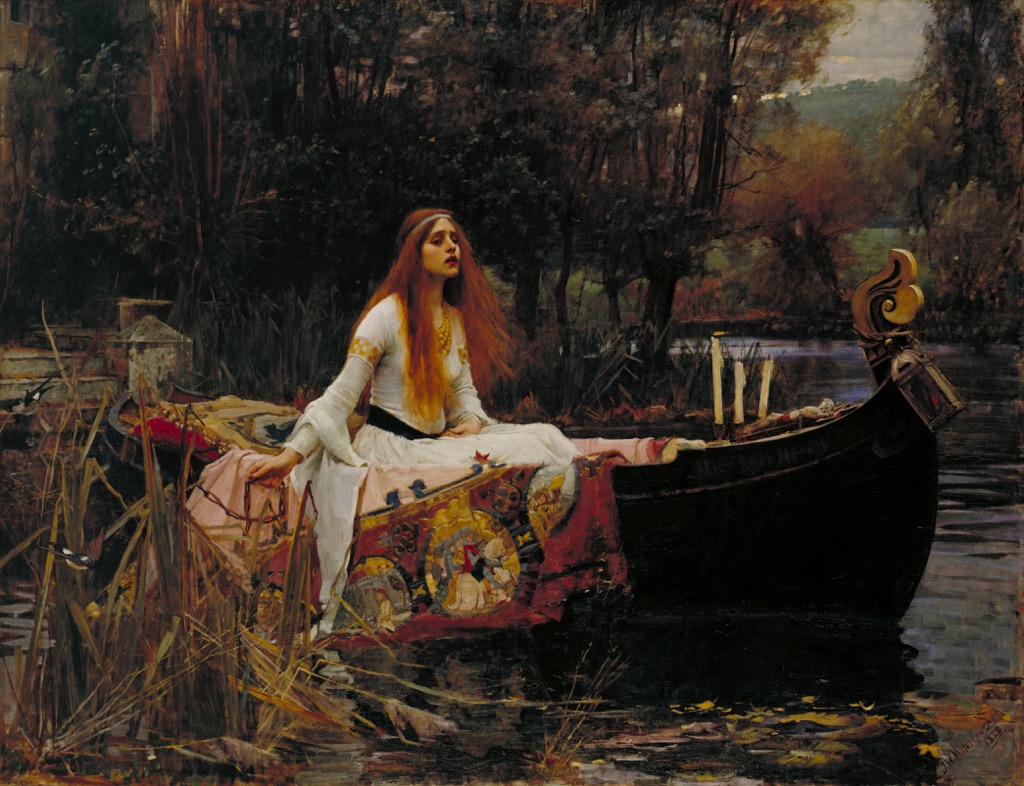
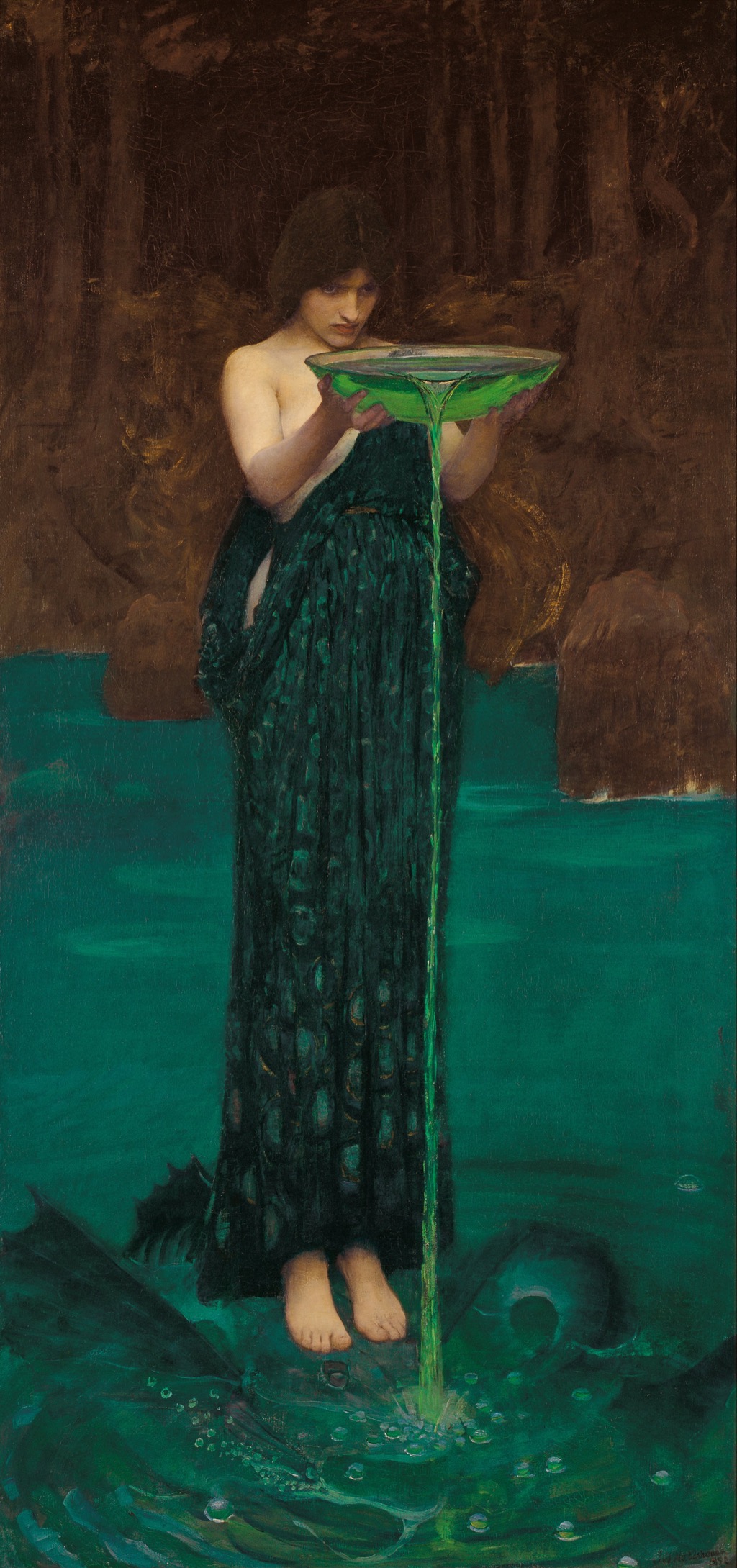
In Circe Offering the Cup to Ulysses, a large mirror reflects the hero and transformed crew, expanding narrative space. In The Lady of Shalott, reflection mediates a forbidden world. In Lamia, a pool or reflective surface intensifies enchantment.
Vanity uses the smallest possible glass. It does not reveal another location or supernatural truth.
Its closest thematic relatives are the late images of women at toilette or contemplating jewellery. Vain Lamorna began from a Lamia study and acquired a literary story about a stolen reflection, making it a separate work with different dimensions and provenance. [2]
Conflating the two erases both distinctions. Vanity is upright or near-square, centred on mirror and rose; Vain Lamorna is a wider woodland composition with a specific Mary De Morgan source.
The intimate scale of the hand mirror makes Waterhouse's late subject unusually modern. The grand supernatural mirror has become a personal tool, and drama has contracted to one decision about appearance.
Reflection is nevertheless only implied. By turning the glass away, Waterhouse avoids painting a second face and keeps the composition from becoming a technical demonstration. The mirror matters because of what it does to her gaze, not because its surface dazzles ours.
The withheld reflection also stops the title from proving its own accusation. We cannot know whether she admires, doubts or simply checks. “Vanity” names the convention; her expression preserves a private alternative.
That modest action is precisely what gives the picture its interpretive reach.
Related Pages
- The Lady of Shalott: Compare Waterhouse's best-known literary composition.
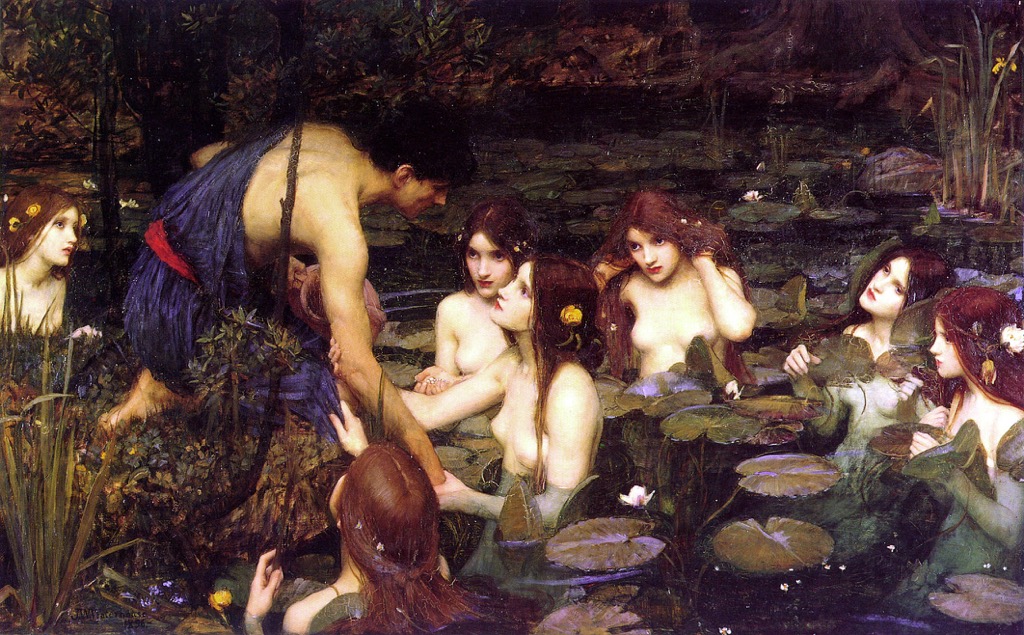
- Hylas and the Nymphs: Compare another major mythological scene.
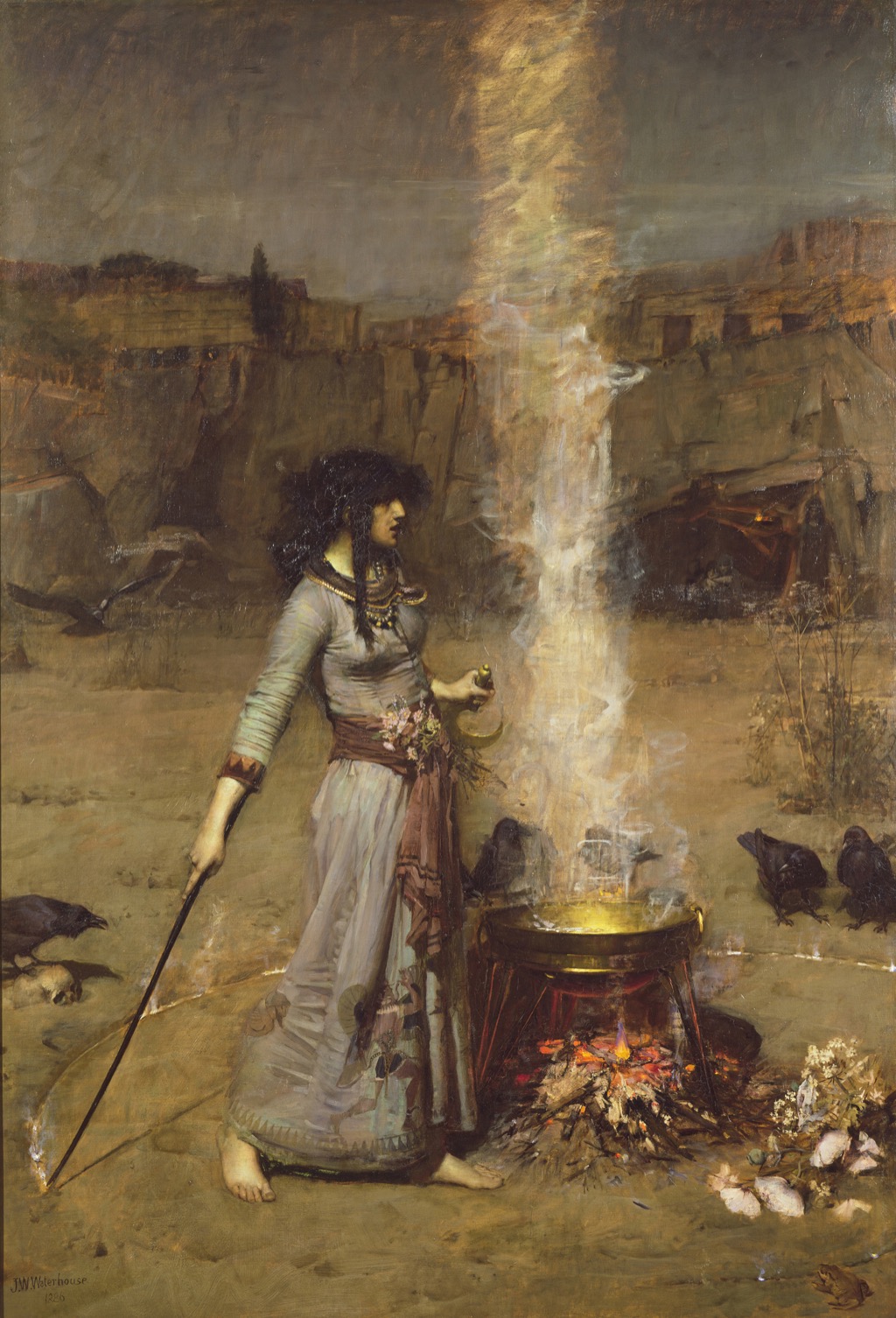
- The Magic Circle: Compare Waterhouse's treatment of ritual and symbolism.
Frequently Asked Questions
It is undated. Its style and posthumous history place it among Waterhouse's late works, but a precise year is not securely documented in the main object record. [1]
She looks into a hand mirror while placing or adjusting a rose in her hair.
Not strictly. It is a figure painting and lacks the explicit mortality symbols common in vanitas still life, although mirror and flower allow themes of pride and transience. [3] [4]
No. Vain Lamorna is a separate, wider painting related to Lamia and a Mary De Morgan fairy tale. [2]
It measures 66 by 69.3 centimetres. [1]
No lifetime exhibition has been established here. It was shown posthumously at the Royal Academy in 1922. [1]
It remained among the works dispersed from Waterhouse's studio after his death. [1]
It is recorded in a private collection. [1]
Discussion
Vanity is easy to moralise and difficult to exhaust. Mirror and rose appear to offer a familiar lesson about pride in temporary beauty, yet Waterhouse excludes the skull, clock and decay that would make that lesson explicit.
Instead, he shows self-fashioning as concentration. The woman evaluates an image unavailable to us and decides where a flower should sit. She is both displayed object and active viewer.
Reader Insights
Which visible detail most changes the way you read this page?
Which source or comparison helps the work feel less familiar and more specific?
What question would you bring back to the painting after reading?
Join the Conversation
Share your reading of this page below.
References
- Christie's, “John William Waterhouse, Vanity,” signature, medium, dimensions, provenance, 1922 Royal Academy exhibition and 1926 studio sale. View source
- Sotheby's, “Vain Lamorna, A Study for Lamia,” separate object identity, dimensions, fairy-tale source and provenance. View source
- National Gallery, London, “Vanitas,” definition, history and typical mortality symbolism. View source
- Metropolitan Museum of Art, Jacques de Gheyn II, Vanitas Still Life, mirror for the tradition's use of skull, bubble, flowers and extinguished flame. View source
- Metropolitan Museum of Art, Vanities: Art of the Dressing Table, history of mirrors, grooming, privacy, identity and the visual culture of vanity. View source