 by Tom Gurney
Tom Gurney BSc (Hons) is an art history expert with over 20 years experience
Published on June 19, 2020 / Updated on November 2, 2026
Email: tomgurney1@gmail.com / Phone: +44 7429 011000
View of the Village by Frédéric Bazille: Introduction
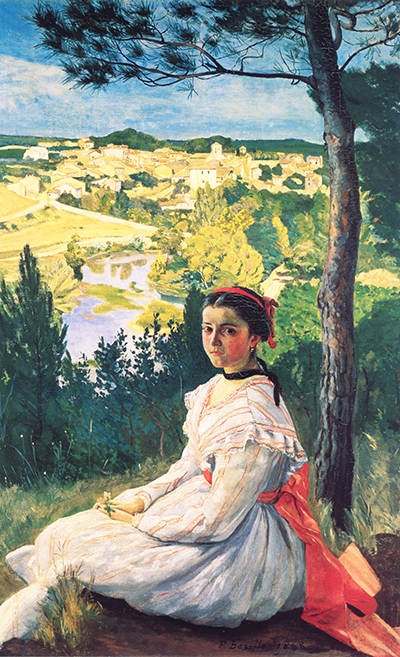
A young woman turns towards us beneath a pine tree. Beyond her shaded dress and face, a river bends through brilliant greenery towards a cluster of pale buildings. Frédéric Bazille’s View of the Village makes these two experiences of looking inseparable: the encounter with someone close at hand and the pleasure of seeing a sunlit town across a valley. Painted in 1868, the oil on canvas belongs to the Musée Fabre in Montpellier, where it is recorded as measuring 137.5 × 85.5 cm. [1]
The town is Castelnau, seen from the vicinity of Bazille’s family property at Méric, above the Lez. Although the title promises a landscape, the sitter commands the foreground. Her body turns across the lower canvas while her face brings our attention back towards its centre. The village remains wonderfully bright, but reaching it with our eyes means looking past another person. That relationship between a substantial figure and an expansive setting is the painting’s central achievement. Bazille signed and dated it July 1868 at the lower right. [2]
At a Glance
- Date1868 [1]
- MediumOil on canvas [1]
- Dimensions137.5 × 85.5 cm [1]
- CollectionMusée Fabre, Montpellier, 898.5.1 [1]
This work across Frédéric Bazille’s career
Family Reunion
1867–1868 (museum)Bazille’s Studio, Rue La Condamine
1869–1870Summer Scene (Bathers)
1869–1870Contents
- A hillside view held inside a portrait
- The sitter and the limits of her identification
- How shade makes the sunlight convincing
- Looking back to The Pink Dress and Family Reunion
- Drawings and an unusual excursion into etching
- The Salon of 1869: success, poor hanging and Morisot’s response
- A family gift to Montpellier
A hillside view held inside a portrait
The narrow upright canvas gives the landscape an unusual shape. Rather than spreading sideways into a panorama, it rises behind the sitter. Her skirt fills much of the lower part; the town forms a broad, luminous band above her head; the pine trunk continues towards the top edge. Overhead branches stretch left across the sky. They provide a roof for the composition without closing the view, since blue and pale cloud remain visible between their dark lines.
The trunk has several jobs. It establishes the nearness of the foreground, makes the sitter’s sheltered position convincing and holds the right side of the picture together. Its dark vertical also checks the long curve of the skirt. The branches repeat this balance on another axis, answering the horizontal accumulation of roofs. The painting feels spacious because these framing forms are so clearly placed: they give us a position from which to look.
Between the girl and the houses, the country changes several times. Dark shrubs occupy the nearer slope. Farther away, the Lez appears in pale, irregular passages broken by banks and vegetation. Beyond that, open yellow ground leads towards the village. The catalogue identifies the wooded middle distance with Bel-Air and the distant settlement with Castelnau. These successive zones give the view a particular geography rather than the general appearance of a sunny rural background. [2]
Yet Bazille does not distribute detail evenly across them. The foreground tree and figure make strong individual shapes. In the distance, small buildings gather into larger groups of cream, white and ochre. Dark openings and roof edges punctuate this brightness, but the town first registers as an illuminated whole. It is possible to follow separate walls and roofs while still feeling how sunlight binds them together.
The title preserves an interesting imbalance. The painting has also been called Young Girl Seated at the Foot of a Tree, Young Girl Seated in a Landscape, Terrace of Bel-Air and View of the Village of Castelnau. Those alternatives move attention between person, position and place. According to Michel Schulman’s catalogue, View of the Village was the title Bazille used when it appeared at the Salon in 1869. The apparently modest landscape title therefore belongs to its original public identity, even though the woman occupies so much of our attention. [2]
The sitter and the limits of her identification
Family tradition identifies the model as the daughter of an Italian tenant farmer associated with the Bazille family. Her personal name is not securely established. The distinction matters: a plausible remembered relationship to the family is more limited than a documented identification of an individual. The painting gives her a face and a commanding presence, but it cannot supply the missing biography. [2]
Her clothes are carefully coordinated. Fine reddish stripes cross the pale dress; red returns more strongly in the wide sash and in the ribbon around her dark hair. The sash falls down beside the tree and reaches towards the lower right corner. It joins the figure to an area of the canvas that might otherwise be dominated by bark and brown ground. Around her shoulders, the ruffled fabric forms small, sharply changing edges, contrasting with the broader folds over her lap.
Schulman describes the costume as suggesting festive or Sunday dress. That is a reading of its appearance, rather than proof of the occasion on which she wore it. The clothing certainly makes the sitting feel considered. Its repeated colours belong to the organisation of the whole picture, and we need not decide whether the outfit was chosen by Bazille or already belonged together to recognise that effect. [2]
The hands rest together towards the left, low against the dress. Their quiet placement balances the more active turn of the head. Her gaze does not take us on a tour of the village; it interrupts our passage towards it. Because the head turns while the seated body extends sideways, the pose holds two directions at once. The sitter appears available to view without becoming a mere device for pointing out the scenery.
Bazille’s correspondence helps explain why finding such a model mattered. In a letter to his father assigned by the Musée Fabre to April 1868, he worried about how he would use his coming months in Montpellier and stressed the need to find a clothed female model. The statement places the search for a sitter within practical plans for work. It does not identify this woman by name or establish that every proposed sitting occurred. It does show that the human figure was a problem he intended to pursue during his southern stay. [3]
How shade makes the sunlight convincing
The dress is the largest pale shape in the foreground, yet its light is quite different from that of the distant houses. Across the skirt, grey-blue folds give weight to fabric protected from direct sun. In the distance, yellow and cream surfaces appear more exposed and more brilliant. A light-coloured object in shade and a light-coloured building in sunshine are therefore made distinct without losing their connection within one view.
This is a more searching arrangement than a simple division between a dark lower half and a bright upper half. Warm colour remains in the girl’s cheeks and red accessories. Green takes many values, from the almost black shrubs beside her head to the yellow-green trees near the water. The landscape contains its own shaded pockets, while the figure contains its own lighter planes. Nearness and distance are bound together by these smaller changes inside the larger contrast.
The face is especially important. Its warm, clearly bounded shape stands against deep foliage, so it remains legible despite its modest size in the whole canvas. The dark hair and red ribbon make a compact group beneath the much larger tree canopy. Looking from the head to the town, we move from concentrated features to scattered architectural marks. Bazille changes the scale of information as well as the scale of objects.
The houses can look strikingly geometric. Roofs and walls overlap as small blocks whose brightness matters as much as their separate identities. Schulman connects these compact forms with later painting, including Cézanne. The resemblance draws attention to the organisation of the town; the painting itself gives those shapes a specific purpose within the relation between a seated person, vegetation, buildings and daylight. [2]
Nor does the impression of outdoor brightness require every contour to dissolve. The skirt has mass; the tree has an emphatic edge; the face holds its place. Their stability allows the distant brilliance to register more forcefully. We experience light through differences between substantial things. The picture’s stillness is part of its visual method, without providing evidence for the sitter’s private feelings or the painter’s temperament.
Watch: Bazille and early Impressionism
Explore a Paris studio with Smarthistory, then discover the beginnings of Impressionism with the National Gallery of Art.
Jean-Frédéric Bazille, The Artist’s Studio, Rue Visconti, Paris
A close look at Bazille’s 1867 painting of the studio he shared in Paris.
Watch on YouTubeLooking back to The Pink Dress and Family Reunion
The Pink Dress offers the closest comparison. Begun in 1864, it also places a seated woman above the countryside towards Castelnau. But there the figure turns largely away from us, making her attention to the distance part of our own experience of the view. In View of the Village, the later sitter looks towards us. Similar ingredients produce a changed relationship between the painted person and the spectator. [2]
The difference becomes clearer if we follow the direction of the head before looking at the scenery. In The Pink Dress, the partly averted face encourages us to share a vantage point. Here, the head’s turn gives us the feeling of arriving before someone who already occupies the place. The distant town is seen across her presence. Neither arrangement is simply a portrait with scenery attached; each uses the figure to determine how the landscape is encountered.
The comparison also complicates an easy story of spontaneous outdoor painting. Bruno Mottin’s laboratory study shows that The Pink Dress underwent extensive alterations after its initial campaign. Its dress, pose and other passages were reworked. These findings describe the material history of the earlier canvas. They also reveal how patiently Bazille could adjust an outdoor composition, bringing fresh observation and sustained revision into the same painting. [4]
Family Reunion expands the same set of questions to a group. Under its canopy, people remain firmly described while brilliant country opens behind them. Several look towards the viewer, establishing a collective encounter. View of the Village concentrates that exchange in one person. The tall pine takes over the framing role of the larger canopy, while the solitary pale dress becomes a principal field for the study of shaded light. Schulman places these paintings together within Bazille’s continuing exploration of figures in the southern landscape. [2]
Another useful contrast is The Little Gardener. There, a small working figure is absorbed within an extensive cultivated garden. Here, the sitter is large enough to rival the entire distant settlement. The comparison shows how much depends on scale: a person can animate a landscape from within, or can stand between its spaces and our own. The garden, the terrace and the river valley give Bazille different ways of testing that relationship.
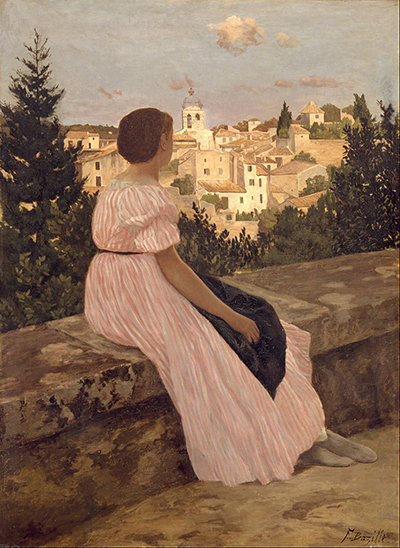
La Robe Rose
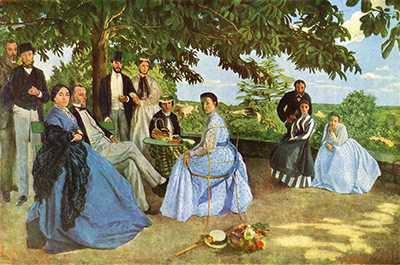
Family Reunion
Drawings and an unusual excursion into etching
Preparatory drawings show that the relationship between sitter, tree and village was worked through on paper. Schulman discusses changes in the girl’s position, the amount of description given to the distant buildings and the way the pine is indicated. Their precise sequence is not established, but they preserve alternatives that Bazille considered while developing the composition. [2]
This matters because the painting looks so settled. The trunk seems to occupy an inevitable position, and the head appears securely held between foreground foliage and the village. Drawings reveal the choices behind such apparent inevitability. Moving a figure slightly changes the amount of river visible beside her; altering the tree changes both the frame and the interval between near and far. An outdoor subject still requires decisions about the distribution of shapes across a flat surface.
Bazille also made an etching of View of the Village, dated 1868 and held by the Musée Fabre under inventory number 52.3.1. This separate work on paper is catalogued as MSb-121. Schulman reports, through Michel Hilaire, a posthumous printing of about fifty impressions and describes it as Bazille’s only known venture into etching. [5] [2]
The existence of the print extends the subject beyond the finished canvas. A composition whose effect depends so strongly on colour was also considered in a medium organised through lines and printed tones. That is a useful reminder of its underlying structure: the figure, tall tree and distant settlement form a recognisable arrangement before the differences between red, green and yellow are considered. The surviving evidence supports this particular experiment, rather than a larger undocumented career as a printmaker.
The Salon of 1869: success, poor hanging and Morisot’s response
Before the painting reached the Salon, it had an audience in Paris. In his letter to his mother assigned to mid-February 1869, Bazille reported that visiting painters had warmly received the picture of the young Italian woman, despite his family’s earlier unfavourable opinion. Some visitors preferred it, while others preferred his male nude. The letter records a lively process of showing and comparing work rather than a single verdict shared by everyone. [6]
Alfred Stevens gave him particularly encouraging praise. Bazille also reported that Stevens intended to bring the jury members Eugène Fromentin and Charles-François Daubigny to see his pictures once they were varnished and framed. This was a prospect of introductions, not evidence of particular jury votes. It shows how studio visits, professional advice and hopes for a good place on the exhibition walls formed part of a painting’s passage into public view. [6]
View of the Village was accepted at the Salon of 1869, while Fisherman with a Net, also submitted, was rejected. Acceptance did not guarantee visibility. Schulman cites Bazille’s letter to his father of 2 May complaining about how badly the village picture had been hung. The contrast between Stevens’s hopes and Bazille’s disappointment makes the distinction between admission and advantageous display unusually clear. [2]
Berthe Morisot nevertheless noticed it. The Musée Fabre’s account of her letter to her sister Edma, dated 5 May 1869, records her admiration for the pale dress in the tree’s shade and the sunlight of the village behind. She recognised the task of placing a figure convincingly outdoors as one she and her sister had also pursued, and judged that Bazille had succeeded. Her response makes the painting part of a shared artistic investigation, with a practising painter identifying the difficulty that had been overcome. [7]
Other responses were less sympathetic. In the contemporary criticism assembled by Schulman, Léon Gautier questioned the prominent white-clothed woman and found the landscape strange. A Journal de Montpellier review of 12 June moved from uncertainty about the picture’s eccentricity towards praise for the truth of its bold composition and colour. Gill also sketched it in La Parodie on 4 June. These notices reveal disagreement about the very arrangement that gives the work its force: the large foreground person within a picture called a village view. [2]
Morisot’s attention is particularly valuable beside those reactions. What might look like an awkward mixture of portrait and landscape to one critic could appear to another painter as a difficult pictorial problem successfully resolved. The figure’s shade does not weaken the sense of sunshine. It makes the sunshine beyond her believable, while allowing her to retain weight, distinct features and a direct relationship with the viewer.
A family gift to Montpellier
The painting entered the Musée Fabre in 1898 as a gift from Bazille’s mother, identified in its collection record as Madame Gaston Bazille. The museum’s inventory number is 898.5.1. Her gift brought the canvas into the collection thirty years after it was painted. [1]
Michel Hilaire places the donation alongside her gift of Still Life with Heron in the same year. In his account, these gifts helped begin the movement of Bazille’s work from family and friends into public collections, where historians and wider audiences could reconsider it. Preservation by the family and later museum display were therefore active parts of the artist’s posthumous reputation. [8]
The two paintings also offered different evidence of his achievement. One brings a person into the light and space of the countryside; the other concentrates attention on suspended birds and still-life materials. Together they resist a reputation built solely around one famous subject or around the painter’s early death. For View of the Village, the return to Montpellier gives particular resonance to a painting made from familiar local ground.
The Musée Fabre presents it as a major success in Bazille’s effort to place a human figure within landscape. Its continuing interest lies in how fully that problem remains visible. We can follow the river towards Castelnau, examine the dress’s changing folds, or return to the young woman’s face. Each movement alters what seems central, yet the tree, sitter and town continue to hold together. [1]
Bazille catalogue directory
The 284 records comprise 85 painting records,40 separate works-on-paper records and 159 album or study records. They describe the catalogue’s organisation rather than 284 independent objects or unanimously accepted attributions. Recto, verso, albums and multiple studies remain distinct. Dates are qualified where needed; the Drawing filter includes the etching, gouache and mixed works on paper. Manuscript mentions and unproved projects are listed separately below.
Works known through documents
These mentions remain separate from the 284 catalogue records. Some may concern surviving studies or underlying compositions; they cannot simply be added together as missing physical paintings.
- A copy after Rubens mentioned in March 1863 is unlocated.
- A portrait of an unidentified woman was reported completed before July 1866.
- A portrait of Monet and a composition of two life-size women arranging flowers were reported in progress in April 1867. Their mention does not establish two otherwise unknown surviving canvases.
- Gertrude et le père Lapin was at least begun in the summer of 1870.
Further reported works and uncertain attributions
- A Bouquet of Lilacs was reportedly stolen and returned in 1864; a portrait of the friend Theulier and Yellow Narcissi reported by Maître in 1868 are also documentary mentions.
- Unidentified pictures associated with Guillemet and Mme Rolina are reported through later correspondence cited by the catalogue.
- Children Dressed as Bride and Groom was associated with Vallotton’s collection and also attributed to Renoir. Its identification and authorship should remain open.
Projects whose completion is unproved
- A portrait of Pauline was planned in July 1865.
- A portrait of Marc was proposed in April 1866; a related drawing survives.
- A Jardinière project appears in album inscriptions and related figure material. Written plans are not evidence of a completed painting.
| Name | Date | Medium |
|---|---|---|
| Mystic Marriage of St. Catherine | 1863 | Oil on canvas |
| Trees, Study | 1863 | Oil on canvas |
| Farm of Saint-Sauveur | 1863 | Oil on canvas |
| In the Garden of the Parc Monceau, Paris | 1864 | Oil on canvas |
| Naked Woman from Behind | 1864 | Oil on canvas |
| Reclining Nude | 1864 | Oil on canvas |
| Courtyard of the Auberge du Cheval blanc at Chailly near Barbizon | 1864 | Oil on canvas |
| Covered Soup Bowls | 1864 | Oil on canvas |
| Two Herrings | 1864 | Oil on canvas |
| The Pink Dress | 1864 | Oil on canvas |
| The Dog Rita Asleep | 1864 (catalogue); c. 1864 (2017 checklist) | Oil on canvas |
| The Scoter | 1864 | Oil on canvas |
| Naked Reclining Woman | 1864 | Oil on canvas |
| Landscape at Chailly | 1865 | Oil on canvas |
| Rocks at Chailly, Forest of Fontainebleau | 1865 | Oil on canvas |
| Undergrowth at Chailly, Forest of Fontainebleau | 1865 | Oil on canvas |
| Still Life with Grapes and Nuts | 1865 | Oil on canvas |
| Self-Portrait with a Palette — Chicago | 1865 | Oil on canvas |
| Landscape of Saint-Sauveur | 1865 | Oil on canvas |
| Beach at Sainte-Adresse | 1865 | Oil on canvas |
| The Improvised Field Hospital | 1865 | Oil on canvas |
| Village Street, Chailly | 1865 | Oil on canvas |
| Small Valley in the Forest of Fontainebleau | 1865 | Oil on canvas |
| Forest of Fontainebleau | 1865 | Oil on canvas |
| Woman Ironing | 1866 | Oil on canvas |
| The Artist's Studio on the rue de Furstenberg | 1865–66 (museum) | Oil on canvas |
| Still Life with Fish | 1866 | Oil on canvas |
| Little Italian Street Singer | 1866 | Oil on canvas |
| Potted Flowers | 1866 | Oil on canvas |
| The Little Gardener | 1866–1867 | Oil on canvas |
| Young Woman Playing the Piano | 1866–1867 | Oil on canvas |
| End of a Summer Day | 1866–1867 | Oil on canvas |
| A Studio on the rue Visconti | 1867 | Oil on canvas |
| Thérèse Reading in the Park at Méric | 1867 | Oil on canvas |
| Portrait of Verlaine | 1867 | Oil on canvas |
| The Terrace at Méric | 1867 | Oil on canvas |
| Still Life with Heron | 1867 | Oil on canvas |
| The Family Gathering | 1867–68 (museum) | Oil on canvas |
| Oleanders | 1867 | Oil on canvas |
| Woman on the Terrace at Méric | 1867 | Oil on canvas |
| The Ramparts at Aigues-Mortes from South | 1867 | Oil on canvas |
| The Western Ramparts at Aigues-Mortes | 1867 | Oil on canvas |
| Portrait of Edmond Maître — head study | 1867 | Oil on canvas |
| Porte de la Reine at Aigues-Mortes | 1867 | Oil on canvas |
| Portrait of Sisley | 1867 | Oil on wood |
| Portrait of Renoir — Cleveland | 1867 | Oil on canvas |
| Portrait of Renoir — Musée d’Orsay | 1867 | Oil on canvas |
| Self-Portrait with a Detachable Collar — Minneapolis | 1865–67 (museum); 1867–68 (catalogue) | Oil on canvas |
| Vase of Flowers on a Console | 1868 (museum); 1867–68 (catalogue) | Oil on canvas |
| Portrait of a Woman | 1868 | Oil on canvas |
| Young Woman in the Vineyards | 1868 | Oil on card |
| Harvester with a Basket | 1868 | Oil on card |
| Harvester with a Yellow Hat | 1868 | Oil on card |
| Harvester with a Headdress | 1868 | Oil on panel |
| On the Banks of the Lez | 1868 | Oil on canvas |
| After the Bath (attribution questioned) | 1868? | Oil on canvas |
| Young Woman with Lowered Eyes | 1868 | Oil on canvas |
| Fisherman with a Net | 1868 | Oil on canvas |
| View of the Village | 1868 | Oil on canvas |
| Portrait of Bazille (attributed to Monet by Musée Fabre; disputed catalogue attribution) | 1864 (museum); 1868 (catalogue) | Oil on panel |
| Studies for a Grape Harvest (two panels) | 1868 | Oil on canvas (two panels) |
| The Fortune Teller | 1868–69 (catalogue); c. 1869–70 (2017 checklist) | Oil on canvas |
| Harvester with a Cap | 1869 | Oil on card |
| Portrait of Edmond Maître — 1869 | 1869 | Oil on canvas |
| Woman in a Moorish Costume | 1869 | Oil on canvas |
| Young Woman in the Garden | 1869 | Oil on canvas |
| Portrait of Alphonse Tissié in a Cavalryman's Uniform | 1869 | Oil on canvas |
| Portrait of a dragoon | 1869 | Oil on canvas |
| Portrait of Zacharie Astruc | 1869 | Oil on canvas |
| Bunch of Grapes in a Bucket | 1869 | Oil on card |
| Portrait of Edouard Blau | Probably 1869; inscribed 1866 | Oil on canvas |
| Young Male Nude Lying on the Grass | 1870 | Oil on canvas |
| Summer Scene | 1869–1870 | Oil on canvas |
| The Studio on the rue La Condamine | 1869–1870 | Oil on canvas |
| La Toilette | 1870 | Oil on canvas |
| Young Woman with Peonies — Montpellier | 1870 | Oil on canvas |
| Young Woman with Peonies — Washington | 1870 | Oil on canvas |
| Monotonous Chant | 1870 | Oil on canvas |
| Flowers — private collection | 1870 | Oil on canvas |
| Flowers — Musée Fabre | 1870 | Oil on canvas |
| Young Fisherman | 1870 | Oil on canvas |
| Study for Ruth and Boaz | 1870 | Oil on wood |
| Ruth and Boaz | 1870 | Oil on canvas |
| Self-Portrait in Shirt Sleeves | 1870 | Oil on canvas |
| Landscape on the Banks of the Lez | 1870 | Oil on canvas |
| Study after an Alpine Landscape | 1860 | Graphite on watercolour-tinted paper |
| Profile Head | 1862 | Charcoal on laid paper |
| Studies after Delacroix | 1863 | Ink and graphite, with gouache and watercolour, on paper |
| Academic Head | 1863 | Charcoal on paper |
| Study of a Woman's Head in Profile on a Chair | 1863 | Charcoal on paper |
| Academic Head of a Woman | 1863 | Charcoal on paper |
| Academy of Woman | 1863 | Black pencil and charcoal, stumped, on watermarked laid paper |
| Academy of Man | 1863 | Black pencil and charcoal, stumped, on watermarked laid paper |
| Naked Man | 1863 | Charcoal on paper |
| The Pont au Change in Paris | 1864 | Watercolour on paper |
| Study for the Pink Dress or Portrait of Thérèse des Hours | 1864 | Black pencil on paper |
| Naked Woman Standing | 1864 | Pencil on paper |
| Study of a Reclining Nude | 1864 | Charcoal on paper |
| Bathers | 1864 | Charcoal on paper |
| Portrait of a Man | 1864 | Charcoal on paper |
| Study for The Pink Dress | 1864 | Black pencil, squared, on paper |
| Study for Landscape of Saint-Sauveur | 1864 | Graphite on paper |
| Study for Landscape of Saint-Sauveur | 1865 | Pencil on paper |
| Man Taming a Bull | 1866 | Pen and black pencil on paper |
| Man Half Lying on a Sofa | 1866 | Charcoal on paper |
| Study for The Family Gathering | 1867 | Pencil on paper |
| Study for The Family Gathering | 1867 | Graphite, charcoal and black pencil on paper |
| The Embroiderer | 1867 | Pencil on pink paper |
| Study of Children | 1867 | Pencil on paper |
| Women in a Garden | 1867 | Pencil drawing |
| View of the Village | 1868 | Etching on paper |
| Portrait of a Bearded Man (catalogued as Self-Portrait) | Undated (museum); 1869 (catalogue) | Charcoal and brown ink |
| Man Smoking Pipe | 1869 | Watercolour on paper |
| Manet Drawing | 1868–70(?) (museum) | Charcoal and white chalk on paper |
| Study for the Summer Scene | 1869 | Charcoal, pen and ink on paper |
| Family Portrait | 1869 | Pastel and charcoal on paper |
| Study for Ruth | 1870 | Pencil and charcoal on paper |
| Woman Arranging a Hat | 1870 | Pencil drawing |
| Study for Boaz Asleep | 1870 | Pastel and red chalk |
| Boaz Asleep | 1870 | Charcoal and pencil on paper |
| Study for Boaz Asleep | 1870 | Black and beige pastel with red chalk on laid paper |
| Ruth Lying down | 1870 | Charcoal and pastel on paper |
| Head, Arm and Chest of Ruth | 1870 | Charcoal on paper |
| Chest of Ruth | 1870 | Black chalk and charcoal on paper |
| Black Woman with Peonies — gouache | c. 1870 | Gouache, watercolour, pencil and black chalk on card |
| Various Unidentified Subjects | Undated | Pencil drawing |
| Rocky Sea Side | Undated | Charcoal on paper |
| Studies of a Dancing Woman | Undated | Drawing with white chalk |
| Study of a Leg | Undated | Pencil drawing |
| Dancers in Camargue | Undated | Pencil drawing |
| Academy of Woman | Undated | Charcoal |
| Caricature of Venus of Milo and Various Other Caricatures | Undated | Charcoal |
| Caricature | Undated | Pencil drawing |
| Study of Landscape | Undated | Charcoal |
| Caricatures and Seated Monk | Undated | Charcoal |
| Caricatures and Various Subjects | Undated | Pencil drawing |
| Women Carrying a Pitcher | Undated | Pencil drawing |
| The Hanged Man | Undated | Charcoal |
| Castle in the Plain | Undated | Charcoal |
| Naked Woman from Behind | Undated | Charcoal |
| Caricatures | Undated | Charcoal and pencil |
| Unidentified Subjects | Undated | Pencil drawing |
| Landscape with a Castle | Undated | Charcoal |
| Study of Landscape | Undated | Charcoal |
| Horse Rider seen from Behind | Undated | Charcoal |
| Mazeppa | Undated | Pencil and charcoal |
| Study of Rider and Others Subjects | Undated | Pencil, pen and brown ink |
| Study of an Unidentified Man | Undated | Pencil drawing |
| Study for an Unknown Historic Scene | Undated | Pencil drawing |
| Study a Man Reading | Undated | Pencil drawing |
| Study of Men Reading | Undated | Pencil drawing |
| Study of Landscape ? | Undated | Charcoal |
| Study of a Head of a Man | Undated | Pencil drawing |
| Erotic Scene | Undated | Pencil drawing |
| Study of Dog | Undated | Charcoal |
| Studies of Unidentified Subjects and Erotic Scene | Undated | Pencil and charcoal drawing |
| Study for a Theater Scene | Undated | Charcoal |
| Study of a Reclining Naked Woman | Undated | Charcoal |
| Two Studies of Landscape | Undated | Pencil drawing |
| Caricature | Undated | Pencil and charcoal drawing |
| Portrait of an Unidentified Young Man | Undated | Charcoal |
| Study of an Unidentified Subject | Undated | Brown ink drawing |
| Unidentified Man with a Hat | Undated | Pencil and charcoal |
| Study of an Unidentified Women | Undated | Pencil drawing |
| Study for a Theater Character ? | Undated | Pencil drawing |
| Study for a Theater Character ? | Undated | Pen drawing |
| The Pavillon de la Reine in Paris | Undated | Pencil drawing |
| Study of a Horse Rider | Undated | Pencil and charcoal drawing |
| Entwined Couple. Caricature ? | Undated | Pencil drawing |
| Woman Sitting on a Sofa | Undated | Pencil drawing |
| Studies of Unidentified Subjects | Undated | Pencil and charcoal drawing |
| Studies of Animals | Undated | Pencil drawing |
| Study of a Horse Rider in Camargue | Undated | Charcoal |
| Study of Hunting Dogs | Undated | Pencil drawing |
| Study of Soldiers. Caricatures | Undated | Pencil drawing |
| Studies of Hunting Dogs ? | Undated | Pencil drawing |
| Hunting Scene. Hunter Playing the Horn | Undated | Pencil drawing |
| Caricature | Undated | Pencil drawing |
| Study of an Ibex | Undated | Pencil drawing |
| Theater Scene. Caricatures | Undated | Pencil drawing |
| Studies of Animals. Horses ? | Undated | Pencil drawing |
| Caricatures | Undated | Pencil drawing |
| Studies of Various Subjects and Animals | Undated | Pencil drawing |
| Unidentified Subject | Undated | Pencil drawing |
| Rider Taming a Horse [in Camargue ?] | Undated | Pencil drawing |
| Caricature of a Soldier | Undated | Pencil drawing |
| Study of a Woman and Mouse | Undated | Pencil drawing |
| Historic Scene | Undated | Charcoal |
| Architecture Studies | Undated | Pencil drawing |
| Mythologic Scene | Undated | Charcoal |
| Ophelia | Undated | Pencil drawing |
| Mythologic Scene | Undated | Charcoal |
| Studies of Various Subjects | Undated | Pencil and pen drawing |
| Studies of Peasants | Undated | Pencil drawing |
| Historic Scene | Undated | Pencil drawing |
| Historic or Literary Scene | Undated | Pencil drawing |
| Unidentified Historic Scene | Undated | Pencil drawing |
| Studies of Unidentified Subjects | Undated | Pencil drawing |
| Unidentified Study | Undated | Pencil drawing |
| Man in an Armchair | Undated | Pencil drawing |
| Studies of Various Subjects | Undated | Pencil drawing |
| Portraits of Unidentified Men | Undated | Pencil drawing |
| Studies of Various Subjects | Undated | Pencil drawing |
| Horse Rider and Artist | Undated | Charcoal and pencil |
| Study of Unidentified Characters | Undated | Charcoal |
| Dead Horse in a Plain | Undated | Charcoal |
| Study of Various Subjects and Furniture | Undated | Pencil drawing |
| Caricatures and Various Notes about Opéra | Undated | Pencil drawing |
| Galloping Horse | Undated | Charcoal |
| Study for La Toilette | Undated | Pencil drawing |
| Study of a Naked Woman | Undated | Pencil drawing |
| Domestic Scene | Undated | Pencil drawing |
| Physiognomies | Undated | Pencil drawing |
| Study for a Grape Harvest | Undated | Pencil drawing |
| Study for the Summer Scene | Undated | Pencil drawing |
| Female Profiles | Undated | Pencil drawing |
| Various Subjects | Undated | Pencil drawing |
| Study for The Terrace at Méric | Undated | Pencil drawing |
| Study for The Ramparts at Aigues-Mortes | Undated | Pencil drawing |
| Study for The Ramparts at Aigues-Mortes | Undated | Pencil drawing |
| Study for a Grape Harvest | Undated | Charcoal |
| Children Portraits | Undated | Pencil drawing |
| Study for Children's Heads | Undated | Pencil drawing |
| Study of Minerva | Undated | Pencil drawing |
| Study for a Grape Harvest | Undated | Pencil drawing |
| Study for The Family Gathering | Undated | Pencil drawing |
| Study for a Young Fisherman | Undated | Charcoal |
| Self-Portraits | Undated | Black pencil drawing |
| Study of Horses for the Porte de la Reine at Aigues-Mortes | Undated | Ink drawing |
| Study of Horses for the Porte de la Reine at Aigues-Mortes | Undated | Ink drawing |
| Study of Horses for the Porte de la Reine at Aigues-Mortes | Undated | Ink drawing |
| Study for an Outdoor Concert | Undated | Pencil drawing |
| Studies of Legs | Undated | Pencil drawing |
| Study for The Ramparts at Aigues Mortes | Undated | Pencil drawing |
| Studies of Hats | Undated | Pencil drawing |
| Studies of Men | Undated | Pencil drawing |
| Study for The Little Gardener | Undated | Pencil drawing |
| Study for The Ramparts at Aigues Mortes | Undated | Charcoal |
| Studies of Sail Boats | Undated | Pencil drawing |
| Portrait of Marc Bazille | Undated | Charcoal, black pencil and graphite |
| Studies of Children's Heads | Undated | Pencil drawing |
| Study for Aigues-Mortes | Undated | Pencil drawing |
| Studies of Women's Heads | Undated | Pencil drawing |
| Portrait of Camille des Hours and an Unidentified Man | Undated | Charcoal |
| Study of Flying Birds | Undated | Charcoal or graphite |
| Study for the Summer Scene | Undated | Pencil drawing |
| Study of Hands | Undated | Pen drawing |
| Self-Portrait | Undated | Black pencil drawing |
| Study for the Summer Scene | Undated | Pencil drawing |
| Study for the Summer Scene | Undated | Pencil drawing |
| Study for a Grape Harvest | Undated | Pencil drawing |
| Study of Branches | Undated | Pencil drawing |
| Study of a Seated Child | Undated | Pencil drawing |
| Study for a Couple and Unidentified Women | Undated | Pencil drawing |
| Studies of Unidentified Women | Undated | Pencil drawing |
| Study of Buildings | Undated | Pencil drawing |
| Study for a Grape Harvest | Undated | Pencil and charcoal |
| Studies of Boaters | Undated | Pencil drawing |
| Study of a Man Writing at his Table | Undated | Pencil drawing |
| Study of a Woman Cutting Flowers | Undated | Pencil drawing |
| Study of Hand | Undated | Pencil drawing |
| Women in a Garden | Undated | Pencil drawing |
| Studies of Women in Profile | Undated | Pencil drawing |
| Study for Ruth and Boaz | Undated | Charcoal |
| Study for The Family Gathering | Undated | Pencil drawing |
| Study for the View of the Village | Undated | Pencil drawing |
| Study of the View of the Village | Undated | Pencil drawing |
| Study for the Fisherman with a Net | Undated | Pencil drawing |
| Study for the View of the Village | Undated | Charcoal |
| Study for The Little Gardener | Undated | Charcoal |
| Portrait of a Man with a Top Hat | Undated | Pencil drawing |
| Portrait of a Man with a Top Hat | Undated | Pencil drawing |
| Inscriptions | Undated | Pencil inscriptions |
| Study of Tree | Undated | Pencil drawing |
| Caricature of Nina la Belle | Undated | Pencil drawing |
| Study for Saint Sebastian | Undated | Pencil drawing |
| Young Woman Sewing | Undated | Pencil drawing |
| Studies of Hands | Undated | Pencil drawing |
| Woman in a Garden | Undated | Pencil drawing |
| Elegant Woman | Undated | Pencil drawing |
| Various Inscriptions | Undated | Inscriptions (medium unspecified in index) |
| Study of a Man with a Hat | Undated | Pencil drawing |
| Study of a Child | Undated | Pencil drawing |
| Study of a Man with a Hat | Undated | Pencil drawing |
Frequently Asked Questions
It belongs to the Musée Fabre in Montpellier, inventory 898.5.1. [1]
Discussion
A seated girl and a distant village occupy very different scales. What joins their spaces?
Reader Insights
How does the red sash connect the shaded sitter with the brighter landscape?
Compare the girl’s turned face with the back-facing sitter in The Pink Dress. How does the encounter change?
What role does the large tree trunk play in holding the narrow composition together?
Join the Conversation
Share a detail, comparison or question about View of the Village by Frédéric Bazille below.
References
- Musée Fabre, Vue de village, 1868, inventory 898.5.1, collection record. Museum record (in French). View source.
- Michel Schulman, View of the Village, MSb-46, digital catalogue raisonné, object record and critical essay. Catalogue entry (English translation of French scholarship; historical reviews and letters discussed here are mediated through this entry unless separately referenced). View source.
- Frédéric Bazille, letter to his father, Thursday [April 1868], inventory 92.2.4, Musée Fabre, transcription, PDF page 4. Letter and museum transcription (in French; date assigned in the transcription). View source.
- Bruno Mottin, “L’œuvre de Frédéric Bazille (1841–1870) examiné au laboratoire,” Technè, 46 (2018), pp. 30–38, especially paragraphs 3–10 on The Pink Dress. Technical study (in French). View source.
- Michel Schulman, View of the Village, MSb-121, 1868 etching, Musée Fabre 52.3.1, digital catalogue raisonné. Etching record (English interface with French object terminology; edition history discussed in reference 2). View source.
- Frédéric Bazille, letter to his mother, Thursday [mid-February 1869], inventory 94.7.3, Musée Fabre, transcription, PDF page 5. Letter and museum transcription (in French; date assigned in the transcription). View source.
- Musée Fabre, Frédéric Bazille: la jeunesse de l’impressionnisme, 2016 exhibition press dossier, p. 17, “Peindre des figures au soleil,” reproducing Berthe Morisot’s letter to Edma Pontillon of 5 May 1869. Museum dossier (in French; Morisot’s response paraphrased through this museum source). View source.
- Michel Hilaire, “Bazille ou la vie brève,” Académie des Sciences et Lettres de Montpellier, communications presented in 2016, pp. 166–172, especially p. 166 on the 1898 gifts. Scholarly lecture (in French). View source.
- Joconde/POP, La Robe rose, RF2450. View source. (in French).
- Musée d’Orsay, L’Ambulance improvisée, RF 1967 5. View source. (in French).
- Musée d’Orsay, Réunion de famille,RF2749. View source. (in French).
- Musée d’Orsay, Pierre Auguste Renoir,DL1970 3. View source.
- National Gallery of Art, Frédéric Bazille and the Birth of Impressionism: exhibition checklist,2017. View source.
- National Gallery of Art, Young Woman with Peonies,1983.1.6. View source.
- Michel Schulman, painting index and documentary introduction (English titles; French metadata). View source.
- Michel Schulman, works-on-paper index (English titles; French metadata). View source.
- Michel Schulman, albums and studies index (English titles; French metadata). View source.
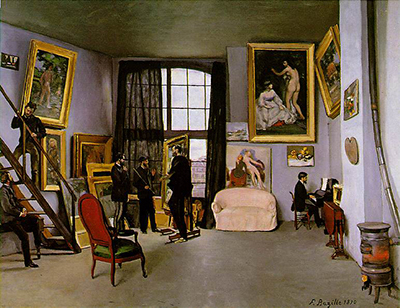
 Frederic Bazille.jpg)