



 by Tom Gurney
Tom Gurney BSc (Hons) is an art history expert with over 20 years experience
Published on June 19, 2020 / Updated on November 2, 2026
Email: tomgurney1@gmail.com / Phone: +44 7429 011000
Porte de la Reine at Aigues-Mortes by Frédéric Bazille: Introduction
The brightest part of Frédéric Bazille’s Porte de la Reine at Aigues-Mortes is a small opening through an enormous wall. Beyond the arch, a sunlit street draws the eye between rows of houses. Outside, horses and people occupy a green foreground in shadow. Painted in 1867, this oil on canvas brings the old fortifications close enough to dominate the view, while making the light passing through them the picture’s most compelling event. It belongs to the Metropolitan Museum of Art in New York. [1]
The gate might initially seem to be the whole subject. Its two rounded towers fill the middle of the painting, their weathered masonry stretching across almost its entire width. But look lower down. A rider pauses beside a standing figure; a pale horse grazes; a seated woman and two children occupy the grass. These small presences give the monument a second scale. Bazille shows a place people inhabit and pass through, with the weight of the walls set against the unhurried movements of an ordinary day.
At a Glance
- Date1867 [1]
- MediumOil on canvas [1]
- Dimensions80.6 × 99.7 cm [1]
- CollectionMetropolitan Museum of Art, New York, 1988.221 [1]
This work across Frédéric Bazille’s career
Family Reunion
1867–1868 (museum)Bazille’s Studio, Rue La Condamine
1869–1870Summer Scene (Bathers)
1869–1870Contents
- A gateway that fills the landscape
- The small lives below the wall
- Light passing through stone
- The Aigues-Mortes stay in 1867
- Drawing the horses and children
- Different distances from the same town
- Collectors, exhibitions and the Met
- Annotated details
A gateway that fills the landscape
Bazille gives the two towers a forceful, nearly frontal presence. They are recognisably related forms without being exact pictorial twins. Their upper contours rise unevenly against the sky, their dark openings interrupt different patches of stone, and the connecting structure draws attention down towards the arch. The gate’s size becomes particularly apparent when the eye returns to the mounted man below: horse and rider together reach only a little way up the immense façade.
There is enough sky to prevent the architecture from closing the picture entirely. Clouded blue spreads above the towers and opens more broadly at the right, where the wall drops to a lower height. Pale cloud strokes curve and gather around the dark silhouette. Against this open atmosphere, the rounded masses of stone appear solid, although their surfaces remain restless with marks of paint.
The architecture also changes character as we look into the opening. Outside, the towers are broad and heavy; inside the passage, one arch sits within another, narrowing towards the bright exit. The street beyond recedes rapidly between small façades. Bazille compresses an extensive distance into a tiny area of canvas. The eye can move from the apparently impenetrable wall into this miniature town almost instantaneously.
That passage is displaced slightly to the left of the picture’s centre. The arrangement leaves room for the large right tower and for the grazing horse beneath the lower rampart. It also prevents the composition from settling into a perfectly balanced architectural elevation. The gate is an imposing structure encountered from a particular viewpoint, with irregular ground and scattered activity in front of it.
The canvas measures 80.6 by 99.7 centimetres. [1] These proportions give the towers considerable height while preserving a broad foreground. That grassy interval places the spectator outside the walls and gives the small figures room to exist apart from the monument. We must cross that space with our eyes before entering the town.
The small lives below the wall
The mounted group at the left concentrates the picture’s strongest colours below the gate. The rider’s blue clothing stands out against the subdued stone and green ground. His horse faces broadly towards us, bringing its legs and narrow head into a different alignment from the grazing animal at the right. A slender staff rises beside the rider. The nearby standing figure, marked by a red cap, turns towards him, suggesting an exchange.
Michel Schulman interprets the mounted man as a Camargue gardian, a herdsman associated with the region’s horses and cattle. That is a plausible reading of his clothing, mount and staff; the picture does not establish his personal identity or occupation. [2] The encounter works visually without a more elaborate story. The two upright people bring our attention to a pause in movement just outside the gate.
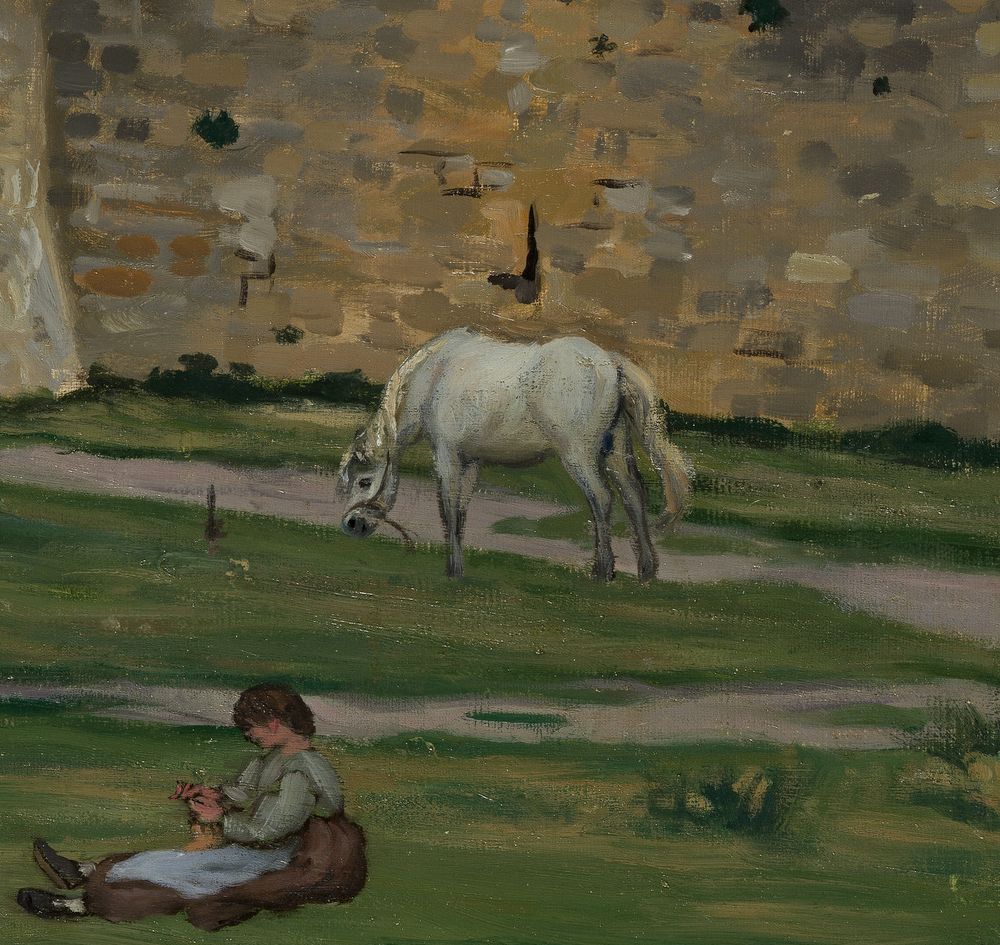
At the right, the pale horse lowers its head towards the grass. Its side-on position opens out the shape of the body, contrasting with the foreshortened mounted horse. The animals are separated by a generous stretch of ground. Their related grey colouring ties the foreground together, while their different poses keep it from becoming repetitive.
Closer to the spectator, the seated woman forms a low, spreading shape. Her skirt, bent arms and extended legs hold the eye near the earth. Schulman describes her as knitting; the small scale of her hands makes the precise activity less immediately legible than her absorbed posture. Two children play nearby, one dark-clothed and the other in a paler outfit. [2] Their low bodies establish another level beneath the standing figures and horses.
The progression from children to seated adult, standing figure, rider and towers gives us a series of heights. Bazille has made scale something the eye can experience across the picture. The tiny people visible in the distant street extend that progression inward. Human life appears at several distances, while the architecture remains the setting that connects them.
None of the foreground figures addresses the spectator directly. Their attention belongs within the scene: towards a companion, the grass, an activity in the hands or the other children. This makes the view feel available to observation without turning it into a posed assembly. The spectator can study these relationships while remaining outside their immediate exchanges.
Annotated Details from Porte de la Reine at Aigues-Mortes
The numbered points identify visible features discussed in this article. Return from each detail to the whole composition. Porte de la Reine at Aigues-Mortes
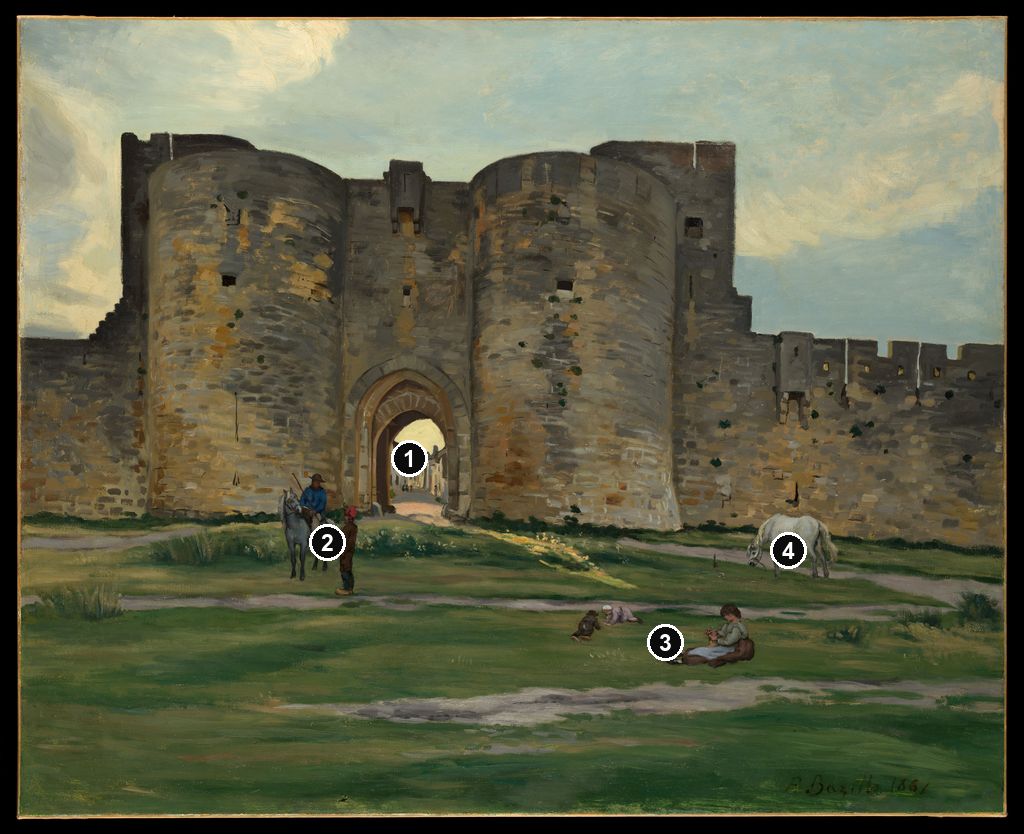
Details from PORTE DE LA REINE AT AIGUES-MORTES
Compare the cropped details with the complete images above. Notice how their colours, shapes and positions contribute to the larger compositions.
Light through the arch
The small bright street opens inside successive dark arches, compressing a long distance into a narrow interval.
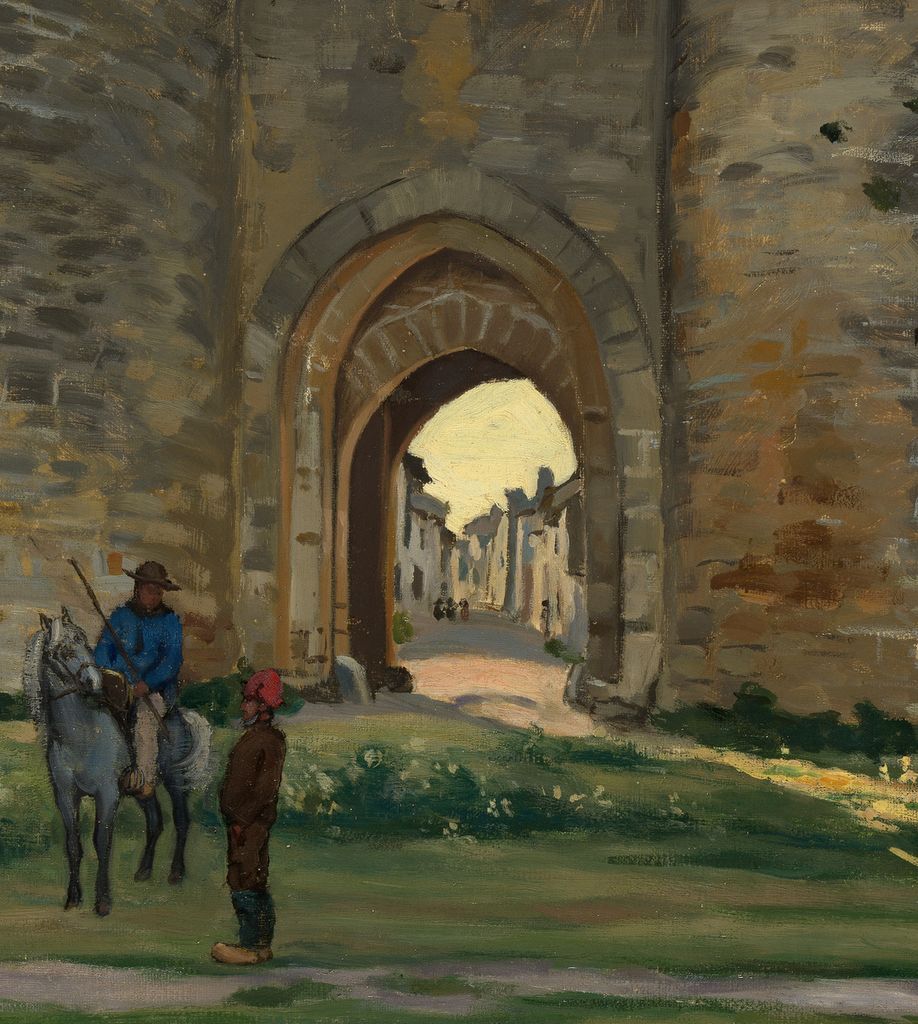
Rider and standing figure
Blue clothing and a red cap separate the two people from the warm masonry and green ground.
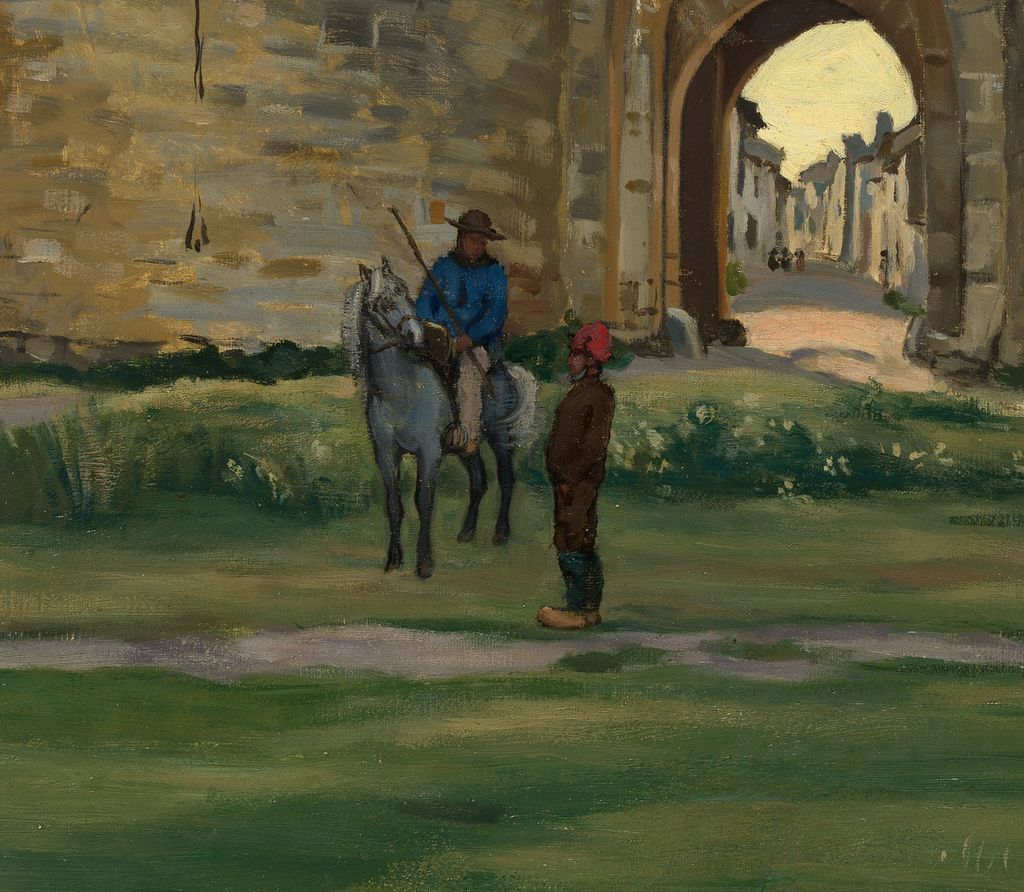
The seated woman and children
Low poses establish another scale beneath the wall, with their attention contained within the foreground.
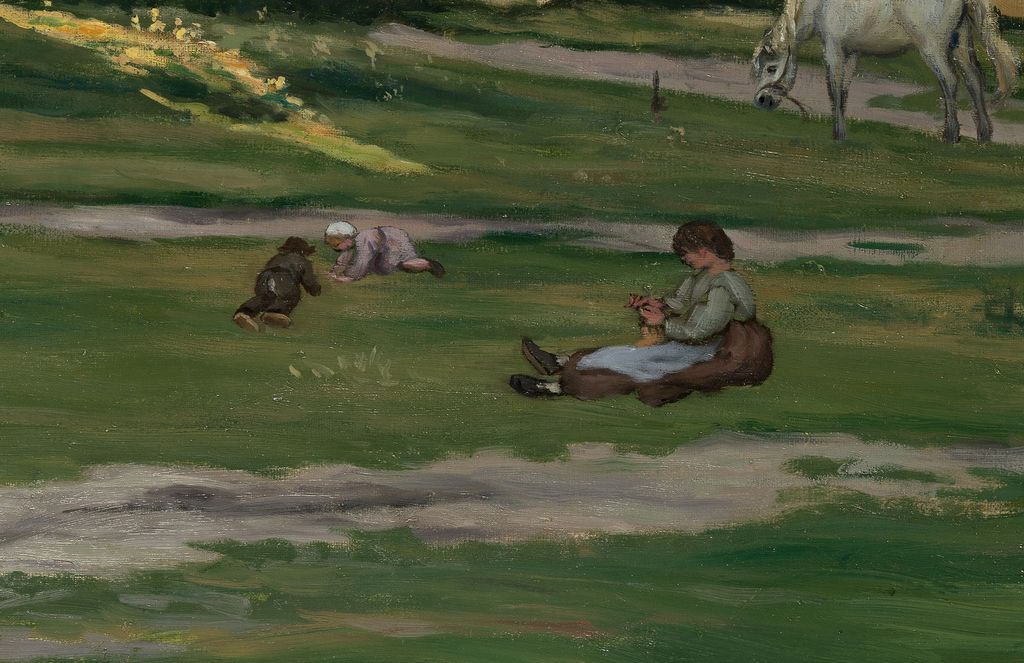
The grazing horse
The side-on animal and lowered head contrast with the frontal mounted horse across the field.
Light passing through stone
The Metropolitan Museum emphasises the contrast between sunlight coming through the archway and the afternoon shadow surrounding the figures and grazing pony. [1] That distinction is essential to the painting. The most brilliant light occurs beyond a dark barrier, and reaches the foreground only in a narrow, oblique passage.
Follow the pale strip emerging from the gate. It begins at the warm ground inside the opening and runs diagonally across the grass towards the right. Along its edges, yellow-green touches sharpen the difference between lit and shaded ground. The effect makes light seem to travel through the building. The gate is both the obstacle that interrupts it and the aperture that gives it a visible direction.
The broad foreground shadows are full of colour. Dark green, cooler blue-green and muted brown passages sit beside paler paths. The pale horse remains visible within this subdued area, its back and flank picking up changes of tone. The blue blouse and red cap remain distinct, too. Shadow here is an environment shared by the figures and animals, rather than a blanket darkness that erases them.
The wall likewise contains more colour than its sombre first impression suggests. Ochre, grey, muted pink and brown marks suggest irregular courses of stone. Small dark openings and scattered green touches disturb the surface. The rounded towers emerge from the changing direction and density of these marks, especially where their sides turn away. Bazille gives the masonry weight without making its whole surface smooth or uniform.
The paint changes pace from one area to another. Repeated short marks articulate the stones; broader strokes spread across grass and sky. Near the lower edge, elongated touches of pale earth interrupt the green. These differences make each material recognisable while preserving the visible work of the brush. We can read a stone wall, a cloud or a patch of ground and still notice how economically each has been painted.
The distinction between surface and distance is particularly clear in the street. At close viewing, its houses and people resolve into small touches; from farther back, they form a convincing recession. The distant scene is precise in its effect without requiring the detail of an architectural survey. The gate’s dark frame concentrates our attention on those few illuminated marks.
Watch: Bazille and early Impressionism
Explore a Paris studio with Smarthistory, then discover the beginnings of Impressionism with the National Gallery of Art.
Jean-Frédéric Bazille, The Artist’s Studio, Rue Visconti, Paris
A close look at Bazille’s 1867 painting of the studio he shared in Paris.
Watch on YouTubeThe Aigues-Mortes stay in 1867
Schulman traces Bazille’s interest in painting at Aigues-Mortes to plans made in 1866, before the stay he eventually undertook the following spring. The signed and dated canvas records the year 1867 at the lower right. [2] A surviving letter brings us closer to the practical circumstances of that landscape campaign.
Writing to his mother from Aigues-Mortes, in a letter dated late May 1867 by the Musée Fabre, Bazille reported that he was staying at the Hôtel Saint-Louis. Unsuitable weather had allowed him to go out to paint only four times. He had nevertheless started three or four landscapes of the surrounding area. [3]
For a large canvas, he planned to paint the walls reflected in the water at sunset. He expected a simple composition, but thought he would need at least eight fine days to complete it. [3] That description is especially relevant to the panoramic rampart subjects. It should not be treated as an exact description of the gate picture, whose foreground is organised around grass, paths, people and horses. The letter places the surviving works within a shared undertaking without identifying every canvas or giving a complete sequence of execution.
Its estimate of the days required also complicates any impression that these landscapes were effortless records of a moment. Bazille depended on conditions he could not command. A subject could be clear in his mind while the time needed to paint it remained uncertain. The sunny opening in Porte de la Reine can be appreciated as a carefully selected relationship of light and shade within that weather-dependent practice.
Other parts of the letter bring the stay into the rhythms of daily life. He requested a newspaper, arranged money for the rent of his Paris studio in the rue Visconti, and asked for very black, wood-cased Conté pencils. He also wanted Victor Hugo’s book about travels along the Rhine. “I have a great need for books,” he wrote, in a new English translation from the French. [3] His practical and intellectual life extended beyond the hours spent outdoors. The request does not establish that Hugo’s writing supplied this picture’s subject.
The Musée Fabre’s account of the Aigues-Mortes landscapes treats them as an important development in Bazille’s southern work, associating the exposed light with a clearer palette and freer handling, and placing Monet’s example in the background. [4] Michel Hilaire similarly regards the three landscapes as evidence of growing artistic maturity. [5] In the gate picture, that development is visible in the assurance with which large architectural masses, small figures and fleeting light coexist. Its colour can be restrained in the shadows and still feel luminous.
Drawing the horses and children
The associated drawings direct attention towards the foreground rather than merely confirming the importance of the monument. Schulman links the painting with three ink studies of horses, catalogued as MSb-225, MSb-226 and MSb-227, and with a pencil study of a seated child, MSb-249. The sheets belong to the album RF 5259 in the Musée d’Orsay collections. [2] [6]
These connections help explain why small figures and animals deserve sustained attention. A horse occupies little of this large façade, yet its pose must remain readable. The relation between head, body and legs is quite different in the frontal mounted animal and the grazing horse seen from the side. The children present another problem of scale and posture, their bent bodies needing to register low against the grass.
The surviving titles and catalogue associations do not establish an exact order in which the sheets were made, or prove that every mark was transferred into the painting. They show that studies of living forms belonged alongside the architectural landscape. A preparatory drawing can concern a modest component whose effect becomes decisive only in the finished arrangement.
Bazille’s request for Conté pencils adds documentary evidence that he wanted drawing materials during the stay. [3] It does not identify the material of the ink studies or date each album leaf. The useful connection is broader: working outdoors involved selecting and testing separate motifs as well as confronting the whole view. His drawings and sketchbooks reveal comparable exchanges between individual studies and larger painted compositions.
Different distances from the same town
Three Aigues-Mortes views survive, although the letter mentions three or four projects begun. The 2017 National Gallery of Art retrospective checklist distinguishes the western ramparts, the Porte de la Reine and the other ramparts view as separate paintings. [3] [7] Their relationship is best understood through changes in viewpoint and pictorial emphasis, rather than an assumed sequence.
In The Western Ramparts at Aigues-Mortes, a broad expanse of water separates the spectator from the long wall. Its horizontal shape makes room for the architecture to extend laterally and for reflections to break beneath it. The gate painting brings us onto the ground immediately outside the fortifications. The wall rises in front of us, and the distant town must be glimpsed through a single opening. The two works turn the same kind of substantial structure into very different experiences of space.
The comparison also reveals how much the foreground does. Water in the western view allows colour to repeat and loosen the shapes above it. Here the grassy field supports separate bodies, paths and shadows. The towers seem especially heavy because the figures below are so small, while the foreground itself remains broad enough to carry their activities. Bringing architecture closer has created room for a more intimate encounter with contemporary life.
Earlier, in Landscape at Chailly, dated 1865, Bazille had explored another meeting of substantial forms and open atmosphere: pale rocks and rising tree masses beneath a large sky. [8] Comparing that clearing with the gate is useful because the subjects differ so much. Stone can organise a landscape whether it appears as broken ground or as an immense constructed wall. In each case, contrasts of light help the eye move between the near surface and more distant space.
The later Landscape on the Banks of the Lez, dated 1870, distributes attention through trees, a clearing and rough foreground earth. [9] Its low masonry opening is almost absorbed into the terrain. The gateway at Aigues-Mortes commands the view. Seen together, the paintings show Bazille changing the role of built structures within landscape, from the monumental centre to a small element encountered among trees and stones.

The Western Ramparts at Aigues-Mortes
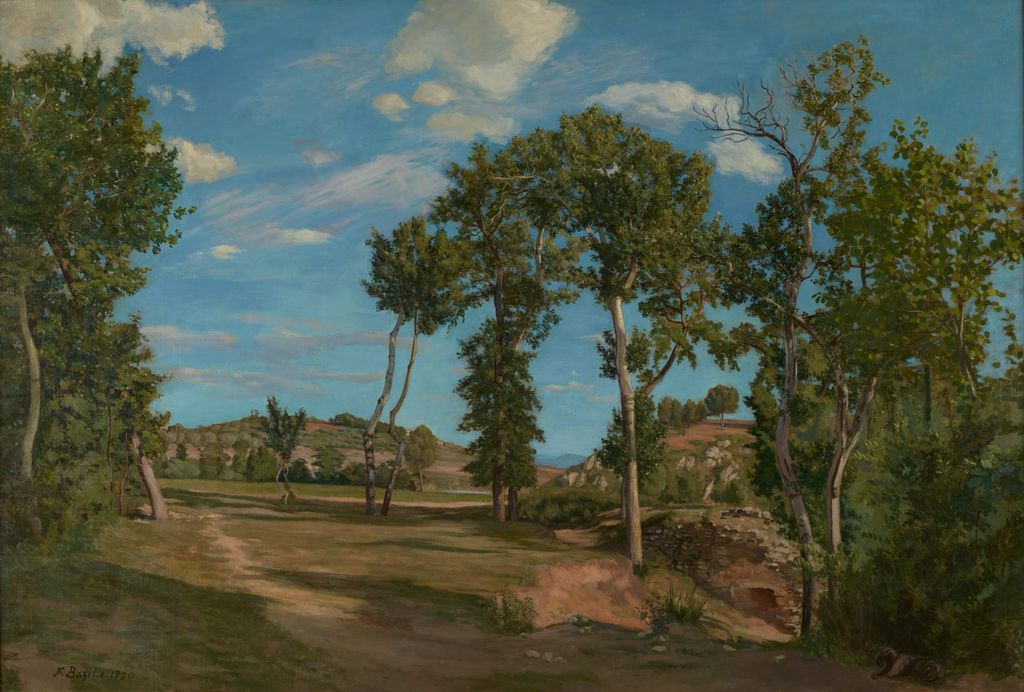
Landscape on the Banks of the Lez Image source. Public domain. Resized proportionally; full painting retained.
Collectors, exhibitions and the Met
Schulman’s ownership history begins with Jules Leenhardt and records subsequent private owners before the painting passed through Wildenstein in New York and the collection of Alan Clore. It appeared at Christie’s in London on 27 June 1988. [2] The Metropolitan Museum acquired it that year by exchange, using the gift of Raymonde Paul in memory of her brother, C. Michael Paul. Its accession number is 1988.221. [1]
The work’s exhibition history charts its place in the reassessment of Bazille. Schulman lists its appearance in the Montpellier retrospective of 1927, the Art Institute of Chicago’s exhibition in 1978, and the Montpellier, Paris and Washington retrospective of 2016–17. [2] The Washington checklist included it alongside the two other Aigues-Mortes views, allowing the close encounter with the gate to be considered within the larger landscape campaign. [7]
The Met’s interpretation is particularly helpful in directing attention back to the painting itself: the immense wall and the modest opening through which light enters. [1] That relationship connects its different scales. The towers hold their place above the rider and grazing horse; the children remain occupied near the seated woman; the distant street continues beyond the arch. Bazille gives all these elements a common atmosphere, making an old gate the centre of a landscape still being lived in.
Bazille catalogue directory
The 284 records comprise 85 painting records,40 separate works-on-paper records and 159 album or study records. They describe the catalogue’s organisation rather than 284 independent objects or unanimously accepted attributions. Recto, verso, albums and multiple studies remain distinct. Dates are qualified where needed; the Drawing filter includes the etching, gouache and mixed works on paper. Manuscript mentions and unproved projects are listed separately below.
Works known through documents
These mentions remain separate from the 284 catalogue records. Some may concern surviving studies or underlying compositions; they cannot simply be added together as missing physical paintings.
- A copy after Rubens mentioned in March 1863 is unlocated.
- A portrait of an unidentified woman was reported completed before July 1866.
- A portrait of Monet and a composition of two life-size women arranging flowers were reported in progress in April 1867. Their mention does not establish two otherwise unknown surviving canvases.
- Gertrude et le père Lapin was at least begun in the summer of 1870.
Further reported works and uncertain attributions
- A Bouquet of Lilacs was reportedly stolen and returned in 1864; a portrait of the friend Theulier and Yellow Narcissi reported by Maître in 1868 are also documentary mentions.
- Unidentified pictures associated with Guillemet and Mme Rolina are reported through later correspondence cited by the catalogue.
- Children Dressed as Bride and Groom was associated with Vallotton’s collection and also attributed to Renoir. Its identification and authorship should remain open.
Projects whose completion is unproved
- A portrait of Pauline was planned in July 1865.
- A portrait of Marc was proposed in April 1866; a related drawing survives.
- A Jardinière project appears in album inscriptions and related figure material. Written plans are not evidence of a completed painting.
| Name | Date | Medium |
|---|---|---|
| Mystic Marriage of St. Catherine | 1863 | Oil on canvas |
| Trees, Study | 1863 | Oil on canvas |
| Farm of Saint-Sauveur | 1863 | Oil on canvas |
| In the Garden of the Parc Monceau, Paris | 1864 | Oil on canvas |
| Naked Woman from Behind | 1864 | Oil on canvas |
| Reclining Nude | 1864 | Oil on canvas |
| Courtyard of the Auberge du Cheval blanc at Chailly near Barbizon | 1864 | Oil on canvas |
| Covered Soup Bowls | 1864 | Oil on canvas |
| Two Herrings | 1864 | Oil on canvas |
| The Pink Dress | 1864 | Oil on canvas |
| The Dog Rita Asleep | 1864 (catalogue); c. 1864 (2017 checklist) | Oil on canvas |
| The Scoter | 1864 | Oil on canvas |
| Naked Reclining Woman | 1864 | Oil on canvas |
| Landscape at Chailly | 1865 | Oil on canvas |
| Rocks at Chailly, Forest of Fontainebleau | 1865 | Oil on canvas |
| Undergrowth at Chailly, Forest of Fontainebleau | 1865 | Oil on canvas |
| Still Life with Grapes and Nuts | 1865 | Oil on canvas |
| Self-Portrait with a Palette — Chicago | 1865 | Oil on canvas |
| Landscape of Saint-Sauveur | 1865 | Oil on canvas |
| Beach at Sainte-Adresse | 1865 | Oil on canvas |
| The Improvised Field Hospital | 1865 | Oil on canvas |
| Village Street, Chailly | 1865 | Oil on canvas |
| Small Valley in the Forest of Fontainebleau | 1865 | Oil on canvas |
| Forest of Fontainebleau | 1865 | Oil on canvas |
| Woman Ironing | 1866 | Oil on canvas |
| The Artist's Studio on the rue de Furstenberg | 1865–66 (museum) | Oil on canvas |
| Still Life with Fish | 1866 | Oil on canvas |
| Little Italian Street Singer | 1866 | Oil on canvas |
| Potted Flowers | 1866 | Oil on canvas |
| The Little Gardener | 1866–1867 | Oil on canvas |
| Young Woman Playing the Piano | 1866–1867 | Oil on canvas |
| End of a Summer Day | 1866–1867 | Oil on canvas |
| A Studio on the rue Visconti | 1867 | Oil on canvas |
| Thérèse Reading in the Park at Méric | 1867 | Oil on canvas |
| Portrait of Verlaine | 1867 | Oil on canvas |
| The Terrace at Méric | 1867 | Oil on canvas |
| Still Life with Heron | 1867 | Oil on canvas |
| The Family Gathering | 1867–68 (museum) | Oil on canvas |
| Oleanders | 1867 | Oil on canvas |
| Woman on the Terrace at Méric | 1867 | Oil on canvas |
| The Ramparts at Aigues-Mortes from South | 1867 | Oil on canvas |
| The Western Ramparts at Aigues-Mortes | 1867 | Oil on canvas |
| Portrait of Edmond Maître — head study | 1867 | Oil on canvas |
| Porte de la Reine at Aigues-Mortes | 1867 | Oil on canvas |
| Portrait of Sisley | 1867 | Oil on wood |
| Portrait of Renoir — Cleveland | 1867 | Oil on canvas |
| Portrait of Renoir — Musée d’Orsay | 1867 | Oil on canvas |
| Self-Portrait with a Detachable Collar — Minneapolis | 1865–67 (museum); 1867–68 (catalogue) | Oil on canvas |
| Vase of Flowers on a Console | 1868 (museum); 1867–68 (catalogue) | Oil on canvas |
| Portrait of a Woman | 1868 | Oil on canvas |
| Young Woman in the Vineyards | 1868 | Oil on card |
| Harvester with a Basket | 1868 | Oil on card |
| Harvester with a Yellow Hat | 1868 | Oil on card |
| Harvester with a Headdress | 1868 | Oil on panel |
| On the Banks of the Lez | 1868 | Oil on canvas |
| After the Bath (attribution questioned) | 1868? | Oil on canvas |
| Young Woman with Lowered Eyes | 1868 | Oil on canvas |
| Fisherman with a Net | 1868 | Oil on canvas |
| View of the Village | 1868 | Oil on canvas |
| Portrait of Bazille (attributed to Monet by Musée Fabre; disputed catalogue attribution) | 1864 (museum); 1868 (catalogue) | Oil on panel |
| Studies for a Grape Harvest (two panels) | 1868 | Oil on canvas (two panels) |
| The Fortune Teller | 1868–69 (catalogue); c. 1869–70 (2017 checklist) | Oil on canvas |
| Harvester with a Cap | 1869 | Oil on card |
| Portrait of Edmond Maître — 1869 | 1869 | Oil on canvas |
| Woman in a Moorish Costume | 1869 | Oil on canvas |
| Young Woman in the Garden | 1869 | Oil on canvas |
| Portrait of Alphonse Tissié in a Cavalryman's Uniform | 1869 | Oil on canvas |
| Portrait of a dragoon | 1869 | Oil on canvas |
| Portrait of Zacharie Astruc | 1869 | Oil on canvas |
| Bunch of Grapes in a Bucket | 1869 | Oil on card |
| Portrait of Edouard Blau | Probably 1869; inscribed 1866 | Oil on canvas |
| Young Male Nude Lying on the Grass | 1870 | Oil on canvas |
| Summer Scene | 1869–1870 | Oil on canvas |
| The Studio on the rue La Condamine | 1869–1870 | Oil on canvas |
| La Toilette | 1870 | Oil on canvas |
| Young Woman with Peonies — Montpellier | 1870 | Oil on canvas |
| Young Woman with Peonies — Washington | 1870 | Oil on canvas |
| Monotonous Chant | 1870 | Oil on canvas |
| Flowers — private collection | 1870 | Oil on canvas |
| Flowers — Musée Fabre | 1870 | Oil on canvas |
| Young Fisherman | 1870 | Oil on canvas |
| Study for Ruth and Boaz | 1870 | Oil on wood |
| Ruth and Boaz | 1870 | Oil on canvas |
| Self-Portrait in Shirt Sleeves | 1870 | Oil on canvas |
| Landscape on the Banks of the Lez | 1870 | Oil on canvas |
| Study after an Alpine Landscape | 1860 | Graphite on watercolour-tinted paper |
| Profile Head | 1862 | Charcoal on laid paper |
| Studies after Delacroix | 1863 | Ink and graphite, with gouache and watercolour, on paper |
| Academic Head | 1863 | Charcoal on paper |
| Study of a Woman's Head in Profile on a Chair | 1863 | Charcoal on paper |
| Academic Head of a Woman | 1863 | Charcoal on paper |
| Academy of Woman | 1863 | Black pencil and charcoal, stumped, on watermarked laid paper |
| Academy of Man | 1863 | Black pencil and charcoal, stumped, on watermarked laid paper |
| Naked Man | 1863 | Charcoal on paper |
| The Pont au Change in Paris | 1864 | Watercolour on paper |
| Study for the Pink Dress or Portrait of Thérèse des Hours | 1864 | Black pencil on paper |
| Naked Woman Standing | 1864 | Pencil on paper |
| Study of a Reclining Nude | 1864 | Charcoal on paper |
| Bathers | 1864 | Charcoal on paper |
| Portrait of a Man | 1864 | Charcoal on paper |
| Study for The Pink Dress | 1864 | Black pencil, squared, on paper |
| Study for Landscape of Saint-Sauveur | 1864 | Graphite on paper |
| Study for Landscape of Saint-Sauveur | 1865 | Pencil on paper |
| Man Taming a Bull | 1866 | Pen and black pencil on paper |
| Man Half Lying on a Sofa | 1866 | Charcoal on paper |
| Study for The Family Gathering | 1867 | Pencil on paper |
| Study for The Family Gathering | 1867 | Graphite, charcoal and black pencil on paper |
| The Embroiderer | 1867 | Pencil on pink paper |
| Study of Children | 1867 | Pencil on paper |
| Women in a Garden | 1867 | Pencil drawing |
| View of the Village | 1868 | Etching on paper |
| Portrait of a Bearded Man (catalogued as Self-Portrait) | Undated (museum); 1869 (catalogue) | Charcoal and brown ink |
| Man Smoking Pipe | 1869 | Watercolour on paper |
| Manet Drawing | 1868–70(?) (museum) | Charcoal and white chalk on paper |
| Study for the Summer Scene | 1869 | Charcoal, pen and ink on paper |
| Family Portrait | 1869 | Pastel and charcoal on paper |
| Study for Ruth | 1870 | Pencil and charcoal on paper |
| Woman Arranging a Hat | 1870 | Pencil drawing |
| Study for Boaz Asleep | 1870 | Pastel and red chalk |
| Boaz Asleep | 1870 | Charcoal and pencil on paper |
| Study for Boaz Asleep | 1870 | Black and beige pastel with red chalk on laid paper |
| Ruth Lying down | 1870 | Charcoal and pastel on paper |
| Head, Arm and Chest of Ruth | 1870 | Charcoal on paper |
| Chest of Ruth | 1870 | Black chalk and charcoal on paper |
| Black Woman with Peonies — gouache | c. 1870 | Gouache, watercolour, pencil and black chalk on card |
| Various Unidentified Subjects | Undated | Pencil drawing |
| Rocky Sea Side | Undated | Charcoal on paper |
| Studies of a Dancing Woman | Undated | Drawing with white chalk |
| Study of a Leg | Undated | Pencil drawing |
| Dancers in Camargue | Undated | Pencil drawing |
| Academy of Woman | Undated | Charcoal |
| Caricature of Venus of Milo and Various Other Caricatures | Undated | Charcoal |
| Caricature | Undated | Pencil drawing |
| Study of Landscape | Undated | Charcoal |
| Caricatures and Seated Monk | Undated | Charcoal |
| Caricatures and Various Subjects | Undated | Pencil drawing |
| Women Carrying a Pitcher | Undated | Pencil drawing |
| The Hanged Man | Undated | Charcoal |
| Castle in the Plain | Undated | Charcoal |
| Naked Woman from Behind | Undated | Charcoal |
| Caricatures | Undated | Charcoal and pencil |
| Unidentified Subjects | Undated | Pencil drawing |
| Landscape with a Castle | Undated | Charcoal |
| Study of Landscape | Undated | Charcoal |
| Horse Rider seen from Behind | Undated | Charcoal |
| Mazeppa | Undated | Pencil and charcoal |
| Study of Rider and Others Subjects | Undated | Pencil, pen and brown ink |
| Study of an Unidentified Man | Undated | Pencil drawing |
| Study for an Unknown Historic Scene | Undated | Pencil drawing |
| Study a Man Reading | Undated | Pencil drawing |
| Study of Men Reading | Undated | Pencil drawing |
| Study of Landscape ? | Undated | Charcoal |
| Study of a Head of a Man | Undated | Pencil drawing |
| Erotic Scene | Undated | Pencil drawing |
| Study of Dog | Undated | Charcoal |
| Studies of Unidentified Subjects and Erotic Scene | Undated | Pencil and charcoal drawing |
| Study for a Theater Scene | Undated | Charcoal |
| Study of a Reclining Naked Woman | Undated | Charcoal |
| Two Studies of Landscape | Undated | Pencil drawing |
| Caricature | Undated | Pencil and charcoal drawing |
| Portrait of an Unidentified Young Man | Undated | Charcoal |
| Study of an Unidentified Subject | Undated | Brown ink drawing |
| Unidentified Man with a Hat | Undated | Pencil and charcoal |
| Study of an Unidentified Women | Undated | Pencil drawing |
| Study for a Theater Character ? | Undated | Pencil drawing |
| Study for a Theater Character ? | Undated | Pen drawing |
| The Pavillon de la Reine in Paris | Undated | Pencil drawing |
| Study of a Horse Rider | Undated | Pencil and charcoal drawing |
| Entwined Couple. Caricature ? | Undated | Pencil drawing |
| Woman Sitting on a Sofa | Undated | Pencil drawing |
| Studies of Unidentified Subjects | Undated | Pencil and charcoal drawing |
| Studies of Animals | Undated | Pencil drawing |
| Study of a Horse Rider in Camargue | Undated | Charcoal |
| Study of Hunting Dogs | Undated | Pencil drawing |
| Study of Soldiers. Caricatures | Undated | Pencil drawing |
| Studies of Hunting Dogs ? | Undated | Pencil drawing |
| Hunting Scene. Hunter Playing the Horn | Undated | Pencil drawing |
| Caricature | Undated | Pencil drawing |
| Study of an Ibex | Undated | Pencil drawing |
| Theater Scene. Caricatures | Undated | Pencil drawing |
| Studies of Animals. Horses ? | Undated | Pencil drawing |
| Caricatures | Undated | Pencil drawing |
| Studies of Various Subjects and Animals | Undated | Pencil drawing |
| Unidentified Subject | Undated | Pencil drawing |
| Rider Taming a Horse [in Camargue ?] | Undated | Pencil drawing |
| Caricature of a Soldier | Undated | Pencil drawing |
| Study of a Woman and Mouse | Undated | Pencil drawing |
| Historic Scene | Undated | Charcoal |
| Architecture Studies | Undated | Pencil drawing |
| Mythologic Scene | Undated | Charcoal |
| Ophelia | Undated | Pencil drawing |
| Mythologic Scene | Undated | Charcoal |
| Studies of Various Subjects | Undated | Pencil and pen drawing |
| Studies of Peasants | Undated | Pencil drawing |
| Historic Scene | Undated | Pencil drawing |
| Historic or Literary Scene | Undated | Pencil drawing |
| Unidentified Historic Scene | Undated | Pencil drawing |
| Studies of Unidentified Subjects | Undated | Pencil drawing |
| Unidentified Study | Undated | Pencil drawing |
| Man in an Armchair | Undated | Pencil drawing |
| Studies of Various Subjects | Undated | Pencil drawing |
| Portraits of Unidentified Men | Undated | Pencil drawing |
| Studies of Various Subjects | Undated | Pencil drawing |
| Horse Rider and Artist | Undated | Charcoal and pencil |
| Study of Unidentified Characters | Undated | Charcoal |
| Dead Horse in a Plain | Undated | Charcoal |
| Study of Various Subjects and Furniture | Undated | Pencil drawing |
| Caricatures and Various Notes about Opéra | Undated | Pencil drawing |
| Galloping Horse | Undated | Charcoal |
| Study for La Toilette | Undated | Pencil drawing |
| Study of a Naked Woman | Undated | Pencil drawing |
| Domestic Scene | Undated | Pencil drawing |
| Physiognomies | Undated | Pencil drawing |
| Study for a Grape Harvest | Undated | Pencil drawing |
| Study for the Summer Scene | Undated | Pencil drawing |
| Female Profiles | Undated | Pencil drawing |
| Various Subjects | Undated | Pencil drawing |
| Study for The Terrace at Méric | Undated | Pencil drawing |
| Study for The Ramparts at Aigues-Mortes | Undated | Pencil drawing |
| Study for The Ramparts at Aigues-Mortes | Undated | Pencil drawing |
| Study for a Grape Harvest | Undated | Charcoal |
| Children Portraits | Undated | Pencil drawing |
| Study for Children's Heads | Undated | Pencil drawing |
| Study of Minerva | Undated | Pencil drawing |
| Study for a Grape Harvest | Undated | Pencil drawing |
| Study for The Family Gathering | Undated | Pencil drawing |
| Study for a Young Fisherman | Undated | Charcoal |
| Self-Portraits | Undated | Black pencil drawing |
| Study of Horses for the Porte de la Reine at Aigues-Mortes | Undated | Ink drawing |
| Study of Horses for the Porte de la Reine at Aigues-Mortes | Undated | Ink drawing |
| Study of Horses for the Porte de la Reine at Aigues-Mortes | Undated | Ink drawing |
| Study for an Outdoor Concert | Undated | Pencil drawing |
| Studies of Legs | Undated | Pencil drawing |
| Study for The Ramparts at Aigues Mortes | Undated | Pencil drawing |
| Studies of Hats | Undated | Pencil drawing |
| Studies of Men | Undated | Pencil drawing |
| Study for The Little Gardener | Undated | Pencil drawing |
| Study for The Ramparts at Aigues Mortes | Undated | Charcoal |
| Studies of Sail Boats | Undated | Pencil drawing |
| Portrait of Marc Bazille | Undated | Charcoal, black pencil and graphite |
| Studies of Children's Heads | Undated | Pencil drawing |
| Study for Aigues-Mortes | Undated | Pencil drawing |
| Studies of Women's Heads | Undated | Pencil drawing |
| Portrait of Camille des Hours and an Unidentified Man | Undated | Charcoal |
| Study of Flying Birds | Undated | Charcoal or graphite |
| Study for the Summer Scene | Undated | Pencil drawing |
| Study of Hands | Undated | Pen drawing |
| Self-Portrait | Undated | Black pencil drawing |
| Study for the Summer Scene | Undated | Pencil drawing |
| Study for the Summer Scene | Undated | Pencil drawing |
| Study for a Grape Harvest | Undated | Pencil drawing |
| Study of Branches | Undated | Pencil drawing |
| Study of a Seated Child | Undated | Pencil drawing |
| Study for a Couple and Unidentified Women | Undated | Pencil drawing |
| Studies of Unidentified Women | Undated | Pencil drawing |
| Study of Buildings | Undated | Pencil drawing |
| Study for a Grape Harvest | Undated | Pencil and charcoal |
| Studies of Boaters | Undated | Pencil drawing |
| Study of a Man Writing at his Table | Undated | Pencil drawing |
| Study of a Woman Cutting Flowers | Undated | Pencil drawing |
| Study of Hand | Undated | Pencil drawing |
| Women in a Garden | Undated | Pencil drawing |
| Studies of Women in Profile | Undated | Pencil drawing |
| Study for Ruth and Boaz | Undated | Charcoal |
| Study for The Family Gathering | Undated | Pencil drawing |
| Study for the View of the Village | Undated | Pencil drawing |
| Study of the View of the Village | Undated | Pencil drawing |
| Study for the Fisherman with a Net | Undated | Pencil drawing |
| Study for the View of the Village | Undated | Charcoal |
| Study for The Little Gardener | Undated | Charcoal |
| Portrait of a Man with a Top Hat | Undated | Pencil drawing |
| Portrait of a Man with a Top Hat | Undated | Pencil drawing |
| Inscriptions | Undated | Pencil inscriptions |
| Study of Tree | Undated | Pencil drawing |
| Caricature of Nina la Belle | Undated | Pencil drawing |
| Study for Saint Sebastian | Undated | Pencil drawing |
| Young Woman Sewing | Undated | Pencil drawing |
| Studies of Hands | Undated | Pencil drawing |
| Woman in a Garden | Undated | Pencil drawing |
| Elegant Woman | Undated | Pencil drawing |
| Various Inscriptions | Undated | Inscriptions (medium unspecified in index) |
| Study of a Man with a Hat | Undated | Pencil drawing |
| Study of a Child | Undated | Pencil drawing |
| Study of a Man with a Hat | Undated | Pencil drawing |
Frequently Asked Questions
It belongs to the Metropolitan Museum of Art in New York, accession 1988.221. [1]
Schulman interprets him as a Camargue gardian, but neither his personal identity nor his occupation is proved by the picture. [2]
Discussion
The gate connects sunlit masonry, a dark passage and small figures. What first makes its scale convincing?
Reader Insights
How does the small illuminated street change your impression of the immense wall?
Compare the frontal mounted horse with the side-on grazing horse. How do they give the foreground different kinds of movement?
What do the seated woman and children contribute to the scale of the architecture?
Join the Conversation
Share a detail, comparison or question about Porte de la Reine at Aigues-Mortes by Frédéric Bazille below.
References
- Metropolitan Museum of Art, Porte de la Reine at Aigues-Mortes, 1867, accession 1988.221; collection commentary, object data and acquisition credit. Collection record. View source.
- Michel Schulman, Frédéric Bazille: Le catalogue raisonné numérique, “Porte de la Reine at Aigues-Mortes,” MSb-32; critical essay, related drawings, provenance and exhibition history. Catalogue entry (English translation of French scholarship; provenance and exhibition fields partly in French). View source.
- Frédéric Bazille, letter to his mother, Aigues-Mortes, late May 1867, Musée Fabre, inventory 94.7.2; manuscript facsimile and transcription, PDF pp. 1–4. Date assigned editorially by the museum; English quotation newly translated from the French. Letter (in French). View source.
- Musée Fabre, Frédéric Bazille: la jeunesse de l’impressionnisme, 2016 press dossier, especially “Dans la lumière du Sud,” p. 16. Press dossier (in French). View source.
- Michel Hilaire, “Bazille ou la vie brève,” Académie des Sciences et Lettres de Montpellier, 2016, pp. 166–172, especially p. 169. Lecture (in French). View source.
- Michel Schulman, Frédéric Bazille: Le catalogue raisonné numérique, horse studies MSb-225, MSb-226 and MSb-227, and Study of a Seated Child, MSb-249; medium and album metadata (English titles; object fields in French). View source 1. View source 2. View source 3. View source 4.
- National Gallery of Art, Frédéric Bazille and the Birth of Impressionism, 2017 exhibition checklist, catalogue nos. 36–38. Checklist. View source.
- Michel Schulman, Frédéric Bazille: Le catalogue raisonné numérique, “Landscape at Chailly,” MSb-14; object date and reproduction. Catalogue entry (English translation of French scholarship; object fields partly in French). View source.
- Minneapolis Institute of Art, Landscape by the Lez River, 1870, accession 69.23; object data and reproduction. Collection record. View source.
- Joconde/POP, La Robe rose, RF2450. View source. (in French).
- Musée d’Orsay, L’Ambulance improvisée, RF 1967 5. View source. (in French).
- Musée d’Orsay, Réunion de famille,RF2749. View source. (in French).
- Musée d’Orsay, Pierre Auguste Renoir,DL1970 3. View source.
- Musée Fabre, Vue de village, 898.5.1. View source. (in French).
- National Gallery of Art, Young Woman with Peonies,1983.1.6. View source.
- Michel Schulman, painting index and documentary introduction (English titles; French metadata). View source.
- Michel Schulman, works-on-paper index (English titles; French metadata). View source.
- Michel Schulman, albums and studies index (English titles; French metadata). View source.


 Frederic Bazille.jpg)


