 by Tom Gurney
Tom Gurney BSc (Hons) is an art history expert with over 20 years experience
Published on June 19, 2020 / Updated on November 2, 2026
Email: tomgurney1@gmail.com / Phone: +44 7429 011000
Frédéric Bazille: Biography: Introduction
Frédéric Bazille’s life was divided between the working rooms of Paris and the family properties around Montpellier. In Paris he learned alongside Monet, Renoir and Sisley, helped sustain their shared studio life and sought a place for his own paintings at the Salon. In the south he developed the ambitious combinations of figure and landscape that became his most distinctive achievement. Born on 6 December 1841 and killed at Beaune-la-Rolande on 28 November 1870, he had less than a decade in which to turn his decision to become an artist into a substantial body of work. He died aged twenty-eight, eight days before his birthday. [1]
His letters make that short career unusually vivid. They move between painting, rent, family expectations, model fees, musical evenings and plans for the next summer. They also show an artist whose ambition grew through practical work: studying the figure in winter, finding subjects outdoors, submitting pictures and revising them. The story of Bazille is therefore more than an account of a promising painter lost to war. It is the history of choices he made, pictures he completed and relationships through which a new approach to painting took shape. [2]
At a Glance
- Born6 December 1841, Montpellier [1]
- Died28 November 1870, Beaune-la-Rolande [1]
- TrainingCharles Gleyre’s studio in Paris [2]
Frédéric Bazille in context
Movement dates are approximate. Bazille died before the Impressionist exhibitions began in 1874.
Bars show each artist’s lifespan.
Charles Gleyre
1806–1874 [7]Eugène Delacroix
1798–1863 [8]Gustave Courbet
1819–1877 [9]Édouard Manet
1832–1883 [10]Alfred Sisley
1839–1899 [11]Claude Monet
1840–1926 [12]Frédéric Bazille
1841–1870 [13]Pierre-Auguste Renoir
1841–1919 [14]Family Reunion
1867–1868 (museum)Bazille’s Studio, Rue La Condamine
1869–1870Summer Scene (Bathers)
1869–1870Contents
- Montpellier, family and the discovery of painting
- Paris, medicine and Charles Gleyre
- Monet, Furstenberg and a working routine
- Chailly, friendship and the first Salon
- Rue Visconti: generosity and its limits
- Rejection and an independent exhibition proposal
- Aigues-Mortes and the family at Méric
- Batignolles, model fees and the Salon of 1869
- Music, theatre and a wider life
- The crowded ambitions of 1870
Montpellier, family and the discovery of painting
Jean Frédéric Bazille was born into an established Protestant family in Montpellier. Earlier generations had worked as goldsmiths; the family’s nineteenth-century interests included commerce and agriculture. His father, Gaston Bazille, participated in the public and agricultural life of the region. The family gave Frédéric access to education, cultivated company and the countryside that would supply so many of his subjects. It also expected him to prepare for a profession. In 1859, after obtaining his science baccalaureate, he entered the medical faculty at Montpellier. [2]
Painting was already a serious attraction. He studied drawing with the Montpellier sculptors Baussan, while the Musée Fabre offered old masters to copy and examine. The museum’s account of his formation stresses his interest in colourists such as Veronese. Nearby, the collector Alfred Bruyas provided another kind of education through his paintings by Delacroix and Courbet. Bazille’s beginnings consequently joined academic study, older painting and the challenging art of his own time. His later friendships in Paris expanded interests that had already begun at home. [2]
The family estate of Méric, overlooking the Lez near Castelnau, became central to his art. Its terraces, garden paths, trees and adjoining countryside offered subjects close enough to revisit. Relatives could pose there; familiar views could be reorganised in successive compositions. Méric also belonged to a working agricultural world. The unfinished project of a grape harvest, mentioned in his correspondence, reminds us that his southern surroundings included labour and cultivation as well as summer leisure. [2]
Family background helps explain his opportunities, but it cannot explain every quality of the pictures. His Protestant upbringing has sometimes been invoked to account for their stillness or restraint. Such readings are interpretations rather than direct evidence of what he intended. A more tangible connection lies in the continuing exchange between son and parents: he needed their financial support, wanted them to recognise his progress and returned to their world to make some of his most ambitious work. Michel Hilaire’s account of Bazille’s life places this dependence alongside the family’s later importance in preserving his reputation. [1]
Four stages of Frédéric Bazille’s career
These periods group related projects; subjects and working methods overlap.
Medicine, training and new companions
Medical studies were followed by artistic training in Paris and work in Gleyre’s studio. The friendship with Monet brought an early outdoor campaign at Chailly. [2]
Testing the studio against the countryside
The Pink Dress, the Normandy commission and the Chailly paintings reveal varied outdoor problems. Winter living-model work and portable equipment formed part of that preparation. [2]
Making ambitious pictures for public view
Still lifes, portraits, southern landscapes and Family Reunion extended his subjects. Salon decisions and plans for an independent exhibition made public recognition an active question. [2]
Several kinds of painting at once
Summer Scene, the peony paintings, Condamine and the final southern works pursue different aims. His death in 1870left several projects unresolved. [2]
 Frederic Bazille.jpg)
Paris, medicine and Charles Gleyre
Bazille moved to Paris late in 1862 under an arrangement that allowed him to develop his art while continuing medicine. He entered the studio of Charles Gleyre, a Swiss-born academic painter whose teaching emphasised drawing, antique models and the human figure. There he came into contact with Monet, Renoir and Sisley. Their friendships grew out of a common place of training, but the painters brought different experience and resources to it. Bazille’s family position gave him advantages that some of his friends lacked; it did not make him their artistic master or remove his own uncertainties as a beginner. [2]
Gleyre’s studio matters because the later story can make these young painters seem fully formed opponents of academic practice. Bazille learned through exercises and live models, and he continued to rely on drawing when constructing paintings. Outdoor work developed beside that training. Monet, already experienced in landscape, helped him paint around Chailly and the forest of Fontainebleau in the spring of 1863. Their expeditions placed them within a landscape tradition associated with Corot and the Barbizon painters while opening room for their own responses to light and the immediate appearance of a place. [2]
In the spring of 1864 he accompanied Monet to Normandy, visiting the coast around Honfleur and encountering Boudin and Jongkind at the Ferme Saint-Siméon. No painting by Bazille from that stay is known to survive. The journey nevertheless broadened his experience of landscape beyond the woods of Fontainebleau and his southern home. His later work would move among distinct settings rather than develop exclusively around Méric. Through the Lejosne family’s Paris circle he also met artists and writers, including Manet, whose treatment of modern subjects became an important example. Family connections and friendships made in training opened different doors into the capital’s artistic life. [2]
The attempt to maintain medicine and painting eventually failed. In a letter assigned to mid-July 1864, Bazille admitted to his father that he feared another examination failure and considered avoiding the examination. In the same letter he described the demanding picture he was trying to finish: sections repeatedly had to be redone, and a day’s work might undo what he had achieved the day before. The letter does not securely identify that canvas. It does show how far the reality of his early practice was from effortless accomplishment. Painting required time that the medical course also demanded. [15]
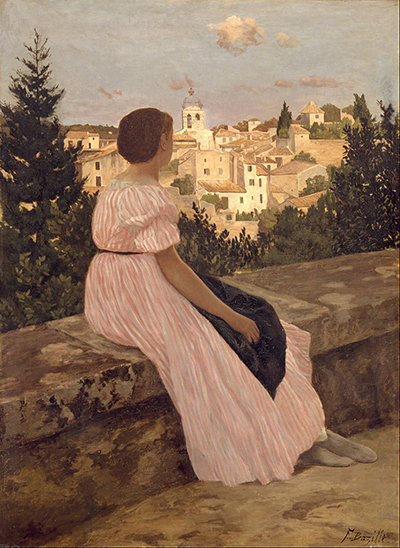
During 1864 he abandoned medicine and committed himself to becoming a painter. His early large Reclining Nude brought together figure training and his interest in contemporary realism. That summer he also began The Pink Dress, placing his cousin Thérèse in front of the distant village of Castelnau. The seated woman turns away towards the view; the relation between a solid near figure and a brightly lit distance becomes the picture’s central problem. Technical research has shown substantial later reworking, so the painting records an evolving solution rather than a single summer’s unaltered result. [2] [16]
Monet, Furstenberg and a working routine
By 6 January 1865 Bazille was installed at 6 place Furstenberg. His letter to his father supplies domestic details as well as the address: an iron bed, newly arrived sheets, adequate blankets and curtains still to come. The room was becoming a place where he could live and work. These ordinary provisions mattered to an artist trying to establish independence while still depending on parcels and money from home. [17]
The same letter offers a memorable glimpse of Monet’s role. “Monet takes the trouble to come and wake me every morning,” Bazille wrote, in a translation from the French. He went on to describe sustained work from the living model. His purpose was explicit: “I must paint a great many figures this winter,” so that he could use the spring and summer in the countryside well. Studio practice and outdoor painting formed parts of one programme. The body had to be studied before it could be placed convincingly within the changing light and space of a landscape. [17]
The letter also sought to reassure his father. Bazille acknowledged his parents’ sacrifices and promised progress; he was accounting for both his time and their money. At the end he asked for his paintings to be sent from Montpellier, together with his parasol and folding stool. The artist’s equipment joins the family’s household goods in a letter that makes the material arrangements behind his working life unusually clear. [17]
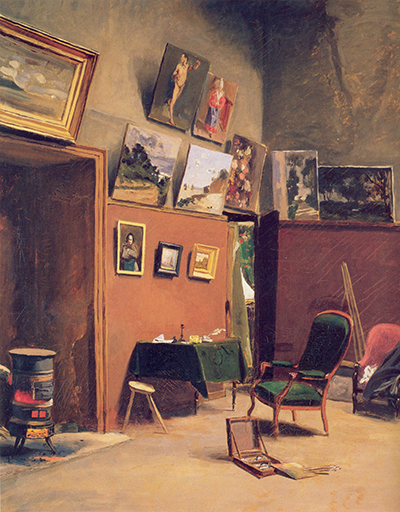
His painting of the Furstenberg studio, dated 1865–66 by the Musée Fabre, makes the room itself a subject. Pictures crowd the upper walls; a heater, chairs and a small table occupy the lower space. The angled floor draws the viewer into an interior where working materials and furnishings share limited room. The furnishings establish the human use of the place even without a sitter. The museum’s dating of the canvas should be distinguished from the letter’s earlier, certain evidence that Bazille was already living at the address in January 1865. [18]
Chailly, friendship and the first Salon
In July 1865 Bazille told his father that he intended to return to Chailly to pose for a large painting by Monet. The project was Monet’s Déjeuner sur l’herbe. It made the friend’s body part of an ambitious modern composition and turned posing into one of the practical services artists provided for one another. Bazille had his own work underway, including a life-size portrait that he described as preparation for a proposed portrait of his cousin Pauline at Méric. His letter distinguishes completed work, current work and attractive plans; those plans should not all be treated as finished pictures. [19]
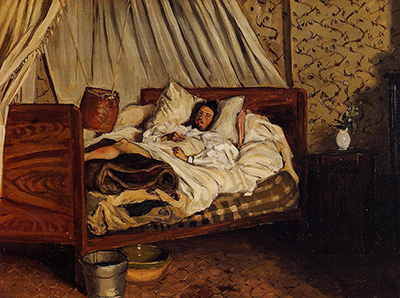
During the Chailly period Monet injured his leg, and Bazille painted him resting in bed in The Improvised Field Hospital. The title can mislead: this is a domestic sickroom, made specific by the bed canopy, patterned wall, chair and vessels on the floor. It belongs to the artists’ life before the Franco-Prussian War. Bazille’s medical studies make the occasion especially suggestive, but they do not establish that he was a qualified doctor or tell us exactly what treatment he gave. The precise accident and the identification of the inn have also acquired differing accounts. The securely documented core is the friendship and the injured Monet represented in 1865. [20]
The next public test was the Salon of 1866. Bazille submitted a still life of fish and a more ambitious contemporary scene of a young woman at the piano with a young man listening. The jury accepted Still Life with Fish and rejected the piano picture. His debut thus came through a genre whose concentrated observation he could handle persuasively: pale cloth, gleaming fish, a basket and a dark background. Acceptance gave him an entry into the official exhibition, while the rejection withheld approval from a composition built around modern social life and music. [2]
The piano painting did not survive as an independent visible canvas. Years later Bazille reused its support for Ruth and Boaz. Scientific imaging has recovered evidence of the earlier composition beneath the later one. This joins two apparently distant moments of his career: an early effort to win recognition with a modern interior and a late experiment with biblical and literary subject matter. It also shows how a rejected work could remain physically available for another purpose. [16]
Rue Visconti: generosity and its limits
From the summer of 1866 until late 1867, the rue Visconti studio became another important setting for Bazille’s work. Renoir and Monet stayed with him there. The room offered working space, shelter and company, while the pictures circulating through it made it a place of comparison. In his view of the studio, an easel, palette, crowded wall and long stretch of floorboards turn the daily apparatus of painting into a carefully arranged interior. The work is both a record of a room and a composition with its own pressures and intervals. [2] [21]
Bazille’s help to his friends was substantial. He housed them, posed for them and agreed to purchase Monet’s Women in the Garden for 2,500 francs. The purchase placed an important painting within the same network that supported their experiments with figures outdoors. Yet the familiar description of Bazille as the rich friend can make these relationships seem simpler than they were. His resources came chiefly through his family; his letters repeatedly discuss the need to pay for space and models. Giving assistance did not mean possessing unlimited independent wealth. [2] [15]
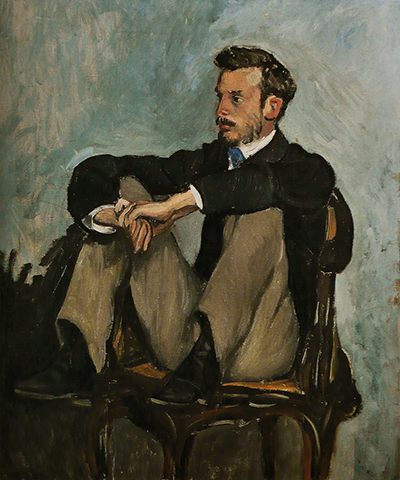
Nor was the exchange entirely financial. Renoir painted Bazille working on the heron still life, while Bazille painted Renoir in a compact, unceremonious pose, with knees raised and arms folded across them. In Portrait of Renoir, the sitter’s gathered limbs and dark clothing matter as much as a conventional presentation of status. These portraits show artists looking at one another as subjects and fellow workers. The reciprocal practice produced works that stand independently of the friendships they document. [22] [23]
Shared rooms and shared models sometimes left material traces within the paintings. Bruno Mottin’s laboratory study examines particular instances of reuse, revision and possible intervention by friends. Its conclusions encourage care: working in the same room did not make authorship interchangeable. In several cases, technical comparisons support Bazille’s own authorship of an underlying composition previously assigned to another painter. The studio was a place of exchange in which individual responsibility remained significant. [16]
Portrait of Renoir
Rejection and an independent exhibition proposal
The Salon rejected Bazille’s submissions in 1867. His April letter to his mother moves quickly from the disappointment to a proposed alternative. A group of about a dozen young artists, he explained, intended to hire a large studio each year and exhibit as many works as they wished. They would invite painters they admired to participate. Bazille named Courbet, Corot, Diaz and Daubigny as supporters and expressed extraordinary confidence in Monet. “You will see that people will talk about us,” he concluded, in a translation from the French. [24]
The proposal reveals ambition, organisation and a desire to control access to the public. Bazille wanted a way around the jury’s decisions, rather than an existence without exhibitions or recognition. His insistence that this was a reasonable undertaking was also directed towards a parent who might worry about youthful revolt. The letter belongs to the history of independent exhibition ideas before Impressionism acquired its public name. It does not make him a participant in the first Impressionist exhibition, which took place in 1874, after his death. [24] [2]
His declaration that he would stop submitting to the jury proved temporary. He continued to seek Salon acceptance. An independent exhibition remained a proposed solution, while the Salon offered an established route to public recognition. The following years would show him pursuing modern subjects through that institution, sometimes successfully. His career developed through alternating acceptance and refusal, rather than a single decisive break. [2]
Watch: Bazille and early Impressionism
Explore a Paris studio with Smarthistory, then discover the beginnings of Impressionism with the National Gallery of Art.
Jean-Frédéric Bazille, The Artist’s Studio, Rue Visconti, Paris
A close look at Bazille’s 1867 painting of the studio he shared in Paris.
Watch on YouTubeAigues-Mortes and the family at Méric
In May 1867 Bazille went to Aigues-Mortes. The surviving landscapes open his art towards broad water, walls, sky and southern light. His letter from the Hôtel Saint-Louis gives the experience a practical scale: the weather had permitted only four working outings, and he had begun three or four landscapes. He hoped to paint a large view of the walls reflected in water at sunset and estimated that he would need at least eight fine days. An apparently calm finished landscape could depend on waiting, interrupted sessions and exact conditions. [25]
The same letter asks for Victor Hugo’s book about the Rhine and black Conté pencils. Reading and drawing accompanied the search for outdoor subjects. The three surviving Aigues-Mortes paintings also differ in their demands. The western ramparts stretch across a wide field of water and sky, while the Porte de la Reine brings the monumental gate forward. Bazille was testing how the scale and placement of architecture could organise a landscape. The letter’s three or four beginnings should not be converted into proof of an additional surviving canvas. [25] [2]
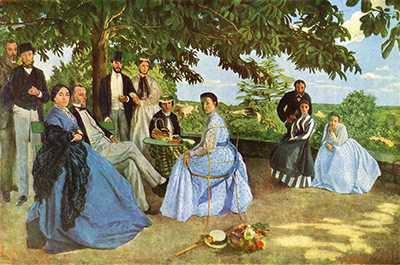
Back at Méric that summer he began Family Reunion, one of his largest and most exacting compositions. The terrace brings together relatives beneath a dense canopy, with brilliant countryside visible beyond. Many faces turn towards the viewer. Dresses, dark suits, wicker furniture and the circular green table establish separate presences within a common space. Rather than losing the sitters in the surrounding light, Bazille holds their forms against it. The family supplied his subjects, but organising their assembly was a demanding pictorial task. [26]
He continued revising the painting after the summer. Technical examination has revealed changes to figures and the addition of his own image at the left. These alterations explain why the work is dated 1867–68 despite its 1867 signature. The finished group’s stillness is the outcome of decisions made over time. At the Salon of 1868 it appeared alongside Potted Flowers. Émile Zola’s contemporary review valued the individuality of the portraits and the use of modern clothing, recognising a painter willing to take the appearance of his own society seriously. [16] [2] [27]
In a letter assigned to April 1868, Bazille explained an older restaurant debt that had reached his father’s attention. He had tried to arrange a loan from a friend and wanted to manage the matter himself. In the same letter he expected the Méric painting to be rejected and thought the flower picture he had given the Lejosnes more likely to pass. Both were accepted. Financial anxiety and uncertainty about the jury existed beside the confidence needed to undertake a large family portrait. The letter also shows him seeking a clothed female model for his forthcoming stay in Montpellier: the next summer’s work already required practical arrangements. [28]
Family Reunion
Batignolles, model fees and the Salon of 1869
Bazille’s need for space continued to grow. In late November 1867 he told his father that rue Visconti was too small and that he had rented a much larger studio in the Batignolles. It would cost 200 francs more; a replacement tenant would take over his remaining Visconti commitment, and he planned to move in January. This places the beginning of his occupation of the studio associated with rue La Condamine in early 1868. The letter’s careful account of expense shows him negotiating ambition in financial terms his family could assess. [29]
Batignolles brought him closer to the circle around Manet and the Café Guerbois. Discussions with artists and critics formed one part of his Paris life; testing pictures before visitors was another. In February 1869 he reported enthusiastic responses to the young Italian sitter in View of the Village and his nude fisherman. Alfred Stevens offered to bring the jurors Fromentin and Daubigny to see his work. Bazille valued that encouragement even though he was no great admirer of Stevens’s own painting. Approval from an established artist could offer practical help without requiring complete artistic agreement. [2] [30] [31]
The same letter sets this success beside a request for money. Daily model sessions and overdue fees had left him without funds. He asked for a subsidy to reach the end of the month and insisted that the expense was for work. He was also looking ahead to Méric, seeking models and requesting the exact dimensions of the unfinished grape-harvest canvas. Paris and Montpellier were connected by plans, measurements and labour as much as by different seasons. [30]
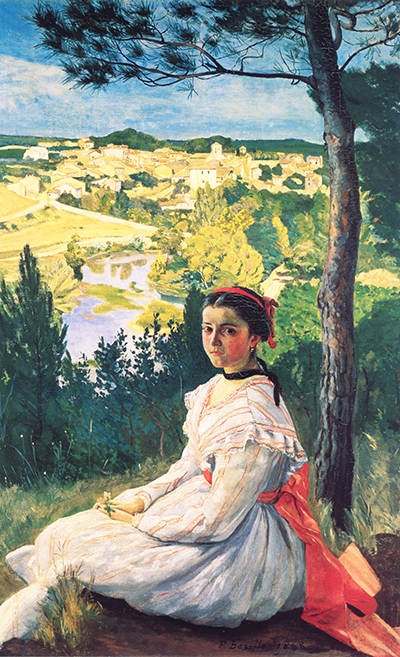
At the Salon of 1869, View of the Village was accepted and Fisherman with a Net rejected. Both had developed from his southern figure-and-landscape work. In the former, a seated girl faces the viewer from shade, with Castelnau shining beyond; the identification of her as a tenant farmer’s daughter rests on family tradition. The fisherman presents a nude male body from behind within a wooded waterside setting. Different jury outcomes divided pictures that his studio visitors had assessed within the same period of growing confidence. [31] [32]
Berthe Morisot’s response to View of the Village, reported in the Musée Fabre’s account of the exhibition, singled out the successful placement of a figure outdoors. Her judgement identifies the problem that connects it to The Pink Dress and Family Reunion. Bazille was returning to a difficult relationship between body, shade and distance, finding different arrangements rather than repeating one formula. [2]
Music, theatre and a wider life
Painting occupied an increasingly important part of Bazille’s life, but music and theatre remained essential pleasures. Edmond Maître, whom he came to know in 1865, shared his musical enthusiasm and played piano with him. The 1869 portrait of Maître gives this cultivated friend a book and cigar, presenting him in profile with his attention lowered. It is an intimate image of a sitter absorbed in his own activity, rather than a document from which his whole character can be reconstructed. [1] [33]
Bazille also tried writing for the stage. His July 1865 letter describes a play completed with Édouard Blau after a month of evenings together. They had read it to friends, sought further opinions and hoped to interest the actress Déjazet. He imagined the pleasure of seeing it performed and receiving royalties, while acknowledging that the outcome remained uncertain. This collaboration establishes their friendship well before the later portrait. The same letter reports winning a rowing prize at Bougival, offering a glimpse of a physically active life beyond the studio. [19]
In 1869 he rehearsed a role in Ruy Blas, attended performances and explored the backstage world of the Opéra. His account to his mother is alert to workers, discomfort and ordinary conversation behind theatrical spectacle. Later that year he described hearing Fidelio with Maître and Renoir, followed by a cheerful meal. These letters give substance to the friendships that the paintings bring together: their shared culture extended through performance, conversation and food. [30] [34] [35]
He remained interested in older painting too. Advising his cousin Louis on purchases in April 1869, he praised Delacroix, Ingres, Corot, Rousseau, Millet and, with a qualification, Courbet. Advice about old-master prints continued in a letter assigned by the museum to February 1870. His developing modernity did not require him to abandon earlier art. These preferences also help explain why the subjects of his final year could range from contemporary bathers to a scene drawn from the Bible and Hugo. [36] [37]
The crowded ambitions of 1870
Late in 1869 Bazille listed three works in progress: the interior of his studio, a portrait of Blau and a female nude intended for the Salon. The list helps date the Blau portrait, which the National Gallery of Art gives as probably 1869 even though its inscription reads 1866. It also catches the studio picture and La Toilette in the making, rather than as isolated masterpieces detached from competing demands on his winter. [35] [38]
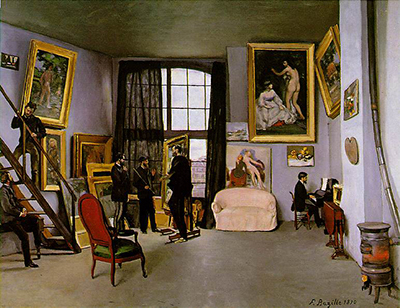
In Bazille’s Studio, Rue La Condamine, the room gathers paintings for display and discussion. The painter stands by the easel near Manet; Maître plays at the piano. Other identifications remain disputed. The empty floor, forward chair, stove and high window are as important to the arrangement as the gathered men. The rejected Fisherman is prominent on the left wall, giving a refused picture a place within Bazille’s own representation of artistic life. Manet’s contribution to Bazille’s painted figure belongs to this living friendship; it was not a posthumous addition. Technical study also indicates that the room was first painted without its occupants. [39] [16]
For the Salon of 1870, Bazille submitted Summer Scene and La Toilette. The outdoor group of eight male bathers was accepted; the interior with three female figures was rejected, despite an initial report that both had passed. Summer Scene drew attention from critics and caricaturists. Its bodies occupy different distances and actions—reclining, swimming, wrestling—within a carefully constructed riverside space. Its apparent ease belongs to a painting developed through studies and revision, not an unplanned gathering copied in one sitting. [2] [40]
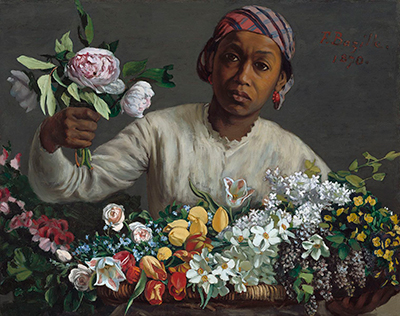
The year also produced two distinct Young Woman with Peonies paintings, one now in Washington and the other in Montpellier. One woman faces the viewer while offering flowers above a basket; in the other she concentrates on arranging stems in a vase. The pictures bring together portrait-like presence, labour and the colour possibilities of flower painting. Manet’s example forms part of their context, but the model’s personal name remains unproved. The two compositions should not be collapsed into a single image or assigned a certain order of execution. [2] [23]
In spring 1870 Bazille left the Condamine studio for rue des Beaux-Arts. That summer in the south he worked on several different projects: the large landscape beside the Lez, a reclining male nude, Ruth and Boaz and the young fisherman traditionally identified as Louis Auriol. Some remained unfinished. Ruth and Boaz turned towards a nocturnal biblical and literary subject, while the Lez landscape concentrated on trees, sky and rough ground without visible human figures. A small dog rests at its lower-right edge. The variety cautions against treating any one canvas as the certain final statement of his career; a definitive last painting has not been established. [2] [23]
Enlistment, death and the recovery of his work
On 16 August 1870 Bazille volunteered for the 3rd Zouave Regiment. His enlistment document, reproduced in the Musée Fabre’s account, records a twenty-eight-year-old painter. Maître and Renoir reacted with alarm. After time in Algeria, Bazille returned to France with his regiment and was sent into the campaign. He was killed at Beaune-la-Rolande on 28 November. The documented sequence is clear; a single private motive that fully explains his decision is not. The war ended his work while a number of paintings and ideas were still developing. [2]
His family commemorated him at Beaune-la-Rolande and in Montpellier’s Protestant cemetery, where he was buried. The loss was immediate for his friends, but the public reputation of the painter developed slowly. Much of his work remained within the family and its circle. When the first Impressionist exhibition opened in 1874, Bazille had been dead for more than three years. His place in its prehistory rests on the work and associations of the 1860s, including his own independent exhibition proposal, rather than participation in that later event. [2]
The family’s actions eventually changed the public visibility of his paintings. In 1898 his mother gave View of the Village and Still Life with Heron to the Musée Fabre. Family Reunion entered the French national collection in 1905 with assistance from his brother Marc; works including the Condamine studio and The Pink Dress followed through Marc’s 1924 bequest. These were separate acts over many years, gradually establishing the museum presence through which Bazille could be reassessed. Hilaire identifies family preservation and the work of historians and curators, including Roger Marx and André Joubin, as central to that recovery. [1] [2] [23]
The retrospective that travelled from Montpellier to Paris and Washington in 2016–17 brought his pictures into sustained comparison with those of his contemporaries. Scientific examination undertaken around the exhibition also exposed earlier compositions and revised accounts of his methods. Mottin’s subsequent technical study made the labour of repainting, reuse and construction especially clear. These discoveries sharpen a biography already present in the letters: Bazille learned by trying difficult things, reconsidering them and beginning again. [2] [16]
The career he might have had remains unknowable. The paintings he left offer firmer ground: family portraits in outdoor light, rooms made into statements about artistic life, still lifes, landscapes and ambitious modern nudes. Read beside the letters, they reveal an artist increasingly able to turn friendship, family circumstances and sustained study into pictorial decisions of his own. [1] [2]
Bazille catalogue directory
The 284 records comprise 85 painting records,40 separate works-on-paper records and 159 album or study records. They describe the catalogue’s organisation rather than 284 independent objects or unanimously accepted attributions. Recto, verso, albums and multiple studies remain distinct. Dates are qualified where needed; the Drawing filter includes the etching, gouache and mixed works on paper. Manuscript mentions and unproved projects are listed separately below.
Works known through documents
These mentions remain separate from the 284 catalogue records. Some may concern surviving studies or underlying compositions; they cannot simply be added together as missing physical paintings.
- A copy after Rubens mentioned in March 1863 is unlocated.
- A portrait of an unidentified woman was reported completed before July 1866.
- A portrait of Monet and a composition of two life-size women arranging flowers were reported in progress in April 1867. Their mention does not establish two otherwise unknown surviving canvases.
- Gertrude et le père Lapin was at least begun in the summer of 1870.
Further reported works and uncertain attributions
- A Bouquet of Lilacs was reportedly stolen and returned in 1864; a portrait of the friend Theulier and Yellow Narcissi reported by Maître in 1868 are also documentary mentions.
- Unidentified pictures associated with Guillemet and Mme Rolina are reported through later correspondence cited by the catalogue.
- Children Dressed as Bride and Groom was associated with Vallotton’s collection and also attributed to Renoir. Its identification and authorship should remain open.
Projects whose completion is unproved
- A portrait of Pauline was planned in July 1865.
- A portrait of Marc was proposed in April 1866; a related drawing survives.
- A Jardinière project appears in album inscriptions and related figure material. Written plans are not evidence of a completed painting.
| Name | Date | Medium |
|---|---|---|
| Mystic Marriage of St. Catherine | 1863 | Oil on canvas |
| Trees, Study | 1863 | Oil on canvas |
| Farm of Saint-Sauveur | 1863 | Oil on canvas |
| In the Garden of the Parc Monceau, Paris | 1864 | Oil on canvas |
| Naked Woman from Behind | 1864 | Oil on canvas |
| Reclining Nude | 1864 | Oil on canvas |
| Courtyard of the Auberge du Cheval blanc at Chailly near Barbizon | 1864 | Oil on canvas |
| Covered Soup Bowls | 1864 | Oil on canvas |
| Two Herrings | 1864 | Oil on canvas |
| The Pink Dress | 1864 | Oil on canvas |
| The Dog Rita Asleep | 1864 (catalogue); c. 1864 (2017 checklist) | Oil on canvas |
| The Scoter | 1864 | Oil on canvas |
| Naked Reclining Woman | 1864 | Oil on canvas |
| Landscape at Chailly | 1865 | Oil on canvas |
| Rocks at Chailly, Forest of Fontainebleau | 1865 | Oil on canvas |
| Undergrowth at Chailly, Forest of Fontainebleau | 1865 | Oil on canvas |
| Still Life with Grapes and Nuts | 1865 | Oil on canvas |
| Self-Portrait with a Palette — Chicago | 1865 | Oil on canvas |
| Landscape of Saint-Sauveur | 1865 | Oil on canvas |
| Beach at Sainte-Adresse | 1865 | Oil on canvas |
| The Improvised Field Hospital | 1865 | Oil on canvas |
| Village Street, Chailly | 1865 | Oil on canvas |
| Small Valley in the Forest of Fontainebleau | 1865 | Oil on canvas |
| Forest of Fontainebleau | 1865 | Oil on canvas |
| Woman Ironing | 1866 | Oil on canvas |
| The Artist's Studio on the rue de Furstenberg | 1865–66 (museum) | Oil on canvas |
| Still Life with Fish | 1866 | Oil on canvas |
| Little Italian Street Singer | 1866 | Oil on canvas |
| Potted Flowers | 1866 | Oil on canvas |
| The Little Gardener | 1866–1867 | Oil on canvas |
| Young Woman Playing the Piano | 1866–1867 | Oil on canvas |
| End of a Summer Day | 1866–1867 | Oil on canvas |
| A Studio on the rue Visconti | 1867 | Oil on canvas |
| Thérèse Reading in the Park at Méric | 1867 | Oil on canvas |
| Portrait of Verlaine | 1867 | Oil on canvas |
| The Terrace at Méric | 1867 | Oil on canvas |
| Still Life with Heron | 1867 | Oil on canvas |
| The Family Gathering | 1867–68 (museum) | Oil on canvas |
| Oleanders | 1867 | Oil on canvas |
| Woman on the Terrace at Méric | 1867 | Oil on canvas |
| The Ramparts at Aigues-Mortes from South | 1867 | Oil on canvas |
| The Western Ramparts at Aigues-Mortes | 1867 | Oil on canvas |
| Portrait of Edmond Maître — head study | 1867 | Oil on canvas |
| Porte de la Reine at Aigues-Mortes | 1867 | Oil on canvas |
| Portrait of Sisley | 1867 | Oil on wood |
| Portrait of Renoir — Cleveland | 1867 | Oil on canvas |
| Portrait of Renoir — Musée d’Orsay | 1867 | Oil on canvas |
| Self-Portrait with a Detachable Collar — Minneapolis | 1865–67 (museum); 1867–68 (catalogue) | Oil on canvas |
| Vase of Flowers on a Console | 1868 (museum); 1867–68 (catalogue) | Oil on canvas |
| Portrait of a Woman | 1868 | Oil on canvas |
| Young Woman in the Vineyards | 1868 | Oil on card |
| Harvester with a Basket | 1868 | Oil on card |
| Harvester with a Yellow Hat | 1868 | Oil on card |
| Harvester with a Headdress | 1868 | Oil on panel |
| On the Banks of the Lez | 1868 | Oil on canvas |
| After the Bath (attribution questioned) | 1868? | Oil on canvas |
| Young Woman with Lowered Eyes | 1868 | Oil on canvas |
| Fisherman with a Net | 1868 | Oil on canvas |
| View of the Village | 1868 | Oil on canvas |
| Portrait of Bazille (attributed to Monet by Musée Fabre; disputed catalogue attribution) | 1864 (museum); 1868 (catalogue) | Oil on panel |
| Studies for a Grape Harvest (two panels) | 1868 | Oil on canvas (two panels) |
| The Fortune Teller | 1868–69 (catalogue); c. 1869–70 (2017 checklist) | Oil on canvas |
| Harvester with a Cap | 1869 | Oil on card |
| Portrait of Edmond Maître — 1869 | 1869 | Oil on canvas |
| Woman in a Moorish Costume | 1869 | Oil on canvas |
| Young Woman in the Garden | 1869 | Oil on canvas |
| Portrait of Alphonse Tissié in a Cavalryman's Uniform | 1869 | Oil on canvas |
| Portrait of a dragoon | 1869 | Oil on canvas |
| Portrait of Zacharie Astruc | 1869 | Oil on canvas |
| Bunch of Grapes in a Bucket | 1869 | Oil on card |
| Portrait of Edouard Blau | Probably 1869; inscribed 1866 | Oil on canvas |
| Young Male Nude Lying on the Grass | 1870 | Oil on canvas |
| Summer Scene | 1869–1870 | Oil on canvas |
| The Studio on the rue La Condamine | 1869–1870 | Oil on canvas |
| La Toilette | 1870 | Oil on canvas |
| Young Woman with Peonies — Montpellier | 1870 | Oil on canvas |
| Young Woman with Peonies — Washington | 1870 | Oil on canvas |
| Monotonous Chant | 1870 | Oil on canvas |
| Flowers — private collection | 1870 | Oil on canvas |
| Flowers — Musée Fabre | 1870 | Oil on canvas |
| Young Fisherman | 1870 | Oil on canvas |
| Study for Ruth and Boaz | 1870 | Oil on wood |
| Ruth and Boaz | 1870 | Oil on canvas |
| Self-Portrait in Shirt Sleeves | 1870 | Oil on canvas |
| Landscape on the Banks of the Lez | 1870 | Oil on canvas |
| Study after an Alpine Landscape | 1860 | Graphite on watercolour-tinted paper |
| Profile Head | 1862 | Charcoal on laid paper |
| Studies after Delacroix | 1863 | Ink and graphite, with gouache and watercolour, on paper |
| Academic Head | 1863 | Charcoal on paper |
| Study of a Woman's Head in Profile on a Chair | 1863 | Charcoal on paper |
| Academic Head of a Woman | 1863 | Charcoal on paper |
| Academy of Woman | 1863 | Black pencil and charcoal, stumped, on watermarked laid paper |
| Academy of Man | 1863 | Black pencil and charcoal, stumped, on watermarked laid paper |
| Naked Man | 1863 | Charcoal on paper |
| The Pont au Change in Paris | 1864 | Watercolour on paper |
| Study for the Pink Dress or Portrait of Thérèse des Hours | 1864 | Black pencil on paper |
| Naked Woman Standing | 1864 | Pencil on paper |
| Study of a Reclining Nude | 1864 | Charcoal on paper |
| Bathers | 1864 | Charcoal on paper |
| Portrait of a Man | 1864 | Charcoal on paper |
| Study for The Pink Dress | 1864 | Black pencil, squared, on paper |
| Study for Landscape of Saint-Sauveur | 1864 | Graphite on paper |
| Study for Landscape of Saint-Sauveur | 1865 | Pencil on paper |
| Man Taming a Bull | 1866 | Pen and black pencil on paper |
| Man Half Lying on a Sofa | 1866 | Charcoal on paper |
| Study for The Family Gathering | 1867 | Pencil on paper |
| Study for The Family Gathering | 1867 | Graphite, charcoal and black pencil on paper |
| The Embroiderer | 1867 | Pencil on pink paper |
| Study of Children | 1867 | Pencil on paper |
| Women in a Garden | 1867 | Pencil drawing |
| View of the Village | 1868 | Etching on paper |
| Portrait of a Bearded Man (catalogued as Self-Portrait) | Undated (museum); 1869 (catalogue) | Charcoal and brown ink |
| Man Smoking Pipe | 1869 | Watercolour on paper |
| Manet Drawing | 1868–70(?) (museum) | Charcoal and white chalk on paper |
| Study for the Summer Scene | 1869 | Charcoal, pen and ink on paper |
| Family Portrait | 1869 | Pastel and charcoal on paper |
| Study for Ruth | 1870 | Pencil and charcoal on paper |
| Woman Arranging a Hat | 1870 | Pencil drawing |
| Study for Boaz Asleep | 1870 | Pastel and red chalk |
| Boaz Asleep | 1870 | Charcoal and pencil on paper |
| Study for Boaz Asleep | 1870 | Black and beige pastel with red chalk on laid paper |
| Ruth Lying down | 1870 | Charcoal and pastel on paper |
| Head, Arm and Chest of Ruth | 1870 | Charcoal on paper |
| Chest of Ruth | 1870 | Black chalk and charcoal on paper |
| Black Woman with Peonies — gouache | c. 1870 | Gouache, watercolour, pencil and black chalk on card |
| Various Unidentified Subjects | Undated | Pencil drawing |
| Rocky Sea Side | Undated | Charcoal on paper |
| Studies of a Dancing Woman | Undated | Drawing with white chalk |
| Study of a Leg | Undated | Pencil drawing |
| Dancers in Camargue | Undated | Pencil drawing |
| Academy of Woman | Undated | Charcoal |
| Caricature of Venus of Milo and Various Other Caricatures | Undated | Charcoal |
| Caricature | Undated | Pencil drawing |
| Study of Landscape | Undated | Charcoal |
| Caricatures and Seated Monk | Undated | Charcoal |
| Caricatures and Various Subjects | Undated | Pencil drawing |
| Women Carrying a Pitcher | Undated | Pencil drawing |
| The Hanged Man | Undated | Charcoal |
| Castle in the Plain | Undated | Charcoal |
| Naked Woman from Behind | Undated | Charcoal |
| Caricatures | Undated | Charcoal and pencil |
| Unidentified Subjects | Undated | Pencil drawing |
| Landscape with a Castle | Undated | Charcoal |
| Study of Landscape | Undated | Charcoal |
| Horse Rider seen from Behind | Undated | Charcoal |
| Mazeppa | Undated | Pencil and charcoal |
| Study of Rider and Others Subjects | Undated | Pencil, pen and brown ink |
| Study of an Unidentified Man | Undated | Pencil drawing |
| Study for an Unknown Historic Scene | Undated | Pencil drawing |
| Study a Man Reading | Undated | Pencil drawing |
| Study of Men Reading | Undated | Pencil drawing |
| Study of Landscape ? | Undated | Charcoal |
| Study of a Head of a Man | Undated | Pencil drawing |
| Erotic Scene | Undated | Pencil drawing |
| Study of Dog | Undated | Charcoal |
| Studies of Unidentified Subjects and Erotic Scene | Undated | Pencil and charcoal drawing |
| Study for a Theater Scene | Undated | Charcoal |
| Study of a Reclining Naked Woman | Undated | Charcoal |
| Two Studies of Landscape | Undated | Pencil drawing |
| Caricature | Undated | Pencil and charcoal drawing |
| Portrait of an Unidentified Young Man | Undated | Charcoal |
| Study of an Unidentified Subject | Undated | Brown ink drawing |
| Unidentified Man with a Hat | Undated | Pencil and charcoal |
| Study of an Unidentified Women | Undated | Pencil drawing |
| Study for a Theater Character ? | Undated | Pencil drawing |
| Study for a Theater Character ? | Undated | Pen drawing |
| The Pavillon de la Reine in Paris | Undated | Pencil drawing |
| Study of a Horse Rider | Undated | Pencil and charcoal drawing |
| Entwined Couple. Caricature ? | Undated | Pencil drawing |
| Woman Sitting on a Sofa | Undated | Pencil drawing |
| Studies of Unidentified Subjects | Undated | Pencil and charcoal drawing |
| Studies of Animals | Undated | Pencil drawing |
| Study of a Horse Rider in Camargue | Undated | Charcoal |
| Study of Hunting Dogs | Undated | Pencil drawing |
| Study of Soldiers. Caricatures | Undated | Pencil drawing |
| Studies of Hunting Dogs ? | Undated | Pencil drawing |
| Hunting Scene. Hunter Playing the Horn | Undated | Pencil drawing |
| Caricature | Undated | Pencil drawing |
| Study of an Ibex | Undated | Pencil drawing |
| Theater Scene. Caricatures | Undated | Pencil drawing |
| Studies of Animals. Horses ? | Undated | Pencil drawing |
| Caricatures | Undated | Pencil drawing |
| Studies of Various Subjects and Animals | Undated | Pencil drawing |
| Unidentified Subject | Undated | Pencil drawing |
| Rider Taming a Horse [in Camargue ?] | Undated | Pencil drawing |
| Caricature of a Soldier | Undated | Pencil drawing |
| Study of a Woman and Mouse | Undated | Pencil drawing |
| Historic Scene | Undated | Charcoal |
| Architecture Studies | Undated | Pencil drawing |
| Mythologic Scene | Undated | Charcoal |
| Ophelia | Undated | Pencil drawing |
| Mythologic Scene | Undated | Charcoal |
| Studies of Various Subjects | Undated | Pencil and pen drawing |
| Studies of Peasants | Undated | Pencil drawing |
| Historic Scene | Undated | Pencil drawing |
| Historic or Literary Scene | Undated | Pencil drawing |
| Unidentified Historic Scene | Undated | Pencil drawing |
| Studies of Unidentified Subjects | Undated | Pencil drawing |
| Unidentified Study | Undated | Pencil drawing |
| Man in an Armchair | Undated | Pencil drawing |
| Studies of Various Subjects | Undated | Pencil drawing |
| Portraits of Unidentified Men | Undated | Pencil drawing |
| Studies of Various Subjects | Undated | Pencil drawing |
| Horse Rider and Artist | Undated | Charcoal and pencil |
| Study of Unidentified Characters | Undated | Charcoal |
| Dead Horse in a Plain | Undated | Charcoal |
| Study of Various Subjects and Furniture | Undated | Pencil drawing |
| Caricatures and Various Notes about Opéra | Undated | Pencil drawing |
| Galloping Horse | Undated | Charcoal |
| Study for La Toilette | Undated | Pencil drawing |
| Study of a Naked Woman | Undated | Pencil drawing |
| Domestic Scene | Undated | Pencil drawing |
| Physiognomies | Undated | Pencil drawing |
| Study for a Grape Harvest | Undated | Pencil drawing |
| Study for the Summer Scene | Undated | Pencil drawing |
| Female Profiles | Undated | Pencil drawing |
| Various Subjects | Undated | Pencil drawing |
| Study for The Terrace at Méric | Undated | Pencil drawing |
| Study for The Ramparts at Aigues-Mortes | Undated | Pencil drawing |
| Study for The Ramparts at Aigues-Mortes | Undated | Pencil drawing |
| Study for a Grape Harvest | Undated | Charcoal |
| Children Portraits | Undated | Pencil drawing |
| Study for Children's Heads | Undated | Pencil drawing |
| Study of Minerva | Undated | Pencil drawing |
| Study for a Grape Harvest | Undated | Pencil drawing |
| Study for The Family Gathering | Undated | Pencil drawing |
| Study for a Young Fisherman | Undated | Charcoal |
| Self-Portraits | Undated | Black pencil drawing |
| Study of Horses for the Porte de la Reine at Aigues-Mortes | Undated | Ink drawing |
| Study of Horses for the Porte de la Reine at Aigues-Mortes | Undated | Ink drawing |
| Study of Horses for the Porte de la Reine at Aigues-Mortes | Undated | Ink drawing |
| Study for an Outdoor Concert | Undated | Pencil drawing |
| Studies of Legs | Undated | Pencil drawing |
| Study for The Ramparts at Aigues Mortes | Undated | Pencil drawing |
| Studies of Hats | Undated | Pencil drawing |
| Studies of Men | Undated | Pencil drawing |
| Study for The Little Gardener | Undated | Pencil drawing |
| Study for The Ramparts at Aigues Mortes | Undated | Charcoal |
| Studies of Sail Boats | Undated | Pencil drawing |
| Portrait of Marc Bazille | Undated | Charcoal, black pencil and graphite |
| Studies of Children's Heads | Undated | Pencil drawing |
| Study for Aigues-Mortes | Undated | Pencil drawing |
| Studies of Women's Heads | Undated | Pencil drawing |
| Portrait of Camille des Hours and an Unidentified Man | Undated | Charcoal |
| Study of Flying Birds | Undated | Charcoal or graphite |
| Study for the Summer Scene | Undated | Pencil drawing |
| Study of Hands | Undated | Pen drawing |
| Self-Portrait | Undated | Black pencil drawing |
| Study for the Summer Scene | Undated | Pencil drawing |
| Study for the Summer Scene | Undated | Pencil drawing |
| Study for a Grape Harvest | Undated | Pencil drawing |
| Study of Branches | Undated | Pencil drawing |
| Study of a Seated Child | Undated | Pencil drawing |
| Study for a Couple and Unidentified Women | Undated | Pencil drawing |
| Studies of Unidentified Women | Undated | Pencil drawing |
| Study of Buildings | Undated | Pencil drawing |
| Study for a Grape Harvest | Undated | Pencil and charcoal |
| Studies of Boaters | Undated | Pencil drawing |
| Study of a Man Writing at his Table | Undated | Pencil drawing |
| Study of a Woman Cutting Flowers | Undated | Pencil drawing |
| Study of Hand | Undated | Pencil drawing |
| Women in a Garden | Undated | Pencil drawing |
| Studies of Women in Profile | Undated | Pencil drawing |
| Study for Ruth and Boaz | Undated | Charcoal |
| Study for The Family Gathering | Undated | Pencil drawing |
| Study for the View of the Village | Undated | Pencil drawing |
| Study of the View of the Village | Undated | Pencil drawing |
| Study for the Fisherman with a Net | Undated | Pencil drawing |
| Study for the View of the Village | Undated | Charcoal |
| Study for The Little Gardener | Undated | Charcoal |
| Portrait of a Man with a Top Hat | Undated | Pencil drawing |
| Portrait of a Man with a Top Hat | Undated | Pencil drawing |
| Inscriptions | Undated | Pencil inscriptions |
| Study of Tree | Undated | Pencil drawing |
| Caricature of Nina la Belle | Undated | Pencil drawing |
| Study for Saint Sebastian | Undated | Pencil drawing |
| Young Woman Sewing | Undated | Pencil drawing |
| Studies of Hands | Undated | Pencil drawing |
| Woman in a Garden | Undated | Pencil drawing |
| Elegant Woman | Undated | Pencil drawing |
| Various Inscriptions | Undated | Inscriptions (medium unspecified in index) |
| Study of a Man with a Hat | Undated | Pencil drawing |
| Study of a Child | Undated | Pencil drawing |
| Study of a Man with a Hat | Undated | Pencil drawing |
Frequently Asked Questions
He was born in Montpellier on 6 December 1841. [1]
He was killed at Beaune-la-Rolande on 28 November 1870, aged 28, after enlisting that August. [1]
Discussion
Consider how the practical choices in Bazille’s letters appear in the pictures he made.
Reader Insights
What do the letters about model fees, rent and equipment add to the story told by Bazille’s portraits?
Where do the studio interiors show the practical effects of working alongside friends?
Which change between his early and late figure paintings seems most significant to you?
Join the Conversation
Share a detail, comparison or question about Frédéric Bazille: Biography below.
References
- Michel Hilaire, “Bazille ou la vie brève,” Académie des Sciences et Lettres de Montpellier, 2016, pp. 166–172. Lecture text (in French). Exact vital dates corroborated by RKDartists, Frédéric Bazille, record 5278 (in Dutch). View source 1. View source 2.
- Musée Fabre, Frédéric Bazille, la jeunesse de l’impressionnisme, exhibition press dossier, 2016, especially pp. 4, 6–23 and 25. Museum dossier (in French). View source.
- Kunstmuseum Den Haag, Romanticism: 1800–1850. View source
- Metropolitan Museum of Art, Nineteenth-Century French Realism: about 1840 to the late nineteenth century. View source
- Museum of Modern Art, Impressionism: experiments from the early 1860s; group exhibitions ended in 1886. View source
- National Gallery of Art, Frédéric Bazille and the Birth of Impressionism, exhibition overview. View source
- Bibliothèque nationale de France, Charles Gleyre (1806–1874). View source
- National Gallery, London, Eugène Delacroix (1798–1863). View source
- National Gallery, London, Gustave Courbet (1819–1877). View source
- National Gallery, London, Edouard Manet (1832–1883). View source
- National Gallery, London, Alfred Sisley (1839–1899). View source
- National Gallery, London, Claude Monet (1840–1926). View source
- Musée d’Orsay, Frédéric Bazille (1841–1870). View source
- National Gallery, London, Pierre-Auguste Renoir (1841–1919). View source
- Frédéric Bazille, letter to his father, [mid-July 1864], Musée Fabre, inventory 92.2.3, transcription p. 4. Facsimile and transcription (in French; date editorially assigned). View source.
- Bruno Mottin, “L’œuvre de Frédéric Bazille (1841–1870) examiné au laboratoire,” Technè 46, 2018, pp. 30–38, especially paragraphs 3–15 and 16–23. Technical study (in French). View source.
- Frédéric Bazille, letter to his father, [6 January 1865], Musée Fabre, inventory 92.2.1. Facsimile and transcription (in French; English quotations translated here from French). View source.
- Musée Fabre, Atelier de la rue Furstenberg, inventory 85.5.3, 1865–66. Collection record (in French). View source.
- Frédéric Bazille, letter to his father, [17 July 1865], Musée Fabre, inventory 92.2.2. Facsimile and transcription (in French; date editorially assigned). View source.
- Michel Schulman, digital catalogue raisonné, The Improvised Field Hospital, MSb-17. Catalogue entry and critical essay (English translation of French scholarship). View source.
- Michel Schulman, digital catalogue raisonné, A Studio on the Rue Visconti, MSb-27. Catalogue entry and critical essay (English translation of French scholarship). View source.
- Musée d’Orsay, Pierre Auguste Renoir, 1867. Collection record. View source.
- National Gallery of Art, Frédéric Bazille and the Birth of Impressionism, exhibition checklist, 2017. Complete checklist. View source.
- Frédéric Bazille, letter to his mother, [April 1867], Musée Fabre, inventory 94.7.1. Facsimile and transcription (in French; date editorially assigned; English quotation translated here from French). View source.
- Frédéric Bazille, letter to his mother, [late May 1867], Musée Fabre, inventory 94.7.2. Facsimile and transcription (in French; date editorially assigned). View source.
- Michel Schulman, digital catalogue raisonné, The Family Gathering, MSb-37. Catalogue entry and critical essay (English translation of French scholarship). View source.
- Émile Zola, “Les Actualistes,” Mon Salon 1868, L’Événement illustré, 24 May 1868, transcription published by Les Cahiers naturalistes. Contemporary review (in French). View source.
- Frédéric Bazille, letter to his father, [April 1868], Musée Fabre, inventory 92.2.4. Facsimile and transcription (in French; date follows the museum transcription). View source.
- Frédéric Bazille, letter to his father, [late November 1867], Musée Fabre, inventory 92.2.5. Facsimile and transcription (in French; date editorially assigned). View source.
- Frédéric Bazille, letter to his mother, [mid-February 1869], Musée Fabre, inventory 94.7.3. Facsimile and transcription (in French; date editorially assigned). View source.
- Michel Schulman, digital catalogue raisonné, View of the Village, MSb-46. Catalogue entry and critical essay (English translation of French scholarship). View source.
- Michel Schulman, digital catalogue raisonné, Fisherman with a Net, MSb-45. Catalogue entry and critical essay (English translation of French scholarship). View source.
- National Gallery of Art, Edmond Maître, 1869, accession 1985.64.2. Collection record. View source.
- Frédéric Bazille, letter to his mother, [5 April 1869], Musée Fabre, inventory 94.7.4. Facsimile and transcription (in French; date editorially assigned). View source.
- Frédéric Bazille, letter to his father, [late 1869], Musée Fabre, inventory 92.2.6. Facsimile and transcription (in French; date editorially assigned). View source.
- Frédéric Bazille, letter to Louis Bazille, 27 April 1869, Musée Fabre, inventory 94.2.1. Facsimile and transcription (in French). View source.
- Frédéric Bazille, undated letter to Louis Bazille, assigned to February 1870 by the Musée Fabre, inventory 94.7.5. Facsimile and transcription (in French). View source.
- National Gallery of Art, Édouard Blau, probably 1869, accession 1963.10.81. Collection record. View source.
- Michel Schulman, digital catalogue raisonné, The Studio on the Rue La Condamine, MSb-58. Catalogue entry and critical essay (English translation of French scholarship). View source.
- Michel Schulman, digital catalogue raisonné, Summer Scene, MSb-55. Catalogue entry and critical essay (English translation of French scholarship). View source.
- Musée d’Orsay, Réunion de famille,RF2749. View source. (in French).
- Musée Fabre, Vue de village, 898.5.1. View source. (in French).
- Joconde/POP, La Robe rose, RF2450. View source. (in French).
- National Gallery of Art, Young Woman with Peonies,1983.1.6. View source.
- Musée d’Orsay, L’Ambulance improvisée, RF 1967 5. View source. (in French).
- Michel Schulman, painting index and documentary introduction (English titles; French metadata). View source.
- Michel Schulman, works-on-paper index (English titles; French metadata). View source.
- Michel Schulman, albums and studies index (English titles; French metadata). View source.