


 Frederic Bazille.jpg)
 by Tom Gurney
Tom Gurney BSc (Hons) is an art history expert with over 20 years experience
Published on June 19, 2020 / Updated on November 2, 2026
Email: tomgurney1@gmail.com / Phone: +44 7429 011000
Summer Scene (Bathers) by Frédéric Bazille: Introduction
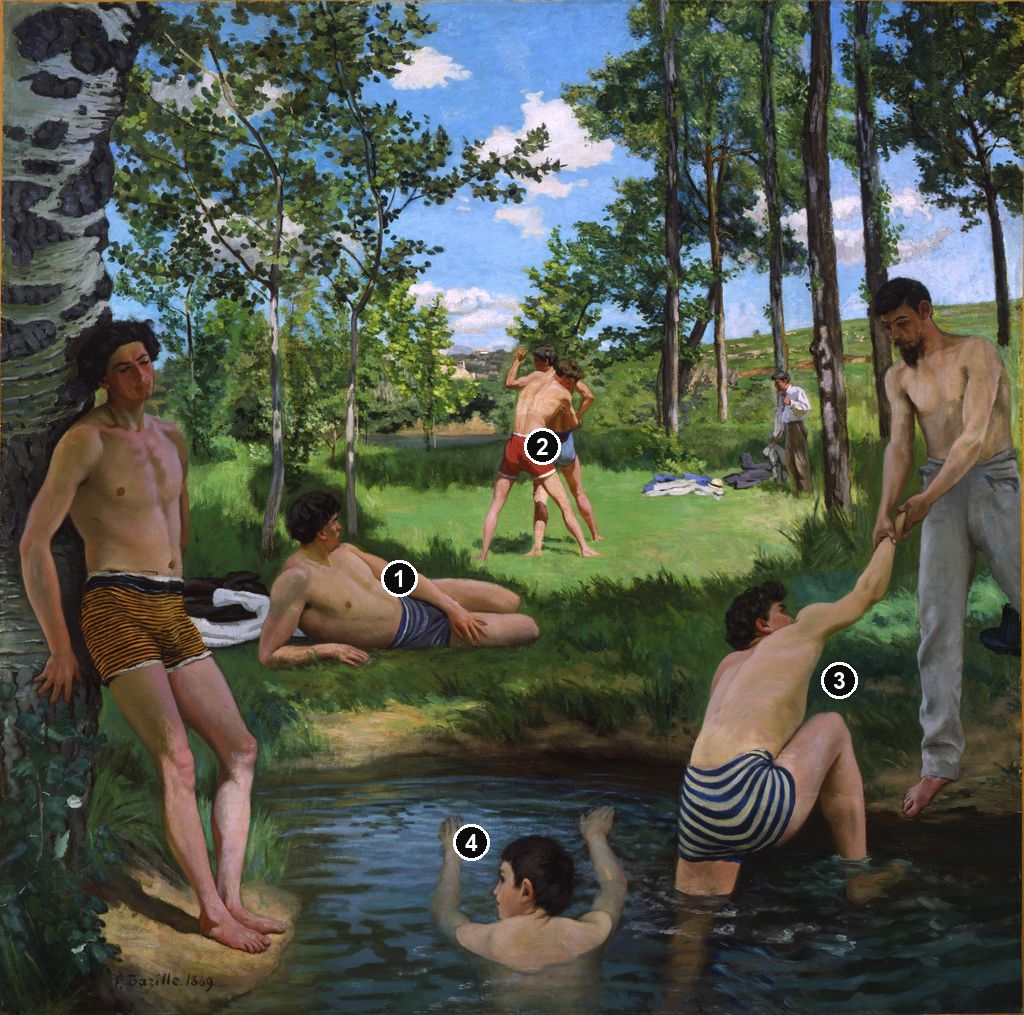
Eight male figures occupy a wooded waterside clearing in Frédéric Bazille’s Summer Scene (Bathers). Some swim or wrestle; others rest, dress, or help a companion onto the bank. Their varied movements give the picture the ease of an afternoon spent outdoors. Yet this almost square canvas is the product of sustained preparation. Begun in 1869 and worked on into 1870, it brings together the study of individual bodies and the larger problem of making figures belong to a landscape. It is now in the Harvard Art Museums’ Fogg Museum collection. [1]
The distinction between apparent leisure and deliberate construction is central to the painting. Bazille gives each figure a separate action while connecting the group through touch, looking, colour and the intervals between the trees. The result is neither a single incident nor a row of studies. It is a place in which different experiences of summer seem to coexist. Its acceptance at the Salon of 1870 gave Bazille unusually conspicuous public exposure, accompanied by both praise and ridicule. [2]
At a Glance
- Date1869–70 [1]
- MediumOil on canvas [1]
- CollectionHarvard Art Museums / Fogg Museum [1]
- ExhibitedSalon of 1870 [2]
This work across Frédéric Bazille’s career
Family Reunion
1867–1868 (museum)Bazille’s Studio, Rue La Condamine
1869–1870Contents
- A summer afternoon without a single story
- Trees, water and the square canvas
- An outdoor painting prepared through study
- Where the bodies resist the landscape
- Companionship and the male nude
- From a rejected fisherman to the Salon of 1870
- The painting at Harvard and its wider place
- Annotated details
A summer afternoon without a single story
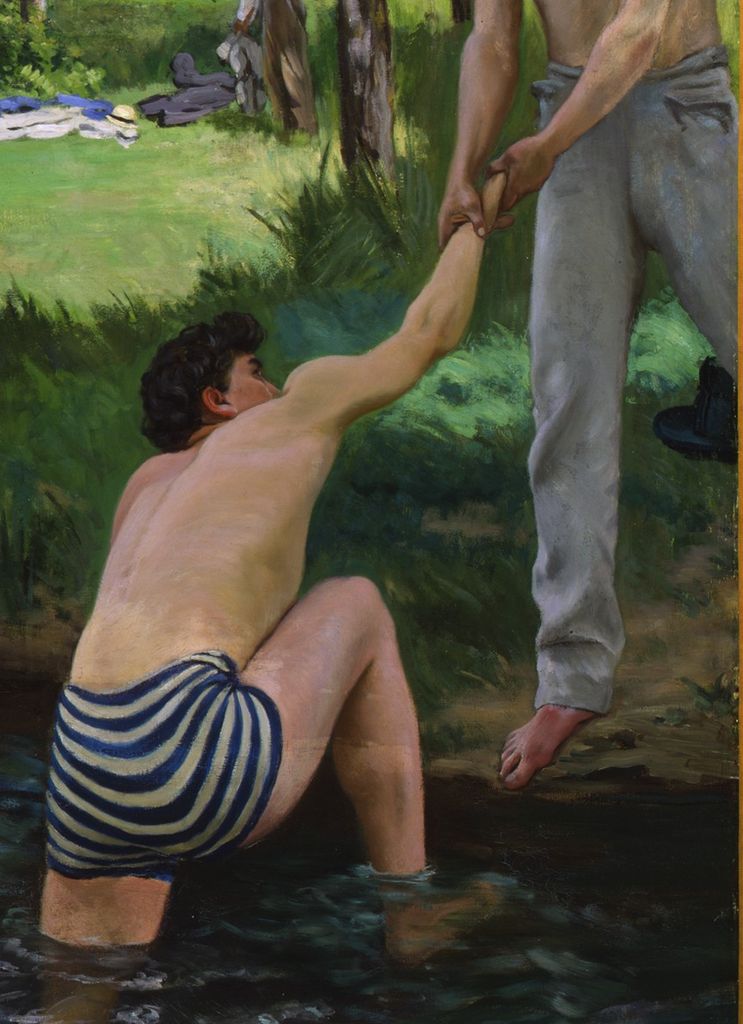
The first encounter is with the two large figures at opposite sides of the foreground. At the left, a young man in closely striped yellow and dark trunks leans against a pale, heavily marked tree. His feet meet the bank beside the water, and one hand spreads against the trunk. At the right, a bearded man in loose pale trousers grips another bather’s outstretched arm. That bather, seen from behind in blue-and-white striped trunks, lifts a knee towards the bank. The contact between their hands makes the movement intelligible before one has worked out the exact arrangement of their legs.
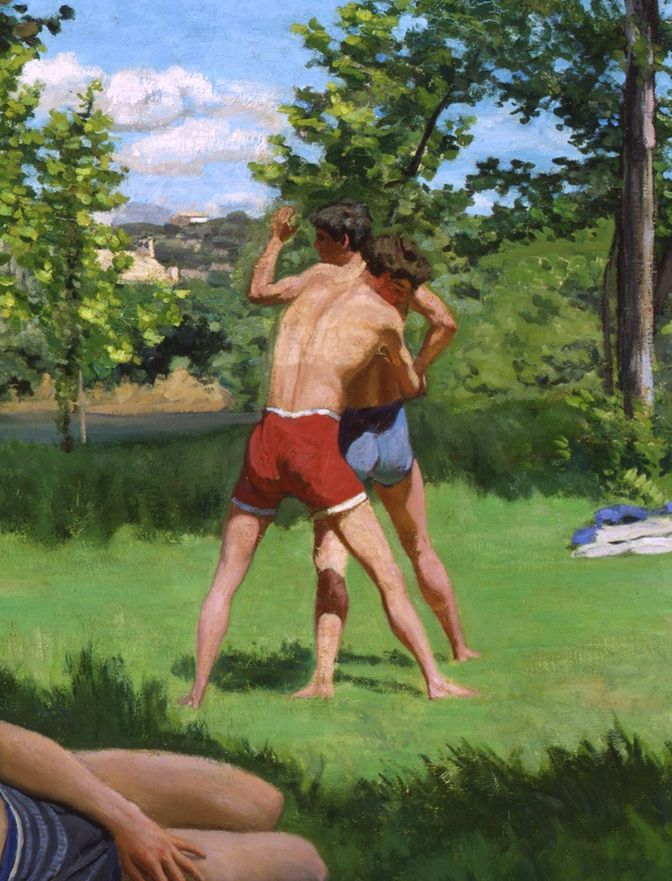
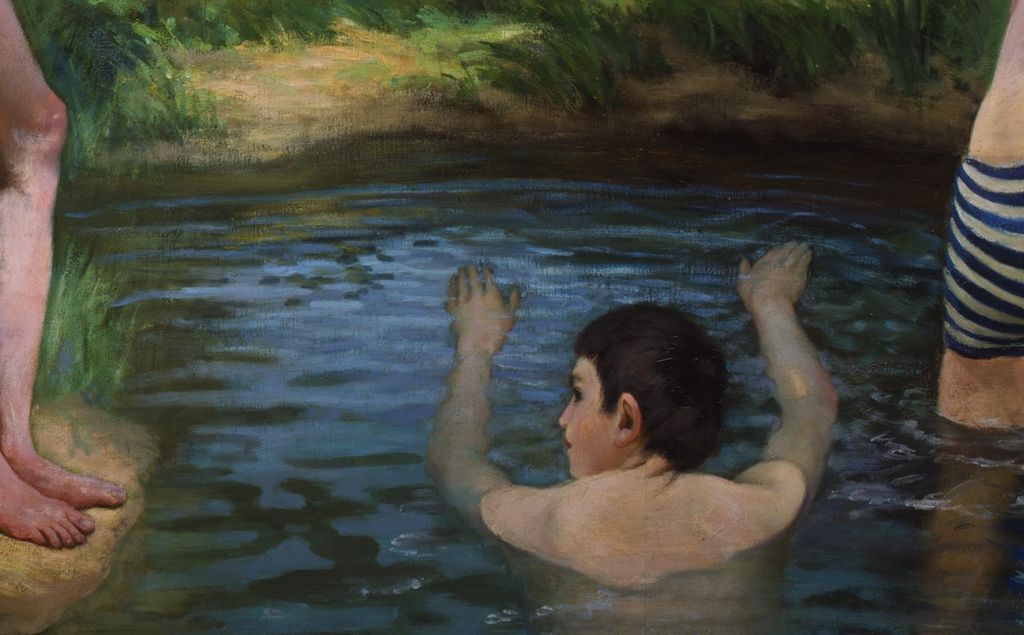
Between these two groups is a swimmer seen mainly from behind, his head and shoulders emerging from the pool and his arms raised in front of him. Behind the water, a reclining man props himself on an elbow. He turns towards two wrestlers farther back, whose red and blue trunks separate their intertwined bodies. An eighth figure stands near discarded clothing on the right. His shirt and trousers distinguish him from the bathers, while his small scale places him within the same receding space.
The painting does not tell us whether the clothed man is about to enter the water or has finished bathing. Nor does it explain why the figure against the left tree remains apart from the activity. Such gaps allow the scene to retain the looseness of ordinary life. People sharing a place need not share an action or a mood. The left figure’s averted gaze, the lounging spectator’s attention and the concentration required by the helping gesture create different degrees of engagement.
Looking moves through the picture by several routes. The reclining man directs attention towards the wrestlers. The raised arm on the right carries the eye upwards from water to bank. The left figure faces generally across the composition but offers no equally clear destination for his gaze. These movements prevent the distant wrestlers from becoming the sole subject. An energetic event occupies the centre, but much of the picture’s interest lies in the quieter relations around it.
There is also an unusually direct sense of bodily scale. The foreground men are close enough for hands, feet and bathing clothes to command attention. The smaller figures beyond do not simply repeat them. The wrestlers open their legs into angular supports, the reclining figure stretches horizontally across the grass, and the clothed man forms a narrow upright. Each supplies a different relation between a body and the surrounding space.
Trees, water and the square canvas
At approximately 1.6 metres in each direction, the painting has a substantial physical presence. The National Gallery of Art’s retrospective checklist dates it from spring 1869 into early winter 1870, a longer working span than the 1869 inscription at the lower left alone would suggest. Its nearly equal height and width matter because the scene requires room both for a broad spread of figures and for the trees rising above them. [1]
The foreground pool occupies a relatively shallow band. Above it, the bank rises towards a clearing and distant buildings. Tree trunks act as vertical markers across these successive zones. The immense pale trunk at the left belongs to the viewer’s immediate space; thinner trunks divide the middle distance; the darker group at the right gathers around the helping pair. The trees make depth readable while also giving the canvas a firm, upright structure.
Open sky appears between the foliage rather than as a continuous strip along the top. The largest opening is near the centre, above the wrestlers. It establishes an airy distance beyond the crowded foreground without separating the men from their environment. Branches, blue sky and pale clouds fit together in irregular shapes. Below, the grass is broken by longer dark passages that show where shade passes through the clearing.
The water offers a second, compressed version of this colour world. Broad blue patches are interrupted by green and dark strokes. Around the swimmer, the surface gathers into short horizontal marks; near the bather climbing out, it becomes darker and more disturbed. Water, flesh and bank meet without the sharp clarity of a diagram. The swimmer’s submerged body is less definite than his exposed shoulders, making the surface itself an active boundary.
Colour also joins figures who are far apart. Blue occurs in the sky, the water and several articles of clothing. Warm skin tones lead towards the red trunks in the middle distance, while the left bather’s yellow stripes echo the exposed earth at his feet. The emphatic stripes on the right-hand bather wrap around his body and turn away from us. Their curvature makes his twisting position easier to read, while the fine stripes at the left offer a steadier horizontal rhythm.
Schulman draws attention to a preparatory annotation concerning the relative tonal values of clear water and sunlit grass. The note identifies a precise working problem: how to distinguish adjacent illuminated surfaces without allowing either to overwhelm the other. The finished painting makes that question visible. The water appears cool and mobile, the grass brighter and more opaque, but they remain parts of one light-filled setting. [2]
Annotated Details from Summer Scene (Bathers)
The numbered points identify visible features discussed in this article. Return from each detail to the whole composition. Each caption identifies the work shown.
Summer Scene
Scène d'été (Bathers Summer Scene)
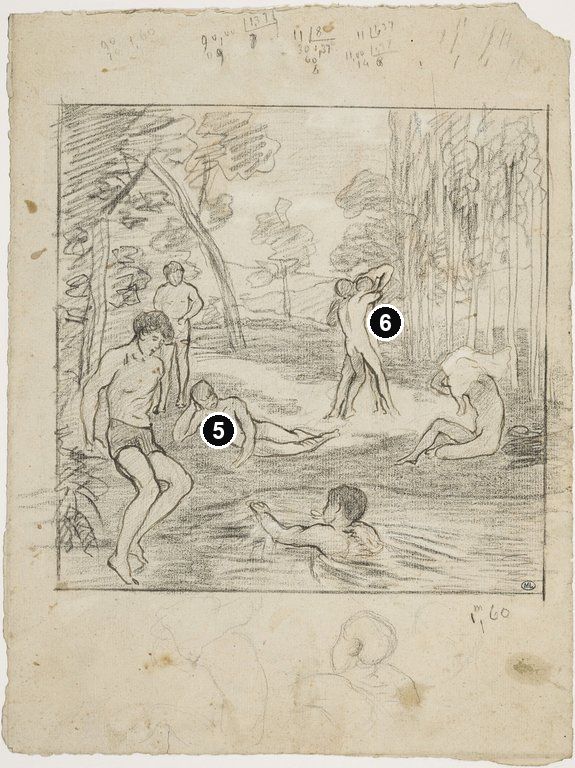
Study for Summer Scene
Study for Summer Scene, RF 29731 recto Image source. Public domain. Whole sheet retained; resized only where needed, without enlargement.
Details from SUMMER SCENE (BATHERS)
Compare the cropped details with the complete images above. Notice how their colours, shapes and positions contribute to the larger compositions.
Summer Scene
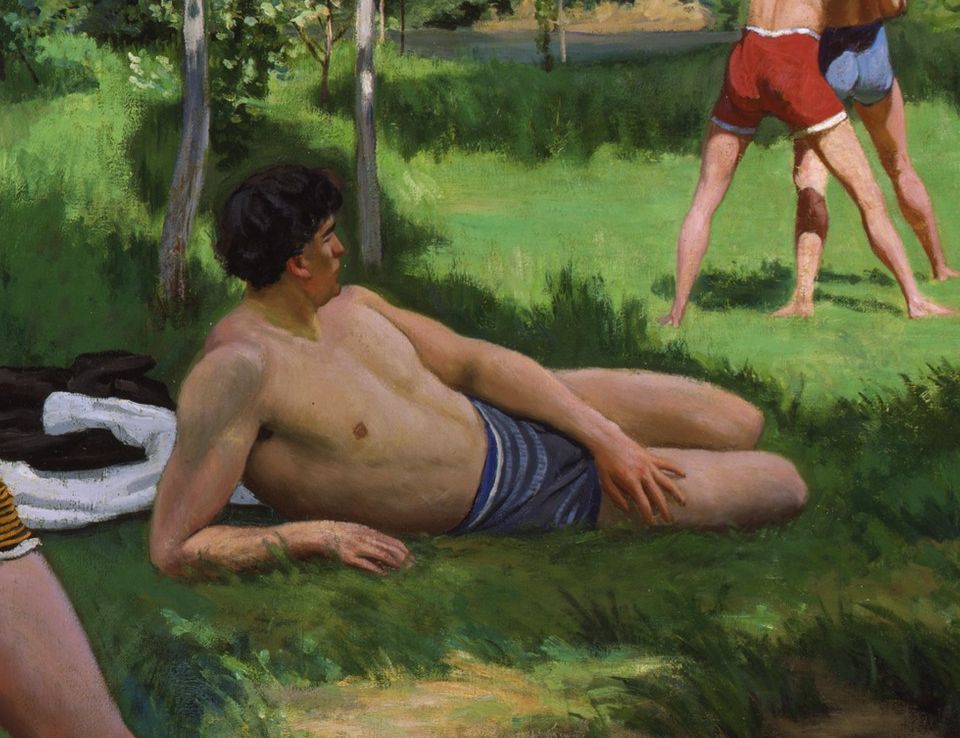
The resting figure on the bank
A reclining body spreads across the grass while its raised head directs attention into the gathering.
The wrestlers in the clearing
The paired poses create a compact event in the middle distance, distinct from the larger foreground bodies.
Helping a companion from the water
The joined hands make a long diagonal between two bodies at different heights.
Water against grass
Broken blue reflections meet a bank built from warmer earth and green strokes. The meeting gives each surface a different movement.
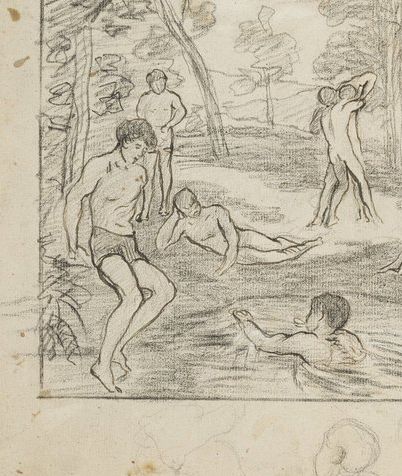
Study for Summer Scene
Resting and standing bodies
Large foreground poses overlap the smaller people farther back. The arrangement leaves room for changes when compared with the painting.
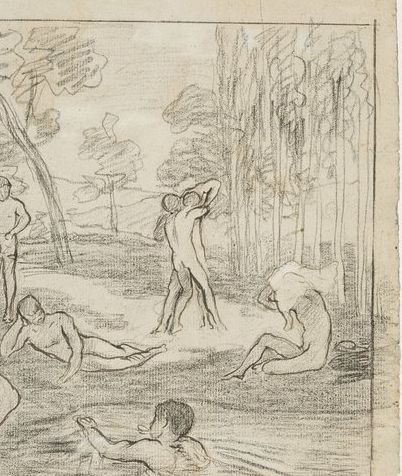
The wrestlers and enclosing trees
The pair occupies an opening between trunks, allowing their action to be tested within the larger landscape.
An outdoor painting prepared through study
Bazille’s interest in figures outdoors had a long preparation. In a letter of 6 January 1865, he told his father, “I must paint a great many figures this winter” — a new translation from the French. The following context explains that this work would prepare him for painting in the countryside during spring and summer. The letter describes study from the living model as a practical foundation for outdoor painting. [3]
That connection helps explain why Summer Scene can feel both observed and arranged. Its bodies do not appear to have been discovered simultaneously in one moment. Each has the clarity of a pose considered separately, then placed in relation to others. The large foreground figures establish the scale of the encounter; the smaller ones extend the scene into a lived environment. The task was to preserve the individuality of these poses while making the whole canvas convincing.
In a letter assigned by the Musée Fabre to mid-February 1869, Bazille described frequent paid modelling sessions in Paris and plans to work at Méric, his family’s estate near Montpellier. He also mentioned beginning a picture in Paris so that he could finish it there. Schulman connects this statement with the development of Summer Scene. The letter itself records a broader working life: models had to be paid, compositions planned, and work in the south anticipated while the painter was still in his Paris studio. [4] [2]
The setting is associated with the banks of the Lez below Méric, but the painting should not be approached simply as an exact record of a bathing party. Preparatory work and subsequent changes are integral to its making. The interval between conception, southern work and the final Salon submission allowed Bazille to rethink the connection between the figures and their surroundings. [2]
Schulman also identifies a letter of 2 May 1869 as evidence that Bazille was preparing the composition through three studies. The surviving drawings make this sustained development tangible. [2]
The Louvre holds a developed drawing, RF 29731 recto, made in charcoal and brown ink on cream paper. The museum records a sheet measuring 30.5 by 23.2 centimetres; the square composition drawn within it should be distinguished from the proportions of the whole sheet. The drawing was given to the museum in 1948. [5]
There are seven figures in that study, compared with eight in the painting. Positions and activities change as well. In Schulman’s discussion of the sheet, a figure near the left bank tests the water with a foot, another stands behind him, and the right-hand bather is occupied with removing a shirt. The finished painting establishes a more emphatic foreground exchange through the man helping his companion out. The difference is consequential: bodily contact now brings the pool and the bank together across the right side of the canvas. [6]
Other pencil studies explore wrestlers and alternative placements. A related sketchbook page establishes much of the group arrangement; further sheets try different positions for the struggling men and the bather at the right. They show that Bazille could isolate a practical difficulty, such as the disposition of a pair of bodies, without resolving the entire setting at once. Their relationships are more useful than an artificially precise sequence in which every sheet must occupy a fixed place. [7] [8] [9]
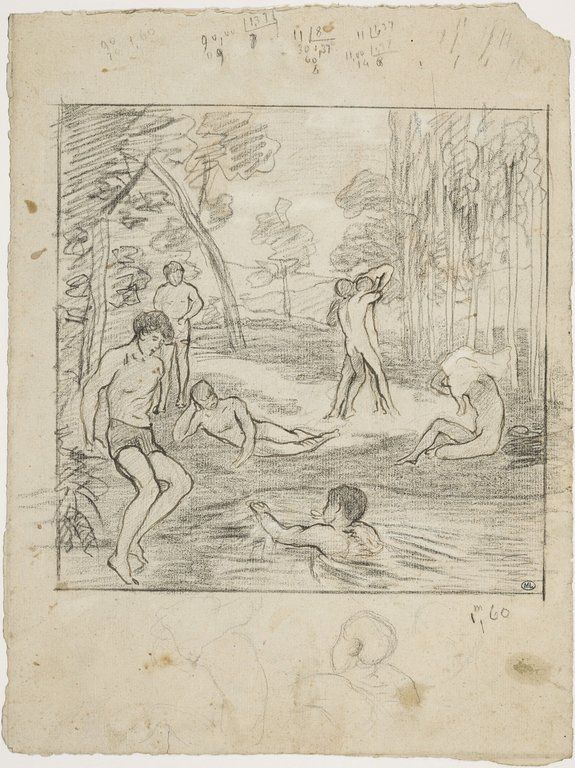
Study for Summer Scene, RF 29731 recto Image source. Public domain. Whole sheet retained; resized only where needed, without enlargement.
Watch: Bazille and early Impressionism
Explore a Paris studio with Smarthistory, then discover the beginnings of Impressionism with the National Gallery of Art.
Jean-Frédéric Bazille, The Artist’s Studio, Rue Visconti, Paris
A close look at Bazille’s 1867 painting of the studio he shared in Paris.
Watch on YouTubeWhere the bodies resist the landscape
The painting’s deliberate assembly has not pleased every critic. In his survey of its reception, Schulman records objections to elongated arms, emphatic hands and figures that seem insufficiently integrated with their surroundings. Other writers valued the landscape and colour more highly than the anatomy. These responses describe a lasting tension in the picture, although they need not settle its quality for a present-day viewer. [2]
Look, for example, at the arm reaching upwards on the right. Its length and diagonal thrust are indispensable to the helping action. At the same time, its outline is so assertive that it can feel almost independent of the surrounding air. The broad back below it is a large, relatively continuous area of flesh beside the smaller broken marks of water and grass. The body is legible in a different way from its setting.
A similar distinction appears at the left. The resting man’s torso has a continuous outline against the light tree and green foliage, while the leaves are made from many separate touches. His pose appears held, even though the setting suggests changing light and moving air. Across the picture, firmly presented bodies coexist with a more dispersed, flickering environment.
This is part of what makes the canvas interesting. Bazille does not dissolve every edge into sunlight. He preserves the presence of the posed model within a setting that asks for a different kind of handling. The eye alternates between reading a figure as a stable form and following the smaller marks that make up the open air around it. The painting’s cohesion comes as much from distributed colour, repeated gestures and the spacing of trees as from a uniform treatment of every surface.
The canvas itself also has a history beyond the visible composition. In his laboratory study of Bazille’s work, Bruno Mottin notes that Summer Scene was lined following transport damage, referring to the retrospective catalogue. Lining means that a further supporting canvas was attached to the original. This is a fact about the picture’s subsequent material life; it should be kept distinct from the drawings that document Bazille’s compositional decisions. [10]
Companionship and the male nude
The men share a place through physical nearness, looking and touch. The wrestlers test one another’s strength; the foreground pair cooperate; the lounging figure watches. The man at the tree supplies a quieter possibility of being together without actively joining in. Summer leisure here includes exertion, assistance, display and withdrawal.
Paul Perrin has interpreted Summer Scene, alongside Fisherman with a Net, in terms of pleasure in male companionship and the possibility of homoerotic feeling. Schulman discusses this reading through Perrin’s contribution to the 2016–17 retrospective catalogue. It draws attention to relationships that can be overlooked when the painting is treated solely as an exercise in outdoor light. It remains an interpretation of the work, rather than documentary evidence establishing Bazille’s sexual identity. [2]
The distinction allows the painting to retain its openness. The helping gesture can carry ordinary practicality and an awareness of bodily contact at the same time. The wrestlers can be understood as participants in a sport and as forms arranged for sustained looking. No single explanation removes the others. The painting presents male bodies as subjects of attention without providing a written account of what every relationship means.
Earlier art has also supplied comparisons. Schulman reports that Ernest Scheyer associated the man leaning against the tree with Saint Sebastian; later discussion proposed a painting attributed to Jacopo Bassano as a possible parallel. A resting shepherd by Laurent de La Hyre has been mentioned as well. Schulman’s account of Sarraute’s study of the preparatory drawing adds a comparison with a gesture in Poussin’s Landscape with Orpheus and Eurydice. [6] These comparisons concern pose and pictorial tradition. The canvas gives the figure no arrows, martyrdom or explicit sacred narrative, and the analogy does not establish a religious intention. [2]
The most productive comparisons preserve the difference between an inherited pose and its new circumstances. A body beside a tree can recall older painting while belonging to a contemporary scene of bathing clothes, discarded garments and informal recreation. Bazille’s modern subject does not require him to have forgotten the art he knew. It gives familiar arrangements of the body another setting and another social atmosphere.

The Fisherman with a Net
From a rejected fisherman to the Salon of 1870
Fisherman with a Net, painted in 1868, preceded Summer Scene in confronting the problem of the modern male nude outdoors. It was rejected at the Salon of 1869. The distinction matters: 1868 is the painting’s date, while 1869 is the year of rejection. In the earlier canvas, the standing nude is seen largely from behind with his fishing net, and a second figure sits farther away. Summer Scene distributes attention across a much larger company and gives its bodies several kinds of relationship. [11]
The later painting was admitted to the Salon of 1870. Bazille also submitted La Toilette, which was rejected despite his initial report to his parents that both works had been accepted. The two pictures made different claims for the nude: one assembled male figures in a landscape; the other arranged female models, patterned fabrics and attendant roles within a staged interior. Their divergent outcomes caution against reducing Salon judgement to a simple rule about nudity. [2]
Admission brought Summer Scene into a public arena where attention could be uncomfortable as well as rewarding. Schulman’s account records caricatures by Cham and Bertall and a range of written responses. Philippe Burty objected to abrupt juxtapositions of light and dark while recognising the sustained effort to render outdoor illumination. Zacharie Astruc responded more enthusiastically to the painting’s daylight; Théodore de Banville valued the truthfulness of its water and figures. These assessments are preserved here through Schulman’s discussion of the contemporary criticism. [2]
The disagreement helps explain the work’s force. The same separations of light, dark and firmly outlined flesh that could look awkward to one viewer could seem newly convincing to another. The contrast between sharply presented bodies and broken passages of vegetation made the painter’s decisions conspicuous. Viewers could recognise the activity immediately while disagreeing about how convincingly it had been painted.
Bazille’s responses, as recounted by Schulman from the correspondence, also changed. Before exhibition he had expressed anxiety about how his male figures would be received. Once the picture was hung, its visibility and the amount of discussion mattered to him even when the comments were unkind. Public recognition did not require unanimous praise. It meant that a substantial new work could attract notice and make later submissions objects of expectation. [2]
The painting at Harvard and its wider place
The catalogue traces Summer Scene through the artist’s family to the Meynier de Salinelles family and records its gift to the Fogg Art Museum in 1937. The National Gallery of Art’s 2017 checklist names the donors as Mr. and Mrs. F. Meynier de Salinelles and the lender as Harvard Art Museums/Fogg Museum. Its collection history is therefore distinct from the family gifts that brought other major Bazille paintings into French museums. [2] [1]
Its exhibition history likewise extends well beyond the Salon. Schulman records its appearance in the Bazille retrospective at the Grand Palais in 1910, and its later inclusion in the 2016–17 retrospective placed it within a fuller account of the artist’s drawings, friendships and working methods. That context changes how it can be seen: the apparently spontaneous summer gathering becomes a major instance of an ambition pursued through several kinds of preparation. [2]
The unfinished Young Male Nude Lying on the Grass offers a useful further comparison. Dated 1870 by the Musée Fabre, it concentrates attention on a single reclining body and retains conspicuous evidence of an earlier composition below. It makes the labour and incompleteness of painting unusually visible, whereas Summer Scene has to bring several independent poses into one public exhibition picture. [12]
Conversely, Landscape on the Banks of the Lez lets trees, ground, open sky and a distant view carry a broad composition without a human group. Both pictures belong to the late work, but they pursue different possibilities. The landscape comparison makes it easier to recognise how much of Summer Scene is achieved by intervals of grass and foliage between the men, rather than by their bodies alone. [1]
Schulman also places the painting beside later work by Caillebotte and Cézanne: waterside recreation in one case, groups of bathers in the other. These are illuminating comparisons of pictorial problems, rather than proof of a direct chain of influence. Summer Scene is most rewarding when allowed its own particular balance: a carefully made outdoor world in which a gesture of help, a stretch of shaded grass and a body at rest can each hold the viewer’s attention. [2]
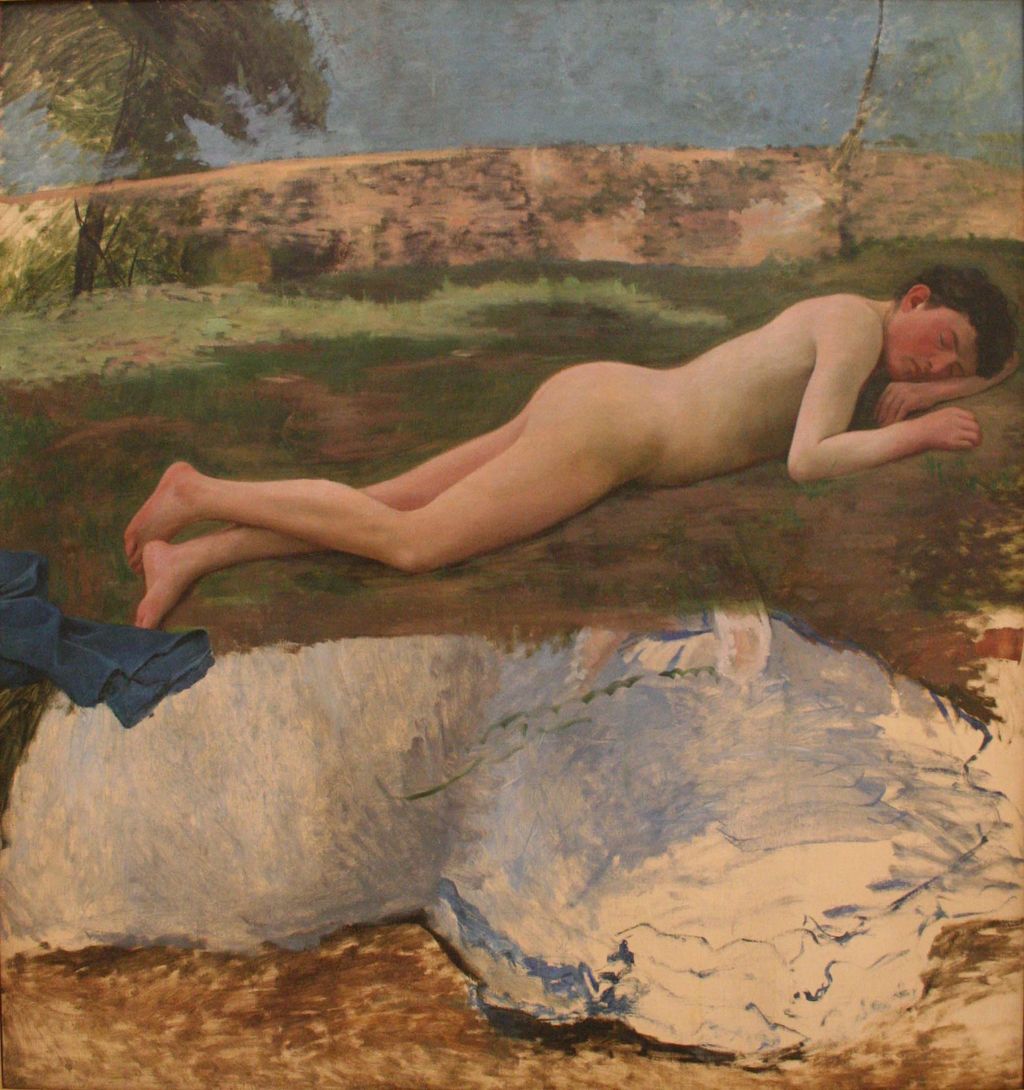
Young Male Nude Lying on the Grass Photograph: Rvalette / Wikimedia Commons. Image source. CC BY-SA 3.0. Resized proportionally; full canvas retained.
Bazille catalogue directory
The 284 records comprise 85 painting records,40 separate works-on-paper records and 159 album or study records. They describe the catalogue’s organisation rather than 284 independent objects or unanimously accepted attributions. Recto, verso, albums and multiple studies remain distinct. Dates are qualified where needed; the Drawing filter includes the etching, gouache and mixed works on paper. Manuscript mentions and unproved projects are listed separately below.
Works known through documents
These mentions remain separate from the 284 catalogue records. Some may concern surviving studies or underlying compositions; they cannot simply be added together as missing physical paintings.
- A copy after Rubens mentioned in March 1863 is unlocated.
- A portrait of an unidentified woman was reported completed before July 1866.
- A portrait of Monet and a composition of two life-size women arranging flowers were reported in progress in April 1867. Their mention does not establish two otherwise unknown surviving canvases.
- Gertrude et le père Lapin was at least begun in the summer of 1870.
Further reported works and uncertain attributions
- A Bouquet of Lilacs was reportedly stolen and returned in 1864; a portrait of the friend Theulier and Yellow Narcissi reported by Maître in 1868 are also documentary mentions.
- Unidentified pictures associated with Guillemet and Mme Rolina are reported through later correspondence cited by the catalogue.
- Children Dressed as Bride and Groom was associated with Vallotton’s collection and also attributed to Renoir. Its identification and authorship should remain open.
Projects whose completion is unproved
- A portrait of Pauline was planned in July 1865.
- A portrait of Marc was proposed in April 1866; a related drawing survives.
- A Jardinière project appears in album inscriptions and related figure material. Written plans are not evidence of a completed painting.
| Name | Date | Medium |
|---|---|---|
| Mystic Marriage of St. Catherine | 1863 | Oil on canvas |
| Trees, Study | 1863 | Oil on canvas |
| Farm of Saint-Sauveur | 1863 | Oil on canvas |
| In the Garden of the Parc Monceau, Paris | 1864 | Oil on canvas |
| Naked Woman from Behind | 1864 | Oil on canvas |
| Reclining Nude | 1864 | Oil on canvas |
| Courtyard of the Auberge du Cheval blanc at Chailly near Barbizon | 1864 | Oil on canvas |
| Covered Soup Bowls | 1864 | Oil on canvas |
| Two Herrings | 1864 | Oil on canvas |
| The Pink Dress | 1864 | Oil on canvas |
| The Dog Rita Asleep | 1864 (catalogue); c. 1864 (2017 checklist) | Oil on canvas |
| The Scoter | 1864 | Oil on canvas |
| Naked Reclining Woman | 1864 | Oil on canvas |
| Landscape at Chailly | 1865 | Oil on canvas |
| Rocks at Chailly, Forest of Fontainebleau | 1865 | Oil on canvas |
| Undergrowth at Chailly, Forest of Fontainebleau | 1865 | Oil on canvas |
| Still Life with Grapes and Nuts | 1865 | Oil on canvas |
| Self-Portrait with a Palette — Chicago | 1865 | Oil on canvas |
| Landscape of Saint-Sauveur | 1865 | Oil on canvas |
| Beach at Sainte-Adresse | 1865 | Oil on canvas |
| The Improvised Field Hospital | 1865 | Oil on canvas |
| Village Street, Chailly | 1865 | Oil on canvas |
| Small Valley in the Forest of Fontainebleau | 1865 | Oil on canvas |
| Forest of Fontainebleau | 1865 | Oil on canvas |
| Woman Ironing | 1866 | Oil on canvas |
| The Artist's Studio on the rue de Furstenberg | 1865–66 (museum) | Oil on canvas |
| Still Life with Fish | 1866 | Oil on canvas |
| Little Italian Street Singer | 1866 | Oil on canvas |
| Potted Flowers | 1866 | Oil on canvas |
| The Little Gardener | 1866–1867 | Oil on canvas |
| Young Woman Playing the Piano | 1866–1867 | Oil on canvas |
| End of a Summer Day | 1866–1867 | Oil on canvas |
| A Studio on the rue Visconti | 1867 | Oil on canvas |
| Thérèse Reading in the Park at Méric | 1867 | Oil on canvas |
| Portrait of Verlaine | 1867 | Oil on canvas |
| The Terrace at Méric | 1867 | Oil on canvas |
| Still Life with Heron | 1867 | Oil on canvas |
| The Family Gathering | 1867–68 (museum) | Oil on canvas |
| Oleanders | 1867 | Oil on canvas |
| Woman on the Terrace at Méric | 1867 | Oil on canvas |
| The Ramparts at Aigues-Mortes from South | 1867 | Oil on canvas |
| The Western Ramparts at Aigues-Mortes | 1867 | Oil on canvas |
| Portrait of Edmond Maître — head study | 1867 | Oil on canvas |
| Porte de la Reine at Aigues-Mortes | 1867 | Oil on canvas |
| Portrait of Sisley | 1867 | Oil on wood |
| Portrait of Renoir — Cleveland | 1867 | Oil on canvas |
| Portrait of Renoir — Musée d’Orsay | 1867 | Oil on canvas |
| Self-Portrait with a Detachable Collar — Minneapolis | 1865–67 (museum); 1867–68 (catalogue) | Oil on canvas |
| Vase of Flowers on a Console | 1868 (museum); 1867–68 (catalogue) | Oil on canvas |
| Portrait of a Woman | 1868 | Oil on canvas |
| Young Woman in the Vineyards | 1868 | Oil on card |
| Harvester with a Basket | 1868 | Oil on card |
| Harvester with a Yellow Hat | 1868 | Oil on card |
| Harvester with a Headdress | 1868 | Oil on panel |
| On the Banks of the Lez | 1868 | Oil on canvas |
| After the Bath (attribution questioned) | 1868? | Oil on canvas |
| Young Woman with Lowered Eyes | 1868 | Oil on canvas |
| Fisherman with a Net | 1868 | Oil on canvas |
| View of the Village | 1868 | Oil on canvas |
| Portrait of Bazille (attributed to Monet by Musée Fabre; disputed catalogue attribution) | 1864 (museum); 1868 (catalogue) | Oil on panel |
| Studies for a Grape Harvest (two panels) | 1868 | Oil on canvas (two panels) |
| The Fortune Teller | 1868–69 (catalogue); c. 1869–70 (2017 checklist) | Oil on canvas |
| Harvester with a Cap | 1869 | Oil on card |
| Portrait of Edmond Maître — 1869 | 1869 | Oil on canvas |
| Woman in a Moorish Costume | 1869 | Oil on canvas |
| Young Woman in the Garden | 1869 | Oil on canvas |
| Portrait of Alphonse Tissié in a Cavalryman's Uniform | 1869 | Oil on canvas |
| Portrait of a dragoon | 1869 | Oil on canvas |
| Portrait of Zacharie Astruc | 1869 | Oil on canvas |
| Bunch of Grapes in a Bucket | 1869 | Oil on card |
| Portrait of Edouard Blau | Probably 1869; inscribed 1866 | Oil on canvas |
| Young Male Nude Lying on the Grass | 1870 | Oil on canvas |
| Summer Scene | 1869–1870 | Oil on canvas |
| The Studio on the rue La Condamine | 1869–1870 | Oil on canvas |
| La Toilette | 1870 | Oil on canvas |
| Young Woman with Peonies — Montpellier | 1870 | Oil on canvas |
| Young Woman with Peonies — Washington | 1870 | Oil on canvas |
| Monotonous Chant | 1870 | Oil on canvas |
| Flowers — private collection | 1870 | Oil on canvas |
| Flowers — Musée Fabre | 1870 | Oil on canvas |
| Young Fisherman | 1870 | Oil on canvas |
| Study for Ruth and Boaz | 1870 | Oil on wood |
| Ruth and Boaz | 1870 | Oil on canvas |
| Self-Portrait in Shirt Sleeves | 1870 | Oil on canvas |
| Landscape on the Banks of the Lez | 1870 | Oil on canvas |
| Study after an Alpine Landscape | 1860 | Graphite on watercolour-tinted paper |
| Profile Head | 1862 | Charcoal on laid paper |
| Studies after Delacroix | 1863 | Ink and graphite, with gouache and watercolour, on paper |
| Academic Head | 1863 | Charcoal on paper |
| Study of a Woman's Head in Profile on a Chair | 1863 | Charcoal on paper |
| Academic Head of a Woman | 1863 | Charcoal on paper |
| Academy of Woman | 1863 | Black pencil and charcoal, stumped, on watermarked laid paper |
| Academy of Man | 1863 | Black pencil and charcoal, stumped, on watermarked laid paper |
| Naked Man | 1863 | Charcoal on paper |
| The Pont au Change in Paris | 1864 | Watercolour on paper |
| Study for the Pink Dress or Portrait of Thérèse des Hours | 1864 | Black pencil on paper |
| Naked Woman Standing | 1864 | Pencil on paper |
| Study of a Reclining Nude | 1864 | Charcoal on paper |
| Bathers | 1864 | Charcoal on paper |
| Portrait of a Man | 1864 | Charcoal on paper |
| Study for The Pink Dress | 1864 | Black pencil, squared, on paper |
| Study for Landscape of Saint-Sauveur | 1864 | Graphite on paper |
| Study for Landscape of Saint-Sauveur | 1865 | Pencil on paper |
| Man Taming a Bull | 1866 | Pen and black pencil on paper |
| Man Half Lying on a Sofa | 1866 | Charcoal on paper |
| Study for The Family Gathering | 1867 | Pencil on paper |
| Study for The Family Gathering | 1867 | Graphite, charcoal and black pencil on paper |
| The Embroiderer | 1867 | Pencil on pink paper |
| Study of Children | 1867 | Pencil on paper |
| Women in a Garden | 1867 | Pencil drawing |
| View of the Village | 1868 | Etching on paper |
| Portrait of a Bearded Man (catalogued as Self-Portrait) | Undated (museum); 1869 (catalogue) | Charcoal and brown ink |
| Man Smoking Pipe | 1869 | Watercolour on paper |
| Manet Drawing | 1868–70(?) (museum) | Charcoal and white chalk on paper |
| Study for the Summer Scene | 1869 | Charcoal, pen and ink on paper |
| Family Portrait | 1869 | Pastel and charcoal on paper |
| Study for Ruth | 1870 | Pencil and charcoal on paper |
| Woman Arranging a Hat | 1870 | Pencil drawing |
| Study for Boaz Asleep | 1870 | Pastel and red chalk |
| Boaz Asleep | 1870 | Charcoal and pencil on paper |
| Study for Boaz Asleep | 1870 | Black and beige pastel with red chalk on laid paper |
| Ruth Lying down | 1870 | Charcoal and pastel on paper |
| Head, Arm and Chest of Ruth | 1870 | Charcoal on paper |
| Chest of Ruth | 1870 | Black chalk and charcoal on paper |
| Black Woman with Peonies — gouache | c. 1870 | Gouache, watercolour, pencil and black chalk on card |
| Various Unidentified Subjects | Undated | Pencil drawing |
| Rocky Sea Side | Undated | Charcoal on paper |
| Studies of a Dancing Woman | Undated | Drawing with white chalk |
| Study of a Leg | Undated | Pencil drawing |
| Dancers in Camargue | Undated | Pencil drawing |
| Academy of Woman | Undated | Charcoal |
| Caricature of Venus of Milo and Various Other Caricatures | Undated | Charcoal |
| Caricature | Undated | Pencil drawing |
| Study of Landscape | Undated | Charcoal |
| Caricatures and Seated Monk | Undated | Charcoal |
| Caricatures and Various Subjects | Undated | Pencil drawing |
| Women Carrying a Pitcher | Undated | Pencil drawing |
| The Hanged Man | Undated | Charcoal |
| Castle in the Plain | Undated | Charcoal |
| Naked Woman from Behind | Undated | Charcoal |
| Caricatures | Undated | Charcoal and pencil |
| Unidentified Subjects | Undated | Pencil drawing |
| Landscape with a Castle | Undated | Charcoal |
| Study of Landscape | Undated | Charcoal |
| Horse Rider seen from Behind | Undated | Charcoal |
| Mazeppa | Undated | Pencil and charcoal |
| Study of Rider and Others Subjects | Undated | Pencil, pen and brown ink |
| Study of an Unidentified Man | Undated | Pencil drawing |
| Study for an Unknown Historic Scene | Undated | Pencil drawing |
| Study a Man Reading | Undated | Pencil drawing |
| Study of Men Reading | Undated | Pencil drawing |
| Study of Landscape ? | Undated | Charcoal |
| Study of a Head of a Man | Undated | Pencil drawing |
| Erotic Scene | Undated | Pencil drawing |
| Study of Dog | Undated | Charcoal |
| Studies of Unidentified Subjects and Erotic Scene | Undated | Pencil and charcoal drawing |
| Study for a Theater Scene | Undated | Charcoal |
| Study of a Reclining Naked Woman | Undated | Charcoal |
| Two Studies of Landscape | Undated | Pencil drawing |
| Caricature | Undated | Pencil and charcoal drawing |
| Portrait of an Unidentified Young Man | Undated | Charcoal |
| Study of an Unidentified Subject | Undated | Brown ink drawing |
| Unidentified Man with a Hat | Undated | Pencil and charcoal |
| Study of an Unidentified Women | Undated | Pencil drawing |
| Study for a Theater Character ? | Undated | Pencil drawing |
| Study for a Theater Character ? | Undated | Pen drawing |
| The Pavillon de la Reine in Paris | Undated | Pencil drawing |
| Study of a Horse Rider | Undated | Pencil and charcoal drawing |
| Entwined Couple. Caricature ? | Undated | Pencil drawing |
| Woman Sitting on a Sofa | Undated | Pencil drawing |
| Studies of Unidentified Subjects | Undated | Pencil and charcoal drawing |
| Studies of Animals | Undated | Pencil drawing |
| Study of a Horse Rider in Camargue | Undated | Charcoal |
| Study of Hunting Dogs | Undated | Pencil drawing |
| Study of Soldiers. Caricatures | Undated | Pencil drawing |
| Studies of Hunting Dogs ? | Undated | Pencil drawing |
| Hunting Scene. Hunter Playing the Horn | Undated | Pencil drawing |
| Caricature | Undated | Pencil drawing |
| Study of an Ibex | Undated | Pencil drawing |
| Theater Scene. Caricatures | Undated | Pencil drawing |
| Studies of Animals. Horses ? | Undated | Pencil drawing |
| Caricatures | Undated | Pencil drawing |
| Studies of Various Subjects and Animals | Undated | Pencil drawing |
| Unidentified Subject | Undated | Pencil drawing |
| Rider Taming a Horse [in Camargue ?] | Undated | Pencil drawing |
| Caricature of a Soldier | Undated | Pencil drawing |
| Study of a Woman and Mouse | Undated | Pencil drawing |
| Historic Scene | Undated | Charcoal |
| Architecture Studies | Undated | Pencil drawing |
| Mythologic Scene | Undated | Charcoal |
| Ophelia | Undated | Pencil drawing |
| Mythologic Scene | Undated | Charcoal |
| Studies of Various Subjects | Undated | Pencil and pen drawing |
| Studies of Peasants | Undated | Pencil drawing |
| Historic Scene | Undated | Pencil drawing |
| Historic or Literary Scene | Undated | Pencil drawing |
| Unidentified Historic Scene | Undated | Pencil drawing |
| Studies of Unidentified Subjects | Undated | Pencil drawing |
| Unidentified Study | Undated | Pencil drawing |
| Man in an Armchair | Undated | Pencil drawing |
| Studies of Various Subjects | Undated | Pencil drawing |
| Portraits of Unidentified Men | Undated | Pencil drawing |
| Studies of Various Subjects | Undated | Pencil drawing |
| Horse Rider and Artist | Undated | Charcoal and pencil |
| Study of Unidentified Characters | Undated | Charcoal |
| Dead Horse in a Plain | Undated | Charcoal |
| Study of Various Subjects and Furniture | Undated | Pencil drawing |
| Caricatures and Various Notes about Opéra | Undated | Pencil drawing |
| Galloping Horse | Undated | Charcoal |
| Study for La Toilette | Undated | Pencil drawing |
| Study of a Naked Woman | Undated | Pencil drawing |
| Domestic Scene | Undated | Pencil drawing |
| Physiognomies | Undated | Pencil drawing |
| Study for a Grape Harvest | Undated | Pencil drawing |
| Study for the Summer Scene | Undated | Pencil drawing |
| Female Profiles | Undated | Pencil drawing |
| Various Subjects | Undated | Pencil drawing |
| Study for The Terrace at Méric | Undated | Pencil drawing |
| Study for The Ramparts at Aigues-Mortes | Undated | Pencil drawing |
| Study for The Ramparts at Aigues-Mortes | Undated | Pencil drawing |
| Study for a Grape Harvest | Undated | Charcoal |
| Children Portraits | Undated | Pencil drawing |
| Study for Children's Heads | Undated | Pencil drawing |
| Study of Minerva | Undated | Pencil drawing |
| Study for a Grape Harvest | Undated | Pencil drawing |
| Study for The Family Gathering | Undated | Pencil drawing |
| Study for a Young Fisherman | Undated | Charcoal |
| Self-Portraits | Undated | Black pencil drawing |
| Study of Horses for the Porte de la Reine at Aigues-Mortes | Undated | Ink drawing |
| Study of Horses for the Porte de la Reine at Aigues-Mortes | Undated | Ink drawing |
| Study of Horses for the Porte de la Reine at Aigues-Mortes | Undated | Ink drawing |
| Study for an Outdoor Concert | Undated | Pencil drawing |
| Studies of Legs | Undated | Pencil drawing |
| Study for The Ramparts at Aigues Mortes | Undated | Pencil drawing |
| Studies of Hats | Undated | Pencil drawing |
| Studies of Men | Undated | Pencil drawing |
| Study for The Little Gardener | Undated | Pencil drawing |
| Study for The Ramparts at Aigues Mortes | Undated | Charcoal |
| Studies of Sail Boats | Undated | Pencil drawing |
| Portrait of Marc Bazille | Undated | Charcoal, black pencil and graphite |
| Studies of Children's Heads | Undated | Pencil drawing |
| Study for Aigues-Mortes | Undated | Pencil drawing |
| Studies of Women's Heads | Undated | Pencil drawing |
| Portrait of Camille des Hours and an Unidentified Man | Undated | Charcoal |
| Study of Flying Birds | Undated | Charcoal or graphite |
| Study for the Summer Scene | Undated | Pencil drawing |
| Study of Hands | Undated | Pen drawing |
| Self-Portrait | Undated | Black pencil drawing |
| Study for the Summer Scene | Undated | Pencil drawing |
| Study for the Summer Scene | Undated | Pencil drawing |
| Study for a Grape Harvest | Undated | Pencil drawing |
| Study of Branches | Undated | Pencil drawing |
| Study of a Seated Child | Undated | Pencil drawing |
| Study for a Couple and Unidentified Women | Undated | Pencil drawing |
| Studies of Unidentified Women | Undated | Pencil drawing |
| Study of Buildings | Undated | Pencil drawing |
| Study for a Grape Harvest | Undated | Pencil and charcoal |
| Studies of Boaters | Undated | Pencil drawing |
| Study of a Man Writing at his Table | Undated | Pencil drawing |
| Study of a Woman Cutting Flowers | Undated | Pencil drawing |
| Study of Hand | Undated | Pencil drawing |
| Women in a Garden | Undated | Pencil drawing |
| Studies of Women in Profile | Undated | Pencil drawing |
| Study for Ruth and Boaz | Undated | Charcoal |
| Study for The Family Gathering | Undated | Pencil drawing |
| Study for the View of the Village | Undated | Pencil drawing |
| Study of the View of the Village | Undated | Pencil drawing |
| Study for the Fisherman with a Net | Undated | Pencil drawing |
| Study for the View of the Village | Undated | Charcoal |
| Study for The Little Gardener | Undated | Charcoal |
| Portrait of a Man with a Top Hat | Undated | Pencil drawing |
| Portrait of a Man with a Top Hat | Undated | Pencil drawing |
| Inscriptions | Undated | Pencil inscriptions |
| Study of Tree | Undated | Pencil drawing |
| Caricature of Nina la Belle | Undated | Pencil drawing |
| Study for Saint Sebastian | Undated | Pencil drawing |
| Young Woman Sewing | Undated | Pencil drawing |
| Studies of Hands | Undated | Pencil drawing |
| Woman in a Garden | Undated | Pencil drawing |
| Elegant Woman | Undated | Pencil drawing |
| Various Inscriptions | Undated | Inscriptions (medium unspecified in index) |
| Study of a Man with a Hat | Undated | Pencil drawing |
| Study of a Child | Undated | Pencil drawing |
| Study of a Man with a Hat | Undated | Pencil drawing |
Frequently Asked Questions
Yes. Summer Scene was accepted at the Salon of 1870. [2]
It belongs to Harvard Art Museums’ Fogg Museum. [1]
Discussion
The bathers form several separate actions within one landscape. How does Bazille bring them together?
Reader Insights
Which figure first leads your eye into the scene, and where does its pose send you next?
Compare the seven-figure drawing with the painting. What does the changed arrangement do to the open spaces?
Where do the bodies blend with the bank, and where do their contours feel deliberately emphatic?
Join the Conversation
Share a detail, comparison or question about Summer Scene (Bathers) by Frédéric Bazille below.
References
- National Gallery of Art, Frédéric Bazille and the Birth of Impressionism, exhibition checklist, 2017, especially catalogue nos. 53, 64–65. Exhibition checklist. View source.
- Michel Schulman, Summer Scene, MSb-55, digital catalogue raisonné, object record, history, exhibitions and critical essay. Includes mediated discussions of contemporary reviews and later scholarship. Catalogue entry (English translation of French scholarship). View source.
- Frédéric Bazille, letter to his father, 6 January 1865, Musée Fabre, inventory 92.2.1, manuscript and transcription; quoted English wording newly translated from French. Letter (in French). View source.
- Frédéric Bazille, letter to his mother, assigned mid-February 1869, Musée Fabre, inventory 94.7.3, transcription p. 5. Letter (in French). View source.
- Musée du Louvre, Etude pour « La Scène d’été », RF 29731 recto, collection record. Collection record (in French). View source.
- Michel Schulman, Study for the Summer Scene, MSb-110, digital catalogue raisonné, critical discussion of the drawing and its differences from the painting. Catalogue entry (English translation of French scholarship). View source.
- Michel Schulman, Study for the Summer Scene, MSb-242, digital catalogue raisonné. Catalogue entry (English translation of French scholarship). View source.
- Michel Schulman, Study for the Summer Scene, MSb-245, digital catalogue raisonné. Catalogue entry (English translation of French scholarship). View source.
- Michel Schulman, Study for the Summer Scene, MSb-246, digital catalogue raisonné. Catalogue entry (English translation of French scholarship). View source.
- Bruno Mottin, “L’œuvre de Frédéric Bazille (1841–1870) examiné au laboratoire,” Technè, 46 (2018), pp. 30–38, especially paragraph 14. Article (in French). View source.
- Michel Schulman, Fisherman with a Net, MSb-45, digital catalogue raisonné, object record and exhibition history. Catalogue entry (English translation of French scholarship). View source.
- Musée Fabre, Étude de jeune homme nu, collection record, inventory 2002.5.2. Collection record (in French). View source.
- Joconde/POP, La Robe rose, RF2450. View source. (in French).
- Musée d’Orsay, L’Ambulance improvisée, RF 1967 5. View source. (in French).
- Musée d’Orsay, Réunion de famille,RF2749. View source. (in French).
- Musée d’Orsay, Pierre Auguste Renoir,DL1970 3. View source.
- Musée Fabre, Vue de village, 898.5.1. View source. (in French).
- National Gallery of Art, Young Woman with Peonies,1983.1.6. View source.
- Michel Schulman, painting index and documentary introduction (English titles; French metadata). View source.
- Michel Schulman, works-on-paper index (English titles; French metadata). View source.
- Michel Schulman, albums and studies index (English titles; French metadata). View source.


