 by Tom Gurney
Tom Gurney BSc (Hons) is an art history expert with over 20 years experience
Published on June 19, 2020 / Updated on November 2, 2026
Email: tomgurney1@gmail.com / Phone: +44 7429 011000
Studio of the Rue Visconti by Frédéric Bazille: Introduction
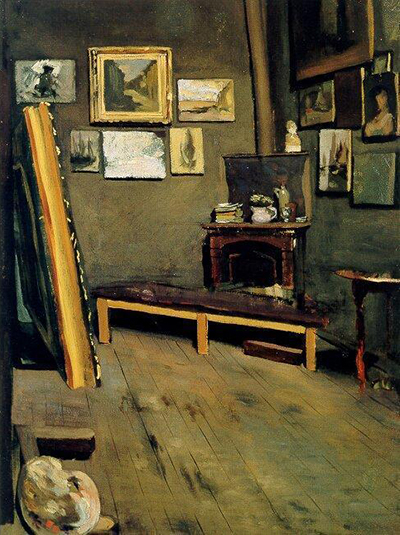
An artist can be present in a painting without appearing in it. In Frédéric Bazille’s Studio of the Rue Visconti, the palette near the bottom edge, the canvas turned almost sideways and the pictures covering the walls make a portrait of a working life. The long stretch of floor invites us towards the back of the room, but the objects placed around it keep reminding us of painting: pictures made, pictures admired and surfaces waiting to be used. Bazille painted this Paris interior in 1867. It belongs to the Virginia Museum of Fine Arts in Richmond, which calls it The Artist’s Studio, Rue Visconti, Paris. [1]
This is a small, upright oil on canvas, approximately 65 × 48 cm. The museum records it as unsigned. [1] The National Gallery of Art’s retrospective checklist dates it more specifically to May 1867. Its modest scale suits the close encounter it offers: we seem to have entered a room whose owner has momentarily stepped away. Yet its emptiness is selective. The painter has omitted human figures while giving considerable space to the things through which artists worked and recognised one another. [2]
At a Glance
- Date1867; May 1867 (2017 checklist) [1] [2]
- MediumOil on canvas; unsigned [1]
- Dimensions64.77 × 48.26 cm [1]
- CollectionVirginia Museum of Fine Arts, Richmond, 83.4 [1]
This work across Frédéric Bazille’s career
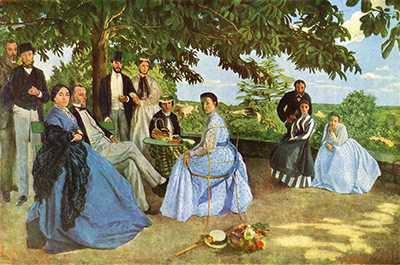
Family Reunion
1867–1868 (museum)Bazille’s Studio, Rue La Condamine
1869–1870Summer Scene (Bathers)
1869–1870Contents
- A floor that leads us into the painting
- A small room shared with friends
- The pictures within the picture
- Friendship beyond the empty room
- Three studios, three ways of representing work
- From Bazille’s family to Richmond
A floor that leads us into the painting
Begin at the bottom rather than with the pictures on the walls. The bare boards fill much of the lower half, widening towards us and narrowing as they approach the bench. Their joints establish the room’s depth. Dark marks and changes of tone interrupt their regular lines, so the floor reads as a used surface rather than a diagram of perspective. It provides an area of visual quiet beneath the much busier walls.
The bench stretches across the back, almost cutting the room in two. Its pale wooden supports stand out against its dark padded top. We can see beneath it, but its horizontal length slows the forward movement established by the boards. Above and behind it, the fireplace forms a second, shorter horizontal ledge. Floor, bench and mantelpiece give the interior three different levels, from the broad space at our feet to the smaller objects concentrated around the hearth.
At the right edge, part of a small round table enters the view. Its curved top and narrow legs provide a light counterpoint to the long, solid-looking bench. Like the easel on the opposite side, it is cropped by the composition: the room seems to continue beyond the edges of the canvas.
The left foreground creates a different kind of obstruction. A large framed canvas stands on an easel, turned so sharply away that its painted face is withheld. Its light-coloured edge forms a strong diagonal against the wall. We are close enough to notice the equipment, but cannot see the work it supports. That distinction matters in a picture filled with smaller paintings facing outwards. Bazille makes the act of viewing conspicuous by allowing us access to some pictures while turning another away.
Near the easel’s foot, the palette supplies a compact patch of varied colour. Its proximity to the lower edge makes it one of the first objects we might encounter on entering the room. It also offers a useful comparison with the rectangles above: here are touches of paint before they become a represented landscape, a face or a bird. The picture connects the material beginnings of painting with its finished appearances without needing to show an artist holding a brush.
The colour is restrained, but it is far from uniform. Greenish wall surfaces meet warm floorboards; a reddish fireplace surround emerges from a darker corner; the framed picture on the left wall has a bright gold border. Pale objects on the mantelpiece break up the shadows. These small contrasts keep the interior from settling into one brown or grey mass. Schulman’s catalogue contrasts its cooler grey-green range with the warmer tones of Bazille’s earlier Furstenberg studio interior. [3]
A small room shared with friends
Bazille occupied the rue Visconti studio from July 1866 until December 1867. The Virginia Museum of Fine Arts places Monet and Renoir’s arrival there in March 1867. Michel Hilaire also describes the address as a gathering place where friends lodged and made portraits of one another. Such accounts establish the room’s social importance, but they do not require us to imagine every member of the circle permanently living or working there together. [1] [4]
Seen in that setting, the absence of figures becomes particularly interesting. This was a place where people met, yet Bazille gives the room to its furniture and paintings. A bench could accommodate a visitor; a canvas could be brought out for discussion; pictures could be compared on the walls. These possibilities remain available to our imagination because the objects have been placed so clearly. No gesture or conversation tells us which one to follow.
The emptiness makes the room itself a subject. Its angles, intervals and changes of light give the painter plenty to organise. Here the floor offers an expansive foreground even though the actual accommodation was small. The composition gives us room to look, while the documentary evidence tells a more cramped story about living and working there.
That evidence is unusually practical. In a letter to his father editorially dated late November 1867, Bazille insisted that the rue Visconti premises did not give him enough space. He had already rented a much larger studio in the Batignolles district, at a cost of two hundred francs more, and intended to move in January. Read in its dated context, this means January 1868. The letter records the new lease and his plan; it should not be mistaken for a notice written after the move. [5]
Bazille’s explanation also gives substance to the question of money. He argued that the previous month showed he could manage the increased expense, mentioned paying for his meals and some costly entertainment, and asked where he would obtain money the following month. He had found a replacement tenant who would cover the rent for the period to which he remained committed at Visconti. His family’s resources made possibilities available to him, but those possibilities still involved requests, calculations and obligations. [5]
The replacement tenant is a small but revealing detail. Bazille could not simply abandon one address as soon as he preferred another. Nor does his confidence that life would cost less in the Batignolles make him financially independent. The letter is an argument made to his family about a proposed household budget. Against that background, the bench, fireplace and painting equipment acquire an ordinary usefulness. This is a room that had to serve several needs at once. [5]
The pictures within the picture
The most conspicuous wall painting is the gold-framed landscape to the left of the corner. The Virginia Museum of Fine Arts identifies it as Monet’s Rue de la Bavole, Honfleur, of about 1864. The frame separates it from its plainer neighbours, and its perspective offers a small view into an outdoor space within Bazille’s view of an interior. The museum reads the relationship between this work and the canvas on the easel as an expression of the artists’ mutual attention. [1]
That interpretation helps us look at the studio as a place of comparison. The framed street scene is a picture one can contemplate; the large canvas on the easel is encountered from the side. One offers an image, the other announces a substantial physical object. Bazille puts both conditions of painting into the same view. A work can be something seen through, into a represented world, and something carried, propped up, framed or turned to the wall.
Schulman counts thirteen paintings in the interior. He discusses possible identities for several, including coastal subjects associated with Monet and a small bird picture associated with Bazille. The number describes the represented display, rather than a complete inventory of everything the artists possessed. Nor should the paintings all be assigned to Bazille merely because they hang in his studio. [3]
Some identifications remain uncertain. The large image partly cut off at the upper right has been linked to Bazille’s Little Italian Street Singer, but the suggestion is reported as a hypothesis in the catalogue. The smaller portrait at the extreme right and the pale sculptural object above the fireplace cannot all be given secure names. Their uncertainty is worth preserving: the room’s significance does not depend on successfully matching every rectangle and object to a surviving work. [3]
Look instead at how different kinds of pictures coexist. Small light landscapes are set beside darker images; a strongly framed work sits among more simply presented canvases; pale prepared surfaces on the right await a different future. The differences make the wall look active. It contains more than a selection of finished works arranged for permanent display. Some objects solicit recognition, while others register as materials and shapes.
The mantelpiece creates a related ambiguity on a smaller scale. A cluster of vessels, a floral arrangement and a short stack of books or papers occupy the ledge. They furnish the room, but they also offer the kind of contrasts that make a still life: pale and dark, upright and rounded, flat and reflective. The small white sculptural form above them adds another potential object of study. Its exact subject need not be known for us to notice how it catches the eye against the dark corner. [3]
Watch: Bazille and early Impressionism
Explore a Paris studio with Smarthistory, then discover the beginnings of Impressionism with the National Gallery of Art.
Jean-Frédéric Bazille, The Artist’s Studio, Rue Visconti, Paris
A close look at Bazille’s 1867 painting of the studio he shared in Paris.
Watch on YouTubeFriendship beyond the empty room
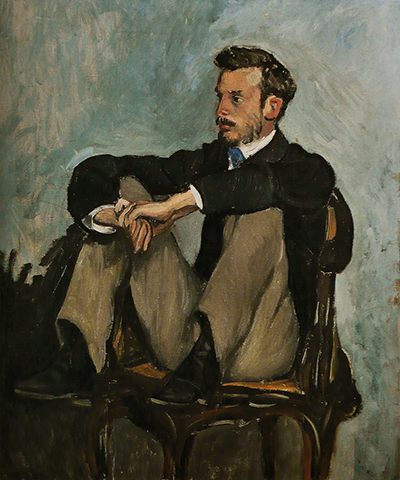
Another painting supplies a useful human counterpart to this interior. In Renoir’s Frédéric Bazille, dated 1867, Bazille sits at work before a still life of birds. The Musée d’Orsay connects that scene to the rue Visconti studio and to the heron still lifes painted by Bazille and Sisley. Renoir’s portrait brings the painter’s body and activity into the foreground; Bazille’s interior lets us study the setting and the things surrounding that activity. [6]
The connection with Still Life with Heron makes friendship concrete. It could involve looking at the same arrangement and making separate paintings from it, or turning a working friend into a portrait subject. We need not reduce these exchanges to the idea of a generous host paying for everyone else. Rooms and supplies mattered, but so did the opportunity to pose, compare results and see one’s work represented in another artist’s picture. The Orsay account of Renoir’s portrait makes this network of artistic responses central to its interpretation. [6]
The studio also belonged to a period of outspoken ambition. In April 1867, after reporting that his Salon submissions had been rejected, Bazille told his mother of a proposal to rent a large studio each year for an independent exhibition. A dozen young artists would show their work and invite admired older painters to contribute. “You will see that people will talk about us,” he wrote, in a new English translation of his French words. This was a proposal for future exhibitions, rather than evidence that such a show took place in the room depicted here. [7]
The letter helps explain why a studio could matter beyond the individual easel. It could provide a place to judge pictures outside the official exhibition setting and even suggest a different way of showing them. Bazille’s painting does not illustrate the proposed exhibition or document a particular meeting. What it does show is an artist living among paintings. Its crowded walls give a visible setting to the habits of looking and comparison on which an independent artistic circle depended.
Three studios, three ways of representing work
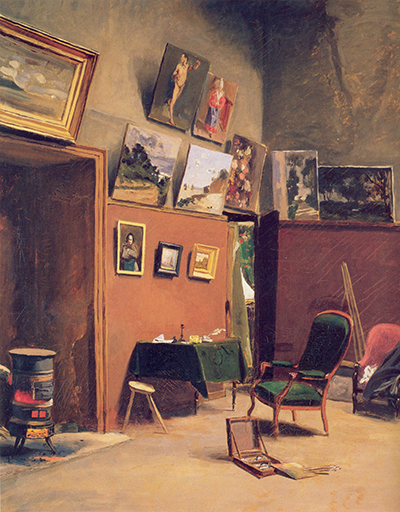
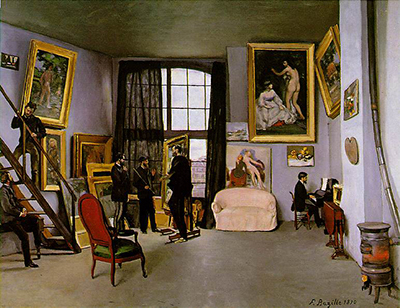
Placed between Studio in the Rue de Furstenberg and Bazille’s Studio, Rue La Condamine, the Visconti picture forms part of a sustained interest in workrooms. The earlier Furstenberg interior also gives furniture and paintings the attention usually reserved for people. Visconti sharpens the approach through the long floorboards and the close presence of the easel. The later Condamine painting opens out into a larger room with figures gathered around paintings and a piano. The National Gallery of Art’s checklist dates that later canvas to winter 1869–70. [2] [3]
The difference involves more than the number of people present. Visconti uses an upright format and brings the furnishings close together around a corner. Condamine uses a broad format, with much more space between its groups and objects. In both, however, bare floor remains an important part of the composition. It allows the viewer to approach the paintings and people, while making their distances from one another legible.
The later interior also provides a caution against treating a studio painting as an instantaneous record. Bruno Mottin’s laboratory study found that the Condamine room was initially painted without its figures; the people and the large armchair were added subsequently. That sequence belongs to the Condamine canvas. It shows how Bazille could construct a scene of artistic company through successive decisions, rather than simply copying everyone present at one moment. [8]
Visconti offers a different experience: we encounter the objects before the people who use them. The room’s visible arrangements have a coherence of their own. The large canvas and palette anchor the near edge, the bench holds the middle distance, and the wall pictures create a varied upper field. Whatever changes occurred in daily use, the painted room has been made into a structure we can explore.
Studio in the Rue de Furstenberg
Studio in Rue de La Condamine
From Bazille’s family to Richmond
The painting’s later history carried this private interior into a much wider public setting. The VMFA provenance begins with André Bazille’s collection in Montpellier, followed by Wildenstein in New York. Mr. and Mrs. Paul Mellon purchased the work in February 1961 and gave it to the Virginia Museum of Fine Arts in May 1983. The distinction between purchase and museum gift matters: it had already spent more than two decades in the Mellons’ collection before entering the museum. [1]
Its exhibition history traces changing settings in which Bazille’s work could be seen. The museum records its inclusion in the Montpellier retrospective of 1927 and the National Gallery of Art’s 1966 exhibition of paintings from the Mellon collections. It later appeared in the 1999 Atlanta exhibition devoted to Monet, Bazille and collaboration in the studio. These are different ways of approaching the same object: through the artist’s individual career, through a collection of French painting, and through the relationships that shaped his practice. [1]
The 2016–17 retrospective brought it into another sustained examination of Bazille’s achievement, travelling through Montpellier, Paris and Washington. In the Washington checklist it appears as catalogue number 35, with its Richmond ownership clearly identified. Its place there beside portraits, landscapes and figure paintings helps restore the studio interior to the range of subjects Bazille chose for himself. [1] [2]
Returning to the painting after that history, the palette is still near our feet and the large canvas still withholds its face. The room offers evidence of work without explaining every work it contains. Its intimacy comes partly from that balance: enough is visible to let us enter an artist’s daily surroundings, while the pictures retain their separate, sometimes uncertain identities.
Bazille catalogue directory
The 284 records comprise 85 painting records,40 separate works-on-paper records and 159 album or study records. They describe the catalogue’s organisation rather than 284 independent objects or unanimously accepted attributions. Recto, verso, albums and multiple studies remain distinct. Dates are qualified where needed; the Drawing filter includes the etching, gouache and mixed works on paper. Manuscript mentions and unproved projects are listed separately below.
Works known through documents
These mentions remain separate from the 284 catalogue records. Some may concern surviving studies or underlying compositions; they cannot simply be added together as missing physical paintings.
- A copy after Rubens mentioned in March 1863 is unlocated.
- A portrait of an unidentified woman was reported completed before July 1866.
- A portrait of Monet and a composition of two life-size women arranging flowers were reported in progress in April 1867. Their mention does not establish two otherwise unknown surviving canvases.
- Gertrude et le père Lapin was at least begun in the summer of 1870.
Further reported works and uncertain attributions
- A Bouquet of Lilacs was reportedly stolen and returned in 1864; a portrait of the friend Theulier and Yellow Narcissi reported by Maître in 1868 are also documentary mentions.
- Unidentified pictures associated with Guillemet and Mme Rolina are reported through later correspondence cited by the catalogue.
- Children Dressed as Bride and Groom was associated with Vallotton’s collection and also attributed to Renoir. Its identification and authorship should remain open.
Projects whose completion is unproved
- A portrait of Pauline was planned in July 1865.
- A portrait of Marc was proposed in April 1866; a related drawing survives.
- A Jardinière project appears in album inscriptions and related figure material. Written plans are not evidence of a completed painting.
| Name | Date | Medium |
|---|---|---|
| Mystic Marriage of St. Catherine | 1863 | Oil on canvas |
| Trees, Study | 1863 | Oil on canvas |
| Farm of Saint-Sauveur | 1863 | Oil on canvas |
| In the Garden of the Parc Monceau, Paris | 1864 | Oil on canvas |
| Naked Woman from Behind | 1864 | Oil on canvas |
| Reclining Nude | 1864 | Oil on canvas |
| Courtyard of the Auberge du Cheval blanc at Chailly near Barbizon | 1864 | Oil on canvas |
| Covered Soup Bowls | 1864 | Oil on canvas |
| Two Herrings | 1864 | Oil on canvas |
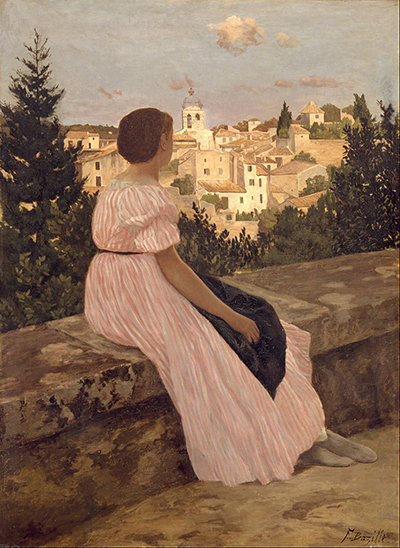
| The Pink Dress | 1864 | Oil on canvas |
| The Dog Rita Asleep | 1864 (catalogue); c. 1864 (2017 checklist) | Oil on canvas |
| The Scoter | 1864 | Oil on canvas |
| Naked Reclining Woman | 1864 | Oil on canvas |
| Landscape at Chailly | 1865 | Oil on canvas |
| Rocks at Chailly, Forest of Fontainebleau | 1865 | Oil on canvas |
| Undergrowth at Chailly, Forest of Fontainebleau | 1865 | Oil on canvas |
| Still Life with Grapes and Nuts | 1865 | Oil on canvas |
| Self-Portrait with a Palette — Chicago | 1865 | Oil on canvas |
| Landscape of Saint-Sauveur | 1865 | Oil on canvas |
| Beach at Sainte-Adresse | 1865 | Oil on canvas |
| The Improvised Field Hospital | 1865 | Oil on canvas |
| Village Street, Chailly | 1865 | Oil on canvas |
| Small Valley in the Forest of Fontainebleau | 1865 | Oil on canvas |
| Forest of Fontainebleau | 1865 | Oil on canvas |
| Woman Ironing | 1866 | Oil on canvas |
| The Artist's Studio on the rue de Furstenberg | 1865–66 (museum) | Oil on canvas |
| Still Life with Fish | 1866 | Oil on canvas |
| Little Italian Street Singer | 1866 | Oil on canvas |
| Potted Flowers | 1866 | Oil on canvas |
| The Little Gardener | 1866–1867 | Oil on canvas |
| Young Woman Playing the Piano | 1866–1867 | Oil on canvas |
| End of a Summer Day | 1866–1867 | Oil on canvas |
| A Studio on the rue Visconti | 1867 | Oil on canvas |
| Thérèse Reading in the Park at Méric | 1867 | Oil on canvas |
| Portrait of Verlaine | 1867 | Oil on canvas |
| The Terrace at Méric | 1867 | Oil on canvas |
| Still Life with Heron | 1867 | Oil on canvas |
| The Family Gathering | 1867–68 (museum) | Oil on canvas |
| Oleanders | 1867 | Oil on canvas |
| Woman on the Terrace at Méric | 1867 | Oil on canvas |
| The Ramparts at Aigues-Mortes from South | 1867 | Oil on canvas |
| The Western Ramparts at Aigues-Mortes | 1867 | Oil on canvas |
| Portrait of Edmond Maître — head study | 1867 | Oil on canvas |
| Porte de la Reine at Aigues-Mortes | 1867 | Oil on canvas |
| Portrait of Sisley | 1867 | Oil on wood |
| Portrait of Renoir — Cleveland | 1867 | Oil on canvas |
| Portrait of Renoir — Musée d’Orsay | 1867 | Oil on canvas |
| Self-Portrait with a Detachable Collar — Minneapolis | 1865–67 (museum); 1867–68 (catalogue) | Oil on canvas |
| Vase of Flowers on a Console | 1868 (museum); 1867–68 (catalogue) | Oil on canvas |
| Portrait of a Woman | 1868 | Oil on canvas |
| Young Woman in the Vineyards | 1868 | Oil on card |
| Harvester with a Basket | 1868 | Oil on card |
| Harvester with a Yellow Hat | 1868 | Oil on card |
| Harvester with a Headdress | 1868 | Oil on panel |
| On the Banks of the Lez | 1868 | Oil on canvas |
| After the Bath (attribution questioned) | 1868? | Oil on canvas |
| Young Woman with Lowered Eyes | 1868 | Oil on canvas |
| Fisherman with a Net | 1868 | Oil on canvas |
| View of the Village | 1868 | Oil on canvas |
| Portrait of Bazille (attributed to Monet by Musée Fabre; disputed catalogue attribution) | 1864 (museum); 1868 (catalogue) | Oil on panel |
| Studies for a Grape Harvest (two panels) | 1868 | Oil on canvas (two panels) |
| The Fortune Teller | 1868–69 (catalogue); c. 1869–70 (2017 checklist) | Oil on canvas |
| Harvester with a Cap | 1869 | Oil on card |
| Portrait of Edmond Maître — 1869 | 1869 | Oil on canvas |
| Woman in a Moorish Costume | 1869 | Oil on canvas |
| Young Woman in the Garden | 1869 | Oil on canvas |
| Portrait of Alphonse Tissié in a Cavalryman's Uniform | 1869 | Oil on canvas |
| Portrait of a dragoon | 1869 | Oil on canvas |
| Portrait of Zacharie Astruc | 1869 | Oil on canvas |
| Bunch of Grapes in a Bucket | 1869 | Oil on card |
| Portrait of Edouard Blau | Probably 1869; inscribed 1866 | Oil on canvas |
| Young Male Nude Lying on the Grass | 1870 | Oil on canvas |
| Summer Scene | 1869–1870 | Oil on canvas |
| The Studio on the rue La Condamine | 1869–1870 | Oil on canvas |
| La Toilette | 1870 | Oil on canvas |
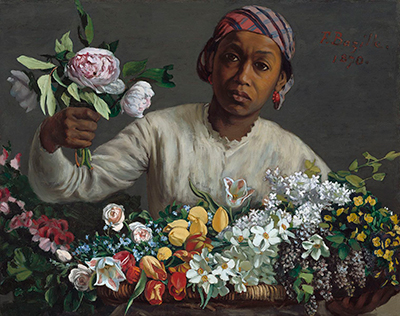
| Young Woman with Peonies — Montpellier | 1870 | Oil on canvas |
| Young Woman with Peonies — Washington | 1870 | Oil on canvas |
| Monotonous Chant | 1870 | Oil on canvas |
| Flowers — private collection | 1870 | Oil on canvas |
| Flowers — Musée Fabre | 1870 | Oil on canvas |
| Young Fisherman | 1870 | Oil on canvas |
| Study for Ruth and Boaz | 1870 | Oil on wood |
| Ruth and Boaz | 1870 | Oil on canvas |
| Self-Portrait in Shirt Sleeves | 1870 | Oil on canvas |
| Landscape on the Banks of the Lez | 1870 | Oil on canvas |
| Study after an Alpine Landscape | 1860 | Graphite on watercolour-tinted paper |
| Profile Head | 1862 | Charcoal on laid paper |
| Studies after Delacroix | 1863 | Ink and graphite, with gouache and watercolour, on paper |
| Academic Head | 1863 | Charcoal on paper |
| Study of a Woman's Head in Profile on a Chair | 1863 | Charcoal on paper |
| Academic Head of a Woman | 1863 | Charcoal on paper |
| Academy of Woman | 1863 | Black pencil and charcoal, stumped, on watermarked laid paper |
| Academy of Man | 1863 | Black pencil and charcoal, stumped, on watermarked laid paper |
| Naked Man | 1863 | Charcoal on paper |
| The Pont au Change in Paris | 1864 | Watercolour on paper |
| Study for the Pink Dress or Portrait of Thérèse des Hours | 1864 | Black pencil on paper |
| Naked Woman Standing | 1864 | Pencil on paper |
| Study of a Reclining Nude | 1864 | Charcoal on paper |
| Bathers | 1864 | Charcoal on paper |
| Portrait of a Man | 1864 | Charcoal on paper |
| Study for The Pink Dress | 1864 | Black pencil, squared, on paper |
| Study for Landscape of Saint-Sauveur | 1864 | Graphite on paper |
| Study for Landscape of Saint-Sauveur | 1865 | Pencil on paper |
| Man Taming a Bull | 1866 | Pen and black pencil on paper |
| Man Half Lying on a Sofa | 1866 | Charcoal on paper |
| Study for The Family Gathering | 1867 | Pencil on paper |
| Study for The Family Gathering | 1867 | Graphite, charcoal and black pencil on paper |
| The Embroiderer | 1867 | Pencil on pink paper |
| Study of Children | 1867 | Pencil on paper |
| Women in a Garden | 1867 | Pencil drawing |
| View of the Village | 1868 | Etching on paper |
| Portrait of a Bearded Man (catalogued as Self-Portrait) | Undated (museum); 1869 (catalogue) | Charcoal and brown ink |
| Man Smoking Pipe | 1869 | Watercolour on paper |
| Manet Drawing | 1868–70(?) (museum) | Charcoal and white chalk on paper |
| Study for the Summer Scene | 1869 | Charcoal, pen and ink on paper |
| Family Portrait | 1869 | Pastel and charcoal on paper |
| Study for Ruth | 1870 | Pencil and charcoal on paper |
| Woman Arranging a Hat | 1870 | Pencil drawing |
| Study for Boaz Asleep | 1870 | Pastel and red chalk |
| Boaz Asleep | 1870 | Charcoal and pencil on paper |
| Study for Boaz Asleep | 1870 | Black and beige pastel with red chalk on laid paper |
| Ruth Lying down | 1870 | Charcoal and pastel on paper |
| Head, Arm and Chest of Ruth | 1870 | Charcoal on paper |
| Chest of Ruth | 1870 | Black chalk and charcoal on paper |
| Black Woman with Peonies — gouache | c. 1870 | Gouache, watercolour, pencil and black chalk on card |
| Various Unidentified Subjects | Undated | Pencil drawing |
| Rocky Sea Side | Undated | Charcoal on paper |
| Studies of a Dancing Woman | Undated | Drawing with white chalk |
| Study of a Leg | Undated | Pencil drawing |
| Dancers in Camargue | Undated | Pencil drawing |
| Academy of Woman | Undated | Charcoal |
| Caricature of Venus of Milo and Various Other Caricatures | Undated | Charcoal |
| Caricature | Undated | Pencil drawing |
| Study of Landscape | Undated | Charcoal |
| Caricatures and Seated Monk | Undated | Charcoal |
| Caricatures and Various Subjects | Undated | Pencil drawing |
| Women Carrying a Pitcher | Undated | Pencil drawing |
| The Hanged Man | Undated | Charcoal |
| Castle in the Plain | Undated | Charcoal |
| Naked Woman from Behind | Undated | Charcoal |
| Caricatures | Undated | Charcoal and pencil |
| Unidentified Subjects | Undated | Pencil drawing |
| Landscape with a Castle | Undated | Charcoal |
| Study of Landscape | Undated | Charcoal |
| Horse Rider seen from Behind | Undated | Charcoal |
| Mazeppa | Undated | Pencil and charcoal |
| Study of Rider and Others Subjects | Undated | Pencil, pen and brown ink |
| Study of an Unidentified Man | Undated | Pencil drawing |
| Study for an Unknown Historic Scene | Undated | Pencil drawing |
| Study a Man Reading | Undated | Pencil drawing |
| Study of Men Reading | Undated | Pencil drawing |
| Study of Landscape ? | Undated | Charcoal |
| Study of a Head of a Man | Undated | Pencil drawing |
| Erotic Scene | Undated | Pencil drawing |
| Study of Dog | Undated | Charcoal |
| Studies of Unidentified Subjects and Erotic Scene | Undated | Pencil and charcoal drawing |
| Study for a Theater Scene | Undated | Charcoal |
| Study of a Reclining Naked Woman | Undated | Charcoal |
| Two Studies of Landscape | Undated | Pencil drawing |
| Caricature | Undated | Pencil and charcoal drawing |
| Portrait of an Unidentified Young Man | Undated | Charcoal |
| Study of an Unidentified Subject | Undated | Brown ink drawing |
| Unidentified Man with a Hat | Undated | Pencil and charcoal |
| Study of an Unidentified Women | Undated | Pencil drawing |
| Study for a Theater Character ? | Undated | Pencil drawing |
| Study for a Theater Character ? | Undated | Pen drawing |
| The Pavillon de la Reine in Paris | Undated | Pencil drawing |
| Study of a Horse Rider | Undated | Pencil and charcoal drawing |
| Entwined Couple. Caricature ? | Undated | Pencil drawing |
| Woman Sitting on a Sofa | Undated | Pencil drawing |
| Studies of Unidentified Subjects | Undated | Pencil and charcoal drawing |
| Studies of Animals | Undated | Pencil drawing |
| Study of a Horse Rider in Camargue | Undated | Charcoal |
| Study of Hunting Dogs | Undated | Pencil drawing |
| Study of Soldiers. Caricatures | Undated | Pencil drawing |
| Studies of Hunting Dogs ? | Undated | Pencil drawing |
| Hunting Scene. Hunter Playing the Horn | Undated | Pencil drawing |
| Caricature | Undated | Pencil drawing |
| Study of an Ibex | Undated | Pencil drawing |
| Theater Scene. Caricatures | Undated | Pencil drawing |
| Studies of Animals. Horses ? | Undated | Pencil drawing |
| Caricatures | Undated | Pencil drawing |
| Studies of Various Subjects and Animals | Undated | Pencil drawing |
| Unidentified Subject | Undated | Pencil drawing |
| Rider Taming a Horse [in Camargue ?] | Undated | Pencil drawing |
| Caricature of a Soldier | Undated | Pencil drawing |
| Study of a Woman and Mouse | Undated | Pencil drawing |
| Historic Scene | Undated | Charcoal |
| Architecture Studies | Undated | Pencil drawing |
| Mythologic Scene | Undated | Charcoal |
| Ophelia | Undated | Pencil drawing |
| Mythologic Scene | Undated | Charcoal |
| Studies of Various Subjects | Undated | Pencil and pen drawing |
| Studies of Peasants | Undated | Pencil drawing |
| Historic Scene | Undated | Pencil drawing |
| Historic or Literary Scene | Undated | Pencil drawing |
| Unidentified Historic Scene | Undated | Pencil drawing |
| Studies of Unidentified Subjects | Undated | Pencil drawing |
| Unidentified Study | Undated | Pencil drawing |
| Man in an Armchair | Undated | Pencil drawing |
| Studies of Various Subjects | Undated | Pencil drawing |
| Portraits of Unidentified Men | Undated | Pencil drawing |
| Studies of Various Subjects | Undated | Pencil drawing |
| Horse Rider and Artist | Undated | Charcoal and pencil |
| Study of Unidentified Characters | Undated | Charcoal |
| Dead Horse in a Plain | Undated | Charcoal |
| Study of Various Subjects and Furniture | Undated | Pencil drawing |
| Caricatures and Various Notes about Opéra | Undated | Pencil drawing |
| Galloping Horse | Undated | Charcoal |
| Study for La Toilette | Undated | Pencil drawing |
| Study of a Naked Woman | Undated | Pencil drawing |
| Domestic Scene | Undated | Pencil drawing |
| Physiognomies | Undated | Pencil drawing |
| Study for a Grape Harvest | Undated | Pencil drawing |
| Study for the Summer Scene | Undated | Pencil drawing |
| Female Profiles | Undated | Pencil drawing |
| Various Subjects | Undated | Pencil drawing |
| Study for The Terrace at Méric | Undated | Pencil drawing |
| Study for The Ramparts at Aigues-Mortes | Undated | Pencil drawing |
| Study for The Ramparts at Aigues-Mortes | Undated | Pencil drawing |
| Study for a Grape Harvest | Undated | Charcoal |
| Children Portraits | Undated | Pencil drawing |
| Study for Children's Heads | Undated | Pencil drawing |
| Study of Minerva | Undated | Pencil drawing |
| Study for a Grape Harvest | Undated | Pencil drawing |
| Study for The Family Gathering | Undated | Pencil drawing |
| Study for a Young Fisherman | Undated | Charcoal |
| Self-Portraits | Undated | Black pencil drawing |
| Study of Horses for the Porte de la Reine at Aigues-Mortes | Undated | Ink drawing |
| Study of Horses for the Porte de la Reine at Aigues-Mortes | Undated | Ink drawing |
| Study of Horses for the Porte de la Reine at Aigues-Mortes | Undated | Ink drawing |
| Study for an Outdoor Concert | Undated | Pencil drawing |
| Studies of Legs | Undated | Pencil drawing |
| Study for The Ramparts at Aigues Mortes | Undated | Pencil drawing |
| Studies of Hats | Undated | Pencil drawing |
| Studies of Men | Undated | Pencil drawing |
| Study for The Little Gardener | Undated | Pencil drawing |
| Study for The Ramparts at Aigues Mortes | Undated | Charcoal |
| Studies of Sail Boats | Undated | Pencil drawing |
| Portrait of Marc Bazille | Undated | Charcoal, black pencil and graphite |
| Studies of Children's Heads | Undated | Pencil drawing |
| Study for Aigues-Mortes | Undated | Pencil drawing |
| Studies of Women's Heads | Undated | Pencil drawing |
| Portrait of Camille des Hours and an Unidentified Man | Undated | Charcoal |
| Study of Flying Birds | Undated | Charcoal or graphite |
| Study for the Summer Scene | Undated | Pencil drawing |
| Study of Hands | Undated | Pen drawing |
| Self-Portrait | Undated | Black pencil drawing |
| Study for the Summer Scene | Undated | Pencil drawing |
| Study for the Summer Scene | Undated | Pencil drawing |
| Study for a Grape Harvest | Undated | Pencil drawing |
| Study of Branches | Undated | Pencil drawing |
| Study of a Seated Child | Undated | Pencil drawing |
| Study for a Couple and Unidentified Women | Undated | Pencil drawing |
| Studies of Unidentified Women | Undated | Pencil drawing |
| Study of Buildings | Undated | Pencil drawing |
| Study for a Grape Harvest | Undated | Pencil and charcoal |
| Studies of Boaters | Undated | Pencil drawing |
| Study of a Man Writing at his Table | Undated | Pencil drawing |
| Study of a Woman Cutting Flowers | Undated | Pencil drawing |
| Study of Hand | Undated | Pencil drawing |
| Women in a Garden | Undated | Pencil drawing |
| Studies of Women in Profile | Undated | Pencil drawing |
| Study for Ruth and Boaz | Undated | Charcoal |
| Study for The Family Gathering | Undated | Pencil drawing |
| Study for the View of the Village | Undated | Pencil drawing |
| Study of the View of the Village | Undated | Pencil drawing |
| Study for the Fisherman with a Net | Undated | Pencil drawing |
| Study for the View of the Village | Undated | Charcoal |
| Study for The Little Gardener | Undated | Charcoal |
| Portrait of a Man with a Top Hat | Undated | Pencil drawing |
| Portrait of a Man with a Top Hat | Undated | Pencil drawing |
| Inscriptions | Undated | Pencil inscriptions |
| Study of Tree | Undated | Pencil drawing |
| Caricature of Nina la Belle | Undated | Pencil drawing |
| Study for Saint Sebastian | Undated | Pencil drawing |
| Young Woman Sewing | Undated | Pencil drawing |
| Studies of Hands | Undated | Pencil drawing |
| Woman in a Garden | Undated | Pencil drawing |
| Elegant Woman | Undated | Pencil drawing |
| Various Inscriptions | Undated | Inscriptions (medium unspecified in index) |
| Study of a Man with a Hat | Undated | Pencil drawing |
| Study of a Child | Undated | Pencil drawing |
| Study of a Man with a Hat | Undated | Pencil drawing |
Frequently Asked Questions
They purchased it in February 1961 and gave it to the Virginia Museum of Fine Arts in May 1983. [1]
No. Written in late November 1867, it plans the move to larger premises for January 1868. [5]
Discussion
Begin with the palette near the foreground and follow the room towards the displayed pictures. What connects the two?
Reader Insights
What changes when you begin looking at the palette near the bottom rather than the wall pictures?
How do the floorboards and bench direct and interrupt your movement through the room?
Which wall-picture identification helps your reading, and which uncertain object remains interesting without a name?
Join the Conversation
Share a detail, comparison or question about Studio of the Rue Visconti by Frédéric Bazille below.
References
- Virginia Museum of Fine Arts, The Artist’s Studio, Rue Visconti, Paris, object 83.4; collection interpretation, Additional Information, Exhibition History and Provenance. Museum record. View source.
- National Gallery of Art, Frédéric Bazille and the Birth of Impressionism, exhibition checklist, 2017, catalogue nos. 16, 35 and 57. Checklist PDF. View source.
- Michel Schulman, Frédéric Bazille: The Digital Catalogue Raisonné, “A Studio on the rue Visconti,” MSb-27, critical essay and object record. Catalogue entry (English translation of French scholarship; provenance and bibliography in French). View source.
- Michel Hilaire, “Bazille ou la vie brève,” Académie des Sciences et Lettres de Montpellier, 2016, pp. 166–172, especially pp. 169–170. Lecture PDF (in French). View source.
- Frédéric Bazille, letter to his father, editorially dated late November 1867, Musée Fabre, inventory 92.2.5, transcription p. 4. Letter and museum transcription (in French). View source.
- Musée d’Orsay, Auguste Renoir, Frédéric Bazille, 1867, RF 2448, collection interpretation and object details. Museum record (English interpretation; detailed catalogue fields in French). View source.
- Frédéric Bazille, letter to his mother, editorially dated April 1867, Musée Fabre, inventory 94.7.1, manuscript p. 2 and transcription p. 4; English quotation newly translated. Letter and museum transcription (in French). View source.
- Bruno Mottin, “L’œuvre de Frédéric Bazille (1841–1870) examiné au laboratoire,” Technè, 46, 2018, pp. 30–38, especially paragraphs 21–23. Article (in French). View source.
- Joconde/POP, La Robe rose, RF2450. View source. (in French).
- Musée d’Orsay, L’Ambulance improvisée, RF 1967 5. View source. (in French).
- Musée d’Orsay, Réunion de famille,RF2749. View source. (in French).
- Musée d’Orsay, Pierre Auguste Renoir,DL1970 3. View source.
- Musée Fabre, Vue de village, 898.5.1. View source. (in French).
- National Gallery of Art, Young Woman with Peonies,1983.1.6. View source.
- Michel Schulman, painting index and documentary introduction (English titles; French metadata). View source.
- Michel Schulman, works-on-paper index (English titles; French metadata). View source.
- Michel Schulman, albums and studies index (English titles; French metadata). View source.
 Frederic Bazille.jpg)