



 by Tom Gurney
Tom Gurney BSc (Hons) is an art history expert with over 20 years experience
Published on June 19, 2020 / Updated on November 2, 2026
Email: tomgurney1@gmail.com / Phone: +44 7429 011000
Bazille’s Studio, Rue La Condamine: Introduction
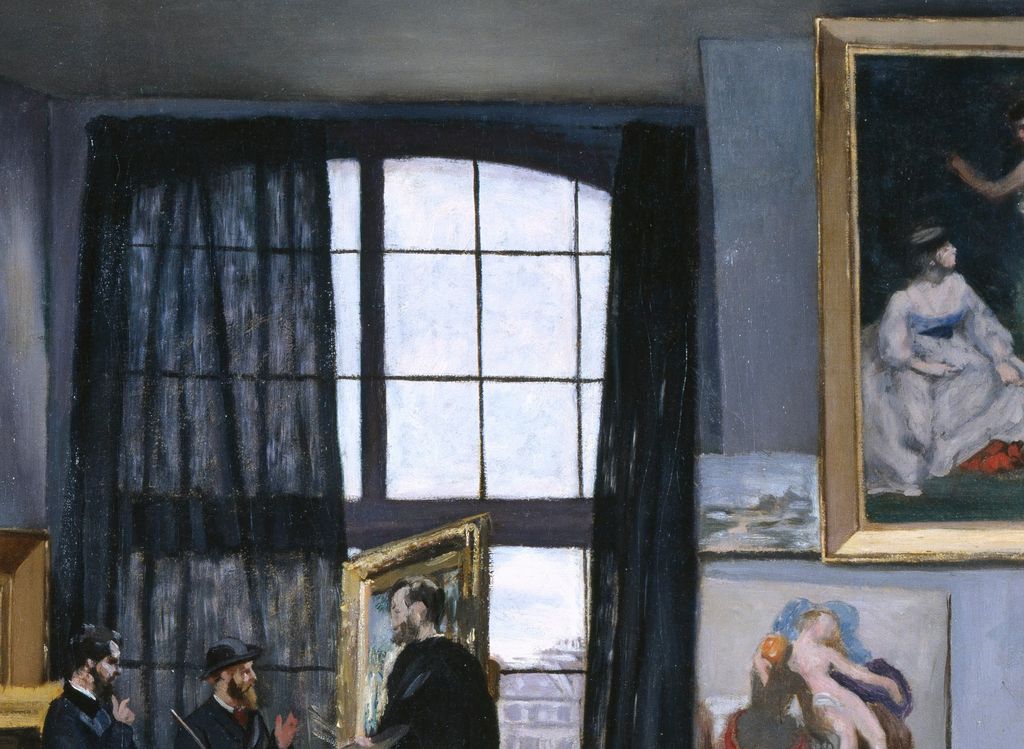
Six men occupy Frédéric Bazille’s Paris studio, yet much of the room remains open. A green chair stands empty in the foreground. Paintings climb the walls, gather beneath the window and lean behind a conversation at an easel. At the far right, a pianist attends to his music. Painted in the winter of 1869–70, Bazille’s Studio, Rue La Condamine turns an artist’s workplace into a meeting between pictures, people and competing judgements about art. The oil painting belongs to the Musée d’Orsay in Paris. [1]
The tall painter holding a palette is Bazille; the man in a hat beside him is Édouard Manet. Edmond Maître plays the piano. Other identifications remain disputed, as do some of the miniature paintings displayed around them. Those uncertainties matter because this is more than a record of who happened to visit. Bazille has arranged a room in which art receives the attention of friends, including works rejected by the official Salon. The studio offers another place to look and judge. [2]
At a Glance
- Date1870; developed in winter 1869–70 [1]
- MediumOil on canvas [3]
- CollectionMusée d’Orsay, Paris, RF 2449 [3]
This work across Frédéric Bazille’s career
Contents
- A room organised around looking
- The space Bazille chose to pay for
- Who is in the studio?
- The paintings within the painting
- An alternative to the Salon’s judgement
- Manet’s contribution and the making of Bazille’s figure
- An empty room, then people—and another painting underneath
- Three studios, three ways of presenting an artist’s life
- From family possession to the Musée d’Orsay
- Annotated details
A room organised around looking
The window is the room’s principal source of brightness, but Bazille does not make it a simple opening onto the city. Its dark curtains occupy a broad area of the back wall, filtering and framing the light. A grid of bars holds the pale panes in place. Through the lower portion, a strip of buildings gives the interior a location beyond its own walls. Light enters an inhabited working room rather than dissolving its boundaries.
The architecture is emphatically solid. The staircase cuts diagonally across the left side; the right wall pushes towards us; the ceiling stretches overhead in a broad grey plane. Upright frames, window bars, easel and stovepipe repeat one another without producing perfect regularity. Paintings hang at different heights and angles. Some present themselves squarely, while others lean away or are partly hidden. The room has order, but it retains the awkwardness of storing and using things.
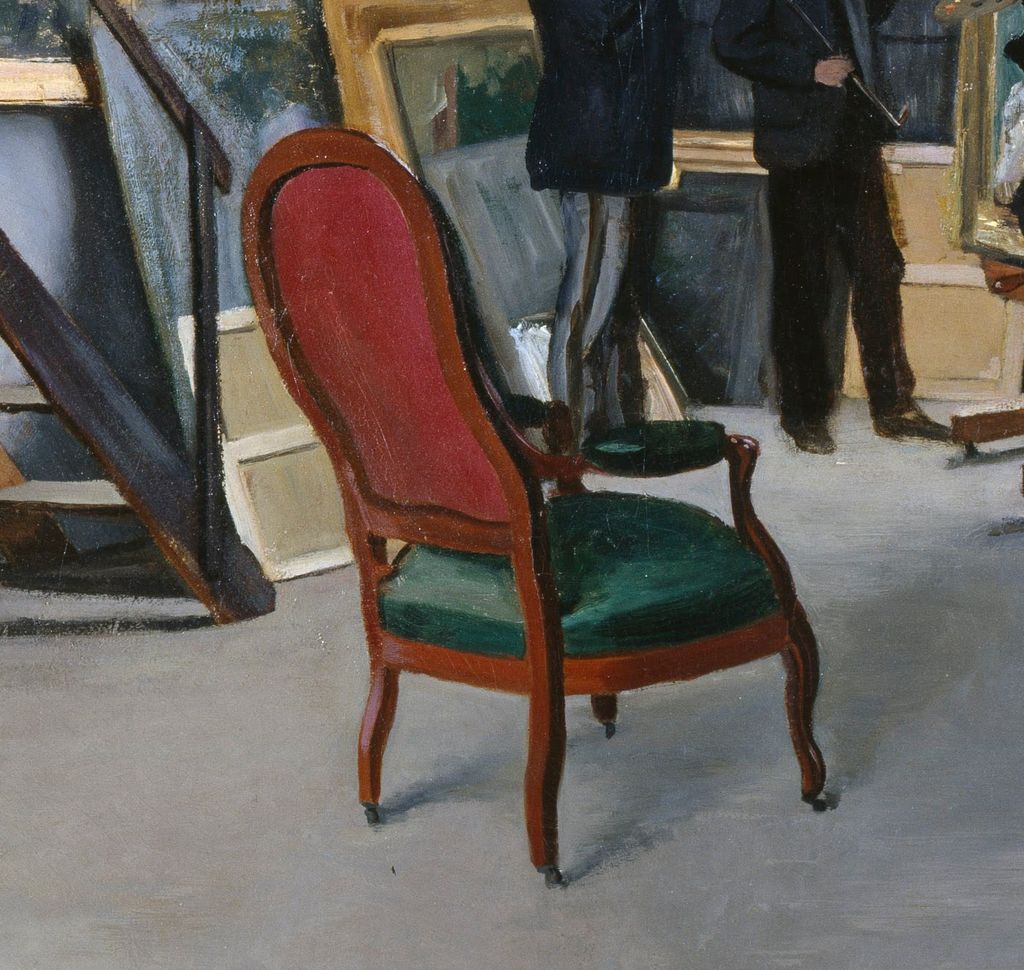
Its most striking feature is the bare floor. The central conversation takes place beyond a broad foreground interval, leaving us space in which to approach. The empty chair marks that interval without filling it. Its green upholstery and reddish wooden frame make a strong colour accent against the subdued floor. Seen from behind and at an angle, it directs attention towards the easel while keeping its own seat conspicuously vacant.
The pale pink sofa performs a different task. Pushed beneath the pictures at the back, it supplies a large, rounded patch of light. Its curved arms soften the succession of rectangles above and around it. The chair, sofa and cylindrical stove offer changes of shape within an interior governed by corners and edges. Their colours also distinguish areas of use: sitting, conversation, warmth, work.
The stove is particularly easy to overlook as the eye moves towards the people. It stands close to the picture’s lower-right edge, its warm red opening visible beneath the dark upper surface. The pipe rises through almost the full height of the right wall. Opposite the staircase, it helps enclose the room. These useful objects give the studio weight and temperature, qualities that a display of portraits alone would not convey.
The people belong to separate activities. At left, one man sits while another stands on the stairs; near the easel, three men concentrate on a picture; Maître sits apart at the piano. No general conversation unites all six. Instead, the arrangement permits different forms of companionship to coexist. The room’s emptiness is therefore productive: it keeps the smaller exchanges legible and lets the paintings remain active participants.
The space Bazille chose to pay for
The spaciousness had a practical history. In a letter assigned by the Musée Fabre to late November 1867, Bazille told his father that the rue Visconti studio was too small. He had rented a much larger room in the Batignolles district, at an additional cost of 200 francs, and intended to move in January. The sequence points to January 1868, rather than January 1869. He had also found a replacement tenant to cover his remaining commitment at Visconti. This was a planned move involving rent, obligations and an argument to his family about what he could afford. [4]
The letter helps us read the painted floor. Space was something Bazille had actively sought. A larger studio could accommodate canvases, models and visitors, but it also carried a larger bill. The painting’s expanse need not be treated as a psychological symbol of new confidence to recognise its importance. It represents a material improvement in his ability to work.
By late 1869, the interior itself had become a project. Writing to his father, Bazille listed three works under way: his studio interior, a portrait of Édouard Blau and a female nude intended for the Salon. He expected these projects to occupy the winter. In the same letter he contemplated another studio move for April. The picture thus belongs to an established workplace approaching another change, rather than to the excitement of moving into it. [5]
Life in such rooms depended on more than rent. In February 1869 Bazille described the cost of employing models almost daily and asked his parents for further money. He had paid arrears from the previous month and found continued sittings expensive. At the same time, visiting painters were praising his work, and Alfred Stevens offered to introduce members of the Salon jury to it. The studio was a place of labour, private reception and hoped-for professional opportunity. [6]
Bazille’s resources also helped friends. His letter of 5 April 1869 records Monet lodging with him during a particularly difficult financial period. Such evidence gives substance to the painting’s sociability without reducing Bazille to the wealthy benefactor of more talented men. He supplied space and assistance while trying to establish his own standing as a painter, relying in turn on family support. [7]
The relatively uncluttered room should not conceal those dependencies. The pictured ease is something Bazille constructed out of paid-for space, work and relationships. His friends could look at a canvas here before an official jury or paying public saw it. That private attention was itself valuable.
Annotated Details from Bazille’s Studio, Rue La Condamine
The numbered points identify visible features discussed in this article. Return from each detail to the whole composition. Studio in Rue de La Condamine
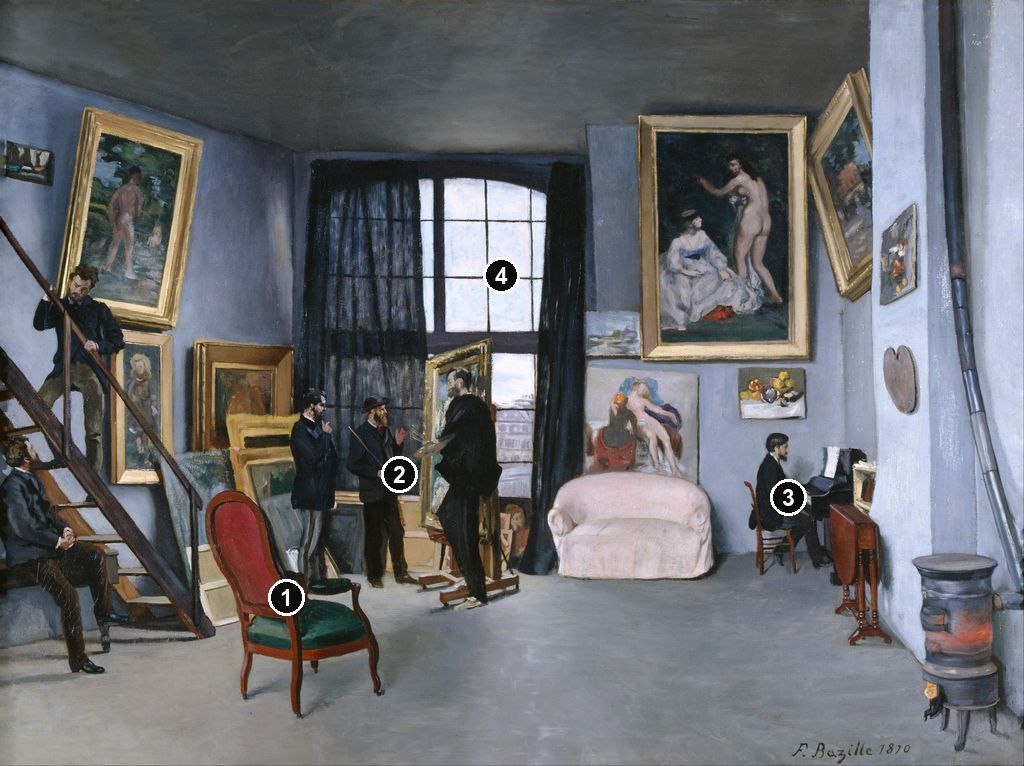
Details from BAZILLE’S STUDIO, RUE LA CONDAMINE
Compare the cropped details with the complete images above. Notice how their colours, shapes and positions contribute to the larger compositions.
The empty foreground chair
Red and green upholstery gives the unoccupied chair a strong presence within the bare floor.
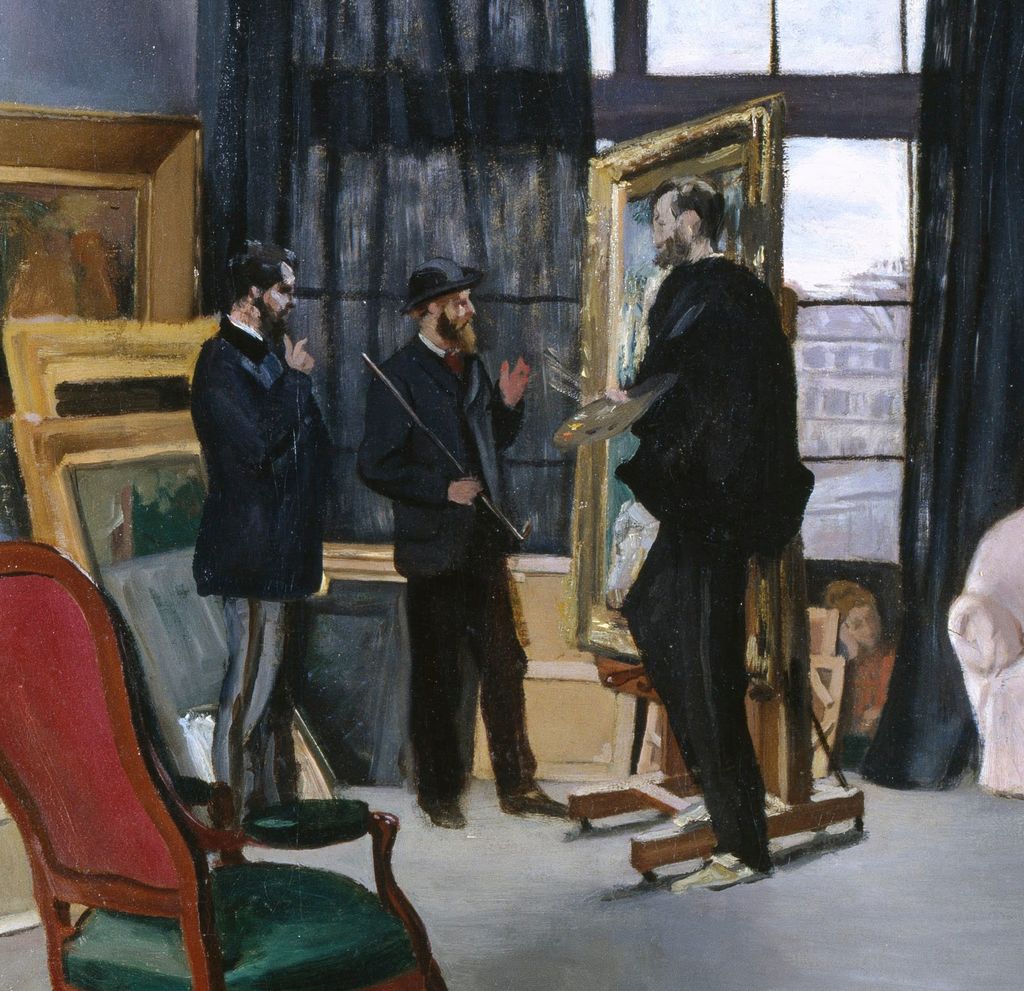
Looking around the easel
Three figures gather around a picture, with their different directions of looking making the exchange legible.
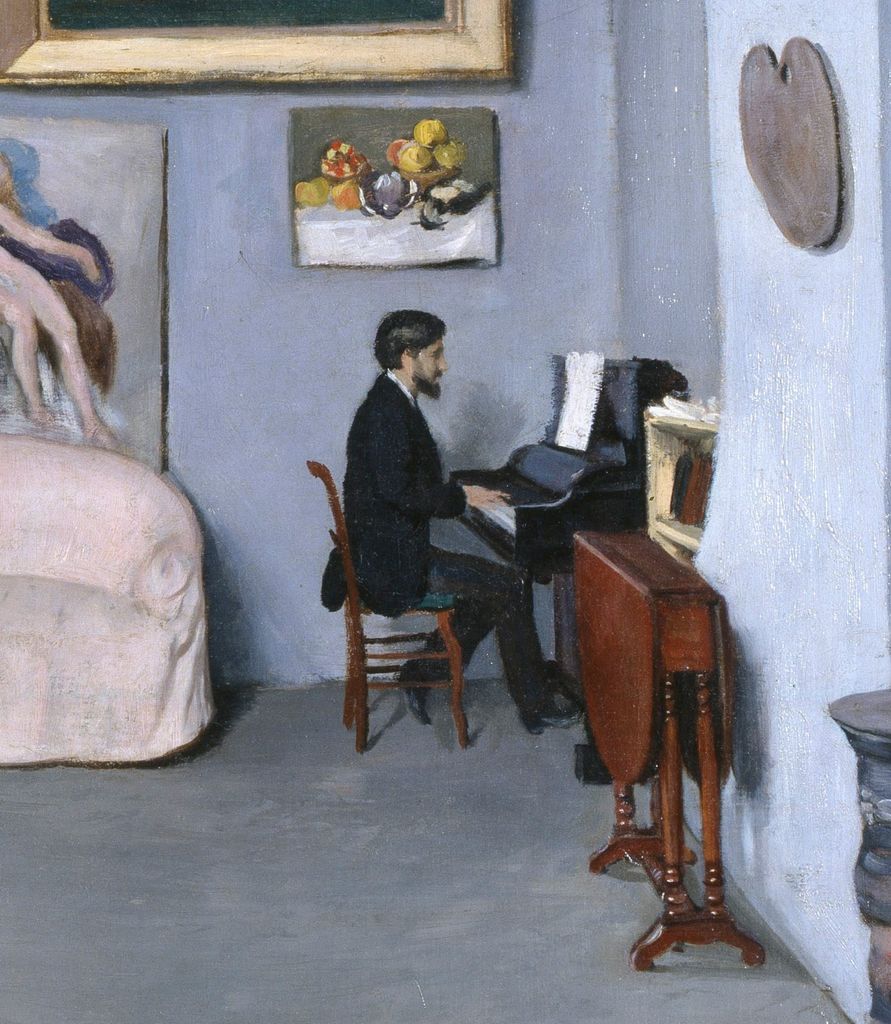
The pianist’s separate corner
Keyboard, music and chair establish a distinct activity beside the room’s central conversation.
The high window and displayed pictures
The bright window and the rectangles around it establish the room before attention turns to its occupants.
Who is in the studio?
Three figures provide the firmest points of orientation. Bazille stands on the right of the easel in a long dark smock, palette in hand. His height and upright position distinguish him from the compact group immediately to his left. Manet wears a hat and faces the canvas, one hand raised. Maître, seated at the piano, turns away from the group towards the score. These identifications are accepted in the museum and scholarly accounts. [2]
The remaining three men resist a definitive roll call. Michel Schulman’s catalogue sets out conflicting traditions. Étienne Moreau-Nélaton identified the man beside Manet as Zacharie Astruc, the seated man at the far left as Alfred Sisley and the man on the stairs as Claude Monet. He later said his information came from Monet. Gaston Poulain instead placed Monet beside Manet, Renoir in the seated position and Émile Zola on the staircase. Later writers have favoured different parts of these accounts; their disagreement has not been decisively resolved. [2]
The difficulty is understandable when looking at the canvas. These are small figures subordinated to a large room. The seated man’s face is seen obliquely, and the stair rail interrupts the standing figure. Even the man nearest Manet receives less pictorial emphasis than the central pair. Their poses establish conversation and attention more readily than they provide individually unmistakable portraits.
It is useful to preserve that distinction. The painting can represent an artistic circle without giving us a securely labelled image of every member. A possible identification should not become certain merely because it makes a satisfying account of the group. Nor does the disputed presence of Renoir undermine the documented fact that he shared the Condamine studio with Bazille. The people painted in a room and the people who used it are related questions, not identical ones. [2]
Maître’s position gives another kind of definition to the gathering. He belongs through music as well as friendship. The Portrait of Edmond Maître offers a more concentrated encounter with him; here, his small profile, moving hands and open score establish an activity. Bazille’s February 1869 letter ends with the prospect of playing the piano with Maître, while the late-1869 letter describes opera-going and dinners with Maître and Renoir. The instrument belongs to their documented shared life. [6] [5]
The paintings within the painting
The walls create a second gathering. Their works differ in scale, subject and finish, turning the studio into a display of artistic choices. The most readily recognisable is Fisherman with a Net, hanging high on the left wall. Its rear-view male nude and wooded setting remain clear despite their reduction. Lower down, other canvases are partly obscured by the staircase, people and stacked frames. Bazille shows pictures as objects occupying space, not simply as images available to be read in full. [2]
That distinction is especially important at the easel. The displayed canvas is largely concealed by Bazille’s body and the surrounding figures. View of the Village has been proposed as its identity, but the visible evidence does not settle the matter. The uncertainty changes our experience of the central exchange: we can see people evaluating a picture more clearly than we can see the picture they evaluate. Their act of looking becomes the subject. [2]
The large framed figure painting to the right of the window has also received conflicting names. Schulman identifies it as Renoir’s Woman with a Bird; an older identification as Bazille’s La Toilette persists in the Musée d’Orsay’s commentary. It is safest to acknowledge that disagreement rather than confidently turn the miniature image into an exact reproduction of La Toilette. What is plainly visible is a standing nude beside a seated, clothed woman, set within a substantial gold frame. [2] [3]
Other identifications are useful when kept at their proper level of confidence. The landscape at the upper right is associated with Bazille’s terrace at Méric; the small landscape near the window has been linked to his Aigues-Mortes views. The fruit still life above the piano is identified as a Monet, while the small picture near the floor beneath the window is associated with The Fortune Teller. Not every painted frame yields a secure title, and the room should not be treated as an exhaustive inventory of Bazille’s possessions. [2]
The placement of the Monet still life is telling even without attaching a larger programme to it. Suspended above Maître, its light cloth and round fruits answer the piano’s dark block. Elsewhere, pale bodies and flashes of landscape interrupt the blue-grey walls. These small images help animate the interior’s restrained colour. Looking at them also changes our sense of scale: a painting that may command a museum wall appears here as one thing among many in daily working life.
Frames themselves become part of the argument. Their gold edges separate the small scenes from the studio while joining them into a larger arrangement. The high pictures look established and ready for scrutiny; leaning canvases suggest work held in reserve, stored or awaiting attention. The difference need not mark a precise division between finished and unfinished work. It gives the room several ways of presenting art.
Watch: Bazille and early Impressionism
Explore a Paris studio with Smarthistory, then discover the beginnings of Impressionism with the National Gallery of Art.
Jean-Frédéric Bazille, The Artist’s Studio, Rue Visconti, Paris
A close look at Bazille’s 1867 painting of the studio he shared in Paris.
Watch on YouTubeAn alternative to the Salon’s judgement
The display includes conspicuous works that had failed to satisfy the official Salon jury. Fisherman with a Net, painted in 1868, was rejected in 1869. Bazille nevertheless placed it high on the studio wall, where its scale and bright frame make it impossible to miss. Schulman, discussing Kimberly A. Jones’s interpretation, connects the prominent rejected pictures with a deliberate challenge to official judgement. Work refused elsewhere receives sustained attention among fellow artists. [2]
The picture’s humour lies partly in that reversal. The studio has its own hanging and its own audience. A jury’s refusal does not make a work disappear; Bazille gives it another setting in which to be seen. Yet the painting does not show a protest meeting or a crowd applauding a manifesto. The men’s quiet, separate activities allow dissent to take the form of continuing artistic work.
There was a documentary precedent for such independence. Following rejection in April 1867, Bazille wrote to his mother about a proposed annual exhibition in a rented studio, organised with other young artists. They would show the number of pictures they chose and invite established painters they admired. “You will see that people will talk about us,” he wrote, in a translation from the French. The letter records an intention, not the fulfilment of that exhibition scheme, but it establishes that alternative ways of showing art occupied his thoughts well before the Condamine painting. [8]
The central conversation can be read against that background. Manet’s presence carries particular weight because Bazille places the older painter beside his easel, attending to the work. The room gives artistic recognition a human form: one painter looking at another’s picture. The statement remains social and pictorial rather than a written declaration of shared principles.
There is a broader tradition behind the subject. Schulman compares Bazille’s interior with artists’ group pictures and studio scenes by Fantin-Latour, Courbet and Degas. Those comparisons help distinguish two things that meet here: the representation of a room and the representation of artistic allegiance. Bazille gives neither complete precedence. The architecture occupies more space than the assembled friends, while the friends make the stored pictures into objects of present judgement. Calling the work a manifesto catches its assertion of allegiance, but the word should leave room for its domestic scale, musical diversion and unresolved conversations. [2]
Calling it a picture of the beginnings of Impressionism is useful provided the later movement does not obscure this earlier situation. Bazille died in 1870, before the first Impressionist exhibition in 1874. His studio records friendships and ambitions still taking shape. It does not depict a meeting of an already constituted exhibition society. [9]
Manet’s contribution and the making of Bazille’s figure
Manet’s involvement adds an unusual reciprocity. The received account, supported by correspondence discussed in the catalogue, is that he painted Bazille’s figure into the studio scene. The Musée d’Orsay also records his contribution, while phrasing the attribution cautiously in its detailed object information. Bazille could therefore present himself among his friends through a likeness made by the very painter shown judging his work. [2] [3]
The tall black figure is visually forceful. Its broad dark mass anchors the easel group; the light face and palette punctuate the silhouette. But recognising a difference in handling is not the same as being able to assign every brushstroke. Bruno Mottin’s laboratory study treats the reported participation carefully and notes changes in the figures’ proportions that may reflect work at successive sittings. The scene emerged through stages rather than one simultaneous gathering before the canvas. [10]
Nothing in this evidence requires a posthumous addition of Bazille. The painting belongs to his winter work before his death, and the correspondence places Manet’s participation within that living exchange. A later viewer may experience the figure as commemorative, but that response should remain distinct from the circumstances of its making. [2]
An empty room, then people—and another painting underneath
Technical examination makes the construction especially clear. Mottin reports that Bazille first painted the room without its occupants. The figures and the upholstered Voltaire chair were added afterwards. The empty foreground is therefore part of a spatial structure established before the final company assembled within it. [10]
This finding changes how we understand the picture’s apparent informality. Bazille did not simply set down six people wherever they happened to be. Architecture, light and furnishings supplied a framework into which he introduced human relationships. The finished result allows us to follow a conversation and a musical activity, but its underlying problem was how to make a room cohere.
The canvas carries an earlier history as well. Beneath the studio is a painted seated female nude, traditionally linked with Renoir’s Diana. Comparing the underlying figure with other works, Mottin favours a different explanation: Bazille probably painted the same model. The resemblance need not mean that Renoir supplied the abandoned painting. It is an important distinction between artists sharing a model and artists sharing authorship. [10]
The hidden composition and the later figure additions belong to different stages. The nude lies under the studio image; the people and chair were introduced into the already painted room. Keeping those sequences separate prevents a general impression of collective improvisation from replacing the specific evidence. Reuse, revision and an invited contribution coexist within Bazille’s considered composition. [10]
Three studios, three ways of presenting an artist’s life
Condamine becomes still more revealing beside Bazille’s earlier interiors. In Studio in the Rue de Furstenberg, chairs, pictures and working objects establish an absent artist’s presence. The room is narrower and more enclosed. Its diagonals lead across an interior whose furnishings carry much of the narrative. A related green-upholstered chair and heater link ordinary equipment with the later painting, although recurring objects should not turn every detail into a documented move from one address to another. [11]
Studio of the Rue Visconti is likewise unoccupied. Its long floorboards and densely arranged pictures make us conscious of how a painter fits work into limited space. The easel’s edge and low palette keep the practice of painting close to the viewer. Condamine opens that relationship out: equipment remains visible, but there is room for the painter’s audience as well as his production. [12]
The comparison is more persuasive than a simple progression from loneliness to happiness. Empty rooms can convey concentrated work, possessions and ambition without diagnosing their owner’s state of mind. Condamine’s figures introduce another means of describing artistic life. Bazille shows not only where he paints, but how pictures circulate among people who make, discuss and support them.
This is also what distinguishes the studio from a conventional group portrait. The room refuses to become a neutral background. Remove its displayed paintings, staircase, light and empty floor, and much of its meaning disappears. Bazille’s achievement is to give the workplace enough independence that it can hold several activities and several kinds of attention at once.

Studio of The Rue Visconti

Studio in the Rue de Furstenberg
From family possession to the Musée d’Orsay
The painting remained in the collection of Bazille’s brother Marc until its bequest to the French national museums was accepted in 1924. It entered the Musée du Luxembourg, subsequently passed to the Louvre and its Jeu de Paume galleries, and was assigned to the Musée d’Orsay in 1986. The museum’s record also places it in the 1910 Salon d’Automne retrospective, an early public occasion for reconsidering Bazille’s achievement. His signature and the date 1870 appear at the lower right. [3]
Its inclusion in the 2016–17 Bazille retrospective brought the familiar studio image into a broader examination of his work. The Washington checklist dated it to the winter of 1869–70, placing the gathering at a specific moment of active production. More recently, the National Museum of Western Art’s 2025 Orsay exhibition placed it at the opening of a section on interiors, working and the projection of professional identity. The room continues to offer more than a souvenir of famous friendships. [1] [13]
What lasts is its precision about the experience of being among paintings. Some works are easy to see, others tantalisingly blocked; one conversation draws us close while another remains at the edge. The empty chair leaves the foreground available. Bazille gives his art a setting in which attention can continue, with the studio itself making room for the viewer.
Bazille catalogue directory
The 284 records comprise 85 painting records,40 separate works-on-paper records and 159 album or study records. They describe the catalogue’s organisation rather than 284 independent objects or unanimously accepted attributions. Recto, verso, albums and multiple studies remain distinct. Dates are qualified where needed; the Drawing filter includes the etching, gouache and mixed works on paper. Manuscript mentions and unproved projects are listed separately below.
Works known through documents
These mentions remain separate from the 284 catalogue records. Some may concern surviving studies or underlying compositions; they cannot simply be added together as missing physical paintings.
- A copy after Rubens mentioned in March 1863 is unlocated.
- A portrait of an unidentified woman was reported completed before July 1866.
- A portrait of Monet and a composition of two life-size women arranging flowers were reported in progress in April 1867. Their mention does not establish two otherwise unknown surviving canvases.
- Gertrude et le père Lapin was at least begun in the summer of 1870.
Further reported works and uncertain attributions
- A Bouquet of Lilacs was reportedly stolen and returned in 1864; a portrait of the friend Theulier and Yellow Narcissi reported by Maître in 1868 are also documentary mentions.
- Unidentified pictures associated with Guillemet and Mme Rolina are reported through later correspondence cited by the catalogue.
- Children Dressed as Bride and Groom was associated with Vallotton’s collection and also attributed to Renoir. Its identification and authorship should remain open.
Projects whose completion is unproved
- A portrait of Pauline was planned in July 1865.
- A portrait of Marc was proposed in April 1866; a related drawing survives.
- A Jardinière project appears in album inscriptions and related figure material. Written plans are not evidence of a completed painting.
| Name | Date | Medium |
|---|---|---|
| Mystic Marriage of St. Catherine | 1863 | Oil on canvas |
| Trees, Study | 1863 | Oil on canvas |
| Farm of Saint-Sauveur | 1863 | Oil on canvas |
| In the Garden of the Parc Monceau, Paris | 1864 | Oil on canvas |
| Naked Woman from Behind | 1864 | Oil on canvas |
| Reclining Nude | 1864 | Oil on canvas |
| Courtyard of the Auberge du Cheval blanc at Chailly near Barbizon | 1864 | Oil on canvas |
| Covered Soup Bowls | 1864 | Oil on canvas |
| Two Herrings | 1864 | Oil on canvas |
| The Pink Dress | 1864 | Oil on canvas |
| The Dog Rita Asleep | 1864 (catalogue); c. 1864 (2017 checklist) | Oil on canvas |
| The Scoter | 1864 | Oil on canvas |
| Naked Reclining Woman | 1864 | Oil on canvas |
| Landscape at Chailly | 1865 | Oil on canvas |
| Rocks at Chailly, Forest of Fontainebleau | 1865 | Oil on canvas |
| Undergrowth at Chailly, Forest of Fontainebleau | 1865 | Oil on canvas |
| Still Life with Grapes and Nuts | 1865 | Oil on canvas |
| Self-Portrait with a Palette — Chicago | 1865 | Oil on canvas |
| Landscape of Saint-Sauveur | 1865 | Oil on canvas |
| Beach at Sainte-Adresse | 1865 | Oil on canvas |
| The Improvised Field Hospital | 1865 | Oil on canvas |
| Village Street, Chailly | 1865 | Oil on canvas |
| Small Valley in the Forest of Fontainebleau | 1865 | Oil on canvas |
| Forest of Fontainebleau | 1865 | Oil on canvas |
| Woman Ironing | 1866 | Oil on canvas |
| The Artist's Studio on the rue de Furstenberg | 1865–66 (museum) | Oil on canvas |
| Still Life with Fish | 1866 | Oil on canvas |
| Little Italian Street Singer | 1866 | Oil on canvas |
| Potted Flowers | 1866 | Oil on canvas |
| The Little Gardener | 1866–1867 | Oil on canvas |
| Young Woman Playing the Piano | 1866–1867 | Oil on canvas |
| End of a Summer Day | 1866–1867 | Oil on canvas |
| A Studio on the rue Visconti | 1867 | Oil on canvas |
| Thérèse Reading in the Park at Méric | 1867 | Oil on canvas |
| Portrait of Verlaine | 1867 | Oil on canvas |
| The Terrace at Méric | 1867 | Oil on canvas |
| Still Life with Heron | 1867 | Oil on canvas |
| The Family Gathering | 1867–68 (museum) | Oil on canvas |
| Oleanders | 1867 | Oil on canvas |
| Woman on the Terrace at Méric | 1867 | Oil on canvas |
| The Ramparts at Aigues-Mortes from South | 1867 | Oil on canvas |
| The Western Ramparts at Aigues-Mortes | 1867 | Oil on canvas |
| Portrait of Edmond Maître — head study | 1867 | Oil on canvas |
| Porte de la Reine at Aigues-Mortes | 1867 | Oil on canvas |
| Portrait of Sisley | 1867 | Oil on wood |
| Portrait of Renoir — Cleveland | 1867 | Oil on canvas |
| Portrait of Renoir — Musée d’Orsay | 1867 | Oil on canvas |
| Self-Portrait with a Detachable Collar — Minneapolis | 1865–67 (museum); 1867–68 (catalogue) | Oil on canvas |
| Vase of Flowers on a Console | 1868 (museum); 1867–68 (catalogue) | Oil on canvas |
| Portrait of a Woman | 1868 | Oil on canvas |
| Young Woman in the Vineyards | 1868 | Oil on card |
| Harvester with a Basket | 1868 | Oil on card |
| Harvester with a Yellow Hat | 1868 | Oil on card |
| Harvester with a Headdress | 1868 | Oil on panel |
| On the Banks of the Lez | 1868 | Oil on canvas |
| After the Bath (attribution questioned) | 1868? | Oil on canvas |
| Young Woman with Lowered Eyes | 1868 | Oil on canvas |
| Fisherman with a Net | 1868 | Oil on canvas |
| View of the Village | 1868 | Oil on canvas |
| Portrait of Bazille (attributed to Monet by Musée Fabre; disputed catalogue attribution) | 1864 (museum); 1868 (catalogue) | Oil on panel |
| Studies for a Grape Harvest (two panels) | 1868 | Oil on canvas (two panels) |
| The Fortune Teller | 1868–69 (catalogue); c. 1869–70 (2017 checklist) | Oil on canvas |
| Harvester with a Cap | 1869 | Oil on card |
| Portrait of Edmond Maître — 1869 | 1869 | Oil on canvas |
| Woman in a Moorish Costume | 1869 | Oil on canvas |
| Young Woman in the Garden | 1869 | Oil on canvas |
| Portrait of Alphonse Tissié in a Cavalryman's Uniform | 1869 | Oil on canvas |
| Portrait of a dragoon | 1869 | Oil on canvas |
| Portrait of Zacharie Astruc | 1869 | Oil on canvas |
| Bunch of Grapes in a Bucket | 1869 | Oil on card |
| Portrait of Edouard Blau | Probably 1869; inscribed 1866 | Oil on canvas |
| Young Male Nude Lying on the Grass | 1870 | Oil on canvas |
| Summer Scene | 1869–1870 | Oil on canvas |
| The Studio on the rue La Condamine | 1869–1870 | Oil on canvas |
| La Toilette | 1870 | Oil on canvas |
| Young Woman with Peonies — Montpellier | 1870 | Oil on canvas |
| Young Woman with Peonies — Washington | 1870 | Oil on canvas |
| Monotonous Chant | 1870 | Oil on canvas |
| Flowers — private collection | 1870 | Oil on canvas |
| Flowers — Musée Fabre | 1870 | Oil on canvas |
| Young Fisherman | 1870 | Oil on canvas |
| Study for Ruth and Boaz | 1870 | Oil on wood |
| Ruth and Boaz | 1870 | Oil on canvas |
| Self-Portrait in Shirt Sleeves | 1870 | Oil on canvas |
| Landscape on the Banks of the Lez | 1870 | Oil on canvas |
| Study after an Alpine Landscape | 1860 | Graphite on watercolour-tinted paper |
| Profile Head | 1862 | Charcoal on laid paper |
| Studies after Delacroix | 1863 | Ink and graphite, with gouache and watercolour, on paper |
| Academic Head | 1863 | Charcoal on paper |
| Study of a Woman's Head in Profile on a Chair | 1863 | Charcoal on paper |
| Academic Head of a Woman | 1863 | Charcoal on paper |
| Academy of Woman | 1863 | Black pencil and charcoal, stumped, on watermarked laid paper |
| Academy of Man | 1863 | Black pencil and charcoal, stumped, on watermarked laid paper |
| Naked Man | 1863 | Charcoal on paper |
| The Pont au Change in Paris | 1864 | Watercolour on paper |
| Study for the Pink Dress or Portrait of Thérèse des Hours | 1864 | Black pencil on paper |
| Naked Woman Standing | 1864 | Pencil on paper |
| Study of a Reclining Nude | 1864 | Charcoal on paper |
| Bathers | 1864 | Charcoal on paper |
| Portrait of a Man | 1864 | Charcoal on paper |
| Study for The Pink Dress | 1864 | Black pencil, squared, on paper |
| Study for Landscape of Saint-Sauveur | 1864 | Graphite on paper |
| Study for Landscape of Saint-Sauveur | 1865 | Pencil on paper |
| Man Taming a Bull | 1866 | Pen and black pencil on paper |
| Man Half Lying on a Sofa | 1866 | Charcoal on paper |
| Study for The Family Gathering | 1867 | Pencil on paper |
| Study for The Family Gathering | 1867 | Graphite, charcoal and black pencil on paper |
| The Embroiderer | 1867 | Pencil on pink paper |
| Study of Children | 1867 | Pencil on paper |
| Women in a Garden | 1867 | Pencil drawing |
| View of the Village | 1868 | Etching on paper |
| Portrait of a Bearded Man (catalogued as Self-Portrait) | Undated (museum); 1869 (catalogue) | Charcoal and brown ink |
| Man Smoking Pipe | 1869 | Watercolour on paper |
| Manet Drawing | 1868–70(?) (museum) | Charcoal and white chalk on paper |
| Study for the Summer Scene | 1869 | Charcoal, pen and ink on paper |
| Family Portrait | 1869 | Pastel and charcoal on paper |
| Study for Ruth | 1870 | Pencil and charcoal on paper |
| Woman Arranging a Hat | 1870 | Pencil drawing |
| Study for Boaz Asleep | 1870 | Pastel and red chalk |
| Boaz Asleep | 1870 | Charcoal and pencil on paper |
| Study for Boaz Asleep | 1870 | Black and beige pastel with red chalk on laid paper |
| Ruth Lying down | 1870 | Charcoal and pastel on paper |
| Head, Arm and Chest of Ruth | 1870 | Charcoal on paper |
| Chest of Ruth | 1870 | Black chalk and charcoal on paper |
| Black Woman with Peonies — gouache | c. 1870 | Gouache, watercolour, pencil and black chalk on card |
| Various Unidentified Subjects | Undated | Pencil drawing |
| Rocky Sea Side | Undated | Charcoal on paper |
| Studies of a Dancing Woman | Undated | Drawing with white chalk |
| Study of a Leg | Undated | Pencil drawing |
| Dancers in Camargue | Undated | Pencil drawing |
| Academy of Woman | Undated | Charcoal |
| Caricature of Venus of Milo and Various Other Caricatures | Undated | Charcoal |
| Caricature | Undated | Pencil drawing |
| Study of Landscape | Undated | Charcoal |
| Caricatures and Seated Monk | Undated | Charcoal |
| Caricatures and Various Subjects | Undated | Pencil drawing |
| Women Carrying a Pitcher | Undated | Pencil drawing |
| The Hanged Man | Undated | Charcoal |
| Castle in the Plain | Undated | Charcoal |
| Naked Woman from Behind | Undated | Charcoal |
| Caricatures | Undated | Charcoal and pencil |
| Unidentified Subjects | Undated | Pencil drawing |
| Landscape with a Castle | Undated | Charcoal |
| Study of Landscape | Undated | Charcoal |
| Horse Rider seen from Behind | Undated | Charcoal |
| Mazeppa | Undated | Pencil and charcoal |
| Study of Rider and Others Subjects | Undated | Pencil, pen and brown ink |
| Study of an Unidentified Man | Undated | Pencil drawing |
| Study for an Unknown Historic Scene | Undated | Pencil drawing |
| Study a Man Reading | Undated | Pencil drawing |
| Study of Men Reading | Undated | Pencil drawing |
| Study of Landscape ? | Undated | Charcoal |
| Study of a Head of a Man | Undated | Pencil drawing |
| Erotic Scene | Undated | Pencil drawing |
| Study of Dog | Undated | Charcoal |
| Studies of Unidentified Subjects and Erotic Scene | Undated | Pencil and charcoal drawing |
| Study for a Theater Scene | Undated | Charcoal |
| Study of a Reclining Naked Woman | Undated | Charcoal |
| Two Studies of Landscape | Undated | Pencil drawing |
| Caricature | Undated | Pencil and charcoal drawing |
| Portrait of an Unidentified Young Man | Undated | Charcoal |
| Study of an Unidentified Subject | Undated | Brown ink drawing |
| Unidentified Man with a Hat | Undated | Pencil and charcoal |
| Study of an Unidentified Women | Undated | Pencil drawing |
| Study for a Theater Character ? | Undated | Pencil drawing |
| Study for a Theater Character ? | Undated | Pen drawing |
| The Pavillon de la Reine in Paris | Undated | Pencil drawing |
| Study of a Horse Rider | Undated | Pencil and charcoal drawing |
| Entwined Couple. Caricature ? | Undated | Pencil drawing |
| Woman Sitting on a Sofa | Undated | Pencil drawing |
| Studies of Unidentified Subjects | Undated | Pencil and charcoal drawing |
| Studies of Animals | Undated | Pencil drawing |
| Study of a Horse Rider in Camargue | Undated | Charcoal |
| Study of Hunting Dogs | Undated | Pencil drawing |
| Study of Soldiers. Caricatures | Undated | Pencil drawing |
| Studies of Hunting Dogs ? | Undated | Pencil drawing |
| Hunting Scene. Hunter Playing the Horn | Undated | Pencil drawing |
| Caricature | Undated | Pencil drawing |
| Study of an Ibex | Undated | Pencil drawing |
| Theater Scene. Caricatures | Undated | Pencil drawing |
| Studies of Animals. Horses ? | Undated | Pencil drawing |
| Caricatures | Undated | Pencil drawing |
| Studies of Various Subjects and Animals | Undated | Pencil drawing |
| Unidentified Subject | Undated | Pencil drawing |
| Rider Taming a Horse [in Camargue ?] | Undated | Pencil drawing |
| Caricature of a Soldier | Undated | Pencil drawing |
| Study of a Woman and Mouse | Undated | Pencil drawing |
| Historic Scene | Undated | Charcoal |
| Architecture Studies | Undated | Pencil drawing |
| Mythologic Scene | Undated | Charcoal |
| Ophelia | Undated | Pencil drawing |
| Mythologic Scene | Undated | Charcoal |
| Studies of Various Subjects | Undated | Pencil and pen drawing |
| Studies of Peasants | Undated | Pencil drawing |
| Historic Scene | Undated | Pencil drawing |
| Historic or Literary Scene | Undated | Pencil drawing |
| Unidentified Historic Scene | Undated | Pencil drawing |
| Studies of Unidentified Subjects | Undated | Pencil drawing |
| Unidentified Study | Undated | Pencil drawing |
| Man in an Armchair | Undated | Pencil drawing |
| Studies of Various Subjects | Undated | Pencil drawing |
| Portraits of Unidentified Men | Undated | Pencil drawing |
| Studies of Various Subjects | Undated | Pencil drawing |
| Horse Rider and Artist | Undated | Charcoal and pencil |
| Study of Unidentified Characters | Undated | Charcoal |
| Dead Horse in a Plain | Undated | Charcoal |
| Study of Various Subjects and Furniture | Undated | Pencil drawing |
| Caricatures and Various Notes about Opéra | Undated | Pencil drawing |
| Galloping Horse | Undated | Charcoal |
| Study for La Toilette | Undated | Pencil drawing |
| Study of a Naked Woman | Undated | Pencil drawing |
| Domestic Scene | Undated | Pencil drawing |
| Physiognomies | Undated | Pencil drawing |
| Study for a Grape Harvest | Undated | Pencil drawing |
| Study for the Summer Scene | Undated | Pencil drawing |
| Female Profiles | Undated | Pencil drawing |
| Various Subjects | Undated | Pencil drawing |
| Study for The Terrace at Méric | Undated | Pencil drawing |
| Study for The Ramparts at Aigues-Mortes | Undated | Pencil drawing |
| Study for The Ramparts at Aigues-Mortes | Undated | Pencil drawing |
| Study for a Grape Harvest | Undated | Charcoal |
| Children Portraits | Undated | Pencil drawing |
| Study for Children's Heads | Undated | Pencil drawing |
| Study of Minerva | Undated | Pencil drawing |
| Study for a Grape Harvest | Undated | Pencil drawing |
| Study for The Family Gathering | Undated | Pencil drawing |
| Study for a Young Fisherman | Undated | Charcoal |
| Self-Portraits | Undated | Black pencil drawing |
| Study of Horses for the Porte de la Reine at Aigues-Mortes | Undated | Ink drawing |
| Study of Horses for the Porte de la Reine at Aigues-Mortes | Undated | Ink drawing |
| Study of Horses for the Porte de la Reine at Aigues-Mortes | Undated | Ink drawing |
| Study for an Outdoor Concert | Undated | Pencil drawing |
| Studies of Legs | Undated | Pencil drawing |
| Study for The Ramparts at Aigues Mortes | Undated | Pencil drawing |
| Studies of Hats | Undated | Pencil drawing |
| Studies of Men | Undated | Pencil drawing |
| Study for The Little Gardener | Undated | Pencil drawing |
| Study for The Ramparts at Aigues Mortes | Undated | Charcoal |
| Studies of Sail Boats | Undated | Pencil drawing |
| Portrait of Marc Bazille | Undated | Charcoal, black pencil and graphite |
| Studies of Children's Heads | Undated | Pencil drawing |
| Study for Aigues-Mortes | Undated | Pencil drawing |
| Studies of Women's Heads | Undated | Pencil drawing |
| Portrait of Camille des Hours and an Unidentified Man | Undated | Charcoal |
| Study of Flying Birds | Undated | Charcoal or graphite |
| Study for the Summer Scene | Undated | Pencil drawing |
| Study of Hands | Undated | Pen drawing |
| Self-Portrait | Undated | Black pencil drawing |
| Study for the Summer Scene | Undated | Pencil drawing |
| Study for the Summer Scene | Undated | Pencil drawing |
| Study for a Grape Harvest | Undated | Pencil drawing |
| Study of Branches | Undated | Pencil drawing |
| Study of a Seated Child | Undated | Pencil drawing |
| Study for a Couple and Unidentified Women | Undated | Pencil drawing |
| Studies of Unidentified Women | Undated | Pencil drawing |
| Study of Buildings | Undated | Pencil drawing |
| Study for a Grape Harvest | Undated | Pencil and charcoal |
| Studies of Boaters | Undated | Pencil drawing |
| Study of a Man Writing at his Table | Undated | Pencil drawing |
| Study of a Woman Cutting Flowers | Undated | Pencil drawing |
| Study of Hand | Undated | Pencil drawing |
| Women in a Garden | Undated | Pencil drawing |
| Studies of Women in Profile | Undated | Pencil drawing |
| Study for Ruth and Boaz | Undated | Charcoal |
| Study for The Family Gathering | Undated | Pencil drawing |
| Study for the View of the Village | Undated | Pencil drawing |
| Study of the View of the Village | Undated | Pencil drawing |
| Study for the Fisherman with a Net | Undated | Pencil drawing |
| Study for the View of the Village | Undated | Charcoal |
| Study for The Little Gardener | Undated | Charcoal |
| Portrait of a Man with a Top Hat | Undated | Pencil drawing |
| Portrait of a Man with a Top Hat | Undated | Pencil drawing |
| Inscriptions | Undated | Pencil inscriptions |
| Study of Tree | Undated | Pencil drawing |
| Caricature of Nina la Belle | Undated | Pencil drawing |
| Study for Saint Sebastian | Undated | Pencil drawing |
| Young Woman Sewing | Undated | Pencil drawing |
| Studies of Hands | Undated | Pencil drawing |
| Woman in a Garden | Undated | Pencil drawing |
| Elegant Woman | Undated | Pencil drawing |
| Various Inscriptions | Undated | Inscriptions (medium unspecified in index) |
| Study of a Man with a Hat | Undated | Pencil drawing |
| Study of a Child | Undated | Pencil drawing |
| Study of a Man with a Hat | Undated | Pencil drawing |
Frequently Asked Questions
The painting is dated 1870 and developed during the winter of 1869–70. [1]
It belongs to the Musée d’Orsay in Paris, inventory RF 2449. [3]
Technical examination indicates that the room came first and its figures and foreground chair were added later. [10]
Discussion
Pictures, music and conversation compete for attention inside the studio. Where do you begin looking?
Reader Insights
Which displayed painting first draws your attention away from the central group?
How does the empty foreground chair change your imagined position inside the room?
What does the separation of the pianist from the easel conversation contribute to the scene?
Join the Conversation
Share a detail, comparison or question about Bazille’s Studio, Rue La Condamine below.
References
- National Gallery of Art, Frédéric Bazille and the Birth of Impressionism, exhibition checklist, 2017, catalogue no. 57. Source. View source.
- Michel Schulman, The Studio on the Rue La Condamine, digital catalogue raisonné, MSb-58. Source (English translation of French scholarship). View source.
- Musée d’Orsay, L’Atelier de Bazille, collection record, RF 2449. Source (English commentary with French collection fields). View source.
- Frédéric Bazille, letter to his father, dated by the Musée Fabre to late November 1867, inventory 92.2.5. Source (in French). View source.
- Frédéric Bazille, letter to his father, dated by the Musée Fabre to late 1869, inventory 92.2.6. Source (in French). View source.
- Frédéric Bazille, letter to his mother, dated by the Musée Fabre to mid-February 1869, inventory 94.7.3. Source (in French). View source.
- Frédéric Bazille, letter to his mother, 5 April 1869, inventory 94.7.4, Musée Fabre. Source (in French). View source.
- Frédéric Bazille, letter to his mother, dated by the Musée Fabre to April 1867, inventory 94.7.1. Source (in French; quotation translated into English). View source.
- Musée d’Orsay, Frédéric Bazille (1841–1870): The Youth of Impressionism, 2016–17 exhibition presentation. Source. View source.
- Bruno Mottin, “L’œuvre de Frédéric Bazille (1841–1870) examiné au laboratoire,” Technè 46, 2018, pp. 30–38, especially paragraphs 20–23. Source (in French). View source.
- Michel Schulman, The Artist’s Studio on the Rue de Furstenberg, digital catalogue raisonné, MSb-21. Source (English translation of French scholarship). View source.
- Michel Schulman, A Studio on the Rue Visconti, digital catalogue raisonné, MSb-27. Source (English translation of French scholarship). View source.
- National Museum of Western Art, Impressionist Interiors: From the Collection of the Musée d’Orsay, exhibition checklist, 2025, opening section and no. 1. Source (in Japanese and English; English fields consulted). View source.
- Joconde/POP, La Robe rose, RF2450. View source. (in French).
- Musée d’Orsay, L’Ambulance improvisée, RF 1967 5. View source. (in French).
- Musée d’Orsay, Réunion de famille,RF2749. View source. (in French).
- Musée d’Orsay, Pierre Auguste Renoir,DL1970 3. View source.
- Musée Fabre, Vue de village, 898.5.1. View source. (in French).
- National Gallery of Art, Young Woman with Peonies,1983.1.6. View source.
- Michel Schulman, painting index and documentary introduction (English titles; French metadata). View source.
- Michel Schulman, works-on-paper index (English titles; French metadata). View source.
- Michel Schulman, albums and studies index (English titles; French metadata). View source.

 Frederic Bazille.jpg)


