 by Tom Gurney
Tom Gurney BSc (Hons) is an art history expert with over 20 years experience
Published on June 19, 2020 / Updated on November 2, 2026
Email: tomgurney1@gmail.com / Phone: +44 7429 011000
Young Woman with Peonies (Montpellier version): Introduction
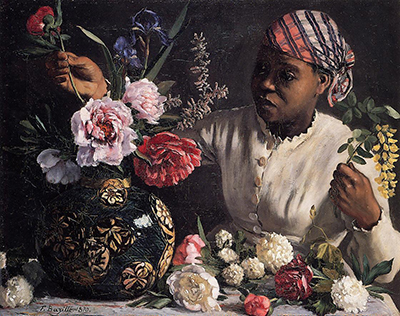
A woman raises a flower towards a vase while holding another stem against her white blouse. Her eyes follow the arrangement rather than meeting ours. Around her hands, pale pink petals, deep red blooms and small white flower heads spread across the table. Frédéric Bazille gives the act of arranging flowers the scale and concentration of a portrait. The person doing the work is as consequential as the flowers being displayed.
Painted in 1870, this Young Woman with Peonies belongs to the Musée Fabre in Montpellier, inventory 18.1.3. It is the canvas with the large decorated vase, distinct from the basket composition now in Washington. Both paintings bring a Black woman into the foreground of Bazille’s art; their different gestures create different relationships between the sitter, her flowers and the spectator. [1] [2]
At a Glance
- Date1870 [1]
- MediumOil on canvas [1]
- Dimensions60.5 × 75.4 cm [1]
- CollectionMusée Fabre, Montpellier, 18.1.3 [1]
This work across Frédéric Bazille’s career
Family Reunion
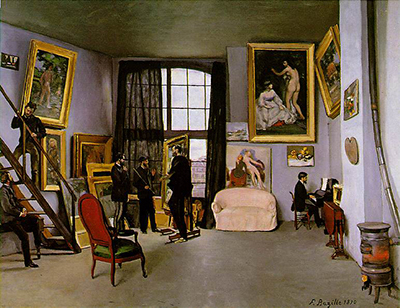
1867–1868 (museum)Bazille’s Studio, Rue La Condamine
1869–1870Summer Scene (Bathers)
1869–1870Contents
- Identifying the Montpellier painting
- Following the hands and the gaze
- A vase, a tabletop and several kinds of brightness
- Two oils and a work on paper
- Flowers were already part of Bazille’s ambitions
- Manet, the model and the roles within paintings
- A family gift and changing museum contexts
Identifying the Montpellier painting
The Montpellier picture is an oil on canvas measuring 60.5 × 75.4 cm. Its horizontal proportions make room for two substantial presences: the vase and its flowers on the left, the woman on the right. The signature and date sit at the lower left. In Michel Schulman’s catalogue raisonné it is MSb-60; the Washington painting has the separate number MSb-61. These identifiers matter because reproductions and older accounts can make the two compositions sound interchangeable. [1] [2]
The year is secure, although assigning an exact moment within it is less straightforward. The National Gallery of Art’s 2017 exhibition checklist dates both peony canvases to spring 1870. Their shared subject and similar scale invite comparison, but do not establish which Bazille painted first. The question remains open in the scholarship discussed by Schulman. It is more useful to approach them as two sustained treatments of a subject than to make one a preliminary step towards the other. [3] [4]
The Musée Fabre now calls the work Jeune femme aux pivoines, while recording its former racialised title, Négresse aux pivoines. The older wording remains part of the painting’s history, but the present title directs attention towards a young woman engaged in an activity. Neither title supplies her personal name. The visible individual and the unnamed person who posed for Bazille deserve to be considered together, without filling the documentary silence with an invented biography. [1] [2]
Following the hands and the gaze
Begin with the woman’s raised hand at the upper left. Its fingers grip a slender stem close to the dark background, beneath a small red flower. That hand is surrounded by taller stems, leaves and flower heads, but its warm colour and broad shape keep it legible. Across the painting, her other hand gathers a yellow-flowered branch near her chest. Between the two hands, her face turns towards the vase. The activity describes an open circuit: a stem, an attentive face, another stem waiting to be placed.
This is a particularly effective way of making a half-length figure active. We see neither the full body nor a large working space, yet the separated hands suggest reach, selection and adjustment. Her arms stretch across the arrangement instead of sitting decoratively beside it. One reaches towards the upper flowers; the other holds material in reserve. The picture catches a gesture whose outcome has not quite arrived. We can imagine the arrangement changing without needing to invent a story about who ordered it or where it will go.
Her gaze holds the structure together. It is directed across the surface, towards the flowers, and leads our eyes back into the painting. The forehead, cheek, nose and mouth remain clearly modelled even where the face approaches the dark ground. Her expression is attentive, but it does not disclose a private mood. Concentration is a useful description of the depicted action; melancholy, shyness or contentment would go beyond what the pose can establish.
The white blouse opens a broad light area around the face and hands. Small warm buttons descend along its front, while gathered edges and shadowed folds prevent the garment becoming a flat white screen. The sleeve at the lower right turns around the forearm and meets the cropped edge of the composition. Higher up, the striped headscarf introduces narrow lines and alternating colours against the relatively broad areas of skin and cloth. Its knot is visible behind the head, another small indication that the figure occupies space rather than simply forming a silhouette.
The arrangement allows our attention to alternate between doing and looking. The flowers are conspicuous enough to draw the eye immediately, but the hands explain their presence. Conversely, the woman is not presented apart from her task: the flower stems give her pose its shape. This reciprocity is the painting’s central achievement. A still life becomes an encounter with someone who handles, chooses and arranges its contents.
A vase, a tabletop and several kinds of brightness
The vase occupies much of the lower left. Its rounded dark body is covered with pale gold-coloured floral ornament. Against this patterned surface, the actual flowers have irregular edges, soft petals and varying degrees of openness. Bazille thus places one representation of flowers inside another: painted flowers rise above a vessel decorated with floral forms. The vessel’s controlled ornament makes the looseness of the living arrangement more noticeable.
The largest pale peonies spread outward above the vase. Their broken pink and white surfaces contrast with the red bloom beside them, which reads as a more compact mass. Higher stems interrupt the background with sharper leaves and smaller accents. At table level the flowers gather into a lower, denser band. White rounded clusters sit beside red petals and broad green leaves. There is no need to identify every plant to recognise how differently these forms behave: some droop, some spread, and others remain tightly gathered.
The tabletop gives this abundance a firm base. Its near edge runs along the bottom of the canvas, close enough to make the flowers feel within reach. The woman and the vessel rise from a continuous foreground rather than occupying separate compartments. Yet the arrangement is not equally dense everywhere. Small dark intervals between stems preserve their individual shapes, while the blouse supplies a much larger opening. The brightest patches have enough surrounding darkness to remain distinct.
That darkness has several functions. Behind the head it makes the scarf’s stripes conspicuous; around the flowers it separates petal from petal; within the vase it carries the ornament. A single dark setting can therefore accommodate several kinds of brightness. The blouse has relatively continuous folds, the gold-coloured pattern has crisp turns, and the peonies have scattered light touches. The pleasure of the painting comes partly from these differences in surface, rather than from flower colour alone.
Schulman emphasises the close packing of figure and flowers and relates the floral handling to the still lifes of Courbet and Fantin-Latour. Those comparisons place the canvas within a wider interest in substantial, closely observed flowers. They need not make it a demonstration of another painter’s manner. Here, the floral display acquires a particular rhythm from the woman’s movements, and the vase’s weight counters the lifted hand above it. [2]
Watch: Bazille and early Impressionism
Explore a Paris studio with Smarthistory, then discover the beginnings of Impressionism with the National Gallery of Art.
Jean-Frédéric Bazille, The Artist’s Studio, Rue Visconti, Paris
A close look at Bazille’s 1867 painting of the studio he shared in Paris.
Watch on YouTubeTwo oils and a work on paper
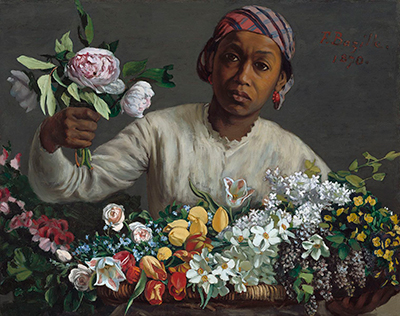
In the Washington Young Woman with Peonies, the sitter faces outward and raises pale flowers towards the viewer. A broad basket and its contents occupy the foreground. The Montpellier vase instead establishes a more upright mass on one side, while her turned face directs attention towards the work in progress. The same broad combination of woman and flowers produces two different experiences: an outward presentation in Washington and an activity observed from nearby in Montpellier. [4]
The distinction is especially clear if we follow the raised hand in each picture. In Washington, its flowers can seem to be offered for our inspection. We become the possible recipient of a gesture, even though the painting does not specify a transaction. In Montpellier, the hand belongs to the arrangement’s internal construction. We watch a stem being held in relation to the other stems. The viewer is present as an observer without becoming the immediate object of the woman’s attention.
These differences make a simple opposition between an active and a passive sitter unhelpful. Both figures act; what changes is the direction and purpose suggested by the action. Nor does the frontal gaze provide a personal history that the averted gaze withholds. The two paintings give the model pictorial presence through different means. Their relationship becomes richer when neither is treated as the corrected or completed form of the other.
A third related work belongs to the Fitzwilliam Museum in Cambridge. Its Black Woman with Peonies, inventory PD.1-2004, combines watercolour and gouache with black chalk and graphite on card, and is dated about 1870. It is a separate work on paper, not a small oil replica of either canvas. Schulman discusses it as a possible preparatory study for Montpellier while also stressing its independent finish. That relationship remains a proposal rather than a securely dated sequence of study followed by painting. [5] [6]
The existence of three treatments is valuable evidence of Bazille’s interest in the subject. It shows him considering it across different materials as well as different poses. It does not tell us how many sittings took place, what the model said, or whether all three works arose from one uninterrupted campaign. The surviving images offer variations; they leave the practical timetable largely unresolved. [4] [6]
Young Woman with Peonies
Flowers were already part of Bazille’s ambitions
The peony paintings grew from a sustained interest in flower painting. In its 2016 retrospective, the Musée Fabre placed Bazille’s floral work within the renewed enthusiasm for the genre among painters including Courbet, Fantin-Latour, Monet and Manet. Flowers offered opportunities to test colour, arrangement and material description. Bazille’s Study of Flowers, also called Potted Flowers, signed 1866 and accepted at the Salon of 1868, belongs to this earlier engagement. Its paper-wrapped bouquet also prompted the museum’s comparison with Manet’s Olympia. [7]
His correspondence supplies a more specific connection between flowers and figures. Writing to his mother in April 1867, Bazille described a painting in progress of two life-size women arranging flowers, which he hoped to finish when peonies were available. The letter records a project, rather than identifying the Montpellier canvas of three years later. It nevertheless establishes that the conjunction of women, arranging gestures and seasonal flowers had occupied him well before the two surviving peony oils. [8]
Technical research adds another piece of that earlier history. Bruno Mottin’s laboratory study reports a woman behind flowers beneath Bazille’s Still Life with Heron. Mottin also records Paul Perrin’s proposed links between that hidden composition and related figure and flower studies. This concerns a reused canvas elsewhere in Bazille’s work; it does not reveal an underpainting beneath the Montpellier peonies. It does show that a woman seen in relation to flowers was a subject he had explored and reconsidered. [9]
Seen against these earlier attempts, the Montpellier painting unites two kinds of attention Bazille had already cultivated. The flowers demand separate decisions about shape and colour, while the figure introduces coordinated movement. Neither element serves merely to fill the space left by the other. The red bloom beside the vase and the hand above it are linked by their positions and contrasting surfaces; the white flowers below the figure answer the blouse without repeating its structure. The composition makes its subject through those relationships.
Manet, the model and the roles within paintings
The connection with Manet is substantial. The Musée Fabre’s 2016 curators associated Bazille’s peony canvases with the Black woman holding flowers in Olympia, painted in 1863 and exhibited at the Salon in 1865. They also pointed to Manet’s interest in peonies as a still-life subject. Bazille brings these two elements together, allowing a figure associated with the margins of a larger scene to become the principal human presence of a flower painting. [7] [10]
The comparison becomes more precise when we ask where the woman’s attention goes. In Olympia, the flowers participate in an exchange involving other people. In Montpellier, no second figure directs the action. The woman’s hands and gaze organise the entire encounter. This change does not erase the racial and social conventions surrounding such imagery, but it alters the visual hierarchy. She has the space, activity and scale through which we understand the subject.
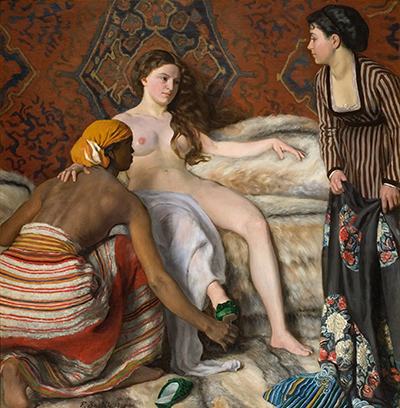
Bazille’s La Toilette offers a different arrangement. Its Black figure bends beside a reclining nude within an elaborate ensemble of bodies and textiles. Scholars have proposed that the model also posed for the peony paintings. The identification is plausible and frequently repeated, but her personal name is not established. Nor should the attendant’s role within La Toilette be mistaken for a record of the model’s actual occupation or circumstances. A real person posed for these scenes; the painter assigned different actions and relationships within them. [2] [7]
The Musée d’Orsay’s 2019 exhibition Black Models: From Géricault to Matisse, co-curated by Cécile Debray, Stéphane Guégan, Denise Murrell and Isolde Pludermacher, made the artist–model relationship central to its account of modern art. Its framing asked viewers to recognise Black models as participants in artistic life and to reconsider the conventions through which their images had been understood. This provides a productive context for Bazille’s paintings without supplying a missing identification. The name Laure, associated with Manet’s model, cannot simply be transferred to Bazille’s sitter. [10]
The distinction also changes how we read older criticism. Schulman’s discussion preserves a history of responses that move between floral exuberance, comparisons with Manet and judgements of the woman’s appearance. Some of that language racialises or sexualises the sitter. We can understand its place in the painting’s reception while attending more closely to what the picture gives her to do: hold stems, assess an arrangement and occupy a substantial part of the canvas. [2]
La Toilette
A family gift and changing museum contexts
Marc Bazille, the artist’s brother, gave the Montpellier canvas to the Musée Fabre in 1918. Its public life therefore belongs to the family’s long preservation and promotion of Bazille’s work. Michel Hilaire identifies the artist’s mother’s gifts of View of the Village and Still Life with Heron in 1898 as an important beginning of that recovery, followed by further family gifts and the work of historians and curators. The peonies entered a growing museum account of an artist whose career had ended in 1870. [1] [11]
The painting’s exhibition history shows how differently it could be framed. The Musée Fabre records its inclusion in the 1931 Colonial Exhibition in Paris, as well as the later Working Among Flowers exhibitions of 2014–15 and the Bazille retrospective of 2016–17. These settings place it within colonial display, flower painting and the study of a single artist respectively. The canvas remains the same; the surrounding questions change. [1]
The two canvases also travelled separately within the Black Models exhibition project. The 2019 Orsay dossier illustrates the Washington peony oil, alongside La Toilette and the Fitzwilliam work on paper. The Musée Fabre records that the Montpellier oil appeared at the Pointe-à-Pitre stage of the wider tour. The exhibition’s intellectual context is relevant to both oils, although their individual journeys differed. [10] [1]
Returning to Montpellier’s painting after these comparisons, the quiet precision of the gesture becomes more striking. Her turned head, reaching hand and waiting stem give the arrangement its human measure. Bazille leaves us with an activity held in balance: flowers gathered and still being gathered, a substantial vase and an attentive person whose task is still in progress.
Bazille catalogue directory
The 284 records comprise 85 painting records,40 separate works-on-paper records and 159 album or study records. They describe the catalogue’s organisation rather than 284 independent objects or unanimously accepted attributions. Recto, verso, albums and multiple studies remain distinct. Dates are qualified where needed; the Drawing filter includes the etching, gouache and mixed works on paper. Manuscript mentions and unproved projects are listed separately below.
Works known through documents
These mentions remain separate from the 284 catalogue records. Some may concern surviving studies or underlying compositions; they cannot simply be added together as missing physical paintings.
- A copy after Rubens mentioned in March 1863 is unlocated.
- A portrait of an unidentified woman was reported completed before July 1866.
- A portrait of Monet and a composition of two life-size women arranging flowers were reported in progress in April 1867. Their mention does not establish two otherwise unknown surviving canvases.
- Gertrude et le père Lapin was at least begun in the summer of 1870.
Further reported works and uncertain attributions
- A Bouquet of Lilacs was reportedly stolen and returned in 1864; a portrait of the friend Theulier and Yellow Narcissi reported by Maître in 1868 are also documentary mentions.
- Unidentified pictures associated with Guillemet and Mme Rolina are reported through later correspondence cited by the catalogue.
- Children Dressed as Bride and Groom was associated with Vallotton’s collection and also attributed to Renoir. Its identification and authorship should remain open.
Projects whose completion is unproved
- A portrait of Pauline was planned in July 1865.
- A portrait of Marc was proposed in April 1866; a related drawing survives.
- A Jardinière project appears in album inscriptions and related figure material. Written plans are not evidence of a completed painting.
| Name | Date | Medium |
|---|---|---|
| Mystic Marriage of St. Catherine | 1863 | Oil on canvas |
| Trees, Study | 1863 | Oil on canvas |
| Farm of Saint-Sauveur | 1863 | Oil on canvas |
| In the Garden of the Parc Monceau, Paris | 1864 | Oil on canvas |
| Naked Woman from Behind | 1864 | Oil on canvas |
| Reclining Nude | 1864 | Oil on canvas |
| Courtyard of the Auberge du Cheval blanc at Chailly near Barbizon | 1864 | Oil on canvas |
| Covered Soup Bowls | 1864 | Oil on canvas |
| Two Herrings | 1864 | Oil on canvas |
| The Pink Dress | 1864 | Oil on canvas |
| The Dog Rita Asleep | 1864 (catalogue); c. 1864 (2017 checklist) | Oil on canvas |
| The Scoter | 1864 | Oil on canvas |
| Naked Reclining Woman | 1864 | Oil on canvas |
| Landscape at Chailly | 1865 | Oil on canvas |
| Rocks at Chailly, Forest of Fontainebleau | 1865 | Oil on canvas |
| Undergrowth at Chailly, Forest of Fontainebleau | 1865 | Oil on canvas |
| Still Life with Grapes and Nuts | 1865 | Oil on canvas |
| Self-Portrait with a Palette — Chicago | 1865 | Oil on canvas |
| Landscape of Saint-Sauveur | 1865 | Oil on canvas |
| Beach at Sainte-Adresse | 1865 | Oil on canvas |
| The Improvised Field Hospital | 1865 | Oil on canvas |
| Village Street, Chailly | 1865 | Oil on canvas |
| Small Valley in the Forest of Fontainebleau | 1865 | Oil on canvas |
| Forest of Fontainebleau | 1865 | Oil on canvas |
| Woman Ironing | 1866 | Oil on canvas |
| The Artist's Studio on the rue de Furstenberg | 1865–66 (museum) | Oil on canvas |
| Still Life with Fish | 1866 | Oil on canvas |
| Little Italian Street Singer | 1866 | Oil on canvas |
| Potted Flowers | 1866 | Oil on canvas |
| The Little Gardener | 1866–1867 | Oil on canvas |
| Young Woman Playing the Piano | 1866–1867 | Oil on canvas |
| End of a Summer Day | 1866–1867 | Oil on canvas |
| A Studio on the rue Visconti | 1867 | Oil on canvas |
| Thérèse Reading in the Park at Méric | 1867 | Oil on canvas |
| Portrait of Verlaine | 1867 | Oil on canvas |
| The Terrace at Méric | 1867 | Oil on canvas |
| Still Life with Heron | 1867 | Oil on canvas |
| The Family Gathering | 1867–68 (museum) | Oil on canvas |
| Oleanders | 1867 | Oil on canvas |
| Woman on the Terrace at Méric | 1867 | Oil on canvas |
| The Ramparts at Aigues-Mortes from South | 1867 | Oil on canvas |
| The Western Ramparts at Aigues-Mortes | 1867 | Oil on canvas |
| Portrait of Edmond Maître — head study | 1867 | Oil on canvas |
| Porte de la Reine at Aigues-Mortes | 1867 | Oil on canvas |
| Portrait of Sisley | 1867 | Oil on wood |
| Portrait of Renoir — Cleveland | 1867 | Oil on canvas |
| Portrait of Renoir — Musée d’Orsay | 1867 | Oil on canvas |
| Self-Portrait with a Detachable Collar — Minneapolis | 1865–67 (museum); 1867–68 (catalogue) | Oil on canvas |
| Vase of Flowers on a Console | 1868 (museum); 1867–68 (catalogue) | Oil on canvas |
| Portrait of a Woman | 1868 | Oil on canvas |
| Young Woman in the Vineyards | 1868 | Oil on card |
| Harvester with a Basket | 1868 | Oil on card |
| Harvester with a Yellow Hat | 1868 | Oil on card |
| Harvester with a Headdress | 1868 | Oil on panel |
| On the Banks of the Lez | 1868 | Oil on canvas |
| After the Bath (attribution questioned) | 1868? | Oil on canvas |
| Young Woman with Lowered Eyes | 1868 | Oil on canvas |
| Fisherman with a Net | 1868 | Oil on canvas |
| View of the Village | 1868 | Oil on canvas |
| Portrait of Bazille (attributed to Monet by Musée Fabre; disputed catalogue attribution) | 1864 (museum); 1868 (catalogue) | Oil on panel |
| Studies for a Grape Harvest (two panels) | 1868 | Oil on canvas (two panels) |
| The Fortune Teller | 1868–69 (catalogue); c. 1869–70 (2017 checklist) | Oil on canvas |
| Harvester with a Cap | 1869 | Oil on card |
| Portrait of Edmond Maître — 1869 | 1869 | Oil on canvas |
| Woman in a Moorish Costume | 1869 | Oil on canvas |
| Young Woman in the Garden | 1869 | Oil on canvas |
| Portrait of Alphonse Tissié in a Cavalryman's Uniform | 1869 | Oil on canvas |
| Portrait of a dragoon | 1869 | Oil on canvas |
| Portrait of Zacharie Astruc | 1869 | Oil on canvas |
| Bunch of Grapes in a Bucket | 1869 | Oil on card |
| Portrait of Edouard Blau | Probably 1869; inscribed 1866 | Oil on canvas |
| Young Male Nude Lying on the Grass | 1870 | Oil on canvas |
| Summer Scene | 1869–1870 | Oil on canvas |
| The Studio on the rue La Condamine | 1869–1870 | Oil on canvas |
| La Toilette | 1870 | Oil on canvas |
| Young Woman with Peonies — Montpellier | 1870 | Oil on canvas |
| Young Woman with Peonies — Washington | 1870 | Oil on canvas |
| Monotonous Chant | 1870 | Oil on canvas |
| Flowers — private collection | 1870 | Oil on canvas |
| Flowers — Musée Fabre | 1870 | Oil on canvas |
| Young Fisherman | 1870 | Oil on canvas |
| Study for Ruth and Boaz | 1870 | Oil on wood |
| Ruth and Boaz | 1870 | Oil on canvas |
| Self-Portrait in Shirt Sleeves | 1870 | Oil on canvas |
| Landscape on the Banks of the Lez | 1870 | Oil on canvas |
| Study after an Alpine Landscape | 1860 | Graphite on watercolour-tinted paper |
| Profile Head | 1862 | Charcoal on laid paper |
| Studies after Delacroix | 1863 | Ink and graphite, with gouache and watercolour, on paper |
| Academic Head | 1863 | Charcoal on paper |
| Study of a Woman's Head in Profile on a Chair | 1863 | Charcoal on paper |
| Academic Head of a Woman | 1863 | Charcoal on paper |
| Academy of Woman | 1863 | Black pencil and charcoal, stumped, on watermarked laid paper |
| Academy of Man | 1863 | Black pencil and charcoal, stumped, on watermarked laid paper |
| Naked Man | 1863 | Charcoal on paper |
| The Pont au Change in Paris | 1864 | Watercolour on paper |
| Study for the Pink Dress or Portrait of Thérèse des Hours | 1864 | Black pencil on paper |
| Naked Woman Standing | 1864 | Pencil on paper |
| Study of a Reclining Nude | 1864 | Charcoal on paper |
| Bathers | 1864 | Charcoal on paper |
| Portrait of a Man | 1864 | Charcoal on paper |
| Study for The Pink Dress | 1864 | Black pencil, squared, on paper |
| Study for Landscape of Saint-Sauveur | 1864 | Graphite on paper |
| Study for Landscape of Saint-Sauveur | 1865 | Pencil on paper |
| Man Taming a Bull | 1866 | Pen and black pencil on paper |
| Man Half Lying on a Sofa | 1866 | Charcoal on paper |
| Study for The Family Gathering | 1867 | Pencil on paper |
| Study for The Family Gathering | 1867 | Graphite, charcoal and black pencil on paper |
| The Embroiderer | 1867 | Pencil on pink paper |
| Study of Children | 1867 | Pencil on paper |
| Women in a Garden | 1867 | Pencil drawing |
| View of the Village | 1868 | Etching on paper |
| Portrait of a Bearded Man (catalogued as Self-Portrait) | Undated (museum); 1869 (catalogue) | Charcoal and brown ink |
| Man Smoking Pipe | 1869 | Watercolour on paper |
| Manet Drawing | 1868–70(?) (museum) | Charcoal and white chalk on paper |
| Study for the Summer Scene | 1869 | Charcoal, pen and ink on paper |
| Family Portrait | 1869 | Pastel and charcoal on paper |
| Study for Ruth | 1870 | Pencil and charcoal on paper |
| Woman Arranging a Hat | 1870 | Pencil drawing |
| Study for Boaz Asleep | 1870 | Pastel and red chalk |
| Boaz Asleep | 1870 | Charcoal and pencil on paper |
| Study for Boaz Asleep | 1870 | Black and beige pastel with red chalk on laid paper |
| Ruth Lying down | 1870 | Charcoal and pastel on paper |
| Head, Arm and Chest of Ruth | 1870 | Charcoal on paper |
| Chest of Ruth | 1870 | Black chalk and charcoal on paper |
| Black Woman with Peonies — gouache | c. 1870 | Gouache, watercolour, pencil and black chalk on card |
| Various Unidentified Subjects | Undated | Pencil drawing |
| Rocky Sea Side | Undated | Charcoal on paper |
| Studies of a Dancing Woman | Undated | Drawing with white chalk |
| Study of a Leg | Undated | Pencil drawing |
| Dancers in Camargue | Undated | Pencil drawing |
| Academy of Woman | Undated | Charcoal |
| Caricature of Venus of Milo and Various Other Caricatures | Undated | Charcoal |
| Caricature | Undated | Pencil drawing |
| Study of Landscape | Undated | Charcoal |
| Caricatures and Seated Monk | Undated | Charcoal |
| Caricatures and Various Subjects | Undated | Pencil drawing |
| Women Carrying a Pitcher | Undated | Pencil drawing |
| The Hanged Man | Undated | Charcoal |
| Castle in the Plain | Undated | Charcoal |
| Naked Woman from Behind | Undated | Charcoal |
| Caricatures | Undated | Charcoal and pencil |
| Unidentified Subjects | Undated | Pencil drawing |
| Landscape with a Castle | Undated | Charcoal |
| Study of Landscape | Undated | Charcoal |
| Horse Rider seen from Behind | Undated | Charcoal |
| Mazeppa | Undated | Pencil and charcoal |
| Study of Rider and Others Subjects | Undated | Pencil, pen and brown ink |
| Study of an Unidentified Man | Undated | Pencil drawing |
| Study for an Unknown Historic Scene | Undated | Pencil drawing |
| Study a Man Reading | Undated | Pencil drawing |
| Study of Men Reading | Undated | Pencil drawing |
| Study of Landscape ? | Undated | Charcoal |
| Study of a Head of a Man | Undated | Pencil drawing |
| Erotic Scene | Undated | Pencil drawing |
| Study of Dog | Undated | Charcoal |
| Studies of Unidentified Subjects and Erotic Scene | Undated | Pencil and charcoal drawing |
| Study for a Theater Scene | Undated | Charcoal |
| Study of a Reclining Naked Woman | Undated | Charcoal |
| Two Studies of Landscape | Undated | Pencil drawing |
| Caricature | Undated | Pencil and charcoal drawing |
| Portrait of an Unidentified Young Man | Undated | Charcoal |
| Study of an Unidentified Subject | Undated | Brown ink drawing |
| Unidentified Man with a Hat | Undated | Pencil and charcoal |
| Study of an Unidentified Women | Undated | Pencil drawing |
| Study for a Theater Character ? | Undated | Pencil drawing |
| Study for a Theater Character ? | Undated | Pen drawing |
| The Pavillon de la Reine in Paris | Undated | Pencil drawing |
| Study of a Horse Rider | Undated | Pencil and charcoal drawing |
| Entwined Couple. Caricature ? | Undated | Pencil drawing |
| Woman Sitting on a Sofa | Undated | Pencil drawing |
| Studies of Unidentified Subjects | Undated | Pencil and charcoal drawing |
| Studies of Animals | Undated | Pencil drawing |
| Study of a Horse Rider in Camargue | Undated | Charcoal |
| Study of Hunting Dogs | Undated | Pencil drawing |
| Study of Soldiers. Caricatures | Undated | Pencil drawing |
| Studies of Hunting Dogs ? | Undated | Pencil drawing |
| Hunting Scene. Hunter Playing the Horn | Undated | Pencil drawing |
| Caricature | Undated | Pencil drawing |
| Study of an Ibex | Undated | Pencil drawing |
| Theater Scene. Caricatures | Undated | Pencil drawing |
| Studies of Animals. Horses ? | Undated | Pencil drawing |
| Caricatures | Undated | Pencil drawing |
| Studies of Various Subjects and Animals | Undated | Pencil drawing |
| Unidentified Subject | Undated | Pencil drawing |
| Rider Taming a Horse [in Camargue ?] | Undated | Pencil drawing |
| Caricature of a Soldier | Undated | Pencil drawing |
| Study of a Woman and Mouse | Undated | Pencil drawing |
| Historic Scene | Undated | Charcoal |
| Architecture Studies | Undated | Pencil drawing |
| Mythologic Scene | Undated | Charcoal |
| Ophelia | Undated | Pencil drawing |
| Mythologic Scene | Undated | Charcoal |
| Studies of Various Subjects | Undated | Pencil and pen drawing |
| Studies of Peasants | Undated | Pencil drawing |
| Historic Scene | Undated | Pencil drawing |
| Historic or Literary Scene | Undated | Pencil drawing |
| Unidentified Historic Scene | Undated | Pencil drawing |
| Studies of Unidentified Subjects | Undated | Pencil drawing |
| Unidentified Study | Undated | Pencil drawing |
| Man in an Armchair | Undated | Pencil drawing |
| Studies of Various Subjects | Undated | Pencil drawing |
| Portraits of Unidentified Men | Undated | Pencil drawing |
| Studies of Various Subjects | Undated | Pencil drawing |
| Horse Rider and Artist | Undated | Charcoal and pencil |
| Study of Unidentified Characters | Undated | Charcoal |
| Dead Horse in a Plain | Undated | Charcoal |
| Study of Various Subjects and Furniture | Undated | Pencil drawing |
| Caricatures and Various Notes about Opéra | Undated | Pencil drawing |
| Galloping Horse | Undated | Charcoal |
| Study for La Toilette | Undated | Pencil drawing |
| Study of a Naked Woman | Undated | Pencil drawing |
| Domestic Scene | Undated | Pencil drawing |
| Physiognomies | Undated | Pencil drawing |
| Study for a Grape Harvest | Undated | Pencil drawing |
| Study for the Summer Scene | Undated | Pencil drawing |
| Female Profiles | Undated | Pencil drawing |
| Various Subjects | Undated | Pencil drawing |
| Study for The Terrace at Méric | Undated | Pencil drawing |
| Study for The Ramparts at Aigues-Mortes | Undated | Pencil drawing |
| Study for The Ramparts at Aigues-Mortes | Undated | Pencil drawing |
| Study for a Grape Harvest | Undated | Charcoal |
| Children Portraits | Undated | Pencil drawing |
| Study for Children's Heads | Undated | Pencil drawing |
| Study of Minerva | Undated | Pencil drawing |
| Study for a Grape Harvest | Undated | Pencil drawing |
| Study for The Family Gathering | Undated | Pencil drawing |
| Study for a Young Fisherman | Undated | Charcoal |
| Self-Portraits | Undated | Black pencil drawing |
| Study of Horses for the Porte de la Reine at Aigues-Mortes | Undated | Ink drawing |
| Study of Horses for the Porte de la Reine at Aigues-Mortes | Undated | Ink drawing |
| Study of Horses for the Porte de la Reine at Aigues-Mortes | Undated | Ink drawing |
| Study for an Outdoor Concert | Undated | Pencil drawing |
| Studies of Legs | Undated | Pencil drawing |
| Study for The Ramparts at Aigues Mortes | Undated | Pencil drawing |
| Studies of Hats | Undated | Pencil drawing |
| Studies of Men | Undated | Pencil drawing |
| Study for The Little Gardener | Undated | Pencil drawing |
| Study for The Ramparts at Aigues Mortes | Undated | Charcoal |
| Studies of Sail Boats | Undated | Pencil drawing |
| Portrait of Marc Bazille | Undated | Charcoal, black pencil and graphite |
| Studies of Children's Heads | Undated | Pencil drawing |
| Study for Aigues-Mortes | Undated | Pencil drawing |
| Studies of Women's Heads | Undated | Pencil drawing |
| Portrait of Camille des Hours and an Unidentified Man | Undated | Charcoal |
| Study of Flying Birds | Undated | Charcoal or graphite |
| Study for the Summer Scene | Undated | Pencil drawing |
| Study of Hands | Undated | Pen drawing |
| Self-Portrait | Undated | Black pencil drawing |
| Study for the Summer Scene | Undated | Pencil drawing |
| Study for the Summer Scene | Undated | Pencil drawing |
| Study for a Grape Harvest | Undated | Pencil drawing |
| Study of Branches | Undated | Pencil drawing |
| Study of a Seated Child | Undated | Pencil drawing |
| Study for a Couple and Unidentified Women | Undated | Pencil drawing |
| Studies of Unidentified Women | Undated | Pencil drawing |
| Study of Buildings | Undated | Pencil drawing |
| Study for a Grape Harvest | Undated | Pencil and charcoal |
| Studies of Boaters | Undated | Pencil drawing |
| Study of a Man Writing at his Table | Undated | Pencil drawing |
| Study of a Woman Cutting Flowers | Undated | Pencil drawing |
| Study of Hand | Undated | Pencil drawing |
| Women in a Garden | Undated | Pencil drawing |
| Studies of Women in Profile | Undated | Pencil drawing |
| Study for Ruth and Boaz | Undated | Charcoal |
| Study for The Family Gathering | Undated | Pencil drawing |
| Study for the View of the Village | Undated | Pencil drawing |
| Study of the View of the Village | Undated | Pencil drawing |
| Study for the Fisherman with a Net | Undated | Pencil drawing |
| Study for the View of the Village | Undated | Charcoal |
| Study for The Little Gardener | Undated | Charcoal |
| Portrait of a Man with a Top Hat | Undated | Pencil drawing |
| Portrait of a Man with a Top Hat | Undated | Pencil drawing |
| Inscriptions | Undated | Pencil inscriptions |
| Study of Tree | Undated | Pencil drawing |
| Caricature of Nina la Belle | Undated | Pencil drawing |
| Study for Saint Sebastian | Undated | Pencil drawing |
| Young Woman Sewing | Undated | Pencil drawing |
| Studies of Hands | Undated | Pencil drawing |
| Woman in a Garden | Undated | Pencil drawing |
| Elegant Woman | Undated | Pencil drawing |
| Various Inscriptions | Undated | Inscriptions (medium unspecified in index) |
| Study of a Man with a Hat | Undated | Pencil drawing |
| Study of a Child | Undated | Pencil drawing |
| Study of a Man with a Hat | Undated | Pencil drawing |
Frequently Asked Questions
The Montpellier canvas is presented here as Young Woman with Peonies, the English equivalent of the Musée Fabre’s Jeune femme aux pivoines. It has also circulated under an older title. [1]
It belongs to the Musée Fabre, inventory 18.1.3. Painted in 1870, it measures 60.5 × 75.4 cm. [1]
Discussion
The woman’s attention turns towards the flowers. Follow the relationship between her hands, the stems and the vase.
Reader Insights
Follow the movement from the woman’s eyes to her hands and the flower. How is the action held together?
How does the dark background affect the colour and physical presence of the blooms?
Compare this absorbed action with the Washington figure’s address to the viewer. Which feels more immediate?
Join the Conversation
Share a detail, comparison or question about Young Woman with Peonies (Montpellier version) below.
References
- Musée Fabre, Jeune femme aux pivoines, inventory 18.1.3, collection record, dimensions, acquisition and exhibition history. Source (in French). View source.
- Michel Schulman, Young Woman with Peonies, MSb-60, digital catalogue raisonné, object record and critical essay. Source (English translation of French scholarly catalogue). View source.
- National Gallery of Art, Frédéric Bazille and the Birth of Impressionism, exhibition checklist, 2017, peony paintings, catalogue nos. 61–62. Source. View source.
- Michel Schulman, Young Woman with Peonies, MSb-61, digital catalogue raisonné, object record and critical essay. Source (English translation of French scholarly catalogue). View source.
- Fitzwilliam Museum, Black Woman with Peonies, PD.1-2004, collection record. Source. View source.
- Michel Schulman, Black Woman with Peonies, MSb-76, digital catalogue raisonné, object record and critical essay. Source (English translation of French scholarly catalogue). View source.
- Musée Fabre, Frédéric Bazille: la jeunesse de l’impressionnisme, exhibition press dossier, 2016, PDF pp. 15 and 21. Source (in French). View source.
- Frédéric Bazille, letter to his mother, April 1867, Musée Fabre, inventory 94.7.1, transcription, PDF p. 4. Source (in French). View source.
- Bruno Mottin, “L’œuvre de Frédéric Bazille (1841-1870) examiné au laboratoire,” Technè 46 (2018), pp. 30–38, especially paragraph 17. Source (in French). View source.
- Musée d’Orsay, Le modèle noir de Géricault à Matisse / Black Models: From Géricault to Matisse, exhibition press dossier, 2019, PDF pp. 5–7, 26, 50–52, 70 and 80. Source (in French and English). View source.
- Michel Hilaire, “Bazille ou la vie brève,” Académie des Sciences et Lettres de Montpellier, communications presented in 2016, printed pp. 166–172, especially p. 166. Source (in French). View source.
- Joconde/POP, La Robe rose, RF2450. View source. (in French).
- Musée d’Orsay, L’Ambulance improvisée, RF 1967 5. View source. (in French).
- Musée d’Orsay, Réunion de famille,RF2749. View source. (in French).
- Musée d’Orsay, Pierre Auguste Renoir,DL1970 3. View source.
- Musée Fabre, Vue de village, 898.5.1. View source. (in French).
- National Gallery of Art, Young Woman with Peonies,1983.1.6. View source.
- Michel Schulman, painting index and documentary introduction (English titles; French metadata). View source.
- Michel Schulman, works-on-paper index (English titles; French metadata). View source.
- Michel Schulman, albums and studies index (English titles; French metadata). View source.
 Frederic Bazille.jpg)