



 by Tom Gurney
Tom Gurney BSc (Hons) is an art history expert with over 20 years experience
Published on June 19, 2020 / Updated on November 2, 2026
Email: tomgurney1@gmail.com / Phone: +44 7429 011000
Fisherman with a Net by Frédéric Bazille: Introduction
A man stands at the water’s edge with his back towards us, his head turned and a fishing net hanging from his hand. His body fills the height of the wooded clearing. Beyond him, another naked man sits on the grass. In Fisherman with a Net, Frédéric Bazille makes the human figure both an imposing presence and a difficult part of an outdoor world: flesh, leaves, sunlight and water ask to be looked at together. Painted in the summer of 1868, the canvas belongs to the Arp Museum Bahnhof Rolandseck / Collection Rau for UNICEF in Remagen, Germany. [1]
The painting brings a familiar exercise in artistic training, the male nude, into a recognisable contemporary landscape. The fishing net supplies an ordinary activity instead of a mythological identity. Yet the scene feels held in suspension. The fisherman is preparing for movement; the painting gives us time to consider the weight and shape of his body before the action happens. Its combination of physical directness and conspicuous arrangement makes it one of Bazille’s most searching encounters between a person and a place.
At a Glance
- DateSummer 1868; inscribed July 1868 [1] [2]
- MediumOil on canvas [1]
- Dimensions137.8 × 86.6 cm [1]
- CollectionArp Museum Bahnhof Rolandseck / Collection Rau for UNICEF, Remagen [1] [3]
This work across Frédéric Bazille’s career
Family Reunion
1867–1868 (museum)Bazille’s Studio, Rue La Condamine
1869–1870Summer Scene (Bathers)
1869–1870Contents
- A large figure in a narrow landscape
- Light that separates and joins
- A model, a pose and a surviving drawing
- The modern male nude
- Praise in the studio, refusal at the Salon
- From the fisherman to the bathers
- From family ownership to the Arp Museum
A large figure in a narrow landscape
This is an oil painting on canvas measuring 137.8 × 86.6 centimetres. Its tall proportions matter. The fisherman does not spread across a wide panorama; his standing body establishes the principal vertical within a picture already crowded with upright trunks. The signature at the lower right includes July 1868, giving the southern summer setting a firm place within Bazille’s short career. [1] [2]
The nearest man faces away from the viewer, but he is not simply turned out of the picture. His head twists enough to show a profile, and his right shoulder directs attention towards the clearing beyond. We can follow a continuous movement from his head down the back, through the hips and into the separated legs. One foot lies comparatively flat beside the water; the other is lifted at the heel. The body appears to be testing its support, readying itself for a turn or a cast.
The net provides a very different kind of shape. It falls in a loose, brownish mass to the left, widening near its lower edge. Beside the smooth, contained silhouette of the back and legs, its mesh and folds introduce a rougher, more yielding material. Michel Schulman describes a weighted net, whose handling helps explain the breadth of the fisherman’s stance. [2] Even without reconstructing the whole cast, the contrast is clear: the man must move an object that hangs, drags and gathers differently from his own body.
Bazille leaves the activity incomplete in the viewer’s imagination. We see neither an airborne net nor a catch. The nearest water occupies the low edge of the canvas, with floating leaves and pale reflections interrupting its dark surface. The person doing the fishing is far more visible than the place where fish might be found. This imbalance moves the picture away from a straightforward account of rural work. The action gives the nude a reason to stand here, while the painting’s real attention falls upon how that body can occupy the landscape.
Light that separates and joins
The fisherman’s back is a broad, relatively continuous area of flesh colour surrounded by innumerable interruptions of green. His shoulder blades and spine are legible through small changes of tone; the flank, arm and legs turn through warmer and darker passages. The body’s surface is less broken than the foliage. That difference makes it possible to read the figure as a solid form without having to disentangle every leaf behind it.
The landscape has its own structure. Tree trunks rise close to the picture surface, while other trunks repeat more distantly through the clearing. The near grass is dark, but brighter bands cross it farther back. Small patches of sky pass between leaves; roofs appear beyond the vegetation at the left. Schulman identifies the setting with the Lez and considers the distant houses probably those of Castelnau. The roofs suggest a nearby settlement without allowing every building to be identified confidently. [2]
It helps to look at the interval between the two men. The farther figure sits beside a bright patch of grass, his bent legs gathering his body into a low shape. Nearby, a white piece of fabric supplies a sharper accent than most of the landscape. The standing fisherman is darker and larger; the seated man is smaller and more exposed to the clearing’s changing light. Their difference in scale gives the grassy space depth, while their common nakedness connects two areas that could otherwise feel separate.
Michel Hilaire places the work beside View of the Village in Bazille’s exploration of shaded foreground figures and brighter distances. [4] The comparison is useful because the two pictures make different demands. A clothed, seated girl can form a compact block against a distant town. Here, the long exposed back, the open stance and the net require more space. The landscape must accommodate a body that reaches down almost to the viewer’s own position at the bank.
Neither painting needs to be treated as a preliminary attempt at the other. Both belong to the summer of 1868, and their related arrangements show Bazille testing a problem through distinct subjects. [2] In Fisherman with a Net, the strongest sunlight does not strike every part of the principal figure. Judging the flesh as though it stood uniformly in an open, sunlit field would miss the canopy that Bazille has put around it.
A model, a pose and a surviving drawing
The fisherman’s personal identity is uncertain. Schulman reports an account transmitted by the earlier catalogue writer Sarraute: the model was a man from Savoy known to Bazille’s brother Marc. This is a reported identification, rather than a securely named sitter established by contemporary documentation. [2] It gives the figure a possible social connection, but it does not tell us the model’s name, occupation or thoughts about posing.
A pencil drawing catalogued as Study for the Fisherman with a Net survives in an album associated with the Musée d’Orsay collection, RF 5259, folio 54 recto. Schulman identifies it as the only study for the painting presently known to him. That statement concerns survival and knowledge; it does not mean Bazille necessarily worked out the entire composition in one drawing. [5]
This modest documentary trace changes the way we read the finished scene. The apparent moment beside the water involved preparation. Bazille had already explained the relationship between figure practice and country painting in a letter to his father dated 6 January 1865: “I must paint a great many figures this winter” — a new English translation of his French — so that he could make good use of spring and summer outdoors. The same letter describes working from a living model. [6] Written three years before Fisherman with a Net, it establishes a continuing ambition rather than a detailed account of this particular canvas’s execution.
The distinction matters. A convincing outdoor figure need not have been painted during a single chance encounter beside the river. Drawing, sustained posing and observation of landscape could contribute to the same result. Here the pose remains unusually available to inspection. The long contour of the back, the turn of the head and the precise separation of the feet feel deliberately maintained for the eye. The picture’s stillness gives bodily movement a permanent shape.
Another drawing linked with Summer Scene has sometimes been connected with this composition because of a similar figure. Schulman presents that connection as a suggestion inherited from Sarraute, not as a settled second preparatory sheet. [2] Such overlaps are a reminder that Bazille’s figure ideas could remain useful across projects. They do not establish an exact sequence for every study.
Watch: Bazille and early Impressionism
Explore a Paris studio with Smarthistory, then discover the beginnings of Impressionism with the National Gallery of Art.
Jean-Frédéric Bazille, The Artist’s Studio, Rue Visconti, Paris
A close look at Bazille’s 1867 painting of the studio he shared in Paris.
Watch on YouTubeThe modern male nude
The Musée Fabre’s retrospective discussion places Fisherman with a Net within the search for a modern nude. Its distinction is helpful: male bodies were familiar in academic training and historical painting, while Bazille gives this figure the identity of an ordinary, unnamed fisherman in a wooded setting. The museum contrasts that choice with academic studies made in preparation for larger historical subjects. [7]
The net is essential to this change of emphasis. Without it, the stance could resemble a model holding a difficult pose. With it, the turn of the torso belongs to a recognisable physical task. Nevertheless, the nude remains more monumental than the task strictly requires. Bazille permits the useful body and the admired body to coexist. We can follow the mechanics of the stance while noticing the shoulder’s width, the long leg and the firm outline against the grass.
This emphasis has encouraged readings of the painting’s sensuality. The Fabre discussion recognises an erotic dimension in Bazille’s male nudes; it is an interpretation supported by the sustained attention given to exposed flesh. [7] It need not become a claim to know the artist’s private desires. The painting offers visible relationships — between two men, between body and setting, and between the nude and its spectator — without supplying a biographical explanation for them.
The farther man also complicates a purely heroic reading. He is occupied with his own low, folded pose, looking towards the near figure rather than addressing us. The two bodies do not form a dramatic encounter, and neither is assigned a mythological name. Their proximity makes the place seem inhabited, but the large intervals of grass and trees prevent the painting from becoming an intimate conversation. The spectator remains outside a scene whose emotional terms are open.
Praise in the studio, refusal at the Salon
Bazille’s letter to his mother, assigned to mid-February 1869, records a buoyant response to two recent paintings. Visitors preferred either the picture of the young Italian girl, identified with View of the Village, or the male nude. Bazille described the painter Alfred Stevens’s encouragement and his offer to bring jury members Eugène Fromentin and Charles-François Daubigny to see the work once it was varnished and framed. [8]
This was a world of personal visits, introductions and hopeful assessments before the public exhibition. It was also expensive. In the same letter, Bazille explained that paying models, including outstanding fees, had exhausted his funds and asked his family for help. [8] The picture’s calm setting should not obscure the paid work and financial support on which sustained figure painting depended.
Encouragement did not guarantee admission. Fisherman with a Net was rejected by the Salon jury in 1869; View of the Village was accepted. [2] The Arp Museum’s In Flux guide presents the nude as a provocative challenge to contemporary expectations. Its emphasis captures the work’s unusual directness, although the existence of male nudes in academic art prevents rejection from being explained simply by the presence of a naked man. [9] Without the jury’s reasons, a single definitive explanation would go beyond the evidence.
Bazille subsequently gave the rejected painting a conspicuous place in Bazille’s Studio, Rue La Condamine. It appears on the left wall above the staircase. The Arp Museum interprets this display as an assertion of the nude’s importance within his work. [2] [9] The painted studio turns a privately retained canvas into a public statement about what deserves attention. Salon refusal and the artist’s own valuation are visibly different judgments.
Later criticism remained divided. As quoted and discussed by Schulman, Gaston Poulain admired the landscape but questioned the anatomy, the pose and the relationship of the flesh to outdoor colour. Schulman challenges that judgment in part by stressing the figure’s shaded position. [2] The disagreement identifies a productive question for looking: how far should body and foliage share a painterly treatment, and how much difference is needed for the figure to remain weighty and distinct?
From the fisherman to the bathers
Summer Scene (Bathers) expands the earlier painting’s two-figure relationship into a larger arrangement of male bodies. Standing, reclining, wrestling and swimming figures distribute attention across a broad, nearly square field. Hilaire describes its mixture of outdoor observation and more measured compositional methods; unlike Fisherman with a Net, it was accepted at the Salon in 1870. [4]
The change is more substantial than adding people. The fisherman’s standing back dominates one narrow column of space. In the later picture, gestures establish connections across the width: one figure reaches towards another, wrestlers form a separate pair, and swimmers extend the human presence into the water. Seen together, the paintings show how Bazille could move from the scrutiny of one principal body towards an environment organised by several different physical actions.
The unfinished Young Male Nude Lying on the Grass offers another comparison. Dated 1870, it carries a reclining body across the canvas and retains conspicuous remains of an earlier composition beneath it. The Fabre retrospective brings it into the same discussion of the modern male nude. [7] Its exposed working state makes a useful contrast with the fisherman’s coherent standing silhouette. Bazille’s interest in the male figure did not lead to one repeated formula.
Schulman also proposes connections with Puvis de Chavannes, Cézanne’s bathers and Suzanne Valadon’s later Casting the Net. These offer ways of comparing the working or resting nude across different kinds of painting, rather than proof of a simple chain of influence. The catalogue records that Bazille’s canvas was shown in the 2023–24 Valadon exhibition at the Centre Pompidou-Metz. [2] A curatorial pairing can make a visual relationship illuminating without demonstrating exactly what one artist saw or borrowed.
 Frederic Bazille.jpg)
Scène d'été (Bathers Summer Scene)
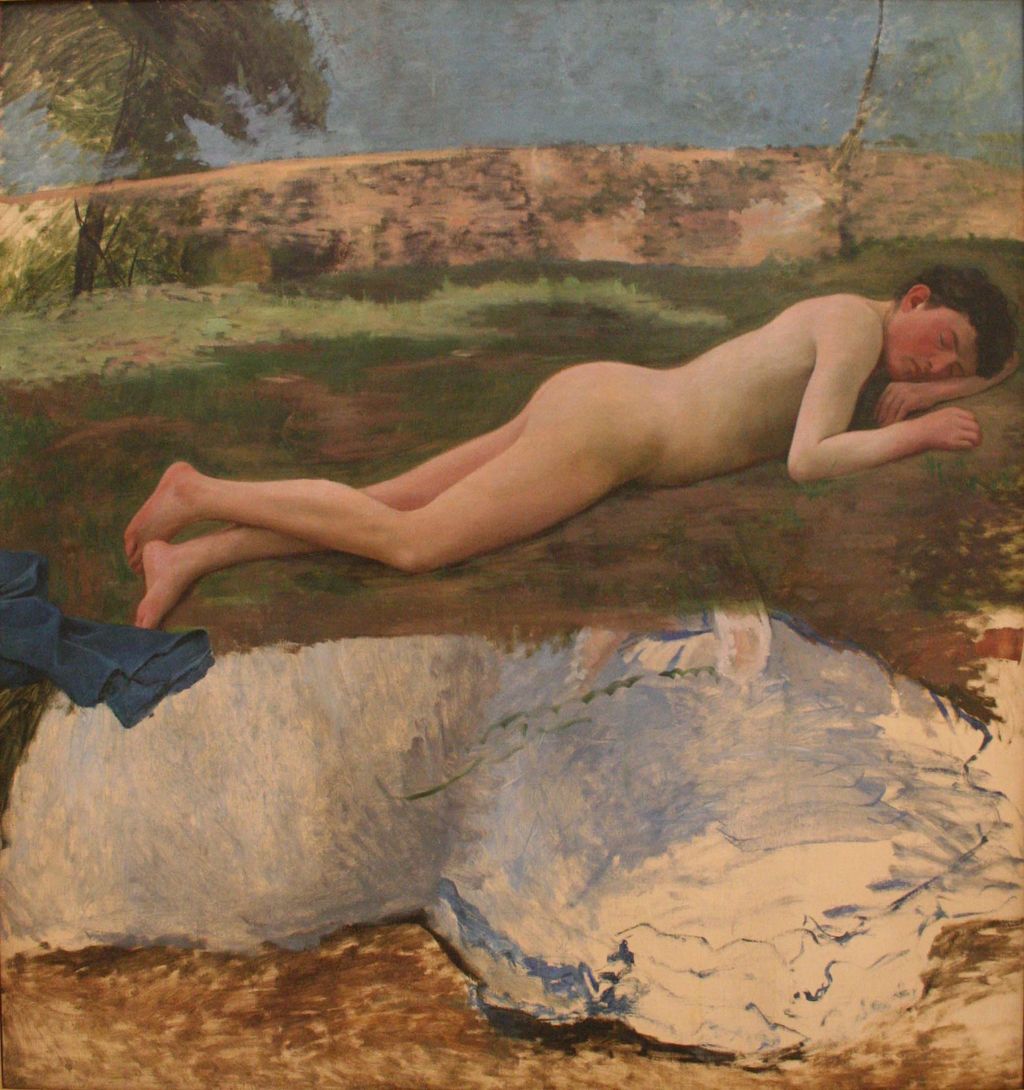
Young Male Nude Lying on the Grass Photograph: Rvalette / Wikimedia Commons. Image source. CC BY-SA 3.0. Resized proportionally; full canvas retained.
From family ownership to the Arp Museum
After remaining with Bazille’s family, the picture passed through the collections of his brother Marc and later descendants. Schulman records its subsequent association with Jean Davray in Geneva, a Paris sale at the Palais Galliéra in June 1961, private ownership and eventual entry into the Rau collection. These are stages in the recorded history, rather than a complete account of every transaction. [2]
Its later exhibition history includes the Salon d’automne of 1910 and the major Bazille retrospective of 2016–17. The work that failed to enter the Salon during its maker’s lifetime became part of the exhibitions through which his independent achievement was reassessed. [2]
The 2017 National Gallery of Art retrospective checklist identifies the lender as the Arp Museum Bahnhof Rolandseck / Collection Rau for UNICEF, Remagen. The Arp Museum continues to identify the work with that collection. [1] [3] Older references to Zurich describe an earlier collection context and should not displace the present institutional location.
At the Arp Museum, the picture’s inclusion in an exhibition about water gives a fresh emphasis to a curious feature: the river itself occupies much less space than the standing body and the trees. [9] Water is the reason for the action, but the bank is where the painting’s main encounter takes place. Bazille makes us look from the man to the landscape and back again, testing whether the body belongs to this place even while its size and stillness set it apart.
Bazille catalogue directory
The 284 records comprise 85 painting records,40 separate works-on-paper records and 159 album or study records. They describe the catalogue’s organisation rather than 284 independent objects or unanimously accepted attributions. Recto, verso, albums and multiple studies remain distinct. Dates are qualified where needed; the Drawing filter includes the etching, gouache and mixed works on paper. Manuscript mentions and unproved projects are listed separately below.
Works known through documents
These mentions remain separate from the 284 catalogue records. Some may concern surviving studies or underlying compositions; they cannot simply be added together as missing physical paintings.
- A copy after Rubens mentioned in March 1863 is unlocated.
- A portrait of an unidentified woman was reported completed before July 1866.
- A portrait of Monet and a composition of two life-size women arranging flowers were reported in progress in April 1867. Their mention does not establish two otherwise unknown surviving canvases.
- Gertrude et le père Lapin was at least begun in the summer of 1870.
Further reported works and uncertain attributions
- A Bouquet of Lilacs was reportedly stolen and returned in 1864; a portrait of the friend Theulier and Yellow Narcissi reported by Maître in 1868 are also documentary mentions.
- Unidentified pictures associated with Guillemet and Mme Rolina are reported through later correspondence cited by the catalogue.
- Children Dressed as Bride and Groom was associated with Vallotton’s collection and also attributed to Renoir. Its identification and authorship should remain open.
Projects whose completion is unproved
- A portrait of Pauline was planned in July 1865.
- A portrait of Marc was proposed in April 1866; a related drawing survives.
- A Jardinière project appears in album inscriptions and related figure material. Written plans are not evidence of a completed painting.
| Name | Date | Medium |
|---|---|---|
| Mystic Marriage of St. Catherine | 1863 | Oil on canvas |
| Trees, Study | 1863 | Oil on canvas |
| Farm of Saint-Sauveur | 1863 | Oil on canvas |
| In the Garden of the Parc Monceau, Paris | 1864 | Oil on canvas |
| Naked Woman from Behind | 1864 | Oil on canvas |
| Reclining Nude | 1864 | Oil on canvas |
| Courtyard of the Auberge du Cheval blanc at Chailly near Barbizon | 1864 | Oil on canvas |
| Covered Soup Bowls | 1864 | Oil on canvas |
| Two Herrings | 1864 | Oil on canvas |
| The Pink Dress | 1864 | Oil on canvas |
| The Dog Rita Asleep | 1864 (catalogue); c. 1864 (2017 checklist) | Oil on canvas |
| The Scoter | 1864 | Oil on canvas |
| Naked Reclining Woman | 1864 | Oil on canvas |
| Landscape at Chailly | 1865 | Oil on canvas |
| Rocks at Chailly, Forest of Fontainebleau | 1865 | Oil on canvas |
| Undergrowth at Chailly, Forest of Fontainebleau | 1865 | Oil on canvas |
| Still Life with Grapes and Nuts | 1865 | Oil on canvas |
| Self-Portrait with a Palette — Chicago | 1865 | Oil on canvas |
| Landscape of Saint-Sauveur | 1865 | Oil on canvas |
| Beach at Sainte-Adresse | 1865 | Oil on canvas |
| The Improvised Field Hospital | 1865 | Oil on canvas |
| Village Street, Chailly | 1865 | Oil on canvas |
| Small Valley in the Forest of Fontainebleau | 1865 | Oil on canvas |
| Forest of Fontainebleau | 1865 | Oil on canvas |
| Woman Ironing | 1866 | Oil on canvas |
| The Artist's Studio on the rue de Furstenberg | 1865–66 (museum) | Oil on canvas |
| Still Life with Fish | 1866 | Oil on canvas |
| Little Italian Street Singer | 1866 | Oil on canvas |
| Potted Flowers | 1866 | Oil on canvas |
| The Little Gardener | 1866–1867 | Oil on canvas |
| Young Woman Playing the Piano | 1866–1867 | Oil on canvas |
| End of a Summer Day | 1866–1867 | Oil on canvas |
| A Studio on the rue Visconti | 1867 | Oil on canvas |
| Thérèse Reading in the Park at Méric | 1867 | Oil on canvas |
| Portrait of Verlaine | 1867 | Oil on canvas |
| The Terrace at Méric | 1867 | Oil on canvas |
| Still Life with Heron | 1867 | Oil on canvas |
| The Family Gathering | 1867–68 (museum) | Oil on canvas |
| Oleanders | 1867 | Oil on canvas |
| Woman on the Terrace at Méric | 1867 | Oil on canvas |
| The Ramparts at Aigues-Mortes from South | 1867 | Oil on canvas |
| The Western Ramparts at Aigues-Mortes | 1867 | Oil on canvas |
| Portrait of Edmond Maître — head study | 1867 | Oil on canvas |
| Porte de la Reine at Aigues-Mortes | 1867 | Oil on canvas |
| Portrait of Sisley | 1867 | Oil on wood |
| Portrait of Renoir — Cleveland | 1867 | Oil on canvas |
| Portrait of Renoir — Musée d’Orsay | 1867 | Oil on canvas |
| Self-Portrait with a Detachable Collar — Minneapolis | 1865–67 (museum); 1867–68 (catalogue) | Oil on canvas |
| Vase of Flowers on a Console | 1868 (museum); 1867–68 (catalogue) | Oil on canvas |
| Portrait of a Woman | 1868 | Oil on canvas |
| Young Woman in the Vineyards | 1868 | Oil on card |
| Harvester with a Basket | 1868 | Oil on card |
| Harvester with a Yellow Hat | 1868 | Oil on card |
| Harvester with a Headdress | 1868 | Oil on panel |
| On the Banks of the Lez | 1868 | Oil on canvas |
| After the Bath (attribution questioned) | 1868? | Oil on canvas |
| Young Woman with Lowered Eyes | 1868 | Oil on canvas |
| Fisherman with a Net | 1868 | Oil on canvas |
| View of the Village | 1868 | Oil on canvas |
| Portrait of Bazille (attributed to Monet by Musée Fabre; disputed catalogue attribution) | 1864 (museum); 1868 (catalogue) | Oil on panel |
| Studies for a Grape Harvest (two panels) | 1868 | Oil on canvas (two panels) |
| The Fortune Teller | 1868–69 (catalogue); c. 1869–70 (2017 checklist) | Oil on canvas |
| Harvester with a Cap | 1869 | Oil on card |
| Portrait of Edmond Maître — 1869 | 1869 | Oil on canvas |
| Woman in a Moorish Costume | 1869 | Oil on canvas |
| Young Woman in the Garden | 1869 | Oil on canvas |
| Portrait of Alphonse Tissié in a Cavalryman's Uniform | 1869 | Oil on canvas |
| Portrait of a dragoon | 1869 | Oil on canvas |
| Portrait of Zacharie Astruc | 1869 | Oil on canvas |
| Bunch of Grapes in a Bucket | 1869 | Oil on card |
| Portrait of Edouard Blau | Probably 1869; inscribed 1866 | Oil on canvas |
| Young Male Nude Lying on the Grass | 1870 | Oil on canvas |
| Summer Scene | 1869–1870 | Oil on canvas |
| The Studio on the rue La Condamine | 1869–1870 | Oil on canvas |
| La Toilette | 1870 | Oil on canvas |
| Young Woman with Peonies — Montpellier | 1870 | Oil on canvas |
| Young Woman with Peonies — Washington | 1870 | Oil on canvas |
| Monotonous Chant | 1870 | Oil on canvas |
| Flowers — private collection | 1870 | Oil on canvas |
| Flowers — Musée Fabre | 1870 | Oil on canvas |
| Young Fisherman | 1870 | Oil on canvas |
| Study for Ruth and Boaz | 1870 | Oil on wood |
| Ruth and Boaz | 1870 | Oil on canvas |
| Self-Portrait in Shirt Sleeves | 1870 | Oil on canvas |
| Landscape on the Banks of the Lez | 1870 | Oil on canvas |
| Study after an Alpine Landscape | 1860 | Graphite on watercolour-tinted paper |
| Profile Head | 1862 | Charcoal on laid paper |
| Studies after Delacroix | 1863 | Ink and graphite, with gouache and watercolour, on paper |
| Academic Head | 1863 | Charcoal on paper |
| Study of a Woman's Head in Profile on a Chair | 1863 | Charcoal on paper |
| Academic Head of a Woman | 1863 | Charcoal on paper |
| Academy of Woman | 1863 | Black pencil and charcoal, stumped, on watermarked laid paper |
| Academy of Man | 1863 | Black pencil and charcoal, stumped, on watermarked laid paper |
| Naked Man | 1863 | Charcoal on paper |
| The Pont au Change in Paris | 1864 | Watercolour on paper |
| Study for the Pink Dress or Portrait of Thérèse des Hours | 1864 | Black pencil on paper |
| Naked Woman Standing | 1864 | Pencil on paper |
| Study of a Reclining Nude | 1864 | Charcoal on paper |
| Bathers | 1864 | Charcoal on paper |
| Portrait of a Man | 1864 | Charcoal on paper |
| Study for The Pink Dress | 1864 | Black pencil, squared, on paper |
| Study for Landscape of Saint-Sauveur | 1864 | Graphite on paper |
| Study for Landscape of Saint-Sauveur | 1865 | Pencil on paper |
| Man Taming a Bull | 1866 | Pen and black pencil on paper |
| Man Half Lying on a Sofa | 1866 | Charcoal on paper |
| Study for The Family Gathering | 1867 | Pencil on paper |
| Study for The Family Gathering | 1867 | Graphite, charcoal and black pencil on paper |
| The Embroiderer | 1867 | Pencil on pink paper |
| Study of Children | 1867 | Pencil on paper |
| Women in a Garden | 1867 | Pencil drawing |
| View of the Village | 1868 | Etching on paper |
| Portrait of a Bearded Man (catalogued as Self-Portrait) | Undated (museum); 1869 (catalogue) | Charcoal and brown ink |
| Man Smoking Pipe | 1869 | Watercolour on paper |
| Manet Drawing | 1868–70(?) (museum) | Charcoal and white chalk on paper |
| Study for the Summer Scene | 1869 | Charcoal, pen and ink on paper |
| Family Portrait | 1869 | Pastel and charcoal on paper |
| Study for Ruth | 1870 | Pencil and charcoal on paper |
| Woman Arranging a Hat | 1870 | Pencil drawing |
| Study for Boaz Asleep | 1870 | Pastel and red chalk |
| Boaz Asleep | 1870 | Charcoal and pencil on paper |
| Study for Boaz Asleep | 1870 | Black and beige pastel with red chalk on laid paper |
| Ruth Lying down | 1870 | Charcoal and pastel on paper |
| Head, Arm and Chest of Ruth | 1870 | Charcoal on paper |
| Chest of Ruth | 1870 | Black chalk and charcoal on paper |
| Black Woman with Peonies — gouache | c. 1870 | Gouache, watercolour, pencil and black chalk on card |
| Various Unidentified Subjects | Undated | Pencil drawing |
| Rocky Sea Side | Undated | Charcoal on paper |
| Studies of a Dancing Woman | Undated | Drawing with white chalk |
| Study of a Leg | Undated | Pencil drawing |
| Dancers in Camargue | Undated | Pencil drawing |
| Academy of Woman | Undated | Charcoal |
| Caricature of Venus of Milo and Various Other Caricatures | Undated | Charcoal |
| Caricature | Undated | Pencil drawing |
| Study of Landscape | Undated | Charcoal |
| Caricatures and Seated Monk | Undated | Charcoal |
| Caricatures and Various Subjects | Undated | Pencil drawing |
| Women Carrying a Pitcher | Undated | Pencil drawing |
| The Hanged Man | Undated | Charcoal |
| Castle in the Plain | Undated | Charcoal |
| Naked Woman from Behind | Undated | Charcoal |
| Caricatures | Undated | Charcoal and pencil |
| Unidentified Subjects | Undated | Pencil drawing |
| Landscape with a Castle | Undated | Charcoal |
| Study of Landscape | Undated | Charcoal |
| Horse Rider seen from Behind | Undated | Charcoal |
| Mazeppa | Undated | Pencil and charcoal |
| Study of Rider and Others Subjects | Undated | Pencil, pen and brown ink |
| Study of an Unidentified Man | Undated | Pencil drawing |
| Study for an Unknown Historic Scene | Undated | Pencil drawing |
| Study a Man Reading | Undated | Pencil drawing |
| Study of Men Reading | Undated | Pencil drawing |
| Study of Landscape ? | Undated | Charcoal |
| Study of a Head of a Man | Undated | Pencil drawing |
| Erotic Scene | Undated | Pencil drawing |
| Study of Dog | Undated | Charcoal |
| Studies of Unidentified Subjects and Erotic Scene | Undated | Pencil and charcoal drawing |
| Study for a Theater Scene | Undated | Charcoal |
| Study of a Reclining Naked Woman | Undated | Charcoal |
| Two Studies of Landscape | Undated | Pencil drawing |
| Caricature | Undated | Pencil and charcoal drawing |
| Portrait of an Unidentified Young Man | Undated | Charcoal |
| Study of an Unidentified Subject | Undated | Brown ink drawing |
| Unidentified Man with a Hat | Undated | Pencil and charcoal |
| Study of an Unidentified Women | Undated | Pencil drawing |
| Study for a Theater Character ? | Undated | Pencil drawing |
| Study for a Theater Character ? | Undated | Pen drawing |
| The Pavillon de la Reine in Paris | Undated | Pencil drawing |
| Study of a Horse Rider | Undated | Pencil and charcoal drawing |
| Entwined Couple. Caricature ? | Undated | Pencil drawing |
| Woman Sitting on a Sofa | Undated | Pencil drawing |
| Studies of Unidentified Subjects | Undated | Pencil and charcoal drawing |
| Studies of Animals | Undated | Pencil drawing |
| Study of a Horse Rider in Camargue | Undated | Charcoal |
| Study of Hunting Dogs | Undated | Pencil drawing |
| Study of Soldiers. Caricatures | Undated | Pencil drawing |
| Studies of Hunting Dogs ? | Undated | Pencil drawing |
| Hunting Scene. Hunter Playing the Horn | Undated | Pencil drawing |
| Caricature | Undated | Pencil drawing |
| Study of an Ibex | Undated | Pencil drawing |
| Theater Scene. Caricatures | Undated | Pencil drawing |
| Studies of Animals. Horses ? | Undated | Pencil drawing |
| Caricatures | Undated | Pencil drawing |
| Studies of Various Subjects and Animals | Undated | Pencil drawing |
| Unidentified Subject | Undated | Pencil drawing |
| Rider Taming a Horse [in Camargue ?] | Undated | Pencil drawing |
| Caricature of a Soldier | Undated | Pencil drawing |
| Study of a Woman and Mouse | Undated | Pencil drawing |
| Historic Scene | Undated | Charcoal |
| Architecture Studies | Undated | Pencil drawing |
| Mythologic Scene | Undated | Charcoal |
| Ophelia | Undated | Pencil drawing |
| Mythologic Scene | Undated | Charcoal |
| Studies of Various Subjects | Undated | Pencil and pen drawing |
| Studies of Peasants | Undated | Pencil drawing |
| Historic Scene | Undated | Pencil drawing |
| Historic or Literary Scene | Undated | Pencil drawing |
| Unidentified Historic Scene | Undated | Pencil drawing |
| Studies of Unidentified Subjects | Undated | Pencil drawing |
| Unidentified Study | Undated | Pencil drawing |
| Man in an Armchair | Undated | Pencil drawing |
| Studies of Various Subjects | Undated | Pencil drawing |
| Portraits of Unidentified Men | Undated | Pencil drawing |
| Studies of Various Subjects | Undated | Pencil drawing |
| Horse Rider and Artist | Undated | Charcoal and pencil |
| Study of Unidentified Characters | Undated | Charcoal |
| Dead Horse in a Plain | Undated | Charcoal |
| Study of Various Subjects and Furniture | Undated | Pencil drawing |
| Caricatures and Various Notes about Opéra | Undated | Pencil drawing |
| Galloping Horse | Undated | Charcoal |
| Study for La Toilette | Undated | Pencil drawing |
| Study of a Naked Woman | Undated | Pencil drawing |
| Domestic Scene | Undated | Pencil drawing |
| Physiognomies | Undated | Pencil drawing |
| Study for a Grape Harvest | Undated | Pencil drawing |
| Study for the Summer Scene | Undated | Pencil drawing |
| Female Profiles | Undated | Pencil drawing |
| Various Subjects | Undated | Pencil drawing |
| Study for The Terrace at Méric | Undated | Pencil drawing |
| Study for The Ramparts at Aigues-Mortes | Undated | Pencil drawing |
| Study for The Ramparts at Aigues-Mortes | Undated | Pencil drawing |
| Study for a Grape Harvest | Undated | Charcoal |
| Children Portraits | Undated | Pencil drawing |
| Study for Children's Heads | Undated | Pencil drawing |
| Study of Minerva | Undated | Pencil drawing |
| Study for a Grape Harvest | Undated | Pencil drawing |
| Study for The Family Gathering | Undated | Pencil drawing |
| Study for a Young Fisherman | Undated | Charcoal |
| Self-Portraits | Undated | Black pencil drawing |
| Study of Horses for the Porte de la Reine at Aigues-Mortes | Undated | Ink drawing |
| Study of Horses for the Porte de la Reine at Aigues-Mortes | Undated | Ink drawing |
| Study of Horses for the Porte de la Reine at Aigues-Mortes | Undated | Ink drawing |
| Study for an Outdoor Concert | Undated | Pencil drawing |
| Studies of Legs | Undated | Pencil drawing |
| Study for The Ramparts at Aigues Mortes | Undated | Pencil drawing |
| Studies of Hats | Undated | Pencil drawing |
| Studies of Men | Undated | Pencil drawing |
| Study for The Little Gardener | Undated | Pencil drawing |
| Study for The Ramparts at Aigues Mortes | Undated | Charcoal |
| Studies of Sail Boats | Undated | Pencil drawing |
| Portrait of Marc Bazille | Undated | Charcoal, black pencil and graphite |
| Studies of Children's Heads | Undated | Pencil drawing |
| Study for Aigues-Mortes | Undated | Pencil drawing |
| Studies of Women's Heads | Undated | Pencil drawing |
| Portrait of Camille des Hours and an Unidentified Man | Undated | Charcoal |
| Study of Flying Birds | Undated | Charcoal or graphite |
| Study for the Summer Scene | Undated | Pencil drawing |
| Study of Hands | Undated | Pen drawing |
| Self-Portrait | Undated | Black pencil drawing |
| Study for the Summer Scene | Undated | Pencil drawing |
| Study for the Summer Scene | Undated | Pencil drawing |
| Study for a Grape Harvest | Undated | Pencil drawing |
| Study of Branches | Undated | Pencil drawing |
| Study of a Seated Child | Undated | Pencil drawing |
| Study for a Couple and Unidentified Women | Undated | Pencil drawing |
| Studies of Unidentified Women | Undated | Pencil drawing |
| Study of Buildings | Undated | Pencil drawing |
| Study for a Grape Harvest | Undated | Pencil and charcoal |
| Studies of Boaters | Undated | Pencil drawing |
| Study of a Man Writing at his Table | Undated | Pencil drawing |
| Study of a Woman Cutting Flowers | Undated | Pencil drawing |
| Study of Hand | Undated | Pencil drawing |
| Women in a Garden | Undated | Pencil drawing |
| Studies of Women in Profile | Undated | Pencil drawing |
| Study for Ruth and Boaz | Undated | Charcoal |
| Study for The Family Gathering | Undated | Pencil drawing |
| Study for the View of the Village | Undated | Pencil drawing |
| Study of the View of the Village | Undated | Pencil drawing |
| Study for the Fisherman with a Net | Undated | Pencil drawing |
| Study for the View of the Village | Undated | Charcoal |
| Study for The Little Gardener | Undated | Charcoal |
| Portrait of a Man with a Top Hat | Undated | Pencil drawing |
| Portrait of a Man with a Top Hat | Undated | Pencil drawing |
| Inscriptions | Undated | Pencil inscriptions |
| Study of Tree | Undated | Pencil drawing |
| Caricature of Nina la Belle | Undated | Pencil drawing |
| Study for Saint Sebastian | Undated | Pencil drawing |
| Young Woman Sewing | Undated | Pencil drawing |
| Studies of Hands | Undated | Pencil drawing |
| Woman in a Garden | Undated | Pencil drawing |
| Elegant Woman | Undated | Pencil drawing |
| Various Inscriptions | Undated | Inscriptions (medium unspecified in index) |
| Study of a Man with a Hat | Undated | Pencil drawing |
| Study of a Child | Undated | Pencil drawing |
| Study of a Man with a Hat | Undated | Pencil drawing |
Frequently Asked Questions
Discussion
The fisherman’s body dominates the clearing, while another figure sits farther back. What makes the two spaces belong together?
Reader Insights
How do the fisherman’s separated feet give weight to the upright body?
What connects the large shaded back with the smaller seated figure in the clearing?
Compare the hanging net with the surrounding leaves. How do these very different surfaces meet the body?
Join the Conversation
Share a detail, comparison or question about Fisherman with a Net by Frédéric Bazille below.
References
- National Gallery of Art, Frédéric Bazille and the Birth of Impressionism, exhibition checklist, 2017, catalogue no. 47. Checklist. View source.
- Michel Schulman, Fisherman with a Net, MSb-45, Frédéric Bazille: The Digital Catalogue Raisonné, object metadata, history, exhibitions and critical essay. Catalogue entry (English translation of French scholarship). View source.
- Arp Museum Bahnhof Rolandseck, Zurück nach vorn: Nostalgie und Aufbruch im Impressionismus, exhibition preview, illustration identification for Bazille’s Fischer mit Netzen. Museum collection identification (in German). View source.
- Michel Hilaire, “Bazille ou la vie brève,” Académie des Sciences et Lettres de Montpellier, 2016, pp. 166–172, especially pp. 170–172. Lecture (in French). View source.
- Michel Schulman, Study for the Fisherman with a Net, MSb-264, Frédéric Bazille: The Digital Catalogue Raisonné. Drawing entry (English translation of French scholarship). View source.
- Frédéric Bazille, letter to his father, dated [6 January 1865], Musée Fabre, inventory 92.2.1, manuscript and transcription. The English quotation is newly translated from the French. Letter (in French). View source.
- Musée Fabre, Frédéric Bazille, la jeunesse de l’impressionnisme, 2016 press dossier, “Le nu moderne,” p. 19. Exhibition discussion (in French). View source.
- Frédéric Bazille, letter to his mother, dated [mid-February 1869], Musée Fabre, inventory 94.7.3, manuscript and transcription. Letter (in French). View source.
- Arp Museum Bahnhof Rolandseck, Im Fluss / In Flux: A Story about Water, short exhibition guide, Bazille entry, pp. 12–13. Museum guide (in German and English). View source.
- Joconde/POP, La Robe rose, RF2450. View source. (in French).
- Musée d’Orsay, L’Ambulance improvisée, RF 1967 5. View source. (in French).
- Musée d’Orsay, Réunion de famille,RF2749. View source. (in French).
- Musée d’Orsay, Pierre Auguste Renoir,DL1970 3. View source.
- Musée Fabre, Vue de village, 898.5.1. View source. (in French).
- National Gallery of Art, Young Woman with Peonies,1983.1.6. View source.
- Michel Schulman, painting index and documentary introduction (English titles; French metadata). View source.
- Michel Schulman, works-on-paper index (English titles; French metadata). View source.
- Michel Schulman, albums and studies index (English titles; French metadata). View source.


