 by Tom Gurney
Tom Gurney BSc (Hons) is an art history expert with over 20 years experience
Published on June 19, 2020 / Updated on November 2, 2026
Email: tomgurney1@gmail.com / Phone: +44 7429 011000
The Fortune Teller by Frédéric Bazille: Introduction
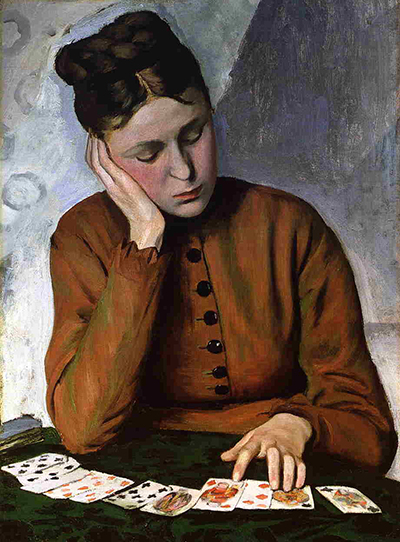
A young woman looks down at playing cards spread across a green table. One hand supports her head; the other rests among the cards. In The Fortune Teller, Frédéric Bazille makes this small interval of apparent concentration the whole subject. The painting is an oil on canvas measuring 61 × 46 cm, held in a private collection. Its date remains unsettled: Michel Schulman’s digital catalogue gives 1868–69, while the National Gallery of Art’s 2017 exhibition checklist places it around 1869–70. [1] [2]
The cards suggest a story, but the woman’s absorbed pose never quite supplies one. There is no visible customer awaiting a prediction, and the picture gives us no spoken exchange to reconstruct. Its interest lies partly in that restraint: a familiar tabletop activity becomes a way to explore the weight of a head, the placement of hands and the relation between a clothed figure and a shallow interior.
At a Glance
- Date1868–69 (catalogue); c. 1869–70 (2017 checklist) [1] [2]
- MediumOil on canvas [1]
- Dimensions61 × 46 cm [1]
- CollectionPrivate collection [1] [2]
This work across Frédéric Bazille’s career
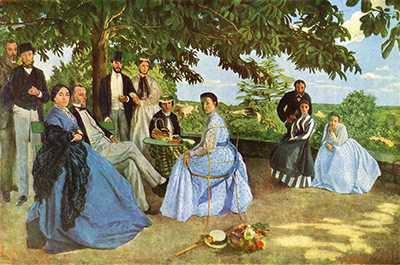
Family Reunion
1867–1868 (museum)The Fortune Teller by Frédéric Bazille (current article)
1868–1869 (catalogue); c. 1869–1870 (2017 checklist)Bazille’s Studio, Rue La Condamine
1869–1870Summer Scene (Bathers)
1869–1870Contents
- A woman, a table and an unanswered question
- The dress and the divided wall
- A painting inside the rue La Condamine studio
- Stillness does not prove an unfinished painting
- Three ways of staging a figure
- Private ownership and public rediscovery
A woman, a table and an unanswered question
The woman occupies almost the entire height of the upright canvas. Her dark hair is gathered high, leaving the neck and the outline of the face clearly legible. Her eyes are lowered, and her head tilts towards the hand pressed against its side. The elbow beneath that hand plants the pose on the table. The opposite forearm brings the composition down to the cards, completing a circuit between face, fingers and tabletop.
That circuit is easier to follow than any narrative. The picture can suggest someone attending to a spread, pausing during a game or reflecting on what she sees. None of these possibilities requires us to assume that her expression records a real emotion outside the sitting. The title directs us towards fortune-telling; the painted gesture remains more open. Schulman notes that Bazille left no explanation of the painting in his correspondence, and raises the question of whether the cards were intended to carry a particular meaning. [1]
Look at the uneven interval between the hands. The supporting hand belongs to the stillness of the head; the fingers on the table appear poised for movement. Small areas of pale flesh connect the upper and lower parts of the painting across the large brown dress. The cards then extend that movement sideways, drawing our eye across the bottom edge. They are active compositional elements even before we ask what they represent.
Several cards overlap, with red and black marks interrupting their white surfaces. Their brightness makes them conspicuous against the green. Yet a list of supposed card values would offer a false precision: neither the painting’s title nor the visible spread establishes a particular system of divination. We can attend to their colour, spacing and relationship to the hand without supplying a prediction for the woman to contemplate.
The close crop makes the viewer feel near the table, but she does not return our gaze. We observe an activity without becoming its obvious recipient. Our relationship with her differs from that of a conventional portrait in which the sitter faces a visitor. Here, the withheld exchange helps hold the composition together.
The dress and the divided wall
The brown dress gives the figure a broad, nearly continuous shape. Its high neckline and vertical row of dark buttons concentrate attention on a few simple divisions: the centre of the torso, the bend of each arm and the narrow opening of pale skin at the wrist. Warm rust and ochre tones are broken by darker folds and muted green passages. The clothing supplies much of the painting’s structure.
The buttons matter because they establish a firm upright within the tilted pose. Follow them upwards and the body seems stable; follow the shoulder towards the head and it inclines. The image balances these two effects without a dramatic gesture. Around the hands, changes of direction become sharper. The long fingers and angular wrist offer a more intricate pattern than the broad sleeves that surround them.
Behind the head, the wall is divided diagonally into lighter and darker areas. This slant complicates what might otherwise be a flat backdrop. It echoes the inclination of the figure without describing a fully furnished room. The light area also separates the dark mass of hair from its surroundings. On the other side, subdued grey-green tones draw closer to the shadows of the dress.
Schulman emphasises the painting’s linear definition and restrained colour relationships. Those observations help explain why this interior does not depend on a wealth of incident. Its clarity comes from a few boundaries and tonal contrasts: dark hair against the pale wall, white cards against green, warm cloth against cool background. [1] The table, wall and seated body remain distinct, while their shared colours keep them from breaking into unrelated pieces.
Even the restricted space contributes to this effect. We receive no broad view through a window and no landscape beyond the sitter. The background offers little opportunity for the eye to wander. The resulting concentration belongs to the arrangement of the painting; it need not be explained as evidence of the woman’s temperament.
A painting inside the rue La Condamine studio
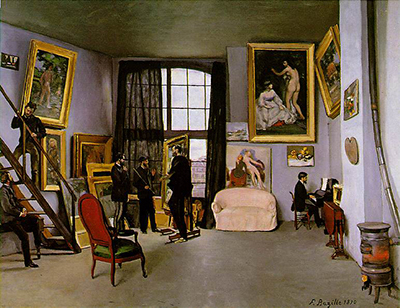
An important clue to the work’s history appears in Bazille’s Studio, Rue La Condamine. In that large interior, The Fortune Teller is recognisable among the canvases beneath the window, low down and partly obscured. The Musée d’Orsay dates the studio painting to 1870. Its inclusion places the smaller picture within Bazille’s working surroundings by the time he represented the room. [1] [3]
This relationship explains some of the dating debate, but it cannot settle it. An older canvas could stand beside a recent one in a studio. Schulman records earlier proposals of 1867 as well as 1868–69, and the later 1869–70 dating adopted for the retrospective. The studio picture provides a latest point by which the work was present; it does not prove that Bazille had just painted it. The most useful way to place The Fortune Teller is therefore within his later Paris years, while retaining the disagreement over its precise date. [1] [2]
Its modest position in the larger painting is revealing. Visitors to the studio scene may first notice the tall window, the figures around the easel or the large pictures on the walls. The small seated woman comes into view more slowly, among works resting near the floor. That placement makes her part of a room where pictures circulate between making, storage, display and discussion. It does not establish how Bazille ranked her painting or whether he planned to submit it to an exhibition.
The studio scene itself was constructed through successive work. Bruno Mottin’s laboratory study shows that Bazille initially painted the room without its occupants and added the people and prominent armchair later. [4] This finding encourages us to treat the interior as a composed account of artistic life, rather than a single unedited glimpse. It also puts a limit on what we can infer from a picture shown within it: the small reproduction documents the work’s place in Bazille’s artistic world, not every stage of its making.
Studio in Rue de La Condamine
Watch: Bazille and early Impressionism
Explore a Paris studio with Smarthistory, then discover the beginnings of Impressionism with the National Gallery of Art.
Jean-Frédéric Bazille, The Artist’s Studio, Rue Visconti, Paris
A close look at Bazille’s 1867 painting of the studio he shared in Paris.
Watch on YouTubeStillness does not prove an unfinished painting
The concentrated pose can make The Fortune Teller feel like an experiment held in suspension. Bazille gives the woman something to do, yet keeps action to a minimum. The pared-down setting and large areas of dress allow us to study how little movement is needed to animate a figure picture. In that sense, it is exploratory: its effect depends on testing the relationships between an upright torso, an inclined head and a horizontal tabletop.
That is a description of its pictorial character, rather than proof that Bazille left it incomplete. The face, buttons, sleeves, hand and cards are articulated clearly. The simple wall does not by itself constitute an abandoned background. Nor does the painting’s presence among leaning canvases in the studio establish that it was awaiting further work.
It is useful to keep these questions apart. We can recognise differing degrees of definition across the image without reconstructing an undocumented sequence of sessions. The cards receive sharp light accents; broad passages of the wall remain comparatively quiet. Such differences organise our attention. They cannot alone tell us which areas Bazille intended to revise, or whether he regarded the painting as finished.
Three ways of staging a figure
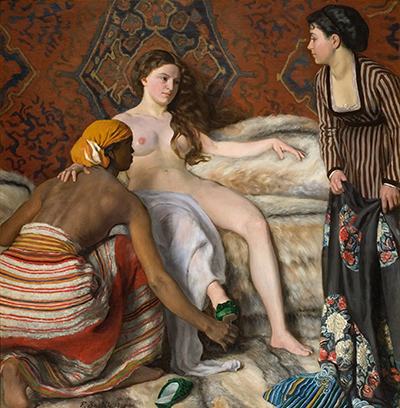
The comparison with La Toilette shows how varied Bazille’s figure painting could be. That large, almost square canvas, dated 1870 and held by the Musée Fabre, brings together three women within an elaborate arrangement of textiles. [5] The seated nude, bending attendant and standing clothed figure turn towards one another, while stripes, patterned fabric and pale fur carry the eye between them.
In The Fortune Teller, the equivalent network has contracted to a single body and a few props. The sleeves supply most of the cloth; the cards supply most of the incident. The green tabletop separates the woman from the viewer, whereas the layered fabrics of La Toilette build a more expansive staged interior. Both paintings make gesture essential to the arrangement, but one distributes it among three figures and the other concentrates it in two hands.
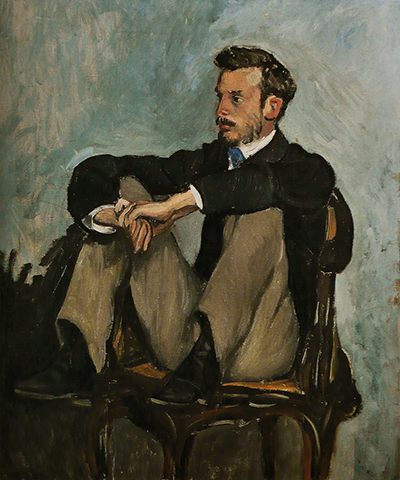
The Portrait of Renoir associated with the Musée d’Orsay offers another comparison. This is the chair portrait dated 1867 in the museum record. [6] Renoir sits with raised knees and arms gathered across them. His body makes a compact structure, with the hands bridging the trousers and dark jacket. The pale wall has a visibly brushed, varied surface.
Both seated figures occupy their frames firmly, but the means differ. Renoir’s gathered limbs make the pose seem informal and physically compressed. The card reader’s upright buttons, long sleeves and lowered head produce a more continuous silhouette. Comparing them does not require a claim that Bazille progressed steadily from loose painting to strict drawing, or in the opposite direction. Each arrangement calls for a different balance between contour, surface and bodily weight.
La Toilette
Private ownership and public rediscovery
The painting’s recorded provenance begins with Bazille’s family. Schulman lists his brother Marc, followed by Mme Meynier de Salinelles, born Laure Bazille, before later private ownership. The record includes a Sotheby’s sale in London on 28 June 1994, subsequent passage through Galerie Schmit in Paris and a private collection. The 2017 National Gallery of Art checklist likewise identifies its lender simply as a private collection. [1] [2]
Private ownership has not kept the picture entirely from public view. Schulman records its inclusion in the Montpellier retrospective of 1927, the Paris exhibition of 1935, the Chicago retrospective of 1978 and the Montpellier–New York exhibition of 1992–93. It returned to the major Montpellier, Paris and Washington retrospective of 2016–17, where it was catalogue number 54. [1] [2] These appearances make it possible to place a relatively small interior alongside the better-known outdoor figure paintings.
Its critical reception has also stressed formal qualities. Schulman recounts Gaston Poulain’s emphasis in 1932 on subdued, wintry colour, and Pierre du Colombier’s comparison in 1935 of its drawing and tonal unity with Degas. He also draws a comparison with Cézanne’s later seated women, particularly their immobility, closed dresses and strongly organised forms. These are comparisons made in criticism, rather than evidence that Bazille intended to anticipate another painter’s work. [1]
Such comparisons are most useful when they return us to the canvas. The woman’s bent head, the heavy sleeve and the bright sequence of cards produce an image that is both firmly constructed and narratively elusive. Bazille gives enough information to make us look closely, while leaving the imagined event unresolved. The painting rewards that attention without requiring the cards to reveal a secret.
Bazille catalogue directory
The 284 records comprise 85 painting records,40 separate works-on-paper records and 159 album or study records. They describe the catalogue’s organisation rather than 284 independent objects or unanimously accepted attributions. Recto, verso, albums and multiple studies remain distinct. Dates are qualified where needed; the Drawing filter includes the etching, gouache and mixed works on paper. Manuscript mentions and unproved projects are listed separately below.
Works known through documents
These mentions remain separate from the 284 catalogue records. Some may concern surviving studies or underlying compositions; they cannot simply be added together as missing physical paintings.
- A copy after Rubens mentioned in March 1863 is unlocated.
- A portrait of an unidentified woman was reported completed before July 1866.
- A portrait of Monet and a composition of two life-size women arranging flowers were reported in progress in April 1867. Their mention does not establish two otherwise unknown surviving canvases.
- Gertrude et le père Lapin was at least begun in the summer of 1870.
Further reported works and uncertain attributions
- A Bouquet of Lilacs was reportedly stolen and returned in 1864; a portrait of the friend Theulier and Yellow Narcissi reported by Maître in 1868 are also documentary mentions.
- Unidentified pictures associated with Guillemet and Mme Rolina are reported through later correspondence cited by the catalogue.
- Children Dressed as Bride and Groom was associated with Vallotton’s collection and also attributed to Renoir. Its identification and authorship should remain open.
Projects whose completion is unproved
- A portrait of Pauline was planned in July 1865.
- A portrait of Marc was proposed in April 1866; a related drawing survives.
- A Jardinière project appears in album inscriptions and related figure material. Written plans are not evidence of a completed painting.
| Name | Date | Medium |
|---|---|---|
| Mystic Marriage of St. Catherine | 1863 | Oil on canvas |
| Trees, Study | 1863 | Oil on canvas |
| Farm of Saint-Sauveur | 1863 | Oil on canvas |
| In the Garden of the Parc Monceau, Paris | 1864 | Oil on canvas |
| Naked Woman from Behind | 1864 | Oil on canvas |
| Reclining Nude | 1864 | Oil on canvas |
| Courtyard of the Auberge du Cheval blanc at Chailly near Barbizon | 1864 | Oil on canvas |
| Covered Soup Bowls | 1864 | Oil on canvas |
| Two Herrings | 1864 | Oil on canvas |
| The Pink Dress | 1864 | Oil on canvas |
| The Dog Rita Asleep | 1864 (catalogue); c. 1864 (2017 checklist) | Oil on canvas |
| The Scoter | 1864 | Oil on canvas |
| Naked Reclining Woman | 1864 | Oil on canvas |
| Landscape at Chailly | 1865 | Oil on canvas |
| Rocks at Chailly, Forest of Fontainebleau | 1865 | Oil on canvas |
| Undergrowth at Chailly, Forest of Fontainebleau | 1865 | Oil on canvas |
| Still Life with Grapes and Nuts | 1865 | Oil on canvas |
| Self-Portrait with a Palette — Chicago | 1865 | Oil on canvas |
| Landscape of Saint-Sauveur | 1865 | Oil on canvas |
| Beach at Sainte-Adresse | 1865 | Oil on canvas |
| The Improvised Field Hospital | 1865 | Oil on canvas |
| Village Street, Chailly | 1865 | Oil on canvas |
| Small Valley in the Forest of Fontainebleau | 1865 | Oil on canvas |
| Forest of Fontainebleau | 1865 | Oil on canvas |
| Woman Ironing | 1866 | Oil on canvas |
| The Artist's Studio on the rue de Furstenberg | 1865–66 (museum) | Oil on canvas |
| Still Life with Fish | 1866 | Oil on canvas |
| Little Italian Street Singer | 1866 | Oil on canvas |
| Potted Flowers | 1866 | Oil on canvas |
| The Little Gardener | 1866–1867 | Oil on canvas |
| Young Woman Playing the Piano | 1866–1867 | Oil on canvas |
| End of a Summer Day | 1866–1867 | Oil on canvas |
| A Studio on the rue Visconti | 1867 | Oil on canvas |
| Thérèse Reading in the Park at Méric | 1867 | Oil on canvas |
| Portrait of Verlaine | 1867 | Oil on canvas |
| The Terrace at Méric | 1867 | Oil on canvas |
| Still Life with Heron | 1867 | Oil on canvas |
| The Family Gathering | 1867–68 (museum) | Oil on canvas |
| Oleanders | 1867 | Oil on canvas |
| Woman on the Terrace at Méric | 1867 | Oil on canvas |
| The Ramparts at Aigues-Mortes from South | 1867 | Oil on canvas |
| The Western Ramparts at Aigues-Mortes | 1867 | Oil on canvas |
| Portrait of Edmond Maître — head study | 1867 | Oil on canvas |
| Porte de la Reine at Aigues-Mortes | 1867 | Oil on canvas |
| Portrait of Sisley | 1867 | Oil on wood |
| Portrait of Renoir — Cleveland | 1867 | Oil on canvas |
| Portrait of Renoir — Musée d’Orsay | 1867 | Oil on canvas |
| Self-Portrait with a Detachable Collar — Minneapolis | 1865–67 (museum); 1867–68 (catalogue) | Oil on canvas |
| Vase of Flowers on a Console | 1868 (museum); 1867–68 (catalogue) | Oil on canvas |
| Portrait of a Woman | 1868 | Oil on canvas |
| Young Woman in the Vineyards | 1868 | Oil on card |
| Harvester with a Basket | 1868 | Oil on card |
| Harvester with a Yellow Hat | 1868 | Oil on card |
| Harvester with a Headdress | 1868 | Oil on panel |
| On the Banks of the Lez | 1868 | Oil on canvas |
| After the Bath (attribution questioned) | 1868? | Oil on canvas |
| Young Woman with Lowered Eyes | 1868 | Oil on canvas |
| Fisherman with a Net | 1868 | Oil on canvas |
| View of the Village | 1868 | Oil on canvas |
| Portrait of Bazille (attributed to Monet by Musée Fabre; disputed catalogue attribution) | 1864 (museum); 1868 (catalogue) | Oil on panel |
| Studies for a Grape Harvest (two panels) | 1868 | Oil on canvas (two panels) |
| The Fortune Teller | 1868–69 (catalogue); c. 1869–70 (2017 checklist) | Oil on canvas |
| Harvester with a Cap | 1869 | Oil on card |
| Portrait of Edmond Maître — 1869 | 1869 | Oil on canvas |
| Woman in a Moorish Costume | 1869 | Oil on canvas |
| Young Woman in the Garden | 1869 | Oil on canvas |
| Portrait of Alphonse Tissié in a Cavalryman's Uniform | 1869 | Oil on canvas |
| Portrait of a dragoon | 1869 | Oil on canvas |
| Portrait of Zacharie Astruc | 1869 | Oil on canvas |
| Bunch of Grapes in a Bucket | 1869 | Oil on card |
| Portrait of Edouard Blau | Probably 1869; inscribed 1866 | Oil on canvas |
| Young Male Nude Lying on the Grass | 1870 | Oil on canvas |
| Summer Scene | 1869–1870 | Oil on canvas |
| The Studio on the rue La Condamine | 1869–1870 | Oil on canvas |
| La Toilette | 1870 | Oil on canvas |
| Young Woman with Peonies — Montpellier | 1870 | Oil on canvas |
| Young Woman with Peonies — Washington | 1870 | Oil on canvas |
| Monotonous Chant | 1870 | Oil on canvas |
| Flowers — private collection | 1870 | Oil on canvas |
| Flowers — Musée Fabre | 1870 | Oil on canvas |
| Young Fisherman | 1870 | Oil on canvas |
| Study for Ruth and Boaz | 1870 | Oil on wood |
| Ruth and Boaz | 1870 | Oil on canvas |
| Self-Portrait in Shirt Sleeves | 1870 | Oil on canvas |
| Landscape on the Banks of the Lez | 1870 | Oil on canvas |
| Study after an Alpine Landscape | 1860 | Graphite on watercolour-tinted paper |
| Profile Head | 1862 | Charcoal on laid paper |
| Studies after Delacroix | 1863 | Ink and graphite, with gouache and watercolour, on paper |
| Academic Head | 1863 | Charcoal on paper |
| Study of a Woman's Head in Profile on a Chair | 1863 | Charcoal on paper |
| Academic Head of a Woman | 1863 | Charcoal on paper |
| Academy of Woman | 1863 | Black pencil and charcoal, stumped, on watermarked laid paper |
| Academy of Man | 1863 | Black pencil and charcoal, stumped, on watermarked laid paper |
| Naked Man | 1863 | Charcoal on paper |
| The Pont au Change in Paris | 1864 | Watercolour on paper |
| Study for the Pink Dress or Portrait of Thérèse des Hours | 1864 | Black pencil on paper |
| Naked Woman Standing | 1864 | Pencil on paper |
| Study of a Reclining Nude | 1864 | Charcoal on paper |
| Bathers | 1864 | Charcoal on paper |
| Portrait of a Man | 1864 | Charcoal on paper |
| Study for The Pink Dress | 1864 | Black pencil, squared, on paper |
| Study for Landscape of Saint-Sauveur | 1864 | Graphite on paper |
| Study for Landscape of Saint-Sauveur | 1865 | Pencil on paper |
| Man Taming a Bull | 1866 | Pen and black pencil on paper |
| Man Half Lying on a Sofa | 1866 | Charcoal on paper |
| Study for The Family Gathering | 1867 | Pencil on paper |
| Study for The Family Gathering | 1867 | Graphite, charcoal and black pencil on paper |
| The Embroiderer | 1867 | Pencil on pink paper |
| Study of Children | 1867 | Pencil on paper |
| Women in a Garden | 1867 | Pencil drawing |
| View of the Village | 1868 | Etching on paper |
| Portrait of a Bearded Man (catalogued as Self-Portrait) | Undated (museum); 1869 (catalogue) | Charcoal and brown ink |
| Man Smoking Pipe | 1869 | Watercolour on paper |
| Manet Drawing | 1868–70(?) (museum) | Charcoal and white chalk on paper |
| Study for the Summer Scene | 1869 | Charcoal, pen and ink on paper |
| Family Portrait | 1869 | Pastel and charcoal on paper |
| Study for Ruth | 1870 | Pencil and charcoal on paper |
| Woman Arranging a Hat | 1870 | Pencil drawing |
| Study for Boaz Asleep | 1870 | Pastel and red chalk |
| Boaz Asleep | 1870 | Charcoal and pencil on paper |
| Study for Boaz Asleep | 1870 | Black and beige pastel with red chalk on laid paper |
| Ruth Lying down | 1870 | Charcoal and pastel on paper |
| Head, Arm and Chest of Ruth | 1870 | Charcoal on paper |
| Chest of Ruth | 1870 | Black chalk and charcoal on paper |
| Black Woman with Peonies — gouache | c. 1870 | Gouache, watercolour, pencil and black chalk on card |
| Various Unidentified Subjects | Undated | Pencil drawing |
| Rocky Sea Side | Undated | Charcoal on paper |
| Studies of a Dancing Woman | Undated | Drawing with white chalk |
| Study of a Leg | Undated | Pencil drawing |
| Dancers in Camargue | Undated | Pencil drawing |
| Academy of Woman | Undated | Charcoal |
| Caricature of Venus of Milo and Various Other Caricatures | Undated | Charcoal |
| Caricature | Undated | Pencil drawing |
| Study of Landscape | Undated | Charcoal |
| Caricatures and Seated Monk | Undated | Charcoal |
| Caricatures and Various Subjects | Undated | Pencil drawing |
| Women Carrying a Pitcher | Undated | Pencil drawing |
| The Hanged Man | Undated | Charcoal |
| Castle in the Plain | Undated | Charcoal |
| Naked Woman from Behind | Undated | Charcoal |
| Caricatures | Undated | Charcoal and pencil |
| Unidentified Subjects | Undated | Pencil drawing |
| Landscape with a Castle | Undated | Charcoal |
| Study of Landscape | Undated | Charcoal |
| Horse Rider seen from Behind | Undated | Charcoal |
| Mazeppa | Undated | Pencil and charcoal |
| Study of Rider and Others Subjects | Undated | Pencil, pen and brown ink |
| Study of an Unidentified Man | Undated | Pencil drawing |
| Study for an Unknown Historic Scene | Undated | Pencil drawing |
| Study a Man Reading | Undated | Pencil drawing |
| Study of Men Reading | Undated | Pencil drawing |
| Study of Landscape ? | Undated | Charcoal |
| Study of a Head of a Man | Undated | Pencil drawing |
| Erotic Scene | Undated | Pencil drawing |
| Study of Dog | Undated | Charcoal |
| Studies of Unidentified Subjects and Erotic Scene | Undated | Pencil and charcoal drawing |
| Study for a Theater Scene | Undated | Charcoal |
| Study of a Reclining Naked Woman | Undated | Charcoal |
| Two Studies of Landscape | Undated | Pencil drawing |
| Caricature | Undated | Pencil and charcoal drawing |
| Portrait of an Unidentified Young Man | Undated | Charcoal |
| Study of an Unidentified Subject | Undated | Brown ink drawing |
| Unidentified Man with a Hat | Undated | Pencil and charcoal |
| Study of an Unidentified Women | Undated | Pencil drawing |
| Study for a Theater Character ? | Undated | Pencil drawing |
| Study for a Theater Character ? | Undated | Pen drawing |
| The Pavillon de la Reine in Paris | Undated | Pencil drawing |
| Study of a Horse Rider | Undated | Pencil and charcoal drawing |
| Entwined Couple. Caricature ? | Undated | Pencil drawing |
| Woman Sitting on a Sofa | Undated | Pencil drawing |
| Studies of Unidentified Subjects | Undated | Pencil and charcoal drawing |
| Studies of Animals | Undated | Pencil drawing |
| Study of a Horse Rider in Camargue | Undated | Charcoal |
| Study of Hunting Dogs | Undated | Pencil drawing |
| Study of Soldiers. Caricatures | Undated | Pencil drawing |
| Studies of Hunting Dogs ? | Undated | Pencil drawing |
| Hunting Scene. Hunter Playing the Horn | Undated | Pencil drawing |
| Caricature | Undated | Pencil drawing |
| Study of an Ibex | Undated | Pencil drawing |
| Theater Scene. Caricatures | Undated | Pencil drawing |
| Studies of Animals. Horses ? | Undated | Pencil drawing |
| Caricatures | Undated | Pencil drawing |
| Studies of Various Subjects and Animals | Undated | Pencil drawing |
| Unidentified Subject | Undated | Pencil drawing |
| Rider Taming a Horse [in Camargue ?] | Undated | Pencil drawing |
| Caricature of a Soldier | Undated | Pencil drawing |
| Study of a Woman and Mouse | Undated | Pencil drawing |
| Historic Scene | Undated | Charcoal |
| Architecture Studies | Undated | Pencil drawing |
| Mythologic Scene | Undated | Charcoal |
| Ophelia | Undated | Pencil drawing |
| Mythologic Scene | Undated | Charcoal |
| Studies of Various Subjects | Undated | Pencil and pen drawing |
| Studies of Peasants | Undated | Pencil drawing |
| Historic Scene | Undated | Pencil drawing |
| Historic or Literary Scene | Undated | Pencil drawing |
| Unidentified Historic Scene | Undated | Pencil drawing |
| Studies of Unidentified Subjects | Undated | Pencil drawing |
| Unidentified Study | Undated | Pencil drawing |
| Man in an Armchair | Undated | Pencil drawing |
| Studies of Various Subjects | Undated | Pencil drawing |
| Portraits of Unidentified Men | Undated | Pencil drawing |
| Studies of Various Subjects | Undated | Pencil drawing |
| Horse Rider and Artist | Undated | Charcoal and pencil |
| Study of Unidentified Characters | Undated | Charcoal |
| Dead Horse in a Plain | Undated | Charcoal |
| Study of Various Subjects and Furniture | Undated | Pencil drawing |
| Caricatures and Various Notes about Opéra | Undated | Pencil drawing |
| Galloping Horse | Undated | Charcoal |
| Study for La Toilette | Undated | Pencil drawing |
| Study of a Naked Woman | Undated | Pencil drawing |
| Domestic Scene | Undated | Pencil drawing |
| Physiognomies | Undated | Pencil drawing |
| Study for a Grape Harvest | Undated | Pencil drawing |
| Study for the Summer Scene | Undated | Pencil drawing |
| Female Profiles | Undated | Pencil drawing |
| Various Subjects | Undated | Pencil drawing |
| Study for The Terrace at Méric | Undated | Pencil drawing |
| Study for The Ramparts at Aigues-Mortes | Undated | Pencil drawing |
| Study for The Ramparts at Aigues-Mortes | Undated | Pencil drawing |
| Study for a Grape Harvest | Undated | Charcoal |
| Children Portraits | Undated | Pencil drawing |
| Study for Children's Heads | Undated | Pencil drawing |
| Study of Minerva | Undated | Pencil drawing |
| Study for a Grape Harvest | Undated | Pencil drawing |
| Study for The Family Gathering | Undated | Pencil drawing |
| Study for a Young Fisherman | Undated | Charcoal |
| Self-Portraits | Undated | Black pencil drawing |
| Study of Horses for the Porte de la Reine at Aigues-Mortes | Undated | Ink drawing |
| Study of Horses for the Porte de la Reine at Aigues-Mortes | Undated | Ink drawing |
| Study of Horses for the Porte de la Reine at Aigues-Mortes | Undated | Ink drawing |
| Study for an Outdoor Concert | Undated | Pencil drawing |
| Studies of Legs | Undated | Pencil drawing |
| Study for The Ramparts at Aigues Mortes | Undated | Pencil drawing |
| Studies of Hats | Undated | Pencil drawing |
| Studies of Men | Undated | Pencil drawing |
| Study for The Little Gardener | Undated | Pencil drawing |
| Study for The Ramparts at Aigues Mortes | Undated | Charcoal |
| Studies of Sail Boats | Undated | Pencil drawing |
| Portrait of Marc Bazille | Undated | Charcoal, black pencil and graphite |
| Studies of Children's Heads | Undated | Pencil drawing |
| Study for Aigues-Mortes | Undated | Pencil drawing |
| Studies of Women's Heads | Undated | Pencil drawing |
| Portrait of Camille des Hours and an Unidentified Man | Undated | Charcoal |
| Study of Flying Birds | Undated | Charcoal or graphite |
| Study for the Summer Scene | Undated | Pencil drawing |
| Study of Hands | Undated | Pen drawing |
| Self-Portrait | Undated | Black pencil drawing |
| Study for the Summer Scene | Undated | Pencil drawing |
| Study for the Summer Scene | Undated | Pencil drawing |
| Study for a Grape Harvest | Undated | Pencil drawing |
| Study of Branches | Undated | Pencil drawing |
| Study of a Seated Child | Undated | Pencil drawing |
| Study for a Couple and Unidentified Women | Undated | Pencil drawing |
| Studies of Unidentified Women | Undated | Pencil drawing |
| Study of Buildings | Undated | Pencil drawing |
| Study for a Grape Harvest | Undated | Pencil and charcoal |
| Studies of Boaters | Undated | Pencil drawing |
| Study of a Man Writing at his Table | Undated | Pencil drawing |
| Study of a Woman Cutting Flowers | Undated | Pencil drawing |
| Study of Hand | Undated | Pencil drawing |
| Women in a Garden | Undated | Pencil drawing |
| Studies of Women in Profile | Undated | Pencil drawing |
| Study for Ruth and Boaz | Undated | Charcoal |
| Study for The Family Gathering | Undated | Pencil drawing |
| Study for the View of the Village | Undated | Pencil drawing |
| Study of the View of the Village | Undated | Pencil drawing |
| Study for the Fisherman with a Net | Undated | Pencil drawing |
| Study for the View of the Village | Undated | Charcoal |
| Study for The Little Gardener | Undated | Charcoal |
| Portrait of a Man with a Top Hat | Undated | Pencil drawing |
| Portrait of a Man with a Top Hat | Undated | Pencil drawing |
| Inscriptions | Undated | Pencil inscriptions |
| Study of Tree | Undated | Pencil drawing |
| Caricature of Nina la Belle | Undated | Pencil drawing |
| Study for Saint Sebastian | Undated | Pencil drawing |
| Young Woman Sewing | Undated | Pencil drawing |
| Studies of Hands | Undated | Pencil drawing |
| Woman in a Garden | Undated | Pencil drawing |
| Elegant Woman | Undated | Pencil drawing |
| Various Inscriptions | Undated | Inscriptions (medium unspecified in index) |
| Study of a Man with a Hat | Undated | Pencil drawing |
| Study of a Child | Undated | Pencil drawing |
| Study of a Man with a Hat | Undated | Pencil drawing |
Frequently Asked Questions
Her identity is not securely established. The lowered gaze and cards do not supply a sitter’s biography. [1]
Discussion
A bent head, two hands and a spread of cards suggest an event without resolving it. Where does the composition hold your attention?
Reader Insights
How does the diagonal wall divide the space around the woman’s tilted head?
Follow the buttons, sleeves and hands towards the cards. Which line makes the pose most stable?
Compare this single seated figure with the group in La Toilette. How much action does each composition need?
Join the Conversation
Share a detail, comparison or question about The Fortune Teller by Frédéric Bazille below.
References
- Michel Schulman, The Fortune Teller, MSb-43, digital catalogue raisonné, metadata, provenance, exhibitions and critical essay. Catalogue entry (English translation of French scholarship; provenance and exhibition fields in French). View source.
- National Gallery of Art, Frédéric Bazille and the Birth of Impressionism, exhibition checklist, 2017, catalogue no. 54, PDF p. 7. Exhibition checklist. View source.
- Musée d’Orsay, L’Atelier de Bazille, 1870, RF 2449. Collection record (English narrative with French collection fields). View source.
- Bruno Mottin, “L’œuvre de Frédéric Bazille (1841-1870) examiné au laboratoire,” Technè 46 (2018), pp. 30–38, particularly paragraphs 21–23. Technical study (in French). View source.
- Musée Fabre, La Toilette, 1870, inventory 18.1.2, object metadata. Collection record (in French). View source.
- Musée d’Orsay, Pierre Auguste Renoir, 1867, DL 1970 3. Collection record (English interface with French collection data). View source.
- Joconde/POP, La Robe rose, RF2450. View source. (in French).
- Musée d’Orsay, L’Ambulance improvisée, RF 1967 5. View source. (in French).
- Musée d’Orsay, Réunion de famille,RF2749. View source. (in French).
- Musée Fabre, Vue de village, 898.5.1. View source. (in French).
- National Gallery of Art, Young Woman with Peonies,1983.1.6. View source.
- Michel Schulman, painting index and documentary introduction (English titles; French metadata). View source.
- Michel Schulman, works-on-paper index (English titles; French metadata). View source.
- Michel Schulman, albums and studies index (English titles; French metadata). View source.
 Frederic Bazille.jpg)