


 by Tom Gurney
Tom Gurney BSc (Hons) is an art history expert with over 20 years experience
Published on June 19, 2020 / Updated on November 2, 2026
Email: tomgurney1@gmail.com / Phone: +44 7429 011000
Frédéric Bazille: Introduction
Frédéric Bazille made people feel solid in the open air. In his paintings, a dress keeps its weight beneath a tree, a face remains distinct in shade, and a gathering of relatives or bathers takes shape against brilliant countryside. The movement between still figures and active light is one of his most absorbing subjects. It connects the family terrace at Méric, near Montpellier, with the working rooms he shared with other painters in Paris.
Born in Montpellier in 1841, Bazille belonged to the circle of Claude Monet, Auguste Renoir and Alfred Sisley before that circle became associated with Impressionism. He died in the Franco-Prussian War in 1870, aged twenty-eight, several years before the first Impressionist exhibition. His short life matters to his story, but the paintings offer much more than the promise of a career interrupted: they show an artist choosing subjects, revising compositions and finding his own balance between modern experience and deliberate construction. [1]
The best introduction is to follow those choices. Eight paintings, from The Pink Dress to Ruth and Boaz, reveal a practice that embraced family portraiture, the male nude, flowers, landscape and literary subjects. His paintings reveal their range through comparison. Bazille repeatedly brought a person, a place and the conditions of looking into relationship on the same canvas.
At a Glance
- Born1841, Montpellier [1]
- Died1870, aged 28 [1]
- Known forFigures in outdoor light, portraits, landscapes and still life [2]
Bazille’s artistic connections
Training, admired painters and shared work brought different kinds of artistic relationship.
- Charles Gleyre: Bazille trained in Gleyre’s studio, where the circle around Monet, Renoir and Sisley took shape. [3]
- Eugène Delacroix: His 1869 letter to Louis expresses exceptional admiration for Delacroix, within practical advice about buying paintings. [4]
- Gustave Courbet: In the same letter Bazille names Courbet among painters he often admired; that qualification remains part of his preference. [4]
- Claude Monet: The January 1865 letter describes Monet’s morning encouragement and Bazille’s living-model work in his studio. [5]
- Pierre-Auguste Renoir: Reciprocal portraits and shared working spaces place Renoir within Bazille’s daily artistic world. [3]
- Alfred Sisley: Sisley belonged to the early studio circle and painted the heron motif alongside Bazille. [3]
- Édouard Manet: The museum’s account places Manet within Bazille’s studio friendships and his engagement with modern painting. [3]
Frédéric Bazille in context
Movement dates are approximate. Bazille died before the Impressionist exhibitions began in 1874.
Bars show each artist’s lifespan.
Charles Gleyre
1806–1874 [10]Eugène Delacroix
1798–1863 [11]Gustave Courbet
1819–1877 [12]Édouard Manet
1832–1883 [13]Alfred Sisley
1839–1899 [14]Claude Monet
1840–1926 [15]Frédéric Bazille
1841–1870 [16]Pierre-Auguste Renoir
1841–1919 [17]Family Reunion
1867–1868 (museum)Bazille’s Studio, Rue La Condamine
1869–1870Summer Scene (Bathers)
1869–1870Contents
- Choosing painting: Montpellier and Paris
- Friendship as a working relationship
- An independent ambition before Impressionism
- Eight paintings through which to know Bazille
- Drawing, revision and the changing surface
- Looking north and south
- Two self-portraits, two ways of appearing
- Recognition, loss and rediscovery
- Where to begin with the collections
Choosing painting: Montpellier and Paris
Bazille grew up in a prosperous Protestant family with roots in Montpellier's commercial and goldsmithing world. Modern art was already close at hand through the collector Alfred Bruyas, whose collection included important works by Delacroix and Courbet. His artistic education therefore began in a city with a substantial visual culture of its own. Paris enlarged that world rather than supplying his first encounter with ambitious painting. [1]
Medicine initially offered the career his family expected. He studied it in Montpellier and continued after moving to Paris in 1862, while also training in Charles Gleyre's studio. There he entered the company of Monet, Renoir and Sisley. Gleyre's emphasis on drawing and the figure provided an academic foundation that remained useful even as these young artists sought different subjects and working conditions. Bazille abandoned medical studies in 1864; he never became a qualified physician. [3]
His letters give that decision a practical texture. Writing to his father in July 1864, he worried about medical examinations, unpaid rent and the difficulty of reworking a canvas. The image of an effortlessly wealthy amateur misses the dependence and accountability involved. Family support gave him possibilities that poorer friends lacked, but he still had to explain expenditure and demonstrate progress. [18]
By 6 January 1865 he could give his father a Paris address at 6 place Furstenberg. The same letter describes a disciplined winter of painting from the living model with Monet. “I must paint a great many figures this winter,” he wrote, explaining that this would prepare him to make good use of spring and summer in the countryside. The quotation is translated here from his French. It supplies a particularly clear guide to his art: studio training and outdoor painting were parts of one undertaking. [5]
The relationship between the two cities remained productive. Paris offered models, friends, exhibitions and the pressure of comparison. At Méric, his family's property beside the Lez, he could work with familiar people and landscape over extended summer visits. The full biography follows those movements in detail; the paintings show what he made of them. A southern setting did not dictate one style. It could become an intimate portrait, an expansive group, a scene of bathing or a nearly unpeopled landscape. [1]
Four stages of Frédéric Bazille’s career
These periods group related projects; subjects and working methods overlap.
Medicine, training and new companions
Medical studies were followed by artistic training in Paris and work in Gleyre’s studio. The friendship with Monet brought an early outdoor campaign at Chailly. [3]
Testing the studio against the countryside
The Pink Dress, the Normandy commission and the Chailly paintings reveal varied outdoor problems. Winter living-model work and portable equipment formed part of that preparation. [3]
Making ambitious pictures for public view
Still lifes, portraits, southern landscapes and Family Reunion extended his subjects. Salon decisions and plans for an independent exhibition made public recognition an active question. [3]
Several kinds of painting at once
Summer Scene, the peony paintings, Condamine and the final southern works pursue different aims. His death in 1870left several projects unresolved. [3]
 Frederic Bazille.jpg)
Friendship as a working relationship
Bazille's friendships involved much more than sociability. Painters shared rooms, sat for one another, offered criticism and struggled to obtain public recognition. His support for Monet was important, yet assistance also flowed through less measurable exchanges: an available model, a working example, an encouraging visit, a picture to study. The studio was both accommodation and a place where one artist's decisions became visible to another. [3]
In the January 1865 letter, Bazille says that Monet came to wake him in the mornings. This small domestic detail places friendship inside a particular working routine. It also counters the idea of Bazille as simply the person who paid for everyone else. He was learning, responding and seeking discipline. His requests for a parasol and folding stool connect the same letter's life-model practice with equipment for painting outside. [5]
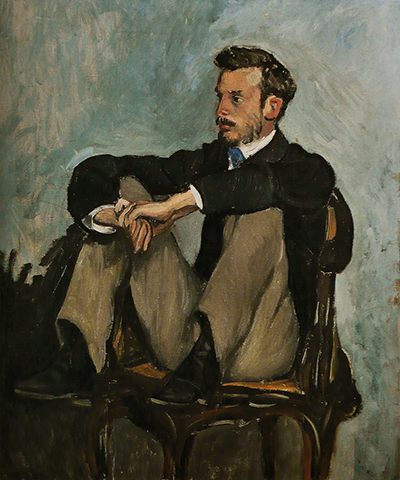
His Portrait of Renoir and Renoir's portrait of Bazille at work make that reciprocity visible. Bazille's Renoir sits with knees raised and arms resting across them, compressed into an informal pose. Renoir, in turn, represented the tall Bazille painting a still life of a heron. These are pictures of fellow practitioners, made within a shared world of objects and working habits. Renoir's portrait dates from 1867; the Musée d'Orsay also currently dates Bazille's portrait of Renoir to that year. [19]
Music and literature broadened this circle. Edmond Maître was an especially close companion in concertgoing and piano playing. In Bazille's portrait of Maître, a book and cigar join the dark suit and lowered gaze. Such objects describe cultivated leisure without telling us everything about the sitter's inner life. Friendship supplied subjects as well as support, and the resulting portraits deserve attention as paintings rather than merely as illustrations of famous names. [1] [20]
An independent ambition before Impressionism
The annual Paris Salon was a central route to recognition, and its decisions affected Bazille's plans. In 1866 a still life of fish was accepted while a more ambitious piano scene was refused. The following year's rejections prompted a different proposal. In a letter assigned to April 1867, he told his mother that a group of roughly a dozen young artists intended to rent a large studio annually and exhibit as many works as they wished. He reported support from established painters and expressed particular confidence in Monet. [3] [21]
“You will see that people will talk about us,” he wrote, in a translation from the French. The confidence belongs to the concrete proposal in that letter. It shows him thinking about how artists might choose their own public setting, alongside deciding what to paint. It does not mean that this proposed exhibition took place as described, or that Bazille participated in the independent exhibition held after his death in 1874. [21] [3]
He also continued submitting to the Salon. Independence was an ambition pursued amid practical opportunities, disappointments and compromises. Calling him an early Impressionist is useful when it locates his friendships and experiments with outdoor light. It becomes less useful if it makes each canvas seem an incomplete step towards a style that other artists later established. The range of his subjects, and the firm construction of many of his figures, deserves to remain visible. [3]
His tastes were correspondingly broad. Advising his cousin Louis about pictures in April 1869, he praised Delacroix, Ingres, Corot, Rousseau and Millet, with a qualified admiration for Courbet. These preferences join drawing, colour, landscape and contemporary life rather than dividing them into opposing camps. They also help explain why an artist committed to modern subjects could still turn towards a biblical and literary composition. The letter records his judgements; it does not establish a direct source for every resemblance we notice in his paintings. [4]
Eight paintings through which to know Bazille
The Pink Dress: a figure turned towards the view
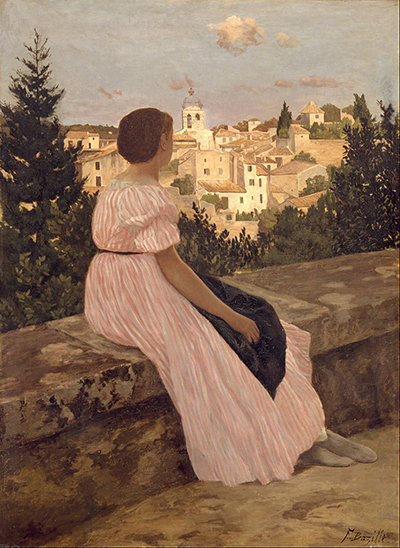
Begun at Méric in 1864, The Pink Dress places Bazille's cousin Thérèse on a stone parapet, looking towards Castelnau. The dress fills much of the foreground, its pale stripes bending around the body. Dark foliage separates her from the bright buildings beyond. Because the sitter turns away, we share her direction of attention without seeing exactly what she sees. The result combines the presence of a portrait with the invitation of a landscape. [3] [2]
The arrangement is more intricate than a simple contrast between a dark foreground and a light distance. The stone seat runs diagonally across the lower field, anchoring the body while carrying the eye sideways. The dress's long stripes pull downwards; the rooflines beyond gather into smaller, brighter shapes. Human scale and the scale of a town remain distinct, yet the eye can move between them.
Technical investigation has revealed extensive alteration after the painting's inception. The dress, feet, torso and arms changed, while examination also identified scraping and renewed preparation. Bruno Mottin proposes a major campaign of revision in summer 1865, but the precise completion history is not fully documented. The familiar date 1864 therefore identifies the work's beginning rather than proving that everything now visible was painted that summer. Its apparent calm was achieved through reconsideration. [22]
Family Reunion: likenesses in shared shade
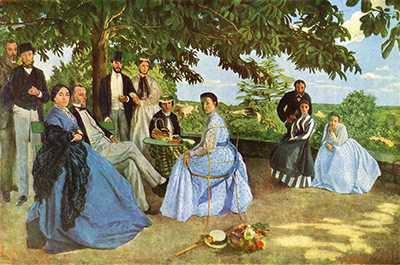
In Family Reunion, also called The Family Gathering, Bazille enlarged the problem from one sitter to a group. Painted in 1867–68, the canvas assembles relatives on the terrace at Méric beneath a broad canopy of leaves. Most faces meet the viewer. Different poses, intervals and costumes hold the gathering together while preserving each person's separateness. The Musée d'Orsay owns the painting. [2]
The blue dress and black lace at the left establish a substantial foreground mass. A light dress, seen partly from behind, turns through the centre, while the people on the right sit across an opening in the terrace. The circular green table and curved chair interrupt the upright bodies. Below them, a hat, parasol and flowers lie in a patch of light. These objects make the terrace feel occupied beyond the formal act of posing.
The distant country is much brighter than the sitters, yet the faces do not dissolve into darkness. Bazille's task was to preserve likeness and bodily weight within outdoor conditions. X-rays reveal changes to several relatives and the later addition of his own figure at the left. The painting consequently records an arranged encounter built in stages, not an instant in which everyone happened to look up together. [22]
View of the Village: meeting the sitter's gaze
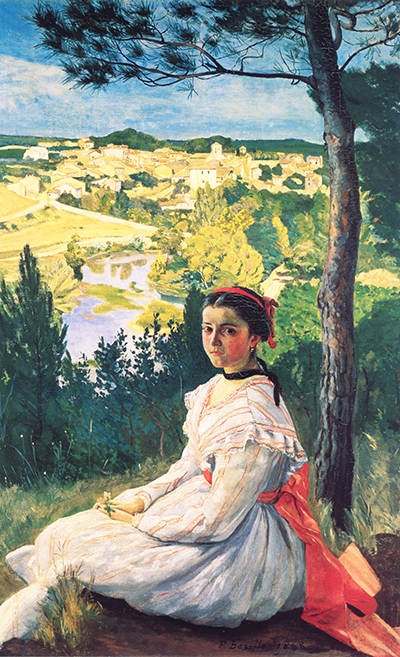
View of the Village, painted in 1868 and now at the Musée Fabre, returns to the relationship between a nearby person and sunlit Castelnau. Here the young sitter faces the viewer. A tall tree and its branches frame the vertical composition; the buildings form a bright band beyond her shaded position. The change from The Pink Dress is fundamental. We encounter someone who occupies the landscape and looks back at us. [23]
Her identification as the daughter of a tenant farmer comes through family tradition rather than a securely named archival record. That uncertainty need not obscure the painting's precision. The small face, the dress and the extensive view demand different kinds of attention. Bazille allows the village to remain compelling without making the sitter a mere foreground device. [24]
Accepted at the Salon of 1869, the picture attracted Berthe Morisot's admiration for its success with a figure in the open air, as reported in later museum and scholarly accounts of her letter. That response identifies a problem shared by contemporary artists, rather than a success visible only in hindsight. Bazille was participating in an active debate about how modern people should appear outdoors. [1]
Bazille's Studio, Rue La Condamine: making a place for paintings
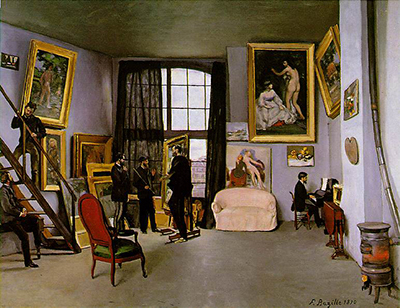
Bazille's Studio, Rue La Condamine carries a date of 1870 and turns the workplace into a major subject. Its high window provides a luminous centre. Friends gather by an easel; a pianist sits apart on the right. A staircase cuts across the left edge, and the stove occupies the near right. Between them extends a surprisingly large area of bare floor. [2]
That open floor is part of the picture's argument. It gives the group and the displayed paintings room to exist, while an unoccupied red-and-green chair suggests another possible position from which to look. The walls become an alternative exhibition. Bazille's Fisherman with a Net, refused by the Salon in 1869, appears prominently at the left. Its presence makes the studio a place where a rejected work could still command attention. [25]
Some people and displayed pictures remain disputed identifications. The central tall artist is Bazille; Manet is credited with painting his figure. Mottin's examination indicates that the room was initially painted without the people, who were added subsequently. His technical account treats the scope of collaboration cautiously and questions the traditional attribution to Renoir of the nude composition hidden beneath the studio scene. Knowing the friends' names does not resolve every question about how they contributed to the painting. [22]
The room itself was available well before the painting's completion. A letter from late November 1867 records Bazille's decision to rent a much larger studio and his plan to move in January, supporting occupation from early 1868. His successive studio interiors trace changing working spaces, but the Condamine canvas gives the most expansive account of what such a space could mean. [26]
Summer Scene: bodies arranged around water
Summer Scene (Bathers) brings eight male figures into a wooded riverside setting. Signed 1869, it developed through work extending into the following winter and was exhibited at the Salon of 1870. It is now in the Harvard Art Museums. A swimmer appears at the lower edge, another man is helped from the water at the right, a reclining figure stretches across the grass, and wrestlers occupy the middle distance. [2] [27]
The tree trunks divide this nearly square scene into unequal intervals. Bodies turn across those vertical divisions: a bent leg, an extended arm, a broad back. The figures closest to us seem substantial and individually posed, while smaller actions recede into the bright ground beyond. Striped bathing clothes make the scene emphatically contemporary. The arrangement combines the casual subject of summer recreation with the measured placing of a large composition.
Preparatory drawings and revisions show that this apparently immediate leisure scene was carefully assembled. A surviving compositional study contains seven figures rather than the final eight. That difference matters more than a search for a single instant that the painting supposedly records. Its separate bodily actions have been brought into relationship through drawing and adjustment. The picture can sustain interpretations of male companionship and bodily display without establishing the painter's private sexuality. [28] [27]
Young Woman with Peonies: a direct encounter
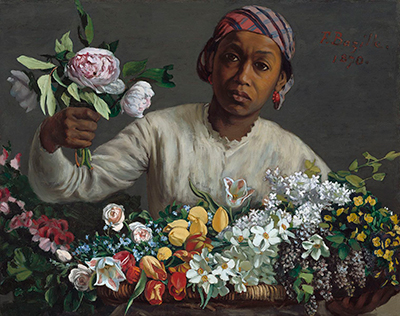
The Washington Young Woman with Peonies of 1870 brings portraiture and still life into close contact. A Black woman faces us above a broad basket of flowers, holding several pale blooms in her raised hand. The headscarf, white blouse, modelling of the face and dense foreground give the painting several centres of attention. Her gaze meets ours across the flowers rather than disappearing into their decorative abundance. The painting belongs to the National Gallery of Art. [2]
There is a separate Montpellier version, also dated 1870, in the Musée Fabre. There the woman turns towards an arrangement and raises a stem beside a vase. Basket and vase, frontal gaze and absorbed gesture are the quickest ways to distinguish these independent canvases. Their sequence remains uncertain. [29] [30]
The model's personal name is unproved. Comparisons with the Black attendant in Manet's Olympia and with Bazille's La Toilette help situate the paintings within the nineteenth-century studio, but resemblance does not establish an identity such as Laure. The Musée d'Orsay's exhibition Le modèle noir placed such paintings within a history that restores attention to Black models as participants in artistic production. Here, the differences between the two gestures reward that attention: one woman offers or displays flowers towards us; the other actively makes an arrangement. [30] [31]
Landscape by the Lez River: an open field of attention
The large Landscape by the Lez River, painted in 1870 and now in Minneapolis, shows how much Bazille could do without a human figure. Trees gather on either side of an opening; their trunks divide the clearing into long intervals. The near ground contains warm earth, pale stones and a low masonry opening. The river is far less prominent than the title might lead one to expect. [32]
Broad strokes cross the sky, while smaller touches gather into leaves. More restrained expanses of colour hold the clearing. At the lower right a small resting dog occupies the shade. The landscape is therefore free of visible people, but not entirely empty of animal life. Its quiet depends on relationships between light, open ground and clustered trees rather than on a narrative event.
The Minneapolis Institute of Art associates the picture with Bazille's description of a large landscape as an eclogue, an idyllic pastoral poem. That literary connection offers a way to understand its spacious repose without making every tree symbolic. It is one of his late works; a definitive claim that it was his final painting goes beyond what the surviving chronology establishes. [32]
Ruth and Boaz: another direction at the end
Ruth and Boaz, left unfinished in 1870, shows that Bazille's late ambitions extended beyond contemporary subjects. The biblical story and Victor Hugo's poetic treatment supplied a different imaginative setting. A dark-draped woman lies at the left, a bearded man reclines at the right, and a crescent moon hangs over an expansive, spare landscape. The Musée Fabre owns the canvas. [33] [34]
Uneven coverage and visible drawn contours around Boaz allow us to see an image still being formed. The figures are separated by space rather than joined into the busy exchanges of Summer Scene. The comparison opens up the range of Bazille's interests: closely observed modern recreation could coexist with an imagined encounter at dusk.
Laboratory examination revealed an earlier piano composition beneath the painting. The reused canvas was inverted, and its history involved rolling and restretching. Thus a literary scene contains material traces of another project, connecting very different ambitions within one support. The discovery helps recover a work long thought lost without making the upper painting merely a container for the picture underneath. [22]
Family Reunion
Studio in Rue de La Condamine
Watch: Bazille and early Impressionism
Explore a Paris studio with Smarthistory, then discover the beginnings of Impressionism with the National Gallery of Art.
Jean-Frédéric Bazille, The Artist’s Studio, Rue Visconti, Paris
A close look at Bazille’s 1867 painting of the studio he shared in Paris.
Watch on YouTubeDrawing, revision and the changing surface
Across these paintings, apparent stillness conceals a good deal of labour. Preparatory drawings show altered arrangements; technical images disclose changes invisible at the surface. The Pink Dress was extensively reworked, Family Reunion acquired revised figures, and the people in the Condamine studio followed the initial painting of the room. These are specific histories, each established by particular evidence. They resist a general claim that Bazille simply captured what he saw in one uninterrupted sitting. [22]
His drawings and sketchbooks are consequently essential to understanding him. The squared study for The Pink Dress offers a different pose and dress arrangement from the finished canvas. Squaring helped organise a composition for enlargement, but it does not prove that a corresponding grid was transferred onto the painting: Mottin identified pencil work there without establishing a visible transferred grid. A drawing is evidence of a decision under consideration, not a contract the final painting had to fulfil. [35] [22]
Reuse was equally individual. Beneath Still Life with Heron lies a woman with flowers; the late Young Male Nude Lying on the Grass retains substantial evidence of an earlier composition of seated women. Mottin argues against assigning that lower composition to Monet, favouring Bazille on technical and stylistic grounds. Such findings sharpen our picture of shared studios: proximity and common models enabled exchange, while the attribution of an actual intervention still requires evidence. [22]
Bazille's style and technique also change with the task. A face may need controlled planes and a clear contour, foliage a more broken touch, a dress broad areas shaped by folds. A sketchy passage can remain beside a more resolved one. Visible looseness alone cannot tell us whether a work was abandoned, deliberately left open or still in progress. Looking at the whole painting, its documentary history and its material state together is more revealing than assigning one fixed manner to the artist.
Looking north and south
The countryside around Montpellier supplies many of Bazille's best-known settings, but it is useful to compare them with the northern places he painted. In the Fontainebleau area, rocks, woodland and clearings offered different structures from Méric's terraces and long views. The wide Beach at Sainte-Adresse approaches coastal space through a decorative horizontal format. These works belong to his actual range, not merely to a preliminary stage before he found a southern subject. [2]
His Aigues-Mortes landscapes are especially helpful in separating different kinds of southern light. The Western Ramparts sets a long wall above water and broken reflections; the Porte de la Reine brings a monumental gateway much closer. Both date from 1867, but their spaces work differently. One stretches laterally; the other centres on an opening through built stone. [2]
A letter written from Aigues-Mortes in late May 1867 describes weather limiting his outings. He had begun three or four landscapes and planned a large view of walls reflected in water at sunset, for which he expected to need at least eight fine days. The letter catches intention, conditions and duration together. It does not prove that four paintings survive, or that the completed works reproduce each announced plan. Outdoor painting depended on waiting as well as looking. [36]
Two self-portraits, two ways of appearing
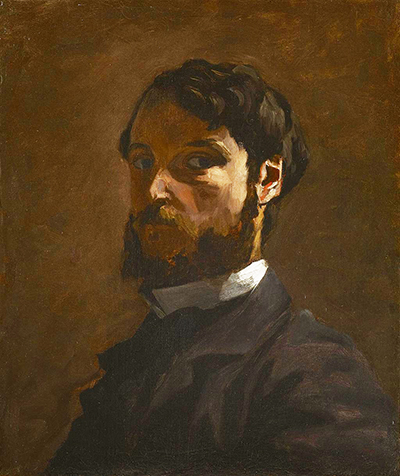
The familiar Self-Portrait with Detachable Collar in Minneapolis presents a bearded head and upper body against a brown ground. Uneven light gives one side of the face greater definition; the pale collar makes a sharp accent above the dark clothing. No palette appears. The museum dates it 1865–67, while Michel Schulman's catalogue proposes 1867–68 and records earlier doubts about the sitter's identity. The current museum title is the usual identification, with that history of discussion kept in view. [37] [38]
Chicago's Self-Portrait, dated 1865–66 by the Art Institute, is a different, larger composition that includes a palette and presents the sitter explicitly as a painter. Remembering the collar in Minneapolis and the palette in Chicago prevents two independent images from merging into an imaginary single portrait. Together they show how professional identity can be asserted through equipment or left to the act of painting a face. [39]
Recognition, loss and rediscovery
Bazille's contemporary reception was uneven, but it was not silence. In his Salon review of 24 May 1868, Émile Zola praised the care and individuality of the figures in Family Reunion, linking the painting to a commitment to modern life. The frock coat mattered to him because ordinary contemporary dress could sustain serious art. That response helps explain why the painting's familiar family gathering could carry a public artistic argument. It was one critic's favourable judgement, rather than a unanimous verdict. [40]
The Salon could also divide his own submissions. In 1870 Summer Scene was accepted while La Toilette was rejected, despite an initial report of acceptance. Such outcomes complicate a simple account of an establishment excluding every new work. Bazille sought visibility through the Salon even while imagining other means of exhibition. His reputation was being made through a succession of individual encounters with pictures. [3]
He enlisted in the zouaves on 16 August 1870 and was killed at Beaune-la-Rolande on 28 November. His paintings cannot tell us exactly why he enlisted, and their later subjects do not supply a prophecy of his death. What was lost was the continuation of a working life whose future direction remains unknowable. The unfinished paintings are evidence of ongoing projects, not a basis for confidently predicting the artist he would have become. [3] [1]
The family's preservation of his work was decisive for its later recognition. In 1898 his mother gave View of the Village and Still Life with Heron to the Musée Fabre. Further gifts and acquisitions gradually moved paintings from family and friends into public view. Michel Hilaire has emphasised this connection between family remembrance, museum display and the scholarship that rebuilt Bazille's reputation during the twentieth century. [1]
That history should be read work by work. Family Reunion was purchased with Marc Bazille's assistance in 1905; The Pink Dress and the Condamine studio were among the works entering the national collection through Marc's 1924 bequest. In Montpellier, Marc gave La Toilette and the peony painting in 1918. These were separate acts of preservation that helped determine which parts of the artist's achievement later audiences could know. [2] [29] [41]
The retrospective shared by Montpellier, Paris and Washington in 2016–17 brought paintings, drawings and works by contemporaries into sustained comparison. The resulting technical research further changed understanding of individual canvases. Rediscovery here means more than adding a neglected name to Impressionism: it involves recovering the decisions, revisions and diverse ambitions inside works already familiar from reproduction. [3] [2] [22]
Where to begin with the collections
The Musée Fabre in Montpellier offers a particularly rich setting for Bazille, bringing major southern figure paintings together with studio subjects and late experiments. View of the Village, Still Life with Heron, La Toilette, the Montpellier peonies and Ruth and Boaz reveal an artist whose interests reach well beyond one celebrated group portrait. The Musée d'Orsay holds Family Reunion, The Pink Dress and the Condamine studio, three powerful points of entry into his handling of figures, place and artistic friendship. [2]
American collections extend that picture. Washington holds the frontal Young Woman with Peonies, Edmond Maître and the Western Ramparts at Aigues-Mortes. Minneapolis brings the close encounter of the collar self-portrait into the same collection as the expansive Lez landscape. Chicago has the palette self-portrait and Landscape at Chailly, while Harvard holds Summer Scene. These collection locations describe the works' homes rather than guaranteeing that every painting is on display. [2] [32] [37] [39]
When looking across them, begin with one recurring question: how does Bazille keep a person present within a larger space? A turned back, a direct gaze, a shaded face or an empty chair offers a different answer. Then look for the places where he changes the question altogether: a landscape without people, a basket of flowers confronting the viewer, or a moonlit scene still taking shape. His achievement resides in that range of realised choices.
Essential Frédéric Bazille works
Family Reunion
1867–68 (museum) · Separate sitters and a distant landscape meet beneath the shade of the Méric terrace.
Bazille’s Studio, Rue La Condamine
1869–1870 · Pictures, conversation and music occupy the room around an extensive empty floor.
Summer Scene (Bathers)
1869–1870 · Eight men rest, swim, wrestle and dress within a carefully prepared outdoor arrangement.
View of the Village
1868 · A shaded sitter faces the viewer against sunlit Castelnau-le-Lez.
The Pink Dress (La Robe Rose)
1864 · A turned figure and striped dress anchor a view across to the village.
Young Woman with Peonies — Washington version
1870 · A woman faces the viewer with an emphatic arrangement of flowers.
Portrait of Renoir — 1867
1867 · A painter represents a working friend through a compact seated portrait.
The Improvised Field Hospital
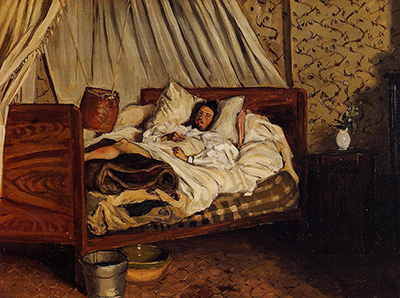
1865 · The injured Monet rests amid the ordinary objects of a temporary sickroom.
Bazille catalogue directory
The 284 records comprise 85 painting records,40 separate works-on-paper records and 159 album or study records. They describe the catalogue’s organisation rather than 284 independent objects or unanimously accepted attributions. Recto, verso, albums and multiple studies remain distinct. Dates are qualified where needed; the Drawing filter includes the etching, gouache and mixed works on paper. Manuscript mentions and unproved projects are listed separately below.
Works known through documents
These mentions remain separate from the 284 catalogue records. Some may concern surviving studies or underlying compositions; they cannot simply be added together as missing physical paintings.
- A copy after Rubens mentioned in March 1863 is unlocated.
- A portrait of an unidentified woman was reported completed before July 1866.
- A portrait of Monet and a composition of two life-size women arranging flowers were reported in progress in April 1867. Their mention does not establish two otherwise unknown surviving canvases.
- Gertrude et le père Lapin was at least begun in the summer of 1870.
Further reported works and uncertain attributions
- A Bouquet of Lilacs was reportedly stolen and returned in 1864; a portrait of the friend Theulier and Yellow Narcissi reported by Maître in 1868 are also documentary mentions.
- Unidentified pictures associated with Guillemet and Mme Rolina are reported through later correspondence cited by the catalogue.
- Children Dressed as Bride and Groom was associated with Vallotton’s collection and also attributed to Renoir. Its identification and authorship should remain open.
Projects whose completion is unproved
- A portrait of Pauline was planned in July 1865.
- A portrait of Marc was proposed in April 1866; a related drawing survives.
- A Jardinière project appears in album inscriptions and related figure material. Written plans are not evidence of a completed painting.
| Name | Date | Medium |
|---|---|---|
| Mystic Marriage of St. Catherine | 1863 | Oil on canvas |
| Trees, Study | 1863 | Oil on canvas |
| Farm of Saint-Sauveur | 1863 | Oil on canvas |
| In the Garden of the Parc Monceau, Paris | 1864 | Oil on canvas |
| Naked Woman from Behind | 1864 | Oil on canvas |
| Reclining Nude | 1864 | Oil on canvas |
| Courtyard of the Auberge du Cheval blanc at Chailly near Barbizon | 1864 | Oil on canvas |
| Covered Soup Bowls | 1864 | Oil on canvas |
| Two Herrings | 1864 | Oil on canvas |
| The Pink Dress | 1864 | Oil on canvas |
| The Dog Rita Asleep | 1864 (catalogue); c. 1864 (2017 checklist) | Oil on canvas |
| The Scoter | 1864 | Oil on canvas |
| Naked Reclining Woman | 1864 | Oil on canvas |
| Landscape at Chailly | 1865 | Oil on canvas |
| Rocks at Chailly, Forest of Fontainebleau | 1865 | Oil on canvas |
| Undergrowth at Chailly, Forest of Fontainebleau | 1865 | Oil on canvas |
| Still Life with Grapes and Nuts | 1865 | Oil on canvas |
| Self-Portrait with a Palette — Chicago | 1865 | Oil on canvas |
| Landscape of Saint-Sauveur | 1865 | Oil on canvas |
| Beach at Sainte-Adresse | 1865 | Oil on canvas |
| The Improvised Field Hospital | 1865 | Oil on canvas |
| Village Street, Chailly | 1865 | Oil on canvas |
| Small Valley in the Forest of Fontainebleau | 1865 | Oil on canvas |
| Forest of Fontainebleau | 1865 | Oil on canvas |
| Woman Ironing | 1866 | Oil on canvas |
| The Artist's Studio on the rue de Furstenberg | 1865–66 (museum) | Oil on canvas |
| Still Life with Fish | 1866 | Oil on canvas |
| Little Italian Street Singer | 1866 | Oil on canvas |
| Potted Flowers | 1866 | Oil on canvas |
| The Little Gardener | 1866–1867 | Oil on canvas |
| Young Woman Playing the Piano | 1866–1867 | Oil on canvas |
| End of a Summer Day | 1866–1867 | Oil on canvas |
| A Studio on the rue Visconti | 1867 | Oil on canvas |
| Thérèse Reading in the Park at Méric | 1867 | Oil on canvas |
| Portrait of Verlaine | 1867 | Oil on canvas |
| The Terrace at Méric | 1867 | Oil on canvas |
| Still Life with Heron | 1867 | Oil on canvas |
| The Family Gathering | 1867–68 (museum) | Oil on canvas |
| Oleanders | 1867 | Oil on canvas |
| Woman on the Terrace at Méric | 1867 | Oil on canvas |
| The Ramparts at Aigues-Mortes from South | 1867 | Oil on canvas |
| The Western Ramparts at Aigues-Mortes | 1867 | Oil on canvas |
| Portrait of Edmond Maître — head study | 1867 | Oil on canvas |
| Porte de la Reine at Aigues-Mortes | 1867 | Oil on canvas |
| Portrait of Sisley | 1867 | Oil on wood |
| Portrait of Renoir — Cleveland | 1867 | Oil on canvas |
| Portrait of Renoir — Musée d’Orsay | 1867 | Oil on canvas |
| Self-Portrait with a Detachable Collar — Minneapolis | 1865–67 (museum); 1867–68 (catalogue) | Oil on canvas |
| Vase of Flowers on a Console | 1868 (museum); 1867–68 (catalogue) | Oil on canvas |
| Portrait of a Woman | 1868 | Oil on canvas |
| Young Woman in the Vineyards | 1868 | Oil on card |
| Harvester with a Basket | 1868 | Oil on card |
| Harvester with a Yellow Hat | 1868 | Oil on card |
| Harvester with a Headdress | 1868 | Oil on panel |
| On the Banks of the Lez | 1868 | Oil on canvas |
| After the Bath (attribution questioned) | 1868? | Oil on canvas |
| Young Woman with Lowered Eyes | 1868 | Oil on canvas |
| Fisherman with a Net | 1868 | Oil on canvas |
| View of the Village | 1868 | Oil on canvas |
| Portrait of Bazille (attributed to Monet by Musée Fabre; disputed catalogue attribution) | 1864 (museum); 1868 (catalogue) | Oil on panel |
| Studies for a Grape Harvest (two panels) | 1868 | Oil on canvas (two panels) |
| The Fortune Teller | 1868–69 (catalogue); c. 1869–70 (2017 checklist) | Oil on canvas |
| Harvester with a Cap | 1869 | Oil on card |
| Portrait of Edmond Maître — 1869 | 1869 | Oil on canvas |
| Woman in a Moorish Costume | 1869 | Oil on canvas |
| Young Woman in the Garden | 1869 | Oil on canvas |
| Portrait of Alphonse Tissié in a Cavalryman's Uniform | 1869 | Oil on canvas |
| Portrait of a dragoon | 1869 | Oil on canvas |
| Portrait of Zacharie Astruc | 1869 | Oil on canvas |
| Bunch of Grapes in a Bucket | 1869 | Oil on card |
| Portrait of Edouard Blau | Probably 1869; inscribed 1866 | Oil on canvas |
| Young Male Nude Lying on the Grass | 1870 | Oil on canvas |
| Summer Scene | 1869–1870 | Oil on canvas |
| The Studio on the rue La Condamine | 1869–1870 | Oil on canvas |
| La Toilette | 1870 | Oil on canvas |
| Young Woman with Peonies — Montpellier | 1870 | Oil on canvas |
| Young Woman with Peonies — Washington | 1870 | Oil on canvas |
| Monotonous Chant | 1870 | Oil on canvas |
| Flowers — private collection | 1870 | Oil on canvas |
| Flowers — Musée Fabre | 1870 | Oil on canvas |
| Young Fisherman | 1870 | Oil on canvas |
| Study for Ruth and Boaz | 1870 | Oil on wood |
| Ruth and Boaz | 1870 | Oil on canvas |
| Self-Portrait in Shirt Sleeves | 1870 | Oil on canvas |
| Landscape on the Banks of the Lez | 1870 | Oil on canvas |
| Study after an Alpine Landscape | 1860 | Graphite on watercolour-tinted paper |
| Profile Head | 1862 | Charcoal on laid paper |
| Studies after Delacroix | 1863 | Ink and graphite, with gouache and watercolour, on paper |
| Academic Head | 1863 | Charcoal on paper |
| Study of a Woman's Head in Profile on a Chair | 1863 | Charcoal on paper |
| Academic Head of a Woman | 1863 | Charcoal on paper |
| Academy of Woman | 1863 | Black pencil and charcoal, stumped, on watermarked laid paper |
| Academy of Man | 1863 | Black pencil and charcoal, stumped, on watermarked laid paper |
| Naked Man | 1863 | Charcoal on paper |
| The Pont au Change in Paris | 1864 | Watercolour on paper |
| Study for the Pink Dress or Portrait of Thérèse des Hours | 1864 | Black pencil on paper |
| Naked Woman Standing | 1864 | Pencil on paper |
| Study of a Reclining Nude | 1864 | Charcoal on paper |
| Bathers | 1864 | Charcoal on paper |
| Portrait of a Man | 1864 | Charcoal on paper |
| Study for The Pink Dress | 1864 | Black pencil, squared, on paper |
| Study for Landscape of Saint-Sauveur | 1864 | Graphite on paper |
| Study for Landscape of Saint-Sauveur | 1865 | Pencil on paper |
| Man Taming a Bull | 1866 | Pen and black pencil on paper |
| Man Half Lying on a Sofa | 1866 | Charcoal on paper |
| Study for The Family Gathering | 1867 | Pencil on paper |
| Study for The Family Gathering | 1867 | Graphite, charcoal and black pencil on paper |
| The Embroiderer | 1867 | Pencil on pink paper |
| Study of Children | 1867 | Pencil on paper |
| Women in a Garden | 1867 | Pencil drawing |
| View of the Village | 1868 | Etching on paper |
| Portrait of a Bearded Man (catalogued as Self-Portrait) | Undated (museum); 1869 (catalogue) | Charcoal and brown ink |
| Man Smoking Pipe | 1869 | Watercolour on paper |
| Manet Drawing | 1868–70(?) (museum) | Charcoal and white chalk on paper |
| Study for the Summer Scene | 1869 | Charcoal, pen and ink on paper |
| Family Portrait | 1869 | Pastel and charcoal on paper |
| Study for Ruth | 1870 | Pencil and charcoal on paper |
| Woman Arranging a Hat | 1870 | Pencil drawing |
| Study for Boaz Asleep | 1870 | Pastel and red chalk |
| Boaz Asleep | 1870 | Charcoal and pencil on paper |
| Study for Boaz Asleep | 1870 | Black and beige pastel with red chalk on laid paper |
| Ruth Lying down | 1870 | Charcoal and pastel on paper |
| Head, Arm and Chest of Ruth | 1870 | Charcoal on paper |
| Chest of Ruth | 1870 | Black chalk and charcoal on paper |
| Black Woman with Peonies — gouache | c. 1870 | Gouache, watercolour, pencil and black chalk on card |
| Various Unidentified Subjects | Undated | Pencil drawing |
| Rocky Sea Side | Undated | Charcoal on paper |
| Studies of a Dancing Woman | Undated | Drawing with white chalk |
| Study of a Leg | Undated | Pencil drawing |
| Dancers in Camargue | Undated | Pencil drawing |
| Academy of Woman | Undated | Charcoal |
| Caricature of Venus of Milo and Various Other Caricatures | Undated | Charcoal |
| Caricature | Undated | Pencil drawing |
| Study of Landscape | Undated | Charcoal |
| Caricatures and Seated Monk | Undated | Charcoal |
| Caricatures and Various Subjects | Undated | Pencil drawing |
| Women Carrying a Pitcher | Undated | Pencil drawing |
| The Hanged Man | Undated | Charcoal |
| Castle in the Plain | Undated | Charcoal |
| Naked Woman from Behind | Undated | Charcoal |
| Caricatures | Undated | Charcoal and pencil |
| Unidentified Subjects | Undated | Pencil drawing |
| Landscape with a Castle | Undated | Charcoal |
| Study of Landscape | Undated | Charcoal |
| Horse Rider seen from Behind | Undated | Charcoal |
| Mazeppa | Undated | Pencil and charcoal |
| Study of Rider and Others Subjects | Undated | Pencil, pen and brown ink |
| Study of an Unidentified Man | Undated | Pencil drawing |
| Study for an Unknown Historic Scene | Undated | Pencil drawing |
| Study a Man Reading | Undated | Pencil drawing |
| Study of Men Reading | Undated | Pencil drawing |
| Study of Landscape ? | Undated | Charcoal |
| Study of a Head of a Man | Undated | Pencil drawing |
| Erotic Scene | Undated | Pencil drawing |
| Study of Dog | Undated | Charcoal |
| Studies of Unidentified Subjects and Erotic Scene | Undated | Pencil and charcoal drawing |
| Study for a Theater Scene | Undated | Charcoal |
| Study of a Reclining Naked Woman | Undated | Charcoal |
| Two Studies of Landscape | Undated | Pencil drawing |
| Caricature | Undated | Pencil and charcoal drawing |
| Portrait of an Unidentified Young Man | Undated | Charcoal |
| Study of an Unidentified Subject | Undated | Brown ink drawing |
| Unidentified Man with a Hat | Undated | Pencil and charcoal |
| Study of an Unidentified Women | Undated | Pencil drawing |
| Study for a Theater Character ? | Undated | Pencil drawing |
| Study for a Theater Character ? | Undated | Pen drawing |
| The Pavillon de la Reine in Paris | Undated | Pencil drawing |
| Study of a Horse Rider | Undated | Pencil and charcoal drawing |
| Entwined Couple. Caricature ? | Undated | Pencil drawing |
| Woman Sitting on a Sofa | Undated | Pencil drawing |
| Studies of Unidentified Subjects | Undated | Pencil and charcoal drawing |
| Studies of Animals | Undated | Pencil drawing |
| Study of a Horse Rider in Camargue | Undated | Charcoal |
| Study of Hunting Dogs | Undated | Pencil drawing |
| Study of Soldiers. Caricatures | Undated | Pencil drawing |
| Studies of Hunting Dogs ? | Undated | Pencil drawing |
| Hunting Scene. Hunter Playing the Horn | Undated | Pencil drawing |
| Caricature | Undated | Pencil drawing |
| Study of an Ibex | Undated | Pencil drawing |
| Theater Scene. Caricatures | Undated | Pencil drawing |
| Studies of Animals. Horses ? | Undated | Pencil drawing |
| Caricatures | Undated | Pencil drawing |
| Studies of Various Subjects and Animals | Undated | Pencil drawing |
| Unidentified Subject | Undated | Pencil drawing |
| Rider Taming a Horse [in Camargue ?] | Undated | Pencil drawing |
| Caricature of a Soldier | Undated | Pencil drawing |
| Study of a Woman and Mouse | Undated | Pencil drawing |
| Historic Scene | Undated | Charcoal |
| Architecture Studies | Undated | Pencil drawing |
| Mythologic Scene | Undated | Charcoal |
| Ophelia | Undated | Pencil drawing |
| Mythologic Scene | Undated | Charcoal |
| Studies of Various Subjects | Undated | Pencil and pen drawing |
| Studies of Peasants | Undated | Pencil drawing |
| Historic Scene | Undated | Pencil drawing |
| Historic or Literary Scene | Undated | Pencil drawing |
| Unidentified Historic Scene | Undated | Pencil drawing |
| Studies of Unidentified Subjects | Undated | Pencil drawing |
| Unidentified Study | Undated | Pencil drawing |
| Man in an Armchair | Undated | Pencil drawing |
| Studies of Various Subjects | Undated | Pencil drawing |
| Portraits of Unidentified Men | Undated | Pencil drawing |
| Studies of Various Subjects | Undated | Pencil drawing |
| Horse Rider and Artist | Undated | Charcoal and pencil |
| Study of Unidentified Characters | Undated | Charcoal |
| Dead Horse in a Plain | Undated | Charcoal |
| Study of Various Subjects and Furniture | Undated | Pencil drawing |
| Caricatures and Various Notes about Opéra | Undated | Pencil drawing |
| Galloping Horse | Undated | Charcoal |
| Study for La Toilette | Undated | Pencil drawing |
| Study of a Naked Woman | Undated | Pencil drawing |
| Domestic Scene | Undated | Pencil drawing |
| Physiognomies | Undated | Pencil drawing |
| Study for a Grape Harvest | Undated | Pencil drawing |
| Study for the Summer Scene | Undated | Pencil drawing |
| Female Profiles | Undated | Pencil drawing |
| Various Subjects | Undated | Pencil drawing |
| Study for The Terrace at Méric | Undated | Pencil drawing |
| Study for The Ramparts at Aigues-Mortes | Undated | Pencil drawing |
| Study for The Ramparts at Aigues-Mortes | Undated | Pencil drawing |
| Study for a Grape Harvest | Undated | Charcoal |
| Children Portraits | Undated | Pencil drawing |
| Study for Children's Heads | Undated | Pencil drawing |
| Study of Minerva | Undated | Pencil drawing |
| Study for a Grape Harvest | Undated | Pencil drawing |
| Study for The Family Gathering | Undated | Pencil drawing |
| Study for a Young Fisherman | Undated | Charcoal |
| Self-Portraits | Undated | Black pencil drawing |
| Study of Horses for the Porte de la Reine at Aigues-Mortes | Undated | Ink drawing |
| Study of Horses for the Porte de la Reine at Aigues-Mortes | Undated | Ink drawing |
| Study of Horses for the Porte de la Reine at Aigues-Mortes | Undated | Ink drawing |
| Study for an Outdoor Concert | Undated | Pencil drawing |
| Studies of Legs | Undated | Pencil drawing |
| Study for The Ramparts at Aigues Mortes | Undated | Pencil drawing |
| Studies of Hats | Undated | Pencil drawing |
| Studies of Men | Undated | Pencil drawing |
| Study for The Little Gardener | Undated | Pencil drawing |
| Study for The Ramparts at Aigues Mortes | Undated | Charcoal |
| Studies of Sail Boats | Undated | Pencil drawing |
| Portrait of Marc Bazille | Undated | Charcoal, black pencil and graphite |
| Studies of Children's Heads | Undated | Pencil drawing |
| Study for Aigues-Mortes | Undated | Pencil drawing |
| Studies of Women's Heads | Undated | Pencil drawing |
| Portrait of Camille des Hours and an Unidentified Man | Undated | Charcoal |
| Study of Flying Birds | Undated | Charcoal or graphite |
| Study for the Summer Scene | Undated | Pencil drawing |
| Study of Hands | Undated | Pen drawing |
| Self-Portrait | Undated | Black pencil drawing |
| Study for the Summer Scene | Undated | Pencil drawing |
| Study for the Summer Scene | Undated | Pencil drawing |
| Study for a Grape Harvest | Undated | Pencil drawing |
| Study of Branches | Undated | Pencil drawing |
| Study of a Seated Child | Undated | Pencil drawing |
| Study for a Couple and Unidentified Women | Undated | Pencil drawing |
| Studies of Unidentified Women | Undated | Pencil drawing |
| Study of Buildings | Undated | Pencil drawing |
| Study for a Grape Harvest | Undated | Pencil and charcoal |
| Studies of Boaters | Undated | Pencil drawing |
| Study of a Man Writing at his Table | Undated | Pencil drawing |
| Study of a Woman Cutting Flowers | Undated | Pencil drawing |
| Study of Hand | Undated | Pencil drawing |
| Women in a Garden | Undated | Pencil drawing |
| Studies of Women in Profile | Undated | Pencil drawing |
| Study for Ruth and Boaz | Undated | Charcoal |
| Study for The Family Gathering | Undated | Pencil drawing |
| Study for the View of the Village | Undated | Pencil drawing |
| Study of the View of the Village | Undated | Pencil drawing |
| Study for the Fisherman with a Net | Undated | Pencil drawing |
| Study for the View of the Village | Undated | Charcoal |
| Study for The Little Gardener | Undated | Charcoal |
| Portrait of a Man with a Top Hat | Undated | Pencil drawing |
| Portrait of a Man with a Top Hat | Undated | Pencil drawing |
| Inscriptions | Undated | Pencil inscriptions |
| Study of Tree | Undated | Pencil drawing |
| Caricature of Nina la Belle | Undated | Pencil drawing |
| Study for Saint Sebastian | Undated | Pencil drawing |
| Young Woman Sewing | Undated | Pencil drawing |
| Studies of Hands | Undated | Pencil drawing |
| Woman in a Garden | Undated | Pencil drawing |
| Elegant Woman | Undated | Pencil drawing |
| Various Inscriptions | Undated | Inscriptions (medium unspecified in index) |
| Study of a Man with a Hat | Undated | Pencil drawing |
| Study of a Child | Undated | Pencil drawing |
| Study of a Man with a Hat | Undated | Pencil drawing |
Frequently Asked Questions
He was 28. He died at Beaune-la-Rolande on 28 November 1870, shortly before his twenty-ninth birthday. [1]
Discussion
Where do Bazille’s people, rooms and outdoor settings most clearly change the way you look at one another?
Reader Insights
Compare the shaded sitters in Family Reunion with the open ground in the Lez landscape. What gives each setting its sense of space?
Which studio painting most clearly changes your understanding of Bazille’s friendships and working life?
How does an unfinished work such as Ruth and Boaz alter your view of the more resolved exhibition paintings?
Join the Conversation
Share a detail, comparison or question about Frédéric Bazille below.
References
- Michel Hilaire, “Bazille ou la vie brève,” Académie des Sciences et Lettres de Montpellier, 2016, pp. 166–172. Lecture (in French). View source.
- National Gallery of Art, Frédéric Bazille and the Birth of Impressionism, exhibition checklist, 2017, especially pp. 2–9 and 13–14. Checklist. View source.
- Musée Fabre, Frédéric Bazille: la jeunesse de l'impressionnisme, exhibition press dossier, 2016, especially pp. 4–23. Dossier (in French). View source.
- Frédéric Bazille, letter to his cousin Louis, 27 April 1869, Musée Fabre, inventory 94.2.1. Manuscript and transcription (in French). View source.
- Frédéric Bazille, letter to his father, 6 January 1865, Musée Fabre, inventory 92.2.1. Manuscript and transcription (in French; English quotation translated here). View source.
- Kunstmuseum Den Haag, Romanticism: 1800–1850. View source
- Metropolitan Museum of Art, Nineteenth-Century French Realism: about 1840 to the late nineteenth century. View source
- Museum of Modern Art, Impressionism: experiments from the early 1860s; group exhibitions ended in 1886. View source
- National Gallery of Art, Frédéric Bazille and the Birth of Impressionism, exhibition overview. View source
- Bibliothèque nationale de France, Charles Gleyre (1806–1874). View source
- National Gallery, London, Eugène Delacroix (1798–1863). View source
- National Gallery, London, Gustave Courbet (1819–1877). View source
- National Gallery, London, Edouard Manet (1832–1883). View source
- National Gallery, London, Alfred Sisley (1839–1899). View source
- National Gallery, London, Claude Monet (1840–1926). View source
- Musée d’Orsay, Frédéric Bazille (1841–1870). View source
- National Gallery, London, Pierre-Auguste Renoir (1841–1919). View source
- Frédéric Bazille, letter to his father, editorially dated mid-July 1864, Musée Fabre, inventory 92.2.3. Manuscript and transcription (in French). View source.
- Musée d'Orsay, Pierre Auguste Renoir, collection record, and Auguste Renoir, Frédéric Bazille, collection record. Bazille's portrait of Renoir; Renoir's portrait of Bazille. View source 1. View source 2.
- National Gallery of Art, Edmond Maître, 1869, inventory 1985.64.2. Collection record. View source.
- Frédéric Bazille, letter to his mother, editorially dated April 1867, Musée Fabre, inventory 94.7.1. Manuscript and transcription (in French; English quotation translated here). View source.
- Bruno Mottin, “L'œuvre de Frédéric Bazille (1841–1870) examiné au laboratoire,” Technè 46 (2018), pp. 30–38, especially paragraphs 3–17 and 20–23. Article (in French). View source.
- Musée Fabre, Vue de village, 1868, inventory 898.5.1. Collection record (in French). View source.
- Michel Schulman, View of the Village, MSb-46, digital catalogue raisonné. Catalogue entry (English version of French scholarly catalogue). View source.
- Michel Schulman, The Studio on the Rue La Condamine, MSb-58, and Fisherman with a Net, MSb-45, digital catalogue raisonné. Studio entry; Fisherman entry (English versions of French scholarly catalogue). View source 1. View source 2.
- Frédéric Bazille, letter to his father, editorially dated late November 1867, Musée Fabre, inventory 92.2.5. Manuscript and transcription (in French). View source.
- Michel Schulman, Summer Scene, MSb-55, digital catalogue raisonné. Catalogue entry (English version of French scholarly catalogue). View source.
- Musée du Louvre, Étude pour la “Scène d'été”, RF 29731 recto. Drawing record (in French). View source.
- Musée Fabre, Jeune femme aux pivoines, 1870, inventory 18.1.3. Collection record (in French). View source.
- Michel Schulman, Young Woman with Peonies, MSb-60 and MSb-61, digital catalogue raisonné. Montpellier entry; Washington entry (English versions of French scholarly catalogue). View source 1. View source 2.
- Musée d'Orsay, Le modèle noir de Géricault à Matisse, exhibition press dossier, 2019, especially pp. 5–7, 26 and Bazille entries. Dossier (in French). View source.
- Minneapolis Institute of Art, Landscape by the Lez River, 1870, inventory 69.23. Collection record. View source.
- Michel Schulman, Ruth and Booz, MSb-66, digital catalogue raisonné. Catalogue entry (English version of French scholarly catalogue). View source.
- Musée Fabre, Ruth et Booz, 1870, inventory 2004.13.1. Collection record (in French). View source.
- Musée du Louvre, Étude pour la “Robe rose”, RF 29730 recto. Drawing record (in French). View source.
- Frédéric Bazille, letter to his mother from Aigues-Mortes, editorially dated late May 1867, Musée Fabre, inventory 94.7.2. Manuscript and transcription (in French). View source.
- Minneapolis Institute of Art, Self-Portrait with Detachable Collar, 1865–67, inventory 62.39. Collection record. View source.
- Michel Schulman, Self-Portrait with a Detachable Collar, MSb-39, digital catalogue raisonné. Catalogue entry (English version of French scholarly catalogue). View source.
- Art Institute of Chicago, Self-Portrait, 1865–66, inventory 1962.336. Collection record. View source.
- Émile Zola, “Les Actualistes,” L'Événement illustré, 24 May 1868, transcription published by Les Cahiers naturalistes. Review (in French). View source.
- Musée Fabre, La Toilette, 1870, inventory 18.1.2, collection and gift metadata. Collection record (in French). View source.
- Musée d’Orsay, Réunion de famille,RF2749. View source. (in French).
- Joconde/POP, La Robe rose, RF2450. View source. (in French).
- National Gallery of Art, Young Woman with Peonies,1983.1.6. View source.
- Musée d’Orsay, Pierre Auguste Renoir,DL1970 3. View source.
- Musée d’Orsay, L’Ambulance improvisée, RF 1967 5. View source. (in French).
- Michel Schulman, painting index and documentary introduction (English titles; French metadata). View source.
- Michel Schulman, works-on-paper index (English titles; French metadata). View source.
- Michel Schulman, albums and studies index (English titles; French metadata). View source.