 by Tom Gurney
Tom Gurney BSc (Hons) is an art history expert with over 20 years experience
Published on June 19, 2020 / Updated on November 2, 2026
Email: tomgurney1@gmail.com / Phone: +44 7429 011000
Portrait of Renoir by Frédéric Bazille: Introduction
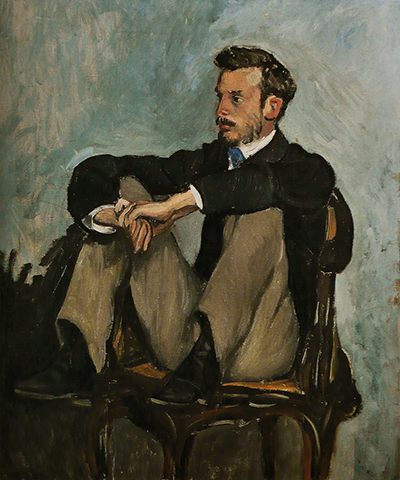
Renoir has pulled both feet up onto his chair. His knees rise almost to his chest, his forearms lie across them, and his hands meet near the middle of the picture. In Frédéric Bazille’s Portrait of Renoir, the whole body participates in the likeness. The folded figure fills a modest vertical canvas with an unexpectedly complicated arrangement of elbows, cuffs, trouser legs and shoes.
The Musée d’Orsay dates this oil painting to 1867 and records its dimensions as 61.2 × 50 cm. It belongs to the Musée national des Beaux-Arts in Algiers and entered the French museum system as a deposit, a distinction easily obscured by its association with Orsay. It is also a separate painting from Bazille’s smaller portrait of Renoir now in Cleveland. [1] [2]
The intimacy comes from more than the sitter’s unconventional position. Bazille gives a fellow painter sustained attention without surrounding him with the equipment of his profession. Renoir’s presence, the chair that supports him and the painted space around his body provide the subject. Beside Renoir’s own portrait of Bazille painting a heron, this apparently simple image opens onto a friendship maintained through shared rooms, exchanged likenesses and close observation of one another’s work. [3]
At a Glance
- Date1867 (Musée d’Orsay); c. 1868–69 (2017 checklist) [1] [4]
- MediumOil on canvas [1]
- Dimensions61.2 × 50 cm [1]
- OwnershipMusée national des Beaux-Arts, Algiers; deposited at Orsay [1]
This work across Frédéric Bazille’s career
Family Reunion
1867–1868 (museum)Bazille’s Studio, Rue La Condamine
1869–1870Summer Scene (Bathers)
1869–1870Contents
- A figure folded into a chair
- Dark clothes and a moving wall
- Friendship in the shared studio
- Renoir paints Bazille painting
- Why the date has been questioned
- From Renoir’s possession to an Algerian collection
A figure folded into a chair
The raised knees change the proportions we expect from a seated portrait. Instead of a long torso descending towards a lap, we see the pale trousers occupying much of the lower picture. The dark jacket spreads sideways across the top of this mass. Renoir’s face emerges above it, turned towards the left edge, while the chair back makes a curved dark boundary on the right.
The pose is compact but not symmetrical. One knee stands higher and more sharply than the other. The arms cross the body at different angles, and the two hands produce a tangle of bent fingers rather than a decorative clasp. The shoes, resting on the seat, extend towards the lower left and lower centre. These differences keep the silhouette open. The eye travels along an arm, down a trouser fold, across the seat and back towards the head.
Look especially at the meeting of the white cuff and the hands. Light paint marks the wrist as a narrow interruption in the dark sleeve; the fingers then turn down against the trousers. The distinction between cloth and skin is economical. Bazille does not have to describe every seam or joint to make the contact legible. The overlapping forms tell us which part of the body is resting on which.
The chair is equally active. Its upright back rises behind Renoir’s shoulder, its seat catches ochre light beneath the shoes, and its legs continue into a darker zone at the bottom. Parts are difficult to separate immediately from the jacket and floor. That temporary uncertainty makes the brighter passages of the body appear more firmly placed. A plain piece of furniture becomes the framework that allows this unusual seated position to hold together.
Renoir’s face resists a simple account of the pose as comic or playful. His mouth is closed and his eyes look away from us. The sharply stated nose, moustache and beard give the head a concentration different from the sprawling arrangement below it. The painting invites us to notice a friend at ease, but it does not disclose what he is thinking. Calling the sitter bored, anxious or melancholy would turn an ambiguous expression into a story the image cannot establish.
Dark clothes and a moving wall
Although the jacket first reads as black, its broad shape is broken by differences of light and direction. The shoulder is rounded; the sleeve at the left edge opens into a looser, more irregular contour; the forearm makes a strong bar across the centre. Against these dark areas, the shirt collar and cuffs seem unusually bright. A small blue necktie supplies a cooler accent close to the face.
The trousers carry their own range of colour. Muted grey, brown and greenish passages rise into the knees and fall into elongated creases. Their relative lightness pushes them towards us, while darker wedges between and beside the legs draw the forms apart. Colour here helps explain the body’s construction. It also prevents the large pale area from looking like a single flat slab beneath the jacket. Schulman challenges an older judgement by Gaston Poulain that gives form priority over colour in this portrait. The distinction is difficult to maintain when the pale trousers and dark sleeves do so much to establish the figure’s shape. [5]
Behind the sitter, the wall is built out of visible strokes. It shifts between blue-grey and warmer, earthier patches, with a lighter area at the upper right. These marks do not resolve into a described room. There is no window, doorway or identifiable picture to locate Renoir within a particular interior. The wall nevertheless has enough variation to keep the air around him from becoming inert.
This is particularly noticeable near the head. The dark hair makes an abrupt silhouette, but the surrounding strokes do not form a smooth, uniformly filled background. They pass in different directions and at different distances from the contour. The head feels placed within a field of paint as well as in an interior space. At the bottom, that open, brushed treatment meets the heavier dark structure of chair and shoes.
Such handling gives the work immediacy, without telling us how long it took to paint. The visible strokes do not establish that Bazille finished the portrait in a single sitting. Nor does the apparently casual pose tell us whether Renoir maintained it easily or how often he returned to it. What matters in the finished image is the balance between a strongly organised body and a surface that leaves its making perceptible.
Friendship in the shared studio
Bazille and Renoir’s friendship grew from the circle around Charles Gleyre’s Paris studio in the early 1860s, where their fellow students included Monet and Sisley. Their later exchange of portraits belonged to a relationship sustained beyond formal training. [6]
The Musée Fabre’s account of their studio friendships reproduces a letter Bazille wrote to his mother in early March 1867. He reported that Monet had arrived with paintings and was lodging with him; Renoir was also staying there. The letter describes pleasure in their company alongside their need for accommodation. Living close together made friends available to pose, discuss a canvas and become part of another painter’s daily subject matter. [7]
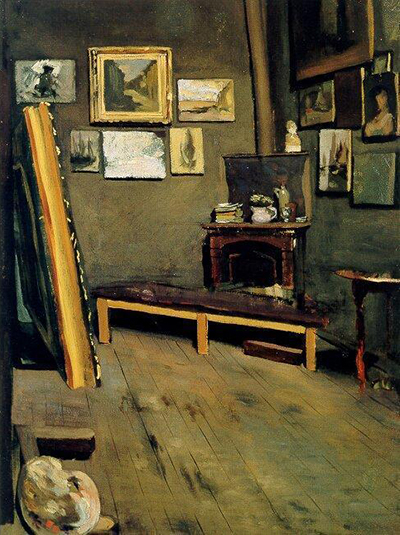
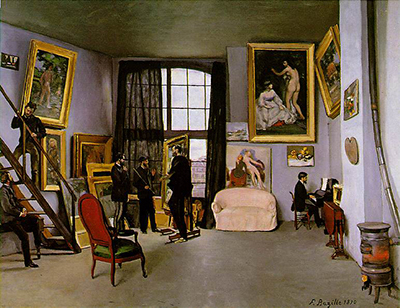
Bazille’s Studio of the Rue Visconti offers a complementary view of that world. Its empty floor, easel, palette and crowded walls describe the place through working objects. Here the room is pared back until almost everything depends on a human occupant. The two pictures make different selections from studio life: equipment and accumulated pictures in one, a friend’s bodily presence in the other. Neither needs to be treated as a complete inventory of the room or everyone using it.
The informality also coexisted with professional ambition. In an April 1867 letter, following rejection by the Salon, Bazille proposed hiring an exhibition space annually with a group of young artists. His plan shows how seriously he was considering ways of bringing their work before an audience. An intimate portrait should not be mistaken for evidence that its painter had withdrawn from public artistic life. [8]
Nor was studio space simply an unlimited resource. Writing to his father in late November 1867, Bazille explained that the Visconti room was too small and that he had rented a much larger studio in the Batignolles, with a move planned for January. The letter documents the pressures of organising a working life as well as the possibilities of sharing one. It gives the friendship a material setting without requiring us to reconstruct the precise day or room in which this portrait was painted. [9]
Studio of The Rue Visconti
Watch: Bazille and early Impressionism
Explore a Paris studio with Smarthistory, then discover the beginnings of Impressionism with the National Gallery of Art.
Jean-Frédéric Bazille, The Artist’s Studio, Rue Visconti, Paris
A close look at Bazille’s 1867 painting of the studio he shared in Paris.
Watch on YouTubeRenoir paints Bazille painting
Renoir’s Frédéric Bazille, signed and dated 1867, changes the terms of the encounter. Bazille sits in profile at an easel, holding a palette and working on a still life. Pictures fill the wall behind him. The canvas is considerably larger than Bazille’s portrait of Renoir, measuring 105 × 73.5 cm, and belongs to Orsay, with a deposit at the Musée Fabre recorded in its collection history. [3]
The two portraits give the sitter’s hands very different jobs. In Bazille’s painting, Renoir’s hands rest across his knees, temporarily released from work. In Renoir’s, Bazille’s hands connect his body to a palette, brush and canvas. One image makes an artist recognisable through activity and surrounding pictures; the other lets the artist appear as a person whose profession need not be demonstrated. Seen together, they show how much the meaning of a portrait depends on the arrangement of an ordinary gesture.
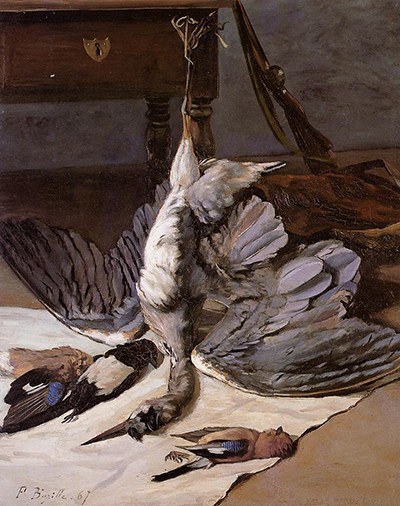
The still life Bazille is painting is connected with his Still Life with Heron. In that work, the bird’s extended wings, smaller dead birds, white cloth and gun create an elaborate arrangement of textures and diagonals. Renoir’s portrait brings a version of that arrangement into another picture, showing both the painter and his painted subject. Sisley also painted the motif. Technical comparison discussed by Bruno Mottin identifies changes in the birds’ arrangement that support the artists’ working together before a shared still life. [10]
There is another level of exchange on Renoir’s studio wall. Mottin reports that the pictures behind Bazille were added after an initial state in which the head stood against a bare wall. He suggests that Monet himself may have painted the snowy landscape represented at the right. That remains a hypothesis about a particular passage within Renoir’s portrait of Bazille; it does not establish Monet’s participation in Bazille’s Portrait of Renoir. The suggestion concerns that small painted landscape alone. [10]
The exchange did not necessarily follow a simple sequence of one portrait immediately answering the other. The pictures demonstrate reciprocal attention, but the exact sequence and circumstances of Bazille’s portrait remain uncertain. They are most revealing when allowed their differences: work and repose, a furnished wall and a brushed field, the painter holding his tools and the painter folding his hands.
The Heron
Why the date has been questioned
Orsay’s present date is 1867, also used in the National Museum of Western Art’s 2025 exhibition checklist. The National Gallery of Art’s 2017 Bazille retrospective checklist, however, listed the portrait as about 1868–1869. Readers encountering both dates are encountering a real difference in scholarly judgement. [1] [11] [4]
Schulman explains that the portrait’s forceful handling has encouraged later dating, while cautioning against treating Bazille’s development as a uniform progression. A family group and an intimate likeness could require different degrees of finish. Style contributes to the dating argument, but cannot by itself securely place this work before or after another canvas. [5]
Schulman also reports that X-rays made for the 2016–2017 retrospective disclosed an unfinished still life beneath the portrait. This indicates an earlier use of the support. It supplies neither a firm date for Renoir’s sitting nor a reason for abandoning the still life; the earlier composition’s authorship should not be assigned to another painter on this evidence. [5]
A comparison with Bazille’s Portrait of Edmond Maître is useful here without becoming a dating test. Maître’s lowered gaze, cigar, book and profile create another private encounter, yet his seated arrangement is more open and his hands are occupied with objects. Renoir’s folded position makes the body itself the principal structure. Intimacy in Bazille’s portraits accommodates several kinds of attention; it does not demand one fixed formula.
From Renoir’s possession to an Algerian collection
The portrait’s earliest ownership gives the friendship a documentary consequence: Bazille gave the picture to Renoir. Orsay’s provenance then records Renoir’s son Claude, followed by the Paris firm Renoir et Colle. In 1935 the Musée national des Beaux-Arts in Algiers bought it from the firm. These successive names explain why a French museum association should not be taken as proof of French ownership. [1]
In 1970 the Algerian museum deposited the painting at the Louvre under the Franco-Algerian agreement of 11 July 1968. Orsay’s record describes a five-year deposit renewable by tacit agreement and records the painting at Orsay from 1986. Later deposits at the Musée Fabre brought it to Montpellier, including a period from 2018 to 2023; the record lists Orsay again in 2023. Location and ownership form separate strands of the painting’s history. [1]
Exhibitions have also changed the company in which viewers encounter it. Orsay lists the portrait in the Bazille retrospective that travelled through Montpellier, Paris and Washington in 2016–2017, while the Tokyo checklist places it within an exhibition of Impressionist interiors in 2025–2026. The first setting encourages comparison across Bazille’s work; the second invites attention to the intimate space around the sitter. Both approaches are productive for a painting that reduces its interior to so few elements. [1] [11]
Cleveland’s Portrait of Renoir, dated 1867 and measuring 40.5 × 32.5 cm, is another object with its own provenance and accession number, 2021.134. Its smaller format should not be used to supply measurements or ownership for the raised-knee portrait discussed here. [2]
Returning to Bazille’s larger portrait, the plain wall becomes more striking after this history of studios, pictures and exchanges. So much of that social world can be explained through other paintings, yet Bazille leaves it outside the frame. What remains is a highly particular body on an ordinary chair: restrained in expression, unusual in its arrangement and continually engaging in the way its forms meet.
Bazille catalogue directory
The 284 records comprise 85 painting records,40 separate works-on-paper records and 159 album or study records. They describe the catalogue’s organisation rather than 284 independent objects or unanimously accepted attributions. Recto, verso, albums and multiple studies remain distinct. Dates are qualified where needed; the Drawing filter includes the etching, gouache and mixed works on paper. Manuscript mentions and unproved projects are listed separately below.
Works known through documents
These mentions remain separate from the 284 catalogue records. Some may concern surviving studies or underlying compositions; they cannot simply be added together as missing physical paintings.
- A copy after Rubens mentioned in March 1863 is unlocated.
- A portrait of an unidentified woman was reported completed before July 1866.
- A portrait of Monet and a composition of two life-size women arranging flowers were reported in progress in April 1867. Their mention does not establish two otherwise unknown surviving canvases.
- Gertrude et le père Lapin was at least begun in the summer of 1870.
Further reported works and uncertain attributions
- A Bouquet of Lilacs was reportedly stolen and returned in 1864; a portrait of the friend Theulier and Yellow Narcissi reported by Maître in 1868 are also documentary mentions.
- Unidentified pictures associated with Guillemet and Mme Rolina are reported through later correspondence cited by the catalogue.
- Children Dressed as Bride and Groom was associated with Vallotton’s collection and also attributed to Renoir. Its identification and authorship should remain open.
Projects whose completion is unproved
- A portrait of Pauline was planned in July 1865.
- A portrait of Marc was proposed in April 1866; a related drawing survives.
- A Jardinière project appears in album inscriptions and related figure material. Written plans are not evidence of a completed painting.
| Name | Date | Medium |
|---|---|---|
| Mystic Marriage of St. Catherine | 1863 | Oil on canvas |
| Trees, Study | 1863 | Oil on canvas |
| Farm of Saint-Sauveur | 1863 | Oil on canvas |
| In the Garden of the Parc Monceau, Paris | 1864 | Oil on canvas |
| Naked Woman from Behind | 1864 | Oil on canvas |
| Reclining Nude | 1864 | Oil on canvas |
| Courtyard of the Auberge du Cheval blanc at Chailly near Barbizon | 1864 | Oil on canvas |
| Covered Soup Bowls | 1864 | Oil on canvas |
| Two Herrings | 1864 | Oil on canvas |
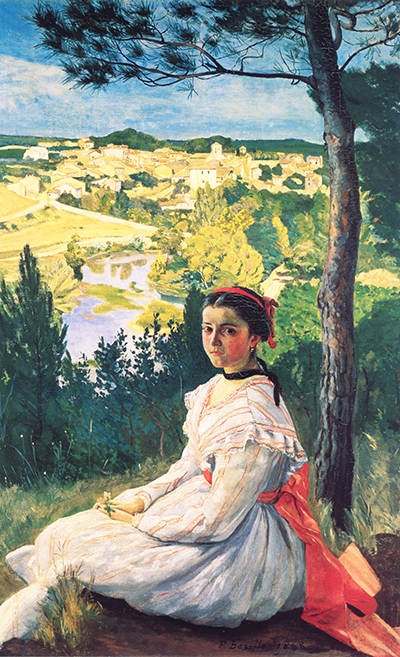
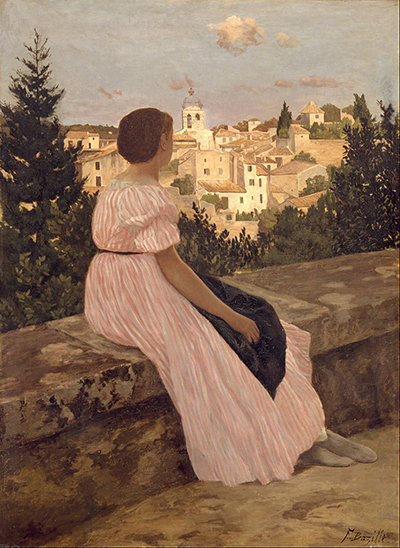
| The Pink Dress | 1864 | Oil on canvas |
| The Dog Rita Asleep | 1864 (catalogue); c. 1864 (2017 checklist) | Oil on canvas |
| The Scoter | 1864 | Oil on canvas |
| Naked Reclining Woman | 1864 | Oil on canvas |
| Landscape at Chailly | 1865 | Oil on canvas |
| Rocks at Chailly, Forest of Fontainebleau | 1865 | Oil on canvas |
| Undergrowth at Chailly, Forest of Fontainebleau | 1865 | Oil on canvas |
| Still Life with Grapes and Nuts | 1865 | Oil on canvas |
| Self-Portrait with a Palette — Chicago | 1865 | Oil on canvas |
| Landscape of Saint-Sauveur | 1865 | Oil on canvas |
| Beach at Sainte-Adresse | 1865 | Oil on canvas |
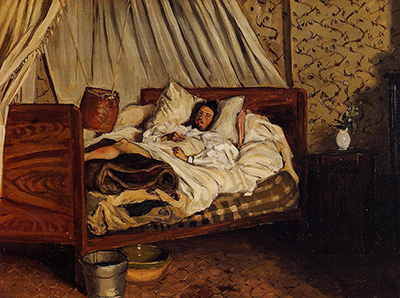
| The Improvised Field Hospital | 1865 | Oil on canvas |
| Village Street, Chailly | 1865 | Oil on canvas |
| Small Valley in the Forest of Fontainebleau | 1865 | Oil on canvas |
| Forest of Fontainebleau | 1865 | Oil on canvas |
| Woman Ironing | 1866 | Oil on canvas |
| The Artist's Studio on the rue de Furstenberg | 1865–66 (museum) | Oil on canvas |
| Still Life with Fish | 1866 | Oil on canvas |
| Little Italian Street Singer | 1866 | Oil on canvas |
| Potted Flowers | 1866 | Oil on canvas |
| The Little Gardener | 1866–1867 | Oil on canvas |
| Young Woman Playing the Piano | 1866–1867 | Oil on canvas |
| End of a Summer Day | 1866–1867 | Oil on canvas |
| A Studio on the rue Visconti | 1867 | Oil on canvas |
| Thérèse Reading in the Park at Méric | 1867 | Oil on canvas |
| Portrait of Verlaine | 1867 | Oil on canvas |
| The Terrace at Méric | 1867 | Oil on canvas |
| Still Life with Heron | 1867 | Oil on canvas |
| The Family Gathering | 1867–68 (museum) | Oil on canvas |
| Oleanders | 1867 | Oil on canvas |
| Woman on the Terrace at Méric | 1867 | Oil on canvas |
| The Ramparts at Aigues-Mortes from South | 1867 | Oil on canvas |
| The Western Ramparts at Aigues-Mortes | 1867 | Oil on canvas |
| Portrait of Edmond Maître — head study | 1867 | Oil on canvas |
| Porte de la Reine at Aigues-Mortes | 1867 | Oil on canvas |
| Portrait of Sisley | 1867 | Oil on wood |
| Portrait of Renoir — Cleveland | 1867 | Oil on canvas |
| Portrait of Renoir — Musée d’Orsay | 1867 | Oil on canvas |
| Self-Portrait with a Detachable Collar — Minneapolis | 1865–67 (museum); 1867–68 (catalogue) | Oil on canvas |
| Vase of Flowers on a Console | 1868 (museum); 1867–68 (catalogue) | Oil on canvas |
| Portrait of a Woman | 1868 | Oil on canvas |
| Young Woman in the Vineyards | 1868 | Oil on card |
| Harvester with a Basket | 1868 | Oil on card |
| Harvester with a Yellow Hat | 1868 | Oil on card |
| Harvester with a Headdress | 1868 | Oil on panel |
| On the Banks of the Lez | 1868 | Oil on canvas |
| After the Bath (attribution questioned) | 1868? | Oil on canvas |
| Young Woman with Lowered Eyes | 1868 | Oil on canvas |
| Fisherman with a Net | 1868 | Oil on canvas |
| View of the Village | 1868 | Oil on canvas |
| Portrait of Bazille (attributed to Monet by Musée Fabre; disputed catalogue attribution) | 1864 (museum); 1868 (catalogue) | Oil on panel |
| Studies for a Grape Harvest (two panels) | 1868 | Oil on canvas (two panels) |
| The Fortune Teller | 1868–69 (catalogue); c. 1869–70 (2017 checklist) | Oil on canvas |
| Harvester with a Cap | 1869 | Oil on card |
| Portrait of Edmond Maître — 1869 | 1869 | Oil on canvas |
| Woman in a Moorish Costume | 1869 | Oil on canvas |
| Young Woman in the Garden | 1869 | Oil on canvas |
| Portrait of Alphonse Tissié in a Cavalryman's Uniform | 1869 | Oil on canvas |
| Portrait of a dragoon | 1869 | Oil on canvas |
| Portrait of Zacharie Astruc | 1869 | Oil on canvas |
| Bunch of Grapes in a Bucket | 1869 | Oil on card |
| Portrait of Edouard Blau | Probably 1869; inscribed 1866 | Oil on canvas |
| Young Male Nude Lying on the Grass | 1870 | Oil on canvas |
| Summer Scene | 1869–1870 | Oil on canvas |
| The Studio on the rue La Condamine | 1869–1870 | Oil on canvas |
| La Toilette | 1870 | Oil on canvas |
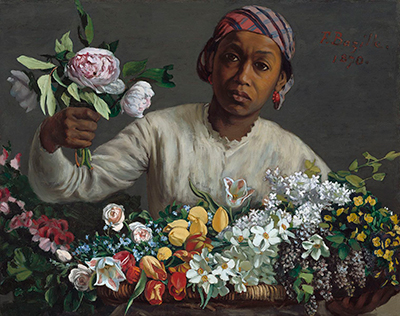
| Young Woman with Peonies — Montpellier | 1870 | Oil on canvas |
| Young Woman with Peonies — Washington | 1870 | Oil on canvas |
| Monotonous Chant | 1870 | Oil on canvas |
| Flowers — private collection | 1870 | Oil on canvas |
| Flowers — Musée Fabre | 1870 | Oil on canvas |
| Young Fisherman | 1870 | Oil on canvas |
| Study for Ruth and Boaz | 1870 | Oil on wood |
| Ruth and Boaz | 1870 | Oil on canvas |
| Self-Portrait in Shirt Sleeves | 1870 | Oil on canvas |
| Landscape on the Banks of the Lez | 1870 | Oil on canvas |
| Study after an Alpine Landscape | 1860 | Graphite on watercolour-tinted paper |
| Profile Head | 1862 | Charcoal on laid paper |
| Studies after Delacroix | 1863 | Ink and graphite, with gouache and watercolour, on paper |
| Academic Head | 1863 | Charcoal on paper |
| Study of a Woman's Head in Profile on a Chair | 1863 | Charcoal on paper |
| Academic Head of a Woman | 1863 | Charcoal on paper |
| Academy of Woman | 1863 | Black pencil and charcoal, stumped, on watermarked laid paper |
| Academy of Man | 1863 | Black pencil and charcoal, stumped, on watermarked laid paper |
| Naked Man | 1863 | Charcoal on paper |
| The Pont au Change in Paris | 1864 | Watercolour on paper |
| Study for the Pink Dress or Portrait of Thérèse des Hours | 1864 | Black pencil on paper |
| Naked Woman Standing | 1864 | Pencil on paper |
| Study of a Reclining Nude | 1864 | Charcoal on paper |
| Bathers | 1864 | Charcoal on paper |
| Portrait of a Man | 1864 | Charcoal on paper |
| Study for The Pink Dress | 1864 | Black pencil, squared, on paper |
| Study for Landscape of Saint-Sauveur | 1864 | Graphite on paper |
| Study for Landscape of Saint-Sauveur | 1865 | Pencil on paper |
| Man Taming a Bull | 1866 | Pen and black pencil on paper |
| Man Half Lying on a Sofa | 1866 | Charcoal on paper |
| Study for The Family Gathering | 1867 | Pencil on paper |
| Study for The Family Gathering | 1867 | Graphite, charcoal and black pencil on paper |
| The Embroiderer | 1867 | Pencil on pink paper |
| Study of Children | 1867 | Pencil on paper |
| Women in a Garden | 1867 | Pencil drawing |
| View of the Village | 1868 | Etching on paper |
| Portrait of a Bearded Man (catalogued as Self-Portrait) | Undated (museum); 1869 (catalogue) | Charcoal and brown ink |
| Man Smoking Pipe | 1869 | Watercolour on paper |
| Manet Drawing | 1868–70(?) (museum) | Charcoal and white chalk on paper |
| Study for the Summer Scene | 1869 | Charcoal, pen and ink on paper |
| Family Portrait | 1869 | Pastel and charcoal on paper |
| Study for Ruth | 1870 | Pencil and charcoal on paper |
| Woman Arranging a Hat | 1870 | Pencil drawing |
| Study for Boaz Asleep | 1870 | Pastel and red chalk |
| Boaz Asleep | 1870 | Charcoal and pencil on paper |
| Study for Boaz Asleep | 1870 | Black and beige pastel with red chalk on laid paper |
| Ruth Lying down | 1870 | Charcoal and pastel on paper |
| Head, Arm and Chest of Ruth | 1870 | Charcoal on paper |
| Chest of Ruth | 1870 | Black chalk and charcoal on paper |
| Black Woman with Peonies — gouache | c. 1870 | Gouache, watercolour, pencil and black chalk on card |
| Various Unidentified Subjects | Undated | Pencil drawing |
| Rocky Sea Side | Undated | Charcoal on paper |
| Studies of a Dancing Woman | Undated | Drawing with white chalk |
| Study of a Leg | Undated | Pencil drawing |
| Dancers in Camargue | Undated | Pencil drawing |
| Academy of Woman | Undated | Charcoal |
| Caricature of Venus of Milo and Various Other Caricatures | Undated | Charcoal |
| Caricature | Undated | Pencil drawing |
| Study of Landscape | Undated | Charcoal |
| Caricatures and Seated Monk | Undated | Charcoal |
| Caricatures and Various Subjects | Undated | Pencil drawing |
| Women Carrying a Pitcher | Undated | Pencil drawing |
| The Hanged Man | Undated | Charcoal |
| Castle in the Plain | Undated | Charcoal |
| Naked Woman from Behind | Undated | Charcoal |
| Caricatures | Undated | Charcoal and pencil |
| Unidentified Subjects | Undated | Pencil drawing |
| Landscape with a Castle | Undated | Charcoal |
| Study of Landscape | Undated | Charcoal |
| Horse Rider seen from Behind | Undated | Charcoal |
| Mazeppa | Undated | Pencil and charcoal |
| Study of Rider and Others Subjects | Undated | Pencil, pen and brown ink |
| Study of an Unidentified Man | Undated | Pencil drawing |
| Study for an Unknown Historic Scene | Undated | Pencil drawing |
| Study a Man Reading | Undated | Pencil drawing |
| Study of Men Reading | Undated | Pencil drawing |
| Study of Landscape ? | Undated | Charcoal |
| Study of a Head of a Man | Undated | Pencil drawing |
| Erotic Scene | Undated | Pencil drawing |
| Study of Dog | Undated | Charcoal |
| Studies of Unidentified Subjects and Erotic Scene | Undated | Pencil and charcoal drawing |
| Study for a Theater Scene | Undated | Charcoal |
| Study of a Reclining Naked Woman | Undated | Charcoal |
| Two Studies of Landscape | Undated | Pencil drawing |
| Caricature | Undated | Pencil and charcoal drawing |
| Portrait of an Unidentified Young Man | Undated | Charcoal |
| Study of an Unidentified Subject | Undated | Brown ink drawing |
| Unidentified Man with a Hat | Undated | Pencil and charcoal |
| Study of an Unidentified Women | Undated | Pencil drawing |
| Study for a Theater Character ? | Undated | Pencil drawing |
| Study for a Theater Character ? | Undated | Pen drawing |
| The Pavillon de la Reine in Paris | Undated | Pencil drawing |
| Study of a Horse Rider | Undated | Pencil and charcoal drawing |
| Entwined Couple. Caricature ? | Undated | Pencil drawing |
| Woman Sitting on a Sofa | Undated | Pencil drawing |
| Studies of Unidentified Subjects | Undated | Pencil and charcoal drawing |
| Studies of Animals | Undated | Pencil drawing |
| Study of a Horse Rider in Camargue | Undated | Charcoal |
| Study of Hunting Dogs | Undated | Pencil drawing |
| Study of Soldiers. Caricatures | Undated | Pencil drawing |
| Studies of Hunting Dogs ? | Undated | Pencil drawing |
| Hunting Scene. Hunter Playing the Horn | Undated | Pencil drawing |
| Caricature | Undated | Pencil drawing |
| Study of an Ibex | Undated | Pencil drawing |
| Theater Scene. Caricatures | Undated | Pencil drawing |
| Studies of Animals. Horses ? | Undated | Pencil drawing |
| Caricatures | Undated | Pencil drawing |
| Studies of Various Subjects and Animals | Undated | Pencil drawing |
| Unidentified Subject | Undated | Pencil drawing |
| Rider Taming a Horse [in Camargue ?] | Undated | Pencil drawing |
| Caricature of a Soldier | Undated | Pencil drawing |
| Study of a Woman and Mouse | Undated | Pencil drawing |
| Historic Scene | Undated | Charcoal |
| Architecture Studies | Undated | Pencil drawing |
| Mythologic Scene | Undated | Charcoal |
| Ophelia | Undated | Pencil drawing |
| Mythologic Scene | Undated | Charcoal |
| Studies of Various Subjects | Undated | Pencil and pen drawing |
| Studies of Peasants | Undated | Pencil drawing |
| Historic Scene | Undated | Pencil drawing |
| Historic or Literary Scene | Undated | Pencil drawing |
| Unidentified Historic Scene | Undated | Pencil drawing |
| Studies of Unidentified Subjects | Undated | Pencil drawing |
| Unidentified Study | Undated | Pencil drawing |
| Man in an Armchair | Undated | Pencil drawing |
| Studies of Various Subjects | Undated | Pencil drawing |
| Portraits of Unidentified Men | Undated | Pencil drawing |
| Studies of Various Subjects | Undated | Pencil drawing |
| Horse Rider and Artist | Undated | Charcoal and pencil |
| Study of Unidentified Characters | Undated | Charcoal |
| Dead Horse in a Plain | Undated | Charcoal |
| Study of Various Subjects and Furniture | Undated | Pencil drawing |
| Caricatures and Various Notes about Opéra | Undated | Pencil drawing |
| Galloping Horse | Undated | Charcoal |
| Study for La Toilette | Undated | Pencil drawing |
| Study of a Naked Woman | Undated | Pencil drawing |
| Domestic Scene | Undated | Pencil drawing |
| Physiognomies | Undated | Pencil drawing |
| Study for a Grape Harvest | Undated | Pencil drawing |
| Study for the Summer Scene | Undated | Pencil drawing |
| Female Profiles | Undated | Pencil drawing |
| Various Subjects | Undated | Pencil drawing |
| Study for The Terrace at Méric | Undated | Pencil drawing |
| Study for The Ramparts at Aigues-Mortes | Undated | Pencil drawing |
| Study for The Ramparts at Aigues-Mortes | Undated | Pencil drawing |
| Study for a Grape Harvest | Undated | Charcoal |
| Children Portraits | Undated | Pencil drawing |
| Study for Children's Heads | Undated | Pencil drawing |
| Study of Minerva | Undated | Pencil drawing |
| Study for a Grape Harvest | Undated | Pencil drawing |
| Study for The Family Gathering | Undated | Pencil drawing |
| Study for a Young Fisherman | Undated | Charcoal |
| Self-Portraits | Undated | Black pencil drawing |
| Study of Horses for the Porte de la Reine at Aigues-Mortes | Undated | Ink drawing |
| Study of Horses for the Porte de la Reine at Aigues-Mortes | Undated | Ink drawing |
| Study of Horses for the Porte de la Reine at Aigues-Mortes | Undated | Ink drawing |
| Study for an Outdoor Concert | Undated | Pencil drawing |
| Studies of Legs | Undated | Pencil drawing |
| Study for The Ramparts at Aigues Mortes | Undated | Pencil drawing |
| Studies of Hats | Undated | Pencil drawing |
| Studies of Men | Undated | Pencil drawing |
| Study for The Little Gardener | Undated | Pencil drawing |
| Study for The Ramparts at Aigues Mortes | Undated | Charcoal |
| Studies of Sail Boats | Undated | Pencil drawing |
| Portrait of Marc Bazille | Undated | Charcoal, black pencil and graphite |
| Studies of Children's Heads | Undated | Pencil drawing |
| Study for Aigues-Mortes | Undated | Pencil drawing |
| Studies of Women's Heads | Undated | Pencil drawing |
| Portrait of Camille des Hours and an Unidentified Man | Undated | Charcoal |
| Study of Flying Birds | Undated | Charcoal or graphite |
| Study for the Summer Scene | Undated | Pencil drawing |
| Study of Hands | Undated | Pen drawing |
| Self-Portrait | Undated | Black pencil drawing |
| Study for the Summer Scene | Undated | Pencil drawing |
| Study for the Summer Scene | Undated | Pencil drawing |
| Study for a Grape Harvest | Undated | Pencil drawing |
| Study of Branches | Undated | Pencil drawing |
| Study of a Seated Child | Undated | Pencil drawing |
| Study for a Couple and Unidentified Women | Undated | Pencil drawing |
| Studies of Unidentified Women | Undated | Pencil drawing |
| Study of Buildings | Undated | Pencil drawing |
| Study for a Grape Harvest | Undated | Pencil and charcoal |
| Studies of Boaters | Undated | Pencil drawing |
| Study of a Man Writing at his Table | Undated | Pencil drawing |
| Study of a Woman Cutting Flowers | Undated | Pencil drawing |
| Study of Hand | Undated | Pencil drawing |
| Women in a Garden | Undated | Pencil drawing |
| Studies of Women in Profile | Undated | Pencil drawing |
| Study for Ruth and Boaz | Undated | Charcoal |
| Study for The Family Gathering | Undated | Pencil drawing |
| Study for the View of the Village | Undated | Pencil drawing |
| Study of the View of the Village | Undated | Pencil drawing |
| Study for the Fisherman with a Net | Undated | Pencil drawing |
| Study for the View of the Village | Undated | Charcoal |
| Study for The Little Gardener | Undated | Charcoal |
| Portrait of a Man with a Top Hat | Undated | Pencil drawing |
| Portrait of a Man with a Top Hat | Undated | Pencil drawing |
| Inscriptions | Undated | Pencil inscriptions |
| Study of Tree | Undated | Pencil drawing |
| Caricature of Nina la Belle | Undated | Pencil drawing |
| Study for Saint Sebastian | Undated | Pencil drawing |
| Young Woman Sewing | Undated | Pencil drawing |
| Studies of Hands | Undated | Pencil drawing |
| Woman in a Garden | Undated | Pencil drawing |
| Elegant Woman | Undated | Pencil drawing |
| Various Inscriptions | Undated | Inscriptions (medium unspecified in index) |
| Study of a Man with a Hat | Undated | Pencil drawing |
| Study of a Child | Undated | Pencil drawing |
| Study of a Man with a Hat | Undated | Pencil drawing |
Frequently Asked Questions
It belongs to the Musée national des Beaux-Arts in Algiers and is deposited at the Musée d’Orsay. Ownership and place of deposit are different facts. [1]
Discussion
The chair, clothing and hands contribute to Renoir’s presence as much as the face. Which detail carries the pose?
Reader Insights
How do the dark clothing and lighter face organise the portrait’s first impression?
What does Renoir’s position in the chair contribute to the sense of an informal encounter?
Compare Bazille’s portrait with Renoir’s image of Bazille painting. How do the two artists represent a working friend differently?
Join the Conversation
Share a detail, comparison or question about Portrait of Renoir by Frédéric Bazille below.
References
- Musée d’Orsay, Pierre Auguste Renoir, Frédéric Bazille, 1867, DL 1970 3. Object details, provenance and exhibition history. Collection record (English interface; object data in French). View source.
- Cleveland Museum of Art, Portrait of Renoir, Frédéric Bazille, 1867, 2021.134. Collection record. View source.
- Musée d’Orsay, Frédéric Bazille, Auguste Renoir, 1867, RF 2448. Collection record (English commentary; object data in French). View source.
- National Gallery of Art, Frédéric Bazille and the Birth of Impressionism, 2017 exhibition checklist, catalogue no. 49. Checklist. View source.
- Michel Schulman, Frédéric Bazille: The Digital Catalogue Raisonné, “Portrait of Renoir,” MSb-30. Catalogue entry (English translation of French scholarly catalogue). View source.
- Michel Hilaire, “Bazille ou la vie brève,” Académie des Sciences et Lettres de Montpellier, 2016, pp. 166–172. Lecture (in French). View source.
- Musée Fabre, Frédéric Bazille, la jeunesse de l’impressionnisme, 2016 press dossier, p. 14, “Amitiés d’atelier.” Museum dossier (in French). View source.
- Frédéric Bazille, letter to his mother, April 1867, Musée Fabre, inventory 94.7.1. Facsimile and transcription (in French). View source.
- Frédéric Bazille, letter to his father, late November 1867, Musée Fabre, inventory 92.2.5. Facsimile and transcription (in French). View source.
- Bruno Mottin, “L’œuvre de Frédéric Bazille (1841-1870) examiné au laboratoire,” Technè 46 (2018), pp. 30–38, especially paragraphs 18–19. Technical study (in French). View source.
- National Museum of Western Art, Impressionist Interiors: Intimacy, Decoration, Modernity, 2025 exhibition checklist, p. 2, entries 1–2. Checklist (in Japanese and English; English entries consulted). View source.
- Joconde/POP, La Robe rose, RF2450. View source. (in French).
- Musée d’Orsay, L’Ambulance improvisée, RF 1967 5. View source. (in French).
- Musée d’Orsay, Réunion de famille,RF2749. View source. (in French).
- Musée Fabre, Vue de village, 898.5.1. View source. (in French).
- National Gallery of Art, Young Woman with Peonies,1983.1.6. View source.
- Michel Schulman, painting index and documentary introduction (English titles; French metadata). View source.
- Michel Schulman, works-on-paper index (English titles; French metadata). View source.
- Michel Schulman, albums and studies index (English titles; French metadata). View source.
 Frederic Bazille.jpg)