

 by Tom Gurney
Tom Gurney BSc (Hons) is an art history expert with over 20 years experience
/
Email: tomgurney1@gmail.com / Phone: +44 7429 011000
Women, Spiritualism and Freedom: Introduction
Women occupy the moral centre of many Evelyn De Morgan paintings. They wait behind bars, turn towards open windows, study, resist monsters or rise into light. Those images invite feminist readings, especially because surviving documents confirm the artist’s support for women’s suffrage. Yet politics is only part of their charge. De Morgan’s Spiritualism also treated the body as a temporary enclosure from which the soul would eventually be released.
Social and spiritual freedom can therefore share the same visual forms without becoming identical. A chain may evoke women’s legal and domestic restriction, the soul’s bondage to matter, or both. The strongest interpretations hold those possibilities together and state clearly where documentary fact ends and close reading begins.
At a Glance
- Documentary evidenceDe Morgan signed women’s-suffrage appeals in 1889 and 1897.
- Recurring figureA woman enclosed, restrained or separated from a freer realm.
- Key symbolsBars, chains, windows, cages, discarded riches, sunrise and ascending light.
- Spiritual premiseThe mortal body could be imagined as a temporary prison for an immortal soul.
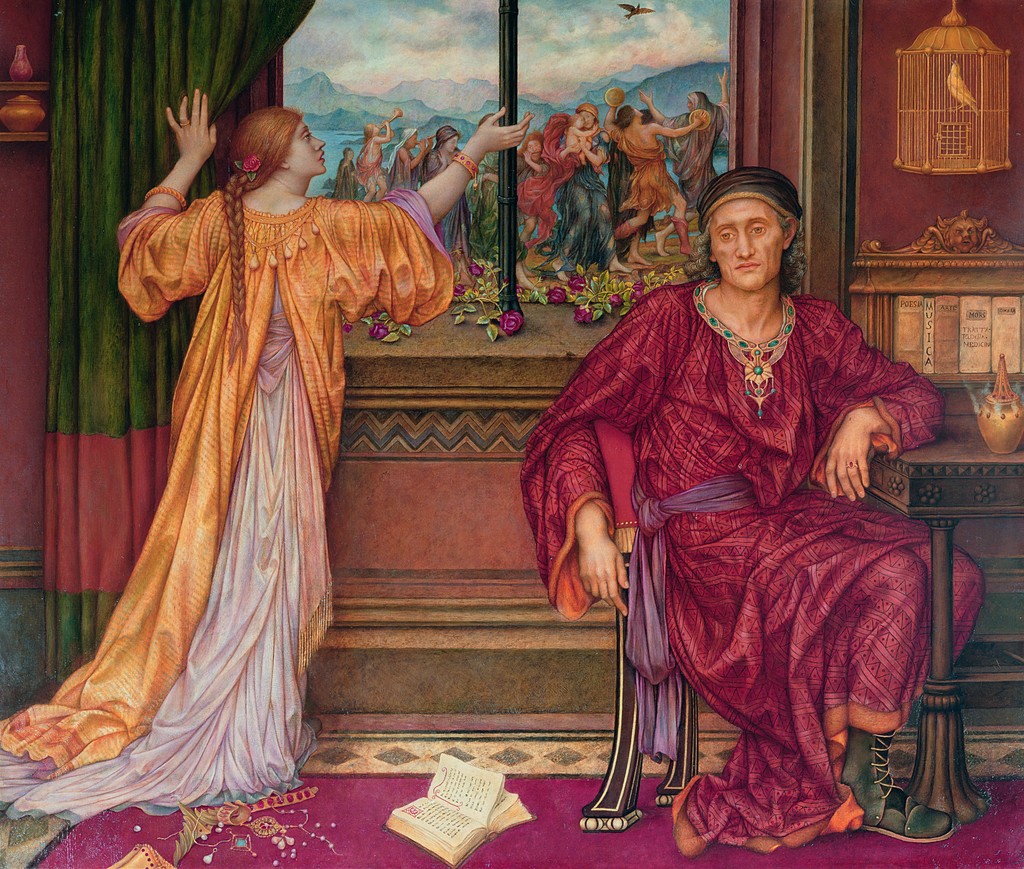
- Principal workThe Gilded Cage, probably 1901–1902, makes domestic luxury and female confinement inseparable.
- Reading cautionDe Morgan’s politics support feminist interpretation, but they do not make every female figure a direct suffrage statement or a disguised self-portrait.
Contents
- What the Suffrage Documents Establish
- Professional Life as Practised Autonomy
- Female-Centred Stories and Altered Viewpoints
- The Social Prison and the Body’s Prison
- The Gilded Cage: Comfort as Confinement
- Agency Without a Single Heroic Pose
- Spiritualism Through Sophia and William
- Evidence, Inheritance and Interpretive Limits
What the Suffrage Documents Establish
There is firm evidence for De Morgan’s political position. In 1889 she signed the Declaration in Favour of Women’s Suffrage, alongside women working in art, literature and social reform. In 1897 she added her name to another petition sponsored by the Central Committee of the National Society for Women’s Suffrage.[2] These public acts matter because they move discussion beyond an attempt to infer her beliefs solely from paintings.
The documents establish support for women’s enfranchisement; they do not record a meaning for each canvas. “Suffragist” is consequently the most precise general description. It denotes advocacy of the vote and fits the petitions. The assigned evidence does not show that De Morgan joined the militant Women’s Social and Political Union, so “suffragette” would claim a more specific affiliation than the record supports.
Her immediate circle reinforces the political context. William De Morgan became a vice-president of the Men’s League for Women’s Suffrage in 1913, while his mother, Sophia, had promoted women’s education and suffrage earlier in the century.[2][3] This was not a concern isolated from domestic life. Even so, shared commitments should not dissolve Evelyn’s individual decisions into a family position: her signatures are her own documentary acts.
Professional Life as Practised Autonomy
De Morgan’s career itself required sustained resistance to gendered expectations. Born Mary Evelyn Pickering, she pursued formal study when her family expected a conventional upper-class life. She attended the National Art Training School and then the Slade School of Fine Art, where she won distinctions in figure drawing and a scholarship. She built an exhibiting career, travelled to study Italian painting and maintained a demanding daily drawing practice.[1][3]
Sarah Hardy notes that her use of “Evelyn”, a name then read as gender-neutral, may have helped work receive judgement without an immediately female identity attached.[3] Because this is an interpretation of her choice rather than a recorded declaration of motive, the qualification matters. What is beyond doubt is the larger pattern: she trained seriously, competed for recognition and worked as a professional painter for decades.
Marriage in 1887 did not end that identity. At points when William’s ceramics enterprise struggled, income from Evelyn’s paintings was important to the household; later his successful novels reduced the commercial constraints surrounding her work.[1] Neither fact makes one spouse merely the other’s dependent. Their changing economic roles belong to the equal, creative relationship explored in Evelyn and William De Morgan. Her fuller biography places this professional autonomy within the chronology of training, exhibitions and patronage.
Female-Centred Stories and Altered Viewpoints
De Morgan repeatedly gives a woman the position from which a story is felt. In classical subjects, she could select a moment of abandonment, endurance or transformation rather than a hero’s triumph. In domestic allegories, a woman’s relation to a room, window or male companion structures the entire picture. This shift does not always turn her subject into a political slogan, but it changes whose predicament commands attention.
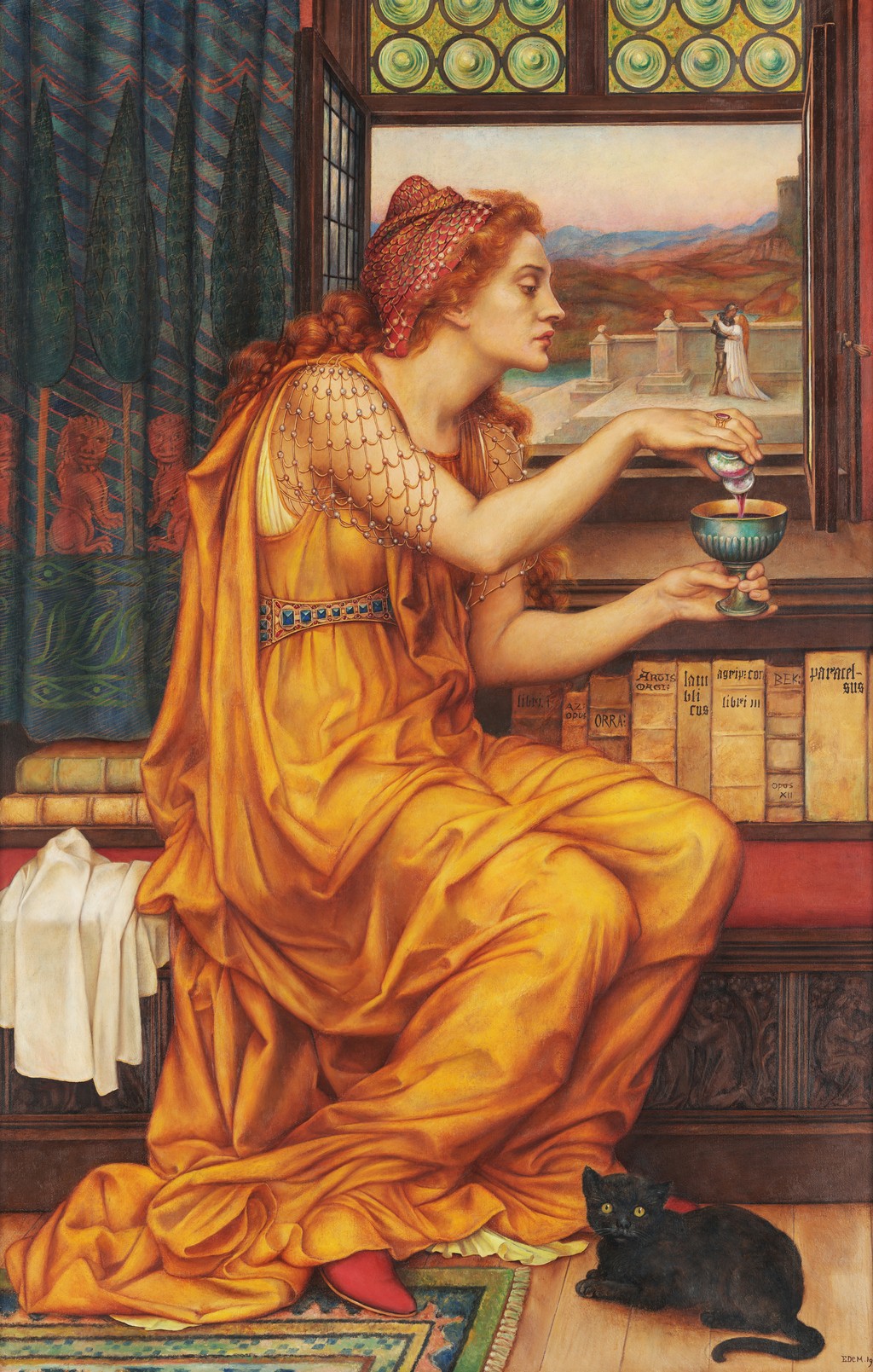
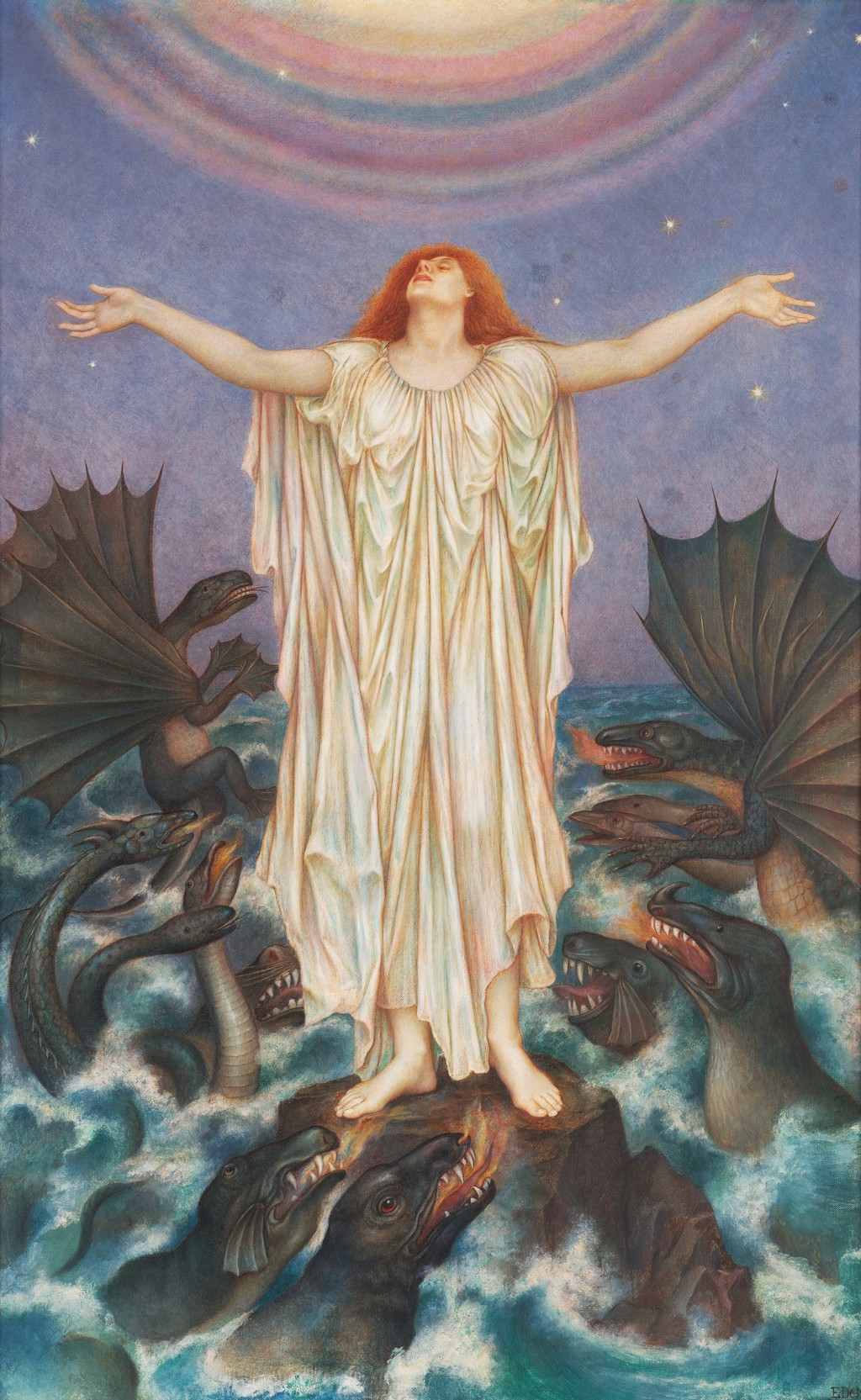
The distinction between centrality and agency is useful. A seated or captive figure may be unable to act physically, yet her gaze can expose the limits of the world around her. A learned protagonist can claim intellectual space without moving at all. The Love Potion is instructive here: its woman should not be reduced to the stock fairy-tale witch when the surrounding books and purposeful activity support a much richer account of knowledge. Elsewhere, a woman in mortal danger reaches towards deliverance, as in S.O.S..
De Morgan’s mythology and transformation paintings also show why no single key is adequate. An ancient name supplies cultural memory, but pose, setting and chosen moment can redirect emphasis. A feminist reading becomes persuasive when the composition, documentary context and treatment of the source story converge—not simply because the principal figure is female.
The Social Prison and the Body’s Prison
Bars, bonds and narrow windows have an obvious social force in paintings of confined women. They recall restricted movement, unequal marriage and the domestic sphere. De Morgan’s Spiritualism adds a second axis. In that belief system, earthly existence is temporary: the spirit survives bodily death and moves towards another state. The flesh can therefore become its own kind of cell.
Hardy’s Foundation essay brings these meanings together in The Soul’s Prison House and The Prisoner. Both present a young woman as the soul, enclosed within a mortal body and oriented towards the light of release. The essay proposes that the same figures can also express women’s entrapment within patriarchal society.[3] This dual reading explains why an image may feel politically urgent even when its explicit allegorical subject is metaphysical.
The two forms of imprisonment should not be collapsed. Spiritual release through death is not a proposal that women accept social oppression while alive. Nor does the female body itself become the enemy. Rather, De Morgan uses visible enclosure to make invisible conditions imaginable. Heavy barriers, linked wrists and distant light give form both to unjust worldly limits and to a Spiritualist distinction between matter and spirit.
This overlap creates difficult, productive questions. Is the figure passive because her body cannot escape, or active because her attention already reaches elsewhere? Does the light promise a future state, expose present deprivation or do both simultaneously? De Morgan often leaves such tensions unresolved, allowing one composition to sustain political and spiritual thought without forcing either into the background.
The Gilded Cage: Comfort as Confinement
The Gilded Cage is the clearest domestic test case. The current De Morgan Foundation object record dates it probably 1901–1902. It is an unsigned oil on canvas measuring 910 × 1087 mm, identified as P_EDM_0037.[4] The qualified date matters: later approximate dates attached to older discussions should not displace the present record.
Within the lavish room, a young woman in gold looks towards revellers outside. Books and jewels lie near her feet, an older man sits in the interior, and a caged canary repeats her condition in miniature. The Foundation interprets her as trapped by the patriarchal domestic order despite material comfort.[4] The title makes the contradiction concise: gilding increases a cage’s value, not its freedom.
The scene is more searching than a division between an innocent woman and a simple villain. The record draws attention to the older man’s dejected expression and allows that he, too, may experience the arrangement as unhappy.[4] His sadness does not remove the unequal structure, but it prevents a complete account from being read off one gesture. The closed division between interior and outdoor music remains the most concrete evidence of her constraint.
Hardy compares the painting’s detailed, jewel-coloured interior with William Holman Hunt’s The Awakening Conscience and argues that De Morgan turns a recognisably Pre-Raphaelite format against patriarchal assumptions.[3] That is a specific scholarly reading, not an uncontested label. It is persuasive because it attends to altered responsibility, the married woman’s adornment, the bird and the inaccessible window. De Morgan’s relation to late Pre-Raphaelite appearance was selective; her visual thought also drew on Renaissance study, Neo-Classicism and Symbolism.
Agency Without a Single Heroic Pose
Freedom in these paintings does not always arrive as an opened door. Sometimes it appears as knowledge, refusal, vision or a change in direction. A prisoner looks towards light; a scholar commands an intellectual interior; a threatened figure continues to reach above the violence around her. These gestures are limited, but not empty.
That breadth helps avoid another trap: treating agency as valuable only when a woman behaves like a conventional male hero. De Morgan’s protagonists may be contemplative, sorrowful or physically still. The pictures ask what consciousness can expose within conditions the figure cannot immediately change. Their abundant drapery and beautiful surfaces should not be mistaken for passivity; visual splendour may sharpen the contrast between possession and self-determination.
The same principle applies to captivity. Chains are powerful signs, but a painting without literal bonds can still organise space around exclusion. Conversely, not every window signals emancipation and not every luminous area guarantees rescue. The relationships among body, boundary and destination are examined more fully in symbolism and allegory.
Spiritualism Through Sophia and William
De Morgan’s interest in death and resurrection preceded her marriage: the Foundation finds an early concern with Christian resurrection in her juvenile poetry. Marriage brought her into close contact with Sophia De Morgan, William’s mother, a social reformer and practising Spiritualist medium. The Foundation suggests that Sophia’s affirmation encouraged Evelyn to state her spiritual ideals more openly in paint.[1]
This history makes Spiritualism a lived intellectual context rather than an atmospheric synonym for “mystical”. It offered propositions about the survival and development of the soul, and De Morgan translated those propositions into bodies turning from shadow towards radiance. Her imagery does not verify supernatural claims; it shows how belief could organise an artist’s account of suffering, death and hope.
William belongs within this context but should not be made the origin of Evelyn’s imagination. The marriage connected her to Sophia and supported shared experiments and reform causes, while Evelyn brought earlier religious thought, classical learning and an established career of her own. Influence here is relational, not a one-way gift.
Evidence, Inheritance and Interpretive Limits
Much of what can now be studied survived through Evelyn’s younger sister, Wilhelmina Stirling. She collected works by both De Morgans, wrote their 1922 biography, displayed the collection at Old Battersea House and ultimately placed it in trust for public benefit.[5] That preservation is fundamental to modern understanding, but a sister’s retrospective account remains different from a contemporaneous statement by the artist.
Reliable interpretation therefore separates several kinds of evidence. An object record controls title, date and material. The image supplies visible relations. Petitions document a political commitment. A family biography preserves recollection. Curatorial and scholarly essays propose connections among those materials. None should silently stand in for another.
This is especially important with feminist readings. De Morgan’s public support for suffrage and her repeated images of women under constraint make such readings historically grounded. They do not prove that every chain refers only to marriage, every ascent depicts political liberation or every woman represents Evelyn herself. The paintings gain, rather than lose, force when social and spiritual meanings are allowed to meet without being declared interchangeable.
About this directory: These 72 entries form a reproducible researched online works census assembled from current public records. It is not a catalogue raisonné and does not claim absolute completeness.
Artworks directory
| Name | Date | Medium |
|---|---|---|
| A Soul in Hell | Date unknown | Painting |
| Ariadne in Naxos | 1877 | Painting |
| Aurora Triumphans | 1877 | Painting |
| Blindness and Cupidity Chasing Joy from the City | 1897 | Painting |
| Boreas and Oreithyia | 1896 | Painting |
| Boreas and the Fallen Leaves | 1910 | Painting |
| By the Waters of Babylon | 1882 | Painting |
| Cadmus and Harmonia | 1877 | Painting |
| Cassandra | 1898 | Painting |
| Clytie | 1886 | Painting |
| Daughters of the Mist | 1909 | Painting |
| Death of a Butterfly | 1910 | Painting |
| Death of the Dragon | 1916 | Painting |
| Deianira | 1878 | Painting |
| Demeter Mourning for Persephone | 1906 | Painting |
| Drapery study | 1890 | Drawing |
| Earthbound | 1897 | Painting |
| Eos | 1895 | Painting |
| Evening Star over the Sea | 1910 | Painting |
| Flora | 1894 | Painting |
| Helen of Troy | 1898 | Painting |
| In Memoriam | 1904 | Painting |
| Life and Thought Emerging from the Tomb | 1893 | Painting |
| Love's Passing | 1883 | Painting |
| Luna (Moon) | 1885 | Painting |
| Lux in Tenebris | 1895 | Painting |
| Medea | 1889 | Painting |
| Medusa | 1879 | Painting |
| Mercury | Date unknown | Painting |
| Moonbeams dipping into the Sea | 1918 | Painting |
| 'Music Sweet Music' (Saint Cecilia) | 1884 | Painting |
| Night and Dawn | 1910 | Painting |
| Night and Sleep | 1878 | Painting |
| Our Lady of Peace | 1907 | Painting |
| Phosphorus and Hesperus | 1881 | Painting |
| Port after Stormy Seas | 1905 | Painting |
| Portrait John Roddam Spencer Stanhope | 1880 | Painting |
| Queen Eleanor and the Fair Rosamund | Date unknown | Painting |
| S.O.S. | 1914–1916 | Painting |
| Sleep and Death: the Children of Night | 1883 | Painting |
| Study for 'Saint Christina' | 1904 | Painting |
| Study from the life | 1890 | Drawing |
| Study of Arms for "The Cadence of Autumn | 1905 | Drawing |
| Sunbeam and Summer Shower | 1910 | Painting |
| The Angel of Death I | 1880 | Painting |
| The Barred Gate | 1910 | Painting |
| The Cadence of Autumn | 1905 | Painting |
| The Captives | Date unknown | Painting |
| The Dryad | 1884 | Painting |
| The Garden of Opportunity | 1892 | Painting |
| The Gilded Cage | probably 1901–1902 | Painting |
| The Grey Sisters | 1880 | Painting |
| The Hourglass | 1904 | Painting |
| The Kingdom of Heaven Suffereth Violence and the Violent Take It by Force | 1878 | Painting |
| The Light Shineth in Darkness and the Darkness Comprehendeth It Not | 1906 | Painting |
| The Little Sea Maid | 1880 | Painting |
| The Love Potion | 1903 | Painting |
| The Martyr (Nazuraea) | 1880 | Painting |
| The Mourners | 1915 | Painting |
| The Passing of the Soul at Death | 1910 | Painting |
| The Poor Man Who Saved the City | 1901 | Painting |
| The Prisoner | 1907 | Painting |
| The Red Cross | 1915 | Painting |
| The Salutation | 1883 | Painting |
| The Sea Maidens | 1885 | Painting |
| The Soul's Prison House | 1880 | Painting |
| The Storm Spirits | 1900 | Painting |
| The Worship of Mammon | 1909 | Painting |
| Twilight | 1910 | Painting |
| Venus and Cupid | 1878 | Painting |
| William De Morgan | 1909 | Painting |
| William De Morgan (1839–1917) | 1893 | Painting |
Frequently Asked Questions
Suffragist is the evidence-based term. She signed national appeals for women’s suffrage in 1889 and 1897.[2] The sources used here do not establish membership of a militant suffragette organisation.
It supplied a belief that spirit survived bodily death and could progress beyond material existence. De Morgan pictured this through cells, windows, sunrise, upward movement and radiant colour. These are visual expressions of belief, not claims that a particular supernatural event occurred.
Many works sustain feminist readings because they centre women’s experience, expose confinement or revise inherited narratives, and the artist’s petition signatures confirm her support for political emancipation. It is still necessary to argue from each painting rather than apply the label automatically.
They make constraint visible. Depending on the work, that constraint may be domestic and political, spiritual and bodily, or deliberately both. Their meaning comes from the figure’s relation to the barrier and to any alternative space or light.
There is no documentary basis here for treating it as a portrait of Evelyn’s marriage. The painting addresses unequal domestic confinement, but its older man and younger woman are allegorical figures. Evelyn and William’s age difference alone does not turn the scene into private testimony.
Discussion
What should readers notice when looking closely at Women, Spiritualism and Freedom?
Reader Insights
Look for gestures of refusal, attention and movement as well as literal cages or bonds.
Keep petition evidence distinct from painting-specific feminist readings while allowing them to inform each other.
Where does spiritual release expand a social reading, and where might it complicate one?
Join the Conversation
Share your reading below, keeping observations specific and evidence clear.
References
- De Morgan Foundation, Evelyn De Morgan (1855–1919), View source
- De Morgan Foundation, The De Morgans and Suffrage, View source
- De Morgan Foundation, Why Evelyn De Morgan Is Not a Pre-Raphaelite Painter, View source
- De Morgan Foundation, The Gilded Cage, View source
- De Morgan Foundation, Wilhelmina Stirling, View source