


 by Tom Gurney
Tom Gurney BSc (Hons) is an art history expert with over 20 years experience
/
Email: tomgurney1@gmail.com / Phone: +44 7429 011000
Evelyn De Morgan Paintings: Introduction
Evelyn De Morgan’s paintings become clearer when they are browsed as a changing body of thought rather than a single decorative style. Classical heroines, Christian martyrs, personified winds, learned women, trapped figures and threatened souls recur across her career. Their settings may glow with flowers, gold, moonlight or rainbows, yet those beautiful surfaces repeatedly carry arguments about choice, knowledge, captivity, materialism and war.
This overview moves from early myth and history painting through mature allegory to late Symbolism and pacifism. It also introduces five close readings and a 72-record researched online works census. For the chronology behind these shifts, begin with the biography; for a concise orientation, return to the Evelyn De Morgan overview.
At a Glance
- Principal mediumOil painting, usually on canvas, with some work on panel
- Career spanExhibiting from the 1870s, with paintings recorded through the First World War years
- Recurrent formsDraped figures, mythological stories, symbolic landscapes, thresholds, light, darkness and metamorphosis
- Active deep readsEarly Night and Sleep, Florentine Flora, the alchemical work The Love Potion, the domestic scene The Gilded Cage and wartime S.O.S.
- Census scope72 researched visual records—69 paintings and three drawings—derived from a dated online snapshot and institutional overrides
- Main collectionsThe De Morgan Foundation holds the central body; other UK public holdings are discoverable through Art UK
Selected Evelyn De Morgan Paintings
Contents
- Early Myths and Histories
- Moral Allegory in the Mature Work
- Knowledge, Spirit and Symbol
- Late Visions and the Language of War
- Paintings Built Through Drawing
- Five Paintings for a Closer Look
- How to Use the Works Census
Early Myths and Histories
The earliest dated group in the census shows how quickly De Morgan found serious subjects. Ariadne in Naxos and Cadmus and Harmonia appear in 1877, followed in 1878 by Deianira, Venus and Cupid and Night and Sleep. Christian, literary and legendary subjects soon joined the classical ones: The Martyr (Nazuraea), By the Waters of Babylon and The Salutation all belong to the first decade of her exhibiting career.
These subjects connect De Morgan with Neo-Classical painting, Renaissance study and the later Pre-Raphaelite world, but none of those labels is sufficient alone. Her protagonists are not simply elegant figures placed in antique stories. Ariadne’s abandonment, Harmonia’s encounter with transformation and Deianira’s dangerous inheritance make narrative consequences central. The study of mythology and transformation follows the way she recast inherited stories around trial, change and female experience.
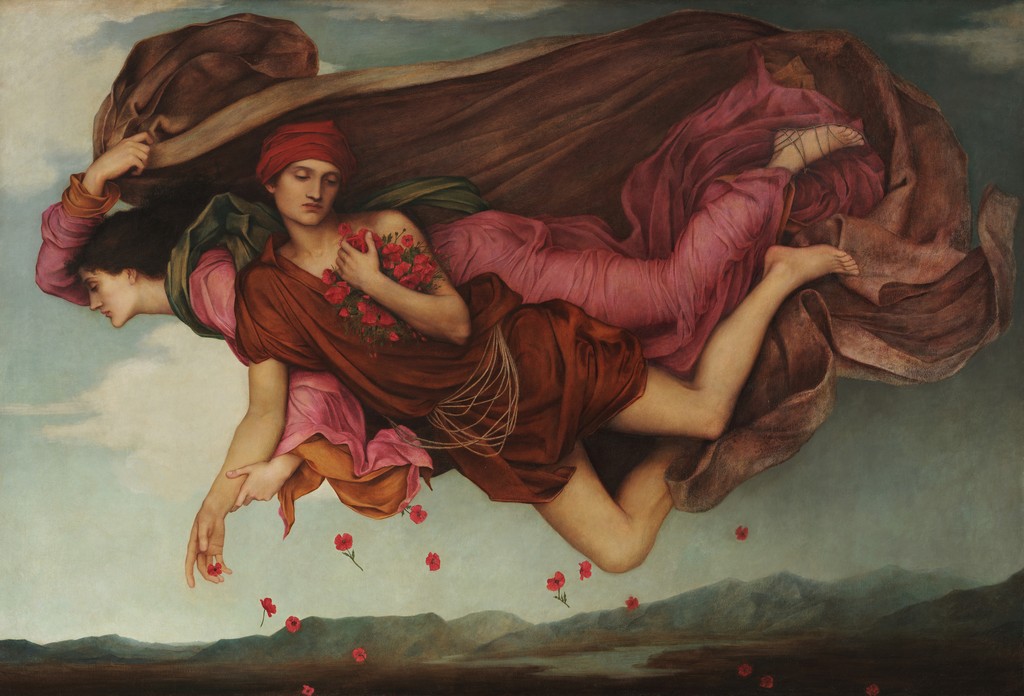
Night and Sleep (1878) offers an early key. Night and Sleep fly together as Sleep scatters poppies over the earth. The Foundation connects their entwined arrangement with Zephyr and Chloris in Botticelli’s Birth of Venus, but De Morgan turns the remembered composition into a mechanism for the arrival of darkness.[2] It is recognisably Aesthetic in atmosphere while already making time and altered consciousness its subject.
Moral Allegory in the Mature Work
By the 1890s, De Morgan’s titles announce increasingly abstract conflicts. The Garden of Opportunity (1892), Life and Thought Emerging from the Tomb (1893), Earthbound (1897) and Blindness and Cupidity Chasing Joy from the City (1897) organise ideas into encounters among figures, objects and spaces. The narrative does not disappear; it becomes an instrument for testing spiritual aspiration against greed, error or confinement.
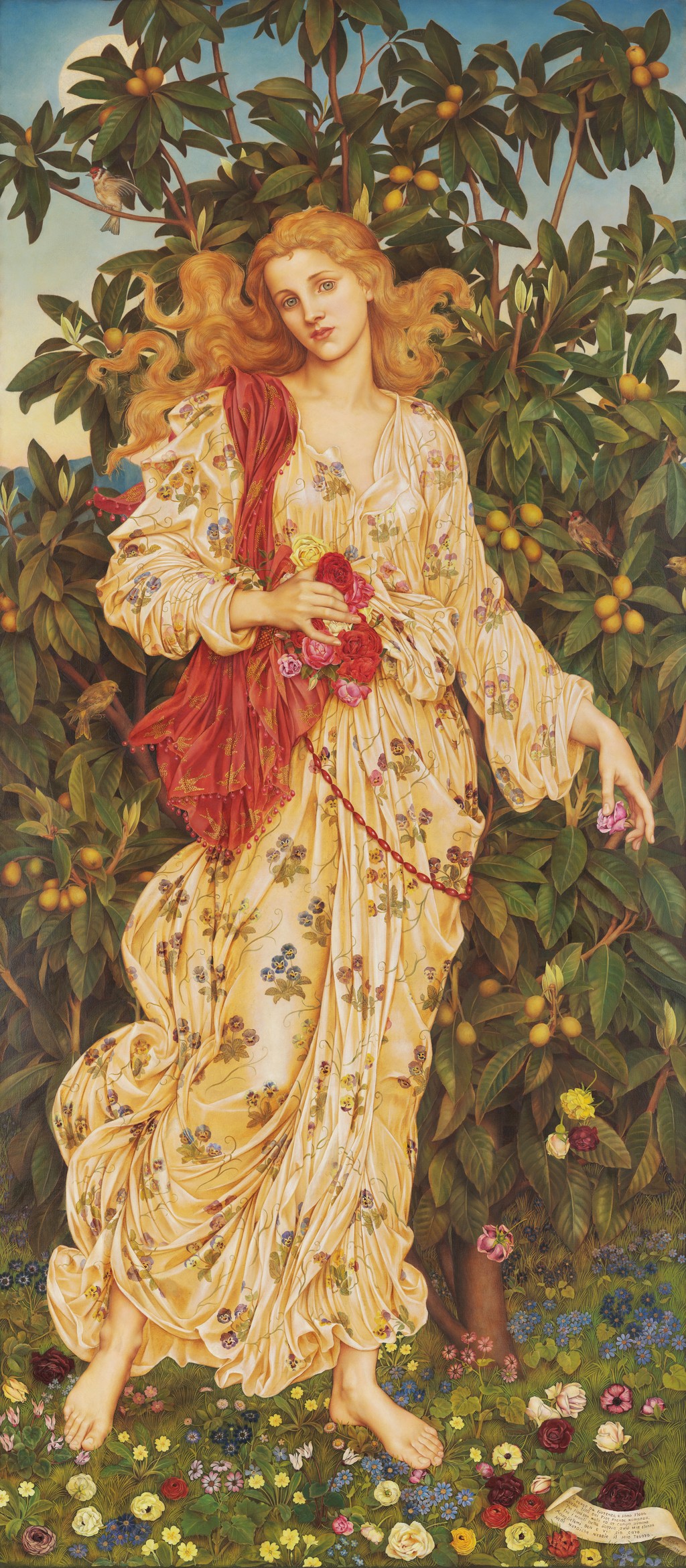
Flora (1894) shows that splendour need not be opposed to meaning. Painted in Florence, it sets the Roman goddess before a loquat tree, birds and abundant flowers. The Italian scroll links Flora’s origin in Florence with a new home in Scotland, acknowledging the painting’s patron William Imrie. Its model was Jane Hales, and its response to Botticelli’s Primavera is explicit.[3] Pattern, place, patronage and Renaissance memory meet in one carefully staged figure.
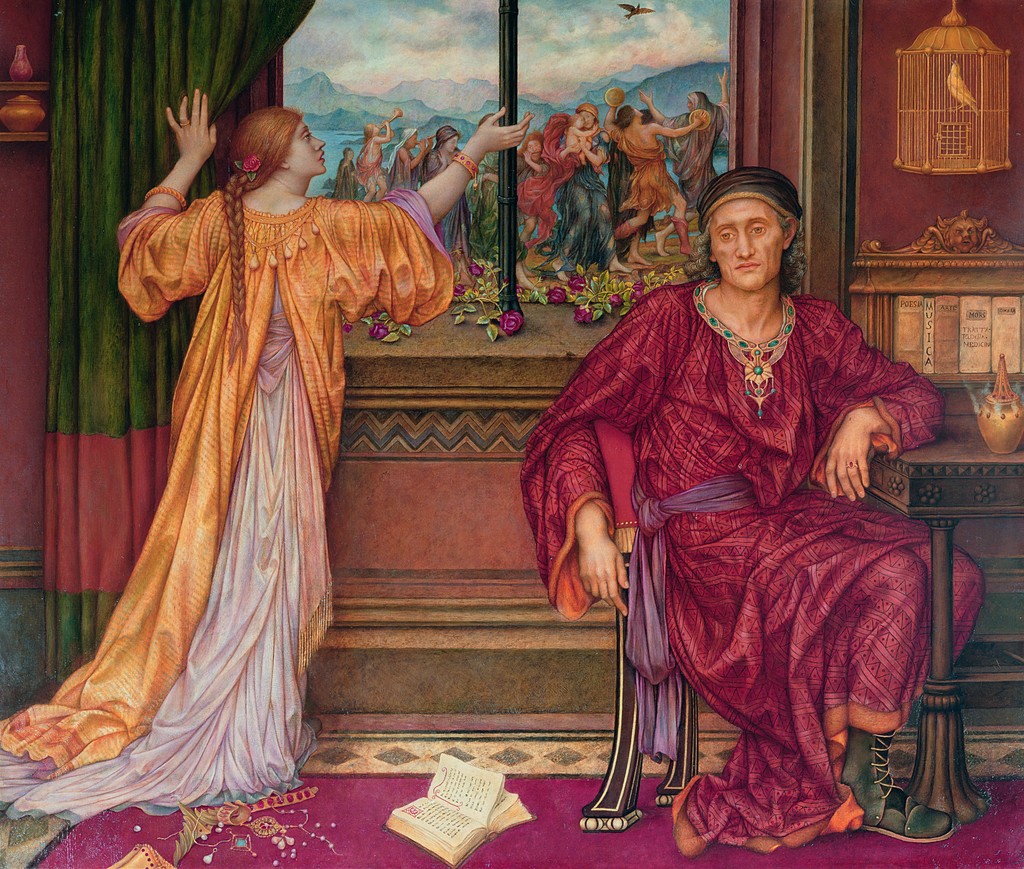
The century’s turn brought sharper pictures of moral and social restriction. In The Gilded Cage, probably 1901–1902, a woman in gold looks towards music and dancing outside while an older man remains within the furnished room. A caged bird reinforces the painting’s structure of enclosure. The Foundation reads it through women’s suffrage but also recognises the older man’s dissatisfaction, a complication that prevents the interior from becoming a simple one-person emblem.[5] The wider account of women, spiritualism and freedom keeps political evidence distinct from painting-specific interpretation.
Knowledge, Spirit and Symbol
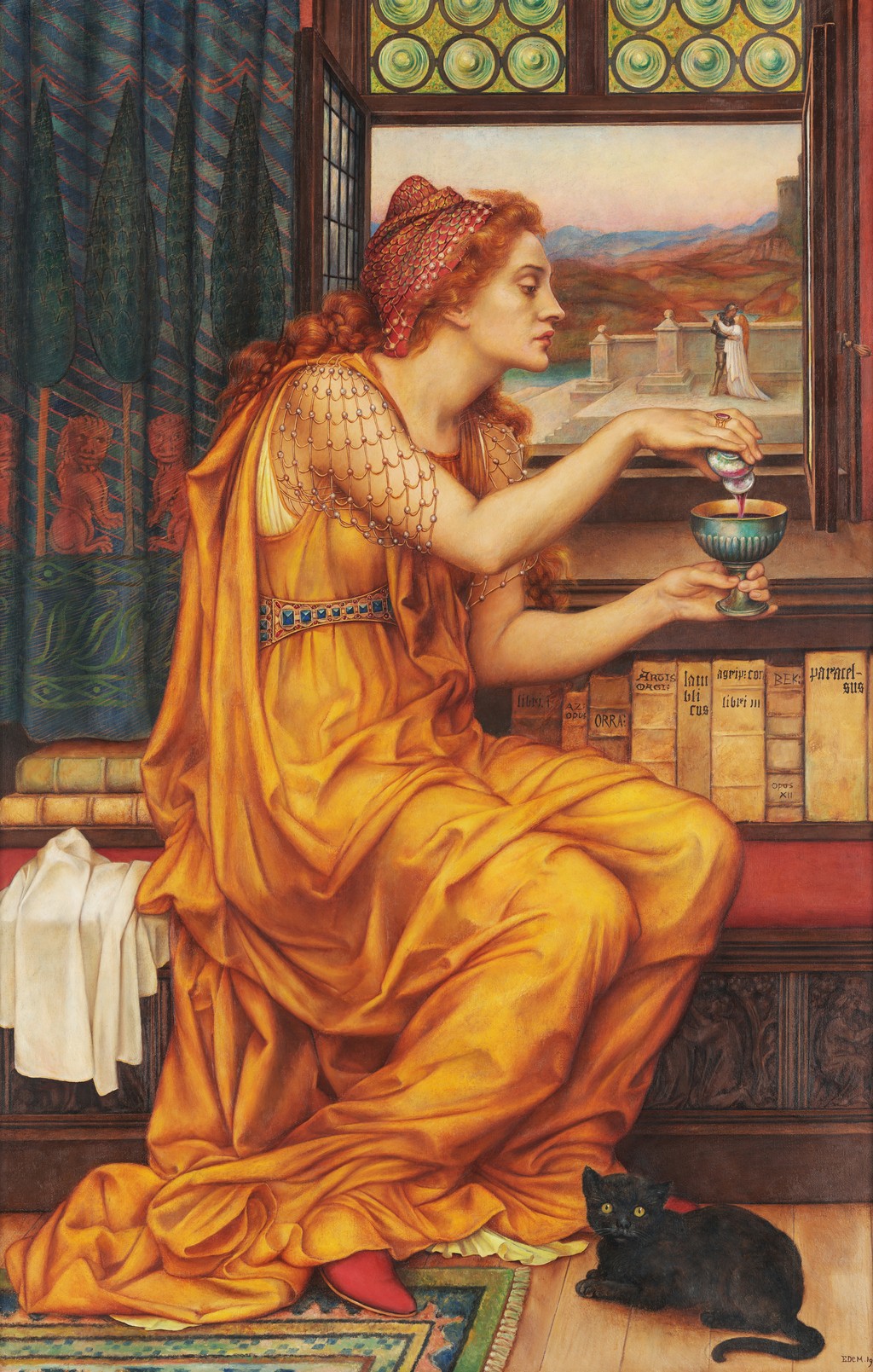
De Morgan’s mature allegories ask viewers to read colour, books, animals and changes of light in relation to one another. The Love Potion (1903) makes this especially clear. Its central woman has often been described as a witch, but the Foundation’s object record rejects that as inadequate. She is presented as a learned practitioner surrounded by philosophical and scientific books, while black, white, red and golden yellow evoke stages in an alchemical and spiritual progression.[4]
That interpretation does not turn every detail into a fixed code. Symbols change with their setting. Gold may evoke illumination in one work and material confinement in another; darkness may threaten, conceal or precede release. The study of symbolism and allegory compares those uses across paintings instead of assigning each motif a universal definition.
De Morgan’s visual relation to late Pre-Raphaelitism therefore needs qualification. Jewel-like colour, medievalising furnishings and close natural detail make the association understandable. Her intellectual structure also draws on Symbolism, spiritualism, Renaissance art and classical learning. What holds the work together is not membership of a single movement, but a repeated conversion of visible things into ethical choices.
Late Visions and the Language of War
The 1900s and 1910s include quiet cosmic images, severe moral allegories and pictures shaped by modern conflict. The Light Shineth in Darkness and the Darkness Comprehendeth It Not (1906), The Worship of Mammon (1909), Night and Dawn (1910) and The Passing of the Soul at Death (1910) make light and transition carry spiritual weight. Other titles—The Mourners, The Red Cross and Death of the Dragon—belong to her confrontation with war.
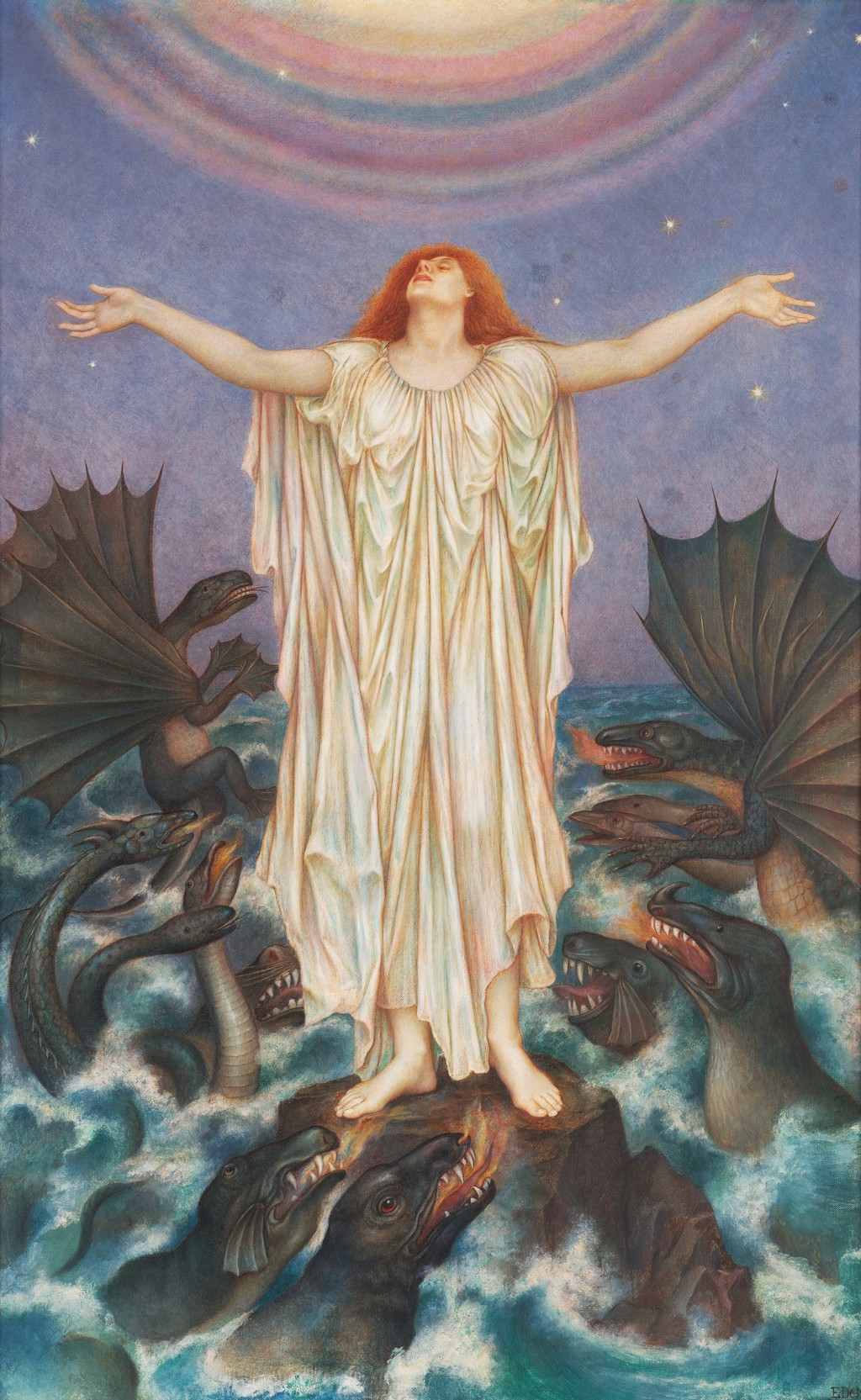
These paintings are not reports from a battlefield. Dragons, sea monsters, rainbows and radiant figures allowed De Morgan to imagine violence as a struggle between destructive forces and hoped-for release. S.O.S. (1914–1916) places one white-robed woman on a rock amid turbulent water and serpentine creatures. Her raised arms and the rainbow above combine bodily danger with a plea for spiritual rescue. The Foundation relates the title to the Morse distress signal and reads the monsters as signs of evil and death.[6]
The dedicated study of war and pacifism follows these motifs across the conflict pictures. It also resists a comforting shortcut: hope in De Morgan is not evidence that suffering has vanished. It is a distant orientation sustained inside scenes of danger.
Paintings Built Through Drawing
The polished surfaces of the oils depended on extensive work on paper. The De Morgan Foundation holds more than 800 drawings, ranging from compositional sketches and life studies to highly finished pastels.[1] Three drawings also appear in this census: a drapery study, a life study and a study of arms for The Cadence of Autumn. They represent only what the online seed returned, not the full scale of her work on paper.
Those surviving sheets let viewers examine choices that a finished canvas can hide: the adjustment of a pose, the fall of cloth, the articulation of an arm or the balance of grouped bodies. Colour, gold and technique explores this drawing-led preparation and the movement from studies to oil. It also helps explain why the boundary between “preparation” and autonomous artwork is not always secure.
Five Paintings for a Closer Look
The five linked studies were chosen as strong entry points, not as a ranking of the whole career.
- Night and Sleep is an early synthesis of Renaissance memory, airborne figure design and the symbols of sleep. The controlling record dates it to 1878, identifies it as oil on canvas and gives the number
P_EDM_0001.[2] - Flora brings together Florence, spring, patronage and extraordinary surface pattern. It is an oil on canvas of 1894, numbered
P_EDM_0017.[3] - The Love Potion centres knowledge rather than fairy-tale villainy. The 1903 oil on canvas is numbered
P_EDM_0035.[4] - The Gilded Cage turns a luxurious room into an argument about constraint. The unsigned oil on canvas is qualified by the Foundation as probably 1901–1902 and numbered
P_EDM_0037.[5] - S.O.S. uses storm, monsters and rainbow to address the First World War. The signed oil on canvas dates from 1914–1916 and is numbered
P_EDM_0056.[6]
Together they open onto the Evelyn and William De Morgan story without reducing Evelyn’s work to the marriage. Shared beliefs and practical support matter, but the paintings sustain their own chronology and visual problems.
How to Use the Works Census
The directory contains 72 records: 69 paintings and three drawings. It began with a Wikidata snapshot dated 31 August 2026 for visual works carrying Evelyn De Morgan as creator. Duplicate normalised titles were reconciled, while current Foundation records replaced the online data for the five linked works. Unknown dates remain labelled as unknown rather than guessed.
This count answers a narrow discovery question. It is a reproducible online works census, not a catalogue raisonné and not a claim of absolute completeness. It should not be compared as though it measured the same thing as the Foundation’s 56 framed oil paintings or the 69 artworks currently shown on Art UK.[1][7] One number describes a single institution’s holdings, another a public-art platform’s results, and the census combines an online creator query with controlled corrections.
Search by title when looking for one work, filter by medium to separate the three drawings, or scan dates to follow clusters. Five entries lead directly to close readings. The remaining records remain concise discovery points because an online title or date alone is not enough evidence for a full interpretation.
About this directory: These 72 entries form a reproducible researched online works census assembled from current public records. It is not a catalogue raisonné and does not claim absolute completeness.
Artworks directory
| Name | Date | Medium |
|---|---|---|
| A Soul in Hell | Date unknown | Painting |
| Ariadne in Naxos | 1877 | Painting |
| Aurora Triumphans | 1877 | Painting |
| Blindness and Cupidity Chasing Joy from the City | 1897 | Painting |
| Boreas and Oreithyia | 1896 | Painting |
| Boreas and the Fallen Leaves | 1910 | Painting |
| By the Waters of Babylon | 1882 | Painting |
| Cadmus and Harmonia | 1877 | Painting |
| Cassandra | 1898 | Painting |
| Clytie | 1886 | Painting |
| Daughters of the Mist | 1909 | Painting |
| Death of a Butterfly | 1910 | Painting |
| Death of the Dragon | 1916 | Painting |
| Deianira | 1878 | Painting |
| Demeter Mourning for Persephone | 1906 | Painting |
| Drapery study | 1890 | Drawing |
| Earthbound | 1897 | Painting |
| Eos | 1895 | Painting |
| Evening Star over the Sea | 1910 | Painting |
| Flora | 1894 | Painting |
| Helen of Troy | 1898 | Painting |
| In Memoriam | 1904 | Painting |
| Life and Thought Emerging from the Tomb | 1893 | Painting |
| Love's Passing | 1883 | Painting |
| Luna (Moon) | 1885 | Painting |
| Lux in Tenebris | 1895 | Painting |
| Medea | 1889 | Painting |
| Medusa | 1879 | Painting |
| Mercury | Date unknown | Painting |
| Moonbeams dipping into the Sea | 1918 | Painting |
| 'Music Sweet Music' (Saint Cecilia) | 1884 | Painting |
| Night and Dawn | 1910 | Painting |
| Night and Sleep | 1878 | Painting |
| Our Lady of Peace | 1907 | Painting |
| Phosphorus and Hesperus | 1881 | Painting |
| Port after Stormy Seas | 1905 | Painting |
| Portrait John Roddam Spencer Stanhope | 1880 | Painting |
| Queen Eleanor and the Fair Rosamund | Date unknown | Painting |
| S.O.S. | 1914–1916 | Painting |
| Sleep and Death: the Children of Night | 1883 | Painting |
| Study for 'Saint Christina' | 1904 | Painting |
| Study from the life | 1890 | Drawing |
| Study of Arms for "The Cadence of Autumn | 1905 | Drawing |
| Sunbeam and Summer Shower | 1910 | Painting |
| The Angel of Death I | 1880 | Painting |
| The Barred Gate | 1910 | Painting |
| The Cadence of Autumn | 1905 | Painting |
| The Captives | Date unknown | Painting |
| The Dryad | 1884 | Painting |
| The Garden of Opportunity | 1892 | Painting |
| The Gilded Cage | probably 1901–1902 | Painting |
| The Grey Sisters | 1880 | Painting |
| The Hourglass | 1904 | Painting |
| The Kingdom of Heaven Suffereth Violence and the Violent Take It by Force | 1878 | Painting |
| The Light Shineth in Darkness and the Darkness Comprehendeth It Not | 1906 | Painting |
| The Little Sea Maid | 1880 | Painting |
| The Love Potion | 1903 | Painting |
| The Martyr (Nazuraea) | 1880 | Painting |
| The Mourners | 1915 | Painting |
| The Passing of the Soul at Death | 1910 | Painting |
| The Poor Man Who Saved the City | 1901 | Painting |
| The Prisoner | 1907 | Painting |
| The Red Cross | 1915 | Painting |
| The Salutation | 1883 | Painting |
| The Sea Maidens | 1885 | Painting |
| The Soul's Prison House | 1880 | Painting |
| The Storm Spirits | 1900 | Painting |
| The Worship of Mammon | 1909 | Painting |
| Twilight | 1910 | Painting |
| Venus and Cupid | 1878 | Painting |
| William De Morgan | 1909 | Painting |
| William De Morgan (1839–1917) | 1893 | Painting |
Frequently Asked Questions
There is no authoritative ranking. Begin with the Florentine abundance of Flora or the airborne figures of Night and Sleep, then compare the learned protagonist of The Love Potion, the confined interior of The Gilded Cage and the wartime peril of S.O.S.
She painted classical mythology, Christian and literary stories, personifications, portraits and moral or spiritual allegories. Recurring concerns include female agency, captivity, material temptation, death, transformation, pacifism and hope.
No. It is a reproducible online researched-works census assembled from a dated snapshot and five institutional overrides. It records 72 discoverable visual works, preserves unknown dates and makes no claim to absolute completeness.
Discussion
What should readers notice when looking closely at Evelyn De Morgan Paintings?
Reader Insights
Compare how figures occupy landscape, interior and symbolic space across the five deep reads.
Use the directory as an online research map, not as a claim that every surviving work is present.
Which change across the career is clearer: subject, colour, composition or the role of symbols?
Join the Conversation
Share your reading below, keeping observations specific and evidence clear.
References
- De Morgan Foundation, The Collection, View source
- De Morgan Foundation, Night and Sleep, View source
- De Morgan Foundation, Flora, View source
- De Morgan Foundation, The Love Potion, View source
- De Morgan Foundation, The Gilded Cage, View source
- De Morgan Foundation, S.O.S., View source
- Art UK, Works by Evelyn De Morgan, View source